Grandpa Skipper

2019-10-23 DavidRoss

David Ross gets a World Series-winning lift from the Cubs in 2016. Now he gets to manage them.

If you take the word of Chicago Tribune columnist Paul Sullivan, the only successor to Joe Maddon who was ever on Cubs president Theo Epstein’s radar was David Ross. And if you read Epstein’s foreword to Ross’s 2017 memoir, Teammate, in which Epstein described Ross in terms that sounded like a job description for a manager, you probably figured the same thing:

The watchful eye from the dugout to make sure we respected the game and played the Cub Way. Unselfish, team-first, winning baseball. The glare when someone did something that wasn’t Cub. The rare harsh word when it happened again. The high-fives and pats on the rear when it got fixed. The instinct when to know when to create levity and when to get guys locked in. Reminding the young players how good they are. Reminding them they can get better. Words to keep the team grounded when winning seemed easy. Words to lift up the team when losing just one more would end the season.

Sounds a lot like the way Grandpa Rossy was during the Cubs’ run to the 2016 World Series conquest. (Which so wasn’t Cub, right?) Especially when he had to handle his buddy Anthony Rizzo’s Game Seven jitters.

Especially when Ross himself needed a big lift after a horror of a Game Seven throwing error one inning, providing it himself the next when this spaghetti bat whose baseball knowledge was ten times as valuable hit a gassed Andrew Miller’s 2-2 service into the left center field bleachers, for his final major league hit en route the Cubs’ stupefying win.

Found reposing alone with his wife and children in the Progressive Field visitors clubhouse, Ross was asked whether he’d now rethink his intended retirement. “Oh, God, no,” he replied. “How can I top this? If I come back, it’ll be to get my [World Series] ring and maybe yell at [Anthony] Rizzo from the seats.”

Ross picked up his World Series ring the following Opening Day in Wrigley Field. Now, despite the Cubs having to go through the hiring process even as a matter of formality under the rules, Ross will get to yell at Rizzo and any other Cub who might need it now and then from the dugout again. This time, as their skipper.

“[I]f you’re looking for a leader to take the Cubs back to the level they believed they’d be at for years after that ’16 title,” Sullivan writes, “those are exactly the qualities you’re seeking—a motivating, demanding, reassuring and fun-loving guy.”

It could be fun loving for Cub Country, too, especially considering the biggest weakness among several that they had in 2019. This year’s Cubs didn’t intimidate pitchers quite as much as they found pitchers absolutely unconcerned about giving up hits because those pitchers got to see them run into outs as if there were free tickets to the nearest clown show at the end of each out.

He might have earned the nickname Grandpa Rossy for his sanguine style as a team leader, but it doesn’t mean Ross is going to be that indulgent a grandpa now that he has the bridge. He won’t stop the Cubs from having fun again, he’ll probably encourage it, but that doesn’t necessarily mean he’ll forget to break out the bull whip when need be.

Unfortunately, it doesn’t necessarily mean there’ll be a lack of laughter over Ross’s hiring. He’s never managed. And the continuing trend of skippers without the backup experience still draws mixed reviews. For every Aaron Boone there’s a Gabe Kapler.

Stop snarling, Yankee fans. It wasn’t even close to Boone’s fault the Yankees got shoved to one side and away from this World Series, and—contrary to popular belief (namely, yours)—Boone did better in his first two Yankee regular seasons (203 wins) than any manager in Yankee history except Ralph Houk (205 wins). Even Joe McCarthy (201), Casey Stengel (195), Joe Torre (188), and Joe Girardi (192).

So Boone was silly enough to let a faltering Aroldis Chapman finish what he started and refuse to put Jose Altuve aboard with a man on and two out to pitch to a glove-first/ spaghetti-bat on deck? There have been equal or worse mistakes in Yankee history, postseason and otherwise, and by skippers with more time in service than Boone.

In his twelfth Yankee season Stengel forgot to align his World Series rotation to give Hall of Famer Whitey Ford three starts—and cost himself the 1960 World Series. Houk in his third had no answer other than expecting the Dodgers to drop dead at the sight of Yankee uniforms—and got swept in the 1963 Series.

Girardi in his final year failed to demand a review of a hit batsman who actually got hit on the bat knob . . . and watched the next Indian hit a grand slam in a division series to push the Yankees to the brink of a sweep they avoided and beat only to lose that pennant when the Astros out-scored them 11-1 in Games Six and Seven.

Ross should have few problems if the front office gives him even a marginally better bullpen than 2019’s, his hitters actually meet balls with their bats, his defenders tighten up, and his baserunners quit auditioning for the next Three Stooges revival. Not to mention the Cubs overcoming a few years of dubious drafts since Epstein yanked the front office inside out.

And remember: Ex-catchers do rather well as major league managers in any era or game culture. It only began with Connie Mack and two Philadelphia Athletics dynasties.

Al Lopez won pennants managing the Indians and the White Sox. Long the third-string backup to Hall of Famer Yogi Berra and his backup Charlie Silvera, Houk won three pennants and two World Series in his first three seasons on the Yankee bridge. The Yogi himself won a pair of pennants managing the Yankees and the Mets. Gil Hodges converted from catching to first base—and managed the 1969 Miracle Mets.

Johnny Oates won three AL Wests managing the Rangers. Joe Torre won an NL West with the Braves a decade plus before his pocket full of pennants and World Series rings with the Yankees. Mike Scioscia won a World Series behind the plate for the Dodgers and on the bridge for the Angels. Before Mike Matheny married his Book and lost his clubhouse, he took the Cardinals to some postseasons and the 2013 World Series, though he lost to the Red Sox. Girardi won three AL Easts plus a pennant and a World Series with the Yankees.

And that’s a former catcher who managed the first Astros World Series winner two years ago and is trying to win their second in a) franchise history and b) three years right now.

Of course, not all catchers become postseason managers, either. Bob Boone, Del Crandall, Doc Edwards, Herman Franks, Rene Lachemann, Jerry Narron, Tony Pena, Paul Richards, Muddy Ruel, Joe (Ol’ Sh@tf@ck) Schultz, Birdie Tebbetts, Jeff Torborg, and Wes Westrum, among others, call your offices.

Grandpa Rossy has reasonable odds of joining either one or the other group. The bad news is that a lot depends on how reasonable or unreasonable the Cubs are from here. The good news is that you won’t see Ross tearing his hair out over Cub mistakes. He hasn’t got any left to tear out. Almost. A bark under the park should suffice.

He even gets his own unique entry in the land of trivia contests: Name the only manager ever hired for the job two years after he finishes as a runner-up on Dancing with the Stars. Look out, you Dancing Nats, here come the Cha-Cha-Cubs!

WS Game One: Why dream it? Drive it.

2019-10-23 WashingtonNationalsWSGM01

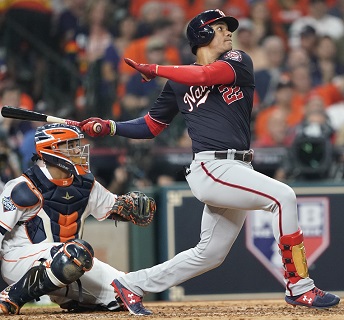
Juan Soto (22) stole the World Series-opening show Monday night; Ryan Zimmerman (11) opened it by hitting the Nats’ first Series homer ever and the first by any Washington team since . . . 1933.

This was supposed to be a duel of the lancers on the mound to open the World Series. Right? It was going to be ace vs.ace, right? Gerrit Cole, baseball’s almost-Invincible Man, vs. Max Scherzer, going tooth, fang, claw, and anything else they could think of against each other, right?

That’ll teach me to forget the modified Lennon’s Law: Baseball is what happens when you’re busy making other plans. Especially when an initially jittery Juan Soto learns a lesson from Cole in the first inning but takes the A train his next time up.

And, when enough other Nationals prove even this year’s model Cole is only human, after all, at least on a single night. And, when Scherzer for five grinding innings out-pitches Cole for seven despite not having his best night. And, when the Nats bullpen bends but doesn’t break.

And, when the Astros’ vaunted enough home field advantage proves no less intimidating to the Nats than it proved to the Yankees in the opener of their American League Championship Series. We know how that worked out for the Yankees in the end. The Nats know bloody well they still have a none-too-simple road to follow even winning World Series Game One, 5-4, Monday night.

“Why dream it? Drive it,” said a 1941 advertisement for the DeSoto car. “This baby can flick its tail at anything on the road,” said a 1957 DeSoto ad. The Soto in a Nats uniform and still two days from the legal drinking age must have dreamed it entering. Then, he drove it twice.

A mammoth solo home run in the fourth, a long two-run double in the fifth. This baby can flick his tail at anything coming down from the mound. So it sure seemed to the Astros after Game One. “I feel like, in the last twenty-four hours, I’ve seen Soto more than my wife,” cracked Astros catcher Martin Maldonado after the game. “You have to prepared, you have to do scouting reports on it. That guy’s good. He’s very good.”

On Monday night that was like saying the Washington Monument was very tall.

The sharks bit and the Astros bit back. Even if Scherzer vs. Cole transpired the way pitching’s closest observers might have expected things to go until the bullpens were opened, nobody—not the Astros and certainly not the Nats—thought either team would win the easy way.

The Astros came into Game One on a 26-0 winning streak in games during which they scored two or more runs in the first inning, and 2-0 in such postseason games. And Cole came into Game One not having been hung with a loss since 22 May or thrown even one pitch when his team was trailing in a game since 2 September.

According to STATS, LLC., he’d also struck out 258 batters between 22 May and Game One. Not to mention pitching 175 innings from his previous three-run inning until the top of the fifth Monday night. STATS also notes that during the previous 22 starts of his winning string Cole threw 150.2 innings and was behind in only four.

There went those streaks. And, for Game One at least, the mystique of invincibility Cole constructed since the White Sox pried six runs out of him that 22 May in Minute Maid Park. Not to mention the second straight start in which he didn’t roll double-digit strikeouts after an eleven-game such streak to end the season and carry into his first two postseason starts.

But the Nats don’t kid themselves. They know Cole’s liable to get another crack at them before this Series is done. They also know Justin Verlander awaits in Game Two and, while he, too, has shown his vulnerability of late, he’s still Justin Verlander, he’s still a future Hall of Famer, and he still has miles to go yet before his limousine, not to mention his right arm, sleeps.

Just ask Patrick Corbin, who got pressed into relief service in the Game One sixth and dealt with nothing more severe than Astro rookie Yordan Alvarez’s one-out single. “It’s a huge win for us no matter who we were facing,” Corbin said after the game. “But [Cole] has been one of their guys all year and they have a great pitcher going tomorrow. All these games seem like they are going to be like this. It’s two good teams fighting.”

Scherzer fought his way through five innings with seven strikeouts, a first-inning two-run double from Yuli Gurriel, and stranding second and third in the top of the third. He got onto the winning side of the pitching ledger thanks to Adam Eaton singling Kurt Suzuki home with a broken bat and Soto swatting his deep two-run double in the top of the fifth. And, thanks to the Nats’ pen shaking away some testy moments until the ninth.

“Tonight,” Max the Knife admitted after the game, “was a grind. Take my hat off to the Astros offense. I was never able to get in the rhythm tonight. I was having to make all my pitches out of the stretch tonight, it felt like.”

But oh did it feel sweet for the Nats when Ryan Zimmerman, Mr. Nat, the true Original Nat, their first draft in 2005, the year they landed in Washington in the first place, got to hit the first World Series home run in Nationals history.

World Series Nationals Astros Baseball

Soto catching the train in the fourth . . .

Zimmerman caught hold of every inch of a Cole fastball traveling 97 miles and hour and arriving right down the chute and drove it high over the center field fence to cut the early 2-0 Astro lead in half in the top of the second. “I’ll be honest with you,” said Nats manager Dave Martinez to former Nats beat writer Chelsea Janes. “I got a little teary eyed for him. “He waited a long time to be in this position.”

“You’re kind of almost floating around the bases,” said Zimmerman, who’s bent on enjoying every last World Series moment now that he and his Nats are here, after a season rudely interrupted by plantar fasciitis in his right foot, and with the knowledge his current deal expires after the Series and his future isn’t exactly written.

And as sweet and sentimental as Zimmerman’s blast was for the Nats even that was nothing compared to Soto leading off the top of the fourth.

Disciplined beyond his years at the plate, as announcers have purred all postseason long and almost to a fare-thee-well, Soto looked at first at a Cole slider that hung up over the top of the zone and inside. Then Soto remembered what he’d learned when Cole struck him out swinging in the first: “He likes the fastball, so I go to the next at-bat ready to hit it.”

Sure enough, here came the fastball considered Cole’s favourite, climbing to the top of the zone. And there went the fastball, the lefthanded Soto driving it high and far enough to land in front of the Minute Maid Park train’s locomotive and bounce between the track rails, tying the game at two. “[He] again used the whole field and he stayed back and stayed within himself,” Cole told reporters after the game. “So you know, good hitters do that.”

Cole knew only two things Monday night. He knew on contact that Soto lit a rocket charge in that 1-0 fastball, and he knew he wasn’t having the sharpest night of a year in which his regular season left him the American League’s Cy Young Award favourite.

“I thought the fastball was leaking a little off the corner a couple times,” he said. “I struggled with the curveball command, kind of buried us in some bad counts and then just a poor pitch to Soto and not being able to finish that inning off without a crooked number.”

For the deep history minded, Zimmerman’s was the first World Series home run by any Washington player since Senators center fielder Fred Schulte smashed a sixth-inning three-run homer in Game Five of the 1933 Series. Providing the only three runs the Ancien Nats got that 5 October. Hall of Famers Heinie Manush and Joe Cronin were on board when he launched.

“Just to get us on the board,” Zimmerman told Sports Illustrated writer/Fox Sports reporter Tom Verducci. “For them to come out and Max grinding it out tonight. He had a lot of guys on base, he made pitches when he needed to, they did a good job not swinging at balls and got his pitch count up. Against a guy like Gerrit it’s not an easy task. So I was just trying to get the ball in the strike zone and, luckily, he made a mistake.

It’s not that any Astros were allergic to making any history themselves. George Springer became first in Show to hit one out in five straight World Series games. Until he sent a 2-1 service from Nats reliever Tanner Rainey over the center field fence to lead off the bottom of the seventh, he’d been tied at four with Hall of Famers Reggie Jackson and Lou Gehrig.

Springer appreciated the feat only to a small extent. “I’d rather win,” he said earnestly after the game. “I mean, cool. Great. It’s an honor . . . But no doubt about it. I’d rather win.”

He did his part to try to make that happen, too, when he doubled in the eighth with Kyle Tucker on second and Daniel Hudson—who’d managed to strand the bases loaded ending the seventh—on the mound for the Nats. And if it hadn’t been for Nats center fielder Victor Robles misreading Tucker at first following his pinch single leading off, and throwing in to first off Aledmys Diaz’s fly out when he might have had a play on Tucker at second, Springer might not have driven in the fourth Astro run of the night.

Springer lingered at first thinking his drive had a shot at going out. Tucker waited to tag thinking the ball might be caught. Then, postgame, Springer fielded questions about why he didn’t end up on third with Tucker scoring. “I can’t go to third right there,” he told reporters. “Because the guy on second had gone back to tag. If I had gone to third, I’m out.”

If not for that, Jose Altuve’s followup high liner to right might have tied the game. But it gave the Nats just enough of a re-awakening for Martinez to reach for Sean Doolittle and ask him for a four-out save. Ask and you shall receive. First, Doolittle ended the eighth by getting Michael Brantley to fly out. Then, he struck Alex Bregman out, got Gurriel to fly out to not-too-deep center, and got Carlos Correa to line the first pitch out to left where Soto snapped it into his glove to end it.

“Welcome to the World Series, baby,” Doolittle replied when asked what he thought about coming in with a man on second. “One-run game, facing Brantley, such a good hitter, such a professional hitter. In the World Series? You know, that’s what you live for, coming into those big moments, in these big games. I’ve tried to change the way that I think about them and embrace them and try to enjoy it.”

Soto surely won’t complain about making a little history of his own. As in, the youngest player to homer and steal a base in the same postseason series, nudging Derek Jeter (Game one, 1996 ALCS) to one side. And, the third youngest to hit cleanup in a World Series game, behind Ty Cobb (1907) and Miguel Cabrera (2003).

Never mind that he’s made an impressions the Astros won’t be able to forget too readily.

“He was the key guy we couldn’t control tonight,” acknowledged Astros manager A.J. Hinch. “His bat-speed is electric . . . He’s calm in the moment. Clearly, this is not too big a stage for him. He was the difference in the game. He’s got that ‘it’ factor. He’s got fast hands. He’s got no fear.”

Springer couldn’t get over Soto’s homer. “I’ve never seen a left-handed hitter hit a ball there against [Cole],” he said of the track job. “Just an incredible swing.”

“He’s a special player,” Zimmerman said. “Really since the day he came up. You can tell the special ones when they come up because they can slow the game down.”

About the only thing the Nats don’t like regarding Soto slowing them down is that, as of Wednesday morning, they’re still two days away from being able to celebrate with Soto in the adult fashion. Come Friday, Soto can have a stiff drink legally.

“That’s why we need to win this,’’ said Nats second baseman Brian Dozier to USA Today‘s Bob Nightengale. “We’ve done all of this celebrating with him, and it sucks, because he’s not old enough to drink. We need to win this so we can do this thing right. This guy is 20 winning a World Series game for us.”

Why dream it? Drive it.

The Astros trip on their own banana peel

2019-10-22 BrandonTaubman

Brandon Taubman.

For an organisation as intelligent as the Astros’ organisation, even they trip on banana peels now and then. But what do you think when one of their own drops the banana peel on which they trip?

Assistant general manager Brandon Taubman dropped this peel, apparently, toward the end of the Astros’ pennant-winning celebration Saturday night. And it exploded into a small firestorm when Sports Illustrated reporter Stephanie Apstein revealed it Monday night.

With three female reporters in earshot, at least one of whom wore a bracelet promoting awareness of domestic violence, Taubman hollered, “Thank God we got [Roberto] Osuna! I’m so [fornicating] glad we got Osuna!” He may or may not have aimed his outburst at those three reporters directly. But this is more than just a terrible look. “Grotesque” may only begin to describe it.

The Astros got Osuna when the Blue Jays couldn’t wait to be rid of him while he was under suspension for domestic violence in mid-2018. The case was withdrawn after the trade to the Astros, when the woman—with whom Osuna has a now four-year-old child—refused to return from Mexico to testify against him and Osuna signed a legal document agreeing not to have contact with her for a year to follow.

“The three female reporters were approximately eight feet away and one was visibly shaken by the comment, the eyewitnesses said,” writes Houston Chronicle reporter Chandler Rome. “There were no players in the area and no interviews were being conducted at the time.” And one Astro staff member reportedly apologised for Taubman’s quick rant.

Taubman’s outburst might seem somewhat bizarre even if Osuna didn’t have a domestic violence case in his recent past. With the Astros leading and hoping to avoid a seventh American League Championship Series game, and thus avoid burning Gerrit Cole in favour of him starting the World Series, Osuna surrendered Yankee first baseman D.J. LeMahieu’s game-tying two-run homer in the top of the ninth.

It took Yankee manager Aaron Boone electing to let his faltering closer Aroldis Chapman try to finish what he started—pitching to Astros second baseman Jose Altuve on 2-1, with outfielder George Springer aboard and a late insertion good-field/spaghetti bat on deck—to get Osuna off that hook. Altuve hit the shot heard ’round Astroworld and sent the Astros to the World Series.

“If [Taubman] wanted to offer support for Osuna, he would tell Osuna,” writes ESPN’s Jeff Passan, “not yell it in front of reporters and cameras.” He’d have taken Osuna to one side, put an arm around him, and reminded him, listen, we wouldn’t have gotten here without you in the first place, and, hey, we won the pennant, my friend, now let it out and shake it away, because we still need you in the World Series.

This was more than an empathetic executive trying to comfort a subordinate whose best-laid plans exploded in his face. And in the middle of the purely baseball mayhem it was too easy to forget one domestic abuser in an Astro uniform got thatclose to blowing the game for the Astros in the top of the ninth while another domestic abuser in a Yankee uniform threw the pennant-losing pitch in the bottom.

Taubman barking his support for Osuna in earshot of others and in the words that he chose was a horror. Not for standing by his man after he’d been humiliated on the mound, but for the implication that in acquiring him in the first place the Astros put a game ahead of a moral and ethical issue.

The Astros responded to Apstein’s story by denouncing it in a statement as a “misleading and completely irresponsible . . . attempt to fabricate a story where one does not exist.” (That would be “fake news” in today’s lingo.) When Apstein tweeted the story and the Astros offered that response, another Chronicle reporter, Hunter Atkins, tweeted in response that it wasn’t misleading at all: “I was there. Saw it. And I should’ve said something sooner.” He wasn’t alone in what he saw.

Neither are the Astros alone in putting the game ahead of moral and ethical issues.

That was the same implication attached to the Cubs when they dealt for Chapman for the Yankees in 2016 and the Yankees for first acquiring, then trading (for middle infielder Gleyber Torres), then re-signing him as a free agent. The Yankees traded Chapman to the Cubs as the Bombers slipped out of contention; they got him in the first place after the Dodgers backed out of a deal with Chapman’s original team, the Reds, upon Chapman’s domestic violence suspension the previous winter.

Chapman’s presence and contribution to the Cubs’ staggering 2016 World Series win put the Cubs on the proverbial horns of a dilemna. Even Cub fans had a difficult time reconciling the 108-years-in-waiting return to the Promised Land to the fact that a pitcher accused of domestic violence helped get them over the mountaintop at last.

The Cubs’ dilemna was resolved only partially when Chapman returned to the Yankees. Forgotten were the small details of Chapman’s case: police didn’t press formal charges against him because of “contrasting stories” as well as concerned of evidence. Also forgotten, alas, was Chapman initially apologising only for having a gun, not necessarily for the incident itself.

Dealing for and eventually re-signing Chapman left the Yankees with a bad look, too. It left them looking as though morality and ethics could just step aside when there were baseball games and pennant races to plan. But unless some New York beat writer is sitting on it even now, nobody in the Yankee organisation to anyone’s knowledge ever hollered, “Thank God we got Chapman! I’m so [fornicating] glad we got Chapman!” and got away with it, either, with or without reporters female or otherwise in earshot.

Yankee owner Hal Steinbrenner spoke about forgiveness and second chances. So did the Cubs, though with a lot less sanguinity, after shortstop Addison Russell’s case exploded last offseason, when—as Russell’s suspension for domestic violence was to carry into this season’s beginning—his former wife gave an interview in which she ran down the details of love turned to infidelity, suspicion, and finally violence.

Chapman’s case dropped for lack of evidence and clashing stories was nothing compared to Russell’s ex-wife delivering the gory details. But standing by Russell even with qualifiers didn’t do the Cubs any favours this season. After returning from his suspension, Russell had an injury-marred season and may not even be a Cub for 2020 after September callup Nico Hoerner made a big impression.

That won’t be the same as it would have been if the Cubs had rid themselves of Russell when the details about his abuse came to light. The Blue Jays knew enough about Osuna to want him out of their sight, the sooner the better; the question of how soon and how much the Cubs really knew about Russell remained open. And Steinbrenner told reporters about Chapman, “He admitted he messed up. He paid the penalty. Sooner or later, we forget, right?”

That’s sort of what the Mets said, too, when relief pitcher Jeurys Familia returned after his brief 2017 suspension for domestic violence. They traded him to the Athletics in July 2018, then re-signed him as a free agent last winter.

Astros general manager Jeff Luhnow said the Osuna deal might actually help raise awareness of domestic violence in due course. And, in fairness, as Apstein herself observed, the Astros have since “made some gestures to demonstrate how seriously they took domestic violence, referencing in a statement their “zero tolerance policy,” donating $214,000 to various shelters and hanging fliers with hotline numbers in every women’s restroom at Minute Maid Park.

Few spoke up about one flip side of those coins—that there’s no such thing as an inherent right to play professional sports.

Maybe the Astros, the Yankees, and the Cubs should have asked former Baltimore Ravens running back Ray Rice about that. He lost his career after he was caught on video attacking his fiancee. In due course Rice’s fiancee became his wife. And the couple together sat for interviews in which Rice candidly admitted he had the end of his football career coming.

When the Astros first acquired Osuna, it put several Astros on the spot, particularly pitcher Justin Verlander. The future Hall of Famer has been outspoken against domestic violence. Two months before Osuna’s acquisition, Verlander tweeted angrily when an Astros minor leaguer named Danry Vasquez was caught on video hitting his girlfriend several times.

“I hope the rest of your life without baseball is horrible. You deserve all that is coming your way!” Verlander thundered. The Astros released Vasquez and he joined the independent Lancaster Barnstormers. The Barnstormers released him when they saw the video. He now plays in the Mexican League for the Rieleros de Aguascalientes.

But when Osuna joined the Astros, Verlander said on the record, “It’s a tough situation. I think the thing for us to remember here is that the details have not come to light. We don’t know the whole story. Obviously, I’ve said some pretty inflammatory things about stuff like this in the past. I stand by those words.”

So far, Verlander’s been right about the actual details never coming to light. But baseball government knew enough to slap Osuna with what was the third-longest domestic violence suspension since its policy was born three years earlier.

Taubman gave the Astros a grotesque look with his late Saturday outburst, which those who were there seem to believe came entirely out of nowhere and without being asked. With the World Series about to begin the timing is worse, but the Astros can and need to do more than just wipe the egg off their faces.

They were foolish enough to lock themselves into a cage over their hair-trigger defense of Taubman and their likewise hair-trigger accusation that Apstein’s story was nothing more than a hit job. There’s also no inherent right to work in a major league baseball organisation off the field, either, whether you’re an assistant general manager or a peanut hawker in the stands.

When then-Cardinals scouting director Chris Correa was caught red-handed hacking into the Astros’ scouting computer database, commissioner Rob Manfred slapped the Cardinals with the maximum allowable $2 million fine and banned Correa from baseball for life, while Correa was sentenced to more than three years in prison.

Acquiring Osuna in the first place discomfited more than just Astro players. Assorted published reports say that not everyone in the Astros’ organisation was thrilled, either. You wouldn’t be wrong if you think those same less-than-thrilled Astro people wish Taubman would go away and fast. I’m betting a boatload of Astro fans feel likewise.

Because those same Astro people now must ask whether the organisation and baseball itself really wants to say computer espionage deserves a lifetime banishment but a man so publicly ignorant about domestic violence, by comparison, is no great shakes.

UPDATE, 11:41 pm Pacific time: Brandon Taubman and Astros owner Jim Crane released statements:

2019-10-22 AstrosTaubmanCrane

Note the phrasing: “if anyone was offended.” There’s no “if” about it. At least three in direct earshot and who knows how many more reading all about it were offended. And, there’s no appropriate language in which to thank your Maker for a man known for domestic violence.

Ready for a none-too-short Serious?

NatsShark-2

Washington hopes the sharks bite. They have a better chance even against the Astros than you might think.

The 1906 White Sox. The 1914 Braves. The 1954 Giants. The 1960 Pirates. The 1969 Mets. The 1987 Twins. The 1988 Dodgers. The 1990 Reds. The 2003 Marlins. The 2006 Cardinals.

The 2019 Nationals?

They’d love nothing more than to join the roll of history’s greatest World Series upsets. And it’ll be about as simple as slicing filet mignon with a paper knife.

Not just because the Astros are their opponents. That much difficulty is a given going in. But difficulty doesn’t quite mean impossibility. And the Nats have already done a couple of impossibles entering the first Washington-team World Series since the year Albert Einstein moved to the United States as a refugee from the Third Reich.

Just picking themselves up from that lousy day in May when they ended their day 19-31, with their manager’s execution orders presumably signed and notarised, may have been impossible enough.

Starting from the following day through today, the Nats have gone 82-40 and scored 700 runs. Only one team in baseball knocked on their door from the same point through today, going 81-41 and scoring 690 runs. Who’s that team? Hint: they have this Series’s home field advantage.

In the postseason? The Baby Sharks faced three elimination games and won. The Astros faced one, and won. Even with the Nats having almost a full week off before going to Houston to start the World Series, they may have a slight momentum advantage.

Especially since they’re probably not even close to feeling the pressure. They’ve already been through the worst of it. Entering this postseason the world said the Nats caved under postseason pressure early. Right? Never even got to the National League Championship Series. Right?

Then the Nats faced an elimination game against the Brewers and won. Then they faced two against the Dodgers—the best-in-the-NL-Dodgers—and won. Then they swept the Cardinals, who had to go down to the wire to win the NL Central by only two fewer than the Nats, in the National League Championship Series. They’re getting pretty damn good at odds defiance.

Division series play began in 1969. The Miracle Mets beat a team that was supposed to smother them in the World Series. Would you like to know how much more often the better regular season team has won the World Series since division play began?

Once.

Thomas Boswell exhumes that starting in 1969 the teams whose regular season showed the better records are 23-24 in the World Series. Fifteen of those Series, he adds, began by looking lopsided with one combatant having a 10+ advantage in regular season wins . . . and those “better” teams are 7-8 in those Series.

The Nats won fourteen fewer games on the regular season than the Astros did. A look at the Astros making their third straight postseason and second World Series in three years might tell you the Nats are David against Goliath. But a look at their 2019 postseasons to date might tell you David has a fair chance of evening Goliath out:

The Nats’ division series slash line: .230/.321/.373. (OPS: .694.) The Astros’: .242/.294/.406. (OPS: .700.) The Nats’ NLCS slash line: .274/.327/.415. (OPS: .741.) The Astros’ ALCS: .179/.281/.318. (OPS: .600.)

The Nats’ division series pitching: 4.20 ERA; 1.27 walks/hits per inning pitched. The Astros’: 3.56/1.23. Then the Nats removed the major culprits from the roster. Presumably with orders that Hunter Strickland and Wander Suero are to be shot on sight if they even think about poking their noses out of their holes.

Now, the Nats’ NLCS pitching: 1.25 ERA; 0.64 WHIP. The Astros’ ALCS? Let’s be fair to them, too, and remove their main culprit, Bryan Abreu. (Two earned in two-thirds of a Game One inning and wasn’t seen again in the set.) And, take Ryan Pressly out of the equation for a moment, since his two earned in two-thirds of a Game One inning belie how well he pitched in Games Four and Six. Now look: 2.51/1.12.

Anthony Rendon (Nats) and Alex Bregman (Astros) are as close to a third base match as you can find, with a slight edge to Bregman for a slightly higher regular-season OBP and an OPS a measly .005 points higher. Advantage: Astros by a sliver.

Ryan Zimmerman is the Nats’ grand old man at first base who doesn’t look as good as Yuli Gurriel on paper, but Gurriel’s bat went mostly to sleep until his first-inning ALCS Game Six three-run homer. Still, the late-blooming Gurriel—who’s a year older than Zimmerman and doesn’t look it—had a better regular season. Slight advantage: Astros.

Howie Kendrick (Nats) has just about the same flair for the jaw-dropping drama as Jose Altuve (Astros), but he’s no Altuve at second base and Altuve is still in his prime while Kendrick has produced magnificently as an elder spare part. Advantage: Astros.

Michael Brantley made one decibel-busting play in left in ALCS Game Six but as a left fielder and at the plate he’s no Juan Soto. Advantage: Nats.

Victor Robles has a very promising future in center field if he can stay healthy, but he’s no George Springer. Springer’s only beginning to shake off his early postseason funk and Robles is still on the comeback trail from a division series hamstring tweak. Advantage: Astros.

Adam Eaton is harmless in right field but the Nats actually would have been better off this year with the $330 million guy he replaced. Even with that, he hits slightly better than Josh Reddick where Reddick is slightly more adept with the leather. Advantage: neither.

Both Trea Turner and Carlos Correa are good defensive shortstops. Correa had two bombs in the ALCS but didn’t hit much of anything else; Turner hit more consistently in the NLCS and is a lot more dangerous on the bases when he gets there. Correa had a slightly better regular season OBP but he tried and stole only one base to Turner stealing 35. (Lifetime stolen base percentages: Turner, .841; Correa, .804.) Advantage: Nats.

To the Astros’ Big Three starters—Gerrit Cole, Justin Verlander, and Zack Greinke, to take the likely World Series-opening order—the Nats have a Big Three Plus the Unexpected One: Max Scherzer, Stephen Strasburg, and Patrick Corbin, plus Anibal Sanchez—you know, the guy who opened the NLCS by damn near no-hitting the Cardinals the day before Max the Knife damn near did.

Cole and Verlander are powerful Cy Young Award candidates and Verlander, of course, is a future Hall of Famer with a formidable postseason jacket since he became an Astro in the first place. But while Cole went from possible Cy Young winner on the season to off the charts early in the postseason, Verlander’s been vulnerable ever since his unlikely short-rest division series start against the Rays.

And Greinke got spanked in his only division series start before graduating back to touchable-but-survivable (three earned in Game One; one earned in a short Game Four outing) in the ALCS.

Scherzer and Strasburg look at least the equal of Cole and slightly better off than Verlander this postseason, and Strasburg carries maybe the most quiet postseason pitching mystique of all time into the World Series. The Nats’ previous postseason implosions obscured that Strasburg lifetime in the postseason has a 1.10 ERA.

Scherzer’s going to be pitching for his legacy, too: Max the Knife has a 3.35 lifetime postseason ERA and a 1.03 WHIP. And you can be sure he’d prefer not to let his old Tigers buddy Justin Time have seconds when he hasn’t had his firsts yet.

Corbin and Greinke, those old Diamondbacks buds, haven’t had their firsts yet, either. Maybe the stars, plus managers A.J. Hinch and Dave Martinez, might find a way to tangle them before it’s over?

The Nats may have the option of bumping Sanchez up to Game Three and sending Corbin out to pitch against an Astros bullpen game. Not as scary for Nats fans as it might have been at first.

Corbin ended (temporarily, we think) the Nats’ starters-as-reliever division series technique when the Dodgers beat six earned runs out of him in a third-game relief outing. But he started NLCS Game Four and struck out twelve Cardinals in five innings despite surrendering four earned runs—which the Nats could well afford since tearing seven out of them in the first inning.

The Nats’ bullpen was mostly a regular season disaster. Then, after a couple of division series disasters, they pruned the pen down to Sean Doolittle, Daniel Hudson, rookie Tanner Rainey (who pitched his way into a setup role), and Grandpa Fernando Rodney. Doolittle and Hudson are veterans who can extend when need be; Rainey’s good for the quick shutdown; and Rodney might be in for matchup play but he can still give you an extra inning here and there.

That’s good for the Nats’ mostly effective and long-running starters, since it’s not enough to even think about matching an Astro bullpen game with one of their own. And while the Astros have a mostly shutdown closer in Roberto Osuna, Osuna’s armour did get blown open in the top of the ninth of ALCS Game Six. He needed every foot of Altuve’s ALCS-winning two-run homer to put it back together again.

And both teams were built in pretty much the same way: a rock-solid homegrown core married to mostly imported pitching.

All of which is to say that this isn’t likely to be a short World Series. Six games minimum, seven games more than probable, barring unforeseen circumstances. (And, nothing personal, Astros and your fans, but you look like you’re in leg casts when you dance for celebration. The Dancing Nats you ain’t.) And baseball is nothing if not the thinking person’s game of unforeseen circumstances.

Great misfortune often leads to unforeseen reward, Don Vito Corleone mused in The Godfather. (The novel, not the film.) In baseball, great fortune often leads to unforeseen disaster. Just ask the 1906 Cubs, the 1914 Athletics, the 1954 Indians, the 1960 Yankees (who actually out-scored the Pirates in that World Series, 55-27), the 1969 Orioles, the 1987 Cardinals, the 1988 and 1990 A’s, the 2003 Yankees, and the 2006 Tigers.

It could work both ways this time around. The Astros’ regular season was great fortune. So is their postseason until now. The Nats’ obeyed Corleone’s Law about unforeseen reward after 23 May and in the postseason to date. Both the Nats and the Astros would like to remind each other of another rule by which Don Corleone lived: Every man has but one destiny.

It’s a shame we can’t really know the Nats’ or the Astros’ destinies just yet. But the Astros are only two years removed from a World Series triumph and still hold the title deed to the American League West, which they’re not likely to surrender for another few seasons yet. The Nats haven’t reached the World Series until now in their franchise history, which isn’t as old as the Astros’ but is as old as Neil Armstrong’s first steps on the moon.

And a Washington team has won but one Series—in the same year as the founding of MGM, the introduction of the tommy gun by bootlegging gangsters, the birth of Miracle Mets manager Gil Hodges (who first managed a second Senators team), and the death of Frank (Tinker-to-Evers-to-) Chance.

As much as I love to watch both these teams play baseball, I’ll say it again: we need something better out of Washington than the nation’s largest organised crime family. And we’ve got it with the Baby Sharks. If I had my way, the Astros can just hurry up and wait one more year. It won’t kill them. Pinkie swear.

How the Yankees beat themselves

2019-10-20 AroldisChapman.jpg

It almost figures that Aroldis Chapman’s smile of utter disbelief would be taken the wrong way by Yankee fans after Jose Altuve’s Saturday night special.

Aroldis Chapman showed a very odd smile almost immediately after Jose Altuve ended his assignment and the Yankees’ season with one swing. Then, as the Astros’ little big man rounded third, Chapman finally made the long, head-down walk off the mound into the Minute Maid Park visitors’ clubhouse.

Every report from that clubhouse after the Astros’s stupefying 6-4 win Saturday night describes Chapman as, phrased politely, bent out of shape. He sank at his locker, refusing to look up unless one or another teammate happened by for a pat on the back. And when he looked up, the towel he put over his head stayed put.

He’s not the only man who ever smiled in disbelief after being humiliated in front of a full house in the ballpark and a throng watching on television or listening on radio. And he won’t be the last. He’s not even the only Yankee who ever smiled in disbelief in a moment like that.

Even Hall of Famer Mariano Rivera showed a very similar smile after Luis Gonzalez singled the Diamondbacks into a World Series ring on the longtime Yankee bellwether’s dollar. But I don’t remember Yankee fans crawling all over The Mariano the way they hammered Chapman over it.

“At that moment when the ball went out, I couldn’t believe it,” the 31-year-old lefthander who still throws the proverbial lamb chops past wolves said after Altuve’s drive banged off the left field pavilion concrete. “I couldn’t believe it went out at that time of the game. For that split-second, I just couldn’t believe it.”

Why did Chapman throw Altuve a second straight slider on 2-1 after showing him two fastballs that didn’t quite reach his once-signature 101 mph but still had plenty enough giddyap to stay above the average? Did beleaguered Yankee catcher Gary Sanchez lose the plot? Did manager Aaron Boone call the pitch from the dugout? And did either or both simply make a terrible call?

“I fell behind in the count and wanted to get ahead with the slider, and I didn’t,” Chapman said. “It didn’t land in the spot where I wanted, and he took full advantage of that. That’s what I was trying to do in that at-bat.”

In the moment you, too, sat in disbelief, even if you were an Astro fan and even if you knew that if anyone could or would come up big enough in that moment, a pennant on the line in a game tied in the top of the ninth, it just had to be Altuve.

Look at the Astros through the full ALCS set. Alex Bregman, who’s liable to be named the American League’s Most Valuable Player if Mike Trout isn’t, had a solid on-base percentage but slugged .222.

Yuli Gurriel looked like an Astro bust overall until he smashed a three-run homer in the Game Six first. Carlos Correa hit a couple of home runs including the electrifying Game Two winner but hit 22 points below his weight otherwise. And their likely AL Rookie of the Year, Yordan Alvarez, was last seen offering a ransom for his kidnapped bat.

And look at the Yankees. Aaron Judge hit one out in Game Two (and it was his only homer all postseason long) but nothing else among his six hits in 27 plate appearances went for extra bases. Except for one home run Giancarlo Stanton’s bothersome quad made him useless in the designated-hitter role. Brett Gardner, Mr. Savages-In-The-Box? He had a .345 . . . series OPS.

Sanchez, the classic good-hit/terrible-field catcher, hit one out and managed to drive three in but he was otherwise good for nothing much at the plate. Of all the Yankee regulars, only D.J. LeMahieu—whose two-run homer in the top of the ninth set the stage for Altuve’s heroics in the bottom of the inning in the first place—and Gleyber Torres showed real value in the batter’s box.

Then you remembered Chapman began reaching for his slider more after 2016. Including 31.1 percent of the time this season and 38.3 percent of the time when he had a hitter at two strikes, according to MLB.com. And with George Springer aboard on a two-out walk, Chapman and the Yankees didn’t even think about putting Altuve on to pitch to Jake Marisnick, a late-game insertion who’s known for his defense far more than his bat.

Boone said it wasn’t an intentional walk situation but a situation to pitch aggressively. “[H]e just hung a breaking ball,” Boone told reporters after the game. “That’s obviously a pitch he’s trying to not give in and probably get down and out of the zone, see if you get a chase or something, and he hung it.”

Except that there wasn’t a jury on earth who’d convict him for malfeasance or cowardice if he’d ordered the free pass to Altuve. And of the eleven breaking balls Chapman threw in the inning, four of them hung—including the strike at which Altuve looked one pitch before the hanger that graduated Altuve from mere Astro heart and soul into eternal Astro legend.

All season long Boone and the Yankees operated around their bullpen. All season long Boone managed his pen adroitly, refusing to overwork those bulls, refusing to let the other guys have the same looks at the same arms in too-short intervals.

And all of that disappeared in the American League Championship Series. Against a team that pounces on the slightest mistake and refuses spurn such gifts as seeing the same arms in just about the same situations. And, against a Chapman whom the Astros hadn’t even seen except for two ALCS innings before Saturday night but whose slider suddenly made the ten most wanted list.

In fact, Chapman was almost in danger of resembling the forgotten Yankee this postseason. And when he did appear, he didn’t miss as many bats as usual. Even inserted to pitch the ninth in a Game One division series blowout, when he got one strikeout and two contact outs plus a walk. When a man with a 13.4 strikeouts-per-nine rate on the season doesn’t miss that many bats, the alarm should be blasting.

Just don’t ask Chapman if his use during this postseason factored into the final disaster. He isn’t buying it. “What happened on the field is what happened on the field,” he said matter-of-factly. “It had nothing to do with that.”

Far more sensible to point to assorted Yankee mistakes all series long and even all Game Six long. They weren’t as slapstick in Game Four as they were in Game Six, but Game Six was its own comedy of errors, official and unofficial alike:

* Playing for the double play with nobody out and the Astros having first and third in the bottom of the sixth. Down a run, the Yankees should have played the infield in. Instead, they got the double play grounder, but shortstop Didi Gregorius unexpectedly took a quick peek toward the plate before throwing. That moment cost the Yankees the double play and the run scored regardless.

* Letting Tommy Kahnle pitch a third day in a row. Kahnle was one of the Yankees’ best relievers in the set but it was bad enough the Yankee bullpen rarely if ever appeared in differing conditions without Kahnle being extended like that. The Yankees may have been lucky to escape the sixth with only one run scoring in the inning.

* Judge ambling too far toward second base on Aaron Hicks’s seventh-inning pop to shallow left. Granted that Astros left fielder Michael Brantley wasn’t known for his defensive virtuosity, but his diving catch, springing up promptly, and throwing strongly back to first doubled Judge up too easily. You got why Judge got over-aggressive but every baserunner matters in a tight game and he cost the Yankees a chance to push one around the circuit.

* Edwin Encarnacion was such a bust as the Yankee designated hitter this series that, with Stanton still ailing, Boone could and should have reached for alternatives. He had Cameron Maybin on the bench. He could have assigned the defensively challenged Sanchez to DH in Game Six and sent Austin Romine, who doesn’t hit much but handles things far better defensively, out behind the plate.

The Astros entered Game Six with a shot at both the pennant and at not having to burn Gerrit Cole in a Game Seven when they’d far prefer to have him open the World Series if they got there. The Yankees entered Game Six needing to do or be dead. Those Game Six mistakes built the Yankee coffin Altuve nailed tight shut.

Neither the Astros nor the Yankees hit with authority during most of the ALCS, but the Yankees had potential tying or go-ahead runs at the plate 26 times in the set. Entering Game Six they were 5-for-29 with men on second base or better. The Yankees also became notorious this set for failing to cash in several bases-loaded situations including first innings in Games Three and Four. But staying loyal to the veteran Encarnacion, a June trade acquisition, cost the Yankees dearly.

He may have hit 34 home runs during the season but come the ALCS Encarnacion looked twice his 36 years. He wasn’t anywhere near resembling the bombardier who once sent the Blue Jays into a division series with a mammoth game-ending three-run homer made possible when Orioles manager Buck Showalter wouldn’t even think about bringing in his best reliever because it wasn’t a quote save situation.

All season long Boone looked like a master administrator. You don’t win 100+ games in your first two seasons otherwise. But in Game Six he looked like a novice while his team got out-played, out-thought, and out-smarted most of the way.

Right down to the moment he wouldn’t even think about giving up the ghost, walking Altuve on the house after 2-0, and pitching to a .289 regular-season on-base percentage instead of a .353 OBP with a man on in the bottom of the ninth. If he’d ordered Altuve walked he might have gotten extra innings and another chance.

And don’t even think about blaming Game Six plate umpire Marvin Hudson. Both the Astros and the Yankees had plenty of reasons to complain about his Rocky Horror Picture Show-wide strike zone: a little to the left, a little to the right, let’s do the Time Warp again. The only wonder was that no Astro or Yankee was tempted to try fouling Hudson into the concussion that took Jeff Nelson out of the set unintentionally.

The Yankees measure their success by World Series appearances. And they’re not even a twentieth as obnoxious about it as their fans. Of all the cliches around the Yankees, the truest is that they don’t like to lose. Of all the cliches around Yankee fans, the truest are a) they think annual trips to the World Series are their birthright; and, b) to err is human, but to forgive is not Yankee fan policy.

They’ve just finished only the second decade in their history without reaching a World Series. And they did it by failing to deliver the second part of their most successful manager ever’s wisdom: Baseball is percentage plus execution. With occasional lapses operating the former.

The first ended the year Eugene Debs was imprisoned for speaking against World War I, Prohibition took legal effect, Albert Cushing Read made history’s first transatlantic flight, American women received the vote, and eight members of the White Sox either did their best to throw a World Series or kept their mouths shut about those trying to do it.

It’s enough to make a team whose average age this season is 28 feel as though the average age is 86.

And the way Jose Altuve 86ed the Yankees in the end sent him to the same chamber of legends where Lew Burdette, Bill Mazeroski, Luis Gonzalez, Dave Roberts, and David Ortiz reside in the small but honoured sub-chamber of Yankee slayers.