Unknown's avatar

About Jeff Kallman

Member, Internet Baseball Writers Association of America and the Society for American Baseball Research.

When getting it right means the worst message to kids

Wilmer Flores, Will Smith, Doug Eddings

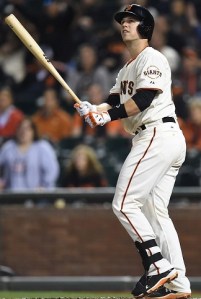
Wilmer Flores—representing the potential Giants’ winning run—checking his swing Thursday night. On appeal from plate umpire Doug Eddings (far right), the check swing was denied by first base umpire Gabe Morales and thus strike three ended the NLDS and the Giant’s season. Some think such robbery sends the “best” message to kids.

Social media isn’t exactly renowned as the exclusive domain of the learned. But when you see something such as I’m going to quote—I won’t embarrass the source by identifying him, though I know him well enough to know that he ought to know better—you tremble for your country when you remind yourself that God may be just but humans may be willfully ignorant.

The gentleman in question responded to “The Strike Heard ‘Round the World,” my account of NLDS Game Five and the shamefully needless way it ended. With Wilmer Flores’s check swing ruled a strike, erroneously, by first-base umpire Gabe Morales on appeal. With Flores robbed of a chance to persevere against Max Scherzer, despite his weak career papers against Max the Knife.

With the potential tying run on first for the Giants and himself representing the potential winning run, Flores should have had the chance to try before it was game over. He was denied improperly. My correspondent says, essentially, so what? “So what” works as a classic jazz exercise by Miles Davis. Not proper baseball analysis.

What the players do is human, what the broadcasters do is human,” said the gentleman in question, being a former baseball broadcaster himself.

[S]o the umpires do human things, smart or stupid. players and fans have to live with it. we’re sending the worst kind of message to our kids. Kids need to know that rotten calls will be made against them and they can’t plead for a review because there won’t be any.

Oh. So one of championship baseball’s most important jobs is to send the best kind of messages to kids. Got it. Very well, I surrender.

Let’s talk, indeed, about the Worst Kind of Messages We Send Kids when an umpire makes a mistake on what might be the final out of a postseason set’s final game, offers at least a mildly coherent explanation, then allows his crew chief to elaborate when asked further with, “Yeah, no, we, yeah, yeah, he doesn’t want to say.”

It tells me that the adults in the room who won’t stand for it when the kids dissemble upon being caught with their hands in the cookie jar or the liquor cabinet haven’t got that strong a leg to stand upon. I’d clean up betting that that’s what the kids in the room figure out, too.

Let’s talk, indeed, about the Worst Kind of Messages We Send Kids when the adults in the room decide, basically, yeah, we’re being rotten sonsabitches. But tough toenails, kids, that’s the way it is. This isn’t up for debate. We’re the mommies and daddies, that’s why. Because we said so, that’s why.

It tells me the adults in the room have no eyes to see. The kids in the room gather that their parents drink deep of power and parch themselves of prudence. They see might making right regardless of justification, in one or a hundred instances. They see authority with unsound foundation.

Let’s talk, indeed, about the Worst Kind of Messages We Send Kids when we tell them review isn’t an option. It tells me the adults in the room know three things about the country in which their game was born, nurtured, and grown in the first place: jack, diddley, and squat. Baseball’s government may lack in the complete range of reviewable acts, but baseball’s country’s government actually consecrated the right to review.

This nation’s founders consecrated a Bill of Rights that mandates, among other things, the right to petition for a redress of grievances. Such grievances are usually (though not exclusively; reference Congressional committee hearings) presented and argued before—what do you know—a Supreme Court. Never mind for the moment that given Supreme Court panels can seem as judicially tyrannic as umpires who are, after all, baseball’s most immediate arbiters.

But the Supreme Court has also overturned its own rulings frequently enough, unless higher authority—you know, the legislative branch, and the president, and in that order—writes and signs laws accordingly. The Supreme Court blew the Dred Scott decision? (It emanated first in the same city from which Curt Flood fired the Second Shot Heard ‘Round the World.) Abraham Lincoln’s Emancipation Proclamation plus the Thirteenth and Fourteenth Amendments took care of that blown call. That’s just one example.

By the way, federal judges up to and including even Supreme Court justices can be impeached. (Sixteen have been, including Supreme Court Justice Samuel Chase.) Baseball’s government hasn’t yet designed or imposed genuine umpire accountability. The better umpires in the game are compromised by their lessers.

Those concerned more with the Best Kind of Messages We Send Kids than with getting things right in championship or championship-aspirant games should ponder something else. Why might it be that ordinary, everyday enterprises impose accountability on their people, from the most obscure warehouse people to the highest-stationed boardroom people—but baseball can’t impose accountability on the arbiters who can, and often do, make, break, or compromise a game?

You want to send the Best Kind of Message to Kids? How about telling them that an improper lack of redress for check swings meant we’ll never know whether Wilmer Flores would have risen to the occasion of a 1-2 count, in a postseason series-deciding game, and overcome his career-long futility against Max Scherzer to keep the Giants’ now-ended season alive?

How about telling them the reason we’ll never know is because Flores was robbed of the chance to try once more at least?

Saying umpires make mistakes because they’re only human is one thing. Saying baseball shouldn’t do its best to correct and prevent key mistakes in-game—especially with a championship or an advance toward one on the line—is pitiful. Saying baseball shouldn’t do it because it would Send the Worst Kind of Messages to Kids, which is patent nonsense, should leave you at minimum with no credibility as a baseball commentator.

The strike heard ’round the world

Don Denkinger, you’re off the hook. Flores checking his swing into the arguable worst blown call in postseason history

Giants manage Gabe Kapler wouldn’t say it, even though anyone with eyes to see would say it for him. Even the Dodger fans among them. Maybe it wouldn’t change the outcome with that wired a Max Scherzer on the mound.

But ending this National League division series with that bad an umpire’s call? For the final out of the season for one team, not the first out of the ninth as was Don Denkinger’s infamous blown call at first in Game Six of the 1985 World Series?

There isn’t a jury in the land that would rule Kapler unjustified if he’d blown his proverbial stack or even demanded an investigation. This tight a Game Five between two of baseball’s most bitter of blood rivals plus the two winningest teams in this year’s Show deserved better than that.

These Dodgers and these Giants deserved better than first base umpire Gabe Morales ruling Wilmer Flores’s checked swing a strike to end it, after home plate umpire Doug Eddings—to his eternal credit—called for Morales’s help. That kind of help neither Eddings nor the Giants needed.

Two teams who’d been even-up in their regular season meetings, had the same number of hits against each other (173), and entered Game Five with each having 109 wins for the year including the postseason thus far, deserved better than a 2-1 Dodger win tainted through no fault of either team’s own.

“There are other reasons we didn’t win today’s baseball game,” Kapler said post-game. “That was just the last call of the game.” That was like a Japanese commander saying Hiroshima and Nagasaki were just the last blows of World War II.

Let’s give Morales a temporary benefit of the doubt. “[C]heck-swings are one of the hardest calls we have,” he said post-game. “I don’t have the benefit of multiple camera angles when I’m watching it live. When it happened live I thought he went, so that’s why I called it a swing.”

But Morales was shown a replay of that final pitch. Then, someone asked if he’d still call it failed check swing. Ted Barrett, the crew chief, answered for him. Sort of. As if Morales was incapable of speaking for himself.

“Yeah, no, we, yeah, yeah, he doesn’t want to say,” Barrett said. If there’s a more mealymouthed response upon a blown call’s questioning on record, I’d love to see it. Even Denkinger wasn’t that foolish when confronted with how badly he’d blown it calling Jorge Orta safe at first despite being out by almost a full step.

“Obviously you don’t want a game to end that way,” Kapler also said. “Obviously it’s going to be frustrating to have a game end like that, but pretty high quality hitter at the plate that can climb back into that count. There’s no guarantee of success in that at-bat. It’s just a tough way to end it.”

Flores checked his swing on an 0-2 pitch that came in just under the low outside corner. All things considered, especially the proliferation of dubious pitch calls all series long against both the Dodgers and the Giants, it wouldn’t have been the worst possible outcome for the plate appearance to continue.

But Flores checked his swing. Eddings called to Morales. Morales rang Flores up for game, set, and match. Sending the Dodgers to a National League Championship Series against the Braves, sending Giants fans reaching for the nearest possible liquid salves, and soiling the Game Five this series deserved otherwise.

They’d gone tooth, fang, claw, and just about anything else not just to get to Game Five in the first place but to get to the bottom of the ninth with only a single run separating them.

The Dodgers had gone to a bullpen game, opening with reliever Corey Knebel, continuing with fellow reliever Brusdar Graterol, then sending starting pitcher Julio Urias out of the pen to pitch a solid enough third through sixth. Then back to the pen men Blake Treinen for the seventh and Kenley Jansen for the eighth.

The thinking was that the Giants—a club full of elders and anonymous role players for the most part—were so deadly in situational play that, as The Athletic‘s Andy McCullough observed, the Dodgers’ best shot at neutralising that advantage by throwing two-thirds of their bullpen at the Giants and returning Urias to the postseason role where he’d been so effective in the recent past while they were at it.

It’s not that teams haven’t gone to bullpen games before. The Rays make about a third of their living doing it. Why, almost a full century ago the Washington Senators (Washington—First in war, first in peace, and last in the American League) won the 1924 World Series going to a bullpen game prototype in Game Seven.

All the Dodgers needed was Urias on board with the idea. “He earned the right to pitch in this game,” said Dodgers pitching coach Mark Prior. “If he said, ‘No, I want it,’ he was going to get it.” They surveyed other Dodgers including starters Scherzer, injured Clayton Kershaw, and Walker Buehler, who’d pitched so effectively in the Dodgers’ Game Four win.

“When they were on board,” Prior said, “it made sense. Everyone is in it to win it. Let’s go.”

That’s how they countered the Giants sending their stout young starter Logan Webb out for Game Five. He gave the Dodgers as good as their pen game gave the Giants. He pitched seven solid innings. The only blemishes on Webb were Mookie Betts delivering three of the four Dodger hits against him, and Corey Seager sending the Mookie Monster home with a double down the left field line in the top of the sixth to deliver the game’s first run.

Until Scherzer came into the game, the only real blemish against the Dodgers’ pitching was Giants left fielder Darin Ruf tying the game at one leading off the bottom of the sixth, by hitting Urias’s full-count fastball over the center field fence.

But until the Flores check swing that should have been, the co-story of the game might have ended up being the Dodgers leaving the Giants behind with yet another Belli-ache plus Max the Knife plunged into their backs in the bottom of the ninth. More’s the pity.

Continuing his re-adjusted postseason revival—after an injury-marred regular season reduced him to terms so low people questioned why Dodger manager Dave Roberts kept running his former MVP out there at all—Cody Bellinger broke the one-all tie in the ninth.

He made the Giants pay after their young relief ace in the making Camilo Doval hit Justin Turner up and in on the first pitch after Will Smith grounded out to shortstop to open the top of the ninth. Gavin Lux snuck a base hit through the right side of the infield to set first and second up.

Then, Bellinger took ball one low, swung through a slider around the middle, bounced a foul ball off to the right, then shot one up the middle and into center field sending Turner home with the tiebreaking run. Which probably amped Scherzer up in the pen even more than he’d already sent himself.

When he wasn’t throwing warmup pitches, Scherzer paced and pranced like a maniac. It was a wonder nobody had to shoot a tranquiliser dart into his rump to make sure he could go in and pitch the bottom of the ninth without dismantling himself.

He all but shot in from the pen to the mound as the sides changed. It was so must-see television that the TBS broadcast obeyed the call, too, not cutting to a commercial break as he made his way to the mound. You’d have thought the back of his uniform carried not his surname and number 31 but Danger! High Explosives! Keep Back 500 Feet!

Pinch hitter Matt Beaty ended the top of the ninth by grounding out to Flores playing first for the Giants. “Flores touched first base,” said Betts with a laugh, “and it felt like Scherz was halfway to the mound.”

This was virgin territory: Scherzer had never recorded a relief save in his entire professional pitching career. Yet he flew in from the pen as though fourteen years’ worth of a Hall of Fame pitching career to date was merely the overture to his kind of Unfinished Symphony.

So, with Bellinger shifted from first base to center field and Billy McKinney out playing first, Max the Knife unsheathed. He got Crawford to line out the other way to left. He shook off Turner bobbling Kris Bryant’s grounder up the third base line enabling Bryant safe on the error to strike out Lamonte Wade, Jr., who’d been making a name for himself with assorted ninth-and-later heroics for the Giants.

Then came Flores, the former Met who’d been part of their 2015 run to the World Series. A slider hitting the middle of the zone for a called strike. A foul off. Then, the fateful slider coming down and just off the corner. The checked swing. Eddings’ appeal to Morales at first. Strike three. Game, and Giants’ season, over.

There are eleven categories of reviewable umpire calls that managers are allowed to challenge. In the postseason, a skipper gets two challenges instead of the one allowed during the regular season. Check swings and pitches aren’t among the eleven. Maybe in the postseason they ought to be.

The “human element” be damned. When Whitey Herzog (Cardinals manager in 1985) called outright for replay in his 1998 memoir You’re Missin’ a Great Game, he had it as right as right can be: “This is for the championship—let’s get it right.” This was toward a potential championship and a win-or-wait-till-next-year game in the bargain. It should have been gotten right.

Seventy years ago, the Giants’ Bobby Thomson hit the Shot Heard ‘Round the World to finish a pennant playoff we’ve long since known, with full proof, was tainted by an off-field-based sign-stealing plot that helped those Giants come from thirteen games back to forcing that playoff in the first place.

Maybe it was tempting the fates a little too flagrantly when it turned out someone with the Giants—not a fan or fans, as I thought when seeing the sign in a flickering moment during the Game One telecast—tacked that “Remember ’51!” up on a deck rim in Oracle Park. Very clever, using a tainted triumph for motivation.

But ’51 was then, and this was Thursday night. Tainted not by cheating but by the kind of malfeasance that’s brought demands for further and fuller umpire accountability and for technology to help get the calls right. I don’t have to be as kind as Gabe Kapler.

Don Denkinger, you’re off the hook for the arguable worst blown call in postseason history. Maybe Scherzer would have retired Flores anyway if the proper call was made; maybe Flores would have kept the inning alive with a base hit. Maybe—unlikely as it might have been, considering his 0-for-17 lifetime jacket against Max the Knife—he might have tied or even won the game with one swing.

Maybe. We’ll never know now.

Until or unless baseball’s government effects real, substantial umpire accountability and stops allowing the “human element” to enable them to get away with murder, this NLDS Game Five’s finish should be known forever as The Strike Heard ‘Round the World.

Freeman frees the Braves to await their NLCS opponent

Freddie Freeman

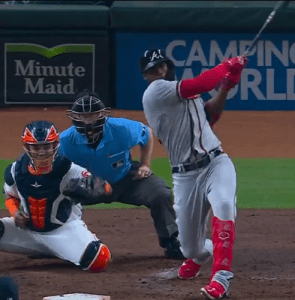
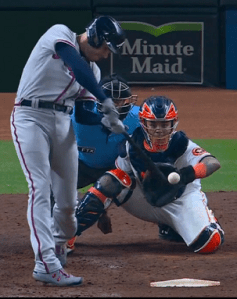
Jubilant Freddie Freeman approaches the plate to finish the eighth-inning bomb that held up to win the NLDS for the Braves Tuesday night.

Maybe it didn’t have quite the last-split-second hair raising quotient that the Red Sox’s final two American League division series wins had. But it wasn’t any less dramatic for Freddie Freeman and his Braves in winning their National League division series Tuesday.

Freeman’s eighth-inning tiebreaking home run off Brewers relief ace Josh Hader turned out the finishing blow in a set during which both teams scored as many runs in the first three games as they ended up scoring in Game Four alone.

What made the bomb so luminous, too, was that it was only the second time in the whole 145-year history of the franchise that any Brave delivered what proved a postseason series-winning hit in the eighth or later. It took one season shy of three decades for Freeman’s homer to join Francisco Cabrera’s National League Championship Series-winning base hit. (The fabled Sid Bream mad-broken-bodied-dash.)

“I’ve had a lot of cool moments in my career,” Freeman said postgame, “but so far I think that’s going to top them right there. But hopefully that’s not the last cool one.” Right now, nobody’s willing to bet too heavily against either Freeman or his Braves. Yet.

You heard all season long about this or that team being wracked by injuries and surrealities? Few had to compensate as heavily as the Braves did. Too many teams losing their number-two franchise player, one of their best young pitchers, and a reliable other power bat might have collapsed like a blimp.

The Braves lost Ronald Acuna, Jr. thanks to a torn ACL making a play in center field. They lost Mike Soroko after his Achilles tendon blew out in May—after nine months’ rehab following its initial 2020 tear. They looked as though their season had paid put to hit without once seeing .500.

They lost Marcell Ozuna when the outfielder/bombardier was arrested for domestic violence in July—charged first with felonious aggravated assault and attempted strangulation, charges reduced to misdemeanor simple assault and battery, on administrative leave through the end of the Braves’ season, after he entered a diversion program.

When Acuna went down, and the Braves more or less sputtered into and past the All-Star break, general manager Alex Anthopoulos made his first move, bringing former Dodger Joc Pederson aboard from the Cubs in exchange for a minor league prospect.

That was Pederson pinch hitting for Braves reliever Luke Jackson in the Game One eighth and hitting a solo home run off Brewers reliever Adrian Houser for the only Braves run in the only series loss. That was also Pederson in Game Three, pinch hitting for Braves starter Ian Anderson, facing Houser again, and launching the three-run homer that proved the only Game Three scoring.

Houser may start seeing Pederson in his sleep. The Braves just want to keep seeing him mash. Even if he got the Game Four start as his reward and had to settle for pushing home the first of the two runs that tied things at four with a ground out to second base.

Freeman thinks landing Pederson merely began the Braves’ reversal. “When Alex went out and got Joc,” he said, “it brought a sense of energy that it just showed us that they still believed in us, to go add at the deadline.” Which is exactly what Anthopolous did. He nailed three 30 July trades to bring Jorge Soler from the Royals, Adam Duvall from the Marlins, and Eddie Rosario from the Guardians-to-be.

The NL East wasn’t a powerful division to begin with. But the longtime-leading Mets imploded, the Nationals hit the reset button, and the Phillies proved just short of being able to hold on. In Atlanta, as proverbially and poetically as feasible, that which didn’t destroy the Braves only made them stronger.

They went 36-19 to finish the regular season, including a too-simple-seeming sweep of the Phillies opening the final week to keep them from finishing what they threatened awhile to do and overthrow the Braves. They even shook off Soler’s COVID diagnosis entering the postseason. Now they’ve dispatched a Brewers team that won seven more regular-season games to lead an only slightly stronger NL Central.

They’re waiting to see who’ll be the last men standing between the Dodgers and the Giants, after the Dodgers tied that division series in Los Angeles Tuesday night in an all-Dodgers/all-the-time 7-2 win.

The game was a still-manageable 2-0 Dodger lead, with the Giants compelled to a bullpen game against a short-rested but deadly effective Walker Buehler, when Mookie Betts checked in in the fourth against Jarlin Garcia—after Buehler himself led off by reaching on an infield error.

“It’s not something we want to do all the time,” said Buehler about going on only three days rest, “but I felt that if things didn’t go our way [in the third game], I would feel really weird not pitching a game that we could lose a series.”

He didn’t have to worry. Until he surrendered a leadoff single to Evan Longoria and a one-out walk to Steven Duggar in the fifth, Buehler pitched stoutly and had to shake only one previous first-and-second spot of trouble away in the second. He even had the Giants slightly flummoxed when he went to his changeup a little more often than they were accustomed to seeing from him.

When the Mookie Monster parked an 0-1 pitch into the right center field bleachers, it suddenly seemed a question not of whether but by how big the Dodgers would take the game. An inning later, Betts sent Cody Bellinger home with a sacrifice fly deep to left center field. But Dodger catcher Will Smith—just call him the Fresh Prince of Dodger Stadium—squared off against Giants reliever Jake McGee with Corey Seager aboard (leadoff line single) and hit the first pitch over the left center field fence.

The Giants looked so overmatched in Game Four that their only two runs scored on ground outs, one with the bases loaded. That was Evan Longoria scoring on Darin Ruf’s grounder to second. The other was Brandon Crawford coming home in the eighth when Kris Bryant grounded one to the hole at third.

Buehler’s short-rest deliverance plus the Dodgers’ bats ensured Julio Urias on regular rest starting Game Five against Logan Webb in San Francisco Thursday. For the Braves, that’s going to be very must-see television. Which is what it already was on the left coast and elsewhere.

For the Brewers, it’s a too-early winter vacation after their pitching virtuosity proved futile against the disappearance of their bats. Christian Yelich’s back injury-abetted struggles continued in the division series, and while the Braves didn’t exactly bring the walls crumbling down the Brewers hit a measly .192 in the set—32 points below the Braves.

They did get beaten in the end when the Braves’ best batter launched against their best pitcher in the Game Four eighth. Starting Eric Lauer for Game Four because ace Corbin Burnes said he wasn’t feeling one hundred percent proved a mistake, and so did manager Craig Counsell not bringing Brandon Woodruff in earlier in higher-leverage.

But then here’s where the Brewers’ best bats fell too short. Avisail Garcia? Eight strikeouts, only two hard-hit balls, and two singles in fifteen at-bats. Kolten Wong? Five strikeouts, likewise only two hard-hit balls, and one single in fifteen at-bats. Willy Adames? Five hits in seventeen at-bats—four singles and a double, plus nine strikeouts and only three balls hit hard.

That’s why the Brewers pitched the division series like Hall of Famers—their three starters Burnes, Woodruff, and Luis Peralta showed a collective 1.56 ERA and 0.92 walks/hits per inning pitched rate, not to mention nineteen strikeouts in 17.1 innings pitched—but the Braves still took them out sweeping three after a Game One Brewers win.

“The vibe is the best that we ever had in this series,” Adames said before Game Four. “Today, the guys, I guess they woke up in a great mood. They came with energy. And I feel today we had the best vibe that we’ve had so far this series so far.”

The trouble was that the Brewers went in with the best vibes but the Braves played them as if they were jazz vibes legend Milt Jackson hammering out another virtuoso chorus of “Bags’ Groove.” Now the Braves wait to see who gets bagged in San Francisco Thursday night.

“Whatever it takes to win”

Kike Hernandez (center, hatless) surrounded by Red Sox teammates after his walk-off sacrifice fly sealed their trip to the American League Championship Series.

Well, the Rays only thought their rather decisive first-game win in this now-concluded American League division series meant the beginning of another deep postseason trip. Who knew it would prove to be just the last win of the year for the American League’s winningest regular season team?

Come to think of it, a lot of people only thought the Red Sox’s apparent disarray in enough of the regular season, including their final home set while the Yankees swept them, and in losing two of three to the Orioles before sweeping the also-ran re-tooling Nationals to finish the schedule?

The Rays won the AL East decisively, and with the best regular-season record in franchise history. The Red Sox had to wrestle their way into the wild card game before beating the Yankees in a game featuring the sort of thing happening to the Empire Emeritus that used to mean surrealistic disaster for the Olde Towne Team.

Lovely way to send the Yankees home, many must have thought, but oh, are they going to feel it when the Rays get hold of them.

The only thing the Red Sox must feel now is that their postseason work has only just begun. But if the ways they shook off that Game One 5-0 loss to take the next three from the Rays are any indication, they’re about as up to the task as any formerly buffeted team awaiting their American League Championship Series opponent can be.

They live by the team play motto to such a fare-thee-well that you can suggest any given one will sacrifice for the good of the team—which makes it so appropriate that they finally won this division series with . . . a sacrifice fly.

Lose a 2-0 top of the first Game Two lead to a grand salami in the bottom of that inning? “No panic,” said manager Alex Cora. No panic—and allow only one more Tampa Bay run while turning that quick-as-you-please 5-2 deficit into a 14-6 blowout.

Lose a 6-2 Game Three lead on an eighth-inning leadoff homer by Rays rookie star Wander Franco and a two-out RBI double by not-too-young Rays rookie star Randy Arozarena, then have to ride a Phillies throwaway named Nick Pivetta for four extra innings? No sweat—just let Christian Vazquez rip a one-out two-run homer into the Green Monster seats in the bottom of the thirteenth and win, 6-4.

Blow a 5-0 Game Four lead off a five-run third crowned by Rafael Devers sending a three-run homer over Fenway Park’s second-highest wall and into the center field seats? We do this kinda stuff to them all through the picture. Just let Kike Hernandez say thank you to the nice Rays for not putting him on to load the bases for an any place/any time/extra-innings ticket double play—by banging the game and set-winning sacrifice fly short of the left center field track.

“I mean, here we are surprising everybody but ourselves,” said Hernandez post-game, once he escaped drowning in the Red Sox celebration. “We knew in spring training we had the team to make it this far and here we are.”

Well, the Red Sox did lead the entire Show in comeback wins during the regular season. They also managed a rather impressive .591 winning percentage in one-run games. But they also suffered a 12-16 August that wasn’t necessarily as disastrous as some other Augusts by some other teams this year. (Hello, Mess—er, Mets.) Between injuries, COVID-19 illnesses, and assorted other mishaps. nobody else seemed to remember if they knew what Hernandez said the Red Sox knew last spring.

Surprising everybody but themselves? Sure. Let’s buy into that despite the Red Sox trailing in three of these four division series games. Let’s buy into that despite the Red Sox having to win twice in their final plate appearances. Let’s buy into that despite an ankle-compromised designated hitter, a second baseman getting his first daily plate appearances in around three months, and pulling a hutch of rabbits out of their hats.

Well, guess what? You’ve probably bought into more improbabilities than those in your lives as baseball fans, observers, writers. If you speculated on the Red Sox’s apparent pitching goulash out-pitching the Rays’ more obvious pitching depth going in? You ought to think about buying lottery tickets in every state that offers them.

If you bought into Garrett Whitlock, a find on the Rule 5 minor league draft heap, pitching no-hit, no-run relief for the final two Game Four innings and becoming the Red Sox’s highest-leverage bullpen bull, forget the lottery? You ought to be investing on Wall Street. You can’t lose. Yet.

If you bought into Jordan Luplow doubling and scoring in the fifth, Franco abusing Red Sox reliever Tanner Houck for a two-run homer in the sixth, and Kevin Kiermaier whacked an RBI double ahead of Arozarena whacking a two-run double to tie things at five in the eighth? You ought to seed the advent of Jetsons-style flying cars.

But if you bought into Game Three hero Vazquez leading off the Red Sox ninth with a base hit, Christian Arroyo sneaking a sacrifice bunt to the short right of the first base line, pinch hitter Travis Shaw slow bouncing a tough hopper toward third that wouldn’t get him in time at first, then taking second on defensive indifference with Hernandez at the plate? That’s beyond my pay grade, too.

Why didn’t Cash put Hernandez on with one out? He wasn’t really about to load the pads for Devers and be forced to prayer that he could get away with it. Devers already had three hits on the night. With the winning run already ninety fee from scoring, putting Hernandez aboard would have meant only the possibility of having put the insult-adding-to-injury run on base.

So Cash trusted his reliever J.P. Feyereisen to take care of Hernandez. The first pitch tied Hernandez up by sailing up and in tight on the Red Sox center fielder. The next pitch sailed into Austin Meadows’s glove in left center, too far back to keep pinch-runner Danny Santana from sailing home with the Red Sox’s ALCS tickets punched.

“It was quick,” Feyereisen said postgame, and he could have been talking the series as well as the end of Game Four. “I think that’s one of the main things when we sat down, like, ‘Wow, I didn’t think it was gonna be over this quickly’. We felt good. We played some good games. You come in here, especially with this atmosphere with these [Fenway] crowds and two walk-off wins, that’s tough.”

What was even more tough for the Rays is that, all series long, they struck out 46 times at the plate to the Red Sox’s 23—and that includes 20 Rays strikeouts in Game Three’s thirteen-inning theater. By contrast, the Red Sox picked up from being shut out in Game One to hit .364 with nine home runs in Games Two through Four and delivered 56 hits the entire set.

The Rays’ wounding offensive flaw, being Three True Outcomes enough all year long, bit their heads off in the division series. They hit seven homers and ten doubles but had a collective .211 team batting average all set long. They’ll have to figure out how to improve their overall contact without sacrificing their impressive power.

They’re young, they’re deep, they’re they’re tenacious, they’re a model of resourcefulness despite their limited dollars. Their championship window isn’t being boarded up just yet.

Their farm is considered deep and still promising. They’ve got their own kind of guts, playing and pitching rookies in the postseason as if it was the natural thing to do. Even if it was borne of the unpleasant necessities delivered by injuries, near-habitual turnover, and in-season moves that didn’t work. The rooks—shortstop Franco, pitchers Shane McClanahan and Luis Patino in particular—showed heart beyond their years even in defeat.

Yes, it’s tough to remember Arozarena was still a rookie this season, technically. His coming-out part last postseason took care of that, and he shone like a well-established veteran this time around. From homering and stealing home in Game One through two hits and that Game Four-tying hit in the eighth, Arozarena was a rookie in name only this year.

Losing righthander Tyler Glasnow to Tommy John surgery was probably the key blow to the Rays in the end. Free-agent veteran Michael Wacha took a 5.05 regular season ERA into the postseason . . . and allowed a mere two-run deficit to turn into that 14-6 Game Two blowout in two and two thirds innings. One more veteran other than Game Four opener Collin McHugh might have made a big difference.

The Red Sox are just as conscious of analytics as any other team so advanced, including the Rays who practically live by it. But they’re a lot better in balancing analytics to the moment. Cora is as much an advance information maven as any skipper in baseball, but he’s also unafraid to shift his cards and play to what’s in front of him when it’s demanded of him.

He doesn’t play October baseball like the regular season. If he did, he wouldn’t have gone to eight postseason series as a manager or a bench coach and been on the winning side in each of them. He’s not afraid to take risks, he doesn’t sweat it if and when they backfire.

“That’s our motto right now: Whatever it takes to win,” said Hernandez. “Just win today, and we’ll worry about tomorrow, tomorrow. Lineup, bullpen, starting rotation, like, it doesn’t matter. We’re a team, and we’re one. We’re not 26 dudes, we’re just one.” Lucky for them the Red Sox aren’t out of tomorrows just yet.

Cora’s Game Four starting pitcher, Eduardo Rodriguez—lifted after an inning and two thirds in Game One following that first-inning disaster, but pitching shutout ball until Luplow scored on a ground out in the fifth, then coming out after Kiermaier doubled to open the sixth—calls Cora “like a father, brother, manager, whatever. He trusts us. He trusts everybody in that clubhouse. He gives you the chance every time that he hands (the ball) to you, and you’ve just got to go out there and do your job.”

“He’s a guy you’d run through a wall for,” said Whitlock. “If he told me to run through that wall, I’d believe that he had something there to make sure it would fall for me.”

It turned out the Rays wall wasn’t quite as sturdy as everyone else thought going in. The Red Sox have sturdier walls to face going forward. Walls that won’t be as friendly to them as the Green Monster seems to be.

Off the wall in Fenway Park

Christian Vazquez

Christian Vazquez’s walk-off bomb should have been the co-story of Game Three with Nick Pivetta’s stout four extra innings’ shutout relief. But no . . .

You could hear the blue-murder screaming even before Christian Vazquez ended American League division series Game Three in the bottom of the thirteenth. You could hear furious Rays fans and sympathisers thinking Game Four deserves no shorter justice than the Red Sox getting killed to death.

They saw Vazquez hit a two-run homer, igniting a berserk celebration around all Fenway Park, and thought to themselves before hollering loud and long, We wuz robbed!!! They probably still think so.

They think the Rays should have come out of the top of the thirteenth with a 5-4 lead, the run scored from first by Yandy Diaz off Kevin Kiermaier’s two-out double against Red Sox reliever Nick Pivetta. That thought would have been wholly reasonable—except for the umpires calling for a rules review, ruling ground-rule double, and thus ruling Diaz back to third base.

The problem was Kiermaier’s drive bounced off the right field wall, off the track, then off Red Sox right fielder Hunter Renfroe and over the wall. Official Rule 5.05(a)(8) spells out the wherefore: If a fair ball not in flight is deflected by a fielder and then goes out of play, the award is two bases from the time of that pitch.

Rule 5.05(a)8 distinguishes between intent and lack of intent. Had Renfroe actually tried and succeeded in deflecting the ball over the wall, Diaz would have been awarded home because he’d passed second base just as the ball ricocheted off Renfroe’s thigh over the wall. But Renfroe never touched the ball with either hand.

Postgame, Kiermaier remained in abject disbelief. “I can’t believe that happened or we don’t get the chance to score right there,” the Rays center fielder said. “For one, I crushed that ball. I was hoping to leave the yard. I got a lot of snap and crackle but no pop. First and foremost, for that to happen right there, it just doesn’t make sense to me.”

Even the Red Sox didn’t know what to think at first.

“I’ve never seen that before in my life,” said center fielder Kike Hernandez, whose fifth-inning homer put the Red Sox up 4-2. “I wasn’t sure what was going to get called. I wasn’t sure if the runners had to return. I wasn’t sure if it was going to be like an errant throw where the runner would get two bags. Like I had no idea.”

It made sense to home plate umpire Sam Holbrook after the review mandated the ground-rule double ruling. “Very simple,” the ump said. “From an umpire’s standpoint, very simple textbook in the rule.”

Maybe the rule should be reviewed and changed, maybe it shouldn’t, if you consider intent paramount on a play that was so freakish in the first place. But within its strict letter, lacking verifiable intent on Renfroe’s part, Kiermaier indeed had to settle for the ground rule double and Diaz indeed had to return to third.

The game remained tied at four. Red Sox reliever Nick Pivetta recovered to finish his fourth inning worth of three-hit, no-run, seven-strikeout relief. Rays fans may consider it having added insult to insulting injury when Renfroe himself held on for the full-count walk with one out in the bottom of the thirteenth.

Then Vazquez—who’d only come into the game as a pinch-hitter for his catching predecessor Kevin Plawecki in the sixth—caught hold of Rays reliever Luis Patino’s first offering and sent it into the Monster seats above left center for the 6-4 Red Sox win. If the would-have-been Diaz run had held up, it would have meant the Rays losing by a single run instead of two.

In a game about which it was entirely fair to say it would be a shame for either side to lose, the Rays wrestled back from a 4-2 deficit in the top of the eighth off Red Sox reliever Hansel Robles. Wander Franco hit a 3-1 fastball down the chute for a leadoff homer over the Monster; Randy Arozarena with two outs doubled pinch-runner Manuel Margot home.

Before that, the Rays re-learned how stingy Red Sox starter Nathan Eovaldi can be after he gets touched up in the beginning. Once Austin Meadows parked a one-out two-run homer into the bullpens in the top of the first, Eovaldi went forward to pitch shutout ball the next four-and-a-third innings.

The Red Sox chased Rays starter Drew Rasmussen with three straight singles in the third, including Hernandez sending leadoff singler Christian Arroyo home with the tying run at two. Josh Fleming relieved Rasmussen and Rafael Devers greeted him with an RBI single up the pipe to put the Red Sox up, 3-2.

After Hernandez’s leadoff yank into the Monster seats off Rays reliever Pete Fairbanks to open the fifth, and the Rays tied things at four in the eighth, Game Three’s big story figured to be Pivetta. His stout extra-innings shutout relief reminded observers of Eovaldi’s own bullpen-saving, six innings stout relief in that marathon Game Three of the 2018 World Series.

Pivetta’s outing probably changed Red Sox manager Alex Cora’s plan to start him in Game Four. After Sunday night’s win Cora probably won’t complain too much. He’d said previously that whatever the plan going in the game itself would govern the moves and the changes. When he needed a stopper before the Rays got any more ornery than tying the game at four, he picked the right man for the job.

Don’t blame the ground-rule double for costing the Rays Game Three. The Red Sox led each of the first six innings off with a man reaching base. The Rays’ none-too-shabby lineup struck out twenty times and worked only four walks. They had one hit in nine opportunities with runners in scoring position.

Don’t use it to steal Vasquez’s big moment, either. The moment in which he became only the fifth catcher in Show history to end an extra-inning postseason game with a walk-off home run. The other three: Carlton Fisk (Game Six, 1975 World Series), Tony Pena (1995 AL division series Game One), Jim Leyritz (1995 AL division series Game Two), and Todd Pratt (1999 National League divison series Game One).

The moment, too, in which he hit the sixth postseason walkoff bomb in Red Sox history, joining Fisk, Manny Ramirez (Game Two, 2007 ALDS), David Ortiz (Game Four, 2004 American League Championship Series; Game Three, 2004 ALDS), and Trot Nixon (Game Three, 2003 ALDS).

“There’s no, ‘He would have done this, would have done that’,” Holbrook said. “It’s just flat-out in the rule book, it’s a ground-rule double.” Though even Holbrook couldn’t remember having seen any similar play in the quarter century he’s been a major league umpire.

But this was not Don Denkinger absolutely blowing what should have been an out call to start the bottom of the ninth of Game Six, 1985 World Series. A blown call that infuriated those Cardinals so much that, after the Royals forced Game Seven and the umpire rotation placed Denkinger behind the plate for it, the Cardinals imploded almost completely to lose that Series.

These Rays are made of far better stuff than that. These Red Sox know it. The Red Sox now stand on the threshold of going to the American League Championship Series, but they won’t kid themselves that the Rays will be pushovers. Neither should you.