Unknown's avatar

About Jeff Kallman

Member, Internet Baseball Writers Association of America and the Society for American Baseball Research.

The Padres show Machado the $300 million

2019-02-19 BryceHarperMannyMachado

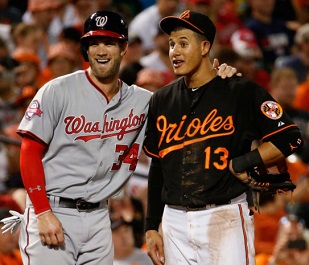
Bryce Harper and Manny Machado—Machado’s signed for 300 million balloons with the Padres. It may mean the beginning of the end of tanking, but now the Harper market becomes a little more intriguing.

Oops. Even as I was writing “Tanks, Damned Tanks, Dollars, and Nonsense,” in which I pondered the pros and cons teams might see in Manny Machado, Machado and the Padres dropped the big one. Ten years, $300 million, with a clause allowing Machado to opt out of the deal after five.

The Padres add a player who’s averaged almost five wins above a replacement level player a season for his first seven seasons and was worth 5.7 WAR in 2018. It’s only his fourth-highest single-season WAR, but it was his best season at the plate: he had his highest-ever single season on-base and slugging percentages, his highest-ever single-season OPS, and his best single season for creating runs with 120. His 191 runs produced in 2018 were ten above his career average per 162 games and tied his career best for a single season.

At age 25, Machado’s a year younger than Mike Trout, generally regarded as baseball’s greatest all-around player today, and a player who’s either going to extend with the Angels or test his own free agency waters after the 2020 season approaching age 28. And, yes, he’s signing the biggest contract ever for a baseball player, bigger than Alex Rodriguez’s $250 million.

But the Padres also add a player who has, like A-Rod though for different reasons, generated a little controversy during his career.

Bryce Harper has a reputation for being superstar caliber and not always fundamentally sound. Machado has one for being superstar caliber and not clean, whether it comes down to hustle or whether he plays the game crossing the line between hard nosed and plain dirty. If it’s not unseemly to crib from something I finished writing not half an hour before I sat down to write this, I’ll do it:

Harper at least has never spoken aloud of being a player who doesn’t always put his best effort forth. Machado has. Notoriously. As in, during the National League Championship Series, when he didn’t run a grounder out in Game Two, and slid so half competently in Game Three that one of the two slides helped make a double play against the Dodgers, then admitted to The Athletic‘s Ken Rosenthal, “Obviously I’m not going to change, I’m not the type of player that’s going to be ‘Johnny Hustle,’ and run down the line and slide to first base and . . . you know, whatever can happen. That’s just not my personality, that’s not my cup of tea, that’s not who I am.”

But Machado went further in the same interview: “Should I have given it a little more effort? One hundred percent. (It’s) my fault like always, I mean that’s just my mentality when I’m in the game. (There are) things that you learn, things that you gotta change. I’ve tried changing it for eight years and I still can’t figure it out but, one of these days I will.” To which Rosenthal added, “Some will see accountability in Machado’s words, viewing him a player who wants to do the right thing, but for whatever reason stumbles at certain times. Others will react to his, ‘I’m not ‘Johnny Hustle’ comment and lambaste him . . . considering anything less than maximum effort unacceptable. Still others might adopt an opinion somewhere in between, appreciating the nuance in Machado’s remarks.”

Those would be legitimate reasons for teams otherwise willing to show them the money to be slow if not hesitant to sign either Harper or Machado . . . And Machado is often seen as a player who crosses lines into dirty play often enough to provoke questions as to how that might translate in a new clubhouse.

Clearly, though, Machado enjoyed his time on the West Coast last season, where he played with the Dodgers and went to the World Series with them, following his mid-season trade from the Orioles. (There were those who thought Machado preferred to play somewhere reasonably closer to his Miami home.) With the Dodgers anticipating the return of shortstop Corey Seager this season, they had little to no place for him if they wanted to sign him on his own.

There were moments when it looked like the Phillies wanted Machado as badly as they’re believed to want Harper. There were moments when it looked like the White Sox wanted Machado badly enough that they sweetened the potential pot by adding his brother-in-law and a close friend or two.

And now comes a wrinkle: Former Yankee star Mark Teixiera, working now as an ESPN analyst, says no big market teams had offers on Machado’s table. Not even the Yankees, who’ve never been afraid to open the vault when there was a chance to land a Machado-type even if they’re not quite as profligate as they used to be when The Boss was still alive. Never mind that the White Sox aren’t a small market team, they only behave like one. And San Diego isn’t Boston, Chicago, Los Angeles, New York, Philadelphia, or San Francisco.

You guessed it. The Padres, the smallish market Padres, whom some people thought were in the tank but who’ve actually been struggling to put a winner on their field, just showed Manny Machado the money you’d have expected only the big market boys and girls to show him. Who says the small market teams don’t have money to spend, stupid or otherwise?

With one stroke of his pen, Machado blows the argument that the smallish market teams don’t have the resources the big boys and girls have in Boston, Chicago, Los Angeles, New York, Philadelphia (where the Phillies’ ownership has said they’re ready to spend “stupid money”—your move, Mr. Harper!), and even San Francisco right out of the ocean. You can just imagine the brass in places like Baltimore, Cincinnati, Cleveland, Detroit, Miami, Oakland, and Tampa Bay ready to measure Padres owner Ron Fowler for a noose, if not a guillotine.

Commissioner Rob Manfred thinks “the notion that payroll is a good measure for how much a team is trying or how successful that team is going to be.” Machado and the Padres say the first four words of the previous sentence are on the wrong side.

There’s no guarantee that spending, stupid money or otherwise, gets you to the Promised Land, if you define the Promised Land as not just playing October baseball but winning the World Series. The Yankees, after all, have gotten back to the Promised Land only once since Y2K, and they’re not exactly baseball’s skinflints. And there have been those who didn’t spend like assorted Congresses or assorted presidents but got to the Promised Land regardless, and more often than you think.

But when it comes to asking, “Do I have a better chance of getting to the Promised Land soon enough with spending big enough,” the Padres and their new have just sent the message that the answer fans of all smallish market teams would most like to hear from their teams is a resounding enough “Yes.”

The Padres weren’t thought to be entering 2019 as a great team or even a minimally good one. But Sam Miller of ESPN thinks they’re going to be better than advertised. “The Padres probably won’t be very good this year, but with the best current farm system in baseball they probably will be quite good in many of the next half-dozen years, and players like Manny Machado aren’t just freely available to pick up when a team decides to flip the switch and compete,” Miller writes. “They just got an MVP candidate for the middle of the lineup and all it cost them was money.”

“This gives San Diego’s entire rebuild a firm foundation,” says Miller’s fellow ESPN scribe Bradford Doolittle. “As big as the contract numbers are, it’s fair value for what Machado is likely to do in the future and because of his age and the length of his track record, the risk is comparatively low for deal this large.”

The deal does a few other favours around baseball. Since Machado isn’t going to the White Sox, the Indians can practically start pacing their players for another October run considering the weakness of the American League Central otherwise. The AL East has one less headache to worry about out of New York now that Machado won’t be wearing those Yankee pinstripes.

It may also do Harper a few favours. With Machado now getting the money he was projected to get when last season ended, and with Harper thought to be in line for similar money, Harper might just get it. Harper has the tools and the upside still, but at the same age with the same seven major league seasons Harper has averaged one less WAR per season. Harper has been more run productive per 162 games by eighteen over their careers, and he created one run less than Machado last year while using a few less outs to do it. Lifetime, Harper has 693 runs created using 2,524 outs to do it and Machado has 586 runs created using 2,845 outs to do it.

Those are striking enough differences in run production and run creation, which are the names of the game when you’re at the plate and on the bases. So what makes Machado the slightly better player? Harper’s defense in the outfield has receded considerably the last couple of years; Machado’s on the left side of the infield has been better. Machado doesn’t cost his teams quite as many runs in the field as Harper does, and Machado plays a tougher pair of defensive positions.

And before you begin to wonder whether Petco Park’s notoriety as a pitcher’s haven will suppress Machado’s bat, be reminded that a) Machado hits high drives when he connects right, which is very often; and, b) Petco Park is actually a lot friendlier to those whose natural high-drive power goes to left field, the seventh best such ballpark in the Show. And, as Eno Sarris of The Atlantic says, “Guess where Machado likes to hit his?”

Sarris also points out that adding Machado now gives the Padres almost the best infield in the league. “The ‘Fans’ projections on FanGraphs are almost always overly optimistic when you’re talking about a one-year projection, but when you’re talking about the upside that an infield like Machado, [Fernando] Tatís, [Jose] Urías and [Eric] Hosmer can produce, they can help. The fans say this group would produce 16+ wins together in full seasons this year. Only the Astros, Dodgers and Cubs are projected to produce more than 16 wins on the infield this year, and we haven’t added in any of the Padres’ depth pieces like [Ian] Kinsler.”

But Machado may have done more now than assure that Harper will be shown the money, give or take a few balloons, or that the Padres will win quite a bit more than projected this season. If the Machado deal begins the end of tanking as we know it, he and the Padres just did baseball and its fans one of the still-new century’s biggest favours yet.

Tanks, damned tanks, dollars, and nonsense

Colorado Rockies v Miami Marlins

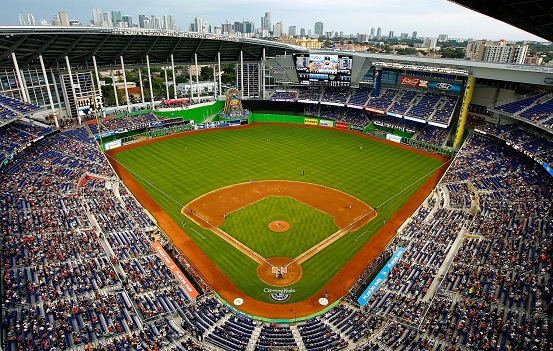
Marlins Park will be one the projected almost half of major league baseball stadiums without hosting even a cursory effort at winning baseball this season.

You don’t have to run numbers through processors to know two things: 1) Mere spending doesn’t always get you to the Promised Land, a.k.a. winning the World Series. 2) Last year, the team that spent the most in baseball on their payroll and their farm system got to the Promised Land. And they beat a team that’s gone to six straight postseasons and won back-to-back pennants and just so happens to be baseball’s richest at this writing.

Sports Illustrated‘s Jon Tayler took Commissioner Rob Manfred’s press conference bull by the proverbial horns Monday morning. Manfred denies there are such things as tanking teams. The players’ union and every baseball fan with the minimum mental capacity knows there are. “I reject the notion that payroll is a good measure for how much a team is trying or how successful that team is going to be,” Manfred told a group of reporters. Tayler knows Manfred isn’t wrong technically, just disingenuous:

The highest payroll doesn’t guarantee a World Series ring, but teams that don’t spend don’t often reach late October . . . The Marlins, Pirates and several other teams, meanwhile, cut payroll and neglected free agents, barely competing last year and not expected to be much better in 2019. Those teams aren’t trying to be good. In the case of Miami or Seattle or Baltimore, a club made the choice to be bad, hope for a top draft pick, and reap the financial benefits of failing.

It’s bad enough to root for a team rich in resources, unafraid to deploy them, and stuck yet again with coming up short enough. (I’m talking about you, Met and Angel fans.) It’s worse to root for a team making a seemingly conscious decision against deploying their resources and making even a semblance of trying to compete reasonably while in favour of pumping up its profits. (I’m talking about you, Mariners, Marlins, Orioles, Pirates, and Royals fans, among others.)

“Why should Marlins fans believe that yet another teardown—apparently two NL MVPs and the game’s best young catcher wasn’t enough to win—will lead anywhere other than yet another rebuild once the new prospects become expensive major leaguers?” Tayler asks, reasonably. “Why should Mariners fans simply trust that better is on the horizon after the front office—owners of the longest playoff drought in professional sports—dumped all the good players for pennies? What do Orioles and Royals and Pirates fans have to look forward to besides the changing of the seasons?”

Last winter players’ union executive director Tony Clark fingered the Athletics, the Marlins, the Pirates, and the Rays for not spending their revenue sharings. Manfred thinks Clark accused them of tanking. Manfred can’t seem to conjugate the distinction between just having a bad season and pocketing money that other teams would have spent on their parent rosters, their farm systems, or both.

The A’s made it to last year’s wild card game; the Pirates and the Rays had +.500 seasons; all four teams had four out of baseball’s five lowest payrolls, and three (the Marlins, the Pirates, and the Rays) cut payroll this winter. Teams may now be wary of handing out deals longer than five years to players past a certain age, and that wariness is not a terrible thing, but if the commissioner thinks there are no such things as consciously tanking teams, he’s blissfully unaware of things like:

* The Cubs and the Astros consciously tanking on behalf of retooling their parent clubs and their systems toward exactly what they achieved in the past few seasons: winning World Series and breaking ages-old Series championship droughts, and continuing competitiveness toward postseasons to follow.

* Fellow tankers using the Cubs and the Astros plans to justify their own tankings without making half the effort the Cubs and the Astros made to return themselves to actual competitiveness. The Cubs and the Astros said from the beginning of their tanks that they had an actual goal. Call it a kind of analogy to Babe Ruth’s actual or alleged called shot: the Cubs and the Astros pointed their bats to the right field seats and hit the balls right there.

* Baseball Prospectus projecting thirteen teams to finish below .500 in 2019, with the Orioles projected to lose 103 without half the style of the 1962-64 Mets; the Tigers to lose 95; the Marlins to lose 94; and, the Rangers to lose 93. Of the sub-.500 finishers projected, they include four out of five American League West teams and three out of five AL  Central teams. They also include two AL East teams (the Woe-rioles and the Rays), one National League East team (three guesses), two NL Central teams (the Pirates and . . . the Cubs, who haven’t been afraid to spend but didn’t lift much of a finger this winter, either), and two NL West teams (the Padres and the Giants). Almost half of major league baseball.

Does Manfred still believe every team is putting their best feet forward? Is that why he’s not willing to try the players’ union’s best idea yet, a tanking tax that would cost teams judged willing to present bad baseball while still making copious money choice draft positions?

Understood: There must be Goliaths for baseball’s Davids to slay. But without the right  slingshot David hasn’t got a prayer. Understood further: Each team in major league baseball is guaranteed $60 million in its hot little hands before the season’s first pitch is thrown. They don’t have to do one blessed thing to get it. And that’s just from shares of national broadcast money and shares from the profits MLBAdvancedMedia generates. Throw in the $20-$30 million each team gets from local/regional broadcast money and we speak now of each team adding $80-$90 million before Opening Day’s first holler of “Play ball!”

And even baseball’s least contentious superstar is not amused by what he sees.

“Everybody sees it. It’s obviously not good for baseball,” says Mike Trout, a player who is compared to the game’s all-time greats over his first eight seasons and looks to qualify as a no-questions-asked Hall of Famer by the time he reaches his first free agency at the end of the 2020 season.

“You got two of the top guys not signed yet. With teams saying they want to rebuild, why not start with one of the top guys?” Trout asks, not unreasonably. “Manny (Machado), Bryce (Harper), look at the pitchers out there. It’s pretty incredible. It’s disappointing for the players.”

Trout plays for a team that evokes the flip side of the tanking issue: his Angels are unafraid to spend, but they spend with unintended consequences (Albert Pujols, ten years and mostly unforeseen physical issues, to name the most notorious) and can’t seem to find ways to keep half their pitching staffs off the disabled list. (The Angels of the past few seasons are not unlike the 1960s Reds who developed sterling pitching only to watch just about all of it come down with arm and shoulder issues that kept them from greatness.) The good news: the Angels, and any other team “saddled” with gigacontracts involving players who can’t avoid injuries, recover the monies guaranteed those players via insurance. They’re not exactly going broke on them.

Harper and Machado have their particular issues. A plumb deeper than the surface of the dollars they’re believed to want reveals that, for all their talents and for all the evidence of their superior play, well, neither of the pair is Mike Trout. They’re both still young men. But Harper is a contradictory player who can be breathtakingly brilliant one week and breathtakingly ordinary the next, who can hustle himself into injuries one minute and give up the ghost running out ground balls the next.

The least problematic portion of Harper’s position now is his 2018 season. Yes, he finished with a modest .247 batting average, which seems to be the number one strike against him in the eyes of those fans who aren’t entirely seduced by him. But he was still the sixth-best in the National League at reaching base and scoring runs last year. And, just before the All-Star break, Harper stopped worrying about his launch angles and, secondarily, overshifts against him, and started thinking just about putting the bat on the ball. He still got his home runs; he still drove 100 runs home on the season; and, he hit .300 in the second half of the season.

The most problematic remained the perception that for all his achievements Harper is still not a completely sound fundamental player. Thomas Boswell isolated the point in the Washington Post Monday: “When the most famous player on the [Nationals] can’t go ten days without failing to run out a ground ball or overthrowing a cutoff man by fifteen feet or throwing to the wrong base or being caught unprepared in the outfield or on the bases, it’s hard to demand total alertness from the other 24.” Yet the Nats were still said to be willing to pay him $300 million for ten years to come, an offer Harper rejected and is now thought off the table entirely.

Harper at least has never spoken aloud of being a player who doesn’t always put his best effort forth. Machado has. Notoriously. As in, during the National League Championship Series, when he didn’t run a grounder out in Game Two, and slid so half competently in Game Three that one of the two slides helped make a double play against the Dodgers, then admitted to The Athletic‘s Ken Rosenthal, “Obviously I’m not going to change, I’m not the type of player that’s going to be ‘Johnny Hustle,’ and run down the line and slide to first base and . . . you know, whatever can happen. That’s just not my personality, that’s not my cup of tea, that’s not who I am.”

But Machado went further in the same interview: “Should I have given it a little more effort? One hundred percent. (It’s) my fault like always, I mean that’s just my mentality when I’m in the game. (There are) things that you learn, things that you gotta change. I’ve tried changing it for eight years and I still can’t figure it out but, one of these days I will.” To which Rosenthal added, “Some will see accountability in Machado’s words, viewing him a player who wants to do the right thing, but for whatever reason stumbles at certain times. Others will react to his, ‘I’m not ‘Johnny Hustle’ comment and lambaste him . . . considering anything less than maximum effort unacceptable. Still others might adopt an opinion somewhere in between, appreciating the nuance in Machado’s remarks.”

Those would be legitimate reasons for teams otherwise willing to show them the money to be slow if not hesitant to sign either Harper or Machado. The classic question of whether their best outweighs their worst. Boswell observes a lessening of tension among the Nats, whose clubhouse wasn’t always a model of stability with unquestioned leadership since Jayson Werth’s departure and whose previous managers “rarely said a discouraging word [about Harper, we presume] and owned no whip.” And Machado is often seen as a player who crosses lines into dirty play often enough to provoke questions as to how that might translate in a new clubhouse.

Two teams some suspect of going into the tank otherwise have shown interest in Machado: the Padres, who actually seem trying to win no matter that Baseball Prospectus projects them a sub-.500 team this season; and, the White Sox, projected to lose 92 this year. The Padres have also shown interest in Harper, as have the Giants. And the talk that it’s still going to end up with Harper in a Phillies’ uniform continues apace, the Phillies being projected as a +.500 team in 2019 even if they’re not predicted to win the NL East just yet. And the talk of “mystery” teams ready to pounce on either continues likewise.

But if either or both players sign right now, wherever, it still leaves a number of free agents unsigned who are either top of the line players or have been there and still have quality enough to offer. There seems no legitimate reason why Dallas Keuchel doesn’t yet have a job with a team who could benefit from a veteran established starting pitcher whose Cy Young season now seems an outlier but who still delivers. Or, why Craig Kimbrel doesn’t yet have a job with a team in need of an established closer, unless his skittish gigs last October have contending teams edgy that he’ll give them a lights out regular season and a nightly angina attack this coming October.

Meanwhile, the Red Sox ponder a contract extension for their starter Chris Sale, and the Mets ponder likewise with their defending Cy Young Award winner Jacob deGrom. Both pitchers, two of the best in the business, seem to want to stay with those teams for a considerable time to come. And Sale’s team’s owner has knocked Manfred’s disingenuity about tanking into the proverbial cocked hat. John Henry says that while there’s no such thing as the perfect correlation between team payroll and winning, “spending money helps.”

Spending wisely helps, and it would be comforting if we could take for granted that all owners really believe in wise over profligate spending. But not spending at all is the wisdom of fools. And there will be too many fools continuing to make money no matter how embarrassing will be the teams they put on the field.

Fans who think all this is nothing more than billionaires refusing to invest in millionaires who just so happen to be the product baseball sells might want to remember two things: You get what you pay for, and you don’t get what you don’t pay for. And a few too many teams are still trying to make money giving you what you don’t pay for—consciously losing baseball.

Just between friends: Captain Video vs. Teddy Ballgame

2019-02-16 TedWilliamsTonyGwynn

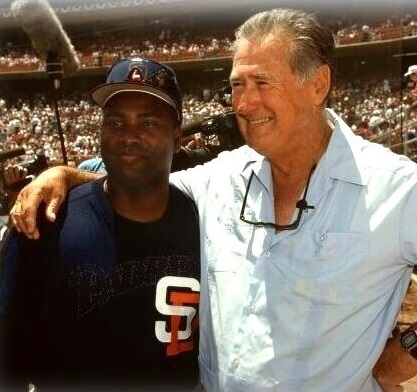
Hall of Famers Tony Gwynn and Ted Williams, a couple of southern California kids who were, as Casey Stengel might have said, rather splendid in their line of work.

The best argument I’ve ever seen on behalf of baseball statistical analysis came from Allen Barra, in the introduction to Clearing the Bases: The Greatest Baseball Debates of the Last Century, published in 2002:

I believe in statistics. I do not trust people who say they do not. Whether it was Benjamin Disraeli or Mark Twain or whoever who said, “There are two kinds of lies, damned lies and statistics,” he was trying to pull the wool over someone’s eyes. Well, no, I take that back; I can see how someone would feel that way, particularly in regard to the manipulation of statistics, but this is not an argument against damned statistics, it is an argument against damned liars. How in the world any baseball fan can say that he doesn’t trust statistics is beyond me; stats are the life blood of the sport. No matter how many games you watch you can only see a tiny fraction of the games played; if you can’t trust numbers to tell you what happened when you weren’t there, then what can you trust? 

For the record, Mark Twain popularised “There are two kinds of lies, damned lies and statistics,” but he attributed the phrase to Benjamin Disraeli. Anyway, the worst argument against statistics? I’d have a hard time picking one, but you’d probably find most of those in arguments about who does or doesn’t belong in the Hall of Fame, or arguments about who did or didn’t deserve to win certain seasonal awards.

As for the worst argument one way or the other about comparing players statistically, I thought most surrealism was exhausted until I bumped into one that put two Hall of Famers, Ted Williams and Tony Gwynn, into the same conversation, with the litigant in question suggesting Gwynn and Williams the two best pure hitters he’d seen in his lifetime. Said litigant is a friend of decent and long enough standing, though I fear our little tiff may have compromised that friendship, after I joined the discussion and suggested it was more than a little foolish to put Gwynn and Williams in the same conversation.

I tripped on my own banana peel. I hadn’t meant to suggest he was a fool himself, and I was (and still am) genuinely sorry that he thought I had. As I said subsequently (to someone who called me out on the inadvertent suggestion), I knew only too well the most intelligent men and women on earth could make a foolish suggestion now and then. (I didn’t have the heart to say that you have only to prowl assorted writings about our politics today to know how many intelligent men and women make how many foolish arguments.) But I’d forgotten for long enough that, when it comes to particular subjects and particular sensibilities, there’s no such thing as an unexposed nerve, even (I say it with no pride) my own.

In some ways, Tony Gwynn and Ted Williams do belong in the same conversation. They both hailed from southern California. They both belong in the Hall of Fame, they were both first-ballot Hall of Famers, even if it is rather astonishing to think that thirteen voters left Gwynn off their ballots, even as it’s slightly more astonishing to know that Williams received a lower percentage of the vote in his election year than Gwynn did in his. They both played their entire careers for a single team, which is more of a comparative rarity than people think. They were both predominantly number three hitters in the lineup. Their lifetime batting averages are six points apart: Williams hit .344; Gwynn hit .338. And they struck up a friendship of sorts during Williams’s final decade of life.

If that was all you considered about the pair, you just might think they’re as close to a match as you can get, and there are those who cling stubbornly enough to batting averages as the alpha and omega of a player’s value. With that stubbornness of course you’d look at Williams hitting .344 and Gwynn hitting .338 and, exploring no further, say to yourself that boy those two guys were about as close a match as you could imagine. But those close batting averages also provoke a reasonable question: how valuable were they, really, to their teams? What did those gaudy batting averages bring to the party aside from the frequency with which they hit? How valuable were their hits? What and how much did they really do toward putting more runs on the scoreboard? (Stop snarling, old schoolers. Putting more runs on the board than the other guys, and making sure they put less runs on the board, is the name of the game.)

That’s what we should want to know if we’re going to have a conversation that marries Tony Gwynn to Ted Williams. And if that’s the case, the marriage needs to be stopped before it heads to divorce court.

Williams played nineteen major league seasons and Gwynn played twenty. Williams at this writing holds the highest on-base percentage of any player who played the game in any era, .482, and he played the bulk of his career in a game that ended its self-imposed talent segregation and shifted into the era of nighttime baseball. (That the Red Sox were the last major league team to admit a black player to its ranks wasn’t Williams’s fault.) Gwynn, whose era was more fully talent integrated and who played at least half his games at night, has a .388 on-base percentage. That’s the 111th best OBP of all time, and it’s almost a hundred points lower than Williams’s. How did that happen when the two only hit six points apart with one season’s difference between their careers?

Gwynn was a tougher man to strike out than Williams, with 275 fewer lifetime, and Williams was tough enough to strike out. (Gwynn averaged 29 strikeouts per 162 games to Williams’s 50, and neither man ever struck out in triple digits in any season.) But Williams was better at working out walks. Gwynn walked 790 times in his career and averaged 52 walks per 162 games. Williams walked 2,021 times in his career and averaged 143 walks per 162 games. That put Williams fourth all time (and you thought eleventh-place Eddie Yost was the Walking Man?) and Gwynn, 272nd place, tied with Joe DiMaggio. Williams also received 243 intentional walks, good for eighth on the all-time list, while Gwynn is seventeenth on the list with 203. You can argue plausibly that the each man faced a different caliber of pitching, but it still seems objectively that pitchers feared Williams at the plate considerably more.

Williams was better at avoiding double plays. In nineteen seasons, Williams hit into 197 double plays; in twenty seasons, Gwynn hit into 259. This is a little astonishing considering that by all indications Gwynn was the faster man out of the box and on the bases. (His stolen base percentage is .718 to Williams’s .585).

Williams, of course, was one whale of a power hitter; he was fourth on the all-time home run list when he retired with 521. Gwynn had some power but was a guppy compared to Williams, hitting 135. Today’s obsession with launch angling, and hitters focused primarily on that to the detriment of other hitting, leaves the home run a little devalued in a lot of fan minds now. But the home run isn’t going to disappear, even if you’d like a better balance between the big blast, some well-struck line drives into the gaps, and some roach-and-roll small ball. (And, while we’re at it, a lot more hitters looking at the rash of overshifts against them and deciding those creamy open spaces they’re being gifted are the perfect places to send some base hits.) The launch anglers who hurt themselves otherwise with the obsession could stop worrying about it and still get their bombs if they were power hitters in the first place. (Just ask Bryce Harper, who turned his 2018 season around when he quit worrying about his launch angles just before the All-Star break and got back to putting the bat on the ball. He got his bombs anyway, he drove in his runs anyway, he kept reaching base anyway, and he hit .300 in the second half.)

Here, we’re discussing two hitters who didn’t even think about things like launch angling, and a man who averaged 37 home runs a season versus a man who averaged nine a season gives himself and his team a big advantage on the scoreboard. The advantage is even bigger when the man averaging 37 bombs a year has better teams setting his table, which is exactly what Williams had and Gwynn didn’t when all was said and done.

Maybe if Gwynn could have played most of his career with someone like Rickey Henderson or Wade Boggs hitting ahead of him instead of just the three seasons he had Henderson as a teammate, it would have made a significant difference. Gwynn averaged 76 runs batted in a season but Williams averaged 130. Most of that comes from how much better the Red Sox were in Williams’s prime seasons than after he returned from Korea, of course. Williams averaged far less RBI a season after Korea than before, but he actually still comes out an RBI or two better on average for those seasons than Gwynn does for his entire career.

Traditional stat lovers point to Triple Crowns, and it’s rare enough for a single player to lead his league in batting average, home runs, and RBIs in the same season. It’s only been done seventeen times in major league history, and Williams did it twice, in 1942 and 1947. But let’s ponder the idea of another Triple Crown: leading your league in batting average, on-base percentage, and slugging percentage. If that’s one of your ideas of a Triple Crown, too, then Gwynn’s going to pull up even shorter because he has none but Williams has three such claims, including his staggering claim at age 38 in 1957, sixteen years after his previous claim.

2019-02-16 TedWilliams

Ted Williams, hitting his final major league home run . . . 

Let’s look at their run production and run creation. If you consider runs produced the sum of runs scored and runs batted in, Gwynn averaged 168 per 162 games . . . but Williams averaged 257 per 162. That’s an 89 run difference in favour of Williams despite Williams hitting eighteen points lower with runners in scoring position than Gwynn did. But run creation, the formula developed by Bill James, isn’t as simple as who hit more home runs, though the aforementioned litigant seemed to think it did based on a subsequent reply to me. To conjugate run creation you factor all base hits (not just the bombs), walks, intentional walks, sacrifices, double plays, stealing, caught stealing. (You could also throw in how often a player advanced runners on non-sacrificial outs, but tracking that information is a bigger challenge.)

So with all that in the track, the record shows Gwynn created 1,636 runs lifetime and used up 6,661 outs to do it. The record also shows Williams created 2,393 runs lifetime and used up 5,291 outs to do it. By seasonal average, Gwynn created 109 runs to Williams’s 169 runs and used 442 outs to do it to Williams’s 374 outs. Even with only one season’s difference in their careers, that differential is astonishing. Yes, it is to wonder, too, what the three full seasons in his mid-20s lost to military service (he missed part of a fourth likewise but at 33) took away from Williams’s production and creation.

And I didn’t even think about wins above a replacement-level player until now. My aforementioned friend thinks of WAR in terms of the old Edwin Starr soul song: War! What is it good for? Absolutely nothing! Simplying the definition of FanGraphs, the stat sums up a player’s total contribution to helping his team win. The formulas aren’t standardised just yet, but addressing position players such as Gwynn and Williams you can say it shows you how many more games their teams won with them than if they’d never existed, by way of their run production, run creation, and what they also contributed to denying the other guys’ scoring.

If the comparison is Gwynn vs. Williams, Gwynn comes out on the short end there, too, alas: his 69.2 lifetime WAR is 53.9 lower. Gwynn was a slightly better defensive outfielder than Williams, but if you were to remove the runs Williams cost his team in the field from the runs he created and produced at the plate, he would still come out ahead by considerable distance. What their WARs mean is that Gwynn’s Padres won 69 more games during his career span with him than they would have won if he didn’t exist, but that Williams’s Red Sox won 123 more games during his career span with him than they would have won if he didn’t exist.

My friend saw both players play; I got to see way more of Gwynn at play than I could have seen of Williams, since Williams retired after the 1960 season and I wasn’t even partially aware of baseball at that particular moment. But how can I complain when I’ve seen Henry Aaron, Ernie Banks, Johnny Bench, Barry Bonds, Jim Bunning, Gary Carter, Roberto Clemente, Whitey Ford, Bob Gibson, Vladimir Guerrero, Reggie Jackson, Derek Jeter, Randy Johnson, Sandy Koufax, Greg Maddux, Mickey Mantle, Juan Marichal, Don Mattingly, Willie Mays, Joe Morgan, Eddie Murray, David Ortiz, Cal Ripken, Mariano Rivera, Brooks and Frank Robinson, Tom Seaver, Ozzie Smith, Warren Spahn, and Mike Trout, to name a few?

I can’t complain, either, about getting to see such teams as the 1961 Reds (immortalised in their relief pitcher Jim Brosnan’s Pennant Race), the 1962 Mets (who had to be seen to be believed), the 1965-66 Dodgers and Giants, the 1967 Cardinals and Red Sox, the 1969 Mets, the 1970 Orioles, the Big Red Machine, the Bronx Zoo Yankees, the 1979 Pirates, the 1986 Mets, the 1988 Dodgers, the 1989 Woe-rioles, the 1990 Reds, the 1998 Yankees, the 2002 Angels, the 2004 Red Sox, the 2008 Phillies, the 2011 Cardinals, the 2016 Cubs, the 2017 Astros, and last year’s Red Sox.

Only later did I get to read about and see film of Williams’s Comeback Player of the Year final season, including the career-finishing home run immortalised so lyrically by John Updike in “Hub Fans Bid Kid Adieu.” And, about Williams’s prickly personality and his seemingly tireless battles with the  carnivorous Boston sports press of his time and place. My first real awareness of Williams was his Hall of Fame induction in 1966, when he wished Willie Mays well after Mays passed him on the all-time home run list. (He has gone past me, and he’s pushing, and I say to him, “Go get ‘em Willie.”) And when he called explicitly for some way for the Hall of Fame to honour Josh Gibson and Satchel Paige (symbols of the great Negro players who are not here only because they weren’t given the chance), he touched a nerve that led to the Hall of Fame forming a committee to name and elect the best Negro Leaguers to the Hall.

Those remarks spoke well of Williams, who asked only to be great and willed himself to greatness, who was cocky on the outside but grew up a bundle of awkwardness anywhere else beside a baseball field. And in due course Williams and Gwynn met, and cantankerous Teddy Ballgame took a genuine liking to Mr. Padre, whom he recognised as a fellow hitting student. That speaks very well of Gwynn, whose childhood was as stable as the day was long.
2019-02-16 TonyGwynn

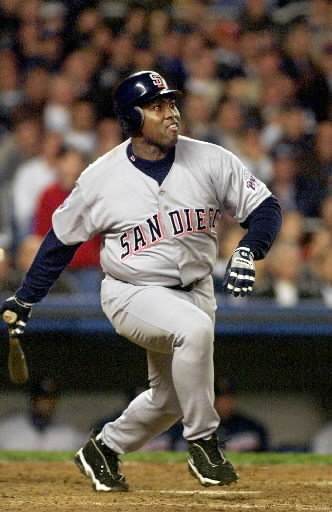
Tony Gwynn, hitting the only postseason home run of his career—a two-run shot in Game One of the 1998 World Series.

Watching Gwynn he resembled a man who studied every possible nuance and technique of hitting, much the way Williams did. As things turned out, he was once nicknamed Captain Video because not only did he have the habit of studying film of himself like a Biblical scholar, his wife videotaped him at least as often as the Padres did so he could study further. He withstood criticism about his tendency to carry a little too much extra weight, only occasionally letting the hurt show.

He also withstood a rather nasty attack upon him in 1990 when Jack Clark, then a Padre, accused him (and, while he was at it, tortured pitcher Eric Show) of playing to pad his statistics instead of for the team, and when someone anonymous (Gwynn thought it might have been a teammate, others thought it was a member of the Padres’ grounds crew) left him a Tony Gwynn figurine hung in effigy with arms and legs missing. But Clark was only the most vocal critic of Gwynn’s playing approach. There were others—particularly two of his managers, Dick Williams and Jack McKeon—who said they’d seen few less selfish players in their baseball times.

Strangely enough, in 1990, one criticism leveled toward Gwynn in his clubhouse was that he would bunt with men on base instead of pulling grounders, the better to protect his batting average. Why, the absolute nerve of the man, assessing a situation, his chance of hitting safely, and deciding his best chance to move runners closer to scoring was to square up and drop a bunt! If someone else did it, even a pure power hitter like Clark, they’d have said what a guy, taking one for the team. Do we dare ask what those fools would have thought if Gwynn had hit into a double play?

It would have been simple for Gwynn to clock Clark when Jack the Ripper ran into bankruptcy in 1992, thanks to profligate spending and a few dubious legal machinations by part of his legal team. But one of Clark’s first public sympathisers turned out to be Gwynn, who knew only two well what bankruptcy does to a man regardless of how he gets there. Gwynn was there himself in 1987, after his then-agent reneged on loans Gwynn co-signed as a favour, and Gwynn tried but ultimately couldn’t handle the repayments by himself when the banks came calling.

Gwynn once appraised himself this way: “[I’m] a good player . . . but I knew my place. I was not a game-changer. I was not a dominant player.” You can accuse Gwynn of a certain degree of modesty there, but in another sense you can accuse him of being only too self-aware. He was good enough to be a first-ballot Hall of Famer and he didn’t have to be better than that to be one of the game’s genuine all-time greats, a player you loved to watch because he was going to put on a batting clinic that helped his teams win even when most of his teams weren’t as good as he was. And he shakes out as the fourteenth best right fielder who ever played the game. We know how many who didn’t make the top twenty as good as we remember them being?

But Williams at his absolute best was a game changer and a dominant player. He has in common with Gwynn playing for a lot of teams who went nowhere much otherwise in spite of his best effort and his best deliverance. Williams wasn’t the reason the 1946 Red Sox couldn’t close the deal in the World Series; he wasn’t the reason the Red Sox couldn’t nail the pennant in 1948 (when Joe McCarthy started Denny Galehouse instead of Mel Parnell) and 1949 (when McCarthy lifted Ellis Kinder late in the game when even the Yankees thought he was getting stronger as the game got older, and the Red Sox were down 1-0).

And Gwynn wasn’t the reason the Padres didn’t win the World Series in 1984 and 1998, or a 1996 National League division series, or pulled up just short enough in the National League West in 1989, any more than Williams was the reason the Red Sox collapsed in the 1950s.

That plus their roots, their career longevity, their customary slots in the batting orders, and their Hall of Fame plaques are all they really have in common. Ted Williams reached base more often, produced and created more runs, used far less outs including hitting into far fewer double plays, to give his teams that much better chance to win.

“Ted liked him,” said one eulogist after Gwynn’s death, “and Ted didn’t like anybody.” (Which isn’t entirely true, if you’ve ever read David Halberstam’s The Teammates, a chronicle of the sweet lifetime friendship between Williams and Red Sox teammates Dom DiMaggio, Bobby Doerr, and Johnny Pesky.) A year after retiring, Gwynn told an interviewer of one exchange he had with the Splinter:

Once, I was trying to explain to him why hitting the ball out of the ballpark for a hitter like me wasn’t that important. Because if you could handle both sides of the plate, all that matters is when they came in, you hit the ball hard somewhere, then they wouldn’t come in anymore. And he was livid. He said, ‘Major league history’s made on the ball inside.’ It took me two years to figure out what he was talking about. But what he was saying was, when you hit a ball inside out of the ballpark, they don’t come in anymore. And my bread and butter was the ball away. Two years later, when I finally realized what he was talking about, I told him, ‘I have to thank you for giving me that piece of advice that you gave me, because it’s really made a huge difference.’ And he looked at me and just winked. Didn’t say a word, just winked at me.

The exchange must have been at least two years before Gwynn had his single best season for run production. He produced 216 runs, hitting 17 home runs (career high), driving in 119 (also career high), and scoring 97 (ten below his career high). He also created 132 runs, second only to the 143 he created in 1987, the only time he ever led the National League in runs created. Once upon a time, Bob Costas interviewed Williams and Gwynn together and they delivered an almost professorial dialogue on hitting. At one point, Costas showed a clip of Gwynn finishing a 4-for-4 game against the Phillies by hitting one over the right field fence. On a pitch up and in. Practically up and in his face.

Generations ago, Branch Rickey, otherwise the most nimble mind baseball’s ever known, by then running the Pirates, tried to beat his Hall of Fame slugger Ralph Kiner down in a contract negotiation by comparing Kiner speciously to Babe Ruth. I say “speciously” because Rickey compared Kiner to the Ruthian myth and not the Ruthian facts. Everything Rickey said Ruth could do that Kiner couldn’t was false except for hitting safely more consistently. (They were the same fielder, they were just about the same mostly pull hitter, Kiner was a better baserunner, and neither Kiner nor Ruth asked for home ballparks favourable to their hitting strengths.) As Barra said in Clearing the Bases, “frankly, I think there are a lot worse insults you can dish out for a player than to tell him he finishes second when being compared to Babe Ruth.”

And there’s likewise a lot worse you can say than to tell Tony Gwynn he finishes well behind Ted Williams. He didn’t have to do more to earn Williams’s respect and even affection, and he didn’t have to do more to earn mine or anyone’s. God rest both their souls in peace, but Mr. Padre wasn’t the only player who finished that far behind Teddy Ballgame.

A tale of two literary baseball seasons

2019-02-15 BrosnanBouton

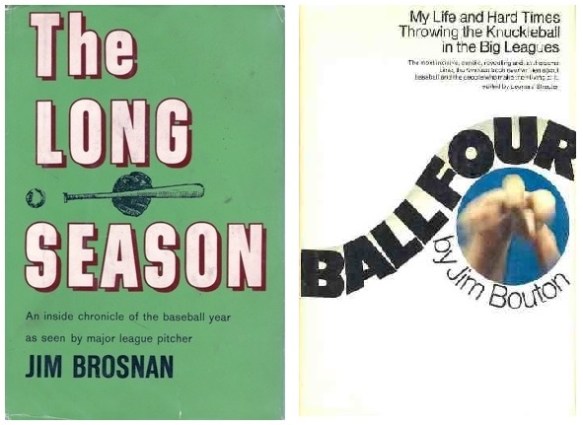
The books they said would subvert baseball. The game goes ever onward and the books never remain out of print. (So far.) Fifty years ago, Jim Bouton pitched his Ball Four season; ten years before that, Jim Brosnan pitched The Long Season.

The New York Public Library’s list of 20th century Books of the Century includes only one book pertaining to sports, Jim Bouton’s Ball Four. Yes, I was surprised, too, considering such volumes as Jim Brosnan’s The Long Season, anything by Roger Angell (one more time: he isn’t baseball’s Homer, Homer was ancient Greece’s Roger Angell), Roger Kahn’s The Boys of Summer, Bernard Malamud’s The Natural, Mark Harris’s Bang the Drum Slowly, and Arnold Hano’s A Day in the Bleachers, among others.

But there Bouton’s volume reposes, in a club to which also belong T.S. Eliot, James Joyce, William Faulkner, Virginia Woolf, Edith Wharton, Ralph Ellison, Jack Kerouac, John Dos Passos, Albert Camus, Agatha Christie, Grace Metalious, and Tom Wolfe. Before you retort that Bouton didn’t exactly write The Waste Land, Light in August, Invisible Man, On the Road, or The Bonfire of the Vanities, it’s only fair to say that Eliot, Faulkner, Ellison, Kerouac, and Wolfe never had to try sneaking a pitch past Carl Yastrzemski, Lou Brock, Harmon Killebrew, or Willie Mays, either.

Bouton was with the Astros when Ball Four was published in April 1970, after excerpts appeared in Look. To say it was received less than approvingly around baseball is to say Baltimore needed breathing treatments after the Mets flattened the Orioles four straight following a Game One loss in the 1969 World Series. “F@ck you, Shakespeare!” was Pete Rose’s review, hollered while Bouton had a rough relief outing against the Reds. All things to come considered, it was a wonder Rose knew Shakespeare wasn’t a brew served on tap at the ballpark.

This year is the fiftieth anniversary season of the one Bouton recorded for Ball Four and the sixtieth anniversary of the one animating Brosnan’s The Long Season. The books have their common ground and their distinctions, chief among the latter being that Bouton didn’t shy from detailing things even Brosnan, whose candor was considered jolting enough in its own time and place, didn’t dare to tread. If Brosnan even hinted at them, it was euphemistically. Bouton didn’t bother with euphemisms.

The two pitchers have something sadder in common, too. Brosnan suffered a stroke from which he was recovering when sepsis came manifest and caused his death in 2014 at 82, a year after his wife of 62 years died. Bouton, on the threshold of 80, suffered a stroke in 2012 that left him with cerebral amyloid angiopathy, a brain disease linked to dementia and compromised his ability to speak and write. Making it worse: the stroke occurred on the fifteenth anniversary of his daughter Laurie’s death in a New Jersey automobile accident.

Bouton’s wife, Paula Kurman, a speech therapist among other things (she has a Columbia University doctorate in interpersonal communications) who has worked with brain damaged children during her career, has worked with him carefully (“Together we make a whole person,” she once told a Society for American Baseball Research panel, to laughter that was sad as much as approving) and he has regained much of his speaking ability.

But he continues to struggle with what Kurman told Tyler Kepner of the New York Times was “a pothole syndrome: Things will seem smooth, his wit and vocabulary intact, and then there will be a sudden, unforeseen gap in his reasoning, or a concept he cannot quite grasp.”

Brosnan’s book was seeded two years before The Long Season‘s focus when he bumped into Sports Illustrated editor Bob Boyle. Having heard the bespectacled reliever had ideas about writing a book about major league baseball, Boyle suggested an article first “if something significant happens.” Brosnan turned in an essay about his trade from the Cubs to the Cardinals for veteran shortstop Alvin Dark, a trade one reporter described as the Cubs committing theft by trading “a mutt for a pedigreed pooch.”

“Loved it,” Boyle told Brosnan. “Why don’t you write a book about a whole season?” Two years later, that’s exactly what Brosnan did. He praised and needled in the same arch but honest tone, even if he did sanitize much of the vocabulary of the locker room or the dugout, as Bouton wouldn’t need to do a decade later. He showed the better and lesser sides of several players, but even his needles seemed not to come from malice aforethought.

Bouton was approached to do what became Ball Four by iconoclastic sports writer/editor Leonard Shecter, who’d previously written an in-depth profile of Bouton for Sport. Shecter proposed an in-season diary somewhat along Brosnan’s lines. “Funny you should mention that,” Bouton replied. “I’ve been taking notes.” During the 1969 season, Bouton would observe of his teammates, “My note-taking is beginning to make the natives restless.”

Brosnan offered no sense of wanting any kind of revenge for any kind of slight, in an era when players were too often slighted under a system that kept them, in essence, indentured servants. (One reviewer for the St. Louis Post-Dispatch wrote that Brosnan’s “pot shots,” such as they were, didn’t enrage fellow players “because ballplayers didn’t read; it was so out of character, or so he said.”) Bouton was often accused of trying to settle scores, particularly about the Yankees, his former team about whom he wrote and spoke extensively enough when the occasion suggested it. All Brosnan and Bouton did was try to show baseball and its players, coaches, managers, and administrators, as a too-human game played and run with too-human foibles, follies, and fantasias alike.

The devil was really in the details and even the language in Ball Four, from neither of which Bouton shied a single step. But both pitchers were accused of a kind of insider trading for fun and profit. “Brosnan has his say about many who may have, in times past, had their say about him,” wrote Bill Veeck of The Long Season, at a time Veeck still owned the White Sox. “This just doesn’t seem to come off so well, and tends to lessen the impact and enjoyment of his undeniably colorful material.” Presumably, Veeck took his own critique to heart when writing his own Veeck—as in Wreck, which did for baseball executives’ memoiring what Brosnan and later Bouton did for players’, and what Veeck did even further with his subsequent The Hustler’s Handbook.

“As an active player on a big-league team I had seemingly taken undue advantage by recording an insider’s viewpoint on what some professional baseball players were really like,” Brosnan wrote, after The Long Season and Pennant Race (his followup, about the 1961 Reds’ unexpected National League pennant winner) were republished on the latter’s season’s fortieth anniversary. “I had, moreover, violated the idolatrous image of big leaguers who had been previously portrayed as models of modesty, loyalty and sobriety — i.e., what they were really not like. Finally, I had actually written the book by myself, thus trampling upon the tradition that a player should hire a sportswriter to do the work. I was, on these accounts, a sneak and a snob and a scab.”

Bouton got the chance to address the hoopla around Ball Four in a followup book, I’m Glad You Didn’t Take it Personally (its jacket featured a baseball with a blackened eye drawn onto the hide) which was just as funny as Ball Four and sometimes a lot more poignant.  “I think it’s possible,” he wrote, “that you can view people as heroes and at the same time understand that they are people, too, imperfect, narrow sometimes, even not very good at what they do. I didn’t smash any heroes or ruin the game for anybody. You want heroes, you can have them. Heroes exist in the mind, anyway.”

Or, out of their minds, if you ponder one reaction to Ball Four. Before the Astros farmed Bouton out in 1970, Bouton discovered a burned copy of the book on the steps of the dugout, courtesy of the Padres. Even Brosnan’s and Veeck’s books avoided that kind of grotesquery.

The worst to happen to Brosnan after The Long Season and Pennant Race, not to mention other essays published in several other magazines, was the White Sox (to whom Brosnan was traded early in the 1963 season, long after Veeck sold the team) inserting a clause in his proposed 1964 contract barring him from writing for publication without prior team approval. Refusing to sign a contract with a clause like that in it, Brosnan retired after no other team took even a flyer on him, despite both Sports Illustrated and The Sporting News taking his side.

Bouton was either reviled as “a social leper” or a cancer on the game for having written and published Ball Four. Commissioner Bowie Kuhn actually tried to suppress the book, hauling Bouton into his office, demanding Bouton sign a statement saying it was all the pernicious work of his editor Shecter. Bouton probably had to restrain himself from telling Kuhn where to shove the statement when he wasn’t trying to restrain himself from laughing.

It was Dick Young of the New York Daily News who described Bouton as a social leper for writing Ball Four. When he ran into Bouton on an Astros visit to Shea Stadium, he said hello and, when Bouton needled him for talking to social lepers, Young replied, “Well, I’m glad you didn’t take it personally.” That reply gave Bouton the title of his followup book, in which he credited such overreactions in the sports press for doing almost the most to ensure Ball Four a best seller.

Both pitchers were witty, literate, and not even close to being thoroughgoing jocks. Brosnan made his way as a competent if mostly unspectacular relief pitcher and spot starter with a strong slider who had his moments. Bouton was a promising, hard throwing Yankee starting star, with a live fastball and a hard curve ball, until two seasons of overwork (1963 and 1964, and a whopping 520.2 innings over the two) left him with arm and shoulder trouble (it began a third of the way through 1964) that reduced him to marginal relief work and prompted him to make the knuckleball, which he’d thrown only as a change of pace previously, his bread and butter pitch.

Brosnan kept so many books in his locker that his 1961 Reds teammate, Hall of Famer Frank Robinson, nicknamed him the Professor. Bouton was no less literate or cerebral, though he may not have had a locker library equal to Brosnan’s, but his early ferocity as a competitor (he was once famous for his cap falling off his head as he delivered) inspired New York Post writer Maury Allen to nickname him Bulldog.

But Bouton may have put baseball into perspective even more than Brosnan did. Both pitchers were very aware of the worlds around them, and both wrote about the periodic spells of boredom, racial tensions, off-field skirt chasings, and self-doubts endemic in their professional baseball lives. Brosnan saved them for his books and articles; Bouton was less reluctant to speak his mind about things like politics, Vietnam, and civil rights when asked or when a conversation left him the opening.

Bouton bought even less into the still-lingering press representations of athletes as heroes. Teammates didn’t always hold with that or other things, like calling them out on it when they made mistakes that cost the Yankees games he pitched.

“After two or three years of playing with guys like [Mickey] Mantle and [Roger] Maris,” he wrote in I’m Glad You Didn’t Take It Personally, “I was no longer awed. I started to look at those guys as people and I didn’t like what I saw. They were fine as baseball heroes. As men they were not quite so successful. At the same time I guess I started to rub a lot of people the wrong way. Instead of being a funny rookie, I was a veteran wise guy. I reached the point where I would argue to support my opinion and that didn’t go down too well either.”

“He stands out,” Shecter wrote of Bouton in Sport, “because he is a decent young man in a game which does not recognize decency as valuable.” Much the same thing was said of Brosnan no matter what particular writers did or didn’t think of his two books.

Brosnan’s post baseball life including writing, advertising work (he’d done it in the offseasons of his pitching career), occasional sportscasting, and raising his family in the same Illinois home he bought with his wife, Anne, in 1956. (When they married, one local story’s headline, referencing his wife’s maiden name, said, “Pitcher Marries Pitcher.”)

Bouton became a sports anchor for New York ABC and then CBS before trying a baseball comeback in the White Sox system and then with the independent (some say notorious) Portland Mavericks, a comeback that ended with getting five starts for the Braves in late 1978. In one of those starts, Bouton squared off against Astros legend J.R. Richard, on the same night Richard broke the National League single-season strikeout record for righthanders, and pitched Richard to a draw. “The young flamethrower against the old junkballer,” Bouton wrote of the game.

A concoction Bouton and Mavericks teammate Rob Nelson invented in the bullpen, shredding gum into strands similar to chewing tobacco, became a hit as Big League Chew when they sold the idea to Wrigley. Bouton also continued writing, became a motivational speaker, and survived the collapse of his first marriage to meet and marry Kurman, blending two families, becoming founders and leaders of a recreational baseball league playing by 19th century rules, and becoming competition ballroom dancers. The Renaissance Bulldog.

The Washington Post‘s distinguished literary critic Jonathan Yardley wrote of The Long Season that it was literature about “[a]n ordinary season — life as it’s really lived — rather than an extraordinary one.” You could say, then, that Pennant Race was literature about an extraordinary season lived and played by ordinary men, if you don’t count Frank Robinson. Ball Four, which ran more temperatures higher up scales than Brosnan could claim, could be called an ordinary season lived and played by ordinary men. Recorded by a man whose extraordinary side was eroded by injuries.

Bouton may have hit the true key as to why all three books also unnerved baseball and its assorted establishments. “If Mickey Mantle had written Ball Four,” he later remembered, “it wouldn’t have been a big deal. A marginal relief pitcher on the Seattle Pilots had no business writing a book.” Likewise, if Robinson or Stan Musial had written The Long Season (Brosnan began 1959 with the Cardinals but was traded to the Reds midway) instead of a middle relief pitcher, it might not have proven a big deal.

Brosnan’s and Bouton’s books became baseball classics (as did Veeck—as in Wreck), and Ball Four also helped further expose the abuses heaped on players by front offices before the end of the reserve clause but probably caused no few of its younger readers to become sports journalists themselves. One suspects even now that Bouton’s revelations about the one-sided contract negotiations to which reserve era players were subject might have infuriated the purists more than his revelations about players’ sex drives, amphetamine indulgences, pranks, and feuds did.

Whenever one of Bouton’s former Ball Four-season teammates goes to his reward, Bouton is genuinely saddened. “I think he came, over the years, to love them,” Kurman told Kepner. “As each one died, he got really teary about it. He realized how deeply they were part of him.” (The Pilots, of course, were sold and moved to Milwaukee for the 1970 season, becoming the Brewers. Writing in Ball Four Plus Ball Five, a tenth-anniversary update, Bouton said, “The old Pilots are a ghost team, doomed forever to circumnavigate the globe in the pages of a book.”)

The Long Season remains “a cocky book, caustic and candid and, in a way, courageous, for Brosnan calls him like he sees them, doesn’t hesitate to name names, and employs ridicule like a stiletto,” as wrote Red Smith, arguably the best baseball writer in New York (then with the Herald-Tribune).

Ball Four‘s true success, wrote Roger Angell himself, “is Mr. Bouton himself, as a day-to-day observer, hard thinker, marvellous listener, comical critic, angry victim, and unabashed lover of a sport. What he has given us is a rare view of a highly complex public profession seen from the innermost side, along with an ironic and courageous mind. And, very likely, the funniest book of the year.”

And in the long, long, long wake of Brosnan’s and Bouton’s books, baseball hasn’t collapsed, the world hasn’t imploded, that Star Spangled Banner yet waves, and men and women of note or fame can be considered in all their human flaws, foibles, and fantasias, without being seen where appropriate as any less than heroes.

For openers, MadBum may be lucky

2019-02-10 MadisonBumgarner

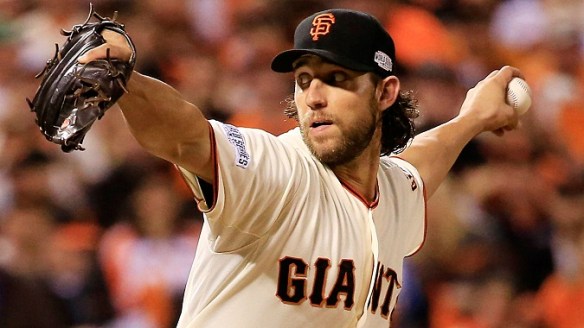
The idea of an opener makes him a very MadBum . . .

Of everything you can say about Madison Bumgarner, dumb isn’t one of them. (Even accounting for the dirt bike accident that took him out for long enough in 2017.) He’s not dumb on the mound, he’s not dumb otherwise.

But then, after new Giants general manager Farhan Zaidi pondered the possibility of some pitchers as openers, at the Giants’ FanFest Saturday, Bumgarner texted manager Bruce Bochy to say, “If you use an opener in my game I’m walking right out of the ballpark,” a text Bochy disclosed to NBC Sports’s Alex Pavlvic.

Time was when a show of defiance such as Bumgarner’s would have gotten him dispatched post haste, on the first rail the Giants could find for him, and never mind that Bochy would probably sooner be tempted to insert himself into the game as a pinch hitter than even think about either using Bumgarner as an opener or bringing him in after an opener’s first and only inning. And if you think I’m writing through my chapeau, you don’t remember Ted Simmons.

Simmons was the Cardinals’ number one catcher in the 1970s and early 1980s, before the Cardinals became winners again and during a long strange drought of their own, a drought Simmons had little enough to do with when it came to the front office’s doings or undoings but enough to do with on the field.

He was a terrific hitter in St. Louis and went to six All-Star teams as a Cardinal. He also came close to being what Dodgers pitcher Andy Messersmith did become, the man who might have forced the end of the reserve era. Simmons refused to sign for 1972 unless he got $30,000 for the season, slightly over twice his 1971 salary. Then-Cardinals GM Bing Devine refused to go past $20,000, thinking Simmons was asking too much, too soon. And he started playing the season without signing, the first time that had ever happened in the majors.

He went on a tear, too; by mid-season, his batting average was .340. And it had the unlikely effect of shifting sympathy away from the Cardinals, especially when Simmons was named to his first All-Star team. The morning of the All-Star Game, Devine called him at his hotel inviting him to the GM’s room to talk. This time, Devine offered him the $30,000 he sought for that season and $75,000 for 1973.

Simmons’s jaw dropped. He called his wife and told her about the two-year deal, with more money than even he imagined coming so swiftly, and elected to sign. And he’d inadvertently showed a rupture in the armour of the Lords of Baseball; they’d rather give a second-year catcher $105,000 over two years than risk any reserve clause test, which they feared Simmons might think about, kid though he was, the longer he played unsigned.

So Simmons wouldn’t be the man to break the reserve clause. But as the seasons went on, his hitting kept him in the number one Cardinals catching job and his personal popularity in St. Louis became such that nobody except opposing teams saw his wounding flaw as a catcher: he had one of the weaker throwing arms in the game. The 3.65 ERA for the pitchers who threw to him speaks well enough of Simmons handling a pitching staff, but Simmons finished his career with enemy baserunners averaging thirty stolen bases a season against him; he had 130 lifetime errors and 62 percent of them were throwing errors.

Hall of Fame manager Whitey Herzog, unfortunately for Simmons, saw the whole picture when he took over as the Cardinals’ manager in 1980. In You’re Missin’ a Great Game, the White Rat wrote:

Ted hit the ball like a sonofagun but when I watched him play, I didn’t see a motor that drove the Cardinals’ boat. He was more like a leak in their hull. Ted Simmons, God bless him, was a fine person who played hard and cared about winning . . . Unfortunately for the Cardinals organisation, that [poor arm strength] was a bigger disaster than anybody around me seemed to realise . . . [I]t’s just as important to stop the other guy from scoring a run as it is to get one home yourself. And your catcher is your most important guy in shutting chances down . . .

Because Ted threw so poorly to second, every team in the world knew they could swipe that base in the late innings. They knew that if they were behind they’d eventually get their . . . shots to score . . . I doubt five fans could have told you about this factor. Announcers never brought it up. It wouldn’t even show up in the [newspaper] box scores. But every manager worth his spikes was clued in. You’d be amazed—amazed—how many games that cost the Cardinals . . . By the standards everybody still uses today, [Simmons] was a star. But again: Everybody doesn’t know baseball. Too many fans, media, and even baseball people get sidetracked by factors that just don’t bear on the big picture. In the Simmons era, the Cards had never finished first.

Herzog first thought about moving Simmons to a position where his weak throwing arm wouldn’t hurt the Cardinals, and Simmons had actually been a better defensive fielder/thrower whenever he played first base, which was often enough to that point. (He’d played 195 games at first as a Cardinal.) The problem was when Herzog or someone made the suggestion. First, Simmons liked the idea—until he didn’t, thinking that first base incumbent Keith Hernandez might be hurt if converted to a left fielder, and asked for a trade.

Wearing both the manager’s and the general manager’s hats, and having also signed free agent catcher Darrell Porter to a five year deal, Herzog had to lose one or the other. Simmons’s arm issues and change in attitude, measured against Porter’s defensive superiority (Darrell’s strong throwing arm, good positioning, and quickness behind the plate shut down the leakage overnight, Herzog would write in due course), made the decision simple.

Herzog was at the beginning of a remake/remodel that would ultimately send 31 Cardinals out and bring in enough to make them World Series winners in 1982 and National League pennant winners in 1985 and 1987. Dealing Simmons, Pete Vukovich, and future Hall of Fame reliever Rollie Fingers (Herzog had just bagged the reliever he really wanted, future Hall of Famer Bruce Sutter) to the Brewers, and the deal helped set the Cardinals and the Brewers up as 1982 World Series opponents.

But he was roasted over trading the still-popular Simmons. “I didn’t want to make it,” the White Rat told The Sporting News. “I was forced to trade him . . . I couldn’t have both him and Porter as catchers. I didn’t have to trade him, but it would have led to a bad situation if he wasn’t happy . . . We’ve improved our defense. We’ve improved our team speed.”  And, in due course, also in You’re Missin’ a Great Game, he’d write of Simmons, “If the National League had had the designated hitter, the man would have gone to his coffin as a Cardinal.”

Herzog might well have kept Simmons if Simmons had accepted the idea of moving to first base, perhaps knowing Hernandez would have found adjusting to an outfield position simple enough. (Hernandez’s feud with Herzog wouldn’t happen until 1983, when Herzog shipped him to the Mets—jump starting their remodeling into a mid-1980s powerhouse.) But when Simmons took a stance that indicated himself instead of team first, Herzog didn’t flinch.

And the Giants shouldn’t.

I get Bumgarner’s alarm over the opener concept. My own take on it is that the opener concept can work—if you need a stopgap when a member of your starting rotation is down with an injury (as Bumgarner has been for parts of the past two seasons) and you don’t have another option to bring you through six or seven innings without throwing your rotation more than slightly out of whack. In that situation why not try a bullpen game?*

At best you win a game, depending on whether your hitters are better than the other guys’ pitchers on the day. At worst, you may lose a game but you don’t have to reshuffle your rotation just yet. And while I certainly get that any manager wants nothing more than to get the best of his pitchers without exhausting them into uselessness when you really need them the most (like down the stretch, or in the postseason), I don’t know that I want the opener to become more than the periodic stopgap I enunciated above.

Bumgarner could and should have found a better or at least less defiant way to express his distaste for the opener concept. He might have said, simply, that it isn’t as healthy for the game, not to mention such established or future starting pitchers as himself, as its supporters think, and those who think he’s too alarmist might have said so and initiated a vigorous but healthy debate. And since when is baseball allergic to vigorous and healthy debate?

But if the Giants decide not to find the nearest available rail on which to run Bumgarner out of town for the text he did send his manager, MadBum should thank God in whichever form the lefthander prays to Him that he’s built enough good will to get away with it.

And, for the fact that this isn’t 1980, and . . . well, try to imagine how Whitey Herzog—who’d have run through a hailstorm of artillery for his players otherwise**—would have answered a text like that.  “Bumgarner to the Mets for three live bodies and a box of balls . . . ” would not have been an unrealistic if slightly surprising headline.


* The bullpenning concept isn’t as recent or radical as you think. The St. Louis Browns actually tried it, first and at its possible greatest extreme, for the final game of a dismal 1949 season. (And weren’t most Browns seasons dismal, anyway?)

For the final game, against the White Sox in St. Louis, Browns starting pitcher Ned Garver pitched the first. Then a different Browns pitcher—including their entire starting rotation otherwise—pitched an inning each: following Garver, it was Joe Ostrowski, Cliff Fannin, Tom Ferrick, Karl Drews, Bill Kennedy, Al Papai, Red Embree, and Dick Starr. The Browns’ pitching that day surrendered four runs only one of which was earned. Kennedy was tagged with the loss after surrendering three in the sixth. The White Sox won, 4-3.

And Garver eventually revealed it was the brainchild of the Browns’ players; considering they’d already lost 100 games, they probably felt they had nothing to lose by trying something out of the left field bullpen.

Not to worry, Garver didn’t have to wait long before making his own kind of baseball history: after the 1951 season, during which he was a 20-game winner for the last-place Browns, Garver would be part of the most unheard-of Most Valuable Player Award vote in the game’s history to that point: he, Hall of Fame Yankee catcher Yogi Berra, and Yankee pitcher Allie Reynolds tied three ways for first-place MVP votes. (Berra won the award by way of earning more votes down the ballot than Garver and Reynolds, the first of Yogi’s three MVPs.)

** Anyone who says a team just can’t remake/remodel itself without downright tanking ought to take a very close look at how Whitey Herzog remade/remodeled the Cardinals into a World Series champion in just one sixteen-month period between 1980 and 1982.