Unknown's avatar

About Jeff Kallman

Member, Internet Baseball Writers Association of America and the Society for American Baseball Research.

9 (runs) 11 (hits)

2019-09-11 MetsCleats

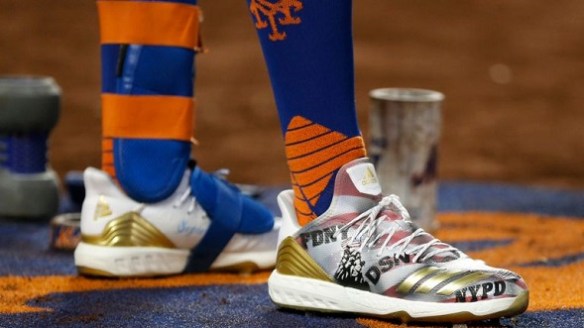
The commemorative cleats the Mets wore at Pete Alonso’s instigation Wednesday night (shown on the feet of J.D. Davis); Alonso didn’t tell anyone outside the team what he was up to, and good for him.

The voices of the Mets’ broadcast team—Gary Cohen and 1986 Mets alumni Keith Hernandez and Ron Darling—wavered emotionally as they spoke of the 9/11 atrocity eighteen years earlier. Cohen then acknowledged the “awkward transition” from commemorating the atrocity to address the baseball game about to be at hand.

Assorted New York first responders lined up along the foul lines with Mets and Diamondbacks players for a playing of “The Star Spangled Banner” before the game. The Mets found a way to defy baseball government’s arbitrariness and wore specially made commemorative cleats, instigated by their Rookie of the Year candidate Pete Alonso.

The cleats featured American flag striping, the initials of first responder agencies, a small image of New York firefighters raising an American flag at Ground Zero, and a silhouette of the Twin Towers. (All teams playing Wednesday night wore commemorative 9/11 ribbons on the right sides of their game caps.) Alonso paid for every pair of the special cleats himself.

He cooked up the plot knowing the commissioner’s office has refused to let the Mets wear first-responder hats in commemoration for every home game played on 11 September. So he did the next best thing. He gathered his teammates’ and manager’s and coaches’ shoe sizes, arranged for the special cleats to be made, and kept his trap shut to MLB.

“I feel like if Major League Baseball kind of got their hands on it, it may not have been approved,” said the first baseman who handed $50,000 of his Home Run Derby prize money to the 9/11-related Tunnel to Towers Foundation. “But I’m really happy that we kind of banded together here in the clubhouse and made something cool happen.”

Those who remember when baseball returned following the mourning period over the World Trade Center atrocity remembered the Mets’ homecoming in long-gone Shea Stadium, after baseball took a break to mourn. They remembered the visiting Braves embracing the Mets pre-game in empathetic grief, and the Mets wearing first-responder police and fire department hats during the game for the first and, thanks to commisioner’s office edict, last time in a live game.

They remember especially the bottom of the eighth that night, with the Mets down 2-1, when Hall of Famer Mike Piazza electrified the stadium, the television audience, and the country with a mammoth two-run homer that flew right into a television camera posted on a special scaffolding behind the center field fence, and put the Mets up 3-2 to stay while Piazza was at it. That bomb just so happens to be the last entry on Piazza’s Hall of Fame plaque.

Then, after all the pre-game commemoration Wednesday night, this edition of Mets—who’ve seemed like crisis junkies one minute and hell on wheels the next, and who’ve managed despite some recent hiccups, bleeps, and blunders to stay within two of the National League’s second wild card—did something even more extraterrestrial than Piazza’s 2001 surrealism.

They shut the Diamondbacks out with . . . nine runs on eleven hits.

Who says the baseball gods in the Elysian Fields watching over Citi Field didn’t know something about doing atrocity victims and their families anniversary honour?

The Mets shook off Diamondbacks left fielder Tim Locastro’s seeming habit of trying to take one for the team, positioning his way into a first-pitch plunk from Mets starter Steven Matz in the first, chased Diamondbacks starter Robbie Ray with a five-run first. The fun only began when Ray thought back-to-back sliders to open against Mets shortstop Amed Rosario was a clever idea but Rosario thought it was even more clever to yank the second down the left field line for a leadoff double.

A strikeout (to Alonso) later, Mets second baseman Jeff McNeil took a first pitch plunk for the team, and—with Ray starting Mets catcher Wilson Ramos with yet another breaking ball—Rosario and McNeil pulled off a nifty double steal with no throw coming up from the plate to set up second and third.

Ramos nudged Rosario home with a bounce out to second and the train kept a-rollin’ when left fielder J.D. Davis shot an 0-2 single on a high line to left that Locastro could have speared on the fly but for an inexplicable hesitation and resulting short hop, scoring McNeil.

Third baseman Todd Frazier shifted the local to the express when he drove Ray’s dangling curve ball into the left center field seats, with Brandon Nimmo—playing right for the Mets, and having missed most of the season on the injured list—busting a speed limit on the rail by hitting Ray’s next pitch into the right center field bullpen. Nimmo ran it out fast enough to tempt you to put him up in a race with the Lexington Avenue Express.

Center fielder Juan Lagares finally ended Ray’s extremely brief evening mercifully with a followup double to the right center field fence before Matt Andriese relieved Ray, shook off a wild pitch, and struck Matz out for the side. Matz himself would cruise for the most part through six innings, other than walking the bases loaded in the top of the second with nobody out, before he ended the prospective disaster with a strikeout and an inning-ending step-and-throw double play.

He was aided and abetted by McNeil hitting a first-pitch, two-out bomb off Arizona reliever Taylor Clarke in the second, Frazier abusing Clarke with a first-pitch, one-out bomb in the third, and—with Alonso aboard and two out—McNeil abusing another Snakes reliever, Yoshihisa Hirano, for (you guessed it) a first-pitch, two-out, two-run bomb.

Led by Alonso’s 47 and Michael Conforto’s 29, Frazier and McNeil hitting their 20th each gave the Mets four 20+ home run hitters in a season for the fourth time in their franchise history. Even in the year of the apparent juiced ball that’s a remarkable achievement.

And the Mets’ too-often-dicey bullpen kept the Diamondbacks from getting past second base the rest of the way. Jeurys Familia had to shake away first and second and two outs to nail pinch hitter Abraham Almonte with a seventh inning-ending ground out to first, and Taylor Bashlor had to shake away first and second and one out in the ninth before he got Jarrod Dyson to fly out to right and pinch hitter Ildemaro Vargas to ground out on the first pitch to end it.

In between those two, Paul Sewald, a veteran but inconsistent at best, got two swift fly outs and a strikeout to make the eighth look like the invisible inning.

It was Ray’s shortest start ever and the shortest for the Diamondbacks since T.J. McFarland got battered for seven Twins runs with only one out on 20 August 2017.

And it almost took a complete back seat to Alonso’s rather daring end-run around MLB’s strictures against commemorating certain tragedies with on-field, in-game apparel. Baseball government elected not to fine the Mets for the gambit. How big of it.

“It just comes from a place where I want to show support to not just the victims but the family members as well because no one really knows how deep those emotional scars can be,” Alonso told reporters. “I just want to show recognition to all the people who are heroes–just ordinary people that felt a sense of urgency and an admirable call of duty. This is for all those people who lost their lives and all of those people who did so much to help.”

Even the Mets know it can never be enough, truly. Not even on nights they defy a capricious commissioner’s office and logic alike, or honour the victims of a terrorist atrocity and their survivors, with nine runs on eleven hits.

Onward, Christian’s soldiers?

2019-09-11 ChristianYelich

Christian Yelich hits the deck after his foul-off fractured his right knee cap and ended his season—and the Brewers’ postseason hopes, very likely.

Gut punch? For a night? How about a possible gut amputation? For the season?

The Brewers had enough trouble keeping up with the Cubs in the National League wild card competition, or on the edge of the NL Central race, without losing their and the league’s arguable best all-around player for the rest of the year.

And it’s worse when you lose him to a freak injury. But that’s what happened to Christian Yelich Tuesday night, against the Marlins, when he fouled one off his right kneecap in the top of the first, dropping at once, in a game the Brewers went on to win, 4-3. He whacked the ball hard enough for it to fracture the cap.

Without him, the Brewers might as well be kneecapped.

“This is a guy who has carried us in a number of ways the last two years,” said general manager David Stearns after the game ended. “He could have been two and a half weeks away from a repeat most valuable player award. I think that’s where our thoughts go first. From a team perspective, we have a lot of guys in the clubhouse who will hurt tonight. This is a gut punch for a night.”

When you lose a player whose 7.7 wins above a replacement-level player are four full ahead of the next man on the team list (pitcher Brandon Workman) and 4.4 ahead of the next position player on the list (third baseman Mike Moustakas), and whose own WAR account for a third of the entire roster’s total WAR, it’s not just a one-night gut punch.

When you lose a man whose 2018 breakout was questioned as a fluke, until he raised his slugging percentage 74 points over last year’s and carried a Brewer offense that went backward when it wasn’t being injured otherwise, it’s not just a one-night gut punch.

When you lose a man with a .736 real batting average (total bases + walks + intentional walks + sacrifices divided by plate appearances) who’s leading the Show in total bases, slugging, OPS, and runs created, it’s not just a one-night gut punch.

(And did I mention that Yelich has a 94 percent stolen base percentage and a 53 percent rate of taking extra bases on followup batted balls?)

When you lose a player like that who takes as much of the sting as Yelich took out of the Brewers being 22nd in the National League in runs scoring off runners in scoring position—while Yelich himself posted a .327/.462/.693 slash line with runners in scoring position and a .384/.460/.791 slash line in high-leverage situations—it’s not just a one-night gut punch.

It’s practically the end of their season as the Brewers knew it. And they seemed to know it, for all their pull-it-together talk about moving forward regardless. Barring any heretofore unseen eruptions from anywhere else in the lineup or off the bench, the Brewers don’t have enough depth (and certainly not the pitching) to withstand a loss like this.

Think of the NL West-clinching Dodgers losing Cody Bellinger with three weeks of regular season yet to play. Or the first wild card-owning Nationals losing Anthony Rendon. (And they might, not to the injured list but to free agency after this season.) Think of the NL East-owning Braves losing Ronald Acuna, Jr. or the resurgent Josh Donaldson. Think of the American League West-owning Astros losing Alex Bregman. Those teams have the depth to survive.

The Brewers may even have to ask the question they surely don’t want to ask yet: Yelich will recover from this injury, but will it prove to be the injury that turns him from a difference-maker and team carrier to just another guy in the lineup who might yet be above average but won’t be the guy the other guys don’t even want to think about anymore?

“To get that kind of news during the game, guys were down in the dugout,” said center fielder Lorenzo Cain, who’s also fought injuries this year but isn’t the player he was during those prime Kansas City seasons, after Tuesday’s game. “We’re going to miss him. Those are big shoes to fill and it’s going to be hard to replace him.”

It may be even harder for Yelich to come to replace the Yelich that’s been.


Anatomy of an execution

2019-09-09 DaveDombrowskiDavidOrtiz

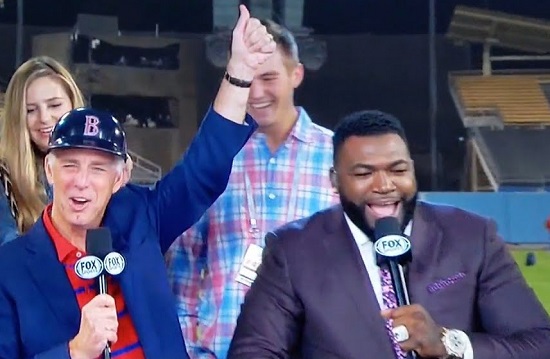
Just shy of eleven months ago, Dave Dombrowski wore a Red Sox helmet and let former Red Sox superstar David Ortiz interview him right after the Red Sox nailed a World Series. After midnight last night, Dombrowski went to the Red Sox guillotine.

Watch and ponder a 10-5, home run heavy Red Sox loss to the Yankees on national television Sunday night. Awaken Monday morning to discover the Red Sox threw out the first president of the season just after midnight. Down the stretch. With the Red Sox down to little if any hope of really defending their 2018 World Series championship.

Every once in awhile not even a World Series appearance or conquest is enough to save someone’s baseball job. It wasn’t for Dave Dombrowski. The GM-made-president of baseball operations, who finished what his predecessor Ben Cherington started and steered the Red Sox back to the Promised Land for the fourth time since the 21st Century began, is finished.

And the questions include the price the Olde Towne Team will pay for last year’s conquest. Dombrowski spent big with dollars and with prospects to make last year’s triumph happen. Now the Red Sox farm system is parched, and a lot of the dollars that finished constructing last year’s conquerors could prove a prison as much as a parade.

Forgotten at times during last year’s triumph was that Cherington built the core of the team. Dombrowski took the bows with everyone else after the Red Sox finished stunning the Dodgers last fall but all he did was finish what Cherington started. And everyone who remembered Dombrowski’s years of trying but failing to get the Tigers to the Promised Land and mortgaging the farm several times couldn’t resist asking how long before Dombrowski’s accomplishment with the Red Sox would endure before he’d be nudged out of Boston, too.

It’s unfair to Dombrowski in a few ways, of course. But running a team whose in-house culture is win/win-now/keep-us-winning isn’t simple business. And men who mortgage the farm on its behalf often have lower survival rates than men who know how to remake/remodel without tanking or without letting the farm become a dust bowl.

Cherington got four years. Dombrowski didn’t survive a fourth. Both were hired seemingly out of nowhere. Except that for one of them, “nowhere” was right under the Red Sox’s noses. Cherington was part of the Red Sox baseball operations offices since 1999 and built himself a solid player development background when he was hired to succeed Theo Epstein in 2011.

Cherington’s first order of serious business, alas, was to take it like a manperson when the powers above made him look like a fool after the infamous 2011 Red Sox collapse. He’d promised numerous players that whomever would take the bridge, after Terry Francona quit before he could be fired, it wouldn’t be the rumoured Bobby Valentine. The powers above hired Valentine (specifically, it may have been Larry Lucchino’s call); Cherington’s choice was almost anyone but. (Actually, at the time, it was Dale Sveum.)

Poor Cherington. He found himself having to keep his back door open to help one after another Red Sox player keep his marble (singular) during the Valentine nightmare. Then, he executed the daring August 2012 trade that sent the Dodgers Josh Beckett, Adrian Gonzalez, and Carl Crawford and concurrently blew open a small tonnage of financial headroom while giving himself the space to hatch and execute a post-Valentine plan.

Cherington spent the 2012-13 offseason buying or dealing for a group of more than useful availables and spare parts—Mike Napoli, Jonny Gomes, Shane Victorino, David Ross, Stephen Drew, Brock Holt, and (especially) sleeper reliever Koji Uehara—and bringing home former Sox pitching coach John Farrell to take the bridge and dissipate the Valentine toxins.

That effort, plus the returns to health of such key men as John Lackey, often-injured (and oft-unfairly alienated) Jacoby Ellsbury, and especially future Hall of Famer David Ortiz, got the Red Sox 2013 World Series rings for Cherington’s efforts. It also got Cherington named as the third Red Sox executive ever named by The Sporting News as Executive of the Year.

Concurrently, he devised and executed a longer-range plan that rebuilt the Red Sox farm without even thinking about tanking, which is never an option for a team whose owner John Henry learned what not to do and how not to do it watching the similarly win-now-or-be-gone thinking of the late Yankee owner George Steinbrenner.

Mookie Betts, Xander Bogaerts, Rafael Devers, Andrew Benintendi, Eduardo Rodriguez, and apparently defense-first Jackie Bradley, Jr.—all of whom factored large enough in last year’s conquest—were Cherington’s handiwork, either by in-house development or trade such as the deal that brought Rodriguez to the Red Sox in late 2014.

Where the earnest Cherington mis-stepped was with some of his subsequent free agency signings, including Pablo Sandoval, Hanley Ramirez, A.J. Pierzynski, and Grady Sizemore. When the Red Sox executed him in favour of Dombrowski, Cherington still left them a solid nucleus that didn’t go unnoticed by the incoming Dombrowski.

It didn’t take Dombrowski long to sign such nuggets as David Price and Craig Kimbrel, and watch as the Red Sox went from last to first in the 2016 American League East, though they were shoved out of the postseason by the eventual pennant-winning Indians. Dombrowski traded for Chris Sale, signed Mitch Moreland, and basked in the 2017 AL East title despite another postseason exit short of the Promised Land.

Then he answered Farrell’s apparently losing his clubhouse at last by canning Farrell and hiring Astros bench coach Alex Cora—while the Astros were still advancing toward their 2017 World Series conquest. And Cora let his new players know immediately how they fell short enough: “You guys were easy to game plan against. Too many bad takes [at the plate].”

Dombrowski also landed J.D. Martinez at almost the eleventh hour of last year’s spring training, then watched Benintendi, Bogaerts, Devers, and Betts especially come into their own, Betts almost running away with last year’s American League Most Valuable Player award. Marry that to Price and Sale shaking away whatever problems they might have had otherwise, and the Red Sox turned the 2018 postseason into a thrill that climaxed when Sale struck out the side to end the World Series hoisting the trophy in Dodger Stadium.

Except that there were a few serious cracks in the structure Dombrowski finished atop Cherington’s foundation:

* Almost typical of a Dombrowski administration, the Red Sox didn’t just empty the farm, they took a torch to it. Assorted observers say the farm’s being rebuilt little by little, though.

* Dombrowski ignored the Red Sox bullpen almost entirely both last offseason and approaching this year’s new single mid-season trade deadline. Some say it’s outperformed its expectations this year; others say it became taxed too heavily as one after another Red Sox starter faltered for assorted reasons—especially after they were barely worked in spring training and looked like spring-training pitchers in April.

* Betts has one more season coming under Red Sox control and, unless something happens between now and October 2020 to constitute an offer he can’t refuse, it looks as though he’s going to play the market for the first time then. The Red Sox may have ideas about trading him this winter, but if they go there they won’t get that solid a return for a one-year rental.

* Martinez is posting another magnificent season at the plate, but he has an opt-out clause he can exercise at season’s end and enough observing the Red Sox fear he’s liable to try playing hardball. For more money? For a longer commitment? Nobody knows just yet, but the Red Sox have to brace themselves for either.

* With Nathan Eovaldi, a postseason hero out of the bullpen last fall, missing too much time to injury this year and then having to shake away rust in a return to the rotation, it leaves the Red Sox with him, Sale, and Price as underperformers among the walking wounded and on long-term contracts while they’re at it.

In fact, Sale—who’s now done for the season thanks to pitching elbow inflammation—won’t even see his contract extension begin until 2020, but some argue Dombrowski signing him to that extension might have seeded Dombrowski’s end. Sale swore when signing that his shoulder troubles were behind him. Everyone wanted to believe it. Then his inconsistent 2019—brilliance here, battery there—ended prematurely when his elbow immolated. Uh-oh.

But there’ve been enough bright lights in Red Sox fatigues to make you confident they can win next year. Betts, Bogaerts, and Devers still make for a powerful threesome at the plate, though the Red Sox may want to think hard and start thinking now about keeping Betts in the family. Even if Henry wants to trim payroll up the street, he can’t afford to let his franchise player leave the family.

Benintendi shook away his first half inconsistencies and is having a magnificent second half, and he should be ready for a full season’s high-level production in 2020. Rodriguez is having a breakout season. Matt Barnes and Brandon Workman have become late-inning godsends out of the bullpen.

And rookie reliever Darwinzon Hernandez’s bullpen performance in his first 25 gigs (2.83 ERA; 2.17 fielding-independent pitching [FIP]; 17.0 K/9) in addition to his widely enough reported early maturity may mean the Red Sox’s late-game/ending-game wipeout option of the future is preparing for that future already, even if Cora isn’t anxious to smother the kid with hype.

But Jhoulys Chacin, whom the Red Sox signed after the Brewers parted ways with him late last month, has no such fear. In a perfect position to know, Chacin isn’t afraid to compare Hernandez to Josh Hader, the Brewers’ bullpen assassin. “He reminds me of Hader,” Chacin tells MassLive.com’s Christopher Smith. “He throws that raised fastball that some guys just can’t catch up.

“I’ve talked to him a lot since I’ve been here,” Chacin continued. “I want him to stay healthy and keep doing what he’s been doing. I played with Hader and to see his fastball just raise up, (Hernandez’s) fastball does pretty much the same, too. Like I said, he just needs to stay healthy and take his approach every day to the field and I think he can be a pretty good pitcher.”

It isn’t just Hernandez’s fastball. He’s developed a solid slider and has a curve ball with wipeout potential. Any way you look at him, Hernandez at 22 may hold the Red Sox bullpen’s future in his left hand.

The Red Sox won’t talk publicly about Dombrowski’s execution just yet. Give them credit, sort of, for doing it almost stealthily. The NFL’s New England Patriots hogged the weekend headlines, first signing controversial wide receiver Antoine Brown, after he wriggled his way out of Oakland, then blowing the Pittsburgh Steelers out 33-3 Sunday night to open their season. The Red Sox dropped the guillotine on Dombrowski almost noiselessly.

They left Cora to be the public face of the putsch. It’s not exactly Cora’s most comfortable position, as he made clear after Sunday night’s loss when he was told the blade sliced  through Dombrowski’s neck. “I’m surprised and shocked, obviously,” the manager said. “Right now, I don’t have too much to say. This is the guy that gave me a chance to come here and be a big-league manager. They just told me so I’m not ready to talk about it.”

Martinez and Rick Porcello have said they were all but blindsided over executing Dombrowski, to whom both players were close going back to their Detroit days. Porcello had enough on his plate apologising publicly to Red Sox fans for his, shall we say, modest performance this season, without losing a man he considered a friend.

“At the end of the day” the righthanded former Cy Young Award winner said, “we’re the players who are on the field and we’re the ones who can make or break a lot of things. Ultimately, the onus comes on us. I’m still processing everything. Processing myself, too. It’s really hard to reflect on it, too. I’ll have potentially a better answer for you in a couple days. You never like to see anybody lose their job over what we’re doing on the field.”

As peculiar as it might sound to read in print, the Yankees have had little but front office stability with Brian Cashman as their general manager since 1998—and only one World Series title to show since the turn of the century. The Red Sox have had five full-time general managers since 1998 (Dan Duquette, Mike Port, Epstein, Cherington, and Dombrowski)—and four World Series titles to show since the turn of the century.

A lot of teams would kill for the Red Sox’s 21st Century track record—four World Series rings in fifteen years—even with the extremes of maximum success and (thanks to three dead-last division finishes) maximum recess. And a lot of GMs or baseball ops presidents would kill for Dombrowski’s overall resume: two World Series rings (his other ring: the 1997 Marlins), two American League pennants (the Tigers), in a little over two decades.

But a lot of them wouldn’t turn the farm into the dust bowl to get there, either.

The Red Sox for now will be run by a trio of assistant GMs, Brian O’Halloran, Eddie Romero (the son of 1986 pennant-winning Red Sox spare part Ed Romero), and Zack Scott. Several reports say Romero among the three is most considered to be a full GM/baseball ops president in waiting. Maybe the Red Sox won’t wait too long to make it happen.

A real Saturday night special

2019-09-08 AaronBarrett

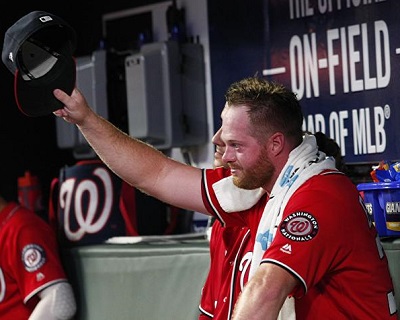
Eyes red after weeping for joy, Nationals reliever Aaron Barrett tips his cap from the dugout Saturday night.

Even down the stretch of the stretch, some things transcend ratings and standings. Aaron Barrett became one of them Saturday night.

When the Nationals righthander was sent out to pitch the bottom of the fifth, it may have been enough that he could be up for the assignment at all, never mind working a scoreless inning in a game that eventually became a ninth-straight Braves win.

And it wasn’t low leverage, either, despite the end of the Braves’s batting order looming. This wasn’t a mop-up assignment on either end of a ferocious blowout or to hold fort in a lost cause. Barrett relieved Nats starter Austin Voth with the Nats down a mere 2-1 and Ronald Acuna, Jr. looming as the third man scheduled to hit.

Maybe Barrett’s kind of comeback was the kind that moves a manager to trust his heart equal to trusting his stuff. It isn’t every major league pitcher who survives Tommy John surgery and a followup broken humerus bone to throw even one pitch, never mind a scoreless inning.

Barrett didn’t exactly start the gig the right way, walking Adeiny Hechevarria on four straight to open the inning. But he made sure Hechevarria was the only Braves runner of the frame. He got Braves starting pitcher Julio Teheran to foul out to first on 1-2. And then came Acuna, who was perfectly capable of spreading the Braves’ lead and the Nats’ concurrent miseries with a single swing.

The husky righthander with the doll-like face under his beard went right back to work. He caught Acuna looking at a strike one two-seam fastball on the upper inside corner. He got Acuna to swing right over a second two-seam fastball that hit the floor of the strike zone. He caught Acuna looking at a sweetly diving slider that landed smack dab on the low outside corner.

It was Barrett’s first major league punchout in 1,499 days, but the way he did it would leave a neurosurgeon envious of that kind of precision.

And when he got Ozzie Albies—who homered in the first—to loft a changeup to moderately short center field for the side, Barrett wiped tears from his eyes with the front of his Nats jersey as he stepped down from the mound toward the dugout. Where manager Dave Martinez and his grinning teammates high-fived and embraced him. Then Barrett took a seat, clutching the towel Martinez handed him, and wept unashamedly into that towel.

A three-run Atlanta sixth, including back-to-back homers by Brian McCann and Matt Joyce, still lurked ahead. So did a Nationals run scoring on a seventh-inning double play, and so did Juan Soto sending a two-run double to the back of center field in the eighth.

So, unfortunately, did the Nats falling ten games behind the Braves in the National League East with the 5-4 loss, while keeping a two-game grip on the league’s first wild card, while the Braves added to a 20-4 string since 11 August and a thirteenth straight home win, the Show’s most since the Indians did it in their pennant-winning 2016.

None of which really overthrew Barrett’s first major league inning in four years. “After the outing was over,” he managed to say after the game, “I’m just walking off and all the emotions just hit me. Just, ‘You did it, man. You did it’.”

He’d been one solid element of the 2014 Nats bullpen with a 2.66 ERA, a 2.59 fielding-independent pitching rate (FIP), a 10.8 strikeouts-per-nine rate, and 49 punchouts in 40 2/3 innings. But he had a rough seventh-inning appearance in Game Four of that year’s division series sweep at the Giants’ hands, walking the bases loaded, then wild-pitching tying run Joe Panik home with Pablo Sandoval at the plate.

He pitched in terrible luck in 2015: a 2.21 FIP against a 4.60 ERA in forty appearances before going down to Tommy John surgery. Then, in his first return, his humerus bone snapped hard enough that those who were there could hear it resemble a gunshot, according to MLB.com’s Nats beat writer Jamal Collier. Thomas Boswell of the Washington Post described it as “look[ing] like his elbow had ‘exploded’.”

Barrett subsequently began the long trek back up from the lowest minor leagues until his 2.75 ERA and 62 strikeouts in 52 1/3 innings at Harrisburg (AA) this year earned him the callup to the Nats. His wife, parents, in-laws, brothers, and physical therapist were at SunTrust Park Saturday. (Barrett lives just outside Atlanta itself.)

They plus thousands of Nats fans hope this is a comeback that sticks, that Barrett even at 31 continues his pitching career at all, never mind in the Show. They surely know others haven’t been that fortunate. Including one whose pitching arm humerus bone betrayed him likewise in 1988.

Dave Dravecky survived cancer in that bone to make a gutsy return to the Giants the following season, beating the Reds with an eight-inning performance. His very next start, against the Expos: the humerus broke while he delivered a pitch to Hall of Famer Tim Raines, sending Dravecky down in a tumbling heap. Season over.

During the subsequent on-field celebration when the Giants beat the Cubs in the 1989 National League Championship Series: arm broken again. X-rays showed the cancer came back as profoundly as Dravecky himself. Career over. Two years later: arm and shoulder amputated. He found a second career as a Christian motivational speaker and writer, often collaborating with his wife, Jan.

Things like that remind you to live in the moment and make it count for as long as you have the moment. Aaron Barrett plans to do just that. Even if he might have a Comeback Player of the Year award in his 2020 to come. With his spirit, don’t rule it out. “You dream about the moment,” Barrett told Collier. “You picture the moment, you try to visualize what it’s going to be like, and you know whatever moment or whatever happens, it’s unlike anything you envisioned.”

He may or may not have envisioned catching Ronald Acuna, Jr. with his pants down for strike three. But doing it only sweetened the rare soils from which Barrett hopes to continue emerging to stay.

How a Verlander Cy would make history

Houston Astros v Toronto Blue Jays

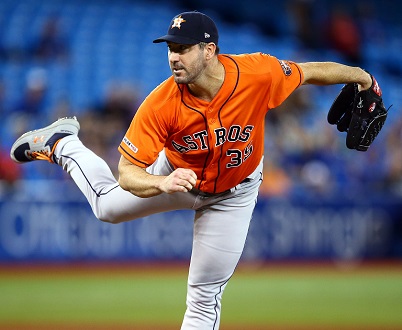
Justin Verlander during his no-hitter against the Blue Jays; if he wins this year’s AL Cy Young Award, he’ll make league history in another way . . .

Even I didn’t catch on and I was watching the game. But Justin Verlander’s no-hitter last Sunday could put him into the history books for reasons other than the no-hitter himself.

That’s because, according to Jayson Stark, five pitchers have thrown no-hitters in the same seasons in which they won Cy Young Awards and Verlander, in theory anyway, could become the sixth. But he’d still make history if he wins this year’s American League Cy—because no American League pitcher has yet won the Cy the same year they went no-no.

The previous five: Jake Arrieta (Cubs), Clayton Kershaw (Dodgers), Hall of Famer Roy Halladay (Phillies), Mike Scott (Astros), and Hall of Famer Sandy Koufax (Dodgers). National Leaguers all. And Koufax did it twice: in 1963, when he pitched the second of his four career no-hitters; and, in 1965, when his fourth proved that practise really makes perfect.

That’s not Verlander’s only shot at the history book this year. (If he does win, it would be his second Cy Young Award.) Suppose he and his rotation mate Gerrit Cole finish one and two in the American League Cy Young Award voting. (It could happen, folks.) According to Stark, it’d be the first time rotation mates ever finished 1-2 in the AL Cy Young vote.

And only one pair of starting rotation mates ever finished 1-2 in a Cy Young Award vote before. No, it wasn’t Koufax and Hall of Famer Don Drysdale. Good guess, though. Koufax won three Cys when it was still a major league award, not one in each league, and he won all three unanimously. Drysdale won it in 1962 even though it’s arguable that Cincinnati’s Bob Purkey probably should have won the award; Dean Chance (Angels) won the 1964 Cy but Koufax was posting a Cy-worth season when it ended after the baserunning injury that exposed his elbow arthritis at last.

It took until 2001 for rotation mates to finish 1-2 in a Cy Young Award vote: Hall of Famer Randy Johnson won the National League award, and should-be Hall of Famer Curt Schilling finished second. The Big Unit, of course, can’t complain since he won five Cy Young Awards including four straight; Schilling’s major Cy Young Award problem is having Cy-worth seasons when someone else was a) just a shade better or b) having a career year.

IF NO KOUFAX—Suppose Sandy Koufax wasn’t in the Show when he copped those three major league-awarded Cy Young Awards? Who would have won them in 1963, 1965, and 1966?

If you go by wins above a replacement-level player, and if Cy Young voters went by it in 1963 (yes, we’re theorising, since nobody thought about WAR back then), the winner would have been . . . Dick Ellsworth, the 23-year-old Cubs lefthander who just so happened to have his career year.

Ellsworth was credited with 22 wins, but he posted career-best full-season 2.11 earned run average (second in the National League to Koufax) and 2.68 fielding-independent pitching. Hall of Famer Juan Marichal won 25 games and had a sub-3.00 ERA for the first time in his career (2.42) and a solid 2.62 FIP.

So how did Ellsworth end up with more WAR than Marichal? Easy: Ellsworth pitched in maybe the National League’s most notorious hitters’ park for a notoriously lousy team still mired in its looney-tooney College of Coaches rotating managers experiment, and he really had to work for those 22 wins. (His ’63 ERA+ was a Show-leading 167.) Marichal’s team was better even though his Giants finished third in the league behind the pennant (and World Series) winning Dodgers and the second-place Cardinals.

Considering that Marichal was credited with 25 wins for a bona-fide pennant contender, it’s entirely possible that if Koufax hadn’t been in the league Marichal would have won the 1963 Cy Young Award. But Koufax was in the league and his ability to miss bats and avoid walks while leading a team to a pennant was just too overwhelming.

Koufax actually didn’t lead major league pitchers in WAR for 1965—Marichal did. So why did Koufax win his second Cy Young Award. Too easy: 26 wins and a fourth no-hitter in as many seasons, which was a perfect game in the bargain. Not to mention pitching the pennant clincher on two days’ rest at the end of a hammer-and-tongs pennant race between the Dodgers and the Giants. And breaking Hall of Famer Bob Feller’s single-season major league strikeout record (with 382) didn’t hurt, either.

But if you went by 1965 WAR Marichal had an MLB-leading 10.3 to Koufax’s fourth-in-Show 8.1. There were two guys in between Marichal and Koufax among the 1965 major league WAR-leading pitchers, both of whom were having their career years: Sam McDowell (Indians) and Jim Maloney (Reds), both of whom finished with 8.2 WAR. And McDowell was arguably better than Maloney that year: McDowell led the American League with a 2.18 ERA and a 2.08 FIP; Maloney’s were a few points higher than Sudden Sam’s.

In 1966, the Dodgers and the Giants went at it for a final time among those 1960s pennant races and this time Koufax led the Show with his 10.3 WAR. He also led with a) his fifth-straight league-leading ERA (1.73, which also led the Show for the third time), his sixth-straight Show-leading FIP (2.07), his fourth Show strikeout title (317), and a Show-leading 27 wins.

Marichal finished right behind Koufax with 9.1 WAR, and Hall of Famer Jim Bunning (Phillies) finished with 9.0. As a matter of fact, only one American League pitcher finished in the top ten Show WAR among the hurlers in ’66: Gary Peters (White Sox), with 5.3.

It’s really to mourn that Juan Marichal, the arguable best righthanded pitcher of the 1960s, never won a Cy Young Award, either the MLB version or the league version, but it wasn’t his fault that a) Sandy Koufax was his contemporary through 1966, and b) someone else not named Koufax had either a career year (Dean Chance, 1964; Mike McCormick, 1967), an extraterrestrial year (Hall of Famer Bob Gibson, 1968), or came into his own completely and to stay (Hall of Famer Tom Seaver, 1969) during several of Marichal’s best seasons.

WHITHER WHITEY?—You may have noticed Hall of Famer Whitey Ford missing from the above discourse. In 1963, the Yankee bellwether got credit for 24 wins while helping lead his Yankees to (what a surprise) the pennant. So why didn’t Ford get much of a Cy Young Award nod that year?

For one thing, Ford wasn’t quite as good as Koufax and Marichal at missing bats; he lived on the ground ball as well as generally avoiding walks. For another thing, Ford got slightly better run support per start than Koufax, Marichal, and Ellsworth did in 1963.

On the other hand, his 24 wins were the second and final time Ford was a 20+ game-winner. And both those seasons came following the Casey Stengel era. The legend about Stengel and Ford is generally true; the Ol’ Perfesser really did tend to save Ford for the Yankees’ best opponents if he could help it.

According to Jay Jaffe’s The Cooperstown Casebook, a researcher named Jason Brannon discovered that Ford made forty percent more starts against the Yankees’ top two rivals than its bottom two in the Stengel era. When Ralph Houk succeeded Stengel starting in 1961, Ford made seven more starts (39) than in the only season Stengel allowed him to make more than thirty. And what do you know: Whitey won the Cy Young Award that year.

Except that he won 25 games but shows only 3.7 WAR. Even if you think Edwin Starr was right (War! What is it good for? Absolutely nothing!), you should know the reason: the 1961 Yankees simply bludgeoned the competition with all those home runs, and they could make any pitcher look like a Hall of Famer, never mind a Whitey Ford who is a bona-fide Hall of Famer.

(The ’61 Yankees are also slightly overrated as a team because of all those home runs and the Mantle-Maris home run chase. If you take the word of Rob Neyer’s Big Book of Baseball Lineups, and it’s a good word to take, five Yankee teams were actually far enough better; from first to fifth—the 1998, 1927, 1939, 1923, and 1937 editions. Me, I’d have thrown in the 1954 edition, if only because there’s something a little sad about a team winning 103 games and not winning the pennant . . . because the Indians chose ’54 to have their career year.)

POOR RICHARD’S ALMANAC—Dick Ellsworth, alas, had a 1966 he’d have just as soon forgotten. At age 26 had a respectable 3.46 FIP but his ERA barely missed reaching 4.00 . . . and he was hung with a major league-leading 22 losses. And the 1966 Cubs finished in tenth place.

The lefthander probably should have suspected it was going to be that kind of year when Topps released his baseball card in the spring. Bad enough: the player shown on the face was righthanded. Worse: The the photograph on the front was actually Ken Hubbs, the Cubs’ second baseman (and 1962 NL Rookie of the Year)—who’d been killed in a February 1964 small plane crash.

The good news is that the 1966 Ellsworth/Hubbs card may not be all that valuable among collectible baseball cards. ComC, the Redmond, Washington-based card and comic trading Website, lists a mint condition Ellsworth/Hubbs at no higher than $55.74. The most valuable Ellsworth card? The 1964 card he shares with Sandy Koufax and Bob Friend (Pirates) showing the National League’s 1963 ERA leaders, at $142.48.

Losing Ken Hubbs was devastating to the Cubs and to baseball, of course, especially given the irony that he took up flying to conquer his fear of it. But Dick Ellsworth didn’t deserve to be embarrassed the way he was on his 1966 baseball card, either.