Unknown's avatar

About Jeff Kallman

Member, Internet Baseball Writers Association of America and the Society for American Baseball Research.

The mental midgets strike

2019-10-18 ZackGreinke

Zack Greinke catches a breath on the Game Four mound Thursday night.

The news came forth toward the end of American League Championship Series Game Four. It’s further evidence that the Yankees themselves, even while imploding late in a game that ran away from them already, have more class than a few too many of their fans.

I don’t think you could find any fan base for any major league baseball team that lacks for a small but orally diarrhetic subset to whom no kind of abuse is off limits. But what a small pack of Yankee fans did to Astros righthander Zack Greinke before Game Four began Thursday night crossed several lines.

Greinke was having a pre-game warmup in the left field visitors bullpen with a police presence there already because of Game Three’s trash throwers from the  right field stands. The small pack above the bullpen, who may or may not have been egged on by a particularly abusive pack of the Twitterpated, let him have it but good.

Not because he’s an Astro and thus the adversary for claiming the American League pennant. Not because his mission for the night was to keep every Yankee bat possible from wreaking havoc. No, these animals taunted Greinke over the very real anxiety disorder and degree of clinical depression with which he’s afflicted and the medications he is prescribed duly to control them.

Stupidity doesn’t begin to describe even a small group of subhumans who think the price of a ticket and a seat in the ballpark includes a license to abuse a still-young man verbally and violently over a mental illness he neither asked to bear nor lives without, whenever he does what those subhumans wouldn’t have even a tenth of the courage to do to earn his keep.

Greinke said after Game Four that he didn’t hear the nasty taunts. Maybe he didn’t. Pitchers are notorious for what the fictional Tiger pitcher Billy Chapel, played by Kevin Costner in the film For Love of the Game, called “clearing the mechanism,” blocking every sound from their heads other than that of their pitches hitting the catcher’s mitt when bats don’t hit their pitches.

But even if Greinke cleared his mechanism even preparing in the pre-game bullpen, it didn’t justify that kind of taunting.

Yankee Stadium security ejected one of the bastards post haste and warned each other to watch out for others. Greinke went to the mound and, except for a shaking first inning in which three consecutive walks produced a single Yankee run with the bases loaded, kept the Yankees at bay with no small help from the Yankees themselves, starting the Astros to an 8-3 win that puts them on the threshold of a World Series date with the Nationals.

And, personally, I hope the Astros get it.

Not because I hold any brief against the Yankees themselves. Not because I kid myself that the Yankees are the only baseball team with a subset of fans about whom “animals” may be speaking politely. (Hello, Phillies, Cubs, Dodgers, and Red Sox, for openers.) I hope the Astros get their date with the Nats because it’s the Yankees in the ALCS and I’m sick of re-learning how the Yankee fan subset can go from worse to intolerable every day.

And if I’m sick of it while not being a Yankee fan, I can only imagine how sick it makes the Yankees themselves feel.

The right field region louts throwing junk and debris onto the field over an overturned play at first base or cheering when Astros third baseman Alex Bregman was hit by a pitch in Game Three were mere louts. Greinke’s assailants could be tried by jury for impersonating human beings.

And it seems very safe to presume that not one of the animals would have accepted any challenge to do what Greinke does with 55,000+ right there in his office and a few million more eavesdropping next to television or radio sets. Not without running home to Mommy at the mere suggestion.

If you want to bark at me for being out of line, go ahead and bark. And go to hell while you’re at it. Because I happen to suffer an anxiety disorder with a degree of clinical depression myself. I’m also one of the lucky ones who doesn’t have to practise my profession with an audience in my office or my daily toil broadcast on the national and international airwaves.

And I don’t care how much money Greinke earns to pitch baseballs every year. You don’t hammer someone dealing day in, day out with mental illness. You don’t reference the medications he is duly prescribed as though it indicates weakness or a character flaw. You don’t even hammer him over going by his middle name as if that suggests he’s a man of any disrepute.

It may be an exercise in futility to hope Justin Verlander and the Astros kick Yankee butt in Game Five. Based on what I saw in Game Four, the Yankees themselves may be more than capable of kicking Yankee butt. It was as if George Springer and Carlos Correa hitting three-run homers reminded them, “Hey! You can’t mop the floor with us like that! Only we can mop the floor with us like that!”

On Thursday night, the Yankees forgot how to pitch, how to hit, how to field, and how pathetic it looks to drag a veteran great out for a relief appearance for one last display for his longtime fans and have to lift him post haste because, bad as his knees became over the course of a great career, his shoulder decided to bark its resignation.

Thursday night’s Yankees performed the impossible: they made the 1962 Mets resemble a smoothly running vacuum cleaner sweeping and cleaning all in their path. The Yankees looked as though they plugged the hose into the blower, not the suction port.

Especially first baseman D.J. LeMahieu and second baseman Gleyber Torres, who suddenly seemed to think of ground balls as oncoming white tornados determined to throw them around like debris in the late innings.

Bregman’s leadoff bouncer in the top of the sixth bounced right up into and off LeMahieu as though trying to have him for dinner on the run, rolling toward the mound. That might have been no great shakes otherwise except that the Yankees’ starting pitcher, Masahiro Tanaka, happened to be nearer to first base covering on the play.

That play ended Tanaka’s rather gutsy evening’s work and began Chad Greene’s out of the bullpen. And one out and one base hit later, Correa sent Greene’s four-seamer right down the pipe right up and into the left field seats in a near-perfect impersonation of Springer’s bomb three innings earlier.

And all that was just the prelude to the Yankees’ eighth-inning version of Operation Dumbo Drop.

Bregman opened against Yankee reliever Adam Ottavino by taking a pitch over the heart of the plate and pumping it right down the left field line for a leadoff double. Yuli Gurriel then bounced one up the first base line. And that one decided LeMahieu must have been awful appetising two innings earlier, because it ate him up like dessert before bouncing away into right field, allowing Bregman to third.

That’s when Yankee manager Aaron Boone decided to get the hapless Ottavino out of there and bring CC Sabathia aboard for a possible final farewell. And Astros super-rook Yordan Alvarez decided to bounce one up to the second base side, where it hopped up off the grass and off the body of Torres, who’d approached the ball with thoughts of throwing home to nail Bregman.

There went those thoughts. The ball bounced away from Torres and Bregman could have bounced off the plate after scoring the seventh Astro run. Then Correa lined one clean to shallow right field and Aaron Judge caught it cleanly enough. Then Judge, who owns one of the best throwing arms in the league, made a fatal mistake.

He caught Alvarez dead to right near second and could taste the double play he would have consummated if his on-the-money throw to Torres didn’t bang in and out of Torres’s glove. Lucky for Torres and LeMahieu that the Astros only got a single run out of those  mishaps.

Sabathia got pinch hitter Aledmys Diaz to fly out to short right but had to leave the game after falling behind Springer on 2-1 when his shoulder flared up. Jonathan Loaisiga got Springer to foul out, which is just about how Sabathia must have felt leaving the mound as he did.

Maybe the only reason the boo birds weren’t so loud in the top of the ninth is because a reported 75 percent of the Game Four crowd had left Yankee Stadium by then. Altuve opened with a weak grounder to second that somehow, some way, rolled under Torres’s glove into right center, enabling the Astros’ second baseman to make second unmolested.

Michael Brantley then hit a jam shot bloop single to shallow left, scoring Altuve with the eighth Astro run. It could have been nine after what was ruled a wild pitch but should have been ruled a passed ball on mal-positioned Yankee catcher Gary Sanchez let Brantley have second on the house with Bregman at the plate. There went the temporary cred Sanchez snatched with his two-run homer in the bottom of the sixth.

Bregman walked, but Gurriel popped out to Gregorius at short and, with Tyler Lyons entering to pitch for the Yankees, Alvarez and Correa struck out in succession to end that threat. All other things considered, the Yankees were probably lucky to escape with what remained of their Game Four lives.

And, for all intent and purpose, the game, after Astros reliever Roberto Osuna shook off a two-out walk to get Torres to fly out to right on the first pitch.

Did you know the Yankees had the game’s first lead thanks to that bases-loaded walk to Brett Gardner in the bottom of the first? I had a hard time remembering, too, after the shenanigans that followed in due course. Especially because the Yankees had the ducks on the pond three times all game long and cashed in only that lone run.

Especially after learning of the abuse thrown at Greinke pre-game. He may be too proud to say that it cut him to his soul enough to walk three in the first and surrender that run, but there isn’t a jury on earth who’d rule him unjustified.

And Greinke more or less settled down from there, before he was lifted with first and second in the fifth. He proved a better man than that small group of Yankee Stadium yahoos who thought taunting his illness, his medication, his mother, and his preferred manner of address was acceptable opposing-ballpark behaviour.

Maybe the least offensive spewings from that left field stands subset involved hammering Greinke concurrently—the louse!—for choosing to go by his middle name instead of his proper given name.

So much for the reputedly overly knowledgeable Yankee fan, who forgot if he really knew about the righthanded pitcher named Selva Lewis Burdette, Jr., once a Yankee prospect, who beat the Yankees three times to help the then-Milwaukee Braves win the 1957 World Series.

Or, about the Hall of Fame relief pitcher named James Hoyt Wilhelm, master of the hydra-headed knuckleball, who was once made a starting pitcher, and who just so happened to throw a 1959 no-hitter at the Yankees in the silks of the Orioles.

Or, about the Hall of Fame Yankee first baseman who considered himself the luckiest man on the face of the earth when forced to retire thanks to the fatal disease that has since borne his name. Well, part of his name, anyway: Henry Louis Gehrig.

Not to mention, about such Hall of Famers as George Thomas Seaver, Lynn Nolan Ryan, and George Kenneth Griffey, Jr. About a longtime Astro great and one-time Yankee named William Lance Berkman. About a Hall of Fame-bound, postseason-haunted Dodger pitcher named Edward Clayton Kershaw.

Not to mention such recent baseball notables as LeRoy Timothy Lincecum, Luis Dustin Pedroia, Ivan Carlos Beltran, D’Vaughn Juan Pierre, Guilleard Alfonso Soriano, Stefan Andrew McCutchen, Augusto Elvis Andrus, and Thompson Nicholas Swisher.

All of that can be dismissed as purely getting your dumb on. (Do those left field bullpen bastards also love the music of the Beatles, whose bassist and co-chief songwriter happened to be named James Paul McCartney?) Taunting Donald Zachary Greinke for his too-real anxiety disorder and clinical depression can’t be and shouldn’t be dismissed that readily.

One of the Twitterpated had the audacity to tweet that Greinke’s sympathisers are too much “mental midgets” to handle New York. This native to the Bronx—a very different Bronx, in which you were taught respect and punished for taunting the afflicted—would suggest such a Twitter twit is too much of a mental midget to handle a man with Greinke’s unpretentious courage.

I don’t envy the Yankees as a team and an organisation for having to contend with such grotesquery. It’s not their fault that they have a subset of fans who need trainers more than ALCS tickets. But let’s go, Astros.

Troll this, Harper haters

2019-10-17 BryceHarper

Even as they celebrate a stupefying sweep to the National League pennant, the Nationals really would have had 2019 life easier with the departed Bryce Harper. Says who? Says the evidence.

Are we over the false addition-by-subtraction narrative involving a certain former National yet? I don’t want to throw any sand in the eyes of Nats fans delirious over their team’s romp to the World Series, but ask not for whom the bell trolls, it trolls for thee.

The Nats’ previous postseason foul-ups, bleeps, and blunders had little to nothing to do with Harper himself. They went to four postseasons with him and didn’t get past the division series. So Nats fans and observers alike think getting past this year’s division series and into the World Series could only have happened without him.

Maybe it wouldn’t have been quite so ramped up if the Nats hadn’t so happened to finish sweeping the Cardinals out of the National League Championship Series the night before Harper’s 27th birthday. In a season before which Harper committed a Freudian slip during his welcome-to-the-Phillies presser (I want to bring a championship to D.C.) with which nobody could resist trolling him now.

Maybe what even the least-believing Nats fans can’t admit to themselves in the flush of the Nats’ surrealistic achievement is that in their heart of hearts—no matter how many catcalls or signs saying “Snake!” or “M(oney)L(oving)B(ryce)!” or “Bryce Arnold” (pasting Harper’s head atop Benedict’s body) showed up—they may think it would have been easier to do with Harper.

If that’s what they really think, they’re actually right. It’s just a shame that what’s proving a glorious Nats season after all had to begin under another false narrative.

Nats fans who misspelled T-R-A-T-I-O-R before Harper smashed a homecoming home run late in his first return to Nationals Park in enemy fatigues either forgot, or chose to ignore, that the Nats lost him after trying to slip him the proverbial mickey as 2018 wound down.

They offered him ten years and $300 million with $100 million of it to be deferred enabling Harper to collect checks until he reaches five years short of Social Security. The part everyone missed or chose to ignore: Deferred money decreases the actual value because it’s a set figure that doesn’t adjust for inflation. In essence, and with the best intentions, the Nats actually offered Harper below his market value to stay.

And when Harper and the Phillies began talking this past February, with Harper essentially telling his agent Scott Boras to keep his big trap shut while he talked turkey with Phillies owner John Middleton, the Phillies didn’t even think about trying to low-ball him.

Harper previously made no secret of wanting to stay in Washington. He knew how appreciated he was in the ballpark and in the city. But if you tell me you’d rather take what proves less than what your fair market tells you you’re really worth, I’ll tell you you’re lying through your teeth. The Nats as much as told him, “We appreciate you, too, but not as much as you think.”

It wasn’t as though the Nats’ owners were going broke, either. The Lerners are actually the wealthiest owners in baseball; Ted Lerner is recorded being worth $4.9 billion. Middleton is merely the third wealthiest baseball owner at $3.2 billion. But Middleton had no problem showing Harper the real market value and securing, not lowballing him.

And don’t go there about the postseasons to which the Nats went with Harper but without getting past the division series. It wasn’t even close to Harper’s fault. Don’t believe me? Ask NBC Sports’ Bill Baer, who also remembers as I do that:

* It wasn’t Harper who let the Cardinals hang four runs on the scoreboard in the top of the ninth in Game Five, 2012 division series—after the Nats jumped the Redbirds for six in the first three innings (with Harper himself starting the scoring with a first-inning RBI triple off Adam Wainwright, then going on to nail Wainwright with a leadoff home run in the third), and following starting pitcher Gio Gonzalez wild-pitching and then walking the Cardinals back to a three-run distance.

* It wasn’t Harper—whose notorious second home run of the set off then-Giants/now-Nats arsonist Hunter Strickland tied Game Five of the 2014 division series—who wild-pitched Joe Panik home with Pablo Sandoval at the plate to break a two-all tie or who stranded himself after a two-out walk in the top of the ninth to end that game and the Nats’ season.

* It also wasn’t Harper’s bright idea to hook Jordan Zimmermann one out from a Game Two shutout in that set, which would have tied the set at a game each; or to leave the better bullpen arms plus available Stephen Strasburg untroubled in Game Five, either.

* It wasn’t Harper who let the Dodgers hang up a four-spot in the top of the seventh of Game Five, 2016 NLDS, or did nothing much from there to answer back even while Clayton Kershaw pitched the ninth to save it. In his final two plate appearances after that seventh, Harper singled a pinch runner to third and worked Kershaw for a one-out walk.

* It wasn’t Harper who puked the Nats’ bed in the fifth inning of Game Five, 2017 NLDS, when an exhausted Max Scherzer was sent to the mound in relief, surrendered a two-run double, and then watched in horror with everyone else when his catcher committed a run-scoring passed ball and a throwing error on the same play, then committed catcher’s interference to load the bases, before the inning’s fourth run scored when Scherzer plunked Jon Jay.

* Harper did, however, set up the next Nats scoring in the bottom of the sixth, when he doubled Jayson Werth to third right before Werth scored on a wild-pitch walk and Ryan Zimmerman doubled Harper home. And after the Cubs made it 9-6, Harper sent the seventh Nats run home with a sacrifice fly.

But no. Everyone wants to remember he struck out to end the game. Nobody wants to remember he wasn’t the reason the Cubs went forward and not the Nats, or that the Cubs made a still-manageable 7-4 game into an 8-4 game when Addison Russell doubled Ben Zobrist home in the top of the sixth.

What of 2019, after the Phillies signed Harper to a platinum contract making him a Phillie for life? Who replaced Harper in right field for the Nats this season, trolls? Fellow named Adam Eaton. Nice fellow. Wouldn’t harm the proverbial fly, seemingly. Good ballplayer. Didn’t exactly hurt the team. Pitched in big in that seven-run first in Game Four.

And wasn’t as good as Harper in 2019. Not even close.

It only begins in right field itself. For a guy whose defense has been solid one season and not so solid the next, Harper in 2019 was worth nine runs saved above the league average to the Phillies in right. Eaton to the Nats? One. I submit a man who saves his teams nine runs above average is more valuable at that position than a man who saves his team but one.

The sourpusses to whom the incomplete traditional batting average (which should really be considered just a hitting average) is the alpha and omega of hitter measurement will look at Harper’s .260 traditional batting average against Eaton’s .279 and decide right then and there, with no further need to examine, apparently, that you should want Eaton at the plate more than Harper.

Well, no, you shouldn’t.

Harper also had an .882 OPS to Eaton’s .792 this season. Harper’s on-base percentage was .372 to Eaton’s .365. I submit that right then and there the argument ought to have stopped. Bryce Harper would have been more valuable to the Nationals than Adam Eaton was this season and beyond.

And so what if Harper struck out 62 more times than Eaton? Harper on a team that turned out not to be quite as good as the Nats this season produced 219 runs (the sum of his runs scored and driven in) to Eaton’s 152. Since Harper’s Phillies finished 2019 with a .327 on-base percentage and Eaton’s Nats finished with a .352 on-base percentage, I submit that Harper looks even better for seeing his opportunities and seizing them.

On a more advanced examination level, Harper created 115 runs to Eaton’s 95; Harper’s run creation boils down to 7.0 runs created per game to Eaton’s 5.9, and Harper used 3.8 outs per run to Eaton’s 4.5 outs per run. You read it right. Bryce Harper in 2019 used fewer outs than Adam Eaton to account for more scoring.

That’s without observing that Harper delivered 72 out of 149 hits for extra bases overall (that’s a .483 extra base hit percentage) while Eaton delivered 47 out of 158 hits for extra bases overall (a .297 extra base hit percentage). And I didn’t even mention Harper hitting 35 home runs to Eaton’s fifteen until this very second.

By the way, if you want to talk about doings on the bases, you might care to observe that Harper and Eaton had the same number of stolen bases and arrests trying in 2019: fifteen thefts, three caught. That’s about the only way in which the Nats got equal value from Eaton this year.

Now we get to the proverbial nitty gritty, the thing that separates the boys from the men around here: how did these two guys do when they checked in at the plate in the highest-leverage moments, the moments that most mean runs on the scoreboard and/or chances to take leads and even win if these guys are at the plate?

All you people who still think the Nats were better off with Adam Eaton than they would have been with Bryce Harper this season aren’t going to like this:

High Leverage Hitting PA H XBH RBI BA OBP SLG OPS TB
Bryce Harper, 2019 127 35 21 50 .307 .370 .667 1.037 76
Adam Eaton, 2019 87 17 5 16 .236 .305 .333 .638 24

The Nats scored the second-most runs (873) in the National League in 2019 behind the Dodgers (886). I submit that Harper would have made the Nats the most-scoring team in the league by a few runs. And if you wanted someone to get the job done when you had runners on second or better and two outs, Harper’s the one you wanted: he has a 2019 OPS of 1.214 in that situation against Eaton’s .559.

Do you still want to tell me this year’s Nats are better off not having had Harper but having had Eaton? Even remembering the world lamented Harper’s low traditional batting average in the first half, consider Harper’s season-long high-leverage hitting and consider in hand whether that would have helped the Nats to far enough better than that much-discussed 19-31 start.

Without denigrating one degree the Nats’ stupefying October run from the wild card game to the World Series they’re now waiting to play, I think it’s fair to say that Harper would have made the Nats’ off-the-charts postseason pitching breathe that much easier whether in right field or at the plate.

Ain’t I a stinker? And I didn’t even think about wins above a replacement-level player until now.

But being the stinker I am, I have to do it: Harper was worth 4.2 WAR by Baseball Reference‘s measurement, and Eaton was worth 1.6. On the Phillies only catcher J.T. Realmuto (4.4) was worth a feather more than Harper and probably because he played a far tougher field position. On the Nats, five position players were well ahead of Eaton, from Anthony Rendon’s 6.3 to Howie Kendrick’s 2.6.

Think about that for a moment. While it seems like too much of the world thinks the Nats were better off this year without Bryce Harper but with Adam Eaton in right field, an aging, injury-historied veteran Nats infielder was worth one full WAR more than Eaton. (And of course you have to love it that Kendrick, worth that one full WAR more, dropped the bomb that yanked the Nats into their freshly-swept NLCS in the first place.)

Stinker that I am further, I have to measure Harper and Eaton by what I call a real batting average. Once again: the traditional batting average is a false measurement because it accounts for nothing more than your hits divided by your official at-bats and treats all your hits as having equal value.

You don’t need more than a nursery school education to know that all hits do not have equal value. But if you think a single is worth a double, a double is worth a triple, or all the above are worth a home run, maybe you should think about going back to night school. In kindergarten. Failing to account for every trip made to the plate is simply an incomplete measure of a batter’s value at the plate.

A real batting average would add your total bases (which do measure the true value of your hits), your walks, your intentional walks (once again: you deserve extra credit when the other guys decide they’d rather you take first base than their pitcher’s head off), your sacrifices, and the times you got hit by a pitch, then divide that total by all your plate appearances.

So—how do Harper and Eaton account for themselves in terms of a real batting average? Again, the Harper-haters aren’t going to like this one:

Real Batting Averages PA TB BB IBB SF HBP RBA
Bryce Harper, 2019 682 292 99 11 4 6 .604
Adam Eaton, 2019 656 242 65 0 3 9 .486

Would you care to remember that the real reason the Phillies ended up four games under .500 had nothing to do with Harper and everything to do with a) their none-too-good pitching this year, b) the apparent regressions of Rhys Hoskins and Maikel Franco; c) losing Andrew McCutchen for the season to injury after 59 games; and, d) their now-executed manager.

Gabe Kapler may have been deft with analytics, but he seemed blissfully unaware of the best ways to apply the data and seemed clumsy too often in the actual, critical, in-the-game, game-on-the-line moment. He forgot, if he ever knew, that the arguable accidental grandfather of analytics, Casey Stengel, boiled it down to one simple sentence: Baseball is percentage plus execution. Steeped in percentage, Kapler—with or without any string pulling from the front office—seemed ignorant of execution until it wasn’t executed but he finally was.

The Nats aren’t allergic to analytics at all, even if they don’t play it up the way other analytically-inclined teams like the Astros do. But they, like the Astros, execute. That’s the real reason why they finally executed the Dodgers before so thoroughly vaporising the Cardinals to reach the coming World Series. The real evidence says the Nats would have had that much more execution if they hadn’t essentially low-balled Harper last year.

So have your fun, Nats fans and others who still can’t resist trolling Harper over the Nats going there without him. I get that you resent him going to the enemy after everything Washington did for him, and you’re not liable to root for him in enemy fatigues, ever.

I also get that it should make you pray that much harder that the Lerners learned their lesson and don’t compel Anthony Rendon further to test his first free agency market, rather than offering to do him right by his actual market value. And, that they do what it takes to make Stephen Strasburg want to ignore the opt-out clause he can exercise this off-season to come and stay in the Nats family after all.

But I don’t get why you cling to the false narratives that say the Nats’ administration had no responsibility for Harper’s departure and that the Nats really were that much better off without him this year. Yes, they won the pennant without him. But the evidence says winning the pennant would have been a lot easier with him.

The Maddoning crowd

2019-10-16 JoeMaddonAngels.jpg

Shown here during his years as Mike Scioscia’s consigliere, Joe Maddon returns to the Angels as their new manager—right in the middle of a further storm over Tyler Skaggs’s death.

Rarely have warnings about being careful what you wish for proven this prescient. If Joe Maddon really wished to return to the Angels he served three decades plus, and as their manager, yet, he couldn’t have picked a worse time to get his wish.

Amidst the thrills of the two League Championship Series a bomb exploded a couple of days ago. There was more to Angel pitcher Tyler Skaggs’s shocking death in Texas before the All-Star break than just an accidental overdose. Too much more.

Now Maddon will take the Angels’ bridge. It may have been a done deal from the moment the Angels pinked first year manager Brad Ausmus, which just so happened to be almost the precise moment in which Maddon learned he wouldn’t be returning as the Cubs’ manager once his contract expired at season’s end.

And if it was bad enough the Angels just had a second straight losing season and a third in four, despite having the best all-around baseball player on the planet, even that was nothing compared to the firestorm now erupting around Skaggs’s death.

“When stuff comes out, you want to know if it’s true,” said Mike Trout when autopsy results made public in early September showed how Skaggs died. “Obviously, if I knew I would definitely have said something or did something.”

Nobody has any reason to disbelieve Trout. But he may not like what transpires further. Especially after signing the gigabucks contract extension making him an Angel for life before spring training ended.

This is what we know so far: Skaggs, the likeable pitcher who was a clubhouse and fan favourite, was an opioid addict. For just how long seems unknown just yet. Also unknown for dead last certain at this writing is what manner of pain led Skaggs to the stuff in the first place. His family hired a Texas legal wolf to get to the bottom of it all. The digging is getting very disturbing.

What we also know so far is that the Angels’ communications director, Eric Kay, himself an opioid addict, knew about Skaggs’s issue with the drugs, procured them for the pitcher, and often used them with him. Kay has also told agents with the federal Drug Enforcement Administration that five more Angels, so far unnamed, use opioids and that there were other team officials aware of Skaggs’s issue with them.

The Angels deny such knowledge. And Kay issued a statement this past weekend concurrent to his denial that he provided the actual pills that provoked Skaggs to overdose accidentally and asphyxiate in his sleep in a Texas hotel room in early July:

I felt and continue to feel that it is time for everyone to stand up and take responsibility for their respective roles in this. Nothing anyone does will ever provide closure for the Skaggs family. I can’t, the Angels can’t, and the courts can’t, regardless of what happens there. But at least I can help them “know”‘ instead of “wonder.” My hope is that there is some peace in that for them.

But four Angels past and incumbent—pitchers Trevor Cahill, Matt Harvey, Andrew Heaney, and Noe Ramirez—have been interviewed and questioned by federal agents. NBC Sports says those four aren’t suspects, just witnesses. So far.

And ESPN’s T.J. Quinn says the Angels may face heavy sanctions from baseball’s government if it’s proven any team officials knew about Skaggs’s problem but didn’t speak up to the commissioner’s office about him using substances banned by baseball. The sanctions could include up to a $2 million fine against the Angels and the officials in question banned from baseball for life if proven.

An Angel spokeswoman, Marie Garvey, issued a statement on Tuesday in which she said the team had no knowledge that Kay provided Skaggs opioids:

We have never heard that any employee was providing illegal narcotics to any player, or that any player was seeking narcotics from him. The current and former employees that are being accused of knowing this behavior have categorically denied that assertion. The Angels maintain a strict, zero tolerance policy regarding the illicit use of drugs for both players and staff. Every one of our players must also abide by the MLB joint drug agreement.

There could be a reason why any Angels officials who did know about Skaggs’s problem, if they did know, were loath to speak up and out. A few years ago, then-Angels outfielder Josh Hamilton—a recovering substance abuser whose Angels seasons were throttled by injuries—had a relapse while watching a Super Bowl. Hamilton didn’t flinch. He reported it to the team and to baseball’s government immediately. That’d teach him.

It wasn’t enough then for Angels owner Arte Moreno. Never mind that Hamilton could have tried to run and hide but didn’t. For his forthrightness Hamilton was run out of town on the proverbial rail, right back to the Rangers from whence he’d come, with Moreno paying Hamilton’s entire salary just to be rid of him.

Adding insult to injury: Hamilton’s forthrightness didn’t impress then-manager Mike Scioscia one degree, Scioscia all but demanding that Hamilton owed the Angels a public apology, if not a perp walk. All Hamilton did was his absolute duty under baseball’s drug agreement when he relapsed. And his reward for doing his duty and shooting straight was orders to be out of town before sundown.

If you think that didn’t scare the living you-know-what out of anyone else working for the Angels, I have a fully-operating California bullet train to sell you for a song. Maybe a short medley. The scared may have included Kay and his boss/mentor Tim Mead, now running the Hall of Fame, but then the Angels’ vice president for communications.

We know that Kay’s mother, Sandra, claims her son told Mead about Skaggs’s opioid issues a few years prior to Skaggs’s death. We know Mead once visited Kay in the hospital with Kay’s mother present, and that Kay checked into a rehab program this past July. (Coincidence? Convenience?) We know Sandra Kay claims to have talked to Mead about Skaggs’s drug issue and that Mead denies the conversation.

“Keep in mind,” says Jessica DeLine, a writer for the SB Nation blog Halos Heaven, “opioid abuse often begins after surgeries, when the drug may be prescribed to the patient. Per the Mayo Clinic, opioids are highly addictive and your risk of addiction is increased after taking the drug for just a few days.”

Skaggs underwent Tommy John surgery in 2014, during his first Angels season after two with the Diamondbacks, and missed the entire 2015 season recuperating and rehabbing from it. It’s entirely possible that things happened for him just as the Mayo Clinic describes: he may have been prescribed one or another opioid (oxycodone and fetanyl were found in his system after his death) after the surgery and he got hooked.

In 2017, Skaggs spent 98 days on the disabled list with a strained oblique; in 2018, he spent three months on the DL with hip adductor muscle issues. If he wasn’t prescribed any opiate after his Tommy John surgery, who’s to say the pain of those injuries instead didn’t lead him to opiates’ doors?

“Someone is lying here,” DeLine writes, “and it’s either Tim Mead . . . or Sandy Kay. What would be the reasons either of them would lie? Sandy’s benefit would perhaps be to shift blame away from her son and onto the Angels. Mead’s reasons should be rather obvious.”

Skaggs’s death shocked baseball. The Angels were thoroughly waylaid by it. They went public with their grief. The Rangers in Texas allowed them to postpone the opening game of their pre-break series out of respect and even laid Skaggs’s number 45 on the back of their home mound, in the Angels’ uniform font style, out of further respect.

The Angels took two of three from the Rangers, lost two of three to the Astros, then returned home after the break to host the Mariners. What they did to open that series shocked baseball even further.

Wearing Skaggs jerseys and numbers one and all in tribute, pitchers Taylor Cole and Felix Pena combined to pitch a no-hit, 13-0 blowout against the Mariners in which Trout himself, emergent as a team leader over his friend’s death, opened the carnage with a two-run homer in the bottom of the first. When the game ended, the players left their jerseys on the mound surrounding Skaggs’s number 45 as a final tribute.

The news of opioids in Skaggs’s system the night he died came forth not long after that game. Now the possibility of the Angels administration sleeping at the switch while their pitcher battled such an addiction, and one of their P.R. people looks to have abetted him, stains their familiar logo halo.

That’s what Maddon is walking into right off the bat after signing a reported three-year contract to manage the team for whom he served as Scioscia’s longtime (and 2002 World Series-winning) consigliere on the bench before starting his own mostly successful managing career.

And Maddon has his own unfortunate small history of being caught with his pants down over comparable troubles. He looked almost entirely clueless in his responses when Cubs shortstop Addison Russell was exposed as a domestic abuser by Russell’s former wife last fall. Nobody with brains suggests Maddon condones domestic violence, but his tepid response at first, upon Russell’s exposure, was a terrible look for the man who shepherded the Cubs to their first World Series win (2016) in over a century.

Now Maddon has to think about more than just bringing a club together under a new bridge commander and thinking about percentages and execution on the field. He has to think about the potentials around disturbing revelations that may or may not prove to have been true involving the death of a popular pitcher and its continuing effects on his new players.

He may even have to think about the ramifications if it should turn out that any Angel players, other than the four current or former pitchers interviewed by federal agents, knew Skaggs had a serious addiction problem and did or said nothing to intercede before it was too late. Especially if the Manfred administration comes to appear more interested in making players do a Pittsburgh drug trials-like perp walk than in making real moves to solve a too-real, too-dangerous issue.

And those will still be nothing compared to the additional anger and grief Skaggs’s widow and family will suffer.

Washington—First in war, first in peace, and first in the National League

2019-10-16 WashingtonNationals

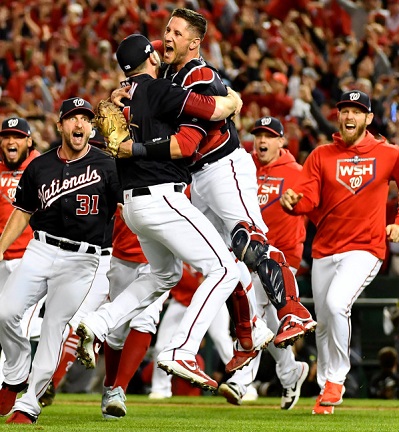
Max (the Knife) Scherzer (31) and Stephen Strasburg (far right) join up as the party starts with finishing reliever Daniel Hudson leaping in the arms of catcher Yan Gomes Tuesday night.

Let’s face it. Three pitching-dominant games are all well and good, for the Nationals and for anyone. But there’s nothing like a little hair-raising to make even a National League Championship Series sweep feel like an honest-to-God battle.

Even die-hard Nationals fans must have suspected it might take some doing, after all, to make it “Washington—First in war, first in peace, and first in the National League.” But make it the Nats did Tuesday night. And make it easy for them the otherwise overmatched Cardinals didn’t.

And somehow the Nats lived long enough to win 7-4 and sweep the Cardinals who never had even a single half-inning lead in the entire NLCS.

This time, there was no Book-damaged manager to hook a boy wonder an out away from a division series shutout and watch his team implode while leaving his best arm in the bullpen. This time, there was no stretch drive collapse. This time, there was no pair of catching errors (interference and throwing) to push the plunger deeper on a fifth-inning implosion. This time even their injuries couldn’t stop them.

This time, the Nats said nuts to all that.

After demolishing the Dodgers in a fifth division series game to get here in the first place, the Nats won the pennant in a sweep that felt more like they used vacuum cleaners instead of brooms. And had Nationals Park going nuts all Game Four long.

“I can truly say this is the best time of my career,” said series MVP Howie Kendrick, who’d been up and down with the Angels, the Dodgers, briefly with the Phillies, and then endured even a career-threatening Achilles tendon rupture as a Nat in 2018 before returning to hoist the best on-base percentage of his major league life as a role player this year.

“(I)t means a lot to be around those guys. I learn so much from them, and I love these guys just as much as they love me, and I know that 100%,” said Kendrick, who went 5-for-15 in the set and hit three doubles with three runs driven in in Game Three. “I think that’s the big reason why we have success, because we truly care about the next guy.”

Enough to land Washington’s first major league pennant since year one of the New Deal. Its first league championship of any kind since the Homestead Grays won the Negro National League pennant in 1948. Making this the second time a single-team city landed pennants in each league with separate teams.

Milwaukee can brag about two National League pennants and a World Series title with the Braves and one Brewers American League pennant. Washington has three Senators pennants and a World Series title in the American League and, now, one Nationals pennant in the National League.

And in the end it didn’t come quite as easily as reading of the four-game sweep on paper will make it look. “We still got work in front of us,” said Max Scherzer after the game, before diving back into the on-field party. The Nats re-learned about hard work Tuesday night without even trying. And they’d already learned about hard work starting in late May as it was.

A team that yanks itself up from a season-opening 19-31 to get to the postseason in the first place doesn’t reach the World Series without beyond-maximum effort in the end. And survival instincts. And baby sharking a la veteran pickup Gerardo Parra, who introduced it in honour of his little daughter who loves Baby Shark.” And Natitude enough.

“We knew where we were at one point, but we knew where we wanted to go,” said third baseman Anthony Rendon, who faces his first free agency after the postseason is finally over. “The season wasn’t over and back then we were upset, but it was still the first half of the season. You don’t win the division or the World Series in the first half of the season.”

Slice and dice Cardinals starter Dakota Hudson with a little help from momentarily caught-frozen Cardinal fielders? Yank another pair off Adam Wainwright coming in to rescue the poor guy but leave the Cardinals in a 7-0 hole after just one full inning? All well and good. The Cardinals escaped three runs shy of knowing exactly how the Braves felt in division series Game Five.

But don’t let Patrick Corbin spend most of his bullets in the first four innings, when he becomes baseball’s first to strike out double digits in four innings of any postseason games, ever. Even despite surrendering a sort-of excuse-me home run to Yadier Molina that rudely interrupted three more Cardinal strikeouts in the top of the fourth.

Because even pushed out of the boat early, these Cardinals weren’t allergic to the smell of blood in the water yet as they came to the top of the fifth.

A walk, a single, and a walk loaded Cardinals on the pond with nobody out. A ground out to second by Tommy Edman nudged a second Cardinal run home; a two-run double by Jose Martinez yanked the Cardinals back to within three. Then Corbin reached for reserves enough to nail Paul Goldschmidt and Marcell Ozuna on back-to-back swinging strikeouts to end that uprising before it got genuinely poisonous.

And that seven-run Nats first started looking safe again even with the Cardinals somehow grinding their way back to within three runs. Until it wasn’t.

Until Daniel Hudson relieving Sean Doolittle with two out in the top of the eighth plunked Molina with a man on and walked Paul DeJong to load the Cardinals on the pond. And with Matt Carpenter pinch hitting, the Cardinals were suddenly one solid swing away from changing the game entirely.

But Hudson ran it to 2-2 before luring a ground out to second out of Carpenter to dodge maybe the biggest howitzer shell of the Nats’ season to date. You can’t say the Cardinals went down like canaries. They made the Nats fight for their right to party.

Among numerous sadnesses for the Cardinals is that their bullpen went on from the first inning disaster to throw seven and two-thirds shutout relief, not without some doing, with seven strikeouts, one walk and four hits against them. This is what’s called heroism in a lost cause in some quarters. And it’ll be forgotten against the Nats’ final stand.

Who knew that after Corbin struck out the side swinging to open Game Four that Rendon’s sacrifice fly with nobody out and two on in the bottom of the first would prove the first splash of a profound flood? The Cardinals couldn’t have known, no matter what they did to the Braves. The racket in Nationals Park probably masked that the crowd knew nothing but merely hoped it wouldn’t stop there.

Juan Soto promptly shot one the other way into the left field corner to send Adam Eaton (double) home. After the Cardinals put eventual NLCS MVP Howie Kendrick aboard on the house, the Cardinals’ normally skintight defense betrayed them yet again.

The Nats’ grand old man, Ryan Zimmerman, slashed one up the third base line that Cardinals third baseman Edman stopped with a racing dive, scrambling up to throw to second. And the throw ricocheted off the glove heel of Kolten Wong, the Cardinals’ Gold Glove-caliber second baseman, unusually and unfortunately.

Leaving the bases loaded for Victor Robles in his second game back from a hamstring tweak. He hit a tall opposite field pop fly to shallow right, not far from the line. Wong from second and Goldschmidt from first ran toward the ball. Right fielder Martinez ran in toward the ball. With the three converging it appeared Martinez snapped his glove a time or two indicating he’d have it.

Martinez held up as if thinking Wong would have the play. Except that Wong made one move suggesting he’d back off. The ball hit the grass off Martinez’s left. It might as well have been a bomb drop. And Soto hit the plate with the third Nats run and the sharks still on the docks. Goldschmidt looked like a robbery victim. Martinez looked skyward as if praying.

But Nats catcher Yan Gomes shot one just past a diving Cardinal shortstop Paul DeJong and Kendrick and Zimmerman scored runs three and four. Cardinal manager Mike Schildt pulled his starter for Wainwright, his veteran approaching the end, who’d been magnificent for him all postseason long so far.

After Corbin dropped the kind of sacrifice bunt that some people still think is sacrilege today, Wainwright ran right into Trea Turner, the Nats shortstop who’d started the merry-go-round with a leadoff single. And Turner continued obeying the Nats’ order of the first inning: jump on the first pitch if it looks meaty enough but swing on the second if you must.

Wainwright hung him a curve ball to open. Turner jumped on it, hitting a high liner to left for which Ozuna inexplicably slowed before playing it on the hop when he was a mere step and a half from a catch. Two more Nats runs. The last two Nats runs of the game as things turned out. The last two they’d need the rest of the night.

This is how pumped the Nats were in the first. Only two Nats—Turner leading off—saw third pitches in their plate appearances that inning. Turner smacked a 2-0 sinker without a lot of sink into right field to open; Robles’ bomb drop in almost the middle of Martinez, Goldschmidt, and Wong was a fifth-pitch loft on 1-2 off a sinker hitting the low inside corner. Eaton’s inning-ending line out was a third-pitch curve ball. His one on/no out double, Rendon’s sacrifice fly, Gomes’s two-run single, and Turner’s eventual two-run single, all came on the first pitch of the turns.

And just like the Cardinals against the Braves, the Nats did it without even one ball flying over the fence. Maybe the baseball that was a little hopped up during the regular season did get just a little deadened down this postseason. Maybe. The Nats bombed their way into the NLCS in the first place and surely didn’t mind settling for pistols, machine guns, bazookas, and mere cannons to win Game Four.

Even if they didn’t suspect the Cardinals would put up four in the fourth and fifth. Even if they didn’t suspect three out of their now four-man flying bullpen—rookie Tanner Rainey and veterans Doolittle and Hudson—would have to perform feats of derring-do without nets over the final couple of innings. Derring-do, hell. Hudson had to plug the leak before the Hindenburg exploded in the top of the eighth. Then he got the three NLCS-ending air outs almost in a blink. Almost.

Once upon a time, just a couple of months ago, calls to the Nats bullpen caused Nats fans to reach for the nitroglycerin pills if not call for the crash carts. Now the only thing missing Tuesday night was Rodney not getting a chance to shoot another invisible arrow up, out, and maybe clear through the Capitol Dome.

Wait until the Nats get to tangle with either the Yankees or the Astros in the Serious. They may have to stop that nasty iceberg from hitting the Titanic. And they just might be able to do it. Only one team in baseball scored more runs over the regular season’s final 123 games than the Nats: the Yankees. And if the Astros can hoist Verlander, Cole, and Greinke, with Greinke not exactly a sure thing lately, the Nats can hoist Scherzer, Stephen Strasburg, and Corbin. Plus Anibal Sanchez and his high enough-flying junkyard.

But World Series against either of those teams won’t be the walk in the park (Nationals or otherwise) they took against the Cardinals, and they did get close enough to being mugged near the end. Neither the Yankees nor the Astros are liable to let even the Nats’ stellar pitching do to them what they did so amazingly to the Cardinals, whom the Nats’ arms struck out 48 times in 123 at-bats.

The Cardinals hit .130 as a team with a team .195 on-base percentage; Goldschmidt, who shook off early season struggles to hit 37 home runs, had one hit in the NLCS while striking out nine times. Their best hitter turned out to be Martinez (.500/.500/.700 NLCS slash line) in a mostly part-time role; he went 3-for-8 as a starter in Games Three and Four.

“There’s not one thing you can point to,” said Goldschmidt, before doing just that in his own case. ”I didn’t play well enough to help us win. One hit in four games, that’s not going to cut it when you’re hitting third. It just came back to bite us.” So does being out-scored 20-6 in a four-game set. Oh, that shark bites.

The Nats’ pitching and depth made the difference. The Cardinals didn’t stand a chance against a pitching staff working to a 1.25 ERA and a 0.64 walks/hits per inning pitched rate in the NLCS, while theirs posted a 4.50 ERA/1.41 WHIP. Against Scherzer (eleven strikeouts in Game Two), Strasburg (twelve in Game Three) and Corbin (twelve in Game Four), the Cardinals looked like the victims of three Bob Gibsons.

These Nats aren’t exactly afraid to go the distance if they have to, either. But another kind of distance may yet be in their way: only one team that ever swept a best-of-seven League Championship Series (it was a best-of-five until 1986) went on to win the World Series, the 1995 Braves.

“You can’t simulate that type of emotion that you go through in an NLCS, nor when the World Series starts,” says Jimmy Rollins, now a TBS analyst but long the Phillies shortstop anchorage who was one key to their 2008 World Series winner after winning the NLCS in five.

“You try to use it as rest. Mentally, you’re on. You’re thinking about execution, you’re thinking about who you may face as you’re watching the games, and game planning,” Rollins continues. “You have to do something mentally. Physically, you’re body’s naturally going to shut down for a day or two, then you have to get on the field, get on a treadmill, start throwing and get it revved back up . . . usually this long of a break is the only thing that stops momentum. Hopefully that’s not the case.”

Are you kidding? These Nats aren’t exactly afraid of any worst-case scenario. They survived the worst of all starting in late May. The pitching coach was executed. The team was going to be broken up or at least partially shaved down by the new single mid-season trade deadline. Manager Dave Martinez was going to the guillotine, the lethal injection chamber, the firing squad, or the electric chair. Whichever came first.

A measly week off to keep their minds calibrated, their bodies in tune, and their hearts well enough massaged shouldn’t be that problematic. Should it? Don’t ask now. The Nats are probably still in party mode today. And considering their franchise drought plus their city not having seen a World Series since the year Franklin D. Roosevelt first threw out a first pitch from the boxes at old Griffith Stadium, you can’t blame them.

On Tuesday night, hoisting the National League championship trophy from a podium set up post-game on the infield, Martinez could afford to channel his inner Ecclesiastian. “Often bumpy roads lead to beautiful places,” he told the Nationals Park throng who refused to leave just yet. “And this is a beautiful place.”

Some Yankee fans travel first crass

2019-10-15 GerritCole

Gerrit Cole was less than his best in Game Three but he let them beat themselves. And enough Yankee fans were worse.

There are reasons why people who don’t live in New York can’t let themselves root for or at least like the Yankees. Even in a season during which the Yankees gave major lessons in survival despite attrition and, like the Astros and maybe more so, won over 100 regular season games despite almost as many Yankees in the infirmary as on the field or at the plate.

A lot of those reasons have to do with a few too many of their fans, unfortunately.

When not behaving as though the Yankees are entitled, mind you to be in the World Series every season on earth, a few too many Yankee fans behave like spoiled brats when things don’t go the Yankees’ way in a game. The look is bad enough if it happens in the regular season. In the postseason it goes from bad enough to downright disgrace.

And there are also times when they do it when one of the other guys suffers a misfortune not of his own making, too.

Edwin Encarnacion looked to have it beaten at first base when his eighth-inning slow grounder was picked by Astros third baseman Alex Bregman but thrown a little off, enough for first baseman Yuli Gurriel to have to reach and bring a sweep tag around Encarnacion’s shoulder area.

Every known video replay showed Gurriel nailed that awkward sweep tag. The Astros called for a review and the original safe call was overturned. The Yankee Stadium faithful in the right field area began throwing debris on the field, though none of it got anywhere near Astros right fielder Josh Reddick.

And they went from bad to worse in the top of the ninth, when Yankee reliever Luis Cessa, turning in a solid turn of work in a lost cause, threw a fastball that ran in on and hit Bregman. There was very audible cheering over that one, too.

That’s the way to travel first crass.

“Stuff like that doesn’t belong in baseball,” Reddick said after the Astros banked the 4-1 Game Three win that put them ahead 2-1 in the American League Championship Series Tuesday afternoon.

Reddick, whose second inning launch into the right field seats provided the second Astro run, spoke specifially about trashing the right field area but he could have been talking about the cheers when Bregman got plunked, too.

Listen up, you creatures in the Yankee Stadium right field area. You want to get indignant? I’ll give you several reasons having nothing to do with an overturned call at first base or an unintentional hit by a pitch.

How about your heroes being unable to lay a glove on Gerrit Cole on a day Cole pitched like anything but the virtuoso of earlier in the postseason? When he could have been had but it turned out to be the Yankees who were had?

How about your heroes loading the pillows on Cole with two out in the bottom of the first, after Jose Altuve hit Luis Severino’s first one-out pitch to him into the left field seats in the top of the inning, and Didi Gregorius grounding out weakly enough to second base?

How about three more first-and-second situations for the Yankees ending with a swinging strikeout (Aaron Judge), a fly out to center field (D.J. LaMahieu), and a fly out to right? (Gregorius.)

How about Adam Ottavino leading Zach Britton with first and third, the Yankees getting rid of George Springer in a rundown down the third base line leaving second and third, and then Britton puking the bed with a run-allowing wild pitch and a sacrifice fly to put the final two Astro runs on the board in the seventh?

How about the Yankees going 0-for-6 with runners on second or better and leaving nine men on base all game long?

How about having Cole vulnerable for a change with more walks than strikeouts at one point but the Yankees still unable to touch him if they’d borrowed one of Cardinal pitching coach Mike Maddux’s drivers to swing?

How about the Yankees having nothing to say to the Astro bullpen other than Gleyber Torres hitting a too-little/too-late solo shot into the right field seats in the bottom of the eighth? Oh, yes. You were still a little too busy throwing debris into right field when Torres nailed a Joe Smith sinker that didn’t quite sink enough.

About the only time you really behaved yourselves was when plate umpire Jeff Nelson had to leave the game, after all, an inning after he took a foul off his mask in the and ended up suffering a concussion, prompting Kerwin Danley to move from second base to the plate and no ump in left field the rest of the game.

All you did for yourselves otherwise, you yahoos in the right field region, was make yourselves look ridiculous while the Yankees let even a not-so-sharp Cole still make them look ridiculous. And you made the Astros, who have class to burn as it is, look that much classier while you were at it.

Listen up. I was born in the Bronx. By right I should have been a Yankee fan. But even then Yankee fan entitlement was a stomach turner, no matter how admirable a lot of Yankees happened to be. Even in those imperial years, even to a six year old kid who decided to plight his troth to an infant troupe known as the Mets, in what was left of the Polo Grounds, and who seemed more human than the larger-than-life Bombers.

I cringed during the 1973 National League Championship Series when Pete Rose and Bud Harrelson tangled after a nasty play at second base, the benches and bullpens emptied, and the Shea Stadium crowd let their worst come forward, throwing garbage on the field, until several Mets and the Shea Stadium scoreboard operator begged them to knock it off.

I watched on television when heartsick Senators fans, knowing their team was about to be absconded to Texas, couldn’t let the Second Nats finish the home season-ending win, highlighted when big Frank Howard himself hit one out midway through, and couldn’t let Joe Grzenda pitch to Yankee second baseman Horace Clarke to finish saving it for Paul Lindblad, bursting the dam rioting on the field, forcing a forfeit to the Yankees as the final act of Washington baseball for three decades plus.

I still remember Indians fans bombed out of their trees on Ten Cent Beer Night turning old Muncipal Stadium into a lunatic asylum on the field, which gave sick new meaning to the old park’s nickname as the Mistake on the Lake.

I still remember White Sox fans going from silly to surrealistically stupid practically blowing up old Comiskey Park on Disco Demolition Night. At least Second Nats fans had a legitimate reason to be heartsick on the last home date in 1971.

And yes, I know you’re not exactly the only fans on the planet who’ve turned into wild animals in the stands when things don’t go your way. (Hello, Phillies fans. Hello, Red Sox fans. Among others.) But nobody else’s fans have done that this postseason. Even those few miscreants running over Clayton Kershaw’s jerseys in the Dodger Stadium parking lot waited until after Game Five of the division series to get their spoiled brats on.

Go ahead and boo when the other guys knock your guys’ blocks off from the plate. Go ahead and boo when they pitch your guys’ ears off or just leave them looking foolish at the plate when the opportunities knock multiple times. Go ahead and boo when the close calls don’t go your guys’ ways, go ahead and boo when your number one rival turns you aside when you least expect it.

But knock it the hell off with the trash tossing and with cheering when the other guy gets hit by a pitch when your pitcher had no intention of even trying to brush him back.

Listen up one more time, you right field area creatures. You’ve got a gorgeous successor park to the old classic Yankee Stadium, and you’ve got a team that actually showed tremendous grace under unconscionable medical pressure this year. But you jerks need either a good fanning—or an animal trainer.