Blackmon doesn’t quite open the door for Rose

Charlie Blackmon, Pete Rose

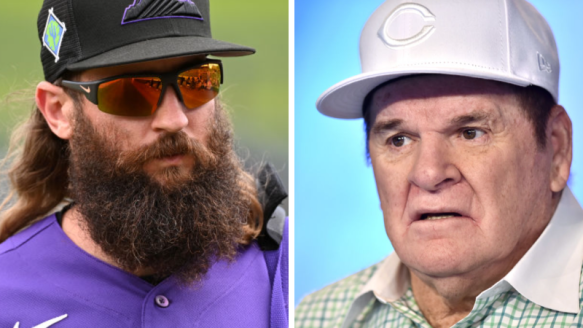
Blackmon (left) has an endorsement deal with a legal Colorado sports book. It doesn’t mean Rose (right) comes off the permanent hook against betting on baseball. (Photo montage by Outkick.)

Almost four years ago, MGM Resorts and Major League Baseball agreed to a promotional deal, MGM Resorts owning several hotel/casinos in Las Vegas and elsewhere. Almost as if by a script, it prompted Pete Rose’s partisans to demand his “rightful” reinstatement to baseball. And it was dismissed simply enough, most profoundly by Craig Calcaterra, then an NBC Sports baseball analyst.

“While there may be the broadest, most cosmic level of discontinuity between baseball going into business with a casino given its ban on players, coaches and umpires gambling,” Calcaterra began, “there is no practical inconsistency or hypocrisy or irony or anything else about it.”

This is because baseball’s ban on gambling was never, ever about gambling being some moral abomination that cannot be countenanced in any way. It was about the manner in which gambling compromised the competitive integrity of the game and thus imperiled baseball as a going concern. Players were gambling on baseball and cozying up to gamblers to throw baseball games. That had to be stopped and it was stopped. Full stop.

What, then, to make of Rockies outfielder Charlie Blackmon signing an endorsement deal with a Colorado sportsbook, MaximBet? Does the first known endorsement deal between an active major league player and a sportsbook—made possible by clauses in the new collective bargaining agreement—equal the open door through which baseball’s most notorious living gambling exile returns to the game’s good graces and, thus, to the Hall of Fame?

Rose’s partisans seem to think yes. Post haste. So does Rose himself. The bad news for them is that they are wrong, on more than one ground. Ground one: As ESPN writer David Purdum noted, MLB policy enjoins Blackmon from promoting baseball betting specifically. Blackmon can promote MaximBet itself as a company but he can’t promote or encourage anything the company does that involves betting on his own sport.

Ground two: Baseball has had promotional partnerships with brewers and distillers in the past. It didn’t and still doesn’t mean that a player, a coach, a manager, or an umpire can get bombed out of their skulls before or during a game. Just let Shohei Ohtani walk out to the mound or check in at the plate with a bottle of sake and a glass in his hand and see if he goes unpunished.

Ground three: If Blackmon were foolish enough to think his MaximBet deal gives him an opening to bet on baseball himself, you can, ahem, bet on it. MaximBet would be obligated to blow the whistle at once, thus subjecting Blackmon to discipline under Rule 21(d), the punishment depending upon whether Blackmon bet on games not involving his Rockies or whether he bet on Rockies games for which he was in the lineup.

Bet on games in which your team isn’t playing, the punishment is one year’s ineligibility to be part of organised baseball. Bet on teams in which your team is playing, and you’re in the lineup, coaching, or managing, and the punishment in plain language is permanent ineligibility.

Do you need one further reminder? Rule 21(d)’s language does not distinguish between whether you bet on your own team or against your own team. The rule also extends to off-field, non-playing personnel from the most obscure ballpark ticket taker to the most visible team owner to the commissioner of baseball himself.

Just because MLB has a promotional deal with MGM Resorts, it doesn’t mean Rob Manfred himself can belly up to the nearest sports book and drop a bet on tonight’s Dodgers-Padres game. Just because Charlie Blackmon has an endorsement deal with a sports book now up and running in Colorado but planning (according to Purdom) to expand to Iowa and Indiana, it doesn’t mean he’s allowed to drop a bet even on whether the Tigers’ future Hall of Famer Miguel Cabrera will nail career hit 3,000 in his first, second, third, or fourth plate appearance against the Rockies tonight.

“I just came up at the wrong time,” Rose said to USA Today when the Blackmon deal with MaximBet became known. “I was thirty years too early. Baseball is pretty much in bed with gambling now.”

Look, I [fornicated] up. I messed up when I did what I did, ok? I can’t bring it back. However, I would wish baseball would just give me an opportunity to be on the [Hall of Fame] ballot. Not, put me in, let the writers decide. I’ve been suspended since ’89, 33 years ago. That’s a long time. And to be honest with you, it probably cost me $100 million. I’m not complaining, I’m just saying I’ve been punished pretty severely.

Baseball is “pretty much in bed with” legal gambling. Rose seems to forget that one of the most powerful pieces of evidence against him is a notebook recording a considerable volume of his baseball bets—made and kept by Michael Bertolini, a bookmaker outside the lines of legal gambling, through whom Rose bet on baseball including on his Reds while he was still an active player as well as the team’s manager.

Blackmon’s MaximBet deal isn’t necessarily a great look, depending upon your point of view, even if it’s major relief that Blackmon will be on a very tight leash that keeps him away from just promoting baseball betting, never mind betting on the game himself. But the deal doesn’t quite open the door for Rose’s return from baseball’s Phantom Zone, either. And it still isn’t up to MLB to put him on a Hall of Fame ballot.

The Hall itself, not governed by MLB, passed a rule denying those permanently ineligible from appearing on Hall ballots. Rose seems almost as forgetful of that distinction as he and his remaining partisans seem of the distinction between “lifetime” and “permanent.”

A Saturday special for Miggy Stardust?

Miguel Cabrera

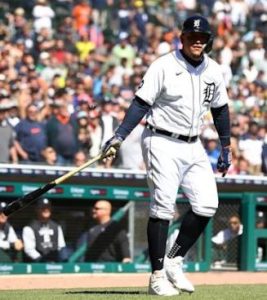
Miguel Cabrera beamed while tapping his heart, as manager A.J. Hinch helpd him accept a memento from the Tigers for his 500th home run last fall. His 3,000th hit was put on hold one more day by Mother Nature.

“I think,” Miguel Cabrera said when asked his first reaction after he might nail hit number 3,000, “I’m going to cry.” Then, he said, he’d remember the uncle who taught baseball to him in his native Venezuela. He also asked for “El Alma Llanera” to be played through the Comerica Park PA system after he nailed the hit.

He didn’t exactly ask for the rainout Friday that postponed it another day.

Amo, lloro, canto, sueño, con claveles de pasión, the song’s lyric says in part: “I love, I cry, I sing, I dream, with carnations of passion.” That’s as good a short description as any you might find of the way Cabrera has played baseball. Even if it omits mention of high-wattage smiling. Cabrera’s been as good at that as he’s been at the plate.

“So long as one can grasp concepts like ‘fun’ and ‘joy,’ Miguel Cabrera has always been delightfully uncomplicated,” writes Bleacher Report‘s Zachary D. Rymer. “Rarely has he shown any pretense that he’s doing something other than playing a game for a living.”

“I used to low-key creep your at-bats in my hotel room EVERY SINGLE NIGHT, after our games,” tweeted Reds first baseman Joey Votto this past Wednesday. “I knew I had to study the best to beat the best. Good luck with your final steps to 3000. You are a joy to watch.”

Votto wasn’t talking about his own hitting, necessarily, so much as he might have been talking about how him and his team could keep Miggy Stardust in check. That was about as simple as trying to stop an oncoming train with a bathroom plunger.

Cabrera may be unpretentious about the game he plays and the game he brings to it, but this is a player whose first major league hit was a home run, whose 1,000th career hit was a home run, and whose 2,000th hit was also a home run. Would it be too much to ask the Elysian Fields to arrange for number 3,000 to clear the fence for Cabrera this weekend?

Wouldn’t it?

They already arranged it for Hall of Famers Derek Jeter and Wade Boggs. They swung it for Álex Rodríguez. But you wouldn’t necessarily bet against them moving their huge hands on Cabrera’s behalf, either. Not for a player who will become the only man in Show history to collect 3,000+ hits, 500+ home runs, and a Triple Crown.

Fifteen other Hall of Famers—including Oscar Charleston, Ty Cobb, Jimmie Foxx, Lou Gehrig, Josh Gibson, Mickey Mantle, Frank Robinson, Ted Williams, and Carl Yastrzemski—were Crown winners without finishing where Cabrera will finish in all three of those places. (Charleston and Gibson, of course, were limited to the Negro Leagues and their shorter playing schedules arbitrarily and unfairly.)

The chunky first baseman/designated hitter whose face is still mostly that of a wide-eyed ten-year-old boy is about to travel aboard his own exclusive jet. Cabrera’s surname translates to “goatherd.” He’s made goats out of plenty of pitchers from the most modest to the Hall of Famer alike.

In ten or more lifetime appearances each against five Hall of Famers, Cabrera would have a 1.000+ OPS if it wasn’t for John Smoltz, against whom his OPS is a puny .611. He has a 1.105 OPS against Greg Maddux, a .933 against Tom Glavine, a .912 against Pedro Martínez, and an .833 against Randy Johnson. When Miggy Stardust enters Cooperstown, he’ll enter with four sets of bragging rights.

The single mark against Cabrera is that he’s been a career-long negative defender. Among first basemen—and Cabrera’s played more games there than at third base since 2014—he’s five fielding runs and 38 defensive runs saved below his league average. As all-around first basemen go, Albert Pujols he ain’t.

Among third basemen, he’s less: 46 fielding runs and 88 defensive runs saved below his league average. As all-around third basemen go, Mike Schmidt he ain’t. (I could have said Adrián Beltré, too, but Beltré finished 23 short of the 500-bomb threshold, alas. It won’t keep him from welcoming Cabrera as a Hall of Famer in due course.)

He hasn’t exactly been the Road Runner on the bases, either. In fact, he’s barely beyond Cecil Turtle but without Cecil’s bag of sneaky tricks. Cabrera has only 106 infield hits in 2,999. And he’s stolen in a career (39) what Hall of Famer Rickey Henderson could steal in a season—near the end of Henderson’s career.

Cabrera has tried sixty thefts and been arrested a little over a third of the time. He’s only tried an average of three times per season. It may be miraculous, or a case of catching the other guys with their pants down, that he has a .650 lifetime stolen base percentage. Presumably, his teams warned him that any more than three tries a year would get him arrested for malicious mischief.

Except there’s no malice aforethought involved with Cabrera. This is the guy who’s been seen hugging opposing fans in the seats when diving for a foul ball, and giving Phillies pitcher Jeremy Hellickson a grinning thumbs-up, after Hellickson once struck him out on a changeup nobody could hit—even swinging a shovel.

It takes something to stay the course even when your team has collapsed. As age and injuries caught up to Cabrera from 2017 through the end of last season, only one team in Show lost more than the Tigers in the same span. Now, the Tigers actually look like a team approaching true contention, and Miggy Stardust is their still-enthusiastic elder statesman.

Mother Nature trumped the Elysian Fields to rain the Tigers out Friday night. Maybe she knows something we and they don’t. Something about a Saturday special that turns Comerica Park into the hardiest party spot in Detroit.

Cabrera and the Yankees have it right

Miguel Cabrera

A free eighth-inning pass after going 0-for-3 to that point Thursday outraged Tiger fans far more than it outraged Miguel Cabrera to remain one knock short of 3,000.

I don’t want to pour any more gasoline onto the fire of Tiger fan’s outrage, but Yankee manager Aaron Boone did the absolute right thing Thursday afternoon. And it wasn’t as though Miguel Cabrera lacked for shots at his 3,000th lifetime hit.

Boone ordered Cabrera walked on the house in the bottom of the eighth rather than risk the righthanded-hitting Cabrera clobbering his lefthanded relief pitcher Lucas Luetge with runners on second and third, two outs, and the Tigers ahead a mere 1-0.

Now, the move backfired, sort of; Austin Meadows ripped a two-run double to make it 3-0. So think of it as the Tigers’ revenge if you wish. But since when is the other guy “entitled” to make history on your dollar? Since when are you just supposed to be nice guys and let him make his history when he might put a game a little further out of reach against you?

Cabrera was 0-for-3 on the day when his eighth-inning plate appearance approached. He didn’t exactly lack for chances to plant number 3,000 somewhere in Comerica Park. He knew it. Understandably, the Comerica crowd wanted history. Understandably, too, the Yankees wanted to come back and win a baseball game.

But a Hall of Famer is more aware of the big picture than the fans booing the Yankees lustily for ordering the free pass before he could even check in at the plate. He simply dropped his bat in the on-deck circle and make the trek to first base without so much as a wince. He waited until he reached the pad to have a word with or toward Boone.

To which Boone replied, perhaps in good humour, “Miggy was jawing at me after I called for the walk. I told him we’re even. He cost me a World Series in 2003, so now he can sleep on 2,999.” (The reference was to Cabrera then being a member of the Marlins who beat the Yankees in six in that Series—into which Boone’s legendary ALCS-winning home run put the Yankees in the first place.)

Tonight will be only the second night Cabrera sleeps on 2,999. After pulling up that short following Wednesday’s play, during which he went 3-for-4 to get there in the first place, he purred, “Who the [fornicate] cares? We lost. When has this game ever been about individual accomplishments?”

Well, fair play. Baseball has been as much about individual feats as team victories since the game was born, more or less. Cabrera may downplay his failure to reach 3,000 Wednesday—and try calming the Comerica crowd down after the free pass and the eventual Tiger win today—but he can’t really be foolish enough to deny that particular feats resonate as deeply as World Series rings.

If he’s rejecting the idea that individual accomplishment is not something to which a player is “entitled,” good for him and better for the game. There’s nothing in the written rules, and little enough unwritten in the Sacred Unwritten Rules, that says a team’s supposed to roll over and play dead so the other guy can reach a landmark.

But there’s plenty on the ethical side that says you’re supposed to achieve your milestones in honest, unmanipulated competition. Including the part that says the other guys have just as much right to try to beat you as you have to try to beat them, history be damned for the moment.

Few teams are quite as conscious or respectful of history and milestones as the Yankees. But they’re also conscious of the season at hand. They took the chance on a lefthander-lefthander matchup offering the best chance to escape the inning unscathed and try once more for victory.

Meadows and thus the Tigers turned out the winners there, fair and square. The Yankees also had a shot at closing the gap and even tying the game in the top of the ninth, when Joey Gallo beat out an infield hit with one out, until Isiah Kiner-Falefa dialed Area Code 6-4-3 for the side and the game.

The Yankees made a smart move and it backfired. That, too, can happen. If Tiger fans want to call it the vengeance of the baseball gods, they’re, ahem, entitled to that. But they shouldn’t condemn the Yankees for putting honest competition and a chance to come back and win ahead of history.

Tiger fans should also heed manager A.J. Hinch’s counsel. “Boonie’s obligation is to his own team and their chances of winning,” Hinch said postgame. “He had the matchup behind Miggy that he wanted. So you could see it coming. I know our fans responded accordingly, but I totally get it.” That’s called being a gracious winner.

Cabrera’s sound counsel, however crudely expressed, is: We still won, and tomorrow’s another day. Especially with the Tigers still at home for this weekend, hosting the Rockies. Cabrera has three more games in front of the home audience to plant number 3,000, fair and square, in honest competition.

Smarts in Houston, suicide in Cleveland

Shohei Ohtani

Ohtani took perfection into the sixth, where a bunt couldn’t do what a subsequent base hit did . . .

Shohei Ohtani didn’t just flirt with perfection Wednesday, he almost seduced it. A twelve-punchout performance on the mound; a two-run double to finish the first-inning carnage against Astros starter Jake Odorizzi; a perfect game broken with one out in the seventh. And his Angels in sole possession of the American League West’s penthouse. For now.

But right before Astros catcher Jason Castro fisted a base hit over second base into short center with one out in the Houston sixth, their own second baseman Niko Goodrum tried to break the would-be perfecto in a manner that usually brings the wrath of the Sacred Unwritten Rules chauvinists down upon the miscreant. On 0-1 leading the inning off, Goodrum tried to bunt an Ohtani slider up the third base line.

This time, the chauvinists didn’t rain acid down upon Goodrum. For one thing, the Angels put an overshift on against the lefthanded-hitting Goodrum. Just why the Angels thought a .133/.133/.200 slash line on the season to date required an overshift escapes for the moment.

But Goodrum did exactly the right thing receiving so much free, delicious real estate upon which to hit. His team down six, and knowing he wouldn’t be wasting an out with a bunt, Goodrum did absolutely nothing wrong sizing the scenario up and dropping a bunt toward that free territory—except the ball bounding over the chalk into foul territory halfway up the third base line.

Which was the spot to where Angels third baseman Anthony Rendon ran from his positioning adjacent to second base and grabbed the ball just in case, with Ohtani also bounding over from the mound. Back on the mound, Ohtani and Goodrum wrestled to a 2-2 count before Goodrum swung and missed at a nasty curve ball hitting the outer edge of the zone.

Maybe if Goodrum had pushed a successful bunt up the line and landed on first base practically on the house, the SUR chauvinists would have gone nuclear. Maybe. It’s become a little more acceptable according to the SURs to drop a bunt if the other guys are silly enough to think an overshift is a good way to keep a batter below the proverbial Mendoza Line from breaking it up the old fashioned way.

Come to think of it, Ohtani himself put on a demonstration of one of the only other times it’s wise to bunt—if you think you can get a base hit out of it without a full shift against you. With one out and nobody on in the Angels’ sixth, against Astros reliever Cristian Javier, the lefthanded-hitting Ohtani faced a slight overshift, slight enough to move Astros third baseman Alex Bregman to a more standard shortstop positioning but still leaving him room to move if he wanted to drop one.

On 1-2 Ohtani chopped a beauty toward the third base side of the mound and blasted out of the box. Javier pounced as best he could but he threw a rising sailer over and past the upstretched mitt of leaping Astros first baseman Yuli Gurriel. It was an exercise in futility, considering Ohtani would have beaten a cleaner throw by about a step on the play, and considering the Angels stranded him on first for the inning.

Goodrum and Javier have a teammate who understands, ahem, perfectly about perfecto-breaking bunts. Justin Verlander had it happen to him, while still pitching for the Tigers on 21 June 2017. He took a perfect game bid against the Mariners into the sixth, with the Tigers up 4-0 to that point.

With one out, Seattle’s swift center fielder Jarrod Dyson squared, bunted one between the mound and first base, and ran himself into a base hit. Unlike Goodrum’s attempt Wednesday, Dyson’s successful bunt that day kicked off a three-run Mariners inning that pushed Verlander out of the game. It also preceded a four-run Mariners seventh at the expenses of Tigers relievers Shane Greene and Alex Wilson.

That was the part that roiled Verlander far more than any perfecto-breaking bunt ever could. “It was a perfect bunt,” Verlander said of Dyson. “That’s part of his game. I don’t think it was quite too late in the game given the situation to bunt, especially being how it’s a major part of what he does. So I didn’t really have any issues with it. It wasn’t like I got upset about it.”

Goodrum played smart baseball, even if his bunt bid bounded foul before he finally struck out swinging. Even if the Angels finished what they started, a 6-0 shutout to take two of three from the Astros in Houston after losing three of four at Angel Stadium to open the season. At least neither manager, Dusty Baker (Astros) nor Joe Maddon (Angels), fell asleep at the proverbial switch Wednesday.

Dallas Keuchel

. . . but Keuchel looks to be praying for mercy amidst an unconscionable nine-run second/ten-run total beating before he was lifted too little/too late.

That dishonour belonged to White Sox manager Tony La Russa in Cleveland earlier in the day, in the first game of a doubleheader. Despite a well-enough rested bullpen thanks to a week-opening pair of rainouts, a pen that hadn’t exactly been overworked in a preceding set against the Rays, either, La Russa inexplicably left his veteran starter Dallas Keuchel in to take an early ten-run beating on a day Keuchel’s stuff didn’t exist from the outset.

Keuchel had enough trouble trying to shake off a first inning during which a pair of White Sox defensive miscues helped cost him a run before he surrendered a hit. He never got out of the second alive: a leadoff throwing error; four straight singles two of which pushed runs home with the bases loaded; a grand slam; three straight singles more, a wild pitch advancing the first of those Guardians to second and the third sending another run home; a run-scoring ground ball turned into another White Sox error; and yet another RBI single.

Finally, La Russa got Keuchel out of there and brought in Tanner Banks. He got a prompt step-and-throw double play at first and a ground out right back to the box for the side.

Joe and Jane Fan can bleat all they want, as one or two I saw aboard social media did, that sometimes you just have to take one for the team, sometimes you just have to try to  “save” your bullpen even if it means getting murdered, and it’s just one April loss against a long season to come, and the goal is to win two of three, innit?

“I’m 100% certain LaRussa knew Keuchel didn’t have it,” said one such fan, in fact. “Sometimes the decision to leave guys in or take them out is more about 162 games than 1 game. As is the case here. He was hoping Keuchel could survive that inning and make it thru an inning or two more.”

A Hall of Fame manager, even coming out of retirement for one more turn, knows he should be thinking of every game until or unless his team is eliminated mathematically from a pennant race. He should know well enough when his starter doesn’t have it. Knowing that, and knowing he had a reasonably rested bullpen, just how does a conscientious manager not get that poor starter the hell out of there before the game goes from a small leak to a flood?

Keuchel came into the game throwing little more than meatballs and matzo balls as it was, before Jose Ramirez—the Guardians third baseman flush with a yummy new contract extension—stood in in that second inning with the bases loaded, three Guard runs in, nobody out yet, and sent a hanging 1-1 cutter over the left field fence.

If La Russa “knew” Keuchel didn’t have it before that, it shouldn’t have been allowed to go there in the first place. Especially if he was going to go to Banks to clean up the mess. Banks hadn’t pitched since the previous Sunday. He also hadn’t surrendered an earned run in his three previous relief gigs. And what did he do when La Russa brought him in?

After getting that step-and-throw double play to end the second inning before the Guards could have made the case against their human rights violations any worse, Banks threw three more hitless, shutout innings, before Matt Foster and Anderson Severino finished with only one further Guards run to come—when Steven Kwan singled Myles Straw home off Severino in the ninth.

There was a time when La Russa would never have let a game get that far out of hand that soon if his starter didn’t have it going in. That’s part of how La Russa became a Hall of Fame manager with three World Series rings in the first place. “The manager didn’t get them ready to play,” La Russa said of his team after that blowout loss, and before the White Sox lost the nightcap, 2-1. “I take the heat for that.”

Lucky for him and them that there is still a long season to play yet.

“But . . . history, dammit!!!”

Clayton Kershaw

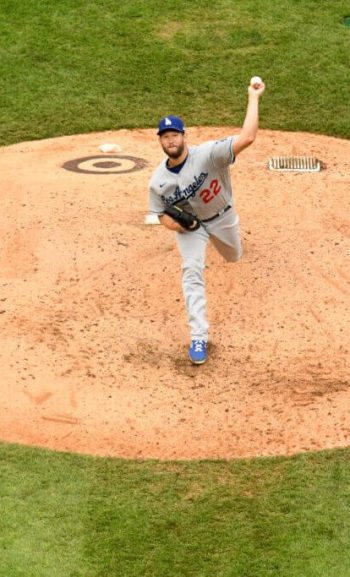
Clayton Kershaw pitching in Target Field, against the Twins, Wednesday. He was lifted after seven perfect innings and the world went nuclear.

Finally, Steven Kwan went hitless. It took his sixth major league game before somebody’s pitchers finally found ways to get him out all day long, if you don’t count the bases-loaded walk he took in the second to start the scoring in a 7-3 Guardians win.

Then Vladimir Guerrero, Jr. smashed three home runs against the Yankees in the south Bronx, including a pair off Yankee ace Gerrit Cole, en route a  6-4 Blue Jays win, a performance that had even the Yankees dropping their jaws in amazement.

Those might have been the top stories Wednesday if not for Clayton Kershaw and Dave Roberts.

Kershaw pitched seven perfect against the Twins in Minneapolis. Despite his having thrown “only” seventy pitches while striking thirteen Twins out including striking the side out in the sixth, Kershaw didn’t come back for the eighth inning. Roberts ended Kershaw’s day knowing both men agreed he’d be on a limited leash in his first season’s start at all, never mind pitching in temperatures in the thirties.

The world went nuclear over it.

Sometimes during the uproar it seemed nobody wanted to listen when Kershaw postgame explained, among other things, “I knew going in that my pitch count wasn’t going to be one hundred. It’s a hard thing to do, to come out of a game when you’re doing that. We’re here to win. This was the right choice.”

He’s Clayton Freaking Kershaw and he should have been entitled to finish that perfect game!

“Those are selfish goals. We’re trying to win,” said the lefthander who pitched a no-hitter in 2014 and whose black ink from ages 23-29 has already secured his reservation in the Hall of Fame.

That’s really all we’re here for. As much as I would’ve wanted to do it, I’ve thrown 75 pitches in a [simulated] game, and I hadn’t gone six innings, let alone seven. Sure, I would’ve loved to do it. But maybe I’ll get another chance.. . . I would have loved to have stayed, but bigger things, man, bigger things . . . Earlier in my career, I’d be built up to a hundred pitches. Blame it on the lockout. Blame it on me not picking up a baseball until January. My slider was horrible the last two innings. It didn’t have the bite. It was time.

Whaddabout history?!? Whaddabout entertainment?!? This is the way baseball brings the fans back?!?

What about the injury history of a 34-year-old pitcher, working in that 30-degree temperature range in crisp Minnesota, after an owners’ lockout-imposed badly abbreviated spring training, and coming off a season ended by forearm/elbow inflammation, accompanied by speculation he might even face Tommy John surgery? To say nothing of Kershaw not picking up a ball until January because of continued recovery from that forearm issue?

Goddam analytics!!!!!

Protecting a pitcher’s health—which is exactly what Roberts did, presiding over a starting rotation about whose long-term health Roberts has said on the record is the key to the Dodgers’ long-term seasonal health and success—has absolutely nothing to do with analytics. All the analytical information available to managers and players about their own and their oppositions’ tendencies isn’t going to tell you whether or when a player’s liable to incur injuries. Analytics aren’t that smart.

“It was a short spring training after a lockout,” reminded no less than Aaron Gleeman, who covers the Twins for The Athletic. “He’s not fully built up. Nothing to do with analytics.”

Nolan Ryan wouldn’t have come out after only seventy [fornicating] pitches, and his manager would have had a fight on his hands if he tried to lift Ryan!!!!

Any time any starting pitcher gets the early hook for any reason in any circumstance—never mind that most managers now have their starters on pitch limits in an admirable bid to compensate for the too-short spring training preparation and assure their long-term season’s health as best as possible—there still comes even one ignorant Ryan name-drop. This one delivered truckloads of them all around social media.

I’m going to let Athletic analyst Keith Law say it for me as I also did when reviewing the book in which he said it, The Inside Game: Bad Calls, Strange Moves, and What Baseball Behaviour Teaches Us About Ourselves, two years ago:

The center square on your [Pitch Count Bingo] card is Nolan Ryan, whose name is certain to come up in any attempt to discuss the limits of the human body to throw a projectile at 95 mph repeatedly over a three-hour span . . .

Nolan Ryan was a physical marvel, and an extreme outlier when it came to durability, although most discussions of the latter ignore the part where he missed 1967 and 1968 with persistent arm trouble. Ryan did things we will probably never see again, not now that pitchers throw harder than ever and play more than ever as kids, while teams work to keep their most gifted pitchers healthy until they reach the majors . . .

Nolan Ryan is the ultimate survivor, the survivor ne plus ultra, the übersurvivor when it comes to survivorship bias. Yes, Ryan defied everything we know now about pitch limits, and shouldered (pun intended) workloads that no MLB would ever allow a pitcher to carry [now], whether in individual games or entire seasons . . .

He is . . . an outlier, a great exception—not one that “proves” the rule, but one that causes many people to discard the rule. Most pitchers can’t handle the workloads that Ryan did; they would break down and suffer a major injury to their elbow or shoulder, or they would simply become less effective as a result of the heavy usage, and thus receive fewer opportunities to pitch going forward. Teams did try to give pitchers more work for decades, well into the early 2000s, but you don’t know the names of those pitchers because they didn’t survive: they broke down, or pitched worse, or some combination of the above. (Emphasis added.)

By the way, the Dodgers did finish the victory they began while Kershaw was in the game. They led 3-0 when he came out. With one out in the top of the eighth, Cody Bellinger, Gavin Lux, and Austin Barnes smashed back-to-back-to-back home runs off Dereck Rodriguez working his fourth inning of relief. Then Max Muncy greeted Rodriguez’s relief Griffin Jax by leading off the top of the ninth hitting a full-count fastball over the right field fence.

They also lost the perfecto when Kershaw’s relief Alex Vesia surrendered a one-out line single to former Yankee Gary Sanchez in the bottom of the seventh. Nobody saw Kershaw complain. If anything, he looked about as jovial and hail-fellow in the dugout as a man can look after being “robbed” of a shot at “history.” A man who knows his baseball immortality is already assured is far more sanguine in such circumstances than the world going nutshit about his “robbery.”

There were 233,345 major league baseball games before Wednesday, and only 23 of them were perfect. Thirteen (57 percent) were pitched by men who’d get to the Hall of Fame as visitors only. Only one—Hall of Famer Sandy Koufax’s jewel of 9 September 1965, after Koufax threw mere no-hitters in each of his three previous seasons—actually proved that practise makes perfect.

Should the Dodgers fail in their quest for one full-season World Series championship while Kershaw remains among them, it won’t be because he was lifted after seven perfect innings in his first season’s start. Should they succeed in that quest, it will be in considerable part because Roberts placed his pitcher’s long-term, season’s health—with his pitcher on board entirely—ahead of “history.”

“But who is a perfect game for, anyway?” asks Sports Illustrated writer Emma Baccelieri, who answers promptly. “It might be just as easy to conceive of it as selfless rather than selfish: a great communal gift as much as a great individual achievement. Everything on Wednesday made sense. But perhaps it is not selfish—not unreasonable—to wish that everything did not have to make so much sense all the time.”

Would I have loved to see Kershaw consummate a perfect game? You might as well ask if I still enjoy being alive. Just don’t ask me to list the roll of Hall of Fame pitchers who never got to pitch perfect games, either. They’d only begin with Walter Johnson, Christy Mathewson, Warren Spahn, Whitey Ford, Juan Marichal, Bob Gibson, Tom Seaver, and, yes, St. Ryan himself—who threw seven no-hitters but was never perfect even once.

You’re worried about “entertainment?” The single most entertaining things in baseball other than actual games and even World Series triumphs are arguments liable to last as long as baseball itself will last. Even when those arguments are as witless as the day is long.