2024: Taking the Fifth, and Other Lamentations

Aaron Judge

This is not what was meant when the phrase, “I’ve got the drop on you,” was coined . . .

Hands up to everyone who can’t wait for 2024 to depart. Now, hands up to everyone who thinks 2024 was just the most wonderful year of the decade. My, but that’s a barren sea of hands over that second suggestion.

Much like its home country, baseball’s 2024 was . . . well, why don’t we let some of the signature moments, doings, and undoings of baseball’s year speak for themselves. The new flimsy uniforms sucked. The All-Star Game uniforms didn’t suck that badly, but still. Meanwhile, I’m thankful to folks such as Jayson Stark and a few other intrepid sleuths of BBW—that’s Baseball Bizarro World, you perverts—who either unearthed or reminded us about . . .

Take the Fifth—Please Dept.—“Come an’ see my amazin’ Mets,” their manager Casey (I Lost With This Team What I Used to Win with the Yankees) Stengel liked to say of his maiden squad. “I been in this game a hundred years but I see new ways to lose I never knew were invented yet.”

That was the Ol’ Perfesser gazing down from the Elysian Fields, watching the team with whom he won ten pennants and seven World Series perform the single most splendid imitation of the 1962 Mets since . . . the 2024 White Sox finished their sad, sad, sad regular season.

Pace George F. Will, look to your non-laurels, White Sox—the Bronx Bumblers captured 21st Century baseball’s booby prize. You White Sox only out-lost the 1962 Mets this season. You probably never did in one regular season game what only began in a World Series game . . . with a Yankee center fielder who does a credible impersonation of the Leaning Tower of Pisa approaching the plate and Frank Howard at the plate committing his first error playing center field after 538 fly balls hit his way in his entire career to date became outs.

Then . . .

* A Gold Glove-finalist shortstop threw for a force play at third base and saw the ball ricochet off the base instead of reach his third baseman’s glove.

* The arguable best pitcher in the American League got thatclose to escaping a bases-loaded, nobody-out jam when he suffered the brain fart heard ’round the Bronx and the world: he forgot to cover first when Mookie Betts hit a screwdriving ball toward Anthony Rizzo. Oops.

* The Yankee anti-party included a balk and catcher’s interference.

* The Dodgers became the only team in baseball history to score five runs in a World Series game after they were in the hole 5-0.

* The Yankees became the only team in baseball history to serve up five unearned runs in a World Series game since they started counting earned and unearned runs as official statistics. (When did they start? In the same year during which premiered Ford’s moving assembly line, the first newspaper crossword puzzle (in the New York World), and Louis Armstrong’s first cornet. In the New Orleans Home for Coloured Waifs.)

* And the fifth-inning party actually started with everyone from the television announcers to the fans and back pondering whether Gerrit Cole might, maybe, consummate a no-hitter to keep the Yankees alive.

Your Reality Check Bounced Dept.—Too many Yankee fans continue infesting social media with proclamations that the Yankees still have the dynastic history of dynastic histories. And too many baseball fans steeped in reality and not fantasy keep reminding them, Your damn dynasty is just soooooo 20th Century!

Juan Not-So-Small Step for Met World—That’s $765 million the Mets will pay Juan Soto over the next fifteen years. This may or may not mean the end of Pete Alonso’s days as a Met, which may or may not mean . . .

Out with a Bang Dept. . . . that Polar Bear Pete’s final act as a bona-fide Met was the biggest blow on their behalf this century: the three-run homer he blasted in the ninth inning that proved the game, set, and National League division series winner against the Brewers. Which was also the only home run hit by any Met in the set.

Did I Do That Dept.—Alonso’s division series-winning blast came off Devin Williams . . . who’d never allowed a ninth-inning lead-changing bomb in his major leaguer life until then. Then, after some time passed, the Brewers let the Yankees talk them out of keeping Williams, sending them pitcher Nestor Cortes, infielder Caleb Durbin, and cash to take Williams. We still don’t know if the deal was Milwaukee payback for surrendering Alonso’s game-changing/game-swiping bomb.

Out with a Bigger Bang Dept.—That would be Walker Buehler, pitcher. One minute, locking down the Dodgers’ World Series win with a spotless Game Five ninth including two swinging strikeouts. The next, practically (well, give or take a few hours): Signing for one year and $21 million with the Red Sox. Anyone remember the Dodgers making Buehler a qualifying offer for that money and Buehler turning it down? He’s rolling serious dice on himself with this deal.

Shohei-hei Rock and Roll Dept.—You might think anyone can become a member of the 50 home run/50 stolen base club. But you won’t be able to predict who might do it the same way Shohei Ohtani did in September against the Marlins: 6-for-6 at the plate; three home runs; five extra base hits; two stolen bases; ten runs batted in. His own planet? Try realising Ohtani exists in his own quadrant.

A Cut Below Dept.—Pete Fairbanks, Rays reliever. He missed a game in 2024 because of a finger cut. He cut the finger opening a bottle of spring water. Considering his bizarre 2023 injury (incurring a black eye while trying to dunk against his toddler son through a water basketball net), it seems as though Fairbanks just couldn’t cut it anymore.

On Your Knee Dept.—Presented for your consideration: Miguel Sanó, Angel. Aleady on the injured list with an inflamed knee. He put a heating pad over it. He forgot about it just enough to burn the knee and place himself for another month on the IL. Miguel Sanó, who proved he certainly could stand the heat in . . . the Angels’ continuing Twilight Zone.

The King of Pop Dept.—Mookie Betts performs amazing feats at the plate and on the field. At the plate, they usually involve baseballs shot on lines into the outfield, or driven like ballistic missiles over fences. They didn’t involve him popping out for the cycle . . . until 25 September, when, in order, he popped out to: second baseman, third baseman, first baseman, and shortstop.

Don’t do it. Don’t Google “MLB players who’ve popped out for the cycle.” It won’t even call up the Mookie Monster, yet, never mind anyone else who might have had that kind of a day—whether a Hall of Famer, a Hall of Famer in the making, or a guy who’s destined to be forgotten outside such a single singular feat.

Mystique and Aura, kidnapped by the Dodgers

Walker Buehler

Walker Buehler (21, far left) about to be swarmed by fellow Dodgers after he locked the Bronx Bumblers down for keeps to finish World Series Game Five.

Has it really sunk in yet that the Dodgers are full-season, no-doubt, take-no-quarter World Series champions? Has it really sunk in yet that the Yankees aren’t just another group of also-rans but a team as fully able to implode at the wrong time as any team in major league history?

Both teams needed the best they had available for Game Five Wednesday night. The Dodgers to win it, the Yankees to stay alive long enough to force a cross-country trip to Los Angeles for Game Six at minimum. When the Dodgers needed reinforcements, they found them, sometimes in places unexpected outside their portal.

Anyone remember Mystique and Aura? The Dodgers kidnapped them with no known ransom demand turning up at this writing. The Yankees needed Mystique and Aura but they got Wobbly and Rickety.

Just one night after showing serious enough life by blowing the Dodgers out of Game Four, the Bronx Bumblers self-dismantled in ways almost unheard-of by any previous World Series contestant. The Series-clinching, Game Five final was 7-6. It was a close game only if you ignore the way the Yankees helped the Dodgers close an early 5-0 Yankee lead.

The Game Five Dodgers almost didn’t need stout innings from their bullpen, a shutdown ninth from projected Game Seven starter Walker Buehler, and too-timely hits enough to matter. If you didn’t know better, you’d be swearing the Yankees were handing it to the Dodgers on a platinum platter.

The 161st Street Stumblers lost the Series to a Dodger team that found ways not to let little things like too many injured pitchers and a half-effective bullpen keep them down for very long. bullpen half of which would be effective keep them down for very long. But Game Five night just might have been the single most surrealistic game of this Series, if not any Series.

Trust me when I say that that’s saying something.

The top of the fifth challenges such sad Series mishaps past as Fred Snodgrass’s glove turning into a trampoline, Freddie Lindstrom’s pebble, Ernie Lombardi being dismantled at the plate, Mickey Owen’s passed ball, Willie Davis losing two Oriole flies in the sun in the same inning, Curt Flood losing Jim Northrup’s drive in the sun, or Bill Buckner’s horror seeing the slow grounder skip beneath his downstretched mitt.

Does anyone remember that the 11-4 Game Four beatdown the Yankees dropped on the Dodgers actually had people predicting with straight faces that the sleeping giants were awakening enough to do the unheard-of and take the next three straight to teach those ornery louts from Los Angeles a lesson in manners and championship?

There went those ideas. Above and beyond the Yankees waiting fifteen years to get back here only to tumble away this time, above and beyond the Dodgers winning eleven out of twelve National League West titles with only one World Series conquest to show for it until now, this is what everyone will remember about this Series in general and Game Five in particular:

They’ll remember Series MVP Freddie Freeman’s Game One-winning ultimate grand salami as the first salvo toward his reaching the seats in the first four games, which marries to his bombs in Games Five and Six in 2021 (when he was still a Brave) to tie George Springer for the longest Series home run streak (six games).

They’ll even remember Freeman overcoming a balky ankle keeping him somewhat calm in the earlier postseason rounds. Somewhat. Because by the time Freeman got finished with his bombing in Game Four, Yankee fans were holding up signs pleading, “Freddie, Please Stop!” As if Freeman had any intention of obeying.

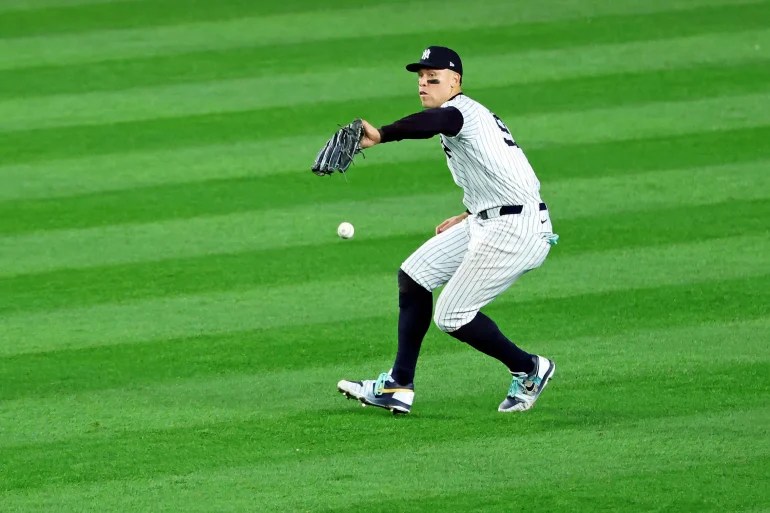
Aaron Judge

First, Judge was the sleeping giant coming wide awake . . .

They’ll remember Shohei Ohtani jamming his shoulder on a failed Game Two stolen base attempt, leaving himself all but useless for most of the Series, but insisting upon staying in the lineup just in case. If only for the presence.

They’ll remember Dodger starting pitcher Jack Flaherty keeping the Yankees to two runs starting Game One but getting flogged for four before he could get out of the Game Five second—including Aaron Judge, heretofore the Yankees’ first among the sleeping giants, awakening himself and Yankee Stadium with a two-run homer in the bottom of the first, followed immediately by Jazz Chisholm, Jr.’s solo bomb . . . until . . .

They remember the Yankees leading 5-0, and Yankee starter Gerrit Cole striking Gavin Lux and Ohtani out swinging back to back, and not one Dodger hit thus far.

Until . . . come the fifth . . .

* With Kiké Hernandez aboard on a leadoff single, busting any shot Cole had at a no-hitter, Tommy Edman lined one that Judge—who committed only one error all year to that point—normally catches in his sleep. This time, the ball hit the web of Judge’s glove and bounced away.

* Five pitches later, Will Smith grounded one to Yankee shortstop Anthony Volpe’s right. Volpe picked it clean the way a Gold Glover does. Then he threw an awkward short-hopper to Chisholm at third the way a Cold Glover does. Chisholm couldn’t get the handle on that throw. The Dodgers had the bases loaded and nobody out.

* The Mookie Monster singled Hernandez home, on a squibber first baseman Anthony Rizzo had to step back to snag because it was spinning like a gyroscope, practically . . . leaving Cole not covering first because the pitcher took a bad route to the ball, leaving both men resembling raw rookies with signals crossed and knotted.

* Freeman singled Edman and Will Smith home and set up first and third.

* Teoscar Hernández doubled Betts and Freeman home.

* And every last one of those five runs in the Dodger fifth was unearned.

Aaron Judge

. . . but, then, his unlikely error began handing the Dodgers the fifth inning and beyond.

“This is as bad as it gets,” Cole said postgame. “It’s the worst feeling you can have. You have to keep sometimes willing yourself to believe and give yourself a chance. You keep pushing and pushing, and ultimately, you fall short. It’s brutal.”

“You can’t give teams like that extra outs,” said Judge, who’d made what threatened to be the play of the night when he stole an extra-base hit from Freeman by scaling the left center field fence in the fourth. “They’re going to capitalize—their 1-2-3 at the top of the order, they don’t miss. You give them a chance with guys on base, they’re going to capitalize. You gotta limit the mistakes.”

Then, everyone will remember Blake Treinen, the man who usually gets the final three outs of a Dodger win, coming in a little bit sooner than usual to clean up a mess and keep the Yankees at bay from there. As in, the bottom of the sixth, with the Yankees back in the lead 6-5 but threatening to put the game back out of reach with first and second, two out, and Volpe due at the plate.

The same Volpe who really started the Yankees’ Game Four mayhem—when they were down 2-1 in the third thanks to yet another Freeman flog two innings earlier, but with the bases loaded on two out—by hitting Daniel Hudson’s first service into the left field seats.

Treinen got Volpe to ground out to second for the side this time. Then he retired the Yankees in order in the seventh and squirmed out of a first-and-second jam with a fly out by Giancarlo Stanton and a swinging strikeout on Anthony Rizzo.

Somewhere in the middle of all that, Buehler ambled down to the Dodger bullpen. Just call me if you need me, boss. He’d only told any Dodger personnel, from teammates to front office people, that he was available to work in Game Five if need be. He made for the Dodger bullpen after the bottom of the fifth.

Then, Buehler started loosening up. Then, he started warming up in earnest. He may well have thrown the equivalent of the first two and a half innings worth of a quality start by the time he got the call to handle the bottom of the Game Five ninth.

He got Volpe to open with a sharp ground out to third base. He struck Austin Wells out swinging on a full count. He struck former teammate Alex Verdugo out swinging on 1-2. Buehler then spread his arms like an old-time nightclub singer inviting applause for the big finish and his mates began pouring onto the Yankee Stadium infield to start the party.

They survived the early bombs by Judge, Chisholm, and Giancarlo Stanton. They survived their Game Four bullpen game plan getting vapourised, going into sacrificial lamb mode the better to keep their six best relief arms available for Wednesday night. They survived their own recent past of, manager Dave Roberts admitted postgame, losing games that handed them what Game Five had before the fifth inning.

They didn’t stop to ask questions when the Yankees began passing out early Christmas presents one botched out after the other in the top of the fifth. They knew the answers going into the Series.

Their knowledge only began with Betts working on playing caroms off the wall almost as incessantly as he does on his batting swing. It only continued with every Dodger no matter how wounded attacking basepaths rather than just running them. The Dodgers scouted the Yankees and determined they were über talented but fundamentally lacking. They didn’t have to advertise it. They simply exposed it.

The Yankees didn’t pay close enough attention to any reports telling them the Dodgers could match them talent for talent even with their MIAs. The Dodgers, for all their star and firepower, were too grounded fundamentally to let the Yankees treat them like just another poor-relations team.

Freddie Freeman

To absolutely nobody’s surprise, Freddie Freeman was named the Series MVP. (A home run in each of the first four games, plus tying a Series record with twelve RBIs, does that for you.) Now named for the late Willie Mays, the trophy depicts Mays making his fabled 1954 World Series catch against Vic Wertz.

Most of all—unlike the title they won at the end of the surrealistic, pan-damn-ically shortened season and under-isolation postseason—nobody so inclined can hang any kind of asterisk on this one. These Dodgers went the distance no matter whose interpreter swindled him out of millions to cover debts to a bookie, no matter who hit the injured list, no matter who lost a season to an injury. No matter that they tied and took what proved the winning lead on a pair of eighth-inning sacrifice flies.

The last man standing? A pitcher who once resembled a mound terror until two Tommy John surgeries and other ailments kept him limited this regular season, only to show up in October looking as close to his former self as his age and body allowed and hell bent on doing something, anything, to secure his team the Big Prize.

“This is the only reason I play,” Buehler said postgame, “for games like this. The whole year—the offseason, spring training, the regular season—it doesn’t matter. Well, it matters, but not like these games. To win championships is why I play. It’s the best feeling in the world. I live for this.”

He pitched the ninth to prove it. A ground out and back-to-back swinging strikeouts. Followed by stepping down from the rubber, holding his arms out like a vintage nightclub singer delivering the Big Finish, and being mobbed by a swarm of Dodgers. They all lived for this.

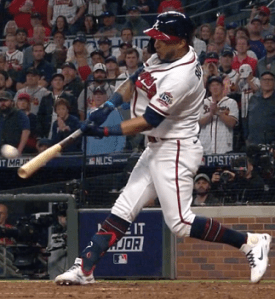
NLCS Game Six: The Braves’ new world

Eddie Rosario

Eddie Rosario hits the three-run homer that proved the game/set/NLCS winner for the Braves. (TBS screen capture.)

You thought Yordan Alvarez was the force the Red Sox couldn’t stop in the American League Championship Series? Have a good, long look at Eddie Rosario, the force the Dodgers couldn’t stop in the National League Championship Series.

There should be some interesting showdowns in the forthcoming World Series. When each LCS Most Valuable Player threatens to throw every round of ammunition they have, including cruise missiles, at each other’s pitching and defenses. If Alvarez and Rosario stay as they just were, they’ll make World War II resemble a snowball fight.

Rosario’s three-run homer off Walker Buehler in the bottom of the fourth Saturday night, and the Braves bullpen—especially AJ Minter and Tyler Matzek—throwing five one-run, ten-strikeout, one-walk innings, sent the Braves to the World Series with a 4-2 win. The regular season’s least-winning division winner buried the season’s second-winningest team.

Maybe the Astros don’t resemble such overdogs after all? Maybe this year’s Braves resemble not on-paper favourites but a miracle team?

Wrestled by the Dodgers out of last year’s short-season, ghoulash-playoff National League pennant. Buried a game under .500 at this year’s All-Star break. Then spending the second half playing .611 baseball while most of the rest of the National League East—which wasn’t all that powerful in the first place—dissipated. The Astros were .604 at the break but .563 in the second half.

Now the Braves stand as National League champions with a legitimate shot at taking the Astros down. They manhandled the Dodgers when it mattered most Saturday night. They didn’t let a little thing like getting blown out 11-2 in Game Five to lose twice in three games in Dodger Stadium bother them all that much.

“We’re up 3-2, and we’re going home,” said Braves first baseman and franchise face Freddie Freeman after Game Five. “It’s a great position to be in.” The guy whose eighth-inning division series Game Four blast off Brewers relief ace Josh Hader made the NLCS possible for the Braves in the first place sounded like an incurable optimist then. After Game Six, he sounds like a prophet.

But he put any prophetic powers he had to one side in the middle of the Braves’ postgame celebration. “I think this might be the definition of pure joy,” he said. “It really is. I really don’t, it hasn’t hit me at all. I don’t really know how to feel.”

Rosario know exactly how to feel, especially after he caught hold of Buehler’s dangling cutter with Travis d’Arnaud (two-out walk) and pinch hitter Ehire Adrianza (two-out double) on second and lined it a few seats inside the right field foul pole. “It’s truly a great moment,” Rosario said amidst the celebration, “not just in my career, but in my life as well, but I want more. I want to win the World Series.”

He was one of three mid-season trades Braves general manager Alex Anthopoulos delivered when the Braves resembled the walking dead. They’d lost young superman Ronald Acuna, Jr. for the year to a torn ACL. They’d lost young pitching comer Mike Soroka to an Achilles tendon blowout after nine months rehabbing its original tear. They’d lost bombardier Marcell Ozuna to domestic violence issues and administrative leave.

Only one man around or observing the Braves decided there was still something worth saving. Anthopolous brought in Rosario from the Indians plus former Dodger Joc Pederson from the Cubs, Adam Duvall from the Marlins, and Jorge Soler from the Royals.

Pederson made himself enough of a pain in the rump roast casting a string of pearls before swine against his former team with his NLCS heroics at the plate. But even Anthopolous couldn’t have predicted Rosario—traded from the Indians for faded early-season pinch-hitting wonder Pablo Sandoval; the guy who came to the Braves injured and unable to play until 28 August—would steal the show and the set in the end.

“It’s still not lost on any of us that we didn’t accomplish our goal,” said Dodgers manager Dave Roberts postgame. “But for me, I’m giving credit to the Braves, because they outplayed us, plain and simple.”

The Dodgers knew going in that winning Game Six Saturday night would be on wings and prayers almost regardless of the opponent. Especially after Max Scherzer’s wing still remained dead enough to keep him from starting the game. Especially having to put the ball into Buehler’s wing on three days’ rest for only the second time in his young and promising career and this postseason.

They couldn’t afford a bullpen game so close to the one that hoisted them while they blew the Braves out in Game Five. But for three innings Buehler looked more than capable of keeping the Braves at bay, other than Austin Riley’s ground rule RBI double in the bottom of the first.

“I could tell when I was warming up that it was still tired,” Scherzer said after his Game Six scratch. The concern is “arm fatigue.” Historically, “arm fatigue” or “shoulder fatigue” have proven too often that they’re euphemisms for more serious issues. Late Saturday we learned Max the Knife said he’d be good to go for starting Game Seven.

Could it be our boy’d done something rash? The Dodgers still had to get there first. So much for that idea.

Scherzer’s trade deadline acquisition from the Nationals along with shortstop Trea Turner helped secure the Dodgers’ postseason arrival in the first place. Now, no matter what Buehler had starting Saturday night, the Dodgers’ streak of seven straight postseason elimination wins started Game Six close to final jeopardy.

Even allowing their injury quotient, they’d played like minor leaguers in most of the first four NLCS games. Chris Taylor almost singlehandedly yanked them back to the majors with his three-bomb Game Five.

Even if they managed to make the Braves look somewhere between silly and foolish in that game, by way of a bullpen worn down to their own winging prayers, and a jack-of-most-trades who’d hit about half his own weight down the final season stretch but who suddenly resembled what used to be his Hall of Famer-in-waiting teammate Albert Pujols.

These Dodgers couldn’t afford much of anything entering Saturday. They entered the postseason without first baseman Max Muncy thanks to his dislocated elbow and without longtime pitching ace Clayton Kershaw thanks to an elbow strain, and Dustin May to Tommy John surgery.

They’d lost reliever Joe Kelly to an injured bicep and third baseman Justin Turner to a hamstring injury during the NLCS. Both were considered gone for the rest of the postseason, however long it might last for the team that won 106 regular-season games—but still had to win the wild card game before the division series triumph that put them here at all.

Dodger fans approaching Game Six wanted to think, “They have us right where we want them,” even in Atlanta. It turned out the Dodgers had the Braves right where the Braves wanted whatever remained of Los Angeles’s Blue Man Group.

It didn’t have to be a plunge. It had only to be Minter relieving starter Ian Anderson and pitching four-strikeout, three-up/three-down ball in the fifth and the sixth. It had only—and especially—to be Matzek, walking into a second-and-third, nobody-out Dodger fire, after A.J. Pollock doubled the second and final Dodger run home . . . and striking out the side on eleven pitches. Including the Mookie Monster on three straight, ending the last serious Dodger threat of the night.

The night before, Red Sox starter Nathan Eovaldi bulled his way out of a bases-loaded jam in Houston by striking out the side. The difference was that Eovaldi stuck his landing while his offense remained sound asleep. Matzek stuck his landings with a two-run lead to protect and hand off.

He dispatched the Dodgers three-and-three in the eighth, handed Braves reliever Will Smith the two run lead, and watched with a packed Truist Park as Smith struck out the first two before getting Pollock to end it with a ground out to shortstop.

Once upon a time, Matzek was a Rockies washout who had to re-invent his pitching career with the independent leagues’ Texas AirHog. Now he’d blown what air was left out of the Dodgers’ tires. With his room for error about the size of a linen closet.

“My job is simple,” the beefy lefthander said after the game. “It’s go ahead, get out there and just try to strike guys out . . . I can’t let a pop up or a ground ball go through. I am looking to get those guys out and strike them out. It’s a simple job. Just go out there and throw my best stuff and I was lucky that my best stuff worked tonight.”

Just about all the Braves’ best stuff worked Saturday night. Just about none of the Dodgers’ did.

Especially against that mid-season pluck from the Indians who just nailed a 1.647 OPS for the entire NLCS, with a posteason series record-tying fourteen hits, nine runs driven in, three home runs including two in Game Four, two four-hit games, plus the base hit that walked a second straight Braves win off in Game Two.

This is a National League champion who didn’t even reach the .500 level until 6 August. They broke the record for the latest .500 reach by three days. The previous record holder was a team that went on to win the pennant and sweep the World Series. You may have heard of them: the 1914 Miracle Braves.

Sometimes things that happen to be in your franchise DNA take awhile to manifest. For the not-so-miraculous Astros awaiting the World Series showdown, that may not prove to be a good thing. It may well depend upon which half of Yordan and Eddie Tonight proves the bigger performer.

They may not have the Hall of Fame power (pitchers Tom Glavine, Greg Maddux, and John Smoltz; third baseman Chipper Jones) of the last Braves World Series team. But there shouldn’t be anyone calling this year’s Braves flukish now.

Freeman frees the Braves to await their NLCS opponent

Freddie Freeman

Jubilant Freddie Freeman approaches the plate to finish the eighth-inning bomb that held up to win the NLDS for the Braves Tuesday night.

Maybe it didn’t have quite the last-split-second hair raising quotient that the Red Sox’s final two American League division series wins had. But it wasn’t any less dramatic for Freddie Freeman and his Braves in winning their National League division series Tuesday.

Freeman’s eighth-inning tiebreaking home run off Brewers relief ace Josh Hader turned out the finishing blow in a set during which both teams scored as many runs in the first three games as they ended up scoring in Game Four alone.

What made the bomb so luminous, too, was that it was only the second time in the whole 145-year history of the franchise that any Brave delivered what proved a postseason series-winning hit in the eighth or later. It took one season shy of three decades for Freeman’s homer to join Francisco Cabrera’s National League Championship Series-winning base hit. (The fabled Sid Bream mad-broken-bodied-dash.)

“I’ve had a lot of cool moments in my career,” Freeman said postgame, “but so far I think that’s going to top them right there. But hopefully that’s not the last cool one.” Right now, nobody’s willing to bet too heavily against either Freeman or his Braves. Yet.

You heard all season long about this or that team being wracked by injuries and surrealities? Few had to compensate as heavily as the Braves did. Too many teams losing their number-two franchise player, one of their best young pitchers, and a reliable other power bat might have collapsed like a blimp.

The Braves lost Ronald Acuna, Jr. thanks to a torn ACL making a play in center field. They lost Mike Soroko after his Achilles tendon blew out in May—after nine months’ rehab following its initial 2020 tear. They looked as though their season had paid put to hit without once seeing .500.

They lost Marcell Ozuna when the outfielder/bombardier was arrested for domestic violence in July—charged first with felonious aggravated assault and attempted strangulation, charges reduced to misdemeanor simple assault and battery, on administrative leave through the end of the Braves’ season, after he entered a diversion program.

When Acuna went down, and the Braves more or less sputtered into and past the All-Star break, general manager Alex Anthopoulos made his first move, bringing former Dodger Joc Pederson aboard from the Cubs in exchange for a minor league prospect.

That was Pederson pinch hitting for Braves reliever Luke Jackson in the Game One eighth and hitting a solo home run off Brewers reliever Adrian Houser for the only Braves run in the only series loss. That was also Pederson in Game Three, pinch hitting for Braves starter Ian Anderson, facing Houser again, and launching the three-run homer that proved the only Game Three scoring.

Houser may start seeing Pederson in his sleep. The Braves just want to keep seeing him mash. Even if he got the Game Four start as his reward and had to settle for pushing home the first of the two runs that tied things at four with a ground out to second base.

Freeman thinks landing Pederson merely began the Braves’ reversal. “When Alex went out and got Joc,” he said, “it brought a sense of energy that it just showed us that they still believed in us, to go add at the deadline.” Which is exactly what Anthopolous did. He nailed three 30 July trades to bring Jorge Soler from the Royals, Adam Duvall from the Marlins, and Eddie Rosario from the Guardians-to-be.

The NL East wasn’t a powerful division to begin with. But the longtime-leading Mets imploded, the Nationals hit the reset button, and the Phillies proved just short of being able to hold on. In Atlanta, as proverbially and poetically as feasible, that which didn’t destroy the Braves only made them stronger.

They went 36-19 to finish the regular season, including a too-simple-seeming sweep of the Phillies opening the final week to keep them from finishing what they threatened awhile to do and overthrow the Braves. They even shook off Soler’s COVID diagnosis entering the postseason. Now they’ve dispatched a Brewers team that won seven more regular-season games to lead an only slightly stronger NL Central.

They’re waiting to see who’ll be the last men standing between the Dodgers and the Giants, after the Dodgers tied that division series in Los Angeles Tuesday night in an all-Dodgers/all-the-time 7-2 win.

The game was a still-manageable 2-0 Dodger lead, with the Giants compelled to a bullpen game against a short-rested but deadly effective Walker Buehler, when Mookie Betts checked in in the fourth against Jarlin Garcia—after Buehler himself led off by reaching on an infield error.

“It’s not something we want to do all the time,” said Buehler about going on only three days rest, “but I felt that if things didn’t go our way [in the third game], I would feel really weird not pitching a game that we could lose a series.”

He didn’t have to worry. Until he surrendered a leadoff single to Evan Longoria and a one-out walk to Steven Duggar in the fifth, Buehler pitched stoutly and had to shake only one previous first-and-second spot of trouble away in the second. He even had the Giants slightly flummoxed when he went to his changeup a little more often than they were accustomed to seeing from him.

When the Mookie Monster parked an 0-1 pitch into the right center field bleachers, it suddenly seemed a question not of whether but by how big the Dodgers would take the game. An inning later, Betts sent Cody Bellinger home with a sacrifice fly deep to left center field. But Dodger catcher Will Smith—just call him the Fresh Prince of Dodger Stadium—squared off against Giants reliever Jake McGee with Corey Seager aboard (leadoff line single) and hit the first pitch over the left center field fence.

The Giants looked so overmatched in Game Four that their only two runs scored on ground outs, one with the bases loaded. That was Evan Longoria scoring on Darin Ruf’s grounder to second. The other was Brandon Crawford coming home in the eighth when Kris Bryant grounded one to the hole at third.

Buehler’s short-rest deliverance plus the Dodgers’ bats ensured Julio Urias on regular rest starting Game Five against Logan Webb in San Francisco Thursday. For the Braves, that’s going to be very must-see television. Which is what it already was on the left coast and elsewhere.

For the Brewers, it’s a too-early winter vacation after their pitching virtuosity proved futile against the disappearance of their bats. Christian Yelich’s back injury-abetted struggles continued in the division series, and while the Braves didn’t exactly bring the walls crumbling down the Brewers hit a measly .192 in the set—32 points below the Braves.

They did get beaten in the end when the Braves’ best batter launched against their best pitcher in the Game Four eighth. Starting Eric Lauer for Game Four because ace Corbin Burnes said he wasn’t feeling one hundred percent proved a mistake, and so did manager Craig Counsell not bringing Brandon Woodruff in earlier in higher-leverage.

But then here’s where the Brewers’ best bats fell too short. Avisail Garcia? Eight strikeouts, only two hard-hit balls, and two singles in fifteen at-bats. Kolten Wong? Five strikeouts, likewise only two hard-hit balls, and one single in fifteen at-bats. Willy Adames? Five hits in seventeen at-bats—four singles and a double, plus nine strikeouts and only three balls hit hard.

That’s why the Brewers pitched the division series like Hall of Famers—their three starters Burnes, Woodruff, and Luis Peralta showed a collective 1.56 ERA and 0.92 walks/hits per inning pitched rate, not to mention nineteen strikeouts in 17.1 innings pitched—but the Braves still took them out sweeping three after a Game One Brewers win.

“The vibe is the best that we ever had in this series,” Adames said before Game Four. “Today, the guys, I guess they woke up in a great mood. They came with energy. And I feel today we had the best vibe that we’ve had so far this series so far.”

The trouble was that the Brewers went in with the best vibes but the Braves played them as if they were jazz vibes legend Milt Jackson hammering out another virtuoso chorus of “Bags’ Groove.” Now the Braves wait to see who gets bagged in San Francisco Thursday night.

“Remember 1951?” OK, you asked for it.

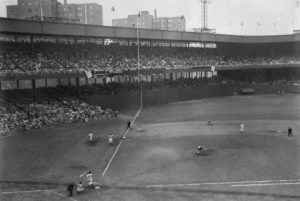
The Shot Heard 'Round the World

No, Giants fan or worker, you do not want anyone  remembering the Mugging at Coogan’s Bluff.

This one’s for the Giants fan[s] or worker[s] who hoisted a large, stylish enough sign showing a flying baseball and the words, “Remember ’51,” in Oracle Park Friday night. Whomever you are, allow me to assure you that the last thing you want anyone remembering is 1951.

I get it. You’re remembering the Giants mounting a staggering pennant race comeback from thirteen games out of first place around mid-August to force a playoff against the Dodgers for the 1951 National League pennant.

You’re remembering Ralph Branca relieving Don Newcombe and pitching to Bobby Thomson. You’re remembering, especially through that flying baseball image, Thomson turning on Branca’s 0-1 fastball and depositing it into the lower deck of the Polo Grounds’ left field seats.

You’re remembering The Shot Heard ‘Round the World. You’re remembering Giants broadcaster Russ Hodges going out of his mind screaming The Giants win the pennant! The Giants win the pennant!

In the thrill of history’s hour Friday night, the 107 game-winning National League West champion Giants and the 106 game-winning National League wild card Dodgers finally met in a proper postseason for the first time ever in their long, ancient, rivalrous history together.

That was then: A pair of pennant playoffs between each other, under the ancient baseball regimes, in 1951 and 1962, both won by the Giants. This was Friday night: The Giants won division series Game One, 4-0, in which the Dodgers weren’t even a quarter of the kind of tenacious and energetic they’d been in beating the Cardinals at the last minute in the wild card game.

Giants second-full-season starter Logan Webb out-pitched the Dodgers four-full-season veteran Walker Buehler. Webb deployed his impressive collection of breaking balls and changeups to catch the Dodgers off-balance, sometimes asleep. Buehler struggled to find a handle but managed to endure after Buster Posey—the last Giant standing from their 2010, 2012, and 2014 World Series winners—sent a two-run homer ricocheting off the back of a Levi’s Landing column into McCovey Cove in the bottom of the first.

By the time Buehler found his handle, he got to exercise it only long enough for another former World Series champion, Kris Bryant (2016 Cubs, a Giant since this year’s trade deadline), to park one into the left field seats to open the bottom of the seventh. With Buehler out of the game after one out in that inning, Brandon Crawford hit one into the center field bullpen with two outs against a second Dodger reliever, Alex Vesia, in the bottom of the eighth.

So, yes, the Giants opened decisively enough and impressively enough Friday night. Now, back to you, Giant fan/worker with the “Remember ’51” sign. I saw the sign, in a brief moment on the TBS telecast early in the game. They didn’t show it again all night but it stuck in my head well into Saturday morning.

You don’t really want the rest of baseball world to remember what you might actually hope the thrill of history’s hour now might compel it to forget. Here’s a hint: The Giants stole the pennant! The Giants stole the pennant!

The 2017 Astros weren’t baseball’s first cheating champions by a long Shot. Come to think of it, neither were the 1951 Giants. But since you brought it up with that stylish-looking sign, gather around and allow me to ask.

Do you really want us to remember again what ’51 Giants manager Leo Durocher hatched after he discovered his recently-acquired spare part, Hank Schenz, owned a hand-held Wollensak spy glass—and had used it to steal signs from the Wrigley Field scoreboard behind that park’s bleachers when he was a Cub?

Do you really want us to remember again that Durocher called a team meeting to announce he’d cooked up a plot to start stealing signs from the Polo Grounds clubhouse above and just beyond center field? With catcher-turned-coach Herman Franks wielding the Wollensak and tapping codes for the stolen signs to the Giants bullpen, from where the purloined intelligence would be flashed to the batter?

Do you really want us to remember again that, when Durocher asked his players who wanted the stolen signs, his Hall of Fame left fielder Monte Irvin refused them? Meaning his rookie Hall of Fame center fielder Willie Mays wouldn’t take them, either? Much as Mays felt beholden to “Mister Leo,” he felt even more beholden to Irvin as a big brother figure, and he’d assuredly follow Irvin’s lead.

Do you really want us to remember again how, while the Dodgers went a very solid 33-26 down the stretch in August and September 1951, the Giants with their little furtive intelligence operation cheated their way to shooting the lights out—going 40-14 down the same stretch, including a sixteen-game winning streak that included thirteen home wins—to end that season in the first-place tie?

Do you really want us to remember again the day Dodger coach Cookie Lavagetto smelled enough of a rat to bring a pair of binoculars into the Dodger dugout in a bid to catch the Giants in the act—but had them confiscated post haste by an umpire?

As now-retired Thomas Boswell snorted in 2001, after The Shot Heard ‘Round the World was chosen baseball’s greatest moment by The Sporting News and second-greatest sports moment by Sports Illusrated, “Why, it would be unfair for the victims to use binoculars to expose the telescopic cheaters!”

Do you really want us to remember Bobby Thomson telling Joshua Prager, the Wall Street Journal writer who affirmed the Durocher plot at last in 2001 (turning it into a splendid but troubling book, The Echoing Green), “I guess I’ve been a jerk in a way. That I don’t want to face the music. Maybe I’ve felt too sensitive, embarrassed maybe.”

Maybe you don’t remember that Ralph Branca never blamed anyone beyond Durocher directly when talking about it for publication. Branca always said of Thomson (who became his friend in later years), “He still had to hit the pitch.” He carried the weight of surrendering that pitch and that loss with uncommon grace for the rest of his and Thomson’s lives. (Thomson died in 2010; Branca died in 2016.)

“Over the years, when interviewing Thomson and Branca,” Boswell wrote, “I’ve been struck that Thomson seemed a bit ambivalent about his Moment while Branca never seemed the least ashamed. I took it that Thomson felt apologetic because he’d caused Branca a lifetime of nagging questions.”

You, Giant fan[s] or worker[s] hoisting “Remember ’51” Friday night. Before you bring that sign back Saturday night, rooting for the team that stunned this year’s National League by winning the West despite everyone else trying to write them off as a fluke phenomenon, think it over. Hard.

You don’t really want everyone else remembering the greatest shame and sham in Giants history. You don’t really want us remembering the Miracle of Coogan’s Bluff long exposed as the Mugging at Coogan’s Bluff. You don’t really want us to remember all over again that the Giants stole the pennant! The Giants stole the pennant!

Do you?