The Yankees, only human after all

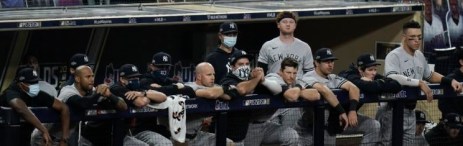
The Yankees watch their season dissipate in the three-up, three-down top of the ninth Friday night.

“Man,” tweeted a Yankee fan of my acquaintance after Friday night’s arms race between the Yankees and the Rays ended. “So sad. Every. single. year.”

Did you ever think you’d see the day when Yankee fans finally tasted what baseball’s hardest of hard luck franchise fans tasted for about as long as the Yankees once ruled the earth? Neither did I.

Did you ever think you’d hear Yankee fans talking the way Chicago Cub and Boston Red Sox fans spoke for decades before the 21st century arrived? Never mind the Red Sox—the Red Sox—owning more 21st century Series rings than the Yankees?

The team that owned most of the 20th century is finding the 21st century impossible to navigate. If it comforts Yankee fans any, their 20th century ancestors found the first two decades of that century tough to navigate, too.

From the birth of the American League through the end of 1919, the franchise finished as high as second place three times. The closest they got to a World Series then was finishing a game and a half behind (imagine that!) the Red Sox, then known as the Americans. When, you ask? The same year New York experienced a pair of firsts: its first underground subway, and its first New Year’s Eve blowout in Times Square.

The 21st century Yankees are actually a little more fortunate. They’ve been to sixteen postseasons, two World Series, and won one Series. Their ancestors of a century ago would have killed to take that kind of jacket into 1920.

Telling that to today’s Yankee fan might amount to wasted energy. There are more cliches attached to the Yankees for better or worse than to any other major league team, and the truest of those are 1) they don’t like to lose; and, 2) they define failure as any season in which they don’t win the World Series.

In most of the 20th century, once they got their bearings for keeps, it was a lot easier for the Yankees to live up to those type of self-imposed pressures. They owned the bulk of the reserve era, when they scouted the deepest of the deep bushes, traded or sold from strength, and plucked jewels suspected and unsuspected alike from the mere mortals.

The free agency era hasn’t been as kind to them as their adversaries thought at first. Turns out that buying pennants—which the Yankees haven’t been the only ones to accomplish, no matter what their riches and resources and Joe and Jane Fan lead you to believe—wasn’t going to be an annual Yankee accomplishment.

Since the Messersmith decision at the end of calendar 1975, the Yankees have been to 27 postseasons, won eleven pennants, and won seven World Series. That’s not exactly the same as their dynastic reserve era, but even the Yankees know there are 29 other major league franchises who’d sell their mothers and grandmothers to show even half that kind of success.

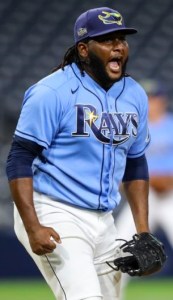
I haven’t heard of any groups of Yankee fans gathering yet to burn Aaron Boone or Aroldis Chapman in effigy after Game Five of the division series freshly lost. But any to come wouldn’t shock. If the truest cliche about the Yankees is that they don’t like to lose, the truest cliche about their fans this century is, “To err is human, to forgive is not Yankee fan policy.”

They’re not even burning longtime general manager Brian Cashman in effigy just yet. Not even if they’re fuming wrongly that Cashman invited too much analytics into the Yankee mindset. The only wonder about that might be what took the Yankees so long to dip into those waters in the first place.

Too much analytics? They just got shoved out of the postseason by a Rays team that lives on analytics. Analytics and assembling competitive teams out of painfully average players on annual budgets that don’t equal a third of Gerrit Cole’s entire nine-year Yankee contract.

Too much dependence on the home run? Well, now. They didn’t become the Bronx Bombers in the first place because they established a tradition of slap-hitting, scratch-hitting basepath pests. The Hitless Wonders, the Gas House Gang, the Go-Go Sox, and the Runnin’ Redbirds they ain’t.

News flash: When pitching doesn’t win postseasons, home runs do, more often than not. The Yankees lived and died by the bomb on the irregular season and hit fourteen more than the Rays. They just hit one fewer than the Rays in Game Five. (And, one fewer than the Rays all ALDS long, incidentally.)

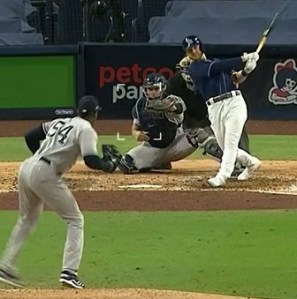
Until Mike Brosseau ended a ten-pitch wrestling match with Chapman with a dramatic one-out home run in the bottom of the eighth Friday night, the Yankees and the Rays were enjoying and wrestling with their own Night of the Pitchers.

A game like that was the most appropriate way to honour the memory of Whitey Ford, the Yankees’ witty and popular Hall of Fame lefthander, who died at his Long Island home Thursday night while watching the Yankees and the Rays tangle.

Cole did exactly what the Yankees are paying him $324 million for nine years to do. The Rays’ and the Yankees’ bullpens did what top of the line bullpens are supposed to do, even though the key Yankee relievers weren’t quite as rested as the key Rays’ bulls.

Until the eighth those pitching staffs had only one run each torn out of them, both solo bombs. The pitching on both sides even shook off a few scattered defensive miscues on both sides.

What the Yankees missed all year—aside from a near-repeat injured list performance akin to 2019’s making the New England Journal of Medicine into the Yankee yearbook—was pitching depth.

They chugged, slugged, and bulled their way to second place in the AL East, blasted the Cleveland Indians to one side in the wild card round, but bumped into the AL East champion Rays. Discovering the Rays could take everything they could dish out from the comfort of their better-rounded bullpen depth and deployment.

The Yankees missed Luis Severino recovering from Tommy John surgery, they lost James Paxton to a flexor strain, and they lost Domingo German to a domestic violence suspension. They worked around Adam Ottavino’s fall from what’s considered the Yankees’ inner circle of bullpen trust.

And it blew up in their faces in Game Two, when Boone deciding to try out-Raying the Rays with an opener and a bullpen game blew up in the Yankees’ faces. That was the first of Boone’s two most egregious series mistakes.

The second was pinch hitting for Kyle Higashioka—establishing himself as the best Yankee option behind the plate—with slumping Mike Ford to open the top of the eighth, then sending Gary Sanchez out to catch the rest of the game. Sanchez’s bat was faltering and his plate work more so.

It was Sanchez who didn’t think that maybe Chapman should have served Brosseau a tenth-pitch splitter instead of a down-and-in fastball. It was Sanchez who may have forgotten that Chapman’s vaunted speed-of-light fastballs get more hittable the longer he works because they don’t climb the ladders or go out on the limbs as well as when he works his first few hitters.

And it was Sanchez and Boone who forgot Chapman nearly let that Game Seven thriller in the 2016 World Series get away from those Cubs with an RBI double and a game re-tying two-run homer. Not to mention failing to put Houston’s Jose Altuve aboard with two outs, George Springer on base, and a spaghetti bat on deck, the better to finish pushing last year’s ALCS to a seventh game.

Sanchez and Boone’s memory vapours disappeared over the left field fence. The only Yankee manager ever to lead his charges to back-to-back 100-plus win seasons in his first two seasons on the Yankee bridge has become Sisyphus in pinstripes.

Sooner or later, the jubilant Rays trolling the Yankees by singing along with Frank Sinatra’s version of “New York, New York” had to call it a night after a hard-earned hearty party. The questions around this Yankee edition won’t call it a night, or a day, too soon this winter.

Neither will the continuing humbling of Yankee fans, who are seen only too often, with too much justification, as among baseball’s most singularly arrogant. Their absolute lowest of the low might have been the subset who trolled Astros pitcher Zack Greinke over his longtime battle with clinical depression last October.

Their forebears were spoiled rotten by all those 20th century decades of Yankee imperialism but never that disgraceful. Now the sons and daughters of those old imperial Yankee fans have to learn, little by little, to live with the idea that the Yankees may be only human, after all.

The boundless world of Rays imagination

A TBS screen capture (including strike zone) as Michael Brosseau demolished Aroldis Chapman’s tenth-pitch fastball Friday night.

“The world of reality has its limits; the world of imagination is boundless,” wrote the French philosophe Jean-Jacques Rousseau. Baseball is so often like that. His near-namesake Tampa Bay Rays utility man re-proved that Friday night.

You’ve heard of the Year of the Pitcher, right? Until Michael Brosseau squared off against recent near-executioner Aroldis Chapman in the bottom of the eighth, Friday was the Night of the Pitchers.

Neither the Yankees nor the Rays wanted to hear any nonsense about re-juiced postseason baseballs. They made Game Five of their American League division series into an arms race. With only three rude interruptions and Brousseau delivering the one that mattered most.

Brosseau. The guy Chapman nearly beheaded with a 101 mph fastball late in the regular season. The guy facing now facing Chapman after entering the game as a sixth-inning pinch hitter. The guy Thomas Boswell says was “undrafted, bypassed 1,216 times–is a ‘utility man’ who played every position except SS & C this year (including pitcher).”

The guy who wrestled Chapman to a ten-pitch plate appearance, after beginning with an 0-2 count, and hit that tenth pitch over the left field fence. Meaning, ultimately, game, set, and a Rays date with the Houston Astros in the American League Championship Series to come.

“I was just trying to get a runner on and get the next guy up,” Brosseau said after the game. “We knew the hits were coming not very often tonight . . . Obviously, going up there, trying to find a barrel, thankfully it happened.”

Brosseau may not have to buy his own steak in Tampa Bay for a very long time to come.

These Rays and these Yankees threw the kitchen, bathroom, and laundry room sinks at each other from the mound and got through seven and a half innings tied at one, with both runs on home runs and twenty strikeouts between them. And the Rays managed practically to sneak a 2-1 win.

That’s the number 28 payroll in all the Show taking down the number one payroll, if you’re scoring at home. (The Yankees actually hadn’t been the number-one payroll since 2011.) The barely no-name Rays, full of excrutiatingly average major league baseball players, taking down the Empire Emeritus and its usual pack of high-priced, high-profile spreaders.

The Rays, who survived Gerrit Cole’s first short-rest outing in his major league life, who got no-hit by Cole until Austin Meadows found the screws on a 1-1 fastball and sent it over the right field corner fence in the bottom of the fifth.

The Rays, whose first reliever on the night, Nick Andersen, didn’t let Aaron Judge’s fourth-inning leadoff launch to about the same region over the same fence knock him into praying to find the nearest available mouse hole into which to crawl in anguish. He shook it off and worked two full innings’ shutout relief from there. Nothing to it, folks.

The Rays, who withstood everything Zack Britton threw at them, pried one base hit and reached on one abnormal error by Yankee third baseman Gio Urshela but cashed neither of them in, until Brosseau won that showdown with Chapman.

“I knew it felt good,” Brosseau said about the immediate contact with that triple-digit-speed fastball. “I haven’t had much playing time [in Petco Park], so it’s kind of hard to read the dimensions, to see from daytime to nighttime, but it felt good off the bat.”

Just don’t ask him about payback. Everyone else noted poetic justice and karma turning superbitch. Not Brosseau. “No revenge,” he said. “We put that in the past. We came here to try and win a series. We came here to move on, do what we do best, and that’s play our game.”

Re-juiced postseason baseballs took about more than a third of postseason talk with all the home runs interfering in bunches with airline flight patterns until Friday night. The Yankees and the Rays must have drained them before getting started. Three hits all night long, and all three were home runs that almost barely cleared the top of the fences.

On normal rest Cole has a 2.74 earned run average. On five or more days rest, it’s 3.73. On short rest, it could have gone either way Friday night. Especially with the Rays having won the ten straight previous games in which Tyler Glasnow was their starting pitcher, or opener if you prefer. Not to mention the Rays’ key bullpenners entering the game rested slightly better than the key Yankee bulls.

It didn’t start brilliantly for Cole. He walked Brandon Lowe after striking Meadows out impressively, then drilled Randy Arozarena on the first pitch—days after Arozarena took Cole over the fence—which he didn’t likely mean to do, but good luck convincing the Rays, who’ve been waging bad-blood war against the Yankees all year as it is.

The punchout of Meadows made Cole the fastest pitcher to reach a hundred postseason strikeouts, in 79 innings. He nudged the Los Angeles Dodgers’ Clayton Kershaw to one side with it. But he walked the bases loaded around a ground out before catching Joey Wendle looking at strike three for the side.

Cole struck out the side swinging in the second, with fastballs hitting just a hair’s breadth short of 100 mph and a generous helping of late movement, and off-speed breakers maybe two hairs’ breadth short of 90 but diving like paratroopers. And then, he struck out two out of three in a 1-2-3 third.

Why, he even made early mincemeat of a hitter who usually does likewise to him. He got rid of Ji-Man Choi twice on ground outs, after the husky Rays first baseman came into the game hitting .526 off Cole including four home runs.

Himself starting on two days’ rest, Glasnow could have ended up with two on and no outs to open the game if Choi hadn’t made a pair of acrobatic plays to turn a pair of bad throws into tight outs. Glasnow himself threw D.J. LeMahieu’s leadoff grounder back to the box offline, and shortstop Willy Adames did likewise with Judge’s followup hopper, before Aaron Hicks lined out to deep center for the side.

Pete Fairbanks and Diego Castillo finished what Glasnow and Andersen started. Castillo finished in reasonable style, striking Giancarlo Stanton and Luke Voit out before Urshela’s nasty liner up the third base line got snapped by third baseman Wendle as if having to catch a baby shot out of a cannon to save the little one’s dear life.

This wasn’t exactly the way the Yankees wanted to honour the memory of their Hall of Fame pitcher Whitey Ford, who died Thursday night at home while watching the Yankees and the Rays tangle in Game Four. (Both teams honoured a moment of silence in Ford’s memory before the game began.)

It was almost a year since Chapman surrendered Jose Altuve’s ALCS-winning two-run homer. When not burning up social media calling for manager Aaron Boone’s head post-game, Yankee fans wasted little time calling for Chapman’s. Determining whom to rage against more was tough enough.

What wasn’t tough was to remind yourself that to err is human but to forgive is not fan policy. The good news is that, even with social-distancing considerations, no groups of Yankee fans have opened street parties at which they can run over Boone, Chapman, or other shortfalling Yankees’ jerseys. Yet.

The Yankees probably wish Ford and his Hall of Fame battery mate Yogi Berra had brewed a little mad chemistry from their Elysian Fields positions Friday night. The Rays only hope that, whatever mad science of their own got them through the Empire Emeritus will be enough for them to turn the Astros aside in the coming week.

“They’ve been the team to beat the last few years,” said Brosseau of the team the Rays got thatclose to knocking out in another tight full-five division series last year. “They knocked us out last year so it will be fun to face them again.”

Don’t bet against these Rays just yet. If they could get rid of the Yankees and their bomb squad, they won’t exactly let the thought of the Astros’ suddenly revived long distance callers shake their gill slits.

California bombs, California rough stuff

The pandemic-mandated empty house aside, 5 October might as well be Alex Bregman Day . . .

Mr. October Fifth? What’s up with that?

It’s not Alex Bregman’s birthday. (For the record, that’s 30 March.) It’s not his engagement date. (He popped the question to a Colorado lady named Reagan Howard in January.) It’s not his future wedding date. There seems nothing significant elsewhere for him about that date.

Except when he plays postseason baseball. For a fourth consecutive 5 October Bregman found a pitch meaty enough to send long distance. Mark your 2021 calendar accordingly if you must.

He led off the top of the fourth against Oakland starter Chris Bassitt Monday afternoon, starting an American League division series, and sent a 1-2 service into the pandemically-required unoccupied left field bleachers.

It put his Houston Astros on the board after the Athletics helped themselves to a 3-0 lead on long balls themselves. It gave his infield teammate Carlos Correa thoughts about not wanting to be left out of the action after Kyle Tucker followed with a single through the left side of the infield, Correa hitting a 2-0 pitch over the center field fence.

And—with no small assistance from Oakland’s normally vacuum-handed shortstop Marcus Semien’s boot on Josh Reddick’s two-out grounder in the top of the sixth—the Astros seized the chance at new life, not letting something like a subsequent 5-3 deficit spoil the day, and finished with a 10-5 Game One win.

It almost figured.

There are far worse talismans to attach to a team than 10-5. Especially to a team who got into this convoluted postseason with a losing record and who spent 2018 and 2019 doing not even once what they did Monday—come back from a pair of multi-run deficits.

Especially when several signature Astro bats returned to life at last. Let’s see. George Springer going 4-for-5 after an irregular season in which he had no four-hit games. Correa dialing nine twice and sending four runs home, after an irregular season in which he didn’t send four home or homer twice. The quartet of Bregman, Correa, Springer, and Jose Altuve each driving in at least one run in the same game after not having done that together even once on the irregular season.

And, thanks to the bubble concept putting postseason teams from the division series forward into neutral parks, the Astros’ three postseason wins have now happened in ballparks not their own.

The third, of course, happened in . . . Dodger Stadium. The home of a team with whom they have, ahem, some recent history. The division series home for Games One, Two, and (if necessary) Five of an A’s team that includes the former Astro who blew the whistle on Astrogate at last, last November, after those too well aware of their illegal, off-field-base, altered or extra camera transmitting sign stealing schemes couldn’t convince anyone else to expose it.

“As the game got deeper, the at-bats got better,” said Springer of the Astros’ Monday breakout. “They played the later innings better than we did. We just didn’t have the at-bats we typically do at the end of the game,” said A’s manager Bob Melvin.

How much of a pitcher’s park is Dodger Stadium still, even if it’s not quite the equal of its first two decades? In 91 previous postseason games played there, not once were six home runs hit there. Bregman’s one and Correa’s two were joined by Oakland’s Khris Davis, Sean Murphy, and Matt Olson.

“I’ve never seen the ball carry like that here,” said Astros manager Dusty Baker, who played eight seasons for the Dodgers from the 1970s to the 1980s.

Bregman’s 5 October long-distance mastery has also broken the three-straight-same-date postseason strings of Hall of Famer-to-be Albert Pujols (17 October 2004-05-06) and Francisco Lindor (6 October 2016-17-18). But he’ll have to wait ’till next year for a shot at equaling the five-streaks of Pujols (five straight 30 Mays) and Ryan Braun (five straight 24 Julys) among still-active players.

What’s the regular-season record? Seven. Who holds it? Hall of Famer Lou Gehrig (8 June 1932-38) and former Astros mainstay Lance Berkman. (21 September 2001-07.)

Then the doings down the freeway in San Diego, in Petco Park, had to go steal the show. The Padres had nothing to do with it. The New York Yankees did. Their winning score against the AL East champion Tampa Bay Rays was a measly 9-3, but oh what a show the Yankees made of it.

Somehow, some way, the Yankees find ways to make history just when you think there isn’t a single piece of history left for that franchise to make. It only began with this: Not since 1956 (when Moose Skowron and Hall of Famer Yogi Berra did it in that World Series) had the Yankees hit two grand slams in a postseason at all—but Monday night they sliced salami for a second straight postseason game. No other American League team has ever done that.

Score nine or more runs in three straight postseason-opening games? Nobody did that before the Yankees did it this year. Score 31 runs in its first three postseason games? Nobody did that, either, until this year’s Yankees delivered.

So who the hell needed Gerritt Cole pitching six, striking out eight, and not letting a measly three runs shake him out of his skin before turning things over to Chad Green, Zack Britton, and Luis Cessa?

. . . but John Curtiss knocking down Gio Urshela (29) and Gleyber Torres after his salami was sliced was an uncalled-for and terrible look.

Luis who?

Simple: with a 9-3 lead, Yankee skipper Aaron Boone—with the spectre of no division series days off looming—wasn’t going to burn Aroldis Chapman unless the Rays got ornery in the ninth, which they didn’t. And Cessa got rid of the Rays with no interruption but a mere two-out walk.

Monday’s delicatessen slicer was Giancarlo Stanton in the top of the ninth against Rays reliever John Curtiss. It wasn’t as if Stanton was unfamiliar with Petco Park—he won the Home Run Derby there four years ago. Batting now on 2-2, Stanton caught hold of Curtiss’s slider just off the middle of the plate, and drove it just beyond Rays center fielder Kevin Kiermaier’s glove-extended leap and over the center field fence.

Then Curtiss just had to make the Rays look even worse, didn’t he? The next batter was Yankee, third baseman Gio Urshela—whose second-inning defense would have made ancient Yankees Clete Boyer and Graig Nettles plus Hall of Fame Oriole Brooks Robinson proud, with his leaping stab to pick Manuel Margot’s high hopper and throw him out, then his rolling seat-of-the-pants throw to nail Joey Wendle off a hard smash into the hole.

Curtiss sent Urshela sprawling on an up and in 0-1 pitch, with Urshela finally wrestling his way to popping out to the infield. Then Yankee shortstop Gleyber Torres checked in at the plate. Curtiss waited until 2-2 before playing Torres a little chin music. No wonder Torres couldn’t resist stealing second while Brett Gardner batted next.

Oops. Apparently, an awful lot of people called Torres out for the ninth-inning theft. “I don’t like seeing disrespectful things in the game,” crowed Hall of Fame pitcher Pedro Martinez on a TBS postgame show. Forget that the Yankees went 2-8 against the Rays on the irregular season and might be thinking that, no matter the score or the inning, every run counts.

Martinez might be the wrong man to ask, of course, but if you don’t like Torres stealing second with his team up by six in the ninth, did you like Curtiss making the usually likeable Rays—those unknown soldiers, who can normally beat you with the same aplomb as the big boys with the big names and the bigger paychecks—resemble unsportsmanlike sore losers?

Curtiss also made the Yankees look the way the beasts of the Bronx rarely look—sympathetic. And that’s over a month after Chapman nearly decapitated Michael Brousseau with a 101 mph fastball. But that was then, and Chapman’s been a little wild most of his career, anyway. He doesn’t have quite the control required to plan an execution. Not even with the Rays pitching inside tight to a few too many Yankees on the season before that head scratcher.

You’re embarrassed when a guy slices salami on your dollar? You man up, tip your hat, shake it off, and get the next guy out. You don’t knock that next guy and the guy following him down, off, back, or through just because your ego was sent into half orbit, with or without the bases loaded. (It would also help if you don’t surrender a leadoff single, a walk, a one-out RBI single, and a bases-loading walk to set it up, too.)

Things were notoriously tense enough between the Yankees and the Rays on the irregular season. Then, both sides tried to indicate going in that they were going to do their level best to play nice and no rough stuff. Then Curtiss had to deliver a little un-called for rough stuff anyway. No more Mr. Nice Guys?

Don’t be terribly shocked if Monday’s proceedings make Yankee rooters out of even those to whom rooting for the Yankees otherwise flouts family tradition. For this postseason, anyway, depending on whether the Rays behave reasonably from here on out.

Blake Snell’s hidden plea

2019-12-07 BlakeSnell

Blake Snell was not amused by the Rays trading Tommy Pham.

Within Tampa Bay Rays pitcher Blake Snell’s gutteral emission upon the trade of Tommy Pham to the San Diego Padres, you could find a plea pondered almost as long as professional baseball’s been played. If you wanted to.

On the surface, Snell fuming aboard the social media outlet Twitch was negative amazement that Pham would be surrendered for lesser elements: “We gave Pham up for [Hunter] Renfroe and a damn slap[penis] prospect?” And he has a pretty point, since the Rays may or may not have received equal value in return.

Baseball administrators are nothing if not men and women seeking the maximum prospective performance at the minimum prospective cost, of course. Pham earned $41. million in 2019 and was liable to earn more next season following salary arbitration; Renfroe earned $582,000 in 2019 and isn’t eligible for arbitration until after next year. And the damn slap[penis] prospect, Xavier Edwards, was ranked number five on the Padres prospect list before the deal.

Renfroe in 2019 was the Clete Boyer of outfielders, hitting 33 home runs against a .289 on-base percentage, rather companionable to the longtime Yankee third base legend’s 1967 with the Braves, 26 home runs and a .292 OBP. And Renfroe is a promising defender in his own right. But the Rays are renowned for mulcting large results out of small costs and the words “salary dump” come to mind for some, surely.

Snell apologised almost post haste. “[J]ust saying I’m sorry I’m just upset we’re losing a guy like Tommy who helped our team in so many ways!” he said. “Didn’t mean any disrespect to Edwards who I didn’t know who he was until after I said that. I was just sad to lose Tommy . . . It’s tough losing someone you respect so much and enjoy being around.”

Thus does Snell invite deeper examination, where you may find the unenunciated very present plea for loyalty and the noticeable absence thereof. Except that when you do enunciate it, you provoke another tirelessly tiring debate on where the loyalty disappeared among, well, the players, who need to learn a thing or three about loyalty while they pursue their unsightly riches, yap yap yap.

It’s been that way ever since the advent of free agency, of course. Once upon a time it amused, if only because those bellowing against the lack of player loyalty were only too obvious in their ignorance, willful or otherwise, regarding the lack of team loyalty even to Hall of Famers. In both the so-called Good Old Days and the days, years, decades to follow. It’s still somewhat amusing, even when it gets somewhat annoying.

Referencing Hall of Famers was something I did about a decade ago, for another publication, when pondering the “loyalty” question. (That publication ceased to exist not long after I published my old finding.) It began then and now with there having been but one single-team player (Walter Johnson) among the inaugural five players enshrined in 1936. The first single-team Hall of Famer to follow: Lou Gehrig, in 1939.

It goes from there to those whose careers were entirely or mostly reserve era. Thirty-six single-team Hall of Famers played all or mostly in the reserve era; eighteen (allowing the prospect of at least Derek Jeter and Thurman Munson being elected for 2020 induction) played all or mostly in the free agency era. Out of all 232 Hall of Fame players (Jeter and Munson included), it means 54 players—23 percent, not even one quarter of all Hall of Fame players—were single teamers.

The reasons vary as much as their playing or pitching styles do. Age is one. The chance to bolster or reconstruct a roster, hopefully without downright tanking, is another. Issues off the field, which didn’t begin with Rogers Hornsby’s trade after winning a World Series (as a player-manager) because he was a horse’s ass so far as his team (and a lot of baseball) was concerned and didn’t end with the Phillies’ barely conscionable mistaking of a slumping should-be Hall of Famer Scott Rolen for lacking heart or passion, are others.

Still others are organisational philosophy changes, and economic hardship real (think of Connie Mack’s fire sales breaking apart two separate Philadelphia Athletics dynasties) or alleged. (Think of M. Donald Grant’s capricious purge of Tom Seaver in 1977, to name one, or Charlie Finley’s capricious practically everything around the dynastic-turned-rubble Oakland Athletics of the 1970s. Among others.)

The loyalty issue has been with us since the signature dried on the Messersmith-McNally ruling that ended the reserve clause’s abuse in 1975 and provoked the immediate firing of arbitrator Peter Seitz, who heard the evidence real or imagined and ruled properly on behalf of Andy Messersmith. (The intending-retirement, non-playing Dave McNally, technically an unsigned player, signed onto the action as an insurance fallback in the event the refusing-to-sign Messersmith wavered during the 1975 season.)

And almost invariably it begins with rare diversions forward with player loyalty. The fact that owners pre- and post-free agency felt little if any comparable “loyalty” to their players remains underrated if not undiscussed if not untouched at all. The millionaires-versus-billionaires debate is an exercise in fatuity; the loyalty-versus-disloyalty debate exercises a lot of plain nonsense by people who’d impress you otherwise as being old enough and smart enough to know better.

This week Washington Nationals owner Mark Lerner said plainly that the team could afford to keep only one of two now-free agent World Series heroes/homegrown Nats, Stephen Strasburg and Anthony Rendon, but not both. Lerner’s are economic reasons by his own proclamation, never mind that between himself and his father they’re baseball’s second-richest owners at this writing. Warble not about “loyalty” when Strasburg and Rendon—neither now under binding contract, each free to negotiate on a fair and open job market—are told, pending an unforeseen change of mind or heart, that the team who raised them can’t afford to keep both.

Last March Mike Trout looked at two seasons to come before his first free agency and no small speculation as to whether he’d stay where he was or move elsewhere, and as to how many teams would prepare to mortgage the gold reserves to bring him aboard. That talk included a certain freshly-signed, $350 million Phillie whispering sweet nothings toward Trout regarding keeping the City of Brotherly Love very much at the front of his mind.

Then Trout and his Los Angeles Angels agreed mutually to make him an Angel for life to a $450 million extent, the major talk of which surrounded how richly he deserved the dollars while there seemed little enough appreciation for Trout himself proclaiming publicly, without sounding sirens or fireworks, that he was plenty enough content where he was. And, by the way, hoping more than kinda-sorta that the Angels, maybe, finally, might reconstruct themselves into a team their and baseball’s best player could be proud of.

That was a mutual exercise in loyalty by player and team that went noticed to a glandular level over the fact that Trout would earn the equivalent of a small country’s economy for the rest of his playing career and to a dust bunny’s level over their hard-earned loyalty to each other. Remember it the next time you eavesdrop upon or partake in yet another exercise in the just plain nonsense that baseball loyalty debates become, at least as often as Trout steals a home run from over the center field fence, or hits one there.

The little engine that couldn’t, quite

2019-10-10 GerritCole

“We had to get hit in the face twice and then we answered the bell.”—Gerrit Cole.

The Rays got to within one game of being the American League’s Little Engine That Could at the expense of the well-honed Astros. The Astros sent the Rays home for the year as the Little Engine That Couldn’t,  Quite Thursday night.

But the Astros know it didn’t come as easily as their four-run first, their two-bomb eighth, and Gerrit Cole’s eight-inning, ten-strikeout performance will look on paper. If you don’t believe that, just ask Cole himself as one reporter did after the 6-1 Astros win.

“It was a really hard fought series. A lot of credit to the Rays. They had an incredible season,” Cole said, after he was all but shoved out from the middle of the celebrating Astros to give Minute Maid Park fans a curtain call. “It was a dogfight for five games. We had to get hit in the face twice and then we answered the bell.”

Hit in the face twice? The Rays destroyed Zack Greinke on the way to a Game Three blowout and manhandled a short-rested Justin Verlander in Game Four to get to the Thursday night fight in the first place.

Despite saying he was only going to treat Game Five like the next game and nothing more, Cole knew better than anyone that the Astros needed not just to answer the bell but to ring their own. Early and often if need be.

They answered with four straight base hits—single, single, single, two-run double—and a 3-0 lead before Rays starter Tyler Glasnow could calibrate his guns properly in the first inning. Assuming he calibrated at all. In fact, the Astros may have known everything that was coming—several former players now working as game analysts swore Glasnow was tipping his pitches Thursday night if not for longer.

“No doubt in my mind,” said Preston Wilson, son of Mets icon Mookie Wilson and a former outfielder himself.

“Glasnow never changed in between starts! Tips every pitch!” tweeted Kevin Fransden, a former utility infielder who now works as a Phillies radio analyst.

To which Trevor Plouffe, another utility infielder the Phillies released in spring training, tweeted back, “I had his pitches this Spring Training. Every one of em and it only took an inning.”

The Astros had Glasnow’s pitches right out of the first inning chute. And it probably wouldn’t have mattered if Glasnow was or wasn’t tipping. If he was, he should be reminded of the elementary tip minimum. The Astros just love generosity. They gorge on it unapologetically. Just ask Yu Darvish, who learned the hard way in Game Seven of the 2017 World Series.

George Springer, who’d had a horror of a division series for the most part until Game Five, started the Thursday night machine gunning. Michael Brantley and Jose Altuve shot theirs to follow. Then Alex Bregman unloaded his bazooka into the right center field gap.

Then, after super-rook Yordan Alvarez grounded one that Rays shortstop Willy Adames had to charge to grab and throw, Yuli Gurriel, the Astros’ sleepy-eyed first baseman who only looks as though he’s having a snooze, cued one through a drawn-in infield to make it 4-0, Astros, before Glasnow struck Carlos Correa and Josh Reddick out swinging to keep it there.

No Cardinals-like opening riot for the Astros. And, thank God and His servant Stengel, no expletives-undeleted postgame rant from Astros manager A.J. Hinch. Hinch has so much class he’d sooner call a fellow manager who’s just been vanquished to offer consolation, encouragement, and maybe a good stiff drink, than stand on the vanquished’s grave giving a [fornicating] that’s-[fornicating]-how-we-[fornicating]-roll speech.

But, alas, no Nationals-like late explosions for the Rays. Not even a couple of firecrackers. They hit plenty of balls hard enough and sharp enough and just about everything the Rays hit found Astro defenders ready, willing, and only too able—by any means necessary—to turn them into outs.

Making Rays second baseman Eric Sogard—who hadn’t played in almost a month thanks to issues with his right foot, other than a pinch hit RBI single in Game One—the excuse-me hitter of the night, yanking Cole’s first pitch of the top of the second into the right field seats.

“You’ve got Gerrit, who is probably the highest-strikeout pitcher in baseball,” said Rays manager Kevin Cash. “We value Eric Sogard as a very high-contact-oriented hitter.” The problem was, they got Gerrit. And, the Astros’ leather. And, only two hits all night long. Tenacious the Rays are, but they couldn’t solve Cole or the defense Thursday night if they had Albert Einstein as their bench coach.

Sometimes the Astros’ leathermen had to do it the hard way. Such as Gurriel having to scoop Bregman’s throw off a slow Adames chopper opening the third like he was helping himself to a heap of ice cream. Such as Altuve having to throw fast and hard to just nip the swift Rays center fielder Kevin Kiermaier in the top of the fifth.

Such as Springer having to leap and reach just enough to spear Austin Meadows’ high leadoff liner in the top of the sixth and Correa having to backhand one in the hole at shortstop and throwing long to nail Tommy Pham right after that.

And, such as Bregman, Altuve, and Gurriel collaborating like grounded acrobats to make sure Avisail Garcia’s bounder to third dialed Area Code 5-4-3 to strand Travis d’Arnaud (leadoff walk) in the top of the seventh.

But as tenacious as Cole proved on the mound and as sharp as the Astros’ defenders were, they still needed to drop something big enough for aboslute insurance against these just as tenacious, just as hell-bent Rays who didn’t know the meaning of the word quit until Astros closer Roberto Osuna struck Choi out swinging to end it.

They got what they needed in the bottom of the eighth. When Michael Brantley looked at ball one low under the corner before hitting the next pitch into the right field seats. And, when Altuve worked the count to 3-1 before hitting one over the right center field fence. Making the Astros’ little big man the all-time postseason bombardier among second basemen with eleven such explosives.

No wonder Altuve’s pretty little daughter went running up the third base line postgame to jump into Daddy’s arms the way Daddy so often runs and jumps to turn high hoppers and bullet liners into outs. She even upstaged Cole being the rare starting pitcher who reaches his closer for a bear hug before the catcher does to start the celebration.

At long enough last the Rays’ bullpenning—which no-hit the Astros from right after Gurriel’s RBI single in the first until Reddick dumped a single into center in the bottom of the seventh, with five arms out of the pen getting that done no matter what the Astros threw their way—ran out of petrol. And luck.

In plain language, and with apologies to Cash, the Rays got Coled. And boy did the Astros need that to happen, after the Rays abused Greinke and Verlander in Tampa Bay. Cole may not have been quite the no-question virtuoso he’d been with his fifteen-strikeout Game Two concerto, but what he gave the Astros in Game Five was suite enough.

“Cole was really, really tough tonight,’’ said Adames, who took a series 1.815 OPS with five hits in ten at-bats including two home runs into Game Five and also impressed with his own deft shortstop work. “I don’t know if anyone can get better than that.”

Earning the Astros an ALCS date with the Yankees. Two teams who spent too much of the season wondering when, not if their next player would find his way to the nearest medical clinic. St. Elsewhere vs. E.R. M*A*S*H vs. Gray’s Anatomy. The sportswriters will have to share press box space with the New England Journal of Medicine.

But oh what fun it would have been to see the Rays figure out a way to get to the next round. The Little Engine That Could against the Super Chief. Thomas the Tank Engine vs. the S-1. It’s not that the Astros won’t be a trainload of fun, but they’re well entrenched among the American League’s well established 4-8-4s now. And they’re not about to bust their own piston rods just yet.