Can Bob Gibson knock this opponent down?

MLB: Cincinnati Reds at St. Louis Cardinals

Bob Gibson (with glasses) enjoying a laugh with fellow Hall of Famers (l to r) Red Schoendienst, Whitey Herzog, and Lou Brock, while celebrating an anniversary of the Cardinals’ 1968 pennant winner.

Bob Gibson wanted the edge every time he took the mound. And in his absolute prime he got it, never mind that his reputation as an intimidating headhunter is more than slightly exaggerated, about which more to come. But what Henry Aaron, Dick Allen, Roberto Clemente, Al Kaline, Mickey Mantle, Willie Mays, and Carl Yastrzemski among others couldn’t do, one particularly pernicious opponent now just might.

Gibson sent his fellow living Hall of Famers a letter informing them that he’s battling pancreatic cancer. The St. Louis Post-Dispatch says Gibson visited Baltimore’s Johns Hopkins Hospital and been hospitalised in his native Omaha for two weeks, anticipating a chemotherapy program to begin Monday. Hall of Famer Jack Morris revealed Gibson’s struggle while announcing a Twins game Saturday.

It’ll keep Gibson from attending the annual Hall of Fame induction a week from today. And it has more than just the Cardinals’ considerable fan base praying for the 83-year-old former pitcher with the whip-like delivery, the sprawling follow-through, the glare from the mound before beginning his windup that made him resemble a quiet storm about to release its full fury.

Those who remember Gibson’s follow-through and finish, in which he resembled a leaning tree with his glove resembling a hanging grapefruit at one branch’s end, may wonder how on earth he could field his position. Much as they do when remembering the late Hall of Famer Jim Bunning, whose yanking sidearm delivery yanked him almost all the way to the grass on the first base side of the mound as if he’d been knocked over by an oncoming car.

Yet Gibson won Gold Gloves for his position consecutively from 1965-73. Bunning, God rest his soul, would probably have won the Concrete Glove if they’d given one.

There was an aggressive elegance to Gibson’s attack on the mound captured best by Roger Angell, in The New Yorker, in an essay called “Distance,” republished in Late Innings: A Baseball Companion in 1982:

Everything about him looked mean and loose—arms, elbows, shoulders, even his legs—as, with a quick little shrug, he launched into his delivery. When there was no one on base, he had an old fashioned full crank-up, with the right foot turning in mid-motion to slip into its slot in fromt of the mound and his long arms coming together over his head before his backward lean, which was deep enough to require him to peer over his left shoulder at his catcher while his upraised left leg crooked and kicked. The ensuing sustained forward drive was made up of a medium-sized strike of that leg and a blurrily fast, slinglike motion of the right arm, which came over at about three-quarters height and then snapped down and (with the fastball and the slider) across his left knee. It was not a long drop-down delivery like Tom Seaver’s . . . or a tight, brisk, body-opening motion like Whitey Ford’s . . . He always looked much closer to the plate at the end than any other pitcher; he made pitching seem unfair.

Angell may have been the only baseball writer to whom Gibson’s coming election to the Hall of Fame had its disturbing side: “He seemed too impatient, too large, and too restless a figure to be stilled and put away in this particular fashion; somehow, he would shrug off the speeches and honorifics when they came, just as he had busied himself unhappily on the mound when the crowd stopped the rush of the game to cheer him at Busch Stadium that afternoon in 1968. For me, at least, Bob Gibson was still burning to pitch to the next batter.”

The writer so wrongly referred to as baseball’s Homer, when in fact Homer was ancient Greece’s Roger Angell, referred to Game One of the 1968 World Series, the day Gibson broke Hall of Famer Sandy Koufax’s record for strikeouts in a World Series game. He tied Koufax when he struck out Hall of Famer Al Kaline in the top of the ninth, and his catcher Tim McCarver held onto the ball while pointing toward the center field scoreboard announcing the feat.

“Throw the goddam ball back, will you! C’mon, c’mon, let’s go!” hollered the righthander who once ordered McCarver, who’d become one of his closest friends, back to his position by barking, “Get back there behind the plate where you belong. The only thing you know about pitching is that you can’t hit it!” When Gibson finally acknowledged the roaring crowd and his achievement with an uncomfortable tip of his cap, he struck out Norm Cash and Willie Horton to end the game with a Cardinals win and seventeen punchouts.

2019-07-13 BobGibsonAlKaline

Bob Gibson striking out fellow Hall of Famer Al Kaline to tie the World Series record for single-game strikeouts that he’d break shortly after, in Game One, 1968. In that Year of the Pitcher Gibson’s regular season 1.12 ERA shone even more than Tiger pitcher Denny McLain’s 31 wins.

Watching Gibson pitch myself was like watching an assassin with the mind of Montaigne, the reflexes of a gymnast, and an arm that found the way to marry a bullwhip to a Gatling gun. The intimidating appearance and delivery sometimes masked a pitcher who applied a Warren Spahn-like intellect to his art. “Hitting is timing,” Spahn, the Hall of Fame lefthander/prankster, liked to say. “Pitching is destroying timing.” Gibson’s mind saw and raised by studying his challengers’ minds as well as their timings.

The late Hall of Famer Frank Robinson, whose plate stance Angell described memorably as “that of an impatient subway traveler leaning over the edge of the platform and peering down the tracks for the D train,” impressed Gibson as deceptive with his once-famous plate crowding, because pitchers were fooled into thinking Robinson wanted inside pitches.

Besides, they’d be afraid of hitting him and putting him on base. So they’d work him outside, and he’d hit the shit out of the ball. I always tried him inside and I got him out there—sometimes. He was like Willie Mays—if you got the ball outside to Willie at all, he’d just kill you. The same with [Hall of Famer Roberto] Clemente. I could throw him a fastball knee high on the outside corner seventeen times in a row, but if I ever got it two inches up, he’d hit it out of sight. That’s the mark of a good hitter—the tiniest mistake and he’ll punish you.

Yet this proud man, who played a major role in easing the Cardinals’ way toward complete integration earlier in his career, using his often-unheralded wit to guide white teammates out of behaviours bred into them without their even realising it, who took his own unshakeable pride in being in control on the mound and taking control of a game, could admit that he, too, had his moments when his “brains small up,” as he told Angell:

I got beat by Tommy Davis twice the same way. In one game, I’d struck him out three times on sliders away. But I saw that he’d been inching up and inching up toward that part of the plate, so I decided to fool him and come inside, and he hit a homer and beat me, one-oh. And then, in another game, I did exactly the same thing. I tried to out-think him, and he hit the inside pitch for a homer, and it was one-oh all over again. So I could get dumb, too.

Gibson’s intelligence played large in his off-field and post-baseball life. He built and opened a successful Omaha restaurant, Gibby’s, in which Angell recorded he had a direct hand in the design and construction, and for which he encouraged integrated clientele. (“A neat crowd,” Gibson once described the mixture.) He suffered no fool gladly and rejected the idea of professional sportsmen as role models. (“Why do I have to be an example for your kid?” this father of three once asked another father, gently but firmly. “You be an example for your own kid.”)

He also wittily discouraged patrons from trying to chat him about baseball when he knew they didn’t truly know the game:

You hear them say, “Oh, I was a pretty good ballplayer myself back when I was in school, but then I got this injury . . . ‘ Some cab driver gave me that one day, and I said, ‘Oh, really? That’s funny, because when I was young I really wanted to be a cab driver, only I had this little problem with my eyes, so I never made it.’ He thought I was serious. It went right over his head.

During his pitching career Gibson was uneasy with the press because he couldn’t grok their wanting “to put every athlete in the same category as every other athlete.” After his pitching days, stories began to come forth that Gibson’s sometimes forbidding public image masked a man who developed intense friendships, especially with those, black, white, otherwise, who accepted and respected that he wouldn’t say what he didn’t believe.

It was one reason why Gibson’s brief and mostly forgotten attempt at broadcasting (on ABC’s Monday Night Baseball) became as brief as it was. He’d interview a player who’d just achieved an unusual feat and question and banter with him as a fellow professional sharing professional truths about the game and its influences outside the park alike, and not a talking head.

Gibson also served actively on the board of an Omaha bank, invested in an Omaha radio station, served as a pitching coach for his friend Joe Torre in Torre’s three brief pre-Yankees managing turns, and once took the motor home the Cardinals presented him as a retirement gift to travel across the western United States.

When I was in the Air Force in the 1980s, I did my entire post-basic training/post-technical school hitch at Offutt Air Force Base in Bellevue, next to Omaha. (I worked as a member of the old Strategic Air Command as an intelligence analyst.) I knew Gibson lived in Bellevue (Angell said he was handy enough to build most of the improvements on the home including a magazine-ready patio) and I knew of his restaurant, not to mention that he was usually at the restaurant at least ten hours a day.

The temptation to go there to eat and hopefully meet him even for a few moments was equaled only by my fear that he’d see me as just another witless fan, even if I wouldn’t insult him by trying to be like the cab driver whose wannabe reverie he’d deflated so deftly.

Three months ago, I guess I did the next best thing. Challenged by an online forum participant who still buys into the myth that a home run hit off Gibson one inning was meant that batter getting a shot in or near the head his next time up, I was crazy enough to look at the game logs. Every game in which Gibson pitched. To see whether and when he really did hit anyone in the same games he surrendered home runs, and whether he’d hit a home run hitter in the same game, especially the hitter’s next time up.

Well, now. That review told me:

* Thirty-six times in his 528 major league games including 482 major league starts, Bob Gibson surrendered at least one home run and hit at least one batter in the same game.

* He only ever hit one such bombardier—Hall of Famer Duke Snider—the very next time the man batted in the game.

* He hit three such bombardiers not the next time up but in a later plate appearances in games in which they homered first.

* He surrendered home runs after hitting batters with pitches in fourteen lifetime games.

And, unless I missed something somewhere, Gibson’s most frequent plunk victim was Roy McMillan, a shortstop for the Braves (when he first took a Gibson driller) and the Mets, who was a study defensively but about as much of a hitter as Wilt Chamberlain was a baseball player. Gibson hit McMillan five times lifetime; McMillan could have been forgiven if the mere mention of Gibson’s name inspired lustful thoughts of first degree murder.

The fifth time was 20 August 1965, against the Mets in New York. McMillan took one in the bottom of the third. With two out in the top of the fifth Mets starter Al Jackson hit Gibson with a pitch. (The plunk hurt the Mets more than Gibson as it turned out: the Cardinals scored from there on a single, a double steal, an RBI triple, an RBI single, and another RBI triple.) McMillan must have wanted to offer to have Jackson’s children right then and there.

Right now about the only thing anybody wants to offer Bob Gibson is every prayer they can think of. He’s up against an enemy that won’t respond easily to a brushback, a knockdown, a plunk, or an elegantly violent strikeout.

I wish now that I’d taken the chance to meet him back in my Omaha days. I probably would have liked and respected him. Even more than I’d liked and respected him when he pitched. All I can do now is join those praying for him.
The joke’s on the Cubs

2019-06-01 MattCarpenter

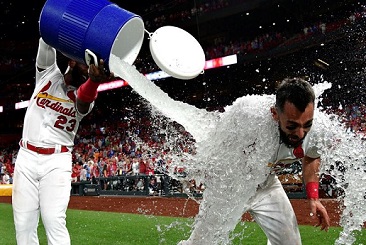
Marcel Ozuna (23) gives Matt Carpenter the icy spoils of thwarting the Cubs’ impersonation of the Chicago Bears’ defensive line Friday night.

Doing a comic sketch over the winter in which he referred to St. Louis (the city, not the Cardinals) as “boring” has gotten Cubs third baseman Kris Bryant a mouthful in Busch Stadium Friday night. It even got him a few from his own teammates, who apparently can go along with a gag.

But it wasn’t all that funny when what began as a rather admirable pitching duel between the Cardinals’ Mike Mikolas and the Cubs’ Yu Darvish ended in the bottom of the tenth with Matt Carpenter driving the winner home off Cubs reliever Steve Cishek with the bases loaded, one out, and the Cubs shooting themselves in the defensive foot.

“They had their entire 25-man roster on the right side of the field, so I just knew that hitting pull side on the ground—pull side in the air, that’s fine, we could still score—pull side on the ground was not an option,” Carpenter said after surviving a celebratory jersey-shredding and a big Gatorade ice dump on the infield. “So my approach in that at-bat was to look for something to hit the other way and get something in the air and was able to do it.”

The Cardinals’ third baseman exaggerated only slightly, of course. But the Cubs did line up four players along the edge of the grass on the right side of the infield and moved their outfield far enough right when Carpenter checked in at the plate. The infield looked more populated by the Chicago Bears’ offensive line than a baseball team.

And the Cubs looked even more ridiculous for putting that exaggerated an overshift upon a batter who’s far more of a line drive hitter than a ground baller. Carpenter may be struggling to get himself on track at the plate this year so far, but he’s a) a .283 hitter lifetime in high leverage situations; and, b) a .646 hitter when he gets something to hit on a line, standard or high.

Most likely the Cubs hoped Carpenter’s comparative weakness as a pure fly ball hitter (.194) and a ground ball hitter (.236) would work in their favour, maybe a double play to send the game to an eleventh inning. They misread their assailant almost completely, especially with Cishek starting Carpenter with nothing he could put on the ground if he’d been swinging an ax to chop the ball in half.

Cishek only got to throw two pitches to Carpenter. The first was a slider that climbed instead of slid up and in for ball one. The second landed almost right down the pipe, and Carpenter lifted it like a golfer with a five-iron, sending it down the left field line.

Where the Cubs’ Willson Contreras, a catcher by trade inserted into left field in a double switch, and about as swift as an earth mover, could only watch as the drive hit the grass a few feet away from his onrushing self and bounced into the corner left field stands.

The net result wasted a delightful pitching duel between Mikolas and Darvish. A duel that shook off an early one-all tie with both runs coming home on sacrifice flies, the Cardinals opening in the bottom of the first with left fielder Marcel Ozuna scoring Carpenter on an opposite field fly and Darvish, of all people, pulling a sac fly to left in the top of the second to score (Chris Berman, call your office) his catcher Victor (Beta) Caratini.

The Cubs managed six hits off Mikolas and the Cardinals three off Darvish, but both pitchers worked effectively enough with Darvish slightly better in six than Mikolas in seven, Darvish striking out six against three walks and pitching mostly to his defenders with somewhat surprising composure considering his continuing inconsistencies.

One minute, Darvish looks like a solid number three starter this year. The next, he looks like he can’t find the strike zone with a search party. His previous outing, against the Reds, saw him get six runs battered out of him in seven innings’ work, after a trio of starts in which he kept the other guys (including the Reds) to three or less.

On Friday night it was as if Darvish wanted revenge for the four-inning, five-run mugging the Cardinals laid on him on 4 May, in which he helped hand them the machetes with five walks. Realising in the shaky first that his fastball started asleep, Darvish went to an array of curve balls and cutters for the most part in the second before his four-seamer awoke.

Miklas had the opposite trouble: his breaking balls weren’t quite as effective as his fastballs early on; Darvish himself tagged a curve ball for that second-inning sac fly. But as the game went on Miklas’s fastballs came alive just enough for him to use as either out pitches or setup pitches for his breakers and the occasional changeup.

The Cubs were more than a little infuriated when young Dillon Maples, sent out to work the tenth, threw what looked at every angle like a full-count strike three to Harrison Bader, the Cardinals’ right fielder, with Cardinals infielder Kolten Wong (one-out double) on second. Except that Laz Diaz called it ball four. It was the type of slider no less than ESPN’s Stats and Information department says gets called a strike 92 percent of the time or better.

“That’s the kind of thing that bums me out,” the manager said after the game. “To have pitches taken away from him in a crucial moment . . . Now my guy has to go home and feel bad about himself tonight. And it wasn’t even a borderline pitch. It was a strike.

Maples tried to shake it off but he walked Jedd Gyorko to load the pads for Carpenter. “I just made a close pitch and obviously didn’t get the call I wanted,” the young reliever said after the game. “So I was a little upset, but you have to move on.”

But when he didn’t, Maddon went to Cishek and the Monsters of the Midway infield defense. And Carpenter de-fanged the beasts with one swing and one floating opposite field fly.

The Cubs didn’t have one of their better games even before Carpenter left them with the proverbial egg on their tenth-inning faces. They went 0-for-8 with men on second or better, officially. The Cardinals weren’t that much better, going 1-for-5 in the same situation.

But the Cubs at least had a few laughs when the game got underway and Bryant batted in the first. When the Busch Stadium audience let him have it as he walked up to the plate, Bryant was amused to see his buddy Anthony Rizzo leading the Cubs dugout and bullpen in a chorus of booing.

“It was pretty funny,” said Bryant after the game. “I wanted to look and see all who was doing it . . . I think he told the bullpen guys to get in on it.”

“I don’t think I’ve ever roundly booed one of my own guys before,” Maddon cracked. “I can check that off the list.”

Bryant hit Miklas’s first pitch to him past the infield for a base hit. It was the only hit Bryant got all night. The goal-line stand the Cubs tried in the tenth, alas, was about as funny as the proverbial pickpocket in the nudist colony. But it gave Carpenter and the Cardinals the last laugh.

A tale of two literary baseball seasons

2019-02-15 BrosnanBouton

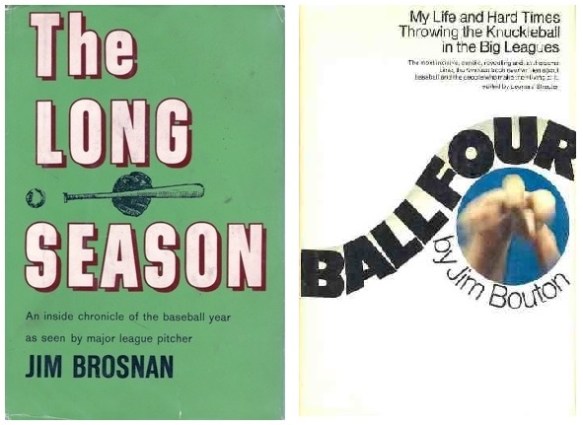
The books they said would subvert baseball. The game goes ever onward and the books never remain out of print. (So far.) Fifty years ago, Jim Bouton pitched his Ball Four season; ten years before that, Jim Brosnan pitched The Long Season.

The New York Public Library’s list of 20th century Books of the Century includes only one book pertaining to sports, Jim Bouton’s Ball Four. Yes, I was surprised, too, considering such volumes as Jim Brosnan’s The Long Season, anything by Roger Angell (one more time: he isn’t baseball’s Homer, Homer was ancient Greece’s Roger Angell), Roger Kahn’s The Boys of Summer, Bernard Malamud’s The Natural, Mark Harris’s Bang the Drum Slowly, and Arnold Hano’s A Day in the Bleachers, among others.

But there Bouton’s volume reposes, in a club to which also belong T.S. Eliot, James Joyce, William Faulkner, Virginia Woolf, Edith Wharton, Ralph Ellison, Jack Kerouac, John Dos Passos, Albert Camus, Agatha Christie, Grace Metalious, and Tom Wolfe. Before you retort that Bouton didn’t exactly write The Waste Land, Light in August, Invisible Man, On the Road, or The Bonfire of the Vanities, it’s only fair to say that Eliot, Faulkner, Ellison, Kerouac, and Wolfe never had to try sneaking a pitch past Carl Yastrzemski, Lou Brock, Harmon Killebrew, or Willie Mays, either.

Bouton was with the Astros when Ball Four was published in April 1970, after excerpts appeared in Look. To say it was received less than approvingly around baseball is to say Baltimore needed breathing treatments after the Mets flattened the Orioles four straight following a Game One loss in the 1969 World Series. “F@ck you, Shakespeare!” was Pete Rose’s review, hollered while Bouton had a rough relief outing against the Reds. All things to come considered, it was a wonder Rose knew Shakespeare wasn’t a brew served on tap at the ballpark.

This year is the fiftieth anniversary season of the one Bouton recorded for Ball Four and the sixtieth anniversary of the one animating Brosnan’s The Long Season. The books have their common ground and their distinctions, chief among the latter being that Bouton didn’t shy from detailing things even Brosnan, whose candor was considered jolting enough in its own time and place, didn’t dare to tread. If Brosnan even hinted at them, it was euphemistically. Bouton didn’t bother with euphemisms.

The two pitchers have something sadder in common, too. Brosnan suffered a stroke from which he was recovering when sepsis came manifest and caused his death in 2014 at 82, a year after his wife of 62 years died. Bouton, on the threshold of 80, suffered a stroke in 2012 that left him with cerebral amyloid angiopathy, a brain disease linked to dementia and compromised his ability to speak and write. Making it worse: the stroke occurred on the fifteenth anniversary of his daughter Laurie’s death in a New Jersey automobile accident.

Bouton’s wife, Paula Kurman, a speech therapist among other things (she has a Columbia University doctorate in interpersonal communications) who has worked with brain damaged children during her career, has worked with him carefully (“Together we make a whole person,” she once told a Society for American Baseball Research panel, to laughter that was sad as much as approving) and he has regained much of his speaking ability.

But he continues to struggle with what Kurman told Tyler Kepner of the New York Times was “a pothole syndrome: Things will seem smooth, his wit and vocabulary intact, and then there will be a sudden, unforeseen gap in his reasoning, or a concept he cannot quite grasp.”

Brosnan’s book was seeded two years before The Long Season‘s focus when he bumped into Sports Illustrated editor Bob Boyle. Having heard the bespectacled reliever had ideas about writing a book about major league baseball, Boyle suggested an article first “if something significant happens.” Brosnan turned in an essay about his trade from the Cubs to the Cardinals for veteran shortstop Alvin Dark, a trade one reporter described as the Cubs committing theft by trading “a mutt for a pedigreed pooch.”

“Loved it,” Boyle told Brosnan. “Why don’t you write a book about a whole season?” Two years later, that’s exactly what Brosnan did. He praised and needled in the same arch but honest tone, even if he did sanitize much of the vocabulary of the locker room or the dugout, as Bouton wouldn’t need to do a decade later. He showed the better and lesser sides of several players, but even his needles seemed not to come from malice aforethought.

Bouton was approached to do what became Ball Four by iconoclastic sports writer/editor Leonard Shecter, who’d previously written an in-depth profile of Bouton for Sport. Shecter proposed an in-season diary somewhat along Brosnan’s lines. “Funny you should mention that,” Bouton replied. “I’ve been taking notes.” During the 1969 season, Bouton would observe of his teammates, “My note-taking is beginning to make the natives restless.”

Brosnan offered no sense of wanting any kind of revenge for any kind of slight, in an era when players were too often slighted under a system that kept them, in essence, indentured servants. (One reviewer for the St. Louis Post-Dispatch wrote that Brosnan’s “pot shots,” such as they were, didn’t enrage fellow players “because ballplayers didn’t read; it was so out of character, or so he said.”) Bouton was often accused of trying to settle scores, particularly about the Yankees, his former team about whom he wrote and spoke extensively enough when the occasion suggested it. All Brosnan and Bouton did was try to show baseball and its players, coaches, managers, and administrators, as a too-human game played and run with too-human foibles, follies, and fantasias alike.

The devil was really in the details and even the language in Ball Four, from neither of which Bouton shied a single step. But both pitchers were accused of a kind of insider trading for fun and profit. “Brosnan has his say about many who may have, in times past, had their say about him,” wrote Bill Veeck of The Long Season, at a time Veeck still owned the White Sox. “This just doesn’t seem to come off so well, and tends to lessen the impact and enjoyment of his undeniably colorful material.” Presumably, Veeck took his own critique to heart when writing his own Veeck—as in Wreck, which did for baseball executives’ memoiring what Brosnan and later Bouton did for players’, and what Veeck did even further with his subsequent The Hustler’s Handbook.

“As an active player on a big-league team I had seemingly taken undue advantage by recording an insider’s viewpoint on what some professional baseball players were really like,” Brosnan wrote, after The Long Season and Pennant Race (his followup, about the 1961 Reds’ unexpected National League pennant winner) were republished on the latter’s season’s fortieth anniversary. “I had, moreover, violated the idolatrous image of big leaguers who had been previously portrayed as models of modesty, loyalty and sobriety — i.e., what they were really not like. Finally, I had actually written the book by myself, thus trampling upon the tradition that a player should hire a sportswriter to do the work. I was, on these accounts, a sneak and a snob and a scab.”

Bouton got the chance to address the hoopla around Ball Four in a followup book, I’m Glad You Didn’t Take it Personally (its jacket featured a baseball with a blackened eye drawn onto the hide) which was just as funny as Ball Four and sometimes a lot more poignant.  “I think it’s possible,” he wrote, “that you can view people as heroes and at the same time understand that they are people, too, imperfect, narrow sometimes, even not very good at what they do. I didn’t smash any heroes or ruin the game for anybody. You want heroes, you can have them. Heroes exist in the mind, anyway.”

Or, out of their minds, if you ponder one reaction to Ball Four. Before the Astros farmed Bouton out in 1970, Bouton discovered a burned copy of the book on the steps of the dugout, courtesy of the Padres. Even Brosnan’s and Veeck’s books avoided that kind of grotesquery.

The worst to happen to Brosnan after The Long Season and Pennant Race, not to mention other essays published in several other magazines, was the White Sox (to whom Brosnan was traded early in the 1963 season, long after Veeck sold the team) inserting a clause in his proposed 1964 contract barring him from writing for publication without prior team approval. Refusing to sign a contract with a clause like that in it, Brosnan retired after no other team took even a flyer on him, despite both Sports Illustrated and The Sporting News taking his side.

Bouton was either reviled as “a social leper” or a cancer on the game for having written and published Ball Four. Commissioner Bowie Kuhn actually tried to suppress the book, hauling Bouton into his office, demanding Bouton sign a statement saying it was all the pernicious work of his editor Shecter. Bouton probably had to restrain himself from telling Kuhn where to shove the statement when he wasn’t trying to restrain himself from laughing.

It was Dick Young of the New York Daily News who described Bouton as a social leper for writing Ball Four. When he ran into Bouton on an Astros visit to Shea Stadium, he said hello and, when Bouton needled him for talking to social lepers, Young replied, “Well, I’m glad you didn’t take it personally.” That reply gave Bouton the title of his followup book, in which he credited such overreactions in the sports press for doing almost the most to ensure Ball Four a best seller.

Both pitchers were witty, literate, and not even close to being thoroughgoing jocks. Brosnan made his way as a competent if mostly unspectacular relief pitcher and spot starter with a strong slider who had his moments. Bouton was a promising, hard throwing Yankee starting star, with a live fastball and a hard curve ball, until two seasons of overwork (1963 and 1964, and a whopping 520.2 innings over the two) left him with arm and shoulder trouble (it began a third of the way through 1964) that reduced him to marginal relief work and prompted him to make the knuckleball, which he’d thrown only as a change of pace previously, his bread and butter pitch.

Brosnan kept so many books in his locker that his 1961 Reds teammate, Hall of Famer Frank Robinson, nicknamed him the Professor. Bouton was no less literate or cerebral, though he may not have had a locker library equal to Brosnan’s, but his early ferocity as a competitor (he was once famous for his cap falling off his head as he delivered) inspired New York Post writer Maury Allen to nickname him Bulldog.

But Bouton may have put baseball into perspective even more than Brosnan did. Both pitchers were very aware of the worlds around them, and both wrote about the periodic spells of boredom, racial tensions, off-field skirt chasings, and self-doubts endemic in their professional baseball lives. Brosnan saved them for his books and articles; Bouton was less reluctant to speak his mind about things like politics, Vietnam, and civil rights when asked or when a conversation left him the opening.

Bouton bought even less into the still-lingering press representations of athletes as heroes. Teammates didn’t always hold with that or other things, like calling them out on it when they made mistakes that cost the Yankees games he pitched.

“After two or three years of playing with guys like [Mickey] Mantle and [Roger] Maris,” he wrote in I’m Glad You Didn’t Take It Personally, “I was no longer awed. I started to look at those guys as people and I didn’t like what I saw. They were fine as baseball heroes. As men they were not quite so successful. At the same time I guess I started to rub a lot of people the wrong way. Instead of being a funny rookie, I was a veteran wise guy. I reached the point where I would argue to support my opinion and that didn’t go down too well either.”

“He stands out,” Shecter wrote of Bouton in Sport, “because he is a decent young man in a game which does not recognize decency as valuable.” Much the same thing was said of Brosnan no matter what particular writers did or didn’t think of his two books.

Brosnan’s post baseball life including writing, advertising work (he’d done it in the offseasons of his pitching career), occasional sportscasting, and raising his family in the same Illinois home he bought with his wife, Anne, in 1956. (When they married, one local story’s headline, referencing his wife’s maiden name, said, “Pitcher Marries Pitcher.”)

Bouton became a sports anchor for New York ABC and then CBS before trying a baseball comeback in the White Sox system and then with the independent (some say notorious) Portland Mavericks, a comeback that ended with getting five starts for the Braves in late 1978. In one of those starts, Bouton squared off against Astros legend J.R. Richard, on the same night Richard broke the National League single-season strikeout record for righthanders, and pitched Richard to a draw. “The young flamethrower against the old junkballer,” Bouton wrote of the game.

A concoction Bouton and Mavericks teammate Rob Nelson invented in the bullpen, shredding gum into strands similar to chewing tobacco, became a hit as Big League Chew when they sold the idea to Wrigley. Bouton also continued writing, became a motivational speaker, and survived the collapse of his first marriage to meet and marry Kurman, blending two families, becoming founders and leaders of a recreational baseball league playing by 19th century rules, and becoming competition ballroom dancers. The Renaissance Bulldog.

The Washington Post‘s distinguished literary critic Jonathan Yardley wrote of The Long Season that it was literature about “[a]n ordinary season — life as it’s really lived — rather than an extraordinary one.” You could say, then, that Pennant Race was literature about an extraordinary season lived and played by ordinary men, if you don’t count Frank Robinson. Ball Four, which ran more temperatures higher up scales than Brosnan could claim, could be called an ordinary season lived and played by ordinary men. Recorded by a man whose extraordinary side was eroded by injuries.

Bouton may have hit the true key as to why all three books also unnerved baseball and its assorted establishments. “If Mickey Mantle had written Ball Four,” he later remembered, “it wouldn’t have been a big deal. A marginal relief pitcher on the Seattle Pilots had no business writing a book.” Likewise, if Robinson or Stan Musial had written The Long Season (Brosnan began 1959 with the Cardinals but was traded to the Reds midway) instead of a middle relief pitcher, it might not have proven a big deal.

Brosnan’s and Bouton’s books became baseball classics (as did Veeck—as in Wreck), and Ball Four also helped further expose the abuses heaped on players by front offices before the end of the reserve clause but probably caused no few of its younger readers to become sports journalists themselves. One suspects even now that Bouton’s revelations about the one-sided contract negotiations to which reserve era players were subject might have infuriated the purists more than his revelations about players’ sex drives, amphetamine indulgences, pranks, and feuds did.

Whenever one of Bouton’s former Ball Four-season teammates goes to his reward, Bouton is genuinely saddened. “I think he came, over the years, to love them,” Kurman told Kepner. “As each one died, he got really teary about it. He realized how deeply they were part of him.” (The Pilots, of course, were sold and moved to Milwaukee for the 1970 season, becoming the Brewers. Writing in Ball Four Plus Ball Five, a tenth-anniversary update, Bouton said, “The old Pilots are a ghost team, doomed forever to circumnavigate the globe in the pages of a book.”)

The Long Season remains “a cocky book, caustic and candid and, in a way, courageous, for Brosnan calls him like he sees them, doesn’t hesitate to name names, and employs ridicule like a stiletto,” as wrote Red Smith, arguably the best baseball writer in New York (then with the Herald-Tribune).

Ball Four‘s true success, wrote Roger Angell himself, “is Mr. Bouton himself, as a day-to-day observer, hard thinker, marvellous listener, comical critic, angry victim, and unabashed lover of a sport. What he has given us is a rare view of a highly complex public profession seen from the innermost side, along with an ironic and courageous mind. And, very likely, the funniest book of the year.”

And in the long, long, long wake of Brosnan’s and Bouton’s books, baseball hasn’t collapsed, the world hasn’t imploded, that Star Spangled Banner yet waves, and men and women of note or fame can be considered in all their human flaws, foibles, and fantasias, without being seen where appropriate as any less than heroes.

The Cardinals say it’s Miller Time

2016-10-15 AndrewMillerIt may be a good thing that Anheuser-Busch no longer owns the St. Louis Cardinals. They’d have one helluva promotional migraine on their hands with Cardinal fans wearing T-shirts and holding up placards saying, “Now . . . it’s Miller Time.”

The Cardinals announced via Twitter Friday morning that relief bellwether Andrew Miller has signed for two seasons with a 2021 vesting option; The Atlantic‘s Ken Rosenthal says the deal guarantees the lefthander $25 million for the two years and $12 million if the option vests.

Anyone wondering what the Cardinals were thinking in signing the 33-year-old lefthander might care to note that, even with an injury-disrupted 2018, his worst season since 2013, Miller’s 0.4 2018 wins above a replacement level player by himself were practically the same as the entire Cardinal bullpen for the season. Of course they were thinking a little more deeply when looking at Miller’s season.

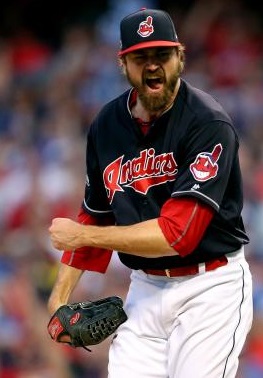
From his return from the DL at August’s beginning until his final assignment of the season on 29 September, Miller pitched as close as possible to the wipeout pen man who helped the Indians get to Game Seven of the 2016 World Series before he ran out of fuel in that game. From 3 August through 28 September, Miller struck out 22 batters and walked only six while surrendering only fifteen hits and five earned runs in 16 innings for a more than solid 2.81 earned run average over the span, even if he had occasional control issues shaking off the rust and plunked two batters.

One bad inning on 29 September—a three-run homer and an RBI single—soiled his return from an early season hamstring strain and the knee inflammation that cost him two months. Clearly the Cardinals bypassed that final disaster, looked at his 3 August-28 September round, and decided that a healthy Miller meant a bullpen improved exponentially with a lefthander who can and has gone multiple innings in his turns and still owns a plus fastball and (when healthy) a slider that drives hitters into at-bat graves.

Just as clearly, the Cardinals offered Miller something other suitors couldn’t or wouldn’t, and Miller was romanced rather ardently since the World Series ended. The Mets and the Yankees had him on their dance cards and both teams asked for his most current medical reports. The Mets especially could have made room enough for Miller since they lack a solid lefthanded bullpen option at all and, if they’re that serious about contending in 2019, Miller healthy would have silenced a lot of the snickering about that stance.

Several reports indicated Miller had a phalanx of two-year offers on his plate but hoped for three. If the Cardinals were willing to give him the third year, even if it’s a vesting option, it means they have Miller through his age-36 season. If he lives up to his restored health and doesn’t let his coffin-nailing slider betray him, the Cardinals make an investment that helps send them back to the postseason post haste.

Miller gives several options for a Cardinal bullpen whose top five members posted a collective 4.50 ERA despite striking out eight or better per nine innings, perhaps because they were also walking a collective 4.16 per nine. Now look closer: the rate would have been far lower without Brett Cecil’s 6.9 walks per nine. Even closer Bud Norris undermined his own 10.9 K/9 rate with a 3.3 BB/9 rate, while converting 28 of 33 save chances.

Miller with an injury-disrupted 2016 still had a slightly better K/9 rate than the collective and individual Cardinal pen. He had a gruesome 4.2 seasonal BB/9 rate but most of that was thanks to his pre-August struggling through and with the injuries. His medicals must have looked even better to the Cardinals than they did to the Mets, the Yankees, and other teams on his trail. The Yankees may have needed to bring Miller back less, but the Mets—whose pen still needs remaking despite bagging Edwin Diaz to close—may have some splainin’ to do about not bringing Miller aboard at all.

The Cardinal pen clearly needed a shot in the arm, if not in the head. A healthy Miller gives them just that and then some, since his calling card once his gears fell into place has been middle, later, or both kinds of relief and not just single innings, either, though you have to be mindful of overworking him approaching age 33. Miller can even close when need be. (He did have such a season for the 2015 Yankees, saving 36.)

It’s going to seem strange, indeed, to see Busch Stadium with its several Budweiser signs including atop the major scoreboard serving Miller on the mound. They used to call Miller the champagne of bottled beer. They hope Miller on the mound means three rounds of champagne in the clubhouse in October.