Wrigley agonistes

2019-09-22 JoeMaddon

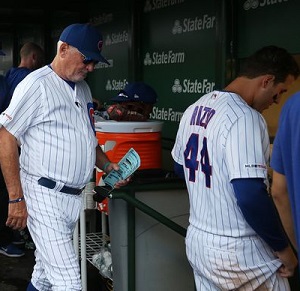
Joe Maddon (left) and Anthony Rizzo after the Cubs’ Sunday loss.

“Adversity,” Cubs manager Joe Maddon pronounced before they played their first home game this season, “is good for the soul, brother.” Did Maddon and the Cubs absolutely have to make it a self-fulfilling prophecy?

You want adversity? This year’s Cubs laid it on themselves good and thick. This weekend and this month. Right down to the moment Maddon decided it was a good idea with a 2-1 lead to send a gallant but past his single-game sell-by date Yu Darvish out to pitch the top of the ninth Sunday afternoon.

He probably did it because when everything else was said and done Brother Joe couldn’t or wouldn’t trust practically his whole bullpen as far as he could throw any home run pitch surrendered by Cardiac Kimbrel this weekend without the benefit of the ball flying off the end of someone else’s bat.

But pinch hitter Jose Martinez led off hitting a 1-0 cutter to the back of center field that just did elude a diving Albert Almora, Jr. for a triple. Former Cub Dexter Fowler sent pinch-runner Tyler O’Neill home promptly with a sacrifice fly. Then Tommy Edman singled to right, Paul Goldschmidt doubled him home, and then Maddon reached for Pedro Strop, who followed a prompt walk with two swinging strikeouts.

And the Cubs had nothing left against even a less-than-his-old-self Andrew Miller in the bottom of the ninth beyond Jason Heyward’s two-out single. The home side of their 2019 ended in four whimpers. Obviously, ending 118 years worth of adversity three years ago just wasn’t good enough for the soul, brother.

“If you just play back the tape,” Maddon said after Sunday’s game, “it’s almost unbelievable that it turned out this way.” The problem is that it’s only too believable. On a weekend when the Cubs needed to play like their 2016 selves in the worst way possible, they played like their 1909-2015 selves—in the worst ways possible.

The Cardinals, though, had just enough left. “There was a time when we could have mailed it in,” said shortstop Paul DeJong after Saturday night’s survival. “But we kept pushing. We’re at a point in the year where we smell blood and we’re trying to take what’s ours.”

Thus did the Cardinals clinch at least a postseason trip. Their magic number for a division clinch is two. The Cubs’ tragic number for even wild card elimination is five. They may get to regroup against what’s left of the Pirates for three in PNC Park, but guess who they end the regular season against and where next weekend?

Does Kris Bryant still think St. Louis is a boring town? I’ve never been there but I know this much about their Cardinals: They have been and they are a good many things. Boring isn’t one of them. Even the best baseball fans on earth, which is the reputation Cardinal fans do have, won’t be able to resist letting the Cubs have it but good next weekend.

The problem is, the Cubs are many things except boring, too, but their kind of excitement did the Cardinals the biggest favour of their month and, just maybe, their season. And if you want to talk about karma, be reminded that Bryant had to leave Sunday’s game after spraining his ankle trying to beat a third inning-ending double play.

Now it’s almost impossible to believe the Cubs began the four-game set against the Cardinals with a clean shot at overthrowing the NL Central leaders. And all four losses were by a single run, making for the longest streak of one-run losses (five) the Cubs have had since 1947, the last time they’d lost four straight one-run games.

How much it would have kept the Cubs’ almost-dissipated postseason hopes alive can’t be known now, but in a season during which he’s been second guessed frequently enough one more won’t kill Maddon.

If he wasn’t even going to think about Kimbrel Sunday, and he probably would have been executed on the spot if he did, why didn’t he give Darvish a pat on the fanny and thanks for a job done well above and beyond the call, and send Strop out to open the top of the ninth?

It’s not that that was the single decision above all that sank the Cubs this year. They were done in by a combination of factors, especially their terrible road results. Yet if Strop had a season to forget for the most part his September’s been plenty strong. He has only one earned run surrendered in six and a third innings’ September work, including five strikeouts now in two and a third innings against the Cardinals this weekend.

But the Cardinals had their own issues. They looked pitiful enough at the All-Star break, their shutdown closer Jordan Hicks went down to Tommy John surgery in June, and even the best fans on earth couldn’t resist the itch to demand president John Mozeliak’s head on the proverbial plate.

Then they picked themselves up, dusted themselves off, and went 44-23 after the break so far, against the Cubs’ post-break 35-30. Mozeliak is presumed safe from the guillotine. The Cardinals don’t necessarily see adversity as good for the soul so much as they see it means time to see what they’re really made of. It looks like they’re made of a lot stronger stuff than even their own fans thought.

Some Cub heads may roll soon enough. A few of those heads may remain Chicago icons for their parts in the 2016 conquest, but a team whose fans too long lamented, “This year is next year,” isn’t really in the mood to go forward saying, “Ahhhh, wait till three years ago.”

Maddon wasn’t offered a contract extension and he’s liable to finish the season as another ex-Cub manager, never mind the one who finally led them to their first World Series conquest since the Roosevelt Administration. (Theodore’s.)

President Theo Epstein’s most recent signings weighed against the net results this year could have him placed on probation, figuratively speaking. This year’s Cubs “were done as soon as ‘urgency’ and ‘October starts in March’ became the alternatives to actually fixing a lineup the front office said ‘broke’ and a bullpen that was an obvious weak link coming out of spring training,” wrote Chicago Sun-Times columnist Rick Morrissey Saturday.

Strop plus trade deadline find Nicholas Castellanos, Cole Hamels, Steve Cishek, and others face free agency this winter. Ben Zobrist—whose season was disrupted sadly by his difficult divorce, which prompted him to leave the team for a spell to tend his children through it—may or may not retire after it’s over.

And Chicago Tribune columnist Paul Sullivan thinks aloud that, if Epstein’s recent talk about days of reckoning can be believed, it’s not impossible that Bryant, Almora, Jose Quintana, and the should-have-been-purged Addison Russell (it wasn’t a great look when the Cubs stood by him despite his too-much-proven domestic violence) will find new uniforms to wear next year.

Adversity may be good for the soul, but not everybody turns it into postseason possibilities. The Yankees and the Astros underwent a lot more adversity this year, but now the Yankees have an American League East clinch, the Astros have a postseason berth clinched at minimum, and those two are battling to see who finishes with baseball’s best record on the season.

This year’s Cubs were a good, not great team, as Morrissey notes. Maybe Maddon should get a re-consideration considering the Cubs managed to get to within a fortnight of securing just the second wild card at all. Maybe. Maybe not.

But Maddon didn’t help his cause or his case Sunday afternoon. The much-maligned, oft-struggling Darvish has been the Cubs’ best pitcher in this year’s second half: a .194 batting average against him; a .605 opposition OPS; a 2.70 ERA; a 0.81 walks/hits per inning pitched rate. He gave the Cubs everything he had Sunday until Maddon asked him for what wasn’t left. And failed to see Darvish’s tank on fumes.

Maybe Epstein should get just a little more than mere probation especially since the promised player development machine over the last eight years has been a broken promise except for Bryant, Kyle Schwarber, David Bote, and this stretch drive’s pleasant-surprise emergency call-up Nico Hoerner. As Morrissey reminds, not one homegrown Cub has thrown a postseason pitch or stuck around for more than a full season.

If adversity’s good for the soul, it should be better for a top down rethinking. There won’t be any more baseball at Wrigley Field this year, barring divine intervention. The angels have only so much kindness to spread around.

Funeral to frat party and back in a Wrigley blink

2019-09-19 MattCarpenter

Matt Carpenter runs out the bomb that proved the difference maker in the tenth Thursday.

You knew it was just round one of total weekend war when a throw to first to catch Kolten Wong in the act was challenged, the safe call upheld, and the Wrigley Field boos rained louder than a heavy mental concert Thursday night. In the top of the first.

And, as Cubs starting pitcher Kyle Hendricks and catcher Willson Contreras ended the half inning with a strike-’em-out (Paul Goldschmidt)/throw-’em-out (Wong) double play,  the cheering from the Confines would have drowned the earlier booing out if both could have happened at once.

Then, for the following seven innings, Wrigley Field resembled a funeral home with Cardinals starting pitcher Jack Flaherty the chief undertaker. Until the Cubs tied things at four in the bottom of the ninth, turned the funeral home into a frat party and sent it to extra innings.

With Craig Kimbrel—returning from elbow inflammation, not having pitched since the beginning of the month—taking the mound for the top of the tenth. Cardiac Craig, about whom it was written snidely that every time he nailed a postseason save for last season’s Red Sox his high-wire act still made it feel like losing.

He struck out former Cub Dexter Fowler on a full count. Then Matt Carpenter—who’d lost his third base job to rookie Tommy Edman, who came into the game late when it looked like the Cardinals had it in the bank, and who hadn’t gone long since late August—hit Kimbrel’s first pitch over the center field wall. That’s what a quick trip back to the minors to fix your swing can do for you.

It also knocked Wrigley back into funeral mode for the moment, until Kimbrel settled enough to get rid of Goldschmidt and Steve Cishek came in to get rid of Marcell Ozuna and get the Cubs one more chance. Which Giovanny Gallegos—the guy the Cardinals surrendered Luke Voit to the Yankees to obtain—had no intention of giving them in his first-ever Cardinals save situation.

Late game Cub insertions Ian Happ (fly out to center) and David Bote (swinging strikeout) were dispatched almost in a blink. And Nicholas Castellanos, the Cubs’ midseason acquisition from the Tigers, who’d been nothing but solid and beyond for the Cubs since, flied out to center to end it.

The 5-4 win pushed the Cubs four behind the Cardinals in the National League Central and one behind the Brewers for the league’s second wild card, the Brewers having flattened the Padres earlier in the day. The Cubs have to win a mere three straight against the Cardinals this weekend to keep pace with them and maybe re-claim their second card grip.

Flaherty’s evening ended after a 1-2-3 bottom of the eighth, 118 pitches, eight strikeouts, a lone walk, three hits overall, and one rudely-interrupting home run, keeping the Cubs otherwise unbalanced with a blend of breakers, changeups, and fastballs a barista would have envied for its smooth richness.

He walked off the mound for the final time of the game so collected he could have been forgiven for saying, quietly, “Well, I guess I’d better be shoveling off.” Even if he knows about as much about the old friendly radio undertaker Digger O’Dell, whose catch phrase it was, as this year’s American League East-and-100 game-winning Yankees know about avoiding the injured list.

And he got a nice respectful hand from even enough Cub fans and he’d earned every finger of it. Even that was just respectful, low-keyed applause and cheering. The real noise came after the Cardinals brought in former starter Carlos Martinez to open the bottom of the ninth, and Martinez opened with a walk to Nicholas Castellanos before Kris Bryant, who’d been kept quiet by Flaherty all night, smacked a single up the pipe.

With Kyle Schwarber and his 37 home runs so far checking in at the plate with the potential tying run. With Martinez falling behind to him 3-0 before striking him out, but with Ben Zobrist doubling home Castellanos, putting the tying runs into perfect position, and with Javier Baez—whose thumb is still balky but who can still run swiftly—pinch running for Zobrist.

It took eight and a half for Wrigley to come back to life. And when Contreras flicked a squirty grounder up the short third base line with Bryant tearing home as if it was supposed to be an unintentionally intentional suicide squeeze, only with all hands safe and first and third, the Confines became as unconfined as you imagine when the Cubs re-awaken from the dead.

Then Cardinals manager Mike Schildt brought in Andrew Miller, whose formidability as an Indian the Cubs remembered only too well from 2016, but who’s been worn down since by health issues stemming from his former bullpen overwork, to face the lefthanded Jason Heyward. Heyward smashed a grounder to second that pushed home Baez to tie things at four.

You got the idea early that even with the Flaherty factor hitting was going to be a challenge thanks to the notorious Wrigley winds, when Nicholas Castellanos skied one that might have flown out elsewhere but hung up for a right field catch in the first, and Jason Heyward hit a cannon shot liner that died a shuttlecock into Wong’s glove playing second ending the second.

And you also got the idea early and often that both sides weren’t exactly going to be in a big hurry to blow plate umpire Bill Welke to a steak dinner any time soon. Welke called so many pitches strikes that didn’t even graze the floor or the outside edges of the zone it’s a wonder neither Cardinal nor Cub decided to serenade him whistling the ancient television theme from The Outer Limits.

But you also knew the delight Cub Country took in Anthony Rizzo deciding to test his recently-sprained ankle by playing first base would be matched only by a sense that it would do a bigger favour to the Cardinals. And in the top of the third, it was.

Flaherty batted with first and second with Rizzo ambling down the line, a la Keith Hernandez, slowly but surely, and practically in front of the mound, aiming as has become a Cubs mainstay to choke off the bunt even if it went near the third base line. Flaherty dropped the bunt, all right. Right up the short third base line. And on his still-balky wheel Rizzo couldn’t get the ball in time to keep the bases from loading.

The pillows stayed stuffed long enough for Dexter Fowler to dial Area Code 4-6-3 with Edman (a leadoff walk) scoring on the play. And Rizzo atoned for his ankle’s betrayal in the bottom of the inning, sending Flaherty’s first pitch to him the other way into the left center field bleachers to tie things at one. Smartly, Rizzo he didn’t run it out any faster than he absolutely had to or could.

The tie held up long enough for Edman to open the top of the fifth with a triple into the right field corner and for Harrison Bader, who’s been as much a struggler at the plate as reliable in the outfield this season, to smack a single up the pipe to break the tie.

The Cardinals got a scare when Wong had to leave the game after ending the top of the fifth with a ground out to first. He fumed over leaving the game and the Cardinals may have fumed quietly with him, since he’s their best player this season by wins above replacement-level.

Then they sent Carpenter out to play third and moved Edman to second. And Flaherty went back to work as though nothing short of an undetected tornado could interrupt his quiet pleasure in his work. You might feel that kind of quiet surety, too, if you took the fifth-best post All-Star break earned run average (1.07) of all time out to the mound to start your evening’s work of play.

Flaherty was so composed and efficient that the Cardinals didn’t even think about getting a reliever up until Martinez got up to throw in the bottom of the eighth, after Flaherty reached 108 pitches on the night. Don’t even think about it: Flaherty doesn’t look like a pure hard, grunting, thrusting thrower; he relies on mechanical soundness to provide the fastball’s power and the command of the breakers.

He nailed the Cubs’ impressive rookie call-up Kyle Hoerner (eleven runs batted in in his first ten games worth of impressive) on a called third strike that looked under and not on the floor, and while Hoerner objected mildly to the call Flaherty simply walked around the mound and went back to work.

Then he struck out his counterpart Hendricks swinging, and Hendricks to that point was working with equivalent composure, not letting the quirky Wrigley elements get as far into his head as a two-run deficit ordinarily might, though he engaged a long yet civilised-appearing discussion with Welke after that swishout before returning to the mound.

He was probably a little more miffed when Goldsmidt opened the St. Louis sixth with a sharp double down the left field line. The Cardinals must have wondered about his ump conversation when Ozuna was rung up on a pitch that didn’t even graze the outer strike zone before Hendricks nicked Paul DeJong on a runaway inside pitch.

But Yadier Molina, the Cardinals’ wise old man behind the plate, lined a single to left that Schwarber played on the carom off the heel of his glove before throwing home. Goldschmidt waved home from second should have been a Deadbird, except that he eluded Cubs catcher Willson Contreras, abetted by Contreras inside the baseline seemingly unable to get the handle on the tag.

Which ended Hendricks’s evening and gave the Cubs more reason to be miffed, when Bader stroked a liner to left center off Hendricks’s relief Rowan Wick, right after Wick turned Edman aside on a swinging strikeout. Then Schwarber opened the bottom of the seventh with a single up the pipe. And Flaherty in a momentary lapse of soundness wild pitched Schwarber to second while working to Ben Zobrist, before Zobrist grounded to second to push Schwarber to third.

And the Cubs’ basepath issues reared up and bit them flush on the fanny, when Contreras bounced one right back to Flaherty and Flaherty bagged the Schwarbinator in a 1-2-5-6 rundown out before Heyward grounded out for the side.

The Cardinals didn’t really look all that much better going 4-14 with men in scoring position in the first seven innings, but what matters is how you make it count when you do it and how you hang in there when the other guys decide it’s party time at the ninth hour. And Carpenter spoiled the party in the top of the tenth.

Leaving the Cubs to resist the temptation toward counting the days and accept the temptation to counting the ways they might keep both feet from their seasonal graves. They’d rather not be shoveling off just yet.

Want a blood feud this weekend? You may get one in Chicago

2019-09-19 WrigleyFieldSignForget the wild card races for a few moments. Have a good gander at the National League Central. Where the Cardinals and the Cubs entered Thursday’s play numeros uno and two-o in the division.

With a measly three games between them in the standings. And, count them, seven games yet to play against each other including three to end the regular season. You wanted an honest-to-goodness rivalry to take the season to the wire? You’ve got it now in the NL Central.

The Red Sox’s dissipation thanks mostly to their starting pitching means no Yankee-Red Sox duel to the death to finish. The American League Central is down to the Twins and the Indians with four games between them in the standings, but such as it is their rivalry seems more like a Friday night bowling league. There’s no blood feud there. Yet.

The western divisions in both leagues are so locked up that both champions-in-waiting (the Astros and the Dodgers) left their age-old or mere territorial rivals behind as far as New York City’s D train leaves 205th Street in the north Bronx when it arrives near Coney Island.

The eastern divisions are sewn up snugly enough, though there’s a vague potential for all-out war if, somehow, by some heretofore unseen alchemy, the Nationals and the Mets end up in the wild card game with one of them getting to deal with the Braves in a division series.

And the wild card rumbles are enough fun, even if you think there’s something just a little out of whack with sitting on the edge biting your nails to the nubs over the thrills, spills, and chills of seeing who’s going to end up . . . in second or even third place but with a postseason ticket regardless.

No, the real blood feuding resumes Thursday night in Wrigley Field. Which will be the Friendless Confines if you’re a Cardinals fan.

Where there’s about as much love or respect for the Cardinals as there was between Frank Hamer and Bonnie & Clyde. Where the legend may still hold that one season’s antics so enraged Hall of Famer Bob Gibson that he begged his manager to pitch him out of turn just for the pleasure of using the Cubs for target practise an extra time or two.

Bad enough the Cardinals’ Thursday starter Jack Flaherty entered as one of the National League’s hottest second-half pitchers. Worse: the Cubs only hit .168 against him with a .297 on-base percentage. Their best swinger against Flaherty, Anthony Rizzo, is down for the count with an ankle injury. Without the only Cub who hits higher than .250 against him—and Rizzo’s hit .533—Flaherty can start the game like a man sinking into a delicious hot tub.

Especially because his Cubs starting opponent, Kyle Hendricks, is a Cardinals pinata by comparison. The Redbirds have hit .249 with a .309 on-base percentage against Hendricks lifetime. The big swinger? Marcell Ozuna, who brings a 1.124 OPS against Hendricks lifetime into the game. Hendricks can’t exactly think about starting in a hot tub. He might have an early shower in which to think afterward if a) he’s not careful and b) his changeup betrays him.

But all September long the Cubs are a game over .500 and the Cardinals, two. But the Cubs just dropped a pair to the lowly but feisty Reds and woke up Thursday morning the winners of six out of their last ten compared to the Cardinals winning five of their last ten.

What a difference a few years makes. As ESPN reporter Jesse Rogers observes, not so long ago the Cardinals had issues on the basepaths, in the field, and out of the bullpen, but that was then and this is now: it’s the Cubs who now lead the league in outs on the bases, sit second in the league in errors (losing Rizzo doesn’t hurt at the plate alone), and haven’t converted more than 58 percent of their bullpen save opportunities.

And his colleague Bradford Doolittle observes that this year’s Cardinals do all the little things right but seem to think the big things are too big, while this year’s Cubs do the big things right while the little things seem not beyond but unknown to them by comparison. Tonight they’re going to test Rizzo’s ankle by letting him play first base. Think the Cardinals might test him the hard way with a few bunts?

There’s also that pesky location factor. The Cubs finish the home portion of their regular season this weekend before playing six on the road to finish, and their 31-44 road record to this point doesn’t exactly bode for getting their kicks on Route 66 or anywhere else. The Cardinals aren’t exactly road hogs, either, but their 36-38 road record when they woke up Thursday morning could turn just as easily into a 40-38 road record when they go to bed Sunday night.

Doolittle thinks Cardinal fans, despite their long standing reputation as being among baseball’s best, suddenly have “a sense of impending doom . . . A lot of people I talk to seem raw that the team didn’t trade for another starter at the deadline, even though their rotation has been lights-out ever since . . . They want to believe, but they aren’t all the way there yet. If the Cards flop against the Cubs, it could get a little ugly in St. Louis.”

Since 2017 the Cubs have actually been 20-5 against the Cardinals in the Confines. What does he think it’s going to get in Chicago if the Cubs flop against the Cardinals this weekend—pretty?

A one-time Cub broadcaster who devolved to become an American president once proclaimed morning in America. Just because it’s still only three years, just about, since their last World Series conquest doesn’t mean Cub Country would proclaim morning in America if the Cubs plotz this weekend.


The Gas Bill Gang

MLB: St. Louis Cardinals at Chicago Cubs

They called Brooks Robinson at third The Hoover? They ought to call the Cardinals’ Kolten Wong at second the Electrolux.

It’s tempting to say don’t look now, but it’s hard to resist more than a look. While the Cubs took advantage of Yu Darvish’s almost unblemished start and the continuing slumber of most Mets bats Tuesday night, the Cardinals continued their takeover of the National League Central.

Not even a slightly odd seventh-inning rain delay in Miller Park could interrupt them. It took nine minutes and at least one playing of Creedence Clearwater Revival’s classic “Who’ll Stop the Rain” before the park’s crew got the roof closed.

It took another two and a third innings for the Cardinals to finish their 6-3 win over the Brewers, the final blow coming when Cardinals right fielder Dexter Fowler took a likely two-run homer away from Brewers late first base insertion Hernan Perez for the last out.

The Cardinals will take their wins any way they can get them. They’ve been getting a lot of them lately. They’ve overtaken the Mets with a 29-14 second half as far as that goes. They’ve shaken away their own 22-31 two-month spread over June and July.

And if you thought last year’s edition wasn’t exactly crawling with star power, this year’s could make last year’s look like the red carpet at the Oscars. The Retiring Redbirds. The Unknown Soldiers. The Gas Bill Gang. You choose.

On Tuesday night the prime damage was done by aging catching mainstay Yadier Molina, sure, but considering he took six multi-home run games into the game with three of them happening in Miller Park, maybe the least surprising thing was Molina going long twice, a one-out solo in the fifth and a two-run shot off the left field foul pole in the seventh, two hitters before the odd rain delay.

“Everyone knows this is a good hitter’s park,” said the Cardinals’ grand old man after the game. “With the background, you see the ball pretty well here. I feel good hitting here.” He wasn’t the only one Tuesday night.

Maybe the strangest part of the Cardinals’ run is that the star they did import last offseason, Paul Goldschmidt, isn’t even one of their top three players on the season to date. He hasn’t been terrible, by any means, not with 29 home runs and an .801 OPS, but neither has he been the player who averaged 6.1 wins above replacement-level in 2017-2018 and finished sixth in last year’s Most Valuable Player voting.

Who’d have thought they’d awaken Wednesday morning to see second baseman Kolten Wong leading the Cardinals with 4.0 WAR, shortstop Paul DeJong right behind him with 3.7, pitcher Jack Flaherty with 3.4, and left fielder Marcel Ozuna with 2.4, right ahead of Goldschmidt’s 2.3?

Baseball Reference‘s WAR definition puts Wong a little past the middle between a qualified starting lineup player and an All-Star. DeJong was the Cardinals’ only All-Star this year. Goldschmidt missed out after six straight selections. And Matt Carpenter still  hasn’t become the bona-fide star he looked to be in the making when he finished sixth in the 2012 National League Rookie of the Year vote and fourth in the next season’s MVP vote.

These are definitely not the heirs to such star-striking Redbird teams past as those of the Rajah, Dizzy and the Gas Housemen, Stan the Man, Hoot Gibson and El Birdos (import star Orlando Cepeda hung that one on them in 1967-68), the Wizard of Oz and the Runnin’ Redbirds, or El Hombre.

And after the Dodgers humiliated them in an early-August sweep that kept them to two runs in three games, leaving them three and a half out in the Central, you could have been forgiven if even the most stubborn of Cardinal Country nationalists were ready to prepare for the season’s funeral.

But they’ve won fifteen out of eighteen since, including Tuesday night making for a six-game winning streak.

They’re getting the kind of second base defense from Wong that they got in ancient times from the late Red Schoendienst and better, Wong leading every second baseman in the Show through this writing with +14 defensive runs saved and nobody else at the position showing better than +6. They used to call Brooks Robinson the Hoover at third base? They ought to call Wong the Electrolux at second.

They’re finally getting the Cy Young Award-level performance expected of Jack Flaherty, even if his rocky first half won’t put him in the award conversation at season’s end. He’s had an 0.80 earned run average in his last nine starts (five runs in 56 1/3 innings, ladies and gentlemanpersons) and the slash line against him (.144/.221/.222) makes Mario Mendoza resemble Mickey Mantle.

And while it seems everyone else’s bullpen has added arson to injuries, the Cardinals’ bullpen snuck in through the service entrance to sport the Show’s second-best bullpen ERA (3.64) behind the Indians’, and the Tribal pen hasn’t been a model of consistency of late. And this was despite Jordan Hicks going down for the count and the season in late June with an elbow demanding Tommy John surgery.

You want to talk about star power or the lack thereof? Once upon a time there were Hornsby, Dean, Harry Brecheen, Gibson, Steve Carlton, and the injury-compromised John Tudor on the mound. Not to mention men like Lindy McDaniel, Bruce Sutter, and Lee Smith out of the bullpen. Flaherty hasn’t established his star power yet. But Giovanny Gallegos makes him look positively charismatic by comparison.

Gallegos is the reason everybody thought the Yankees fleeced the Cardinals in the dead of broad daylight in the Luke Voit deal. But with Hicks gone until some time in 2020, Gallegos is the Cardinals’ stealth bullpen bull. He’s doing what the Cardinals hoped Andrew Miller, a free agency signing over the winter, might revive enough to do once more.

He may have been pried for a run Tuesday night, surrendering a leadoff single to Perez in the eighth before his successor, Miller, let Perez home on a two-run homer (Yasmani Grandal), but he has a 2.07 ERA with 80 punchouts in 61 innings. And his slider does now what Miller’s used to do: enemy batters hit only .133 with a 43 percent strikeout rate when he goes to it.

Gallegos could be called one of the Cardinals’ Little Big Three out of the pen. There’s John Brebia with his 2.94 ERA and 2.91 fielding-independent pitching rate, not to mention 78 punchouts in 64 innings. And there’s John Gant, whose 2.97 ERA is a little deceptive against his 3.60 FIP, but Gant seems to pitch to his defense as much as anything else, which isn’t necessarily a terrible thing.

At least there isn’t anyone out of the Cardinals’ pen who’s liable to make a postseason game resemble a Craig Kimbrel appearance from last fall—yet. They won’t be keeping the crash carts and ambulances on call when these guys come out of the pen. Even Miller, who’s having his ups and downs this year after looking like something resembling his old self in the final third of last year, still has 11.9 strikeout per nine and a respectable if unspectacular 2.5 K/BB rate.

Let’s be fair. The Cardinals came back from three and a half down after that Dodger sweep to three games up in the NL Central with a little help from their fiends—er, friends. Nothing wrong with that, but discredit where due.

The Cubs have three times the star power but they’re only five games over .500 since the All-Star break and fighting for . . . the second National League wild card. They now hold a two-game edge over the Phillies and three over the Mets, and the Phillies and the Mets are showing their vulnerabilities again.

The Phillies’ pitching woes keep betraying their offense; the Mets’ offensive woes, which boil down to nobody else stepping up consistently anymore to support Pete Alonso (who smashed the team’s single-season home run record Tuesday night with number 42) and, lately, a surprising Wilson Ramos (the rockpiling catcher has a 20-game hitting streak as of this morning), hold hands with their continuing bullpen problems to betray their mostly stellar starting pitching.

The Brewers have been done in by pitching that can be called broken, underachieving, spent, or all the above. It’s reasonable now to call the Brewers Christian Yelich and a cast of several. It’s also reasonable to ask how long they can survive with a middle infield (second baseman Keston Hiura, shortstop Orlando Arcia) that could be tried by jury for treason, as good as they are turning double plays: together they’re -9 defensive runs saved this year.

But none of that help would amount to anything if the Cardinals weren’t grateful recipients. Until they hit the 15-3 run they’re on now, their postseason odds at all were a somewhat generous 25 percent. As of this morning, their postseason odds overall are 86 percent, and they have a 57 percent chance of winning the NL Central as compared to 10.5 percent before the current run.

Ladies and gentlemanpersons, catch the paper stars. Meet your Retiring Redbirds. Your Unknown Soldiers. Your St. Louis Swiffers. Your Gas Bill Gang. Take your pick. Baseball’s cliches include the name on the front of the uniform out-ranking the name on the back. But these Cardinals may be taking that to the opposite extreme.

Don’t be shocked if their postseason breakout becomes someone we haven’t even discussed here. These Unknown Redbirds seem capable of the most unheard-of things anyone ever heard of. Come to think of it, and even with Albert Pujols and Tony La Russa, that’s practically how they won their last World Series rings eight years ago.

Ernie Broglio, RIP: Talk of the trade

2019-07-17 ErnieBroglioStanMusial

Ernie Broglio (right) enjoys some dugout levity with Hall of Famer Stan Musial. (Pitcher Larry Jackson is in the background.)

I wish I hadn’t waited. Now I can only say goodbye.

I’d found an address and contact information for Ernie Broglio, the one-time Cardinals pitcher who’d been dealt to the Cubs in the 1964 deal that made a Cardinal out of a talented kid named Lou Brock, with whom the Cubs didn’t seem to know what to do and learned the hard way that the Cardinals knew only too well.

My thought was to interview him not just about the trade that made it seem as though his real surname was BrockforBroglio. Even though I knew from much previous reading that Broglio rather enjoyed talking about it, laughing about it, and mixing in other stories from his baseball life and beyond. A genial man who didn’t take himself too seriously or curse God for any malfortune, he seemed.

“I congratulate all the Hall of Famers,” he once said, “Some I played with, and some I helped put there.” A greater self-valedictory for a pitching career that went from promise to breakdown you’d be hard pressed to find.

I wanted to ask Broglio other questions, too, including and especially about cortisone, shots of which he’d taken two years before the Brock deal. And, about the friendship he struck up with Hall of Famer Brock in the years that followed their very different careers. “I lost a ballgame but I gained a friend,” Ralph Branca once said about Bobby Thomson. Broglio could say plausibly, “I lost a team but I gained a friend.”

As my own cherished new Mets friend Bill Denehy can tell you, too many cortisone shots can portend disaster, as they did for Denehy, who’s now legally blind as a likely result. The smart medical thinking today is that any more than ten cortisone shots can create visual and other issues, but baseball and other sports still seem to rely a little too excessively on them for helping their athletes recover.

After a few delays thanks to other matters of work and life, I finally told myself I would reach out to Ernie Broglio this month. Now I won’t get the chance. He died Tuesday night of cancer at 83; his daughter announced it on social media.

“You live with it,” Broglio told a writer in 2016 about Brock-for-Broglio. “You go along with it. I mean, here you are fifty-some years later after the trade and we’re talking. And I’m thinking, ‘What trade is going to be remembered for 50-something years? I told Lou Brock, ‘I better go before you, because you’re in the Hall of Fame and well-remembered.’ I’m only remembered for the trade.”

Damn it, Broglio’s probably-half-kidding wish came true.

He was an El Cerrito, California product who was so well regarded as a promising pitcher that, in 1953, he went right from high school graduation to signing with the Oakland Oaks of the Pacific Coast League. The Reds signed him in 1954; the New York Giants bought him out of their system in 1956.

The Giants traded Broglio to the Cardinals with pitcher Marv Grissom (the winning pitcher in Game One, 1954 World Series—the game of Willie Mays’s legendary catch) for three spare parts in 1958. Broglio’s rookie 1959 wasn’t much to brag about, but in 1960 he knocked the National League over.

Armed with a curve ball Lou Brock himself once described as the best in the game at one time, perhaps until Sandy Koufax’s matured, Broglio in 1960 was credited with 21 wins to lead the entire Show; his 148 ERA+ and his 6.8 hits per nine rate were the best in Show as well.

He finished third in the Cy Young Award voting (the award was then given to one pitcher across the board) behind winner Vernon Law (Pirates) and runner-up Warren Spahn (Braves), but his ERA+ and his 7.1 wins above replacement-level (fourth of any player and tops among major league pitchers) make a case that Broglio should have won the Cy Young Award if not for Law’s team winning the pennant.

In 2016, Broglio was told of his position on 1960’s major league WAR list. Ahead of him were only Mays, Henry Aaron, and Ernie Banks. (Behind him, in descending order, were Roger Maris, Hall of Famers Eddie Mathews and Don Drysdale, his Cardinals teammate Ken Boyer, and Hall of Famers Jim Bunning and Mickey Mantle.)

“What? I’m in there? Holy cow,” he exclaimed to the San Jose Mercury News. “With all those great hitters! The Hall of Famers!”

Out of spring training in 1961 Broglio came down with shoulder tendinitis and was given eighteen cortisone shots (about one every other starting assignment) during the season. Several years later, Broglio told that to a doctor who told him, astonished, “That’s five years’ worth!”

He had a modestly successful 1962, but Broglio again came up shining again somewhat in 1963, with eighteen wins and a 2.99 ERA, but not all was well. His pitching elbow joined his shoulder in giving him trouble, perhaps from all those curve balls, which may explain the drops in his hits-per-nine rate (7.3) and his career-high 24 home runs surrendered.

The Cubs didn’t bother looking past his surfaces when they cast their lonely eyes upon him in 1964. They saw an eighteen-game winner who’d been a 21-game winner three years before that and, with an acute need for pitching, didn’t pay close attention to Broglio’s actual health.

“The Cubs didn’t know,” Broglio said a few years ago. “Nowadays, that trade never would have happened.” He was wrong. It wasn’t that the Cubs didn’t know, it was that they chose to ignore.

2019-07-17 ErnieBroglioCubs

Broglio relaxing in Wrigley Field after becoming a Cub . . .

Because about a month or so before Brock-for-Broglio, the Cubs acquired another pitcher from the Cardinals, Lew Burdette, the former longtime second banana (as a pitcher) to Spahn on the Braves. (As pranksters, Burdette and Spahn were equals.) And Burdette heard the whispers soon enough that the Cubs were itching to bring Broglio aboard and that they might have in mind sending Brock to get him.

Burdette told Bob Kennedy—then the top banana among the Cubs’ insane College of Coaches experiment—and anyone else who’d listen that Broglio had elbow trouble and was taking shots. Kennedy himself apparently tried to tell the Cubs front office to look before they leaped because the pool might prove empty.

Apparently, the Cubs thought of Brock as expendable because they simply didn’t know how to work with a center fielder who wasn’t really a power hitter but had speed to burn. (Brock’s signature power moment, unlikely as it was, was in 1962, when he became only the second major leaguer to hit a home run into the Polo Grounds bleachers 460something feet from home, against the Mets—the night before Aaron hit one to about the same spot.)

If the Cubs were willing to part with Brock, the Cardinals were only too happy to send them Broglio without saying a word about Broglio’s medical issues. They also sent the Cubs outfielder Doug Clemens and veteran pitcher Bobby Shantz and got Brock plus pitchers Jack Spring and Paul Toth.

Broglio believed the Cardinals knew exactly what they were doing in both coveting the expendable Brock and in deciding to move Broglio onward. He believed to the day he died, never mind in 2011 when he spoke to ESPN’s William Weinbaum, that the Cardinals knew they were sending the Cubs damaged goods.

“If I remember right, at one time I threw about four or five wild pitches in one ballgame,” Broglio told Weinbaum, “and Bob Uecker was catching and I kind of jokingly said, ‘How come you didn’t protect me?’ He couldn’t. He couldn’t have caught the ball or stopped the ball. They were so far in front of home plate that there was an indication that I had problems with my elbow.”

Broglio laughed while he recalled it, but the Cardinals ended up having the last laugh. They turned up the last men standing after the Phillies collapsed into a potential three-way pennant tie in 1964, and went on to win the World Series. They’ve won ten pennants and five World Series since Brock-for-Broglio. Brock went on to a Hall of Fame career breaking Ty Cobb’s lifetime stolen base record. The Cubs, with egg on their face over the deal, needed a mere five decades plus two years to return to, never mind win a World Series.

Hall of Famer Billy Williams learned of Broglio’s insistence that the Cardinals knew they were sending the Cubs a patient and not a pitcher. “That’s how the game was played then,” he told Weinbaum. “Any time a general manager felt he could put stuff on another organization, that’s what they did.”

Broglio pitched eighteen games for the 1964 Cubs looking nothing like the fellow whose ERA in 1960 was 2.74 or whose 1963 ERA was 2.98. After the season, he underwent ulnar nerve surgery and had bone chips removed from his pitching elbow. It didn’t help.

“I was back for spring training in February, which gave me a total of three months rest,” Broglio remembered. “Nowadays, for the same operation, they give you a year or more. That made my career shorter than I wanted it to be.” Indeed. His ERA for 1965 and 1966: 6.64.

2019-07-17 ErnieBroglioHome

Broglio at home, in more ways than one.

He took his wife, Barbara, and their four children home to San Jose, to the same home they’d bought in 1959, and went to work full-time and permanently in the liquor warehouse where he’d been working in the off-seasons. He also coached voluntarily at various area high schools, trying to teach young pitchers about avoiding arm trouble such as put paid to his career.

And he rooted with just about two thirds if not more of the country when the Cubs finally returned to the Promised Land in 2016.

Except for his son, Stephen’s, death at 52 in 2007, Broglio remained cheerful and friendly throughout, with a smile bright enough to walk half a city home when stricken with a power failure. He withstood the onset of type 2 diabetes. (Brock, who has enjoyed post-baseball success as a florist and the creator of a unique umbrella-shaped rain hat, has lost a leg to diabetes and survived (so far) multiple myeloma.)

And his friendship with Brock became one of the sweeter spots in his life. “Ernie is top of the charts,” the Hall of Famer told Weinbaum. “He is a good man, a man with integrity. We have a good relationship because we laugh, we talk, and people, for whatever reason, are still interested.”

Broglio cherished a 1990s Old-Timer’s Day appearance he made with Brock at Wrigley Field. “They introduced me next-to-last, and Lou was last. The Cub fans sure didn’t forget Brock-for-Broglio,” he said. “As I came out, everybody stood up and gave me a great ovation of boos. I started laughing, removed my cap, and took a bow. Then they introduced Lou, and my God, I thought Wrigley Field was going to collapse the way they cheered him.”

Broglio needed only his own good cheer to overcome and even appreciate the trade that made him infamous. That’s just one reason why I wish I hadn’t hesitated to call him. I might have made another new friend, who leaves a legacy of laughter, love, and acceptance, now gone to the Elysian Fields where I can only pray the Lord welcomed him home just as cheerfully.