Alfred Hitchcock presents Opening Night

AlfredHitchcockAt long enough last came Opening Day. Well, Opening Night. On which New York Yankees right fielder Aaron Judge nailed the COVID-19 delayed season’s first hit and his teammate Giancarlo Stanton nailed its first home run two batters later.

On which the Washington Nationals opened without a key element, outfielder Juan Soto, whose positive COVID-19 test result came back well enough before game time to make him a scratch.

Before that rain-shortened game even got started, the word came from the opposite coast that Clayton Kershaw was scratched from his Opening Night start thanks to a back problem sending him onto the injured list.

In Washington, the Nats’ co-ace Max Scherzer would have loved if Judge and Stanton were Thursday night scratches. They accounted for all Yankee runs in the 4-1 final shortened in the top of the sixth when the rains smashed in with the Yankees having first and third and one out.

In San Francisco, Los Angeles Dodgers rookie Dustin May pitched five innings to San Francisco Giants veteran Johnny Cueto’s four, both men leaving with a one-all tie, and the Dodgers’ new $396 million man Mookie Betts broke the tie scoring on an infield ground out in the top of the seventh.

Scherzer’s good news Thursday night: eleven strikeouts. His bad news: four walks and an inability to solve Judge and Stanton. Judge also doubled home Tyler Wade in the third and Stanton singled home Gio Urshela in the fifth. Remove Judge and Stanton from the Yankee lineup and the Nats’ Adam Eaton’s hefty solo home run in the bottom of the first would have been the game’s only score.

Betts singled with one out in the top of the seventh and called for the ball. Published reports indicate that ball plus the evening’s official lineup card now repose in his home. “It’s just a new chapter in life,” he told reporters after the 8-1 Dodgers win.

After he came home when Justin Turner grounded into a force out, Corey Seager’s grounder got Cody Bellinger caught in a rundown at the plate, but Enrique Hernandez singled home Turner and Seager (who’d taken second during the rundown), Joc Pederson and A.J. Pollock walked back-to-back to load the pads, Austin Barnes sent Hernandez home with an infield hit, and Max Muncy walked Pederson home.

And, on both coasts, all four teams figured out a solution to the issue of whether or not to take a knee for “The Star Spangled Banner” that might actually help more than hurt the too-easily outraged.

Abetted by a suggestion from Philadelphia Phillies outfielder Andrew McCutchen, the Yankees and the Nats lined up on the base lines holding a long, long, long black ribbon, standing apart enough for social distance, then took their knees before “The Star Spangled Banner” was played.

On the same suggestion, the Dodgers and the Giants held a similar long, black ribbon and took their knees before the anthem’s playing. In Washington, both the Yankees and the Nats rose from their knees while the anthem was played. In San Francisco, ten Giants including manager Gabe Kapler plus Betts on the Dodgers’ side stayed on their knees during the anthem, with Bellinger and Muncy putting hands on Betts’s shoulder as a gesture of support.

I went back on record Thursday saying that there are far worse ways than kneeling before a national anthem to protest something you think is dead wrong. Kneeling, as two Scientific American writers I cited remind us, is anything except disrespect.

“While we can’t know for sure, kneeling probably derives from a core principle in mammalian nonverbal behavior: make the body smaller and look up to show respect, esteem, and deference,” wrote psychologists Jeremy Adam Smith and Dacher Keltner in 2017.  “. . . Kneeling can also be a posture of mourning and sadness. It makes the one who kneels more vulnerable. In some situations, kneeling can be seen as a request for protection.”

I’ll ask again: Would you rather those outraged by rogue police doing murder against black or any people raise clenched fists, burn a flag on the field, or start a riot with or without looting and plundering in the bargain? Neither would I. But if only now-former football quarterback Colin Kaepernick had thought in the first place to take his original knee before the anthem played, would that have worked very differently for himself and the outraged?

Let me repeat, too, that you don’t have to subscribe to every last clause or every last impulse of the social justice warriors to agree that rogue police doing murder is not what the land of the free and the home of the brave was supposed to mean. Neither must you subscribe to the formal Black Lives Matter movement itself to agree that black lives and all lives don’t deserve to end when those entrusted to uphold the law break it instead.

Let me repeat further that it’d be far better for baseball to limit playing “The Star Spangled Banner” to before games on Opening Days, games played on significant national holidays, the All-Star Game, and Games One and (if it goes that far) Seven of the World Series. Not so much to cut back on the kneeling protests but to re-emphasise that patriotism compulsory is patriotism illusory.

Back on the field, Soto’s COVID-19 positive test approaching Opening Night shook the game up just enough to provoke serious questions as to how MLB is going to navigate even this truncated season without further medical issues. And, whether the most stringent health and safety protocols will keep more Sotos from turning up positive.

Other surrealities include the empty stands, other than cardboard cutouts of fans in the seats, and the canned crowd sounds at the ballparks. The coronavirus world tour already turned baseball into something between The Twilight Zone and the Mad Hatter’s tea party. Now that the season is underway at last, should we throw Alfred Hitchcock Presents into the mix?

At least neither Opening Night game went to extra innings, so we didn’t have to deal right off the bat with the free cookie on second base awarded each team to start its extra half-inning. The mischief that’ll inspire will just have to wait.

Funny thing, though, about that equally nefarious three-batter minimum for pitchers. Two Giants relievers faced the minimum in that five-run Dodger seventh before surrendering any runs. If bullpen preservation was part of it even if those two got pried, I can see already that this dumb rule isn’t going to end well for Kapler and other managers.

And, let’s be real, the PA people in charge of the piped-in sounds are only human, after all. Who’s going to be the first poor sap having to live down the accident of cranking up the wild cheering when the home team’s batter gets hit by a pitch?

On the other hand, it was easy enough to feel normal again once the Yankees and the Nats got underway . . . when home plate umpire Angel Hernandez began blowing pitch calls. Calling a few strikes balls and a few balls strikes? That’s about par for the course for him. So when’s that umpire accountability coming at last?

Before the game, Dr. Anthony Fauci—otherwise doing his best to battle a pandemic involving both a stubborn virus and a political (lack of) class that surely makes him wonder if he was really there when all this happened—threw out a ceremonial first pitch. Later, he was seen in the stands with his Nats-themed face mask off his face a spell. What’s up with that, Doc?

You’d love to say Fauci threw a perfect strike to Nats relief pitcher Sean Doolittle behind the plate, but you’d be lying like an office holder. Fauci’s delivery is described politely as resembling a man trying to compensate for a fractured upper arm. The ball sailed almost to the on-deck circle. Rumour has it that Hernandez called it a strike on the outside corner.
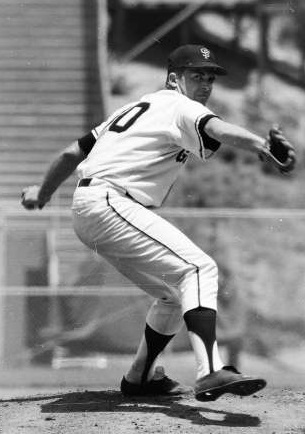
Mike McCormick, RIP: Mr. 500’s battles

2020-06-17 MikeMcCormick02

A Comeback Player of the Year-winning perseverance probably helped Mike McCormick win the first National League Cy Young Award in 1967.

Ask who was the first Giant (New York or San Francisco) to win the Cy Young Award and some might answer with either Tim Lincecum (who did win twice) or Hall of Famer Juan Marichal (who didn’t win even once).

Now, drop a hint: He’s the only pitcher in the 500-home run club. OK, we’re getting technical. But Mike McCormick did hit home run number 500 . . . by any major league pitcher.

The bad news is that he also surrendered Hall of Famer Henry Aaron’s 500th home run. So put McCormick into the membership-of-one 500-home run club on both sides of the ball.

McCormick was also the first pitcher to win the National League’s Cy Young Award, after the prize was divided for each league following Hall of Famer Sandy Koufax’s retirement, ending Koufax’s ownership (three in four seasons, the last two back-to-back) of the original major league award.

Until Lincecum won the Cy Young Award back-to-back, McCormick was also the only Giant ever to win the prize.

You’d have spotted McCormick on the road in a heartbeat if you knew some of the foregoing. His personalised license plate read “Mr. 500.” Mr. 500 died at 81 Saturday at his Cornelius, North Carolina home after a long battle with Parkinson’s disease.

Native to California, the lefthanded, hard-throwing McCormick had ideas about going to the University of Southern California with his high school all-star teammate Ron Fairly before scouts from all but one major league team began showing him the bonus money in 1956. When the New York Giants showed the 16-year-old $50,000, McCormick didn’t hesitate.

“I realized that fifty thousand dollars will buy me a lot of education,” he once told SF Giants: An Oral History author Mike Mandel, “and it’s an opportunity I may never get again, so I accepted it.”

The bonus rule of the day that required such signings to be kept on major league rosters for two full seasons before they could be farmed out. McCormick spent much of his first two in the Giants bullpen as the team moved from New York to San Francisco. Though numerous writings cite the elder Giants treating him decently, McCormick spent an awful lot of time walking the New York streets alone.

His roommate knew only too well how the kid felt: the late Johnny Antonelli, the first of the bonus babies under that old, silly rule. Antonelli was treated often enough as a pariah during his early years with the Boston Braves–until such veterans as pitcher Johnny Sain parlayed Antonelli’s fat bonus into their own salary hikes, and until Antonelli was drafted into the Army and then traded to the Giants.

In 1959 McCormick stepped forth as the Giants’ third starter. In 1960, he led the National League with a 2.70 earned run average and struck out twice as many as he walked. He fell off somewhat in 1962, but the Giants had reason to believe McCormick and Marichal were about to become the core of a youthful and powerful pitching staff.

They didn’t bargain on one little wrinkle. McCormick threw over a thousand major league innings before his 23rd birthday. At 19 he threw 178.1; at 20, 225.2; at 21, 253; at 22, 250. In 1962, his shoulder went AWOL and his manager Alvin Dark accused him of malingering.

“I couldn’t throw the ball 60 feet without getting tears in my eyes,” he once told Mandel. The pain was so serious McCormick admitted to hoping his catchers wouldn’t throw the ball back after a pitch. He spent the 1962 World Series on the bench and was traded to the Baltimore Orioles in the same deal that also made an Oriole out of relief specialist Stu Miller.

With the Orioles McCormick worked as a spot starter in 1963 but was sent to the minors in 1964—his first taste of minor league service. In the interim, Johns Hopkins doctors ruled he’d suffered a torn muscle in his shoulder that may or may not have been his rotator cuff.  Despite pitching well enough on the farm the Orioles traded him to the Washington Senators for another minor leaguer before the 1965 season opened.

Two seasons in Washington enabled McCormick to reinvent himself as a control-oriented pitcher with a lively screwball who looked and worked better than his won-lost records with the Second Nats. (He also took a single cortisone shot each spring from then on, nothing as insane a volume as other pitchers were administered far too often.)

When they traded him to the Giants for outfielder Cap Peterson and pitcher Bob Priddy in December 1966, the Giants hoped McCormick would just help balance the rotation as its only lefthander. They got better than they expected.

The 29-year-old McCormick wasn’t the National League’s most dominant pitcher in 1967 (Hall of Famer Jim Bunning actually was), but getting credit for a league-leading 22 wins and rolling a sub-3.00 ERA, after four seasons in which it looked as though he’d be another shoulder-wrecked casualty of youthful overwork, did him more than a few favours. He had above-league-average run support and his bullpen only blew one of his starts after he left the game.

McCormick probably won his Cy Young Award two ways: those 22 wins and his too-obvious Comeback Player of the Year Award-winning revival. Sometimes voters reward the effort a little more than the actual results. “He left the Giants’ employ five years ago as a fastball pitcher,” wrote then-San Francisco Chronicle writer Ron Fimrite. “He returned this year as a craftsman.”

It would be his final shining moment. In 1968—the year he surrendered Aaron’s 500th— his screwball took a powder and, despite a briefly shining 1969, McCormick’s pitching days were all but finished. Further injuries, further ineffectiveness, bounding from the Giants to the Kansas City Royals to the New York Yankees and back to the Giants, with a few minor league stops along the way.

McCormick found retiring easier said than done when he tried it first in 1972. But he finally called it a career in 1973. “I was a victim of bad pitching,” he once said. “My own.”

He wasn’t exactly left high and dry after baseball. He’d worked as a stockbroker in many offseasons and eventually became a Bay Area office equipment salesman and worked in promotions for the Giants as well. Divorced from his first wife, the father of three re-married happily, had a fourth child, and eventually retired to North Carolina.

“I loved the competing,” he told the Chronicle in 2002. “I’d play every day if I could, and that’s probably part of the reason I hurt my arm. I’d never say no. I’d say, ‘Fine, give me the ball. I’ll go get ’em.’ I loved it.” If only those who coached and managed Mr. 500 knew how to love his arm back.

Money isn’t everything

2019-12-18 ToreyLovulloMadisonBumgarner

The electric horseman: Manager Torey Lovullo (left) welcomes Madison Bumgarner home.

Arizona the region and not necessarily the baseball team said something to Madison Bumgarner for long before he became a Diamondback at last. Enough to compel him to sign a new contract paying him less than he probably could have earned, even though he’s in the re-invention stage of his career. Sometimes there’s no place like a second home, too.

And more often than you think, money isn’t everything.

Time was when you couldn’t have pictured Bumgarner in anything other than the black-and-orange Giants hat and cream fatigues. When you saw the tenacity on the mound that turned him into a postseason myth in those fatigues and assumed, no matter what else came into play around him, that a Giant he was and a Giant he’d stay.

Madison Bumgarner and the Giants? Married even in the free agency era like Hall of Famers George Brett and the Royals, Tony Gwynn and the Padres, Chipper Jones and the Braves, Mariano Rivera and the Yankees, and Mike Schmidt and the Phillies. Not to mention future Hall of Famers Clayton Kershaw and the Dodgers (so far) and Mike Trout and the Angels, plus Yadier Molina and the Cardinals, and David Wright—whom injuries obstructed from consummating a Hall of Fame career—and the Mets. Right?

But maybe you didn’t catch onto Bumgarner and his wife falling in love with something aside when the Giants hit spring training every year in Scottsdale, Arizona. Something like Arizona itself. The place means almost as much to Bumgarner as the heat of baseball competition and the chance for winning that, right now, the Diamondbacks present better than the Giants do.

“First and foremost, winning,” he said when the Diamondbacks introduced him as their newest Snake Tuesday. “That’s what the whole decision is based on, and being with a team that’s my brand of baseball. They play the way I like to play. They just play hard. They’ve got a bunch of grinders on this team, guys that don’t take any pitch off. They’re just a hard-nosed group of guys.”

That’s a terrific reason for a pitcher who doesn’t know the meaning of the word “quit” to think about a new team, of course. But the lure of Phoenix and the surrounding ambience of Arizona itself was just as powerful, maybe the only presence that could hit Bumgarner for distance and get away with it.

The long-enough-time Giants horse becomes the Diamondbacks’ own Electric Horseman. The Bumgarners imported a few of their horses from Bumgarner’s native North Carolina to Arizona every spring. The Giants training there was so seductive to him that, once he knew the Diamondbacks were more than interested when he finally became a free agent, he was even willing to trade a fan base he came to love as deeply as he loves to compete to surrender.

“It’s tough,” he admitted about leaving them behind. “The fans in that city mean so much to me. I mean, shoot, it’s been ten years there and we won three world championships and have been through a lot together. They’ve always been as good as they could possibly be to me, and I’ll never forget that. I’ll always be thankful for it. That part of it was tough, but coming here, so far, this place has exceeded all my expectations, and like I said, I’m really excited about it.”

The fact that he still gets to have a few skirmishes a year with the Dodgers now that he’s staying in the National League West couldn’t possibly have eluded MadBum, either.

Stephen Strasburg re-signing with the Nationals, like Trout extending for life with the Angels last spring, said essentially that there’s no place like home, even an adopted home. (Strasburg is a native southern Californian; Trout is native to a region near the New Jersey-Pennsylvania border.) Bumgarner signing with the Snakes says there can be no place like the home you long for.

The Giants could have offered him everything including ownership of McCovey Cove, his own private cable car, free feed for the rest of his life at the Fisherman’s Wharf eatery of his choice, and an on-the-house lease to any piece he chose at Hearst Castle down Highway 1 in San Simeon. Once the Diamondbacks indicated they wanted him, you couldn’t pay him enough not to swap the Bay for the desert.

If you think that’s even just a slight exaggeration, be advised that assorted published reports say the lefthander with the Dreamliner wing span in the split second before he throws to the plate had nine-figure offers to ponder from elsewhere, but he instructed his agent, VC Sports’ Ed Cerulo, that Arizona was “the number one place for me.” And money wasn’t everything.

“We definitely left some money on the table,” the newest Diamondback said when the team introduced him formally Tuesday. “You can say that.” If the published speculation is true and Bumgarner looked at $100 million or better for five years in other offers, he’s left at least $15 million behind overall while agreeing to pitch—according to The Athletic‘s Zach Buchanan—for $6 million in 2020 before hitting $14 million for 2021, $18 million a year in 2022-23, and back to $14 million in 2024.

Essentially, Bumgarner gave the Diamondbacks a new-home discount. No, make it actually: Buchanan reported that $5 million a year is deferred from the 2021-23 annual salaries until the deal is finished. And general manager Mike Hazen—who traded a somewhat more expensive desert lover named Zack Grienke to the Astros in 2019’s marquee trade deadline swap—“plans to use that [2020 payroll] flexibility” to shore up the Diamondbacks for contention.

Buchanan thinks Bumgarner all but willed the new Diamondbacks deal into existence, sort of, but don’t dismiss Hazen—who once said that on the one hand he wasn’t exactly starving for starting pitching but, on the other hand, he wasn’t exactly going to say no to the chance for more—being just a little bit shrewd in his own right, either:

Hazen admitted that adding to his rotation wasn’t his top priority, or really any sort of priority, entering the offseason, but that Bumgarner made it plain early on that he preferred to end up in Arizona. Though Hazen stopped short of saying that affinity for Phoenix prodded him into engaging on the longtime Giants starter, the structure and overall value of Bumgarner’s deal—and Arizona’s lack of rotation holes before offering it—suggest the Diamondbacks were able to capitalize on a specific advantage they had over the 29 other major-league teams.

It also looked like the early speculation that made the Bumgarner deal a possible to-come trade scenario for incumbent starting pitcher Robbie Ray isn’t necessarily so. Bumgarner’s deal flexibility lets the Snakes shore up without having to invent payroll room. They’d rather save the invention for the field if they can help it.

And, more important, Hazen’s willing to gamble that Bumgarner continues re-inventing himself on the mound to the point where he’ll deliver better goods than he could with the Giants since 2017. “We just watched a guy leave here in the middle of last season who reinvented himself every year he was here,” Hazen told the Tuesday presser, referring to Greinke. “We feel like [Bumgarner] has that ability.”

The entertainment possibilities can’t be resisted, either. Assuming the Diamondbacks have a better sense of humour now than they had when the late Kevin Towers was their general manager, don’t be shocked to discover a hitching post outside the players’ entrance at Chase Field. Or, to see Bumgarner galloping up to the park aboard one of his horses, maybe hollering, “Hi yo, Tumbleweed! Away!”

Or (sorry, it’s impossible to resist), to see a staredown and bawl-out with an enemy batter (preferably a Dodger?) who’s just hit one over the right field fence in Chase Field turn into a cheerfully snarky “Go get it out of the pool!” T-shirt.

Life and baseball with Bumgarner could be mad fun for the Diamondbacks, even if Bumgarner isn’t yet ready to resign his Fun Police commission. Almost as much fun and soul embracing as life in Arizona for Lieutenant and Mrs. MadBum themselves.

MadBum hitches his horses to the Snakes

2019-12-16 MadisonBumgarner

Postseason legend Madison Bumgarner takes flight and gallops in Arizona now.

Picture the next time Madison Bumgarner surrenders a hefty home run in his home park and snarks over the bomber having fun with the blast. The bomber’s mates will be inspired to produce T-shirts saying not, “Get it out of the ocean” but, rather, “Get it out of the pool.”

Bumgarner has signed for five years and $85 million with the Diamondbacks, and the nearest body of water into which the opposition can hit is the pool behind Chase Field’s right field fence. Until Bumgarner gets to face the team for whom he served so well, mostly, for the first eleven years of his career, in his former playpen, that is.

A few years ago, Bumgarner’s asking price wouldn’t have been as low as $85 million for five years or more. A few injuries and, more important, a heavy workload have taken their toll, though at 30 years old Bumgarner isn’t exactly ready for Retirement Row. But yes, it does feel a little strange that you’ll see him for the next five in something other than Giants’ fatigues.

And, yes, Bumgarner really did prefer going to Arizona if the Giants weren’t going to be that interested in keeping the greatest postseason pitcher in their history. The Diamondbacks, admirably, have continued remaking/remodeling themselves without even thinking about tanking, and Bumgarner is nothing if not a competitor no matter how much his left arm doesn’t always obey his orders lately.

But The Athletic‘s Bay Area scribe, Andrew Baggarly, says it was personal as well: “Bumgarner told me in July that he and his wife, Ali, loved Arizona and he’d be interested in playing for the Diamondbacks. He gets his preferred destination from a life perspective, he’ll play for a team with way more near-term upside than the Giants, he still gets to hit (in a lively ballpark where he loves to take BP) and he still gets to stare down the Dodgers five or six times a year. What’s not to love?”

Thus does it make a little more sense that, yes, the Giants “were interested and engaged in retaining” the lefthander whose arm span as he’s about to deliver a pitch makes him resemble a Boeing Dreamliner with a bearded cockpit on takeoff; but, no, they weren’t exactly rolling the old red carpet for his landing, either.

Baggarly caught the drift at last week’s winter meetings. When he asked the Giants’ new manager, Gabe Kapler, how he was selling both himself and re-selling the Giants to their franchise World Series hero. When Kapler said he hadn’t talked to Bumgarner and (Baggarly’s words) “wanted to give him his space,” but would still reach out “if others thought it was a good idea.”

“And that was it,” Baggarly continued. “That was all I needed to know. There was no way that Bumgarner would continue his career with the Giants.” Because, of course, if the Giants wanted him to stay and thought they had a shot even at $85 million for five more years (they’re said to have offered four and $70 million), “you can bet that calls and meetings would’ve been set up. Kapler would have begun the back-channeling before he even got the job. The Giants would have tried to assuage Bumgarner’s every concern and dispel every bit of unease.”

Bumgarner isn’t the only one now shouldering into a Diamondbacks jersey who’s a bounceback candidate. The incumbent Snakes ace, Robbie Ray, is looking to make a comparable comeback from a somewhat dismal 2019, and much analysis has suggested the team hoped for enough of a comeback to make him attractive at next summer’s trade deadline. Bumgarner’s signing may have made Ray look positively glittering as a trade topic and positively assured of bringing back a haul of delicious enough prospects sooner.

MadBum is almost as renowned for the pleasures he takes in hitting as he is for that lifetime 2.11 postseason ERA, including a transdimensional 0.25 lifetime World Series ERA. He’ll fume at or bawl out enemy hitter taking a little too much pleasure in a monster mash on his dollar, but he enjoys hitting one for distance as much as the next man. Even if he admits he just can’t bring himself to let the kids play, or play with the kids, when he’s the bomb victim.

A shame, too. Two Opening Days ago I had a little mad fun with MadBum’s hitting a pair out, against the Diamondbacks of all people, one a leadoff blast against Zack Greinke in the top of the fifth, the other a one-out shot against reliever Andrew Chafin in the top of the seventh.(In between, then-Diamondback/now-Dodger A.J. Pollock hit one out off Bumgarner in the bottom of the sixth.)

I wrote a puckish column pondering the dialogue between the then Cy Ruth Award candidate and the Giants’ then-manager Bruce Bochy, leaning a little heavily off the day Bumgarner and then-Dodger Yasiel Puig tangled verbally after a ground out, with Bumgarner—who loves Puig about as much as a small child loves liver (after Puig joined the Reds and took Bumgarner deep, Bumgarner cracked, “He’s a quick study. It only took him seven years to learn how to hit that pitch”)—hollering, “Don’t look at me!”

Forgive me, MadBum, but I couldn’t resist looking at you on that Opening Day:

Bochy: Bum, it’s not that we don’t need the runs, but would you kindly remember that your job with this team is not to do your impersonation of Henry Aaron every other time up?

Bumgarner: Skip, don’t look at me!

Bochy: Bum, I know you were p.o.ed about losing the perfect game in the sixth. But you’re not getting paid the gigabucks to beat baseballs into earth orbit. You’re getting paid the gigabucks to throw them, preferably down the throats of enemy batters. Think you can remember that while you’re bucking for the Cy Ruth Award?

Bumgarner: Skip, just don’t look at me!

Bochy: Bum, you’re embarrassing our hitters. Hitting one 410 feet over the left center field fence on 1-2. You realize how many guys around here can’t hit on 1-2? You bucking to get our hitting coach fired?

Bumgarner: Skip, just don’t look at me!

Bochy: Okay, I’ll give you this one, Bum. That shot you hit in the seventh with one out. 2-0. Now, that’s a more reasonable count to swing on. And you did bust a three-all tie while you were at it. But c’mon, you don’t have to do everything yourself. Even if you’re the one who let them tie it up at three-all in the first place. Well, okay, it was A.J. Pollack, and even you can’t keep him from hitting one out now and then, you’re only human, after all.

Bumgarner: I’m only what?!?

Bochy: I knew that’d get your attention, Bum! Now, about those eleven strikeouts … that’s why you’re getting paid the gigabucks. Wait a minute — hey, Denard! Not a great way to open, getting yourself arrested for attempted grand theft second!

Bumgarner: Don’t look at him, Skip!

Bochy: Anyway, you’re getting paid to strike those emereffers out, not hit them into the Cove, buddy. There’s no Sandy Mays Award in baseball. I need you to start and when necessary close your own games, so far, depending on how much of an improvement this bullpen’s gonna be over last year’s bullpen. Christ, last year we couldn’t get save a thing if we’d had the Red Cross coming out of the pen.

Bumgarner: Rowrowrowrowwwrrrrrrrrrrrrrrrrrrrrrrr!

Bochy: What’s eating you, Bum?

Bumgarner: What’s with this Hoover? Who does he think he’s fooling with that slop? Why doesn’t he go back and make his vacuum cleaners where he belongs?

Bochy: He just struck Pence out after Hunter fought him back to 2-2.

Bumgarner: That ain’t exactly beating as you sweep as you clean, Skip.

Bochy: Where’d you learn your history?

Bumgarner: I play Trivial Pursuit just like any normal guy.

Bochy: Normal! Normal! Any normal guy who gets paid the gigabucks to pitch and strike out the other guys but who gets up to the plate and thinks he’s Mike Schmidt. You call that normal?

Bumgarner: Do I look like Mike Schmidt, Skip?

Bochy: Only when you hit.

Bumgarner: When did he ever strike out eleven guys in a game? Hey! We got first and second. Buster walked and Craw singled him to second. Who says I’m the one who has to do it all?

Bochy: Nunez just lined out to right, in case you weren’t looking.

Bumgarner: Looks like Hoover needs to change his beater bar brushes.

Bochy: Come on, Bum, give the guy a break, you had to squirm a couple of times too, you know.

Bumgarner: I twist and shout, I do not squirm.

Bochy: Have it your way, buddy. Look at him. Throws two balls to Hernandez, then strikes his ass out on three straight pitches. Looked like he took a couple of lessons from you.

Bumgarner: OK, give you that one. Poor Gork, forget the breeze, I could feel the hurricane.

Bochy: C’mon, Bum, you did more than your share today. Take the rest of the day off. Law can handle these guys.

Bumgarner: Okay, Skip, but remember who would have hit second in the ninth. For all you know I had another home run in me.

Bochy: Bum, let’s not get into that again, shall we? Can’t you settle for being the only pitcher in baseball history ever to hit two bombs on Opening Day and let it go at that?

Bumgarner: Well, look at poor Law, Skip. Two hitters, two singles, and Goldschmidt coming up. Whoa! Two straight strikes he throws on Goldschmidt. Now balls one and two.

Bochy: Gimme a break, Bum, I didn’t want Pollock to pounce on you again.

Bumgarner: You’re all heart, Skip.

Bochy: Damn! The bastard tied it up with a single.

Bumgarner: He fought the Law and won.

Bochy: Forget it. Jerry Seinfeld you ain’t. Hold on, I gotta get Law out of there.

Bumgarner: Good call, Skip. Blach got the double play. And Strickland got the strikeout. Now I know you’re gonna miss me hitting in the ninth!

Bochy: You gonna start that again?

Bumgarner: Who’s the genius who decided I could take the rest of the day off when I might have had another home run in me?

Bochy: I dunno.

Bumgarner: Well, don’t look at me, Skip!

Bochy: Hey, look who’s pitching the ninth.

Bumgarner: It’s old man Rodney! And Panik triples off him to open! C’mon, Skip, I could have gotten him home without hitting one out.

Bochy: See? Gillaspie got him home! Sacrifice fly. So it’s not like you hitting your third homer of the game, just shoot me.

Bumgarner: Don’t start with me, Skip!

Bochy: Now I got to get Melancon in there. The season isn’t even three hours old for us and already we’ve got a blown save. Thirty last year wasn’t enough, we gotta buck for forty already? Damn, how could we load up the pads on old man Rodney and not cash those guys in? How could we get Span thrown out at the plate to end that inning? Coulda had a two or more run lead.

Bumgarner: Well, Melancon isn’t getting paid the big gigabucks to go up to the plate and hit grand slams, Skip. Damn, Skip! Two outs, he gives up a double to Mathis and an RBI single to Daniel Freaking Descalso!! And Owings sends home the winning run! Why are we paying Melancon the big gigabucks? I told you you should have had me available to hit in the ninth! You ever heard of an insurance run?

Bochy: Don’t look at me, Bum!

The word is that the man who’s been a horse for the Giants even when he wasn’t pitching at his peak performance level owns horses in the Phoenix area and, with his wife, loves the horses as much as the area and as much as baseball. The man who doesn’t want you looking at him when you recover from a knockdown pitch or take him out of your shared baseball real estate isn’t averse to a little horsing around.

But wouldn’t it be something if baseball could give him dispensation for Opening Day, lets him keep a horse adjacent to the batter’s box, then—if he hits one out—lets him mount and gallop around the bases?

All the Diamondbacks have to do otherwise now remind Bumgarner the only body of water into which the other guys can hit is small, behind the fence, and features a hot tub off to one corner. And, keep him away from dirt bikes.

Ron Fairly, RIP: See ya later

2019-11-03 RonFairly

Ron Fairly. (Seattle Mariners photograph.)

There’s plenty to be said for a fellow whose baseball life involves over seven thousand games, as a player and a broadcaster. There’s more to be said for Ron Fairly, who died at 81 on the morning the Nationals—for whom Fairly once played when they were the infant Montreal Expos—won the World Series last week.

Fairly was a solid first baseman and outfielder who studied the game as attentively as he played it. When he became a broadcaster, his habits included calling walks by saying, “Those bases on balls, they’ll kill you every time.” Fairly should have known if anyone did: his playing statistics include 1,022 walks to 877 strikeouts. That’s a 0.83 strikeout to walk ratio, .84 below the Show average in his 21 seasons.

A lefthanded hitter with more than a little power, and blessed with almost the perfect surname for a major league hitter, Fairly was killed at the plate by his two Dodger home parks, the Los Angeles Coliseum (the baseball field shoehorned into the football emporium was hell on portsiders who didn’t always hit the other way) and Dodger Stadium (heaven for pitchers, hell for hitters) from 1959 (his first full season) through 1968 (his final full year as a Dodger).

And he knew it.

“I played in an era— the 1960s—that might have been the most difficult in which to make your living, as a hitter, of any in the history of the game of baseball,” said Fairly to FanGraphs interviewer David Laurila in 2011. “I played in Dodger Stadium, which was a big ballpark where the ball didn’t carry very well. It doesn’t take many [lost] hits during the course of a season for your average to drop a little bit, and you weren’t going to have as many home runs or RBIs there.”

He probably had the one of the most quiet instances of World Series shining of them all. Seven Dodger position players played all seven games of the 1965 Series and Fairly out-hit all of them, including Maury Wills, first base mainstay-to-be Wes Parker, the season’s super-sub Lou Johnson, and veteran Jim (Junior) Gilliam, who’d come out of retirement to play most of the season at third base and made a key play to save Hall of Famer Sandy Koufax’s Game Seven shutout.

Fairly’s 1.069 OPS for that Series was the tops among the Dodgers by far, well enough beyond Johnson’s .914. He went 11-for-29 with three doubles and two home runs against the Twins and drove six runs home while he was at it. It was a Series that threatened to become an all-home-team-winning set before Koufax’s Game Seven shutout.

“We started Sandy instead of [Hall of Famer Don] Drysdale, and the reason is that Sandy was more muscular and it would have taken him too long to warm up,” Fairly remembered to Laurila of that game. “Drysdale could warm up a lot faster if Sandy got into trouble.”

Koufax did struggle in the early innings, finding his vaunted curve ball unreliable and deciding to go strictly fastball the rest of the way. “It wasn’t until about the sixth or seventh inning that Sandy started to settle down, loosen up and get it going,” Fairly said. “On two days’ rest, he probably threw 140 pitches—maybe 160—and he was throwing better in the seventh, eighth and ninth innings than he was in the first three innings.”

(Don’t go there: before you start lamenting that today’s pitcher’s haven’t got the kidney to work like that, be reminded that Koufax would pitch only one more season to come, then retire after it, at thirty, beyond the top of his game. Among other things, continuing to be a human medical experiment to keep him pitching despite a then-unfixable arthritic pitching elbow was liable to compromise something a little more important to Koufax—like the rest of his life.)

Fairly also scored the only Dodger run in Game Two (which Koufax pitched after declining Game One because of Yom Kippur); he scored the first Dodger run in Game Three; he sent the first of four Dodger insurance runs home off Twins relief mainstay Al Worthington; his RBI double off Jim Kaat in the third gave Koufax a 4-0 Game Five cushion.

And he followed Johnson’s fourth-inning Game Seven homer with a double before coming home when his first base successor Parker bounced one over Twins first baseman Don Mincher’s head immediately to follow. Said Fairly, “[T]hat was it. Sandy took care of the rest.”

Fairly also remembered the ugliest moment of that 1965 season, the Candlestick Park brawl that climaxed a weekend of tensions between the Dodgers and the Giants, kicked off when Dodger catcher John Roseboro threw a return pitch to Koufax that zipped right past Hall of Fame pitcher Juan Marichal’s head in the batter’s box—when Marichal was still looking ahead of and not behind himself.

Marichal had knocked Fairly down at the plate in the third inning, a little pushback after Koufax—who generally preferred domination over intimidation, but answering for a knockdown of Maury Wills in the first—sent one sailing over Hall of Famer Willie Mays’s head in the second. Marichal was less than thrilled, too, that Wills opened the game bunting for a base hit and Fairly drove him home two outs later.

When Marichal eventually came up to hit leading off the bottom of the third, Fairly was stationed in right field and occupied mostly by the wind that afternoon when Koufax threw Marichal a strike inside that Roseboro let get past him.

“After the pitch was made to Juan,” Fairly told Laurila, “I looked down because the wind was blowing so much, and all of a sudden I heard this roar. I looked up and here was Juan swinging the bat and both teams were running out of the dugout.” The return throw tripped Marichal’s trigger when he realised how close he’d been to a hole in the head.

As John Rosengren (in The Fight of Their Lives) and others have attested, both Marichal and Roseboro were buffeted by off-field events. Marichal was haunted by that year’s civil war in his native Dominican Republic, where his cousin was a presidential running mate; Roseboro was haunted by the Watts riots in Los Angeles.

And when Marichal wheeled around screaming “Why you do that??” he saw Roseboro advancing toward him, knowing Roseboro was karate trained, and in one sickening instant was overcome by fear. That’s when he brought his bat down on Roseboro’s head; it didn’t catch Roseboro’s head flush on but struck enough to open a gash over the catcher’s eye.

“Mays and Len Gabrielson were the two guys on the Giants who tried to break that fight up,” remembered Fairly. “Keep in mind, there wasn’t a lot of love between the Giants and Dodgers. We didn’t even like their uniforms. They didn’t like ours.”

Fairly knew how completely out of character the brawl was for both the normally genial, prankish Marichal (whose wife swore he never awoke on the wrong side of the bed) and the quiet but attentive Roseboro. Indeed, Roseboro eventually forgave Marichal, the two became friends, and Roseboro campaigned for Marichal after the great pitcher was denied first-ballot Hall of Fame enshrinement.

“When you talk about all of the great pitching staffs the Dodgers had, keep in mind that Roseboro was the guy putting the fingers down,” Fairly told Laurila. “John was really good at calling games. He was one of the quietest guys I was ever around, but also one of the nicest. His locker was next to mine for years.”

Fairly remained with the Dodgers until 1969, when he was traded to the maiden voyaging Expos in a deal that brought Maury Wills (exiled to Pittsburgh after he walked away from the Dodgers’ winter ’66 tour of Japan) back to the Dodgers. He spent six seasons with the Expos before they traded him to the Cardinals; now already a part-time player, he also spent time with the Athletics (after their ’70s glory seasons), the Blue Jays, and the Angels before calling it a career.

The trade to Montreal affected Fairly negatively. He wasn’t a cold weather fan as it was, he didn’t like losing after those years of Dodger success, and he was haunted, says a Society for American Baseball Research biography, when he showed his then four-year-old son where Montreal is and the boy replied, “Does this mean I don’t have a daddy anymore?”

When he finished with the Angels it didn’t mean the end of his baseball life. Owner Gene Autry offered him a three-year deal in 1979 to broadcast Angel games on television with Dick Enberg and his old Dodger teammate Don Drysdale. Fairly stayed in the Angel booth until 1987, when came the crowning irony of his broadcast life: the Giants, of all people, invited him to take over for play-by-play man Hank Greenwald.

Try to imagine the Dodgers replacing Vin Scully with Russ Hodges (the legendary longtime voice of the Giants) and you have an idea how popular Fairly wasn’t in San Francisco. At least, not until the Giants brought Greenwald back to pair with him. “[We] had a lot of laughs,” Fairly said of their time together, which ended when Fairly moved up the Pacific to step into the Mariners booth. Where he stayed, very popular, until he retired in 2006.

He was known wherever he was on the air for “See ya later” calling home runs (including Hall of Famer Ken Griffey, Jr.’s in an eighth consecutive game) and as a raconteur steeped in baseball history and borne of a fine wit.

A favourite among Mariners fans was Fairly’s recollection of Koufax manhandling Hall of Famer Mickey Mantle in the 1963 World Series. As the sides changed and Mantle passed Fairly at first on the way back to centerfield, Mantle cracked, “Hey, Red, tell the bastard to lighten up, he’s making me look bad.”

Fairly made one more return to the broadcast booth, when the Mariners’ Hall of Fame announcer Dave Niehaus died unexpectedly after the 2010 season and Fairly filled in for a third of 2011. After that, it was home to Palm Springs and a quiet life of grandchildren and golf until esophageal cancer invaded and at last overtook him. “He had seemingly beaten the disease,” writes Spokesman-Review (Spokane, Washington) columnist Larry Stone, “but friends say it was the radiation that did him in.”

As a hitter, Fairly looked on the surface as though he cratered almost completely after Koufax’s retirement. He told an interviewer it was sort of Drysdale’s fault:

Drysdale told (general manager) Buzzie (Bavasi) that we should lengthen the grass and slow down the infield. I thought that was crazy. We were a ground ball/line drive team. We didn’t hit the ball in the air. Well, Buzzie lengthened the grass and it killed me. I didn’t have the speed to beat out infield hits and ground balls that had been getting through for me were winding up in infielders’ gloves.

Obviously, as a baseball theoretician Don Drysdale was one helluva pitcher.

Early in his career, Fairly had the distinction of rooming with Hall of Famer Duke Snider, a California native who also became a broadcaster after his playing days. Snider loved to regale the kid with tales from Ebbets Field where Snider’s prodigious power hitting and handsome looks earned him the nickname the Duke of Flatbush.

According to Laurila, Fairly remembered Snider saying he was batting in Ebbets Field with Hall of Fame catcher Roy Campanella on deck—with his chest protector and shin guards still strapped on. Campanella apparently didn’t think Snider could hit the pitcher in question with two out.

“Duke wouldn’t get in the batter’s box until Campy took them off,” Fairly said. “A few pitches later, Duke popped the ball up in the air. As he was running to first base, he was hollering at Campy, and Campy was laughing at him.”

I hope Fairly is giving them all a little friendly hell about it while they share a drink in the Elysian Fields now. Then, I hope Campanella gets to horn in with some jokes, and Mantle asks them to tell some bastard to lighten up, when Fairly, Drysdale, and Snider get to call some more games together up there.