“I’m really at peace with this”

Clayton Kershaw

Kershaw gets to retire as few of the greats truly do—on his own terms.

Often as not, you learn more about those whose careers you admire by the way they face the end than by the ways they did what earned your admiration. In Clayton Kershaw’s case, it might not be learning but re-learning.

When Kershaw froze the Giants’ Rafael Devers like ice cream with a strike-three fastball that could have been accused of clogging up the passing lane to open the top of the fifth Friday night, his mates in the infield surrounded and hugged him, then he handed the ball to Dodgers manager Dave Roberts. Roberts’s final season as a player was Kershaw’s first.

Now, Roberts put an arm around Kershaw and congratulated him on the career that’s written his likely first-ballot Hall of Fame ticket. Kershaw had only one reply: “I’m sorry I pitched so poorly tonight.”

Then, the 37-year-old lefthander looked toward his wife and four and a half children (Mrs. Kershaw is expecting their fifth) in the stands and motioned to the Dodger Stadium crowd before walking down from the mound and toward the dugout. He gave the crowd the curtain call they all but demanded, knowing they’d seen him pitch at home for the final time, then disappeared.

“I’m kind of mentally exhausted today, honestly,” he said after the Dodgers finished the game with a 6-3 win, “but it’s the best feeling in the world now. We got a win, we clinched a playoff berth, I got to stand on that mound one last time. I just can’t be more grateful.” Note the order in which he listed all of it. We first, I second.

That attitude enabled Kershaw not just to rule the earth from the mound in his prime but to pick up, dust off, start all over again after more mound heartbreak than the all-time greats should be allowed. When he triumphed, it was splendor on the mound; when he didn’t, it was down at the end of Lonely Street to Heartbreak Hotel. Never once did Kershaw take the triumphs for granted or the heartbreaks for finalities.

Clayton Kershaw

Kershaw beginning to deliver the strike three freezer to the Giants’ Rafael Devers, his final regular season batter and strikeout in Dodger Stadium.

No worse hour befell him, perhaps, than the night the Nationals yanked the Dodgers out of the 2019 postseason. The division series night Roberts sent Kershaw in relief of Walker Buehler and Kershaw yanked the Dodgers out of a seventh-inning Game Five jam by striking Adam Eaton out on three pitches. The night Roberts should have met Kershaw en route the dugout, given him the proverbial pat on the posterior, then taken the ball and brought Kenta Maeda in for the eighth to do what the manager later admitted thinking should have been done originally: face Anthony Rendon and Juan Soto.

Oops. Kershaw went out for the eighth. He threw Rendon a 1-0 fastball that looked as though it might catch the corner. Looks were so deceiving that Rendon sent it over the left field fence. The next pitch Kershaw threw, to Soto, was a slider that hung just enough for Soto to hang it into the right field bleachers. Then Roberts brought Maeda in. And Maeda struck the next three Nats out in order.

Those blows tied the game at three each, but Kershaw wasn’t anywhere near the mound when Howie Kendrick wrecked Joe Kelly and the Dodgers with the grand slam that punched the Nats’ tickets to the National League Championship Series. (And, to their eventual World Series conquest.) Some small packs of Dodger fans relieved themselves by running their cars over Kershaw jerseys in the postgame parking lot anyway.

Kershaw couldn’t bring himself to say what had to be said, that his manager inexplicably set him up to fail. Instead, he took the responsibility for himself.

“That’s the hardest part every year,” Kershaw said postgame. “When you don’t win the last game of the season and you’re to blame, it’s not fun . . . Everything people say is true right now about the postseason. I understand that. Nothing I can do about it right now. It’s a terrible feeling, it really is.”

He’d go forth to claim two World Series rings, in 2020 and 2024, even though his fractured toe kept him from pitching in last October other than cheerleading. His career 154 ERA+ leads all still-active pitchers. His 2.85 lifetime fielding-independent pitching rate is second among the active only to the often ill-fated Jacob deGrom. His resumé includes three Cy Young Awards, a Most Valuable Player award, and a no-hitter. Baseball-Reference considers Kershaw the number 20 starting pitcher who ever hit the mound; he was the best starting pitcher of his own time before his body finally started telling him, “That’s what you think.”

The fastball isn’t Little Johnny Jet anymore. The curve ball Vin Scully himself labeled Public Enemy Number One might be headed for Leavenworth. The slider that really turned Kershaw from good to great to extraterrestrial has lost just enough of its slide. But he is still Clayton Kershaw, and he will still have a role in the Dodgers postseason. Even if it’s coming out of the bullpen. He’ll be valued, even if he’ll let other arms hog the headlines for better or worse.

He didn’t pitch as poorly as he thought he did Friday night. Sure, he surrended a pair of earned runs and walked four while scattering four hits otherwise, but he struck six out in his 4.1 innings’ work. Even if that freezer to Devers looked borderline enough that you could wonder whether plate umpire Lance Barksdale might have let the moment and the legacy inform his judgment.
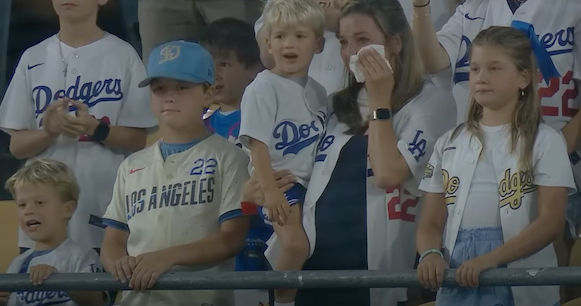
Kershaw Family

L to R—Cooper, Charley, Chance, Ellen, and Cali Kershaw contribute to the ovation for their future Hall of Famer as he’s about to begin his final regular-season Dodger Stadium start.

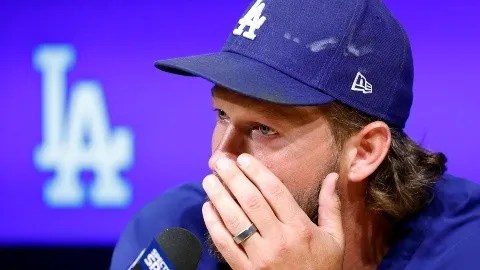
The night before, Kershaw made his pending retirement official, after an annual flirtation with the idea. True to form, he was humble and appreciative, right down to letting his wife share the moment by way of reading a letter she wrote him for the occasion:

From my perch, I have been uncomfortably pregnant, nursed newborns, rocked them to sleep to the roar of the seventh-inning stretch to get their last nap in. Fed them baby food, pouches, teething with crackers, changing blowout diapers, been frazzled with toddlers, tantrums and meltdowns, chased them through the concourses. A Mary Poppins bag filled with tricks and games to keep them occupied, and ironically teaching them the ins and outs of baseball. Explaining all the numbers on the scoreboard and the concession line, the ballpark food.

(I’ve) cried over some really hard losses and some really incredible milestones. (I’ve) watched our kids fall in love with the game, with the players and watching you pitch. Singing “Take Me Out to the Ballgame,” chasing beach balls, ducking from fly balls, spilling food and popcorn all over the fans below them. (I’ve) done it thousands of times, thousands of bathroom runs, all in the stadium. The workers and ushers are (our) best friends now.

A tear crept down Kershaw’s cheek as he read it.

“I’m really not sad. I’m really not,” he said later in the conference. “I’m really at peace with this. It’s just emotional.”

Few of the greats get to choose their own retirement terms. But they show more of what they’re made of when they do so than they ever showed on the field. Kershaw facing the end, whenever it may prove to be, showed more than any triumph and transcended any tribulation. No wonder grown adults wept for and with him.
The Red Sox Devers-ify . . .

Rafael Devers

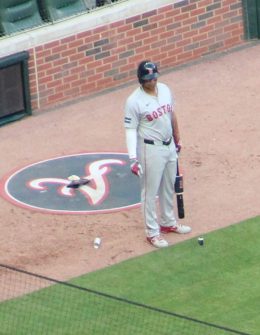
Devers in the on-deck circle. He now joins the Giants in a deal that may not bear immediate fruit for the Red Sox but manna at the plate for the Giants.

Even leading the 21st Century in World Series titles (four), the Red Sox haven’t lost their capacity to stun. They can sweep their eternal rivals and neutralize those rivals’ number one hitting threat one moment (they held Aaron Judge to 1 bomb, while striking him out 9 times during the sweep) and trade a slugging three-time all-star the next.

Yes, that sounds too simple. So we’ll flesh it out a big more. A relationship fractured by foolishness on both sides ends with Rafael Devers going to the Giants and left-handed pitcher Kyle Harrison, right-handed pitcher Jordan Hicks, outfield prospect James Tibbs, and minor league right-hander Jose Bello going to the Red Sox.

Almost five years after the Red Sox traded Mookie Betts rather than think much about paying him his true value, they’ve unloaded a far more problematic player than Betts ever was. That won’t make the deal go down any more smooth for a Red Sox Nation too much flummoxed by the team’s front office follies in recent seasons, alas.

The deal also means the last of the Red Sox’s 2018 World Series winners are gone. The Mookie Monster has since been a critical element in two Dodgers world champions; Xander Bogaerts has become a mainstay in San Diego and a few National League pennant races.

Say what you will about Devers, the man can hit. His to-date .858 OPS, his average 33 home runs per 162 games lifetime, both prove it. His batting eye improves with age; he led the American League in walks at the time of the deal. And he took care of the second of two runs the Red Sox needed to finish sweeping the Yankees with a hefty 2-out home run in the bottom of the fifth. The Giants may have a home ballpark nowhere near as hitter-friendly as Fenway Park, but they’re getting a guy to whom the dimensions don’t matter so long as he can tee it up and swing big.

Part of the problem, and a critical reason why things came to Devers’s transcontinental change of baseball address, is that when you play him at third base “poisonous” doesn’t begin to describe it. He led the league in errors in six of his first seven seasons and the entire Show for the first four of those. He was 80 defensive runs below league average. (Fair disclosure: Bogaerts hasn’t exactly been toxin-free at shortstop, not being 27 defensive runs below league average for his career to date.)

That’s a compelling reason why the Red Sox thought signing free agent third baseman Alex Bregman was a smart idea. The problem was that the Red Sox took the clumsy way to handle both that and the little matter of convincing Devers that the longer he stayed at third base the more likely the Red Sox were to declare the area off limits pending a hazmat cleaning.

How would Devers have done at first base? We won’t know, at least regarding the Red Sox, because Devers didn’t exactly pounce on the opportunity when it was offered as Triston Casas hit the injured list. He won’t be taking a new shot on third in San Fran, either, since the Giants have a verified Gold Glover holding it down (Matt Chapman). He may not get a crack at first, either, with the Giants having a willing Wilmer Flores to move over in case former Met Dominic Smith needs a break or can’t hold it down longer-term.

But Devers will provide the Giants with something they haven’t had since their freshman top executive, Buster Posey, was last seen behind the plate for the Giants — a great hitter. Posey may also give Devers what the Red Sox couldn’t for whatever reason, a clear presentation of the “why” behind any move without insulting Devers’s considerable pride. Posey had bloody well better, too, considering the Giants have taken on the remainder of Devers’s contract — running through 2033 and paying him a nifty $250 million plus.

What do the Red Sox get other than out from under Devers’s remaining money and maybe a little more egg on their faces considering they didn’t exactly handle Devers with graceful hands and heads?

Harrison — Considered highly talented and still only 23, so he has time to put things together despite his 4.56 fielding-independent pitching rate to date. Depending on the Red Sox pitching injury picture, Harrison just might be seen in Red Sox silks before the stretch drive arrives. And that might occur next to any pitching the team ponders acquiring at or before the trade deadline now that they have about $250 million to play with.

Hicks — Serviceable relief pitcher whom the Giants tried out of the rotation last year, but when that experiment imploded Hicks went back to the bullpen, and the Red Sox are liable to keep him there.

Tibbs — A first-round pick last June, he’s been showing plenty of upside in the minors, but the Red Sox will likely wait for his AA-level results before thinking of him as Show bound.

Bello — Has bullpen upside to burn, from the look of his minor league life to date.

The rest of the Sox — With Devers gone, it looks as though there will be plate appearances to spare to spread around especially in dispersing an outfield crowd partially. But it’s an open question as to just whom would replace Devers’s plate production. For now. And maybe longer. Which means the Red Sox’s re-entry into the AL East race picture may be an arduous re-entry to sustain.

Published originally by Sports Central.

26 minutes and other Opening Day salvos

Rafael Devers

Rafael Devers (Red Sox), the Show’s first ever to strike out without a pitch thrown, taken, or swung on and missed—on a pitch clock violation.

So. After encyclopædic volumes worth were said and done, the average shortening of games on Opening Day was a whopping . . . 26 minutes. The new rules, don’t you know?

I may be on board with the pitch clock, but I’m not on board with cheers about the shortening when a fourth grade math student can tell you they’d have been shortened more by eliminating half the broadcast commercials. That’s accounting for the spots before each half inning and during any inning jam in which a pitching change was made.

But it didn’t stop the Blue Jays and the Cardinals needing three hours and 38 minutes to finish with a 10-9 Blue Jays win, paced by George Springer’s five hits for the Jays and opened with Cardinals pitcher Adam Wainwright warbling “The Star Spangled Banner” to just about everyone’s surprise in Busch Stadium.

Two players made history under the new rules. Rafael Devers (third baseman, Red Sox) became the first in Show to strike out on a pitch clock violation. Marcus Stroman (pitcher, Cubs) became the first in Show to be assessed a ball on a clock violation.

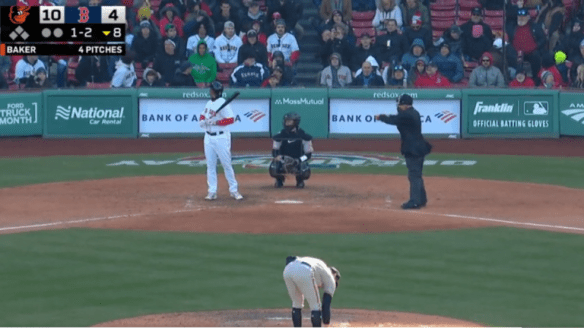
Leading off the eighth, Devers was rung up on 2-2 with Bryan Baker on the mound for the Orioles and the Red Sox in a 10-4 hole. “This doesn’t make sense to me,” said an announcer, “because he’d already looked at the pitcher. The pitcher’s not even ready to throw.”

Devers had checked back into the box with a few seconds remaining after stepping out to knock dirt out of his cleats. Even as Baker wasn’t quite ready to throw, plate umpire Lance Barksdale bagged him. It didn’t stop the Red Sox from posting a three-spot in the inning. “There’s no excuse,” said manager Alex Cora. “They know the rules.”

Knowing them and being able to maneuver within them for the first time in regular-season play are not exactly common. But it’s entirely possible that Devers not being dinged might have made a small difference. Led by Adley Rutschmann becoming the first catcher in Show history to have a five-hit Opening Day, the Orioles out-lasted the Red Sox, 10-9, after almost handing the game all the way back to the Olde Towne Team in the bottom of the ninth.

Remember: I’m also on board with turning the damn clock off in the eighth and later. Devers may yet prove evidence on behalf of that.

Stroman got his while checking Brewers runner Brice Turang at second with Christian Yelich at the plate in the third. The pitch clock expired about a hair before Stroman turned to pitch from the stretch. “It’s tough, this pitch clock,” Stroman told reporters postgame. “It’s a big adjustment. I don’t think people really realize it. It just adds a whole other layer of thinking.”

Yelich finally worked a walk out. The Brewers didn’t score then or the rest of the game. The Cubs won it, 4-0.

Jeff McNeil became the first Met to be hung with a pitch clock violation strike—for waiting for Pete Alonso to get back to first on a foul ball. Oops. Manager Buck Showalter was unamused that the clock began to tick before Alonso returned to the pad. McNeil remained mad just long enough to nail a base hit.

That was in an Opening Day game the Mets won, 5-3, beating the Marlins, but they might have had one more, at least, if not for someone whacking Brandon Nimmo with the stupid stick in the third. With first and third, Nimmo dropped a bunt—and hit into an inning-ending double play despite the run scoring. Thus the risk the wasted out, which is exactly what the sac bunt is, carries against defenders alert enough.

The good news there was Max Scherzer holding on despite all three Miami runs charged to his account and the Mets making simple enough work against a still not quite ready Sandy Alcantara. The bad was Justin Verlander having to miss a week while dealing with a muscle strain in his upper back near his throwing shoulder.

Perhaps it was miraculous that Aaron Judge picked up right where he left off from last season and hit one out in his first plate appearance against the Giants. That launched a 5-0 Yankee win that saw both starting pitchers, Gerrit Cole and Logan Webb, nail eleven and twelve strikeouts, respectively—the first opposing Opening Day starters to do that since Max the Knife (then a National, with twelve) and Jacob deGrom (then a Met, with ten) in 2019.

Speaking of deGrom, alas, the good news was, the Rangers got him a small truckload of runs. The bad news was that deGrom, still not all the way ready after a spring training disrupted by a side strain, also surrendered five before the Rangers unloaded for a nine-run fourth and held on to win, 11-7. They became the first Opening Day team to have a nine run-or-better inning since the Padres dropped 11 in the sixth against the Mets in the 1997 opener.

And Shohei still gonna Shohei. The Angels’ two-way unicorn struck ten Athletics out before his day’s work was finished. He even ripped a 110 mph base hit and threw a 101 mph pitch before he was done. And what did it prove worth in the end? Squatski. The Angels lost, 2-1. It put Ohtani onto a dubious record book page: the only pitcher to punch ten out and surrender no runs in his team’s Opening Day loss.

Meanwhile, the Rockies are still gonna Rockie, alas, even when they win. With a pair of home runs by first baseman C.J. Cron leading the way, the Rockies battered the Padres for seventeen hits—despite striking out at the plate seventeen times against four Padres pitchers. Making them the first team since 1900 to deliver that dubious 1-2 punch in a nine-inning game. Ever.

I’ve said it before, but I’ll say it once more. This is baseball. Where anything can happen—and usually does. With or without rule changes running the bases from the sublime to the ridiculous and back to the absurd. And wish though Commissioner ADD and his minions might, 26 minutes isn’t exactly that big a difference from even last year’s average.

Mr. Commissioner, meet the real faces of the game

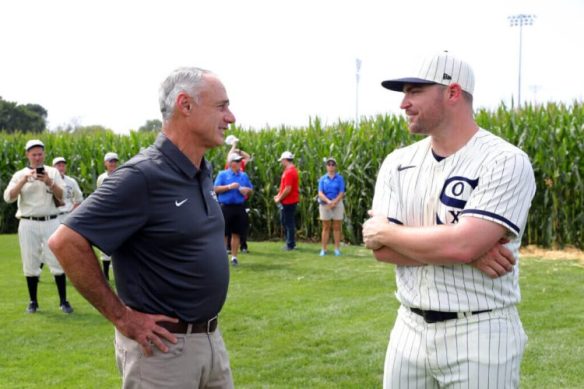
Rob Manfred, Liam Hendriks

Commissioner Rob Manfred with White Sox relief pitcher Liam Hendriks before last year’s Field of Dreams game. (The Athletic.)

Having a read of ESPN writer Don Van Natta, Jr.’s profile of commissioner Rob Manfred, I was almost convinced that maybe, just maybe, there really was more to Manfred than met the eye. Or, more than what comes forth in his stiff presence and often clumsy remarks.

Just maybe, the man isn’t the baseball-hating or baseball-illiterate Rube Goldberg-like abecedarian the caricatures so often portray. He did, after all, grow up a Yankee fan in upstate New York and can say proudly enough that he’s the only baseball commissioner ever who played Little League baseball. “All glove, no bat,” he remembers of being a Little League infielder.

My parents received a set of classic Revere copper-bottom cookware as a wedding present eight years before Manfred was born. (I still remember the fragrance of that special powder used to clean the copper bottoms, too.) Who knew Manfred (three years my junior) was the son of Revere’s production supervisor at their home plant in Rome, New York? An hour’s drive from Cooperstown, as it happens.

Born in 1958, Manfred took in his first live major league game at Yankee Stadium with his sports-obssessed father, sitting between the plate and first base on an Old Timers’ Day. Come game time, Hall of Famer Mickey Mantle crashed a pair of home runs and the Yankees beat the Twins, 3-2. When he finally became the game’s commissioner, he handed his father the first baseball with his stamp upon it.

“This is really an unbelievable thing,” Manfred, Sr. told his son. “I can’t say I disagree,” Manfred, Jr. told Van Natta.

A couple of hundred fathoms down, though, Van Natta noted that “more than once” Manfred told him what few baseball commissioners have dared to admit, that being the buffer absorbing the heat that should go to his bosses, the owners, is part of his job. Even if it’s about as pleasant as your private parts being caught in the vacuum cleaner’s handle.

And then it came.

“Every time it’s me, it ain’t one of those 30 guys—that’s good,” Van Natta quoted Manfred as saying. “Look, who the hell am I? I don’t have $2 billion invested in a team. I’m just a guy trying to do a job. I mean it. [The owners] deserve that layer. I believe they deserve that layer of protection. I’m the face of the game, for good or for bad.”

Mr. Manfred, unless it’s to boo and hiss your heads off over this or that piece of mischief, you may rest assured that no baseball fan anywhere in this country is paying his or her hard-earned money to head for the ballpark to see you or your bosses.

But I’m going to do you a small favour, as if you know me from the greenest bat boy on any professional baseball team. I’m going to introduce you to the true faces of the game. The ones whom those fans do pay their hard-earned money to see at the ballpark regardless of the machinations and deceptions of your bosses and theirs.

Mr. Manfred, meet Mike Trout. This is the guy you blamed once upon a time for not being baseball’s face, based upon his committing no crime more grave than letting his play and his clubhouse presence and his agreeability with fans before and after games speak for themselves, with no jive about the magnitude of being him.

Meet Shohei Ohtani. This is the two-way star who lights up the joint just by flashing that thousand-watt grin of his, never mind when he strikes thirteen out on the mound one night and belts baseballs onto the Van Allen Belt the very next. Between himself and Mr. Trout, you should be asking what on earth is wrong with the Angels that they still can’t find quality pitching enough to keep them in a race after they start in one but sputter unconscionably.

Meet Aaron Judge. This is the Leaning Tower of River Avenue who sends baseballs into the Delta Quadrant one moment and then, when made aware, goes out of his way to meet a Canadian kid to whom he’s number one among baseball men and who was handed one of his mammoth home run balls by an adult fan who knew the boy wanted nothing more than to catch one Judge hit out.

Meet Joey Votto. This is the future Hall of Fame first baseman who got himself tossed from a game early last year, but—after he learned his ejection broke the heart of a little California girl to whom he’s a hero above heroes—sent her a ball with his handwritten apology and autograph on it, prompting his team to drop game tickets and a little extra swag upon her the very next day.

Meet Bryce Harper. This is the guy who never apologised for being on board with letting the kids play. The guy now on the injured list with a thumb fracture and surgery to repair it after getting hit by a pitch thrown with one of the baseballs you and yours still can’t see fit to manufacture uniformly and with allowance for fairness on both sides of it, fairness for the pitchers and for the hitters alike.

Meet Vladimir Guerrero, Jr. and Bo Bichette. One is the son of a Hall of Famer who did last season what even his old man never did: led his league in on base percentage, slugging percentage, OPS, and OPS+, and led the entire Show in total bases. The other is the son of a respected major league slugger, has quite a lethal bat in his own right when his swing is right, and currently leads his league in trips to the plate. Together they’ve put some zip back into the Blue Jays.

Meet Oneil Cruz. The bat has yet to come to full life but the footwork, the glove, the throwing arm, have shown so far that you can be as tall as Frank Howard, J.R. Richard, and Randy Johnson and still play shortstop as though the position was created for you and not the Little Rascals in the first place. They’re falling in love with him in Pittsburgh, which needs all the love it can get, but they ought to fall in love with him all around the Show—except when he’s going so deep into the hole grabbing a grounder or a hopper that an enemy batter loses his lunch when he’s had a base hit stolen from him.

Meet Clayton Kershaw. He’s been around the block a few times. He’s a Hall of Fame lock as maybe the best pitcher of his generation. He’s still a quality pitcher and a class act. They still buy tickets on the road when they know he’s going to take the ball for the Dodgers. He’s faced his baseball aging curve with grace under pressure. And, for good measure, he’s the one active player who was seen fit to be part of the ceremony when the Dodgers unveiled that statue of their Hall of Fame legend Sandy Koufax this month, and you know (well, you damn well should know) what a class act Koufax was on the mound and has been in the decades since off it.

(You’re not still P.O.ed that Koufax waxed your Yankees’ tails twice while his Dodgers swept them in the 1963 World Series when you were seven, are you?)

Meet Justin Verlander. Missed a year plus recovering from Tommy John surgery. He has a 2.23 ERA and a 3.53 fielding-independent pitching rate so far this season. For any pitcher that’d be a remarkable return so far. For a future Hall of Famer who’s still suiting up at Jack Benny’s age (that’s a joke, son), it’s off the chart so far.

Meet Verlander’s 25-year-old Astros teammate, Yordan Álvarez. He’s leading the entire Show with his .667 slugging percentage, his 1.081 OPS, and his 206 OPS+. If there’s one untainted Astro who’s must-see viewing whenever he checks in at the plate, it’s him.

Meet Xander Bogaerts and Rafael Devers. The left side of the Red Sox infield is a big reason why the Olde Towne Team yanked themselves back up from the netherworld into second place in that rough and tumble American League East. Did I mention that Devers currently leads the entire Show with 177 total bases?

Meet José Ramírez. The Guardians’ third baseman is giving Devers a run for his money in the All-Star balloting that closes today. That thumb injury has put a crimp into his bat for now, and it’s had its role in the Guardians’ sudden deflation at the plate, but this guy just may be the face of his franchise right now. He ought to be one of the faces of this game.

Meet Mark Appel. This is the guy who went from number one in the draft to injuries as well as pressures and even to an exit from the game only to try giving it one more try—and finally coming up with the Phillies, nine years after that draft, and tossing a scoreless inning . . . at age 30. That’s as feel good a story as it gets for the oldest former number one to make his Show debut, no matter what happens with the rest of what remains of Appel’s career. They don’t all go to hell and back.

Those are only some of baseball’s faces, Mr. Commissioner. They’re the ones the fans want to see and pay through the nose to see. Despite your tinkerings. Despite your often erroneous readings of the room. Despite your inability or unwillingness to demand the same accountability of umpires that you do of players, coaches, and managers.

Despite your inability to let your professed deep love of the game come through without tripping over itself because, as an improvisor, well, if you were a musician the consensus would be that Miles Davis you ain’t.

ALCS Game Three: Rock and troll

Carlos Correa, Eduardo Rodriguez

Rodriguez (right) couldn’t resist trolling Carlos (It’s My Time!) Correa as the top of the sixth ended . . .

Carlos Correa grounded out to end the Astros’s sixth Tuesday night. Red Sox starter Eduardo Rodriguez couldn’t resist pointing to his wrist, trolling Correa’s becoming-more-familiar “It’s my time!” gesture whenever nailing a key Astros hit. There was a birthday boy in the house who wasn’t necessarily amused.

“No, no,” Alex Cora hollered, as Rodriguez returned to the dugout during the sides changing. “Don’t do that!” The last thing the manager wanted on his 46th birthday was any of his Red Sox poking the Houston bear they were taking down, before the bear could even think about stealing their picnic baskets.

Not even the pitcher who’d just pitched six solid innings the only blemish of which was a three-run homer two innings earlier. Not even while the Red Sox still held a six-run lead that finished in a 12-3 demolition giving the Red Sox a 2-1 American League Championship Series advantage and the Astros a monumental migraine.

An inning and a half worth of three-up, three-down baseball that looked to shape into a pitching duel between Rodriguez and Astros starter Jose Urquidy got ripped into a Red Sox demolition in the bottom of the second after starting as a mere tear. Two walks sandwiching a J.D. Martinez one-out double merely loaded the bases for Christian Vazquez’s line single the other way to right field and kept them there.

Oops. Christian Arroyo ripped one off the mound and off Astros second baseman Jose Altuve to send Martinez home with a second Red Sox run. Falling into an early 2-0 hole with ducks still on the pond against these Astros still seemed surmountable. Until Kyle Schwarber told them otherwise.

After taking ball one inside, ball two downstairs, and ball three just inside, Schwarber took Urquidy’s fastball around the middle halfway up the right field seats. It was the third salami slice for the Red Sox in three ALCS games. As if slicing two in Game Two wasn’t precedent enough, the Schwarbinator’s blast made the Red Sox the first ever to slice three in any postseason series.

Kiké Hernández followed Schwarber at once with a base hit pulled up the left field line, and Xander Bogaerts ripped a single up the pipe one out later, and finally Astros manager Dusty Baker got Urquidy out of there before the Red Sox could cover his grave. Yimi Garcia shook off a second-and-third-making wild pitch to dispatch Alex Verdugo for the side at last, but aftershocks were still to come.

They started an inning later, when Hunter Renfroe drew a one-out walk, stole second, then took third when Astros catcher Martin Maldonado’s throw to second bounced away from Altuve, before coming home on Vazquez’s floating base hit into short center. Then Arroyo drove Garcia’s slightly hanging slide into the rear row of the Green Monster seats.

The Astros may have punctured the impenetrable when Astros center fielder Kyle Tucker parked one into the right field seats with Michael Brantley (leadoff single) and Yordan Alvarez (one-out single banged off the Monster but played perfectly by left fielder Verdugo to hold him) aboard in the top of the fourth.

Two innings and three Astro pitchers later, Rafael Devers took a leadoff walk and the Astros got two outs quick enough to follow, especially center field insertion Jose Siri’s sliding catch running in long to take Verdugo’s floater into shallow center. Phil Maton then relieved Brooks Raley for the Astros, and he arrived just in time to feed Martinez something to hit into the Monster seats about as deep as Arroyo’s blast traveled.

Kyle Schwarber

The Schwarbinator slicing salami in the second to start the Red Sox romp in earnest . . .

Before this ALCS ends, the Red Sox may need to put new tires on the laundry cart into which they dump their home run hitters to celebrate the blasts in each moment. They’re already down to the last millimeter of tread as it is.

As if making sure the sealant on the first puncture held fast, Devers turned on Astro relieve Ryan Stanek’s first one-out pitch in the bottom of the eighth and sent that into the Monster seats, too. Renfroe’s diving catch on Correa’s two-out, opposite-field drive in the top of the ninth must have felt like the first mercy shown the Astros all night long.

Astros pitching coach Brent Strom wondered aloud whether his charges might be tipping pitches. Not willing to commit to that quite all the way, he acknowledged that—between the Red Sox’s postseason plate discipline and all-fields approaches and Astro pitchers falling behind in counts so often now—he’s more than a little concerned.

“This is a very good hitting team,” Strom said of the Red Sox, “and they’re very adept at picking up little things, much more so than most teams,” Strom said. “We need to be very cognizant of the little things, tipping-type things, things like that, that they’re very astute at. We’ve just gotten behind hitters.”

Cora said the Red Sox approach began changing when Schwarber came aboard in a July trade with the Nationals. “We were expanding,” Cora said, meaning the strike zone. “We didn’t walk too much, and when he got here and when he started playing, it was different. It’s a different at-bat, and other guys have followed his lead, and right now, like I said, this is the best I’ve seen this team this season offensively.”

Correa thinks the Red Sox aren’t picking up Astro pitch tips so much as they’re just doing their jobs at the plate when the Astros’ pitchers aren’t doing theirs on the mound. As an Astro, it’s murder for Correa. But as a baseball fan, pardon the expression, it’s a blast.

“It’s fun to watch as a fan of the sport, see how everybody in the lineup has the same approach,” the shortstop said. “They’re not chasing. They’re staying in the zone. They’re not swinging at borderline pitches. It’s beautiful what they’re doing. We’ve got to find a way to throw more strikes and keep the ball in the ballpark.”

But as much talk came about Rodriguez giving Correa a taste of his own celebratory medicine as about the Red Sox’s thorough dismantling of the Astros’ balky pitching staff and shaky offense—particularly their big three of Altuve, Brantley, and Alex Bregman now standing a combined 5-for-36 in the set so far—after the game finally ended.

Cora didn’t exactly hold it against Rodriguez, making a point of embracing his pitcher when Rodriguez returned to the dugout. But he still didn’t want Rodriguez or any of his players re-awakening the suddenly sleeping Astro giants.

“We don’t act that way,” he said postgame. “We just show up, we play, and we move on, and he knows. I let him know. We don’t have to do that. If we’re looking for motivation outside of what we’re trying to accomplish, we’re in the wrong business. The only motivation we have is to win four games against them and move on to the next round.”

Correa didn’t exactly mind. The way he spoke postgame, you’d have thought the Astros forgot about such concepts as bulletin-board fodder. “He did my celebration,” said the shortstop liable to command a nice free agency deal this winter, no matter his Astrogate past.

“I thought it was kind of cool,” continued Correa, who’d done his “It’s my time” wrist-tap in Game One after breaking a three-all tie with an eighth-inning bomb. “It’s just the way baseball should trend. I loved it personally . . . I keep it real all the time and say how it is.”

Rodriguez admitted he was caught up in the moment after getting Correa to end the sixth. Cora was stern but not exactly harsh with his pitcher back in the dugout. His embrace fit perfectly with Rodriguez’s previous insistence that Cora was like a father or older brother to his players as well as a manager.

“He understands that we’re not that way.” said Cora, whose Red Sox almost got humbled out of the races in the second half between injuries, COVID sufferings, and a bullpen remake. “We talk about humble approach and humble players, and that’s who we are. We like to grind, and we like to play, but we don’t do that.”

Well, good Lord, a team hammering and blasting its way to a rout can’t be faulted for being just a little less than humble in the moment here and there. Can they?