“Hey, Dad? Want to pitch me a walk-off?”

Tim Anderson

Tim Anderson, finishing the hype-busting Field of Dreams Game with a two-run homer in the bottom of the ninth Thursday night.

The game finished by crossing its original protagonist, Field of Dreams, with The Natural. The most poetically inclined screenwriting/directing team in film couldn’t imagine climax that surreal.

A pair of two-run homers in the top of the ninth to yank the Yankees back into the lead at 8-7. A two-run homer in the bottom of the ninth to win it for the White Sox, 9-8. This wasn’t the way they won ballgames during the 1910s evoked by the special uniforms the two teams wore for the occasion.

Hey, Dad? Want to pitch me a walk-off?

It was as jolting a climax as ever provided by David Freese, Aaron Boone, Joe Carter, Kirk Gibson, Chris Chambliss, Bill Mazeroski, or Bobby Thomson. Even if it didn’t win a World Series, push a Series to a seventh game,  send a team to a Series, or put them in the postseason at all in the first place.

It defied the game’s subtexts. The ones not spoken often if at all in the hype. The ones involving Field of Dreams‘s unlikely turning of baseball’s worst gambling scandal into a fantasy of reconciliation; and, The Natural‘s study of a live young prospect shot Eddie Waitkus-like, into long, long wandering, into a haunted elder returning to prove neither he nor his old dream died, for however long it still had to live.

No volume of pre-game hype—this game’s tribute to artifices of fantasy was as hyped as any sports event could be—could have promised and delivered that kind of a ninth inning. Even Field of Dreams star Kevin Costner, escorting both teams onto the field from the corn beyond the wall, asking the crowd, “Is this heaven?” with the crowd hollering back, “No, this is Iowa,” wouldn’t have dared demand that in a script.

But there was Liam Hendricks, the engaging White Sox relief pitcher, looking made for wraparound sunglasses thanks to being endowed with wraparound eyes, working the top of the ninth, shaking a leadoff single off to strike Yankee veterans D.J. LeMahieu and Brett Gardner out swinging on four pitches each.

Then there was Hendricks at 2-1 to Aaron Judge. He threw Judge a high fastball and watched it sail far enough into the right field corn. Following which Hendricks wrestled Joey Gallo—the former Ranger whose stock in trade is either home run feast or strikeout famine, but who has the odd discipline of working walks (he averages 94 per 162 games lifetime)—into a walk after starting him 1-1 without throwing another strike.

Up to the plate stepped Giancarlo Stanton, a former National League Most Valuable Player and one of the game’s more formidable bombardiers until injuries began to grind away at him in earnest. Stanton hit Hendricks’s first service into the left field corn.

Even the somewhat partisan, small audience—savouring a game on the field built adjacent to the famous Field of Dreams farmhouse field, many paying through the nose secondarily for tickets with face values of $375 or $425, Iowa fans and White Sox season ticket-holders, the latter by special lottery—roared when that fabled Yankee power detonated in the top of the ninth.

It was nothing compared to what happened in the bottom, when Yankee reliever Zack Britton, himself having been in the top tier of his particular profession before injuries began shaving him down, too, took the role normally assigned to the injured Aroldis Chapman. He opened by luring White Sox pinch hitter Danny Mendick into a ground out to first but walking White Sox catcher Seby Zavala—who’d hit one into the corn himself in the bottom of the fourth.

Up stepped Tim Anderson, the lively White Sox shortstop. Britton pumped and pitched, a fastball right down the pipe. It was too fat a pitch to resist. If the White Sox have a classic kangaroo court in their clubhouse, Anderson would have been fined for malfeasance.

It didn’t win a pennant. It was more out of The Natural than Field of Dreams, whose co-protagonist by default Shoeless Joe Jackson had only one known walk-off hit in his entire career. (For the White Sox, against the Yankees, in July 1919.) But when Anderson hit it out, it won a ball game keeping the Yankees from gaining on the second place Red Sox in the American League East and fattening the White Sox’s AL Central lead to eleven and a half. Slamming an exclamation point down for baseball itself.

What began with Field of Dreams star Kevin Costner escorting the Yankees and the White Sox through the corn and down across the field ended with an African-American man from Alabama, who wouldn’t have been admitted to the 1910-1919 Show because of his race, channeling his inner Roy Hobbs, The Natural‘s psychically-buffeted protagonist.

Hobbs in the film version was down 0-2 and struggling mightily with an ancient bullet lodged in his insides, causing him to bleed through his lower stomach, when he hit the pennant-winning bomb that also shot the ballpark lights out. Anderson had no such encumbrance when he sent Britton’s canteloupe into the left field corn.

Until that ninth inning viewers at home and the fans who’d paid into the field saw a very reasonably played game. They saw White Sox first baseman Jose Abreu hit the first major league home run ever hit in Iowa in the bottom of the first. They saw Judge become the first Yankee to go long in Iowa when he hit a three-run homer in the top of the third.
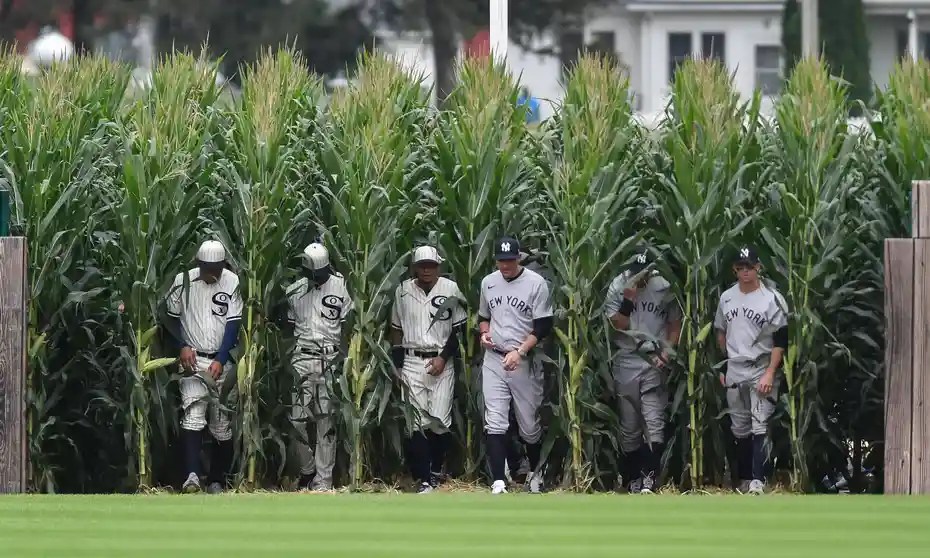
Chicago White Sox, New York Yankees

Wearing 1910s style uniforms, the White Sox and the Yankees entered the Field of Dreams Game through the corn Thursday evening.

They saw White Sox starter Lance Lynn nail the first major league strikeout in Iowa when he froze Gardner on a high called strike, on a night when plate umpire Pat Hoberg was as generous with the strike zone ceiling as he was skinflint about proper strikes on the sidewalls of the zone.

They saw the early 3-1 Yankee lead disappear in a four-run White Sox third, when Anderson doubled center fielder Adam Engel home with one out, and recently-restored-from the-injured-list designated hitter Eloy Jimenez cracked a three-run homer into the right field corn.

They saw Gardner put a number on Lynn’s pitching evening when he hit the second pitch of the top of the sixth not too far from where Jimenez’s bomb landed. They saw Yankee infielder Tyler Wade, one of a host of spare parts coming into regular service thanks to the Yankees’ ongoing shuttle back and forth from the injured list, drop one of the only bunts that should be allowed in a game.

With one out, nobody on, and the non-shifting White Sox infield playing deep enough to prompt calls for sending a search party out to find them, the lefthanded Wade saw enough delicious open real estate to push a bunt to the left side, just enough to the middle to keep third baseman Yoan Moncada from doing anything more than grabbing the ball on the run in.

No wasted out. Nothing but a versatile enough utility infielder, who inclines toward hitting line drives (he has four doubles out of 24 hits this season), not feeling he was going to get something to hit on a line, seeing a free gift and pouncing on it before the supply expired.

Then, Wade stole second while LeMahieu occupied himself with working his way into a walk. Then, a ground out pushing second and third and Judge accepting a walk from White Sox speed reliever Michael Kopech after opening with strike one but seeing four straight balls, including a ball four which should have been called strike two.

No matter, far as the White Sox were concerned. Up stepped Gallo, flashing his usual all-or-nothing style at the plate, swinging mightily enough but whacking a pitch a little up out to shortstop to force Judge for the side.

From the moment Lynn started the game with ball one to LeMahieu and LeMahieu nailed the first major league base hit in Iowa baseball history, to the moment Anderson sent everyone home with his corn ball, the game told the hype to take a shower. Even if the live Fox Sports telecast referenced Field of Dreams to a fare-thee-well.

“I knew it wasn’t over,” Anderson said post-game. “The game’s never over. And once Britton walked (Zavala), I knew there was a chance to start something real dope.” So he finished something real dope with something as dope as it gets. In the immortal words of Hall of Fame baseball writer Jayson Stark, “Because . . . baseball!

Of fathers, sons, dreams, rapproachment, and baseball

Kevin Costner, Dwier Brown

Kevin Costner and Dwier Brown play extraterrestrially reconciled son and father, respectively, in Field of Dreams.

So the Yankees and the White Sox will play the so-called Field of Dreams Game Thursday. They’ll play on the Iowa field rolled out and planted inside an eight thousand feet grandstand, adjacent to the field-in-the-cornfield that was actually built and used to make the film after which the game’s named.

“How,” asks Athletic writer Richard Dietsch, “do you capture the essence of a famous film on a live broadcast between Major League Baseball teams? That’s the question Fox Sports production staffers have been contemplating for months.” The answer may well depend on how you define the essence of Field of Dreams.

I read the original short story, “Shoeless Joe Jackson Comes to Iowa,” turned into the novel Shoeless Joe, by W.R. Kinsella, back when both first appeared. I saw the 1989 film when it first appeared and a few times to follow when it was delivered on videotape, then DVD. The fantasy in print and on film had a particular resonance for me.

What began as an Iowa farmer lured to plow two-thirds of his corn, to build a major league-size field onto which Jackson and his fellow Eight Men Out might return to the game from which they were banished eternally, concluded (spoiler alert, to those few who haven’t seen it) with an estranged son (the farmer) and father (presented as a one-time New York Highlanders player) reconciling as time, illness, and death once denied.

Just like any son first misinterpreting a heavenly voice’s instructions to welcome Shoeless Joe Jackson, kidnap a renowned but reclusive J.D. Salinger stand-in, then do likewise to the elderly doctor turned eager youth who’d once been a single-appearance New York Giants right fielder. Then, bringing the latter two to his fresh field to witness games between the Black Sox and assorted deceased baseball stars

(Don’t bother. IMDb lists those cast members only as “additional ballplayers.” It’s up to you whether you think you see Walter Johnson, Babe Ruth, Lou Gehrig, Honus Wagner, or Cy Young—though the young Moonlight Graham points to and mentions Smokey Joe Wood and a pair of live-ball legends, Mel Ott and Gil Hodges.)

The story has its charms above and beyond capital crime on behalf of the greater good of the game. Above and beyond the very idea that you could turn into heroes eight men who disgraced the game with their World Series tanking for fun and profit or (in the case of infielder Buck Weaver) refusing to blow the whistle on the tank when it might have made a truly significant difference.

And, above and beyond the implication that there but for the grace of the gamblers to whom two or three of the Eight Men Out reached would the White Sox have steamrolled the inferior 1919 Cincinnati Reds. The actual record shows that implication as false as the still-holding idea that Jackson was entirely innocent, to say nothing of whether Jackson really did play to win in that Series. (Says the actual record: he didn’t, quite.)

For me, the film’s climax is the charm that hits too close to home. The adult, fictional Kinsella gets to reconcile with his father on the field, the father frozen by death in his young adulthood, wearing a Highlanders uniform, with a catcher’s chest protector and shin guards.

Father and son in Field of Dreams were estranged by disputes including the one in which the son chastised the father for worshipping a badly tainted baseball hero. Father and son in my case were estranged by contradictions that would be called child abuse today, followed by the ten-month battle against cancer that my father lost in 1966, when I was ten and he, thirty-nine.

My parents were foolish enough to believe nothing but physical discipline, with no concurrent attempt at real teaching, applied to mere human childhood mistakes the same as to real misbehaviour or disobedience. Confirmed decades later by an unimpeachable source (my father’s sister), my parents wanted children in the worst way possible—only to have no patience for children merely being children.

My father, alas, was even more foolish for believing the way to teach a son who didn’t know how to fight was to beat him even more violently, accompanied by every demeaning insult he could throw. The thought that a son needs to be taught to defend himself, that it isn’t knowledge with which you’re born, was never programmed into his software.

My father’s death stole any hope of eventual rapproachment in this world from me. Fantasy thought it is, the rapproachment between John and Ray Kinsella to conclude Field of Dreams was and remains something I envied every time I watched the film. The few things I had in common with my father included baseball. (And, in fairness, music, my interest in and facility for which my father encouraged but my mother rejected.)

I don’t remember whom he declared to be among his baseball heroes, other than his having been a Dodgers fan since their Brooklyn years. He spoke of various players without singling one out as a particular favourite, at least within my earshot, while I had as heroes assorted hapless 1962-66 Mets plus Sandy Koufax, Willie Mays, Juan Marichal, Henry Aaron, and Bob Gibson, among others.

But I do remember numerous catches, a few trips to the Polo Grounds and then Shea Stadium to see those embryonic Mets, and, in one fathers-and-sons game, my ripping a line drive off his crotch when he deliberately lifted his glove above it because (he admitted it later) he didn’t want to be the reason I made a hard out.

For all the contradictions and abuse, whenever I watch the Field of Dreams climax I’d give whatever I have to give to see my father walk toward me one more time, whether or not he wore a baseball uniform, and slip a baseball glove onto his left hand when I slip mine on and say, “Dad, want to have a catch?”

How do you capture the essence of a famous film on a live broadcast between Major League Baseball teams? Asking demands we ask just what that essence really is.

Is it giving eight disgraced baseball players a new home and a chance to recover by the gods what their misbehaviours—ranging from the morally criminal to the complicit to the willfully silent—stripped from them in the mortal world’s furies?

Is it the old, long-gone fans who refused to believe those men could have been anything other than victims of their own caprices, married to those of a purportedly unscrupulous baseball owner (and that theory has been debunked, too) and the professional gamblers a few sought to finance their intended subterfuge?

Is it re-discovering a truth enunciated in short form and long double-negative by Hall of Fame manager Sparky Anderson? We try every way we can think of to kill this game, but for some reason nothing nobody does never hurts it. Or in long form by James Earl Jones as Salinger’s stand-in Terrence Mann?

People will come . . . they’ll walk out to the bleachers; sit in shirtsleeves on a perfect afternoon. They’ll find they have reserved seats somewhere along one of the baselines, where they sat when they were children and cheered their heroes. And they’ll watch the game and it’ll be as if they dipped themselves in magic waters . . . America has rolled by like an army of steamrollers. It has been erased like a blackboard, rebuilt and erased again. But baseball has marked the time. This field, this game: it’s a part of our past . . . It reminds of us of all that once was good and it could be again.

The author's son

Photographed by his father through a fence, my son ends his first-ever national Special Olympics plate appearance with a home run. (Yes, he back-flipped his bat away!) My fortune includes that we will never require reconciliation.

Is it an otherwise composed, ordinary Iowa farmer compelled to restore an un-restorable purity to men who could have destroyed baseball but engaged his lost father enough to return to earth, fostering the rapproachment too many fathers and sons—including mine, wherever he is in the Elysian Fields, with me—wish with each other but never find?

My own fortune includes being a father myself. By marriage and mutual engagement, not biology. The marriage is long past; my fatherhood, never. We made each other father and son. I did my best with whatever I had, for a son whose intelligence and will overcomes his compromise by a speech and language impairment, and whose heart is too large to be contained.

He joined his southern California softball team winning silver at the national 2018 Special Olympics. (His first plate appearance in that event: a healthy home run.) During the tournament, his coach told me and he affirmed: he credited me with teaching baseball and softball to him. There was no one more proud of my son at that Special Olympics (except his mother, surely) than his father.

All I ever did was observe, see what he had beyond the love of baseball we shared at the outset, then let him develop what he had on his time, through his eyes, ears, and hands, through his heart, never once imposing mine upon him. (He imposed one of his own: his boyhood heroes were Shawn Green and Vladimir Guerrero.) I’d learned the hardest way how damaging the other ways around could be.

The pan-damn-ic has prevented in-person time with my son since last year. We’ve missed the pleasures of going to Angel Stadium, sharing a game, sharing an atmosphere, with accompanying talk, theory, and hopes of catching a foul ball. It may well do so again before this season ends. I’ll talk to my son on the phone and in instant messages, as always we do. No one needs to tell either of us it isn’t quite the same as direct human engagement.

Neither of us are Yankee or White Sox fans. My son is a die-hard Angel fan. His father is a Met fan since the day they were born, a Red Sox fan since the 1967 pennant race, an Angel fan since the first day I took him to an Angel game. (They beat the Yankees and The Mariano in extra innings.)

We will probably each watch the Field of Dreams Game, thinking our own thoughts while the Yankees engage the White Sox, adjacent to where a novel was made into a film of fantasy that raises questions not always simple to answer. When not contemplating the good, the bad, the excellent, the dubious, about the play of the actual game.

Far simpler to replay the fictional Ray and John Kinsella reconciling with a simple game of catch. Even more simple to remind myself how much more fortunate I am, for having overcome my own parental estrangement and bereavement. For knowing I can still talk to, counsel, listen to my now-adult son, and play catch with him when conditions allow—for pleasure, not atonement.

Two champion Series finishers move on

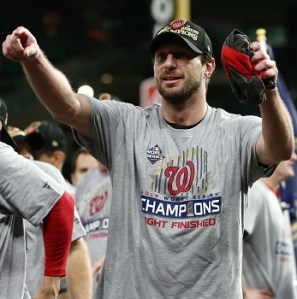
Max Scherzer

Max the Knife celebrates the World Series triumph he helped author with his on-fumes Game Seven start. Can he help the Dodgers go back to the Series?

The author of maybe the single most uplifting game in Nationals history is a Nat no more. The fellow with one blue and one brown eye who forced his way past a neck issue to keep the Nationals in line to win their first World Series has gone west.

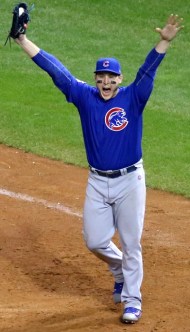
That was hours after the Cubs finally said goodbye to the man who snapped into his mitt the final out of their first World Series win since the premieres of cellophane, the Geiger counter, and the Model T Ford.

Trade deadlines don’t often feature two or more signatures of two off-the-charts World Series champions changing addresses and wardrobes. When they’re men identified that tightly with their teams, even those with no rooting skin in their games can’t help thinking that the world just got knocked more out of order than it seemed going in.

This year’s Nats don’t have a staggering rise from the dead in them just yet, if at all. This year’s Cubs were bent on selling while the selling was good, with their National League Central chances this year anything but. “Go Cubs Go,” that rollicking anthem of the 2016 conquerors, now has another meaning.

Max Scherzer goes west for a better chance at a postseason return with the Dodgers. That was just moments, seemingly, after the entire world thought the splash-happy Padres had him all but loaded on the plane west. Ouch.

Anthony Rizzo goes east in a Yankee hope that a couple of heretofore missing lefthanded bats—they’d landed all-or-nothing portside slugger Joey Gallo from the Rangers just prior—might turn their season from somewhat lost to yet another shot at the Promised Land.

The Nats hope the package of prospects Scherzer and shortstop Trea Turner brought back from Los Angeles mean this season proves a hiccup on their way back to the races to come. The Cubs hope the pair Rizzo brought back from the Bronx means likewise, especially depending on what they can bring back in any deal for Rizzo’s partner in 2016 World Series crime, third baseman Kris Bryant.

But ending eras is never pleasant. And these two deals ended a pair of eras that’ll live as long as Washington and Chicago live. The Rizz speared Bryant’s herky-jerky on-the-move throw over to secure the Cubs’ World Series winner. Max the Knife’s empty-tank performance of sheer will kept the Nats alive enough to pull just enough lingering rabbits out of their hats to nail Game Seven in 2019.

Chicago and Washington won’t forget as long as those cities and those men live. The feeling is very mutual with the players involved.

“This city,” Rizzo said when the deal to the Yankees was done, “will be ingrained in my heart for the rest of my life.” Told he was as transformational a figure in Wrigley Field as anyone who ever wore a Cub uniform, Rizzo accepted the idea with no small pride. “That’s what matters most—leaving this place better than when I found it. I can say the mission was accomplished.”

Scherzer still wasn’t sure whether he’d still be a Nat after he pitched Thursday and threw three-hit, one-run ball at the Phillies, in a start that was as much a showcase for his renewed health (he’d missed a start with a triceps strain a few days earlier) as for the trading floor. But he wanted to think about what Washington meant to him from the moment he’d signed that mammoth seven-year deal due to expire after this season.

Anthony Rizzo

Nobody beats The Rizz: Clutching the final out of the Cubs’ 2016 World Series conquest.

First, there were the purely baseball considerations. “I signed a seven-year deal here and we won a World Series. That’s the first thing I said when I signed, that I was here to win. And we won. We won a World Series,” he said. “That’s a lifelong dream come true and something I’ll always be proud of with these guys here, to be part of a championship team, looking forward to reunions and stuff like that.”

Then, there came the familial and community considerations. Scherzer arrived childless in Washington with his college-sweetheart wife, Erica. They’re going to Los Angeles with two of Scherzer’s three Cy Young Awards and three daughters.

“I’ve watched my girls grow up here,” Max the Knife said. “Living in Virginia in the DMV area, I’ve really gotten used to it, all the politics that are going around. Being in the nation’s capital has been kind of fun as well, driving by the monuments every day . . . What can you say about the fans? That championship will always mean something to all of us and we’ll always have that flag.”

Parting with uber prospects Keibert Ruiz (catcher), Josiah gray (righthanded pitcher), Gerardo Carillo (righthanded pitcher), and Donovan Casey (outfielder) made sense only if the Dodgers were going to bring in something well above average. They brought in the best pitcher and the best position player—a still-young shortstop with a live bat—on the trading floor.

If the Dodgers want to close the brief distance between themselves and the uber-surprising Giants in this year’s National League West, they couldn’t have done better if they’d gone to the lab and mixed the right ingredients in the test tubes and beakers.

The Nats aren’t exactly leaving themselves helpless. They have have pushed the plunger on this year, but with Juan Soto around whom to remodel they’re looking at 2022 and beyond. Particularly with a returning Stephen Strasburg and who knows what off-season deals or signings to come.

Mostly, Scherzer relieves the pressures on the Dodger starting rotation, what with Dustin May lost for the season recovering from Tommy John surgery and Trevor Bauer persona non grata when all is said and done, in the wake of a police investigation into a couple of turns of rough sex crossing the line from consensual to downright unwanted sexual assault.

Whether he proves a rental or whether the Dodgers want to keep him for the rest of his baseball life remains to be seen. Don’t bet against the Dodgers deciding to make the latter happen.

The Yankees should be so lucky with Rizzo and Gallo. Yes, they sent out a lineup full of raw power until those deals, but that lineup lacked consistency and lefthanded hitting, the long-traditional fuel of that long-vaunted, long-legendary Yankee power.

Rizzo is the far more balanced hitter between the two newcomers as well as a multiple Gold Glover at third base. Gallo is so all-or-nothing despite his ability to work walks that he actually lets you imagine Mario Mendoza as a power hitter, but he is a solid defensive outfielder with range and arm enough to maybe make the Yankees forget about Brett Gardner at long enough last. Maybe.

So where was the pitching help the Yankees really needed? Why weren’t they all-in yet on someone like Scherzer? Despite his expressed preference for going west, the Yankees have been nothing if not able to persuade such determined men otherwise in the past.

Why not all-in on resurgent and available Cubs closer Craig Kimbrel? Especially with other teams trailing him including now the Rays, rumoured to be pondering a package of Kimbrel and Bryant coming aboard? Or resurgent and available reliever Daniel Hudson, the 2019 World Series finisher whom the Nats dealt to Seattle before the trading floor really began bristling with prize packages?

Or Jose Berrios, the formidable Twins starter whom the Blue Jays have snapped up for a pair of prospects and who’ll have him through the end of 2022 at minimum pending their ability to sign him longer-term from there?

The Yankees are still in the race, technically. The problem is, they’re three games plus behind the Athletics in the American League wild card picture and eight and a half games behind the Red Sox in the American League East.

And while Dodgers mastermind Andrew Friedman may be taking bows enough for Max the Knife and Trea Chic, Yankee general manager Brian Cashman—whose questionable at minimum construction of the current Yankee roster should take the heat Yankee fans heap upon hapless manager Aaron Boone—may yet have some very serious splainin’ to do.

Can’t we teach the thugs a real lesson?

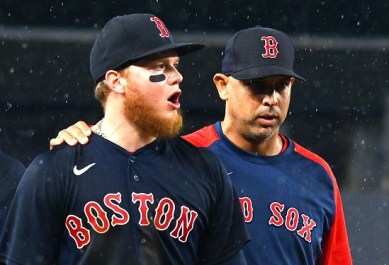
Alex Verdugo, Alex Cora

Alex Verdugo’s (left) generosity turned into a particularly nasty piece of Yankee fan foolishness.

If you want to know why baseball players come to see baseball fans with contempt, as some always have and always will, you can point to the Yankee Stadium doings Saturday night. Even knowing the eternal rivalry between the Empire Emeritus and the Olde Towne Team, this was above and beyond the call of insanity.

All Red Sox left fielder Alex Verdugo did before the bottom of the sixth started was see fit to toss a practise ball to a young Red Sox fan in the bleachers. The ball didn’t quite reach that young fan’s hands, but it did reach a Yankee fan to whom Red Sox generosity might just as well have been a home invasion leaving none alive.

That Yankee fan threw Verdugo’s should-have-been gift ball back to the field and hit Verdugo squarely in the back. Verdugo was anything but amused. He turned toward the bleachers hollering to the fans. Highly-touted Red Sox prospect Jarren Duran hustled over to pull Verdugo away. Umpires, stadium security, and Red Sox coaches sought only to find the miscreant.

Miscreant found. And ejected from the ballpark posthaste. Eliciting a few cheers and a few more boos among the fans in that section. Red Sox manager Alex Cora wasted no time pulling his team off the field after coach Tom Goodwin urged still-steaming Verdugo out of the outfield and toward the Red Sox dugout.

Cora even had to debate with the umpires over letting Verdugo have a few minutes to compose himself in the dugout. It shouldn’t even have been a debate point. This time, it was only Verdugo’s back. It could have been his head.

“I know my left fielder, I know Alex,” Cora said post-game. “He needed time to breathe and to get his thoughts.” Tell that to the umpires, as Cora ultimately did.

It seemed like nobody was listening to me. Like, imagine getting thrown at with an object in a sport and you’ve got to be out there right away because we have to continue to play the game — that part I didn’t agree. But Alex was OK with it. But you never know. What if he jumps the fence? What if he goes out there and attacks somebody? Whatever. That’s what I was telling them, just give us a chance to collect our thoughts, breathe a little bit and we’ll go out and play the game. That was the whole thing.

Verdugo knows the score only too well. Talk all the trash you want. Hammer all the family members you can think of. Chant your little heads off. Even holler “[Fornicate!] Verdugo” until your throat resembles a pair of sand blocks rubbing together. Throw a ball or other debris? Not so fast.

[T]he moment somebody throws — as players, we’re throwing balls in the stands to try to give people souvenirs, try to make little kids’ days and things like that. Just to hear people saying, ‘Throw it back’ and then someone actually throws it back and it felt like it was targeted towards me, it doesn’t sit right with me.

Throwing enemy home run balls back is a tradition almost as old as the live ball in some ballparks. Wrigley Field’s storied Bleacher Creatures have made it so much so that if you happen to watch a Cubs home game without a Creature throwing back an enemy home run ball (unless, of course, it’s a particular milestone mash with dollar value attached) it’s one step short of breaking-news bulletin time.

But no such Creature has ever been known to try separating an enemy outfielder from his assorted anatomy or his brains throwing a ball back. And not even the worst, most bombed out of his or her trees fan was ever been known (unless it just hasn’t been reported, until Saturday) to throw back a ball an opposing player tried to give a visiting fan as a souvenir.

Things weren’t hard enough between the Red Sox and the Yankees with the scheduled series opener last Thursday postponed after several Yankees—including right field star Aaron Judge—turned up COVID-positive? Things weren’t testy enough already Saturday, with a near-hour rain delay before the game and continuing rain during it?

Red Sox Nation should know that they now have an ally in Yankee manager Aaron Boone, who made no secret of his hope that the bleacher idiot ended up behind bars. Cora should also know that Boone would have acted the same as he did if the game had been in Fenway Park and a particularly brain-damaged Red Sox fan did likewise to one of his players.

It’s awful, embarrassing, unacceptable. My understanding is they did catch the guy. Hopefully he’s in jail right now. That’s just a bad situation. If I was Alex Cora, I would have done the same thing as far as going out and getting his guys off the field. There’s zero place for that in this great game, and in this great rivalry. Players should never feel like they have to worry about anything like that. I already reached out to Alex Cora, just to apologize, and to Alex Verdugo that, you know, that’s just a terrible, bad, sad situation. And sorry about that.

This during a season in which Reds first baseman Joey Votto—after getting ejected early in a game over an argument with an umpire, then learning a little girl named Abigail was heartbroken that she wouldn’t get to see her favourite Red play for just about all game long—reached out and sent Abigail a ball he signed, “I’m sorry I didn’t play the entire game. Joey Votto.”

Saturday’s game was supposed to be about Duran’s major league debut. (He went 1-for-2 with a base hit and a run scored, both in the top of the second.) And, about a pitching duel between Nathan Eovaldi (five innings, one earned run) and Gerrit Cole (six innings, one earned run, eleven punchouts).

The nasty weather ended the game after six in a 3-1 Yankee win. (Back-to-back solo bombs from Gary Sanchez and Gleyber Torres in the bottom of the sixth took care of that, on Red Sox reliever Hirokazu Sawamura’s dollar.) The nasty weather in the left field bleachers became the story of the game, unfortunately.

The Yankees travel to Boston for a set in Fenway Park starting this coming Thursday. Red Sox Nation, beware: don’t even think about trying any similar stupidity if any Yankee decides to toss a practise ball to a visiting Yankee fan before an inning begins.

Maybe the thing for baseball government and the players union to consider together is mandating a forfeit to the opposing team, when a team’s own fans get as thuggish as the thug who thought Verdugo’s reward for generosity to a visiting young fan should have been a ball attack upon the left fielder’s back.

Once upon a sad October 1971 time, umpires awarded the Yankees a forfeit after heartsick Washington Senators fans—with Second Nats reliever Joe Grzenda one out from saving what should have been a win, and the Senators playing their final game before moving to Texas—stormed the RFK Stadium field. Grzenda never got to throw a single pitch to Yankee second baseman Horace Clarke.

Those fans didn’t blame the Yankees or try to mangle, bangle, or dismember anything in a Yankee uniform. They’d have preferred decapitating duplicitous Senators owner Bob Short. (Banners with his initials proliferated in the stands.) Absent that, they took it out on RFK Stadium.

If you can forfeit to the visitors over breaking an entire ballpark, you ought to be able to forfeit to the visitors when a home fan decides a baseball offered a visiting fan should be the instrument for spontaneous back surgery upon the visiting player who offered it. Maybe (big maybe) that’ll teach the jackasses a few lessons.

Be careful what you wish for, Yankee fans

Bill Gallo's "Baron von Steingrabber"

There were reasons why the late great New York Daily News cartoonist Bill Gallo portrayed George Steinbrenner as a Prussian autocrat. Today’s Yankee fan demanding “What would George do?” seems almost clueless. Almost.

Steven Goldman is a Baseball Prospectus writer whose Forging Genius: The Making of Casey Stengel should be required reading for anyone clinging to the myth that anyone short of a trained seal could have just wandered in and managed the 1949-60 Yankees to greatness. (Ten pennants, seven World Series rings.)

Goldman also thinks Yankee fans today need to get over the “What would George have done?” syndrome like five minutes ago.

Yes, the Yankees are 5-7 in their last twelve games and dropped two out of three to the Mets in holiday weekend interplay. Yes, they often seem like fish flopping on the dock or the boat deck, after being reeled in following an arduous battle.

And, yes, principal owner Hal Steinbrenner isn’t exactly his father’s son. Not if you consider a hair trigger pro-active leadership. Prince Hal would never have dismissed a promising but struggling prospect as the horse that spit the bit. It’s almost (underline that) to wonder how Prince Hal was a Steinbrenner in the first place.

On Sunday, the Mets nuked Yankee reliever Aroldis Chapman in the seventh of game one of a doubleheader made necessary by a Friday night rainout. Handed a 5-4 lead to protect, Chapman threw a 1-2 pitch to Pete Alonso that got sent over the left center field fence to tie. Oops.

He hit Michael Conforto with an 0-2 pitch, he walked Jeff McNeil on a full count, then watched his relief Lucas Luetge surrender a bases-loading single (Kevin Pillar), get the first Met out of the inning (James McCann, swinging strikeout), but then . . . two-run double (pinch hitter Jose Peraza), two-run single (Brandon Nimmo), RBI single (Francisco Lindor), before Luetge finally escaped the fire with Mets reliever Seth Lugo dispatching the Yankees too quietly in the bottom to end it.

Any team doing that to the Yankees that late in the game would have had The Boss going rogue. The Mets doing it would have had him going so far beyond that “rogue” would have seemed a relief.

“[B]oth social media and the Yankees broadcasters wondered how ‘George’ would have reacted had he been alive to see the resultant defeat. He would have reacted poorly,” Goldman writes.

During his lifetime, which ended 11 years ago, long after he had subsided into senescence, [The Boss] had placed a disproportionate emphasis on beating the Mets during meetings that, prior to the advent of interleague play in 1997, were restricted to meaningless exhibition games.

“He goes crazy if we lose to the Mets, even if it’s spring training,” said five-time Steinbrenner manager Billy Martin in his 1980 memoir Number 1. “He feels we’re going to lose fans to them if they beat us. It’s ridiculous, and it makes the players laugh at him.” Sometimes their reaction was a bit harsher than laughter. “The more we lose, the more he’ll fly in here,” third baseman Graig Nettles said in the last 1970s, “and the more he flies in, the better chance there’ll be a plane crash.”

George Steinbrenner was an awful lot more than just the man who threw out the first manager of the year, before his 1990 banishment over engaging a street hustler to help him soil the reputation of his Hall of Fame right fielder Dave Winfield. When things got a little dicey before then, The Boss left you surprised only that he hadn’t traded his entire organisation for that of the Mariners.

“[W]e know what George would have done were he alive today,” Goldman writes:

He would have flailed spasmodically, he would have made a lot of people unhappy to be Yankees employees, and he would have ordered Jasson Dominquez traded to the Tigers for Matthew Boyd, had Gleyber Torres and Anthony Volpe sent to the Rangers for Kyle Gibson and David Dahl, and taken whatever was left over and given it to the Royals for Mike Minor. And nothing would have changed except that in the short term the team’s record might have gotten even worse and in the longer term it definitely would have gotten worse. Anyone old enough to remember Steinbrenner’s immortal words of July 13, 1987 can tell you how that worked, words that should be emblazoned on Steinbrenner’s grave and the monument to him at Yankee Stadium in burning letters 15 stories high: “Lou, I just won you the pennant. I got you Steve Trout.”

Maybe today’s Yankee fan is typically someone who wasn’t alive when the depth of George Steinbrenner’s act hit depths possibly unseen among baseball owners—whose penchant for hitting depths is only slightly younger than the nation that loves the game to its soul—since the day William B. Cox was forced to sell the Phillies when manager Bucky Harris discovered Cox was betting on his own team.

“Here is a pretty judicial pickle,” wrote George F. Will, on the threshold of Steinbrenner’s suspension, in Newsweek. (The essay was called, “A One-Man Error Machine.”) “Imagine trying to assemble an impartial jury of New Yorkers to hear Steinbrenner’s case. ‘Tell the court, Mr. Prospective Juror, do you have any strong opinions about the owner who masterminded the trade of Fred McGriff from the Yankees to the Blue Jays in exchange for a couple of no-names? Stop snarling, Prospective Juror’.”

Maybe today’s Yankee fan forgets, if he or she really knew, what happened the night the news broke of Steinbrenner’s suspension over l’affaire Winfield: The Yankees hosted the Tigers. Yankee Stadium fans clung to portable radios. The news broke as the Tigers came up to bat. Cheering began at one end of the ballpark and swelled to cover the entire stands. The Tigers had no idea why they were coming up to hit to a loud standing ovation.

Goldman knows the what-would-George-have-done faction among Yankee fans (and broadcasters) either forget or ignore that Steinbrenner’s wholly-earned suspension did what more people than you might think thought would have been impossible during the 1980s. It kept The Boss from continuing his King of Hearts act (Don’t be nervous or I’ll have you executed on the spot!) and enabled general manager Gene Michael to rebuild the Yankees back to greatness.

Michael’s salient quality was the diametric opposite of Steinbrenner’s. Michael knew what he was doing. Michael would never have thought he could make Tommy John or Hall of Famer Phil Niekro into young sprouts again. He never would have traded McGriff. He never would have tried to make Ozzie Smith out of Bobby Meacham. He never would have had twelve managers and seventeen pitching coaches in two decades.

The what-would-George-have-done contingent would have unloaded Derek Jeter, Mariano Rivera, Andy Pettitte, Jorge Posada, and Bernie Williams at the drop of a four-game losing streak. To err is human; to forgive is not Yankee policy. Goldman knows that, too.

To ask what he would have done now or to wish that he were still around to do it is a fundamentally masochistic wish that suggests just how many toxic fathers have damaged their kids along with passing on their baseball fandom. How else to you explain this perverse prayer for an abusive, incompetent papa who, because we grew up to the sounds of his yelling and breaking the furniture, left us longing to experience the same chaos again? It’s the same wish that brought us Donald Trump (he and George were patrons of “Bully/Coward/Victim” Roy Cohn). Please, dear dead daddy, claw your way out of whatever Hell you reside in and show us your impotent love by saying something crude about a player who’s trying his best and then trading a top prospect for Merrill Kelly. You so crippled us that this is the only kind of love we can understand.

Who was Merrill Kelly? Don’t ask. Just thank God and His servant Stengel that Michael’s cooler head prevailed and The Mariano wasn’t traded for Felix Fermin—by a hair.

Did analytics turn this year’s Yankees into an inconsistent mess? Not quite, Goldman says. Analytics, sabermetrics, whatever you wish to call it, is nothing more and nothing less than objective information. “Facts themselves are not slanted; it’s what decision-makers do with them that leads to good or bad outcomes,” he writes.

If analytics exists to supply team leadership with a set of facts, then the opposite of being “weighted 90-10” towards analytics would mean a 90-10 bias in favor of—what? Just going with your gut regardless of what the facts might direct you to do? Well, that’s what George Steinbrenner did. If that’s what Yankees fans are asking for then they deserve what they’re going to get—a whole lotta nothing, just as was the case from 1979 through 1995. Better to shout, “Down beast! Down!” and drive the creature back to the place from whence it came.

“Some kids want to join the circus when they grow up,” said Graig Nettles, who often fenced with The Boss himself over trivialities great, small, and surreal. “Others want to be big league baseball players. I feel lucky. When I came to the Yankees, I got to do both.”

There was no better epitaph for the depths of The Boss’s reign than the late-80s Banner Day winner dressed as a monk, holding a scythe from which hung the sign, “Forgive him, Father, for he knows not what he does.” (The poor fellow got his prize—and was ejected from the ballpark on The Boss’s orders.)

Letting the kids play is one thing. Yankee fans demanding their team be allowed to party like it’s 1980-90 all over again are something else entirely. Forgive them, Father, for they know not what they really want.