Formalising what people of heart, soul, and mind always knew

Monte Irvin and Willie Mays—major leaguers as Giants and as a Newark Eagle (Irvin) and Birmingham Black Baron (Mays).

When Ted Williams was inducted into the Hall of Fame in 1966, he kept it short, sweet, and shameless. One moment, Williams gave props to Willie Mays, who’d passed him on the all-time home run list days earlier: “[H]e’s pushing, and I say to him, ‘Go get ’em, Willie’.” Then, the Splinter hit a grand slam:

Baseball gives every American boy a chance to excel. Not just to be as good as someone else, but to be better. This is the nature of man and the name of the game. I hope that one day Satchel Paige and Josh Gibson will be voted into the Hall of Fame as symbols of the great Negro players who are not here only because they weren’t given the chance.

Gibson didn’t quite live long enough to receive his chance to play major league baseball; he died before Branch Rickey finally began the undoing of what should never have been done in the first place. But he was inducted into the Hall of Fame as a baseball immortal in 1972.

Paige did get his chance. Among other things, he kept Williams to a .222 hitting average and slugging percentage but a .364 on-base percentage, after joining the American League with the Cleveland Indians and in due course the St. Louis Browns—in his forties.

Unlike Gibson, Paige did live long enough to see himself inducted into the Hall of Fame, the first Negro Leagues player so inducted (in 1971) after a special committee was formed to determine, as best they could with what they had, whom among the Negro Leagues’ best belonged in Cooperstown.

Not long before then-commissioner Bowie Kuhn formed the committee, his predecessor William Eckert convened another committee to isolate which among the earliest professional leagues merited official major league status. Four leagues were given such formal recognition by that group: the American Association of 1882-91, the Union Association of 1884, the Players League of 1890, and the Federal League of 1914-1915.

The Negro Leagues weren’t even a topic then. Boy, are they a topic now, with commissioner Rob Manfred having pronounced that the seven professional Negro Leagues which played from 1920 to 1948 shall henceforth be known as major leagues. Did I say seven?

Manfred conferred formal major league status on the first Negro National League of 1920-31, the Eastern Coloured League of 1923-28, the American Negro League of 1929, the East-West League of 1932, the Negro Southern League of 1932, the second Negro National League of 1933-1948, and the Negro American League of 1937-1948.

That’s the formality. Any baseball fan with heart, soul, and mind coordinating properly didn’t need a formal proclamation to know the Negro Leagues were as good and sometimes better than the “official” major leagues. They knew down to their bone marrow that Ted Williams was dead right in his implication that the “official” Show’s pre-1947 segregation denied those leagues and a good number of their players their propers.

Why the 1948 cutoff? That was the year of the final Negro World Series, between the Homestead Grays of the NNL and the Birmingham Black Barons of the NAL. (The Grays flattened the Barons in five, despite the Barons’ sharp center fielder—a child prodigy named Willie Mays.) With Jackie Robinson having cracked the old, disgraceful major league segregation line a year earlier, and National and American League teams beginning to scout and sign Negro Leagues talent, however incrementally, the Negro Leagues’ days were numbered.

After that Series (the Grays won the last such major league-level championship in Washington until last year’s Nationals), the Negro National League folded, followed by the Grays themselves in 1951 after barnstorming proved financially untenable. With the two then-solely recognised major leagues continuing to bring black talent aboard, the Negro American League fell back to the equivalence of the highest minor league before folding in 1958.

Bob Kendrick, a man of impeccable intelligence and sensitivity who presides over the Negro Leagues Baseball Museum, knows the difference between conferring historical merit and validating the Negro Leagues and its players as major leaguers. “[T]hey never looked to Major League Baseball to validate them,” Kendrick tells MLB.com writer (and author of the splendid A Fan’s Guide to Baseball Analytics) Anthony Castrovince.

But for fans and for historical sake, this is significant, it really is. So we are extremely pleased with this announcement. And for us, it does give additional credence to how significant the Negro Leagues were, both on and off the field.

A writer for The Athletic, Marcus Thompson II, sees and raises. “‘Oh, so now they’re good?’ was my initial reaction,” he writes in a forum convened by the journal to discuss the Manfred pronouncement.

Josh Gibson doesn’t need validation from Major League Baseball. Oscar Charleston doesn’t need validation. Pop Lloyd ain’t suddenly legit now because MLB basically decided to include him in the fold. It reeked of baseball’s arrogance. It wasn’t so much the inclusion of Negro League players, but the idea that somehow they are being officialized by this inclusion. This, obviously, should have been done a long time ago. But the pretentiousness of believing this to somehow be an elevation of those players, as if they’re being knighted posthumously, is insane and offensive . . . Satchel Paige was already a Major Leaguer by every other possible definition. Cool Papa Bell’s been official. His name is Cool Papa Bell.
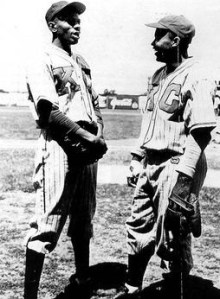
Did we really need Rob Manfred to tell us Satchel Paige (left) and Jackie Robinson were major league level in the Negro Leagues?

Indeed. And, what do you know, just one prowl of social media delivered enough of the half-witticisms of those who think any thought of the Negro Leagues as “official” major leagues carries the whiff of political correctness. One such miscreant sticks uncomfortably in my mind: “[T]hey didn’t play against ball players like Bob Feller and Ted Williams sooooo… they didn’t play against major league talent.”

Well, now. I’d have loved the miscreant to explain what he thinks of the Show’s willful exclusion of non-white talent prior to 1947. (Fair disclosure: I zapped him by answering his foolish remark with the aforequoted Williams valedictory. As I write, he hasn’t offered an answer.) Do he and others of (I hate to use a four-letter word when ladies might be reading) like mind think such “major leaguers” as Robinson, Mays, Larry Doby, Roy Campanella, Henry Aaron, and Ernie Banks were just another bunch of minor leaguers before “organised baseball” deigned to invite them aboard?

Those of us who love the game and share the concurrent strain that its statistics are its life blood face a pretty pickle, too: How to finalise the true statistics of Negro Leagues competition. For one thing, it was known long enough that the Negro Leagues didn’t keep complete statistics for assorted and largely unpleasant reasons tied in large part to the unconscionable segregation of the so-called National Pastime.

The legends yielded by the Negro Leagues have been fun as legends but problematic as statistical analysis. Josh Gibson hitting eight hundred home runs plus in his baseball life is great fun as a legend, but how many did Gibson actually hit in Negro Leagues competition against how many did he actually hit on the barnstorms?

Castrovince observes that Negro Leagues statistics from leagues competition in 1920-1948 will be the ones brought to account, for a couple of very good reasons: Trying to develop the leagues before 1920 weren’t successful “and lacked a league structure.” Fans black, white, brown, and paisley alike may be disappointed with the net result because the barnstorm and exhibition stats won’t be included.

It won’t be simple, says another Athletic forum participant, Marc Carig. “[T]here are still games missing from the historical record,” he begins.

As of now, researchers have documented 73 percent of Negro League games contested in the 1920-1948 window of inclusion. That figure will keep climbing. More and more newspapers are getting digitized, making it easier to search for documentation. But it is still unlikely it will ever get to 100 percent. That can be a challenge. Now begins the work of figuring out how to incorporate that existing data into the official records. That’s the next step in the process. It’s not an easy one. But it’s worthwhile.

Forget about whether Gibson knocks Aaron and Barry Bonds out of the home run record books. He’ll probably still look like the great bombardier of his legend. And, since Aaron’s Negro Leagues play came after 1948, any home runs he hit before joining the Braves’ organisation won’t change his career home run total. Or the magnitude of his career and of a certain night in April 1974.

But Mays will see some changes. Let’s look. He had 73 plate appearances for the 1948 Black Barons, with sixteen hits including two doubles, twelve runs batted in, and twelve walks.He hit .262 with a .384 on-base percentage but a .295 slugging percentage with the ’48 Black Barons. His OBP won’t change, but his hitting average (sorry, the traditional batting average is incomplete and mistreats hits) will fall . . . one point, to .301. His slugging percentage will also fall . . . one point, to .556.

Another Athletic forum participant, Jason Jones, understands the concurrent late symbolism and undercurrent shame in Manfred’s pronouncement. “[I]f it took this announcement for you to believe Josh Gibson was one of the best to ever swing a bat, shame on you,” Jones says. “This is clearly long overdue. I wish those players were here to see baseball finally do the right thing.”

It shouldn’t have taken us that pronouncement, either, to believe Satchel Paige was one of the best ever to take the mound. (Casey Stengel would hector his Yankees when he saw Paige throwing in the bullpen, “Get your runs now—Father Time is coming!” That was when Paige was in his 40s and not exactly in his prime.)

Or, that Buck Leonard was one of the best ever to play first base.

Or, that Monte Irvin may have been the actual best of the Negro League talents to cross into the Show when he finally did, and that he might have given the Show another decade of his best before an ankle injury compromised him while with the Giants. Among others. (Irvin’s lifetime major league hitting average might jump to .304 when the records are adjusted.)

Said Manfred in a formal statement, “All of us who love baseball have long known that the Negro Leagues produced many of our game’s best players, innovations and triumphs against a backdrop of injustice. We are now grateful to count the players of the Negro Leagues where they belong: as Major Leaguers within the official historical record.”

Where they always belonged.

Now, if only Manfred and his minions would take things from there to send the Show on a real, substantial mission to rekindle deeper interest in baseball among black youth around the country, whether inner city, suburbia, or the country life. Black people have elevated the game as men and as players, coaches, managers, and executives, even if the number  among the last three of those remains terribly low.

Today’s young black aspirants deserve to know the game belongs to them, too. Numerous localised organisations carry that mission splendidly. It would give them a badly needed lift, and further honour the Negro Leagues legacy, if Manfred and his get off the schneid and onto the hunt. It’d mean as much and maybe more than how Jackie Robinson’s Hall of Fame plaque would look with the addition of his seasons with the Kansas City Monarchs.
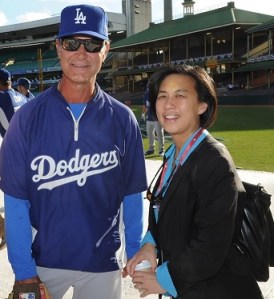
Kim Ng, inside the box

Kim Ng (right) with Don Mattingly, when Mattingly managed the Dodgers and Ng was their assistant GM. Ng is now, among other things, Mattingly’s new boss in Miami.

Whatever you do otherwise, please don’t call Kim Ng’s hiring as the Miami Marlins’ new general manager “outside the box” thinking. It’s an insult to hers and the Marlins’ intelligence, and it should be to anyone else’s, too.

Yes, Ng is the first woman and the first Asian-American to hold such a job. But yes, she also has three decades worth of experience in baseball operations which only began when she joined the White Sox as a front office intern and worked her way to becoming the team’s assistant director for baseball operations.

The Marlins hired her away from baseball government itself, where Ng just finished her ninth year as the Show’s senior vice president for baseball operations, focused specifically on tightening up and administering MLB’s international baseball reach and operations, working with MLB front offices and international organisations alike, and enforcing international signing rules.

In between her term with the White Sox and in the Show’s government, Ng became the youngest assistant GM (at 29) ever when she took that job with the Yankees, then joined the Dodgers as an assistant GM, her performances of which jobs plus her performance in MLB’s organisation itself put her on several team radars as a GM to be.

Outside the box? Ng is about as inside the baseball box as you can get with her experience and reputation. The only thing outside the box about her is that, well, she’s a lady, and she’s the daughter of a Chinese American father who worked as a financial analyst and a Chinese Thai mother who worked as a banker.

She’s Indianapolis born but New York raised, and she grew up among other things playing stickball on the Queens streets before going to the University of Chicago, earning a degree in public policy, and, oh yes, winning a Most Valuable Player award as an infielder on the university’s softball team.

“[I]t is the honor of my career to lead the Miami Marlins as their next General Manager,” Ng says in a formal statement. “We are building for the long term in South Florida, developing a forward-thinking, collaborative, creative baseball operation made up of incredibly talented and dedicated staff who have, over the last few years, laid a great foundation for success.”

When was the last time you heard terms like “forward-thinking” or “collaborative” or “creative baseball operation” applied to the Marlins? OK, so that might be outside-the-box—the Marlins’ box, that is.

“This challenge is one I don’t take lightly,” she continues. “When I got into this business, it seemed unlikely a woman would lead a Major League team, but I am dogged in the pursuit of my goals. My goal is now to bring championship baseball to Miami. I am both humbled and eager to continue building the winning culture our fans expect and deserve.”

It’s a recent enough expectation, of course, but one that doesn’t lend itself to gags now that manager Don Mattingly was named the National League’s Manager of the Year for shepherding the Fish to a second-place irregular season finish in the National League East and as far as a division series in the postseason.

Ng has knocked on history’s door more than a few times in her career. With the White Sox, she was the first woman and youngest human to present and win a salary arbitration case, for pitcher Alex Fernandez. When the Yankees hired her as an assistant GM, Ng became one of only four women ever to hold the position, joining Elaine Weddington Steward and Raquel Ferreira of the Red Sox and fellow Yankee Jean Afterman.

She started showing up on team radars as GM material in 2005, when the Dodgers interviewed her. They handed the GM job to Ned Colletti, but Colletti almost immediately kept her as an assistant GM. She’s since been interviewed for such jobs by the Angels, the Giants, the Mariners, and the Padres.

When she left the Dodgers to take her MLB job, there were those pondering aloud whether Ng had a chance to become the first woman ever named as baseball commissioner. So much for that idea, so far. She’s content to have gotten where she is now. But would you really object to the idea down the road apiece?

Ng won’t exactly be wading into virgin territory with the Marlins. Chief executive officer Derek Jeter was en route his Hall of Fame career as a Yankee shortstop while Ng worked in their front office. Mattingly’s playing career ended a few years before the Yankees made her an assistant GM, but he was a coach for them while she was there. And, he managed the Dodgers while Ng was still their assistant GM.

Jeter’s own formal statement cites Ng’s “wealth of knowledge and championship-level experience.” The Yankees won three straight World Series while she worked there; the Dodgers challenged for or won a few NL Wests while she worked in their front-office brain pool. As a front-office executive Ng has gone to eight postseasons total.

“Her leadership of our baseball operations team will play a major role on our path toward sustained success,” Jeter continues. “Additionally, her extensive work in expanding youth baseball and softball initiatives will enhance our efforts to grow the game among our local youth as we continue to make a positive impact on the South Florida community.”

The lady is a champ who just might deliver when it comes to making the Marlins champs. Just don’t accuse the Fish of going that far outside the box by hiring her in the first place.

Quit the nonsense, Commissioner

2020-08-02 RobManfred

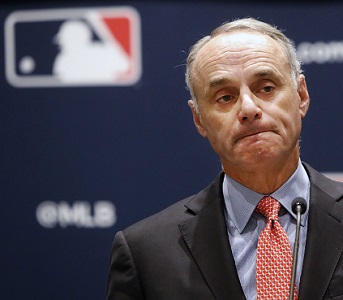
Rob Manfred, who doesn’t seem to grok the distinction between quitting and a strategic retreat.

The incumbent World Series most valuable player, who will hold that distinction until the next World Series is played, dealt with a nerve problem in his pitching hand, costing him one start but amplifying his sense of perspective. The long view matters as much to Stephen Strasburg as do such small details as whether to bust a fastball or a slider in on a hitter.

“To be frank,” the Washington Nationals righthander told reporters after his scratch against the New York Yankees, “this season is kind of a mess to begin with, so I got to think big picture here. It’s my career. I know that in the long run it’s important to try to make as many starts as you can, and by putting yourself in a compromising position now, I don’t really know if it’s the best way moving forward.”

A hand nerve issue in a normal regular season doesn’t cost a pitcher or his team as much as the issue does in a truncated, sixty-game season. Strasburg, however, isn’t an ordinary pitcher. He’s not just the defending World Series MVP, but he got to the career point where it became possible thanks to that “Strasburg Plan” that shut him down well before 2012 ended, in his first full season back from Tommy John surgery.

With the Nats headed for that postseason it seemed most of the world demanded they man up, compel Strasburg to do likewise, because who knew when they’d get another shot, right? Strasburg and his team decided a) they weren’t going to die if they didn’t go to the Promised Land then, and b) they’d get there sooner or later and they’d kinda sorta like Strasburg along for the ride.

Now it may turn out to be that Strasburg missing a little more 2020 time because of that nerve issue is the least controversial portion of this Twilight Zone of a season. Submitted for your further consideration, in case you began considering before I sat down to write:

Since last weekend, twenty-one Miami Marlins and four St. Louis Cardinals have tested COVID-19 positive, while a few Philadelphia Phillies may or may not have returned false positives. The real positives stranded the Marlins in Philadelphia after last weekend’s series, until a bus delivered the Fish to their Miami home waters at last.

They also provoked fifteen to seventeen scheduled games canceled, including this weekend’s set between the Cardinals and the Milwaukee Brewers. The latter’s outfielder Lorenzo Cain joined the list of the opting-out during the week while we were at it. So did Marlins second baseman Isan Diaz on Friday. Diaz wasn’t a COVID-19 positive Marlin but seeing so many told him some things really do come before baseball, after all.

“This has been a decision that I have discussed with my family, and I feel it’s the best one for me and my overall well-being,” he said in an Instagram post. “I will deeply miss my teammates and competing on the field. I wish my brothers the best and look forward to taking the field again with them soon!!”

Meanwhile, commissioner Rob Manfred, who rarely misses the proverbial opportunity to miss an opportunity, has channeled his inner Richard Nixon and harrumphed against quitting on whatever’s passing for this truncated major league season. “We are playing,” Manfred told ESPN’s Karl Ravech on Saturday. “The players need to be better, but I am not a quitter in general and there is no reason to quit now. We have had to be fluid, but it is manageable.”

In one sweep of his tongue Manfred implied the players who opted out of playing this season as they were granted the right to do were a bunch of quitters and implied players were to blame for the COVID-19 outbreaks among the Marlins and the Cardinals. As if the players scheduled the Fish for that final exhibition game in Atlanta, a city in a state where the coronavirus now is about as rare as oppressive July heat in Las Vegas.

Yes, a few Marlins went out on the town while in Atlanta. Not too bright if they weren’t masked and sanitising, but who put that game on the schedule and didn’t even think about calling it off when Georgia’s coronavirus presence metastasised? And who are the bubbleheads who couldn’t even think about finding an appropriate “bubble” in which to play major league baseball this year?

(Not to mention, who couldn’t even think about taking better steps to assure the Toronto Blue Jays wouldn’t have become the Show’s first strictly road team.)

For a couple of decades the Show has strained to get into what it thinks must be step with other leagues such as the National Basketball Association. The problem has been that it’s paid closest attention to the wrong things (championship-diluting, everyone-a-cookie playoffs) and ignored the right ones.

Once upon a time, knowing he’d be impeached over Watergate if he did otherwise, Nixon announced he’d resign the presidency by saying, among other things, “I have never been a quitter.” Which was jarring enough coming from the man who accepted his defeat in the 1962 California gubernatorial race by quitting politics altogether (so we thought), saying, “Gentlemen, you won’t have Nixon to kick around anymore.”

Manfred’s in no position to proclaim himself a non-quitter. He quit on the off-field-based, illegal electronic sign-stealing scandal, baseball’s biggest running story until the coronavirus world tour arrived in America in earnest, giving the cheating Houston Astros and Boston Red Sox players immunity to spill instead of ordering them to spill or be spilled no matter what Players Association grievance might have been filed.

He suspended two managers (one who’d been the Asterisks’ 2017 bench coach before managing the 2018 likewise World Series-winning Rogue Sox) and a general manager, and fined one owner what amounted to tip money. He might have bagged the Astro Intelligence Agency co-masterminds, as also the replay room operator in the Rogue Sox Reconnaissance Ring, but he still let the cheaters skate.

Maybe he thought public outrage—from victimised opponents to Astro and Red Sox fans alike who had to come to terms with their heroes being exposed as high-tech cheaters— would be punishment enough. Then the coronavirus world tour knocked Astrogate and Rogue Soxgate both into the yesterday’s news morgues.

Until Manfred dropped an eight-game hammer on Los Angeles Dodgers pitcher Joe Kelly for doing in spirit if also extreme action what the commissioner failed to do, a quarter of brushback pitches holding at least Alex Bregman and Carlos Correa to account. You don’t have to agree with Kelly throwing near Bregman’s head to get that.

The commissioner still hasn’t pressed the New York Yankees to obey a judge’s ruling that the detailed letter of reprimand over the illegal dugout phone and possible network camera sign-stealing be made public, either.

Manfred also quit on the people whom the fans normally buy tickets to see at the ballpark when, under the impetus of his bosses, the unimpoverished owners, he tried to strong-arm the players out of agreed-upon fully pro-rated 2020 salaries, for whenever a season might begin, then failed to help develop a far more reasonably safe way for the season to be played.

He quit on the game’s integrity with his bread-and-circuses rules experiments such as the free runner on second to open each extra half inning and the three-batter minimum for relief pitchers. When both collide in the extras, it can be (and has been, here and there) murder for the poor sap on the mound and his manager who can’t do a thing to stop the execution until after batter three.

Meanwhile, Commissioner Nero keeps fiddling while the health of the game—in the game’s actual playing terms and the physical health of enough of its players—keeps burning. No wonder Dodgers pitcher David Price, who opted out of pitching in 2020 before the truncated season began, fumed last week:

Now we REALLY get to see if MLB is going to put players health first. Remember when Manfred said players health was PARAMOUNT?! Part of the reason I’m at home right now is because players health wasn’t being put first. I can see that hasn’t changed.

If player health was paramount, Manfred and whatever’s passing for his brain trust—if canceling the 2020 season outright wasn’t to their taste—would have found a healthier mileu than just regionally based games where certain areas in the Show are COVID-heavier than others. And he wouldn’t have slapped even by implication those players who opted out of the season for the sake of their health and their families’ health as quitters.

Manfred may want to revisit his rhetoric if not necessarily reconfigure his mind. He may not have a choice but to cancel this truncated, surrealistic, Twilight Zone-meets-penny arcade season. There’s a difference between quitting outright and making a strategic retreat, which is exactly what canceling the rest of this loopy but risky season would be.

The moment Manfred sees and understands that distinction, the less he’ll look like the  man who misread the signposts up ahead. Less like the commissioner who fiddles while baseball burns, in . . .

DumbassZone01


Alfred Hitchcock presents Opening Night

AlfredHitchcockAt long enough last came Opening Day. Well, Opening Night. On which New York Yankees right fielder Aaron Judge nailed the COVID-19 delayed season’s first hit and his teammate Giancarlo Stanton nailed its first home run two batters later.

On which the Washington Nationals opened without a key element, outfielder Juan Soto, whose positive COVID-19 test result came back well enough before game time to make him a scratch.

Before that rain-shortened game even got started, the word came from the opposite coast that Clayton Kershaw was scratched from his Opening Night start thanks to a back problem sending him onto the injured list.

In Washington, the Nats’ co-ace Max Scherzer would have loved if Judge and Stanton were Thursday night scratches. They accounted for all Yankee runs in the 4-1 final shortened in the top of the sixth when the rains smashed in with the Yankees having first and third and one out.

In San Francisco, Los Angeles Dodgers rookie Dustin May pitched five innings to San Francisco Giants veteran Johnny Cueto’s four, both men leaving with a one-all tie, and the Dodgers’ new $396 million man Mookie Betts broke the tie scoring on an infield ground out in the top of the seventh.

Scherzer’s good news Thursday night: eleven strikeouts. His bad news: four walks and an inability to solve Judge and Stanton. Judge also doubled home Tyler Wade in the third and Stanton singled home Gio Urshela in the fifth. Remove Judge and Stanton from the Yankee lineup and the Nats’ Adam Eaton’s hefty solo home run in the bottom of the first would have been the game’s only score.

Betts singled with one out in the top of the seventh and called for the ball. Published reports indicate that ball plus the evening’s official lineup card now repose in his home. “It’s just a new chapter in life,” he told reporters after the 8-1 Dodgers win.

After he came home when Justin Turner grounded into a force out, Corey Seager’s grounder got Cody Bellinger caught in a rundown at the plate, but Enrique Hernandez singled home Turner and Seager (who’d taken second during the rundown), Joc Pederson and A.J. Pollock walked back-to-back to load the pads, Austin Barnes sent Hernandez home with an infield hit, and Max Muncy walked Pederson home.

And, on both coasts, all four teams figured out a solution to the issue of whether or not to take a knee for “The Star Spangled Banner” that might actually help more than hurt the too-easily outraged.

Abetted by a suggestion from Philadelphia Phillies outfielder Andrew McCutchen, the Yankees and the Nats lined up on the base lines holding a long, long, long black ribbon, standing apart enough for social distance, then took their knees before “The Star Spangled Banner” was played.

On the same suggestion, the Dodgers and the Giants held a similar long, black ribbon and took their knees before the anthem’s playing. In Washington, both the Yankees and the Nats rose from their knees while the anthem was played. In San Francisco, ten Giants including manager Gabe Kapler plus Betts on the Dodgers’ side stayed on their knees during the anthem, with Bellinger and Muncy putting hands on Betts’s shoulder as a gesture of support.

I went back on record Thursday saying that there are far worse ways than kneeling before a national anthem to protest something you think is dead wrong. Kneeling, as two Scientific American writers I cited remind us, is anything except disrespect.

“While we can’t know for sure, kneeling probably derives from a core principle in mammalian nonverbal behavior: make the body smaller and look up to show respect, esteem, and deference,” wrote psychologists Jeremy Adam Smith and Dacher Keltner in 2017.  “. . . Kneeling can also be a posture of mourning and sadness. It makes the one who kneels more vulnerable. In some situations, kneeling can be seen as a request for protection.”

I’ll ask again: Would you rather those outraged by rogue police doing murder against black or any people raise clenched fists, burn a flag on the field, or start a riot with or without looting and plundering in the bargain? Neither would I. But if only now-former football quarterback Colin Kaepernick had thought in the first place to take his original knee before the anthem played, would that have worked very differently for himself and the outraged?

Let me repeat, too, that you don’t have to subscribe to every last clause or every last impulse of the social justice warriors to agree that rogue police doing murder is not what the land of the free and the home of the brave was supposed to mean. Neither must you subscribe to the formal Black Lives Matter movement itself to agree that black lives and all lives don’t deserve to end when those entrusted to uphold the law break it instead.

Let me repeat further that it’d be far better for baseball to limit playing “The Star Spangled Banner” to before games on Opening Days, games played on significant national holidays, the All-Star Game, and Games One and (if it goes that far) Seven of the World Series. Not so much to cut back on the kneeling protests but to re-emphasise that patriotism compulsory is patriotism illusory.

Back on the field, Soto’s COVID-19 positive test approaching Opening Night shook the game up just enough to provoke serious questions as to how MLB is going to navigate even this truncated season without further medical issues. And, whether the most stringent health and safety protocols will keep more Sotos from turning up positive.

Other surrealities include the empty stands, other than cardboard cutouts of fans in the seats, and the canned crowd sounds at the ballparks. The coronavirus world tour already turned baseball into something between The Twilight Zone and the Mad Hatter’s tea party. Now that the season is underway at last, should we throw Alfred Hitchcock Presents into the mix?

At least neither Opening Night game went to extra innings, so we didn’t have to deal right off the bat with the free cookie on second base awarded each team to start its extra half-inning. The mischief that’ll inspire will just have to wait.

Funny thing, though, about that equally nefarious three-batter minimum for pitchers. Two Giants relievers faced the minimum in that five-run Dodger seventh before surrendering any runs. If bullpen preservation was part of it even if those two got pried, I can see already that this dumb rule isn’t going to end well for Kapler and other managers.

And, let’s be real, the PA people in charge of the piped-in sounds are only human, after all. Who’s going to be the first poor sap having to live down the accident of cranking up the wild cheering when the home team’s batter gets hit by a pitch?

On the other hand, it was easy enough to feel normal again once the Yankees and the Nats got underway . . . when home plate umpire Angel Hernandez began blowing pitch calls. Calling a few strikes balls and a few balls strikes? That’s about par for the course for him. So when’s that umpire accountability coming at last?

Before the game, Dr. Anthony Fauci—otherwise doing his best to battle a pandemic involving both a stubborn virus and a political (lack of) class that surely makes him wonder if he was really there when all this happened—threw out a ceremonial first pitch. Later, he was seen in the stands with his Nats-themed face mask off his face a spell. What’s up with that, Doc?

You’d love to say Fauci threw a perfect strike to Nats relief pitcher Sean Doolittle behind the plate, but you’d be lying like an office holder. Fauci’s delivery is described politely as resembling a man trying to compensate for a fractured upper arm. The ball sailed almost to the on-deck circle. Rumour has it that Hernandez called it a strike on the outside corner.

The free cookie on second and the bunt

2020-06-26 KetelMarte

This is not what a Diamondbacks fan should want to see if run-productive Ketel Marte leads off the tenth with the free cookie on second base to start the inning.

Depending upon where you spend time on social media, you can say that no sooner did the free man on second to open extra innings this year arise than at least two lines of discourse opened. 1) It makes major league baseball resemble the Nursery League. 2) To quote one such denizen directly, “[E]very player will have to learn to bunt.”

To the second came the reply, “I hope they teach them not to bunt foul on the third strike.” So I couldn’t resist with what I’m about to write, especially since it might put a finish to such nonsense as the free cookie on second to start.

I can count on one hand the bunts I’ve absolutely loved but I’d need more than two hands to count the theoretical bunt situations that weren’t, or didn’t stay that way. And, as Keith Law once wrote (in Smart Baseball), “I have yet to meet the fan who bought a ticket to a major league game because she really wanted to see guys drop some sac bunts.”

The two greatest bunts that weren’t happened in the mid-1980s.

When Pete Rose was pressured to figure out a way to save the Tying Knock—the hit where he’d meet Ty Cobb on the all-time hit list—for the home folks, he went up to hit late in a game at Wrigley Field, one swat away, with men on first and second in the top of the ninth in a tie game, the last of the set before Rose’s Reds returned to Cincinnati.

Everyone in the game including then-commissioner Peter Ueberroth thought Rose the manager would send Rose the player up only to pinch hit in that Chicago series. Or, in a situation such as he now faced, you could hear every other Reds fan and their nebulous owner (Marge Schott) at the time screaming “BUNT!” Rarely at a loss, Rose would remember, “I had thirty thousand people yelling here and one lady back in Cincinnati, every time I got a hit, kicking her dog.”

Rose the manager had his Reds eight games out of first place and Dave Parker on deck. With his owner, so many Reds fans, and Joe and Jane Fan elsewhere demanding otherwise, Rose the manager didn’t have to remind Rose the player what 23 seasons of major league experience told him: A sacrifice means the Cubs then putting Parker aboard intentionally to load the pads and leaving the bigger hitting to smaller bats.

So Rose the manager, knowing the Reds had that much better chance to win, told Rose the player to swing. (It would have been mad fun if Rose the manager could have told Rose the player, “I’ll fine your ass ten large if you even think about a bunt.”) That was probably the single most most honourable plate appearance and swinging strikeout of the baseball life Rose ultimately dishonoured.

He still got the Big Knock, passing Cobb, when the Reds went home. He got there in the first place by playing the game right, refusing to bunt because it would have taken the bat out of his best clutch hitter’s hands anyway. If you’re going to lose (the Reds did that night), you don’t just roll over and play dead for the other guys.

A year later, New York Mets relief pitcher Jesse Orosco batted in the bottom of the eighth of Game Seven in the 1986 World Series. Darryl Strawberry opened the inning with a parabolic home run to give the Mets a badly needed insurance run, but a two-run lead against those star-crossed but still-tenacious Boston Red Sox wasn’t quite enough.

“I’ll bet the house,” crooned NBC colour commentator Joe Garagiola as Orosco checked in at the plate. “He’s got to bunt.”

With one out and Mets Ray Knight on second and Rafael Santana on first, the Red Sox played Orosco to bunt and put on the rotation or “wheel” play: corner infielders charging down the base lines, middle infielders charging to cover the corner bases. What happened next made you wonder why nobody else thought of it too often, if at all.

On 1-1 Orosco squared to bunt as Red Sox pitcher Al Nipper kicked to deliver. The wheel play was on. And Orosco pulled his bat back, swung gently, and . . . “Swinging!” hollered play-by-play virtuoso Vin Scully. “And a ground ball into center field! In comes Knight, it is 8-5 Mets, and Joe, you just lost your house!”

Rose and Orosco in different ways testified to the wisdom of refusing to hand the other guys outs on trays and gift-wrapped. (With the DH universal this year, a pitcher bunting is moot for now.) Now, a lot of those otherwise dismayed at the free cookie on second to open an extra inning can’t wait to see some leadoff bunts dropped.

Except that you might be, say, the Milwaukee Brewers going to extra innings, and you might have Christian Yelich due to lead off your half of the tenth. Or, you might be the Houston Astros, and you might have Jose Altuve or Alex Bregman due to lead off the tenth. Or, you might be the Los Angeles Angels, with all-universe Mike Trout due to lead off the tenth. Or, you might be the Arizona Diamondbacks, with Ketel Marte to open. Or, you might be the Atlanta Braves, and either Freddie Freeman or Ronald Acuna, Jr. is your scheduled leadoff man.

You’re not going to take the bat out of the hands of those guys and order one of them to take a good loving look at the free cookie on second base and bunt him to third. (Not unless you’ve got someone behind them whom you can trust to deliver the clutch hit—and even then.) If you are, you’d better not be surprised when your bosses want to hang you in effigy, chase you clear across the state line, and then get really mad.

If you’re in the top of the tenth, you want to get ahead as swiftly as possible and with one of those guys leading off you’ve got a better than 50-50 chance of getting the free cookie across the plate and putting another man on base at minimum. At maximum, of course, you’ve got an excellent chance that Yelich, Altuve, Bregman, Trout, Marte, Freeman, or Acuna is going to hit for extra bases, maybe even a two-run homer. Either way, you’ve put the burden on the other guys to tie and win.

If you’re in the bottom of the tenth, you want to win just as swiftly if not more so. Do you still want to take the bats out of the hands of a Yelich, an Altuve, a Bregman, a Trout, a Marte, a Freeman, or an Acuna, and order them to drop a measly bunt when your odds of a game-winning base hit are that much more in your favour with bats like that opening your inning?

OK, you’re foolish enough to want to bunt the cookie to third leading off. Swell. In the bottom of the tenth, you’ve given yourself one less out to work with and your best bat is out of the picture. You might get lucky from there; you might not. In the top of the tenth, maybe a sacrifice fly brings the cookie home but you’ve got only a one-run lead that’s easier to overcome—and, with only one out left to play with, the bases empty and your best bat’s still out of the picture.

Yelich, Altuve, Bregman, Trout, Marte, Freeman, and Acuna might be sitting on the bench scratching their heads if not thirsting for a stiff one over that.

What about the other guys? I’ll guarantee it. If you think about bunting to open with the free cookie on second, be prepared for the other guys’ pitcher being prepared to let you bunt. Be prepared for him making you bunt. Maybe with a big grin on his face. The other guys like gift-wrapped presents, too, you know.

Because that smart a pitcher will throw your opening hitter nothing but something he can only bunt to the third base side, enabling that pitcher to pounce on the ball and throw the cookie out. If your opening hitter doesn’t exactly have enough speed to out-race a cement mixer with a flat tire, be prepared further for Area Code 1-5-3 or, if the third baseman was coming down the line and the shortstop’s moving to cover third, an Area Code 1-6-3.

Brilliant. You just outsmarted yourself into two outs and nobody on.

You think I just brewed that idea alchemically in the dungeon? It’s right out of the book of Casey Stengel, courtesy of his Mets pitcher Al Jackson:

There were men on first and second and you knew the other team wanted to bunt them over. Casey would say, “Here’s what I would do. I would let him bunt. I would throw him a little slider, and I would break toward the third base side, and I would throw his ass out at third.” Casey had the guts to tell you what he’d do in a certain situation when it came up on the ball field.

By the way, Jackson never once allowed men on second to be sacrificed to third.

If they don’t think about letting you bunt, they may think about putting Yelich, Altuve, Bregman, Trout, Marte, Freeman, or Acuna aboard on the house to lead off and giving themselves a shot at an instant double play. Leaving you a man on third, two outs in the hole, and a lesser bat to do your run production.

Giving outs away is unsound baseball as it is. The free cookie on second base to open the extra innings is foolish enough without bringing the bunt back. Under normal circumstances, the only time you ever ought to want to bunt is if your man leads off with nobody on and a) he has speed to burn, it’s one out or less, and he can bunt for a base hit; b) he has a lame infielder (say, Miguel Cabrera) to exploit; or, c) he has a wide-open half infield to play with thanks to a defensive shift.

You give me that extra free space? I’m accepting that gift, with no intention whatsoever of seeking a refund—even when you’re a couple of outs from finishing a no-hitter but I’m only down two or three runs. In that position, I still have a chance to get runs across the plate and win. Why the hell are you giving me a free hit? (If I’m down more than three runs, maybe I don’t even think about it. And maybe you don’t, either.)

If you’re that foolish, you’re paying the penalty. Sure, I respect what your guy’s trying to accomplish, but I also respect that he didn’t pitch his kishkes off just for you to play with fire on his dollar. If my batter sees that yummy wide-open space, and he doesn’t take advantage of it and drop himself a bunt for a free base hit, he’d better have his flight out of the country booked, reserved, and boarding-passed. Because, silly me, I have a job to do too—win.

And I’ve got a future Hall of Famer on my side there. Once upon a time in his life as a Detroit Tiger, Justin Verlander took a perfect game bid into the sixth with one out and a 4-0 lead. Seattle’s Jarrod Dyson dropped a bunt and beat it out for a hit. Tiger Territory screamed blue murder—about Dyson’s bunt more than the three-run rally it launched to help send the Mariners to a 7-5 win. Verlander was more troubled by the three-run rally and eventual loss than he could ever have been about Dyson’s bunt:

It was a perfect bunt. That’s part of his game. I don’t think it was quite too late in the game given the situation to bunt, especially being how it’s a major part of what he does. So I didn’t really have any issues with it. It wasn’t like I got upset about it.

The book of unwritten rules is at least half foolish and maybe more. Just wait until you see someone deciding the unwritten rules include not even thinking about bunting with the free cookie on second base. But you don’t have to play that card to know that that, like too many bunting orders, is the fool’s errand of gifting the other guys precious outs.