Mr. Commissioner, meet the real faces of the game

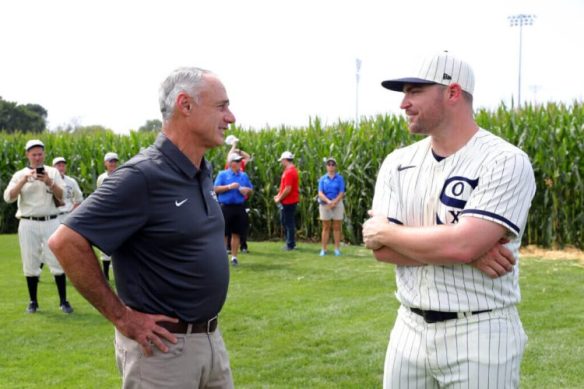
Rob Manfred, Liam Hendriks

Commissioner Rob Manfred with White Sox relief pitcher Liam Hendriks before last year’s Field of Dreams game. (The Athletic.)

Having a read of ESPN writer Don Van Natta, Jr.’s profile of commissioner Rob Manfred, I was almost convinced that maybe, just maybe, there really was more to Manfred than met the eye. Or, more than what comes forth in his stiff presence and often clumsy remarks.

Just maybe, the man isn’t the baseball-hating or baseball-illiterate Rube Goldberg-like abecedarian the caricatures so often portray. He did, after all, grow up a Yankee fan in upstate New York and can say proudly enough that he’s the only baseball commissioner ever who played Little League baseball. “All glove, no bat,” he remembers of being a Little League infielder.

My parents received a set of classic Revere copper-bottom cookware as a wedding present eight years before Manfred was born. (I still remember the fragrance of that special powder used to clean the copper bottoms, too.) Who knew Manfred (three years my junior) was the son of Revere’s production supervisor at their home plant in Rome, New York? An hour’s drive from Cooperstown, as it happens.

Born in 1958, Manfred took in his first live major league game at Yankee Stadium with his sports-obssessed father, sitting between the plate and first base on an Old Timers’ Day. Come game time, Hall of Famer Mickey Mantle crashed a pair of home runs and the Yankees beat the Twins, 3-2. When he finally became the game’s commissioner, he handed his father the first baseball with his stamp upon it.

“This is really an unbelievable thing,” Manfred, Sr. told his son. “I can’t say I disagree,” Manfred, Jr. told Van Natta.

A couple of hundred fathoms down, though, Van Natta noted that “more than once” Manfred told him what few baseball commissioners have dared to admit, that being the buffer absorbing the heat that should go to his bosses, the owners, is part of his job. Even if it’s about as pleasant as your private parts being caught in the vacuum cleaner’s handle.

And then it came.

“Every time it’s me, it ain’t one of those 30 guys—that’s good,” Van Natta quoted Manfred as saying. “Look, who the hell am I? I don’t have $2 billion invested in a team. I’m just a guy trying to do a job. I mean it. [The owners] deserve that layer. I believe they deserve that layer of protection. I’m the face of the game, for good or for bad.”

Mr. Manfred, unless it’s to boo and hiss your heads off over this or that piece of mischief, you may rest assured that no baseball fan anywhere in this country is paying his or her hard-earned money to head for the ballpark to see you or your bosses.

But I’m going to do you a small favour, as if you know me from the greenest bat boy on any professional baseball team. I’m going to introduce you to the true faces of the game. The ones whom those fans do pay their hard-earned money to see at the ballpark regardless of the machinations and deceptions of your bosses and theirs.

Mr. Manfred, meet Mike Trout. This is the guy you blamed once upon a time for not being baseball’s face, based upon his committing no crime more grave than letting his play and his clubhouse presence and his agreeability with fans before and after games speak for themselves, with no jive about the magnitude of being him.

Meet Shohei Ohtani. This is the two-way star who lights up the joint just by flashing that thousand-watt grin of his, never mind when he strikes thirteen out on the mound one night and belts baseballs onto the Van Allen Belt the very next. Between himself and Mr. Trout, you should be asking what on earth is wrong with the Angels that they still can’t find quality pitching enough to keep them in a race after they start in one but sputter unconscionably.

Meet Aaron Judge. This is the Leaning Tower of River Avenue who sends baseballs into the Delta Quadrant one moment and then, when made aware, goes out of his way to meet a Canadian kid to whom he’s number one among baseball men and who was handed one of his mammoth home run balls by an adult fan who knew the boy wanted nothing more than to catch one Judge hit out.

Meet Joey Votto. This is the future Hall of Fame first baseman who got himself tossed from a game early last year, but—after he learned his ejection broke the heart of a little California girl to whom he’s a hero above heroes—sent her a ball with his handwritten apology and autograph on it, prompting his team to drop game tickets and a little extra swag upon her the very next day.

Meet Bryce Harper. This is the guy who never apologised for being on board with letting the kids play. The guy now on the injured list with a thumb fracture and surgery to repair it after getting hit by a pitch thrown with one of the baseballs you and yours still can’t see fit to manufacture uniformly and with allowance for fairness on both sides of it, fairness for the pitchers and for the hitters alike.

Meet Vladimir Guerrero, Jr. and Bo Bichette. One is the son of a Hall of Famer who did last season what even his old man never did: led his league in on base percentage, slugging percentage, OPS, and OPS+, and led the entire Show in total bases. The other is the son of a respected major league slugger, has quite a lethal bat in his own right when his swing is right, and currently leads his league in trips to the plate. Together they’ve put some zip back into the Blue Jays.

Meet Oneil Cruz. The bat has yet to come to full life but the footwork, the glove, the throwing arm, have shown so far that you can be as tall as Frank Howard, J.R. Richard, and Randy Johnson and still play shortstop as though the position was created for you and not the Little Rascals in the first place. They’re falling in love with him in Pittsburgh, which needs all the love it can get, but they ought to fall in love with him all around the Show—except when he’s going so deep into the hole grabbing a grounder or a hopper that an enemy batter loses his lunch when he’s had a base hit stolen from him.

Meet Clayton Kershaw. He’s been around the block a few times. He’s a Hall of Fame lock as maybe the best pitcher of his generation. He’s still a quality pitcher and a class act. They still buy tickets on the road when they know he’s going to take the ball for the Dodgers. He’s faced his baseball aging curve with grace under pressure. And, for good measure, he’s the one active player who was seen fit to be part of the ceremony when the Dodgers unveiled that statue of their Hall of Fame legend Sandy Koufax this month, and you know (well, you damn well should know) what a class act Koufax was on the mound and has been in the decades since off it.

(You’re not still P.O.ed that Koufax waxed your Yankees’ tails twice while his Dodgers swept them in the 1963 World Series when you were seven, are you?)

Meet Justin Verlander. Missed a year plus recovering from Tommy John surgery. He has a 2.23 ERA and a 3.53 fielding-independent pitching rate so far this season. For any pitcher that’d be a remarkable return so far. For a future Hall of Famer who’s still suiting up at Jack Benny’s age (that’s a joke, son), it’s off the chart so far.

Meet Verlander’s 25-year-old Astros teammate, Yordan Álvarez. He’s leading the entire Show with his .667 slugging percentage, his 1.081 OPS, and his 206 OPS+. If there’s one untainted Astro who’s must-see viewing whenever he checks in at the plate, it’s him.

Meet Xander Bogaerts and Rafael Devers. The left side of the Red Sox infield is a big reason why the Olde Towne Team yanked themselves back up from the netherworld into second place in that rough and tumble American League East. Did I mention that Devers currently leads the entire Show with 177 total bases?

Meet José Ramírez. The Guardians’ third baseman is giving Devers a run for his money in the All-Star balloting that closes today. That thumb injury has put a crimp into his bat for now, and it’s had its role in the Guardians’ sudden deflation at the plate, but this guy just may be the face of his franchise right now. He ought to be one of the faces of this game.

Meet Mark Appel. This is the guy who went from number one in the draft to injuries as well as pressures and even to an exit from the game only to try giving it one more try—and finally coming up with the Phillies, nine years after that draft, and tossing a scoreless inning . . . at age 30. That’s as feel good a story as it gets for the oldest former number one to make his Show debut, no matter what happens with the rest of what remains of Appel’s career. They don’t all go to hell and back.

Those are only some of baseball’s faces, Mr. Commissioner. They’re the ones the fans want to see and pay through the nose to see. Despite your tinkerings. Despite your often erroneous readings of the room. Despite your inability or unwillingness to demand the same accountability of umpires that you do of players, coaches, and managers.

Despite your inability to let your professed deep love of the game come through without tripping over itself because, as an improvisor, well, if you were a musician the consensus would be that Miles Davis you ain’t.

Another year, ejection, and autographed ball

Jesse Winker

Jesse Winker (27) triggering a bench-clearing brawl after taking a leadoff pitch on the can in the second Sunday . . .

When pondering how to attract and keep today’s youth bound to baseball, I’m pretty sure a bench-clearing brawl depriving a particular young fan from southern California of seeing a favourite player all game long isn’t exactly what we should have had in mind. It’s hard enough being a Reds fan anywhere these days without that.

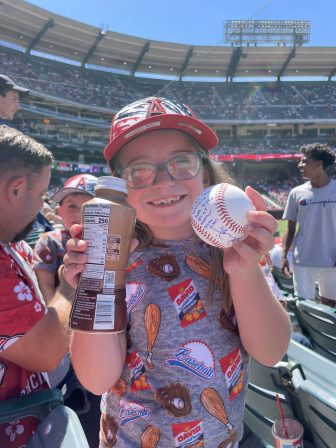
Last year, a little California girl named Abigail Courtney got to see her first live major league game when her beloved Reds hit town to play the Padres. She really wanted to see her personal favourite, first baseman (and future Hall of Famer) Joey Votto. Except that Votto got tossed from the outset after arguing a nebulous pitch call.

The girl’s heartbreak went viral, enough so that it reached Votto himself. He promptly sent her a ball that he signed, “I am sorry that I didn’t play the entire game. Joey Votto.” The next day, Votto granted Abigail a personal audience when the Reds blew her family to tickets for that game.

Abigail’s Reds rooting includes sticking with players after they move on, as several did when the Reds decided to push the plunger on 2022 before the lockout-threatened season even began. And there the Courtneys were in Angel Stadium Sunday afternoon, where Abigail wanted to see two of her now-former Reds heroes, Mariners left fielder Jesse Winker and infielder Eugenio Suárez.

If the little girl has been taught anything about Hall of Fame catcher/malaproprietor Yogi Berra, don’t be shocked if it includes one of the most fabled Berraisms flashing in neon before her pretty eyes in the second inning: It’s déjà vu all over again.

She either didn’t know or didn’t quite comprehend that there might be a little bad blood between the Angels and the Mariners after the Angels’ future Hall of Famer Mike Trout was almost decapitated in the ninth inning Saturday night. She didn’t know Angels opener Andrew Wantz was going to send a return message or two, zipping one past Julio Rodriguez’s head in the top of the first before drilling Winker on the right butt to open the top of the second.

She certainly didn’t know Winker would slip the umpires trying to restrain him and charge the Angels’ dugout on the third base side of the ballpark, luring the rest of the Mariners to pour over for a rumble against the dugout rail after the Angels—who looked to have been chirping at the Mariners after Winker took it on the cheek—came out to defend themselves.

Nor could she know yet that the umpires’ crew chief Adrian Johnson would tell a pool reporter, “I’m not aware of the incident with Trout from last night. You’re talking about the pitch that went over his head. That was nothing for us to issue warnings today. What happened today was a guy got hit. We had warnings in.”

A week earlier, while the Angels took four of five from the Mariners in Seattle, Angels pitcher (and yet another former Red) Michael Lorenzen reeled in horror after a pitch coned former Angel Justin Upton upside the head. Post-game, Lorenzen thundered over the inconsistent baseballs that pitchers were having numerous issues gripping properly including the ones they couldn’t grip well enough to control.

Abigail Courtney

. . . meant a second broken heart over an early ejection of a current or former Reds favourite for Abigail Courtney in slighty over a year . . .

Maybe for the Mariners the Upton splat meant beware. Maybe they didn’t necessarily accept Lorenzen’s post-game commentary as sincere. Maybe both sides pitching inside and tight this weekend was a little bit of mutual messaging. But just how Johnson could have figured that that didn’t mean buzzing Trout’s tower in the ninth Saturday merited pre-game warnings Sunday escapes.

A pre-game warning would have dispatched Wantz post-haste after he’d zipped Rodriguez’s head. It also would have knocked into the proverbial cocked hat any suspicion that Angels manager Phil Nevin elected to go with an opener just to have him take one or two for the team and send the Mariners messages without costing himself too heavily.

Considering the Angels’ usual wounding flaw of inconsistent-to-insufferable pitching rearing its head yet again this season—and contributing well enough to that fourteen-game losing streak that deflated their earlier-season success—Nevin was playing with matches if that was really his plan.

Abigail Courtney knew none of that going in. All she knew in the moment in the top of the second was that here she was at the ballpark to watch a couple of her favourite former Reds (we presume Votto remains her number one man in Cincinnati) and one of them got a shot in the ass, triggered one of the wildest brawls of the season, if not the wildest, then got thrown out of the game.

So did Winker’s fellow Mariners Rodriguez and J.P. Crawford, not to mention Mariners manager Scott Servais. So were Nevin and Angels Wantz, Raisel Iglesias, and Ryan Tepera. (Iglesias had a message of his own to send after his ejection, throwing a large tub of sunflower seed bags out towars the third base line in protest. Brilliant.)

Winker didn’t exactly go gently into that good not-so-grey afternoon. Before he disappeared into the Mariners clubhouse, he flipped the double bird to a section of the seats behind the dugout.

“The only thing I’m gonna apologize for is flipping the fans off,” the left fielder said after the game. “That’s it . . . They pay their hard-earned money to come and see a game, and they didn’t deserve that, so I apologize to the fans, especially the women and children.”

Lucky for Abigail that her mother is a psychologist by profession. “One of the first things I said was, ‘Honey, everybody’s fighting, but they’re all going to be OK’,” Kristin Courtney told Athletic writer Stephen J. Nesbitt. “‘Nobody’s going to get seriously injured. But Jesse’s not going to be playing anymore today’. So, there were more tears.

Abigail Courtney

. . . and, a second apologetically-autographed baseball to Abigail from a chastened player.

“She has a sensitive heart, and she really cares about baseball,” the lady continued. “She feels for everybody, and I know she was disappointed for herself because she’s been waiting to see Jesse. I kept telling her, ‘I don’t think Eugenio is going to get thrown out. I think he’ll be OK. You can cheer for Eugenio’.”

Concurrently, someone made Winker aware of Abigail’s second such broken heart in a year and eight days. And he did something about it.

When Votto got tossed in San Diego last year, he sent her the ball and made a point of meeting her before the next day’s game. When Winker was made aware Sunday, before the game ended in a 2-1 Angels win, he sent Abigail a ball he signed, “Sorry I was ejected! I hope to see you at another game soon.”

If Votto’s precedent is any indication, it’s a consummation devoutly to be wished. Before his ejection broke Abigail’s heart in San Diego, Votto was in something of a 41-game slump. After redeeming himself with her the following day, he went nuts enough to hit 19 home runs with a .674 slugging percentage over the following 52 games.

Winker could use a little of that kind of mojo. Even more than he could have used the pizza an Arkansas fan named Sofie Dill sent to him in the clubhouse. (When Winker texted her thanks, she texted back, “Thank you for being awesome, Jesse! There’s a ton of people on Twitter who love you right now man.”)

The bad news: Winker has a respectable .353 on-base percentage thus far this season, but he’s slugging 153 points below his career percentage. The next time the Mariners might have a chance to see Abigail will be the Fourth of July, when they visit the Padres on her home turf.

I suspect it’s very safe to say that, while she might appreciate the balls she got from Votto and Winker after their ejections broke her heart, Abigail would much rather watch them play baseball when she gets to the ballpark. Autographed baseballs aren’t half as much fun as baseballs diving for line drive hits or flying for home runs.

Hey, Joe, where you goin’ with your head in your hands?

Joe Maddon

The Angels’ lack of true depth wasn’t Maddon’s fault, but . . .

Let’s see. The Phillies dumped manager Joe Girardi last Friday morning. They went on a prompt five-game winning streak under interim Rob Thomson that began with three straight against the Angels. The Angels went from there to a 1-0 loss against the resurgent (we think) Red Sox and padded their losing streak to twelve.

It meant the Angels becoming the first team in Show history to go from ten games above .500 at 27-17 to a twelve-game losing streak. It also meant manager Joe Maddon, in the final year of a three-year deal, didn’t live long enough to finish the third year beyond which the Angels hadn’t even begun talking extension or new deal.

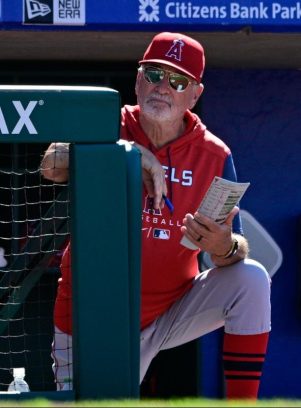
That’s what two straight sub-.500 season finishes plus the incumbent morass does even to a three-time Manager of the Year. The Angels executed Maddon Tuesday. Third base coach Phil Nevin, formerly a twelve-year corner infielder who spent one season as an Angel before becoming a longtime coach, was handed the job on an interim basis.

“Maddon appeared to have few answers” to the Angels’ sudden twelve-game cratering after such a staggering season’s start, writes The Athletic‘s Andy McCullough.

He praised the effort of his group, though his praise grew fainter in the wake of so many defeats. Maddon never found the footing he held in prior stops in Tampa Bay and Chicago. He was hailed as a pioneer with the Rays and adored for ending a curse with the Cubs. With the Angels, though, he was just another ineffective skipper unable to get a team with Mike Trout and Shohei Ohtani into the postseason. It wasn’t really his fault; the team lacked pitching depth and has been hurt by injuries. Even so, he wasn’t able to stop the skid, so the team stopped relying on him. It might not make a difference. It still shouldn’t come as a shock.

Once serving long-term as Mike Scioscia’s bench coach with the Angels, Maddon says he’d like to manage again. He won’t lack for those taking a deep look at the Angels and concluding he’s become the sacrificial lamb for a continuing failure above and beyond even still-freshman general manager Perry Minasian. Another Athletic writer, Marc Carig, has isolated the point:

Stop me if you’ve heard this before: what about the owner’s role in all of this? Arte Moreno has spent a ton of money on the big league roster in an effort to make his team a contender. That’s awesome. It’s what all of the owners should be doing. But Moreno has yet to find the right formula for building a winning culture . . . Front office turnover and, now, the firing of manager Joe Maddon shows that Moreno doesn’t seem to be any closer to building a sustainable winner. All managers know that being fired is part of the deal. This remains true even though skippers no longer occupy the same lofty perches that they once did within organizations. In this case, the Angels dismissed a manager with a World Series championship on his résumé in addition to a lengthy history with the organization. But all that experience wasn’t going to negate a dearth of arms and a banged up roster. Those issues could have only been overcome with depth, and that kind of thing falls outside of a modern manager’s purview.

There may also have been an increasing sense that Maddon was prone humanly enough to egregious mistakes but bent over in prayer at once hoping his players would bail him out. He got away with it the day he walked Corey Seager of the Rangers with the bases loaded and the Angels down; his Angels overcame a wider deficit to win at the eleventh hour. He still looked foolish for doing so.

More than all that: Maddon may have written his own execution order before last winter’s owners’ lockout ended, according to ESPN’s Buster Olney: The Angels’ administration had an idea on how to keep Trout healthier, and Maddon—whether inadvertently or carelessly—killed the idea in the proverbial crib.

The Angels wanted to talk Trout into moving from his longtime center field roost to one of the less-demanding corner outfield positions. They planned to talk to him about it once the lockout ended. The idea made sense. Trout’s past three seasons have been injury marred or injury-ended, and though he’s been a better than plus defender in center field (55 defensive runs above his league average) in his twelve-season career, those injuries have taken their toll. He’s also played 124 games in left field during his career and he’s been worth seven defensive run above league average for them.

The bad news, Olney writes: “Maddon changed the trajectory—telling reporters about it before anyone in the organization said anything to Trout. When Trout balked at the suggestion—he learned about it on Twitter, he said—that possibility was scrapped for 2022 out of respect for Trout, a future Hall of Famer.” If Trout heard it from the team first, the story might be different.

Did the Angels—who already declined to talk contract extension with Maddon—decide the manager simply couldn’t be trusted any longer to know how to mind his players’ health? Did they decide he couldn’t be trusted to keep certain key decisions from leaking before they’d had the chance to present them to the affected parties? Did they decide both? Will it mean Maddon may not get another chance to manage again too soon?

The injuries weren’t Maddon’s doing, of course. Neither was the lack of pitching depth, the Angels’ most constant and wounding flaw for just about as long as Trout’s been an Angel. But if the organisation came to see Maddon as even a tiny degree untrustworthy coming into the season, seeing him looking lost for ways to help the team snap that losing streak probably sealed the un-deal.

Nevin was the Yankees’ third base coach until after last fall’s American League wild card game. He took an inferno of heat for sending Aaron Judge on his way home, trying to score a tying run all the way from first on a ball that banged off the top of Boston’s Green Monster. Nevin misjudged a strong throw in to Red Sox cutoff man Xander Bogaerts, who fired a strike home so perfectly the diving Judge was out by two feet.

The Yankees ended up going home for the winter very early. Nevin ended up with a pink slip and a not too slow hiring to do the same job for the Angels. Now’s he’s the manager. Minasian says Nevin will hold the bridge for the rest of the season.

Tuesday night, Nevin watched his new Angels charges take a game to the tenth inning after blowing lead in the seventh inning or later for the sixth time during their now thirteen-game losing streak, a franchise record.

Trout continued coming out of his horrid slump and opened the night’s proceedings with a first-inning, two-run homer, but then had to leave with left groin tightness after he doubled in the third. The morning after, Trout said he felt something like a cramp leaving the batter’s box on the double but “a little achy” when he pulled up to second.

He came out for pinch runner Jo Adell, who came home on Max Stassi’s ground rule double to snap an early three-all tie, then doubled Luis Rengifo home to make it 5-3, Angels in the fifth. But the Red Sox made it 5-4 with a sixth-inning RBI single and tied it with an RBI infield hit—Trevor Story’s grounder bounding off Angel reliever Ryan Tepera’s glove—in the seventh. Making the sixth time in a now thirteen-game losing streak that the Angels let a lead disappear in the seventh or after.

Christian Vásquez sent what proved the winning run home when he drove tenth-inning-opening free cookie-on-second runner Story home with a single through the hole at second, and the Angels had nothing to say in the bottom of the tenth against Red Sox reliever Matt Strahm.

Trout and Shohei Ohtani said the morning after it was up to the players to re-horse themselves. Nevin said after the 6-5 loss that whatever else went wrong for the Angels during the franchise-record losing streak, morale wasn’t part of it. “I’m not worried about morale at all,” the new skipper told reporters. “You saw the effort from everyone. We had good at-bats. I thought there was a lot of great things. It was just a game where we ended up on the wrong side.”

From 27-17 after beating the Rangers on 24 May to 27-30 as of Wednesday morning, the Angels can’t afford to continue staying on the wrong side. It’s helped cost them one skipper this season already.

Once again: Injuries are not character flaws

Albert Pujols, Mike Trout

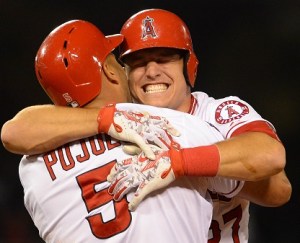
Mike Trout and Albert Pujols—some idiots call Trout a “puss” and others called Pujols a “thief” . . . for the heinous crimes of being injured on the field.

Sometimes it seems as though when a player is injured in the line of duty, he or she becomes a kind of criminal in Joe and Jane Fan’s eyes. Far as they’re concerned, such players are any one of a number of unflattering things. Especially when an injury keeps them out of action for more than, say, a week or two.

It’s as if injury belongs with defeat among moral shortcomings and aren’t covered by simple, irrefutable laws of sports. In a game, somebody has to lose. On the field, someone’s liable to be injured. They’re plain facts of life. They don’t expose the defeated as degenerates or the injured as gutless.

I’ve been steaming over it ever since I saw one social media snit dismissing Mike Trout, who’s dealt with season-disrupting/ending injuries the past couple of full seasons, as “a puss.” Last year, a torn calf muscle incurred running the bases put paid to his season after 36 games.

You’d think that with everything we’ve long since learned we’d quit condemning the wounded as weenies because they were just so much “tougher” in the Good Old Days. News flash: The good old days weren’t so good when it came to athletes’ health. And the next time you look at the numbers of careers you think should have lasted longer or been better than brief flashes of brilliance, stop to think about those players’ injury histories.

They used to say Roger Maris merely proved himself a lamer because he never again had a career spell such as 1960-62. They said the pressure of that 61-homer 1961 took him down. Those people forget that a series of injuries beginning in ’62 began sapping Maris’s formidable power and reducing him to journeyman level by 1965.

The Yankees falling into a lost decade of 1965-75 needed as much box office power as they could still wring out of ancient (and very often injured) Mickey Mantle, Whitey Ford, and Maris. They even forget that that generation of Yankee movers kept the true seriousness of a wrist injury from Maris unconscionably, in order to keep him on the field—at the time the Yankees collapsed due to age on the field and parching in the farm system.

Gene Mauch and Leo Durocher were known to denounce the injured as quitters. Between that and foolish trades, no wonder the post-1964 Phillies wouldn’t be competitive again for almost a decade to come. No wonder the 1969 Cubs were too spent down the stretch to keep up with the surging Mets and take back the National League East that first looked like those Cubs’ for the taking.

They used to call Jim Palmer anything from a prima donna to a hypochondriac when the slightest hint of an injury sent him shuddering over the prospect that his pitching career was over. It came from mishandling an injury he incurred after his rookie splash and out-lasting arthritis-addled, overmedicated Hall of Famer Sandy Koufax in Game Two of the 1966 World Series. Well, now.

Maybe Palmer was onto something after all, no matter how exasperated Earl Weaver and his teammates got with his health concerns—which was plentiful enough, no matter how much they liked him as a person. That’s Palmer reposing in the Hall of Fame as one of the absolute best pitchers of his generation and with three World Series rings to show for it, too.

Forget about the idiot dismissing Trout—who’d be a Hall of Famer and the fifth-best all-around center fielder ever to play the game if his career ended this instant—as a puss. Think of all the idiots who believe to this day that Albert Pujols “stole” that $240 million he earned as an Angel . . . and forget that his lower body, particularly a plantar fasciitis-addled heel and numerous other leg injuries was the real reason he collapsed after a respectable first season in Anaheim.

Ill-fated Jacoby Ellsbury’s reasons for not even thinking about re-signing with the Red Sox when he hit free agency included whispers that he took “too long” to recover from injuries his full-out playing style incurred. He signed big with the Yankees—and the injury parade continued apace, right down to his missing 2018 with a torn labrum and 2019 with foot and shoulder injuries.

It was hell if you do and hell if you don’t for Ellsbury. Return too soon from any injury and you risk re-injury; return not soon enough for teammates’ or managements’ or fans’ tastes, and you risk exactly what Ellsbury put up with, unfairly and unconsionably, a reputation as a fragile goldbrick.

The late Mark (The Bird) Fidrych tried too many premature returns from injuries and re-injuries after his sensational rookie 1976. Career in the toilet and done swiftly enough. Still think he merely “disappeared?”

Often as not the teams themselves don’t help. Last year, Phillies manager Joe Girardi said it was perfectly acceptable to keep injury information out of the press. He was thinking of keeping the other manager from getting a little advantage, but he forgot that a) opposition managers tend to know when an opponent is hurting; and, b) Joe and Jane Fan are ignorant enough about injured players without being lied to even further while they’re lying to themselves.

Basketball people have spent all this season listening to whispers-to-screams denunciations of Brooklyn Nets guard Ben Simmons, missing an entire season because of back trouble. Most of them didn’t want to hear it. He backed out of the fourth game of the Nets’ playoff round against the Boston Celtics with his back still bothering him.

The talking heads went nuclear; some of them called Simmons the same kind of thief that people called Pujols the Angel. Even ex-NBA supermen like Shaquille O’Neal called backing out of the game “a punk move.” That “punk move” turned into back surgery Simmons underwent Thursday.

“The notion that Simmons was faking it, that he was just scared to play in the game because the Nets were down in the series, made no sense,” wrote a furious Deadspin writer named Rob Parker. “And the back is a tricky thing to put a handle on. A back issue could be so bad that a person can’t even tie their shoe, let alone play basketball on the NBA level.”

Reminder: Injuries on the field aren’t the same thing as chasing Jill St. John down a ski slope and turning your knee into bone meal (Jim Lonborg), doing a slam-dunk move and catching your ring in an awning mechanism to shred your hand ligaments apart (Cecil Upshaw), staying too long without the sun screen on a tanning bed (Marty Cordova), or dozing off with an ice bag on your foot to incure frostbite—in August. (Hall of Famer Rickey Henderson.)

I’ve said it before, but I’ll say it again and again if need be. Big money contracts don’t immunise you from the same injuries to which merely mortal players can be susceptible. Nine figures don’t turn Clark Kent into Superman. They also don’t heal a player in ten minutes or less. Anyone who doesn’t get that should never be taken seriously as a fan, a coach or manager, or a professional analyst.

Unless a player was injured doing something stupid off the field, or you have heretofore undetected deep medical knowledge, you have only one recourse whenever a player—from the most modest bench player to the most obvious Hall of Famer in waiting—is injured in the actual line of duty.

That recourse is to shut the hell up and stop treating real sports injuries as evidence of fragility or cowardice. Because the only one resembling a fragile coward in my eyes when you dismiss this injured player as a puss or that injured player as a goldbrick is you.

“I felt like there was an angel by my side tonight”

Noah Syndergaard

The mighty Thor didn’t have to strike ’em out to get ’em out and help shut ’em out Saturday night.

About the only correct observation out of the Angels’ 2-0 shutout of the Astros Saturday night was this, about the starting duel between two returning Tommy John surgery patients, Noah Syndergaard (Angels) and Justin Verlander (Astros): it was a matchup of returning former aces. Vintage, it was not.

But it didn’t have to be. Especially so far as the Angels were concerned. “He’s just a strike thrower,” said Angels manager Joe Maddon of his new pitching toy. “The changeup is outstanding, and the slider, he’s willing to pitch inside . . . He was totally in command of everything that he’s doing out there.”

“It was fun to play behind him,” said Mike Trout, who accounted for the second Angels run with a mammoth late game home run. “He gets on the mound, throws strikes. He tries to get back in the dugout as quick as he can. You saw that tonight. He’s just out there grinding.”

Syndergaard entered the game with a lifetime 4.63 strikeout to walk ratio and 9.7 strikeout-per-nine rate. Verlander entered with a lifetime 2.33 strikeout-to-walk rate and a 12.6 strikeout-per-nine rate. Now, have a gander at their Saturday night special.

The former Met known as Thor struck nobody out, surrendered two hits and issued two walks, and lived mostly on the ground, with eleven grounders among the sixteen outs he got in five and a third innings’ work. Verlander struck seven out (including designated-hitting Shohei Ohtani thrice), walked three, and surrendered three hits while getting an even number of grounders and flies.

“It’s a long road, man,” Verlander said postgame. “Lots of nervousness and anxiousness leading up to it. Felt like my debut. Got some things to work on, but coming out of it feeling pretty good.”

One problem was Verlander feeding Angels first baseman Jared Walsh a fat enough fastball to open the bottom of the second and Walsh hitting it over the right center field fence. Another was no Astro except Kyle Tucker (in the top of the second, a single) and Chas McCormick (top of the third, single) hitting anything that didn’t find an Angel glove, though a third (Aledmys Diaz) reached on a throwing error opening the top of the seventh.

A third, for the Astros, anyway, was Trout serving notice that he’d had it with the slump that marked his first two games and the Astros demolition that accompanied it. The Astros had battered Angels pitching for eight home runs in those games. But while their contact wasn’t hard Saturday night, Trout’s was.

He smoked a fly out to the rear end of Angel Stadium in the first, a hard ground out to second in the fourth, a hard line out to center stranding two runners ending the fifth, and then—as if to prove practise makes perfect—he turned on a 1-2 fastball a little low and a little away, from Astros reliever Ryne Stanek, and yanked it off the rocks behind the left center field fence, 445 feet from the plate, in the eighth.

“Trout’s gonna get you,” observed Astros manager Dusty Baker postgame. After a 2021 ruined early enough by a torn calf muscle, and an owner-lockout-imposed short spring training this time around, one that included a short illness toward its end, Trout found a dramatic way to shake away his season-opening rust.

So did the Angels’ bullpen. Ryan Tepera entered Opening Night by surrendering prompt, back-to-back homers to Alex Bregman and Yordan Alvarez, but on Saturday night he got five straight outs in relief of reliever Aaron Loup—who’d gotten three in relief of Syndergaard but was hapless to prevent Diaz reaching aboard third baseman Anthony Rendon’s off-line throw. And designated closer Raisel Iglesias used only eight pitches to retire the Astros in order to finish it.

The bulls also struck four Astros out, three more punchouts in their 3.2 innings’ work than Syndergaard in 5.1.

Syndergaard had other things on his mind to accompany his manhandling of the Astros’ formidable lineup. Wearing the same number 34 he’d worn as a Met, the number had particularly sober significance for his new team.

No Angel had worn the number since 22-year-old pitcher Nick Adenhart, thirteen years to the day before—when Adenhart was killed by a drunk driver celebrating his successful Angels debut. The Angels didn’t retire 34 officially, but no player sought that number since, just as no Angel since the death of pitcher Tyler Skaggs almost three years ago has asked for Skaggs’s number 45.

By most accounts, Syndergaard asked the team to wear the 34 he’s worn all his life, after signing a one-year, $22 million deal with the Angels, and he was only too well aware of what Adenhart’s death meant to the franchise and its fans. “I felt like there was an angel by my side tonight,” Syndergaard said postgame. “That was really special to me.”

As athletes, I feel like our number—to the everyday person, it’s just kind of a number—but to us, it’s part of our identity. Growing up, my number was 34 because I was a huge fan of Nolan Ryan. But now it kind of means something a little bit different to me. I want to use that to lift up his name.

If Syndergaard continues lifting his team the way he did Saturday night, there could be more than a few angels on the Angels’ shoulders over the long, arduous season yet to come.