Five for Kelly, not eight, but . . .

Syndication: Phoenix

Joe Kelly’s suspension is now five, not eight games. Some say that’s still too excessive.

The good news, such as it is, is that Los Angeles Dodgers pitcher Joe Kelly’s suspension for throwing at Houston Astros Alex Bregman and Carlos Correa, triggering a bench-clearing, safety protocols-defying debate, was reduced from eight to five games. Enough might say that’s still too much.

The bad news is that there remain enough, aboard social media especially, to whom Kelly didn’t go far enough in administering Astrogate justice. Much like rioters and looters turning peaceful if grief-stricken demonstrations into war zones, they would cross the line between demanding justice for the guilty and destroying the innocent.

Asstros [the poster’s spelling] need to be assaulted, often and viciously,” said one such social media poster, perhaps too typically, not specifically about Kelly but about the protocol-defying near-dugout scrum into which Astros coach Alex Cintron goaded Oakland outfielder Ramon Laureano last Sunday afternoon.

“Bean balls, mound charging, spiking, spitting, fighting, punches, headlocks, punches to the face hard and often,” the poster continued. “Umpires should call every pitch against them a strike.” And then we should get really mad?

Such outrage is far more comprehensible than the same poster going forward from there to say violence has deeply therepeutic benefits. For whom? For those whose rage over the lack of Astrogate discipline against the cheating players simply will not be satisfied by one pitcher throwing beanballs?

Or, by one Athletics outfielder fuming over being hit by Astro pitches thrice in one weekend and twice that Sunday while, coincidentally, not one Astro batter saw so much as a brushback all weekend?

Social media hounds such as that demand retribution above and beyond the bounds of the game policing itself, no matter how wanting commissioner Rob Manfred proved to be when he handed Astro players from 2017-18 blanket amnesty in return for spilling about the Astro Intelligence Agency’s illicit electronic sign-stealing operation.

And, no matter how wanting fans and about seven-eighths of major league players found both that amnesty and the Astros’ subsequent unapologetic apologies as spring training opened.

Kelly himself suggested distinctions for which right reason demands acknowledgement as well. That otherwise fine 28 July saw him send a pair of fastballs upside and behind Bregman’s head and—a few batters later, before striking Correa out for the side—a pair of breaking balls making Correa dance in the batter’s box.

Bregman and Correa are two of only six 2017-18 Astros regulars remaining in those positions on this year’s edition. Kelly made a point of send the messages strictly via them when the opportunity arose.

Doing it to that pair made things obvious enough, since no pitcher customarily would think of decking a Bregman on a 3-0 count with one out. Nor would he think normally of putting runners at second and third as happened when one of Kelly’s dusters to Correa sailed past to be ruled a wild pitch officially.

Kelly probably didn’t have to be reminded that justice demands a line between the guilty held to account and those having nothing to do with the crimes in question left unscathed. If he’d elected to deck, say, Michael Brantley, who didn’t become an Astro until 2019, and was the only non-2017-18 Astro he faced in the inning, he would have crossed that line and maybe earned not one degree of the acclaim he received.

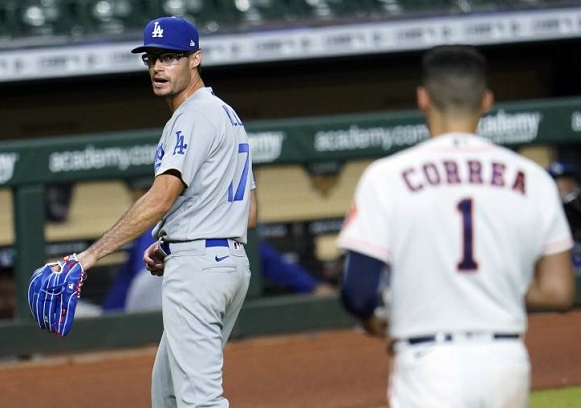
When Kelly struck Correa out, Correa and Kelly jawed a little as Kelly strode from the mound and approached the third base line returning to his dugout. Kelly then sent mock crybaby gestures including a pronounced pout to Correa. From there the dugouts emptied, health and safety protocols be damned. Not too bright on either side’s account.

But it combined with the Bregman knockdowns and Correa dustings to make Kelly a folk hero in Los Angeles, where they’d still like to send the Astros to the guillotine over the 2017 World Series the Dodgers lost to the Astros and, quite possibly, to the AIA as well.

In other places, considering Kelly’s membership on the 2017-18 Boston Red Sox (vanquished by the Astros in the ’17 division series, vanquishers of the ’18 Astros en route their own World Series triumph against the same Dodgers), Kelly’s “hypocrisy”—considering the subsequent revelation of the Red Sox Replay Room Reconnassance Ring sign-stealing—was denounced almost as furiously.

At least, it was until right reasoning people reminded themselves that neither the AIA nor the Rogue Sox operation involved the teams’ pitching staffs specifically. And, that Kelly, who became a Dodger last year, might well have gotten enough of the skinny from his mates to comprehend a significant distinction between the AIA and the Rogue Sox.

The AIA involved either altering an existing off-field camera off mandatory eight-second transmission delay or installing a furtive real-time camera to send the stolen intelligence to a clubhouse monitor for transmission to hitters. The Rogue Sox’s Four Rs involved using screens already installed in replay rooms league wide to decipher signs and signal them to baserunners who’d signal them to the hitters.

In simpler terms, the AIA went off the grid and over the barely-consecrated official line, while the Rogue Sox simply behaved like a teenage boy finding the keys to the hooch hutch unable to resist temptation until he was of legal drinking age. Especially since MLB handed them the hutch in the first place.

When Kelly’s pair of fastballs went upside Bregman’s head, there was a lot of jawing about them showing a lack of “professionalism.” Mostly from people—like Astros pitcher Lance McCullers, Jr.—who called those pitches unprofessional but couldn’t explain why illegal high-tech cheating wasn’t.

In the immediate wake of Kelly’s messaging, the word came unimpeachably that Manfred now has a hammer to drop on future such Astrosoxgate espionage: not only can those players caught taking or transmitting electronically stolen signs be suspended without pay, they lose the days of their suspensions in MLB service time, too.

The poster I cited earlier also demands the Astros’ 2017 World Series title be vacated. So has half the world, seemingly. Good luck with that. Vacate that title and you’ll have to try vacating a host of pennants (the 1940 Detroit Tigers, the 1951 New York Giants, the 1961 Cincinnati Reds) and/or World Series titles (the 2018 Red Sox, perhaps; the 1948 Cleveland Indians, possibly) past.

What the 2017-18 Astros and at least the 2018 Red Sox did was bad enough, even if you agree the Asterisks went over the line while the Rogue Sox were clever if warped enough to use what was handed to them gift wrapped.

But it would be just as wrong to compel those Astros and Red Sox people who weren’t there to pay for the crimes of those who were. Those demanding aboard social media and elsewhere that the innocent in essence must suffer with the guilty can put a sock in it.
Astrogate messages at last?

2020-07-28 JoeKellyCarlosCorrea

Joe Kelly (left) jawing with Carlos Correa, whom he brushed back twice in the same plate appearance Tuesday night. Should the Astros be shocked that somebody sent them post-Astrogate messages at last?

It’s not that you didn’t expect it to happen, but no matter how you feel about the Houston Astros and their extralegal electronic cheating you merely hoped it might not happen. Even if Tuesday night was the first time the Astros and the Los Angeles Dodgers met since that now-tainted 2017 World Series.

They weren’t expected to meet again unless they might tangle in another World Series. Then, the coronavirus world tour happened. When the Show returned at last, the pandemic and its mandate for extraordinary health and safety protocols prompted its governors to sketch regional scheduling featuring the Dodgers and the Astros in Houston this week, in Los Angeles come September.

You might think things are tough enough playing coronaball (reference, especially, the afflicted and drydocked-for-now Miami Marlnis) without the Dodgers having to face the team now believed to have cheated their way to that World Series title.

You might think things were tough enough without other Astro opponents still thinking in the backs of their minds that the Astros need to be taught a few little lessons in manners and in accepting responsibility in the sometimes-forgotten Astrogate wake.

You might have thought so until Joe Kelly relieved fellow Dodger reliever Brustar Graterol for the bottom of the sixth in Minute Maid Park Tuesday night.

With one out, Kelly had Houston third baseman Alex Bregman 3-0 when he decided ball four should be a fastball sailing up and past Bregman’s shoulders. The next batter, outfielder Michael Brantley, forced Bregman at second on a ground ball but made a point of stepping on Kelly’s foot as the pitcher covered first base on the play.

Kelly lingered just a little bit near the base after Brantley’s step-on and a voice was heard in the empty ballpark. It may or may not have been Astros manager Dusty Baker, but it hollered, “Get back on the mound, [maternal fornicator].” Kelly did return and go back to work.

Known to be erratic at times, and un-allergic to brushback pitches when he thinks they’re mandated, Kelly walked Astros first baseman Yuli Gurriel on four straight pitches, then opened to Astros shortstop Carlos Correa with a breaking ball behind Correa’s head and all the way to the backstop.

Officially, of course, it was ruled a wild pitch. Unofficially, even the cardboard cutouts in the otherwise empty stands knew good and bloody well that Kelly wanted to remind the Astros once again that it wasn’t nice to set up a furtive closed-circuit, off-field-based television network for stealing opposing pitch signs and think they could get away with it.

Commissioner Rob Manfred helped them think they could get away with it. Foolishly or otherwise, Manfred handed all Astro players immunity from discipline in return for spilling about the Astro Intelligence Agency after former Astro/current Oakland Athletics pitcher Mike Fiers finally blew the whistle on the AIA to The Athletic‘s Ken Rosenthal and Evan Drellich last November.

The AIA cost three managers (the Astros’ A.J. Hinch and two 2017 Astros-turned managers, Alex Cora in Boston, Carlos Beltran in New York, before he had a chance to manager even one Mets game) and one general manager (the Astros’ Jeff Luhnow) their jobs. (Any thought of Hinch possibly returning for 2021 was vapourised when the Astros exercised Baker’s 2021 club option.)

Astros owner Jim Crane was asked for no accountability beyond being fined for what amounts to maybe a year’s worth of tip money for him. Called upon to stand when spring training opened, Crane and assorted Astros players weren’t exactly apologetic for the AIA’s operations. Numerous opposing players fumed that, one way or the other, they’d find ways to administer justice, and no official edict was going to stop them.

2020-07-29 AlexBregman

“That’s dirty baseball,” Astros manager Dusty Baker fumed over this pitch to Alex Bregman from Joe Kelly. Would Baker call the Astros’ electronic sign-stealing  good clean baseball?

After Kelly struck Correa out swinging for the side, with a couple of more inside pitches in the mix, Correa was distinctly and, apparently, vocally unamused as Kelly walked off the mound and crossed the third base line to his dugout. Prompting Kelly to shoot a couple of mock crybaby faces and choice words Correa’s way.

That may have been the specific flash point under which both benches emptied and milled around the plate area. They forgot some of the social distance protocols, meaning a fine or three might be forthcoming. The dispute was bark, no bite, unless the Astros and the Dodgers were willing to dissipate the tension with some six-feet-apart pantomime boxing, but neither side was in the mood for comedy.

Baker was quoted by USA Today‘s Bob Nightengale thus: “What really enraged everybody was what he told Carlos when he struck him out, ‘Nice swing bitch!”’ Not nice. Send the message, sure. Taunt them no matter what they did or didn’t jaw your way, not so fast. Naturally, one of the Twitterpated couldn’t resist defending Kelly’s taunts thus: “Should have said something along the lines of ‘hard to hit when you don’t know what’s coming’.”

The warnings were handed to both sides after the second Correa duster. Perhaps naturally, Kelly said of the Bregman shoulder kisser, post-game, “It was a ball, obviously. It wasn’t my best pitch. Ball four, I walked him, never good to put a guy on when you’re leading the game.”

Of the breakers bending Correa, he said, “I guess he didn’t take too kind to a curve ball [inside]. It is what it is. I finally made one good pitch for the punchout . . . I pitch competitively, but with the no fans here it’s easy to hear some stuff.”

You stick to that story, son.

Some observers seemed to think, too, that the Astros were more infuriated by the buzzer  off Bregman’s shoulders than the two breakers dusting the otherwise non-entertained Correa. For his own part, Bregman merely shrugged it off when Kelly’s heat ricocheted off his shoulders and took his base. Almost as if he was well enough prepared for the incoming messages Tuesday and yet to come.

“The history obviously is out there,” said outfielder Joc Pederson before the series began. “Everybody knows what’s at stake and what happened. For being no fans, maybe sometimes the energy could be lacking a little bit. I don’t think that will be the case for this series.”

That doesn’t necessarily mean Pederson urged or condoned any message from any Dodger pitcher to any Astro hitter. Nor does it mean the Astros went into the game expecting nothing more than balls, strikes, hits, and outs, considering the jawing between the two teams before spring training was cut off at the coronavirus pass.

Recall: Dodger center fielder Cody Bellinger saying the Astros cheated for longer than affirmed and that their second baseman Jose Altuve stole the 2017 American League Most Valuable Player award from New York Yankees right fielder Aaron Judge. Recall, too: Correa rejoining that Bellinger thus spoke recklessly.

Just don’t kid yourselves that the Astros forgot for even a moment that a brushback or a knockdown was liable to come from any arm, at any time, in any game, no matter how much it seemed the pandemic pushed the long toxins of Astrogate to one side.

Until Tuesday night, only Gurriel and Correa were hit by pitches, both in the second game of the truncated season, at home against the Seattle Mariners. Until Kelly decided to lay down the law, however, all anyone thinking clearly probably thought was that the Astros were so thoroughly roasted in the immediate public Astrogate wake that throwing brushback or knockdown pitches would be as foolish as it would be unnecessary.

Like the Rogue Sox and their 2018 Replay Room Reconnaissance Ring, the Astro Intelligence Agency wear the stain of their extralegal cheating all season long, however long the season, whenever the season began. There but for the lack of grace of the coronavirus would fans and commentators alike remind both teams, good and strong, that crossing the proper gamesmanship line is filthy pool.

Only three Rogue Sox have been plunked on the truncated season thus far. But don’t fool yourself that they’re immune to thoughts that a little extra payback might be coming, too. It may not be quite as pronounced as any the Asterisks face, since they merely used what was available, predicated it with a man on base to transmit the pilfered intelligence, and didn’t install an illegal camera to begin their dirty work.

Baker himself seemed more enraged at the Kelly bullet that almost grazed the back of Bregman’s shoulders. “You don’t throw at a guy’s head,” the manager said. “That’s playing dirty baseball.” Baker’s in the unenviable position of having to help his team past the  Astrogate mess he wasn’t part or parcel of, but what would he call the AIA—good clean baseball?

Kelly wasn’t a Dodger when the AIA’s espionage operated. But he was one of the 2017 Red Sox downed by the Astros in the American League division series and the 2018 Red Sox who beat the Astros in that ALCS. You bear in mind that neither Astro nor Red Sox pitchers were co-operators of those teams’ Spy vs. Spy operations.

Kelly was also the hapless Dodger who served the pitch Washington Nationals second baseman Howie Kendrick destroyed for a tie-breaking, Dodger-burying, National League division series-winning grand slam in the Game Five top of the tenth. The last thing he needed even in abbreviated spring training was his Dodgers and the Astros getting into an Astrogate-inspired jawing contest.

Otherwise, Kelly was a pitcher in need of some kind of redemption, any kind of redemption in the eyes of Dodger fans in Los Angeles and elsewhere. The taunts were more than a little out of line. Perhaps Kelly didn’t need to send more than one brushback Correa’s way, but those weren’t half as juvenile. Well, boys will be boys, even in a time of pandemic.

Still, somewhere in that fan base they’ll remember the Dodgers beat the Astros, 5-2, to open this series, but it’ll be a by-the-way remembrance. One that has to be rushed into the conversations, swiftly, amidst the hot take that Kelly made himself something nobody in Los Angeles thought he’d become to Dodger fans after last October. A hero.

Alfred Hitchcock presents Opening Night

AlfredHitchcockAt long enough last came Opening Day. Well, Opening Night. On which New York Yankees right fielder Aaron Judge nailed the COVID-19 delayed season’s first hit and his teammate Giancarlo Stanton nailed its first home run two batters later.

On which the Washington Nationals opened without a key element, outfielder Juan Soto, whose positive COVID-19 test result came back well enough before game time to make him a scratch.

Before that rain-shortened game even got started, the word came from the opposite coast that Clayton Kershaw was scratched from his Opening Night start thanks to a back problem sending him onto the injured list.

In Washington, the Nats’ co-ace Max Scherzer would have loved if Judge and Stanton were Thursday night scratches. They accounted for all Yankee runs in the 4-1 final shortened in the top of the sixth when the rains smashed in with the Yankees having first and third and one out.

In San Francisco, Los Angeles Dodgers rookie Dustin May pitched five innings to San Francisco Giants veteran Johnny Cueto’s four, both men leaving with a one-all tie, and the Dodgers’ new $396 million man Mookie Betts broke the tie scoring on an infield ground out in the top of the seventh.

Scherzer’s good news Thursday night: eleven strikeouts. His bad news: four walks and an inability to solve Judge and Stanton. Judge also doubled home Tyler Wade in the third and Stanton singled home Gio Urshela in the fifth. Remove Judge and Stanton from the Yankee lineup and the Nats’ Adam Eaton’s hefty solo home run in the bottom of the first would have been the game’s only score.

Betts singled with one out in the top of the seventh and called for the ball. Published reports indicate that ball plus the evening’s official lineup card now repose in his home. “It’s just a new chapter in life,” he told reporters after the 8-1 Dodgers win.

After he came home when Justin Turner grounded into a force out, Corey Seager’s grounder got Cody Bellinger caught in a rundown at the plate, but Enrique Hernandez singled home Turner and Seager (who’d taken second during the rundown), Joc Pederson and A.J. Pollock walked back-to-back to load the pads, Austin Barnes sent Hernandez home with an infield hit, and Max Muncy walked Pederson home.

And, on both coasts, all four teams figured out a solution to the issue of whether or not to take a knee for “The Star Spangled Banner” that might actually help more than hurt the too-easily outraged.

Abetted by a suggestion from Philadelphia Phillies outfielder Andrew McCutchen, the Yankees and the Nats lined up on the base lines holding a long, long, long black ribbon, standing apart enough for social distance, then took their knees before “The Star Spangled Banner” was played.

On the same suggestion, the Dodgers and the Giants held a similar long, black ribbon and took their knees before the anthem’s playing. In Washington, both the Yankees and the Nats rose from their knees while the anthem was played. In San Francisco, ten Giants including manager Gabe Kapler plus Betts on the Dodgers’ side stayed on their knees during the anthem, with Bellinger and Muncy putting hands on Betts’s shoulder as a gesture of support.

I went back on record Thursday saying that there are far worse ways than kneeling before a national anthem to protest something you think is dead wrong. Kneeling, as two Scientific American writers I cited remind us, is anything except disrespect.

“While we can’t know for sure, kneeling probably derives from a core principle in mammalian nonverbal behavior: make the body smaller and look up to show respect, esteem, and deference,” wrote psychologists Jeremy Adam Smith and Dacher Keltner in 2017.  “. . . Kneeling can also be a posture of mourning and sadness. It makes the one who kneels more vulnerable. In some situations, kneeling can be seen as a request for protection.”

I’ll ask again: Would you rather those outraged by rogue police doing murder against black or any people raise clenched fists, burn a flag on the field, or start a riot with or without looting and plundering in the bargain? Neither would I. But if only now-former football quarterback Colin Kaepernick had thought in the first place to take his original knee before the anthem played, would that have worked very differently for himself and the outraged?

Let me repeat, too, that you don’t have to subscribe to every last clause or every last impulse of the social justice warriors to agree that rogue police doing murder is not what the land of the free and the home of the brave was supposed to mean. Neither must you subscribe to the formal Black Lives Matter movement itself to agree that black lives and all lives don’t deserve to end when those entrusted to uphold the law break it instead.

Let me repeat further that it’d be far better for baseball to limit playing “The Star Spangled Banner” to before games on Opening Days, games played on significant national holidays, the All-Star Game, and Games One and (if it goes that far) Seven of the World Series. Not so much to cut back on the kneeling protests but to re-emphasise that patriotism compulsory is patriotism illusory.

Back on the field, Soto’s COVID-19 positive test approaching Opening Night shook the game up just enough to provoke serious questions as to how MLB is going to navigate even this truncated season without further medical issues. And, whether the most stringent health and safety protocols will keep more Sotos from turning up positive.

Other surrealities include the empty stands, other than cardboard cutouts of fans in the seats, and the canned crowd sounds at the ballparks. The coronavirus world tour already turned baseball into something between The Twilight Zone and the Mad Hatter’s tea party. Now that the season is underway at last, should we throw Alfred Hitchcock Presents into the mix?

At least neither Opening Night game went to extra innings, so we didn’t have to deal right off the bat with the free cookie on second base awarded each team to start its extra half-inning. The mischief that’ll inspire will just have to wait.

Funny thing, though, about that equally nefarious three-batter minimum for pitchers. Two Giants relievers faced the minimum in that five-run Dodger seventh before surrendering any runs. If bullpen preservation was part of it even if those two got pried, I can see already that this dumb rule isn’t going to end well for Kapler and other managers.

And, let’s be real, the PA people in charge of the piped-in sounds are only human, after all. Who’s going to be the first poor sap having to live down the accident of cranking up the wild cheering when the home team’s batter gets hit by a pitch?

On the other hand, it was easy enough to feel normal again once the Yankees and the Nats got underway . . . when home plate umpire Angel Hernandez began blowing pitch calls. Calling a few strikes balls and a few balls strikes? That’s about par for the course for him. So when’s that umpire accountability coming at last?

Before the game, Dr. Anthony Fauci—otherwise doing his best to battle a pandemic involving both a stubborn virus and a political (lack of) class that surely makes him wonder if he was really there when all this happened—threw out a ceremonial first pitch. Later, he was seen in the stands with his Nats-themed face mask off his face a spell. What’s up with that, Doc?

You’d love to say Fauci threw a perfect strike to Nats relief pitcher Sean Doolittle behind the plate, but you’d be lying like an office holder. Fauci’s delivery is described politely as resembling a man trying to compensate for a fractured upper arm. The ball sailed almost to the on-deck circle. Rumour has it that Hernandez called it a strike on the outside corner.

The Dodgers bet on Betts

2020-07-23 MookieBetts

Mookie Betts has 396 million reasons to smile big, and the Dodgers aren’t exactly complaining, either.

On the threshold of the Show’s coronavirus-compelled truncated regular season, the Los Angeles Dodgers—whose 2020 payroll, however pro-rated, is higher than all other teams except a certain one out of the south Bronx—proved they still have the ability to surprise and shock. They’ve made just made Mookie Betts the second-richest player in baseball, behind only a guy down the freeway named Mike Trout.

Last year, after Bryce Harper signed his thirteen-year/$330 million deal with the Philadelphia Phillies, the Los Angeles Angels saw and raised, signing Trout to twelve years and $426 million. Betts gets the twelve years and $396 million. Like Harper and Trout, Betts will be in one place for the rest of his playing career, something both those players wanted when all was said and done.

What a difference 45 years makes.

At 1974’s end, Hall of Fame pitcher Catfish Hunter—made a free agent after Oakland Athletics owner Charlie Finley reneged on a contracted-for insurance payment, thus voiding Hunter’s contract—showed fellow players what a truly free market for their services could bring. The following season, the Dodgers’ best righthanded pitcher refused to sign any contract no matter how lucrative that didn’t include a no-trade clause.

After their then-general manager (Al Campanis) injected personal matters into their talks, the pitcher refused to talk to anyone lower than then-president Peter O’Malley. O’Malley wouldn’t even think about the no-trade clause, either. Andy Messersmith said, essentially, “That’s what you think.”

He pitched 1975 without signing a deal, despite the Dodgers swelling the dollars offered. Then-players union executive director Marvin Miller enlisted fellow pitcher Dave McNally, planning to retire but technically unsigned, just in case Messersmith might waver. Messersmith stayed the course and, that December, finished successfully what Curt Flood started unforgettably but unsuccessfully.

Today’s Dodgers are owned by a group to whom spending top to bottom is no allergy. And, to whom securing top-of-the-line talent is no vice no matter how much money they might save otherwise. Like Harper and Trout, Betts’s new gigadeal lacks opt-out clauses. It also lacks a no-trade clause, but Betts probably isn’t worried and the Dodgers didn’t exactly flinch: he’d have ten years’ major league time after the fifth year of his new deal finishes, giving him full no-trade protection automatically.

“And if he is traded,” writes Ken Rosenthal of The Athletic, “his deferrals will be converted into present-day dollars, creating even greater financial value in the deal.” His deferrals are $115 million of the total dollars. His up-front $65 million signing bonus, Rosenthal says, “offers greater tax benefits for him as a non-California resident than regular salary and also helps protect him from the possible lingering effects of the pandemic in ’21 and threat of a lockout in ’22. His $17.5 million salaries in both those seasons will be far below his [average annual value], so he will have less to lose.”

Betts became a Dodger, of course, in last winter’s trade sending him and pitcher David Price from the Boston Red Sox, who gained outfielder Alex Verdugo, infield prospect Jeter Downs, and minor-league catcher Connor Wong in return. Betts and Price were part of the team that beat the Dodgers in five games in the 2018 World Series, though Betts had a very modest Series at the plate while Price started and beat them twice in the set. Call it compelling them to join you if you couldn’t beat them.

Different though things are between 1975 and today, the Dodgers generally still prefer shorter-term deals, Rosenthal observes, but this time around the shorter term wasn’t the more attractive one.

The financial strain created by the pandemic for 2020 and possibly ’21, however, made a lucrative short-term extension with Betts — say, two years, $90 million — far less appealing than it might have been before the game shut down in March.

Extending the term to 12 years allowed the Dodgers to keep Betts’ average annual value to $30.4 million, a big number, to be sure, but more than $5 million below Mike Trout’s AAV and even a few hundred thousand below Clayton Kershaw’s. The Dodgers almost certainly would have needed to go to a higher AAV if they had extended Betts in March; the Angels awarded third baseman Anthony Rendon a $35 million average in a seven-year free-agent deal last offseason. Betts’ lower AAV will benefit L.A. under the game’s current competitive-balance tax system, which might be altered in the next collective-bargaining agreement.

So what do the Dodgers get? Betts at this writing is 27 and even the Dodgers don’t expect him to be today’s Betts in ten years, never mind the final two years of the deal. Let’s compare Betts, then, to Harper, Trout, and San Diego’s Manny Machado, baseball’s fourth $300 million plus man who signed for that lucre last year as well.

I’m going to use my real batting average (RBA) metric, removing sacrifice bunts from the equation because, after further thought about it, I don’t think players should be credited for gifting outs to the other guys. Even if I think their managers ought to be credited even less for ordering the gifts no matter the intentions.

The traditional batting average still makes the old school swoon even though they know that a guy who hit .303 lifetime isn’t necessarily better than the guy who hit .302 lifetime. (The former is Pete Rose’s lifetime batting average; the latter, Willie Mays’s. Let’s set a lineup of Roses against a lineup of Mayses and see which lineup puts more runs on the scoreboard.) It also divides hits by official at-bats and treats every hit equally. Do you really need me to ask you what’s missing from official at-bats or tell you not every hit is equal?

My RBA metric takes total bases (which does treat each hit individually and by its actual value), walks, intentional walks (you damn well should get credit when the other guys would rather you take your base than their heads off), sacrifice flies (they’re not premeditated outs and they put runs across the plate), and hit by pitches. (They want to drill you, let it be on their heads and to your credit.) Add them, then divide by total plate appearances.

Here, then, are the $300+ Million Dollar Quartet:

Player PA TB BB IBB SF HBP RBA
Manny Machado 4,735 2,081 361 37 32 21 .535
Mookie Betts 3,629 1,663 371 25 32 19 .581
Bryce Harper 4,639 1,985 684 81 38 29 .607
Mike Trout 5,273 2,522 803 100 48 81 .674

You knew Mike Trout was the best in the business at this writing, of course, but did you really think he was that far off the charts? You knew Bryce Harper was talented, controversial, and often got hammered because of his inconsistent traditional batting averages, but did you stop to think that he was that much better than his critics have him?

Mookie Betts doesn’t look quite as good as those two because, batting at the absolute top of the order, he doesn’t get as many chances to drive in runs and won’t get as many intentional walks—unless, in this Mad Hatter of a pandemic-shortened season, he just so happens to be the scheduled leadoff hitter in an extra inning for which his team (and every team) gets a free man on second to open the inning.

If you think the other guys are going to let Betts destroy them on the spot (58 of his career 139 home runs have been hit leading off a game or an inning) instead of putting him on to set up a double play right out of the chute, think again. Hard. Especially if it’s the bottom of the extra inning.

Betts also isn’t that sharp when it comes to walks. He’s averaged 76 a season, which isn’t terrible, and is better than Machado’s 54. But it’s not Harper’s 102 or Trout’s 108. A middle-of-the-order man’s team can afford 54 walks a season; a leadoff man’s team needs him to be a lot more selective at the plate and not be afraid to take more walks because his number one job is getting his ass on base by hook, crook, and anything else he can think of.

The Dodgers have time to work with Betts on such things and others. They’ve also looked to the post-pandemic future and decided Betts is that important to their successes to come. They’ve also put a little more pressure on several teams to think long-term about their more obvious top men. Even if those men may not command quite the length and dollars of Betts, Harper, Machado, and Trout.

The Phillies, who have Harper locked in long, must be thinking a little harder about J.T. Realmuto. The Arizona Diamondbacks may start thinking likewise about Ketel Marte, if not now then not too long from now, assuming Marte continues what last year’s breakout began. The Houston Astros may now be thinking harder about George Springer, who also hits the open market at this season’s finish. Baseball’s financial health is better than the owners like to admit, and the time to make those men wealthy and their teams a bit more secure on the field approaches fast.

When the Red Sox dealt Betts and Price to Los Angeles, Betts was vocal enough about pondering his chances on the open market after this season. That was before the coronavirus world tour turned life in general and major league baseball in particular into something between The Twilight Zone and the Mad Hatter’s tea party. At least Betts doesn’t have to scratch his head because this time there really was tea in the cup.

Yu’re kidding, right?

2019-11-16 YuDarvish

Yu Darvish looking staggered after surrendering the 2017 World Series homer that knocked him out of Game Seven after an inning and two thirds.

Practically from the moment Mike Fiers triggered Astrogate, there came a swell of blended rage and remorse from Dodger fans still smarting over Yu Darvish getting battered twice in the World Series, especially Game Seven. A lot of which fans now wanted to apologise. To Darvish.

All of a sudden a high-tech cheating scandal made a hero out of a pitcher whom we thought was caught tipping his pitches and battered accordingly, while any Dodger who was supposed to spot those things didn’t spot them. And who still felt the compulsion to apologise on the record just a couple of days later.

Just two years ago Darvish was Public Enemy Number One. Now, all of a sudden, he was embraced as another possible victim of the Astro Intelligence Agency. As God and His servant Branch Rickey are my witnesses, I swear sports fans take a back seat to few for absurdism.

You could have been Los Angeles’s most notorious wanted criminal, and you wouldn’t have inspired half the dragnet Dodger fans wanted to run to capture, draw, and quarter Darvish. And whatever was left of him. Now the guy who was compelled wrongly to a public apology in the first place gets a lavish bubble bath of apologies from the same fans.

“Why am I trending [sic]?” Darvish tweeted on Day One of Astrogate. “Do people finally realize I’m cool?” Priceless.

He’s too polite to reject them directly, but he’s too self-aware to accept them sight unseen. “I’m not looking for that,” he said in a post on his YouTube channel. “I don’t want them to change their minds.” Be careful what Yu wish for.

A simple “I stunk, that’s all” from Darvish on Twitter wasn’t enough. Nor, perhaps, is his further YouTube demurral. “If you ask me if I got hit in Game Seven because they stole signs, I don’t think so,” he said, in a translation by the Los Angeles Times columnist Dylan Hernandez. “The Astros have great players who don’t have to do that. So I think that whether or not they stole signs, the results wouldn’t have changed.”

Notice Darvish’s phrasing. I said more or less the same thing myself in a previous Astrogate entry. About the Astros having great players who don’t have to resort to crime, high tech or otherwise. Which is almost as much of what makes Astrogate such an outrage as the fact that they so flagrantly broke the actual rules about off-field electronic surveillance in the first place.

These Astros needed high tech spying to win about as much as Richard Nixon’s re-election campaign CREEPs needed whatever they were looking for—while so ineptly bugging Democratic National Committee headquarters in the Watergate complex—for their man to win by a landslide in 1972.

And the Astros are accused only of operating the AIA in Minute Maid Park. So far. Nobody’s yet suggested they sent the agency on surveillance missions in road ballparks in the first place, never mind gotten away with it if they had.

Unless there’s evidence yet to be exhumed, it’s not very likely that the Astros bugged Dodger Stadium to get the drop on Darvish. Unless they had a mole among the stadium personnel, any Astro personnel trying to set up electronic surveillance in the road ballpark would have been caught, thrown out of the stadium, and maybe have to answer to la policia in the bargain.

Wouldn’t they?

Even Darvish himself let the suggestion enter his mind for a moment. “What’s been reported up to this point is that they used cameras at their home field,” he said, “so I don’t know if there was anything like that. But what they were doing was so high-level that I can’t honestly say there’s no chance they were also doing it on the road.”

Dodger fans wanting to make it up to Darvish should stop right at the point of apologising for wanting to hang him after the 2017 World Series. Especially since he wasn’t the only reason the Astros won Game Seven, and getting sent to bed without his supper after an inning and two thirds still left the Dodgers plenty of time to overthrow the 5-0 hole the Dodgers were in when he departed.

Memory time, boys and girls. Darvish’s Game Seven evening began with a leadoff double by George Springer and Springer coming home on a throwing error in the infield, allowing Alex Bregman aboard to reach second on the play. Then Bregman stole third with Jose Altuve at the plate, and Altuve pushed Bregman home on an unassisted ground out to first. Two runs, unearned, in the top of the first.

Top of the second? Brian McCann opened with a full-count walk. Marwin Gonzalez doubled him to third. Josh Reddick grounded out to second. And Astros starting pitcher Lance McCullers, Jr. pushed McCann home and Gonzalez to third on another ground out to second, before Springer hit a full-count pitch into the left field bleachers.

Where were the Dodger brain trusters who didn’t catch him tipping pitches and fix it before the Astros could do any more damage than the Dodgers gifted them in the top of the first?

Where were the Dodger hitters who looked McCullers’s gift horse in the mouth, putting two or more on against him the first few innings including ducks on the pond in the bottom of the first, but swinging like Little Leaguers trying to hit six-run homers on every pitch and leaving the runners grounds for court martials, charges desertion?

The only reward Dodger fans got for Brandon Morrow (ending the second), Clayton Kershaw (four scoreless in relief), Kenley Jansen (a scoreless seventh), and Alex Wood (scoreless eighth and ninth) stopping the bleeding was a one-out RBI single from Andre Ethier in the sixth. The Dodgers had two or better on and men on second or better in five of the first six innings, and Ethier was the only man to cash in.

Now the Dodgers deny pitch tipping was the issue. Their roster included now-retired Chase Utley, said to be expert at catching pitch tipping. “[He] watched the Darvish outings,” says team president Andrew Friedman, “and said you couldn’t sell out on something that Darvish was doing.”

Darvish’s ERA in the first two 2017 postseason rounds was 1.62. His Series ERA: 21.60. The 2017 Dodgers won three more regular season games than the Astros despite the Astros out-hitting them—the Dodgers’ team ERA on that season was 3.38; the Astros’, 4.12. And you don’t need me to tell you the flip side of, “Good pitching beats good hitting.”

Was Darvish more right saying “I stunk?” Or did the Astros find some way to take the AIA on the road with them, after all? Were they that nervous about the Dodgers’ potential to out-pitch them?

I’ve written until I was blue in the fingers about baseball’s goats and fans inane enough to try making their lives to follow nightmares. The last time was in the immediate wake of Bill Buckner’s death on Memorial Day. I inadvertently omitted Darvish from the roll of those who really needed no forgiveness because there wasn’t a damn thing to forgive in the first place.

When Thomas Boswell eulogised Donnie Moore, after Moore’s shocking suicide in 1989, he wrote with no small indignation, “Many of us wish that, just once, we could be in your shoes and have a chance to fail so grandly. Although, if we really had to live the experience and its aftermath, which sometimes lasts a lifetime, maybe we would not.”

So Darvish had five runs torn out of him before he could get a third out in the Game Seven second? That didn’t make him a criminal. It made him a pitcher who tried and failed. The most successful people on earth try and fail, usually before their successes and more often than you think after them.

And they don’t all go to work with 50,000+ plus waiting to watch them in the office and millions more eavesdropping in front of television or radio, either.

Angel fans refused to forgive Moore for throwing a great pitch that Dave Henderson managed somehow to send over the left field fence to tie a game when the Angels were a strike away from the 1986 World Series. Haunted as it was, Moore was finally driven to shoot his wife and then himself. Only his wife survived.

He was only preceded by Fred Merkle, Freddie Lindstrom, Ernie Lombardi, Johnny Pesky, Ralph Branca, Gene Mauch, Willie Davis, Curt Flood, Luis Aparicio, Mike Torrez, Tom Niedenfeuer, and Don Denkinger. He was only followed by Buckner (in the ’86 World Series), Mitch Williams, Alex Gonzalez, Grady Little, and—so far as Astro fans are concerned (wrongly, I might add)—A.J. Hinch.

Come to think of it, if the Astros ended up losing the 2017 Series Ken Giles might have had the goat horns plopped on his head. His crimes included surrendering a fisted cue shot to Corey Seager on an inside fastball, walking Justin Turner on five pitches four of which were borderline corner calls, and throwing Cody Bellinger a fastball off the middle that was driven to deep left center to break a one-all Game Four tie in the top of the ninth.

Hinch brought in Joe Musgrove, who struck Yasiel Puig out and put Logan Forsythe aboard to load the pads for a double play, then surrendered a sacrifice fly before throwing Joc Pederson a slightly up, slightly in fastball on 0-1 and watching it sail into the right field seats.

But Giles took the abuse. Despite owning up after the game: “I didn’t do my job. Plain and simple. I let my team down.” Despite George Springer springing to his and Musgrove’s defense concurrently: “This game’s hard. They’re not out there trying to fail. I hope [Hinch] keeps giving ’em the ball. I have the utmost confidence in them, and I’m glad they’re on my team.”

Giles didn’t see another inning’s work in that Series. And it may have gotten to him a little more in the long run. He struggled in early 2018 and fumed when being lifted after a bad outing against the Athletics. He was demoted to the minors, then traded—in classic adding insult-to-injury style—to the Blue Jays . . . for then domestic violence-suspended Robert Osuna.

The Astros took a public relations beating over acquiring Osuna. And during this year’s World Series, assistant GM Brandon Taubman was fired after the Astros embarrassed themselves trying to defend his indefensible hollering with women reporters in post-ALCS triumph earshot that he was so fornicating glad they got Osuna.

Already still under questioning by baseball government over that incident, Taubman is now liable to face Astrogate questioning—as in, what did he know about the AIA and to what extent did he know it—while he’s at it.

Giles, meanwhile, regrouped entirely in Toronto. Though he finished 2018 on the down side, in 2019 he had a breathtaking comeback—a 2.27 fielding-independent pitching rate and a 1.87 ERA. Except that since he was in Toronto, nobody other than Blue Jays fans cared—if you didn’t count the trade deadline interest he drew before elbow inflammation put him on the injured list before the All-Star break.

Darvish went on to sign a mega-deal with the Cubs. He struggled out of the 2018 chute before going down for the season thanks to a triceps strain and concurrent elbow stress reactions. It’s not impossible that he put pressure on himself trying to live up to his new contract. Wasn’t the first, won’t be the last.

This year, Darvish struggled to regain his form—indignant Cub fans referred to him too often as “Flu Garbage”—before going mostly lights out in August and September: he was still prone to the long ball (well, so was American League Cy Young Award winner Justin Verlander), but his ERA for those two months was 2.99.

And he really doesn’t want to think that the AIA did him in in Game Seven two years ago. “I feel that if I absolve myself and say it was the Astros’ fault . . . I can’t develop as a person,” he said in his YouTube posting.

“In life, I think huge failures are extremely important. I’ve had a few up to this point,” he continued. “The World Series was one of them. I think it will remain a point of reference for me. I’ve already learned a lot from it. So regarding that, I can’t view myself charitably. I think I have to continue to accept the results.”

That makes him an even better man than he already showed himself to be. But we’re going to learn soon enough whether Astrogate involves robbing their road hosts. And if it does, who were their Bonnie and Clyde?