Beyond mere misogyny

Trevor Bauer

Somehow it was easier on the insides when Trevor Bauer was a mere misogynist.

Before Trevor Bauer signed with the Dodgers in February, there were signs enough that the Mets might bring him aboard. And alarms enough that Bauer’s penchant for social media misogyny might require extraordinary pre-emptive strikes to contain potential fallout.

That was a month after the Mets fired general manager Jared Porter over sexual texts and images he sent a female reporter while working for the Cubs in 2016. And, around the time former Mets manager Mickey Callaway got suspended—and, eventually, fired as the Angels pitching coach—over several years’ unwanted pursuit of women around baseball.

A New York Post baseball writer, Joel Sherman, thought the last thing the Mets should consider under those circumstances was signing a pitcher to whom mere misogyny seemed second nature to anything longer than a single-year deal:

Bauer’s behavior does not rise near the malfeasance that Porter copped to and is alleged against Callaway. But Sandy Alderson hired both Porter and Callaway. He said in the aftermath of both disturbing revelations that had he known prior, he would not have hired Porter or Callaway. He knows what he knows about Bauer. Now. Today.

The Mets lost out to the Dodgers in the Bauer hunt. In letting Bauer become the Dodgers’ signing splash and migraine, the Mets may not have dodged just a bullet but a nuclear warhead.

On Monday, a 27-year-old woman filed a domestic violence restraining order against the 30-year-old righthander with pitching smarts to burn and a paleozoic personality to match. The Athletic‘s Brittany Ghiroli and Katie Strang got a look at the details inside the 67-page filing.

They almost make the sadomasochistic1963 novel whose title later became the name of a legendary rock band, The Velvet Underground, resemble The Enchanted Cottage. I can only imagine the sickenings to their stomachs Ghiroli and Strang felt.

“The alleged assaults described by the woman, which are extremely graphic in nature, happened during what she said began as consensual sexual encounters between the two,” Ghiroli and Strang wrote Wednesday.

According to the woman’s declaration attached to the request and obtained by The Athletic, she suffered injuries as a result of the second encounter, including two black eyes, a bloodied swollen lip, significant bruising and scratching to one side of her face. In the woman’s declaration, signed under penalty of perjury of California state laws, she said that her medical notes state that she had “significant head and facial trauma” and that there were signs of basilar skull fracture.

She also said that, in one of those incidents, while unconscious, Bauer penetrated her anally, which she did not consent to in advance.

“I agreed to have consensual sex; however, I did not agree or consent to what he did next,” she says. “I did not agree to be sexually assaulted.”

The two Athletic reporters reached out to Bauer’s side and got no comment beyond a statement from Bauer’s agent, Jon Fetterolf. The statement says, essentially, that Bauer and the woman began “a brief and wholly consensual sexual relationship” which she began, meeting twice, with Bauer leaving quietly but the two continuing to message in “friendly and flirtatious banter.”

But Fetterolf also acknowledged she sent Bauer photographs accompanied by a note that she sought medical treatment for a concussion, to which Bauer responded “with concern and confusion” while the woman was “neither angry nor accusatory.”

Mr. Bauer and [the woman] have not corresponded in over a month and have not seen each other in over six weeks. Her basis for filing a protection order is nonexistent, fraudulent, and deliberately omits key facts, information, and her own relevant communications. Any allegations that the pair’s encounters were not 100% consensual are baseless, defamatory, and will be refuted to the fullest extent of the law.

One of the lady’s own attorneys, Bryan Freedman, had a statement of his own to share with Ghiroli and Strang:

Without going into detail for the benefit of both my client and Mr. Bauer, the pictures evidencing the unconsented abuse do not lie. Any suggestion that she was not the victim of assault is not only false and defamatory but, in fact, perpetuates the abuse. Our client truly wants Mr. Bauer to engage in a medically appropriate therapeutic process where he can receive the treatment he needs to never act this way again.

“If he is willing to meaningfully participate in a process directed by appropriate professionals,” Freedman continued, “it will go a long way toward allowing her to feel safe and resolving this matter. But, regardless, she cannot allow this to happen unknowingly to anyone else.”

The woman accuses Bauer of choking her just enough into unconsciousness. She said in the filing that she awoke disoriented but also to him trying to have rough anal sex with her, “which I had never communicated that I wanted, nor did I consent,” and that the morning after he made a little light of the entire thing before he left an hour later.

The pair continued messaging each other, though. They met again in mid-May. That time, the woman’s filing says, instead of trying a little rough sex after choking her unconscious Bauer basically beat her head in for her—and, after she was fully conscious, told her she was safe and he “would never do those things to you if it wasn’t sexually.”

“As part of the request to the court,” Ghiroli and Strang wrote, “the woman also provided text messages and screenshots of voicemails she said Bauer sent to her inquiring about her well being and checking in with her to see what he could do; in one message, Bauer offers to deliver groceries to her.” What a guy.

The filing also mentions the woman went for two medical exams off that second “encounter,” including “rapid CT scans” for face, neck, and brain. She also met San Diego police detectives, downplayed the whole thing as just “rough sex,” and didn’t drop Bauer’s name then for fear of public repercussion.

“I was afraid what Trevor would do if he found out,” Ghiroli and Strang quote her filing. “I remain afraid that Trevor will find me and hurt me for going to the hospital.” They also quote from a conversation between herself and Bauer under the Pasadena Police Department’s direction: “I said, ‘Thank you for acknowledging what you did to me.’ Trevor acknowledged it and asked how we could move forward and asked if he could still reach out.”

The Pasadena PD is still investigating. Another attorney for the lady, Marc Garelick, said in a statement he and his client both expect criminal action against Bauer. MLB is also investigating and may sanction Bauer under the sport’s domestic violence policy.

“Let the balance between Bauer’s talent and his headaches be on the Dodgers’ heads,” I wrote when Bauer signed that three-year, $102 million deal with them. “The Dodgers may be deep enough that Bauer’s headaches wouldn’t make a huge impact, but they could leave the Dodgers with as many migraines off the field as their presence on it will leave for the rest the National League West, at minimum.”

If all Bauer gives the Dodgers now is a mere migraine, it would be a substantial improvement.

Wild rough sex is one thing. Forgive me if I have an impossible time believing that battering a woman like her head is a boxing gym speed bag, or giving her a back-door slider while she’s out cold, is any kind of erotic for either partner.

“One of the last text messages I sent him,” the lady’s filing said, “was, ‘I appreciate all of your offers to help, but the best way you can help me is to never do that to anyone else ever again.’ To this, Trevor responded, ‘I would never do anything to hurt anyone. That includes you’.”

What a guy.

Mike Marshall, RIP: A prophet scorned

Mike Marshall

Mike Marshall, pitching in the 1974 All-Star Game.

One of Jim Bouton’s teammates on the Ball Four Seattle Pilots was a young righthanded pitcher named Mike Marshall. “I’m afraid Mike’s problem,” Bouton observed, “is that he’s too intelligent and has too much education.”

Marshall’s intelligence and education brought him a groundbreaking 1974 Cy Young Award—the first relief pitcher so honoured. It also brought him a doctorate in exercise physiology, a lifetime of learning, remaking, and trying to teach his art, and further affirmation of his sense that baseball’s entrenched couldn’t decide whether he was a nutbag, a menace, or both.

The doctor has gone to the Elysian Fields. Marshall died Monday at 78. His ideas about pitching remain, even if it took baseball a near-eternity to catch on and even if the game’s most advanced thinkers still don’t get a lot of them.

On the mound, Marshall set one of those records that sets the old school alight and indignant at once. Alight because he appeared in 106 1974 games, pitching 208.1 innings every one of them in relief, and was credited with fifteen pitching wins in relief, not to mention a 0.75 earned run average in the only postseason in which he got to pitch.

Indignant, because that old school continues lamenting the lack of durability among even relief pitchers nowadays. The old school’s ongoing failure to comprehend that no two human beings, never mind pitchers, are constructed entirely alike is one thing Marshall spent his post baseball life doing his best to transcend.

Four years after his Cy Young season, Marshall completed a doctorate in exercise physiology. His graduate education began as much on the mound as it did in the laboratory. If you’d asked Marshall himself, as ESPN writer Jeff Passan once did when Passan still wrote for Yahoo! Sports, Marshall would have told you the mound was his laboratory.

“I’m a researcher,” Marshall told Passan in 2007. “People forget that about me. That’s where my heart is. I pitched baseball, really, as the lab experiment of my research to see if it worked. Turned out it did. I don’t need any more validation that I know something about baseball. I know what works. That’s the greatest truth there is. I have a responsibility to give it back. Nobody wants it? Hey. That’s not my problem.”

Tommy John was one teammate who wanted it long before Marshall attached a doctorate to it. Marshall figured out (and loved reminding people) it was John’s ulnar collateral ligament that blew on the lefthander, leading Dr. Frank Jobe and the surgery that’s long since borne John’s name. Passan noted in ’07 that Marshall also suggested John adopt a regimen including exercises involving swinging his arm at his side with an iron shot-put ball.

Thus did John pitch thirteen major league seasons after his groundbreaking surgery.”We would just look at him and go, ‘He’s kind of wacko’,” John once said. “Yet you saw these feats. What I saw him do, there had to be a reason for it.”

One point in Marshall’s favour was that he didn’t come from the Dick Radatz school of hard-throwing relief monstrosities. His money pitch was a screwball of the kind that normally compromises if not ruins pitching elbows in younger men (Hall of Famer Warren Spahn developed his somewhat late in his career), but he was a pitcher who preferred to out-think both the opposing batter and his own body.

It wasn’t his intellect but a childhood accident that launched Marshall’s interest in kinesiology, that study of the human anatomy’s mechanics. At age eleven, he rode in a car with his uncle and the car was hit by a train, killing the uncle and hospitalising the boy with back injuries. During that hospital stay, the boy became fascinated with just how the whole human body actually works.

He earned his bachelor’s degree at the University of Michigan in 1965, while he was in the Phillies’ organisation. “Marshall applied his college course load to pitching and began to develop his own theories of pitching and pitching mechanics,” wrote Bruce Markusen in The Hardball Times in 2010.

He even devised an unusual pickoff move, in which he twisted his body in the direction of first base while making a throw to second base. The move looked painful, to say the least, but Marshall executed the maneuver without hurting his arm.

What Marshall sought most, after a delivery flaw caused him shoulder issues, was to simplify both the art and the physics of pitching on behalf of performing it as painlessly as possible for as long as possible.

“[H]e used high-speed film to analyze himself and noticed that if a pitcher pronates his forearm, it protects his elbow and shoulder,” wrote Passan, “pronating” being turning your hand so your palm faces down or in. “Marshall continued to refine the motion, adding the pendulum swings, where musculature prevents elbow-ligament damage, and the step forward, to prevent the arm from flying out and locking up. Marshall’s theory: Apply all force toward home plate instead of wasting it laterally with complicated wind-ups.”

Mike Marshall

“I’m afraid Mike’s problem is that he’s too intelligent and has too much education.”—Jim Bouton, Marshall’s teammate on the Ball Four Seattle Pilots.

Marshall began to look like a comer at last with the Montreal Expos of 1971-73. After the Expos traded him to the Dodgers for aging outfielder Willie Davis in December 1973, Marshall performed the impossible in relief. After 1974, though, Marshall’s flaws—including an impatient personality, an intolerance toward those who didn’t at least listen to his developing beliefs, and unapologetic activism in the Major League Baseball Players Association—got him traded to the Braves in mid-1976.

He finished 1976 strongly enough with the Braves but four bad appearances to open 1977 got him sold to the Rangers, where he struggled with injuries before becoming a free agent for the first time. He signed with the Twins and, at ages 35-36, had two sterling seasons before a bad 1980 opening got his outright release. Except for the Mets taking a flyer on him for 1981—and him responding with a 2.62 ERA in twenty games at age 38—Marshall never pitched in the Show again.

He took up the life of the itinerant pitching guru after throwing his last major league pitch. If it was too late for him to continue refining and developing his theories for his own work, he could still bring it to those aspiring to the art after him.

“A major part of Marshall’s teaching involves the highly unusual pitching motion that he advocates,” Markusen observed.

With this delivery, the pitcher has no real leg kick. He does not rotate his hips toward second base. After the pitcher lifts the ball over his ear, he follows through with an extreme pronation—turning the wrist outward with his thumb pointing toward the ground. By following these precepts, Marshall believes, pitchers can become injury free.

I’ve seen Marshall demonstrate this pitching motion on HBO and the MLB Network. It looks painful and awkward. Then again, maybe I’m just imagining that it’s pain-inducing because I’m so used to watching the classic pitching delivery. After all, Marshall knows a lot more about the human body, and the ways that its limits can be stretched, than I do.

Marshall also developed theories and demonstrated their operation regarding the rate and ways a baseball turns out of a pitcher’s hand decades before anyone else thought of analysing spin rates. “Even today, Marshall’s theories are finding new life,” Passan wrote for ESPN upon Marshall’s death.

On his website in 2003, he posited a theory he called “The Marshall Effect” . . . The premise was that the way a baseball is made, the Magnus effect—the phenomenon that predicts that a ball moving through space should do so rationally—was incomplete. There was something else making balls move, and Marshall believed that it had to do with the seam orientation of pitches. Eighteen years later, the concept Marshall introduced — now being referred to as seam-shifted wake—has invigorated a baseball physics community that believes it is perhaps the most important breakthrough in decades for understanding how pitches move.

Marshall ran his own low-rent teaching academy for a couple of decades. Descriptions melded together might make you think of a makeshift pitching lane with maybe a couple of small sheds and shacks, but there he worked and thought and taught, in the futile hope that maybe someone within baseball’s artery-hardened establishment would decide that maybe he really wasn’t baseball’s version of Anton Mesmer.

“I got tired of appeasing the stupid,” Marshall told Passan in that 2007 encounter, answering why he finally quit corresponding with most people inside the official game.

“Put it this way,” said Jeff Sparks, once an also-ran Tampa Bay relief pitcher who found and got wise to Marshall’s philosophies when it was too late to save his pitching career but not too late to learn regardless. “If [Marshall’s] way of throwing becomes the mainstream, what does every pitching coach who has been preaching the traditional pitching motion forever and has no idea how to teach this have?”

“[T]he baseball world sees him for what he hasn’t done, and that is consistently produce major-league-caliber players,” Passan observed then. “And so develops the Catch-22: Teams think Marshall is too much of a kook to send him top-of-the-line talent and elite players avoid him because they don’t want any sort of associated stigma.”

That wasn’t good enough for Markusen, either. “Really, what would be the harm in some major league organization taking a few of its struggling young minor leaguers—pitchers who are not considered prospects—and having them adopt the Marshall philosophy?” he asked. “If they have no chance of reaching the major leagues using their current mechanics, what would they stand to lose by giving another approach a try?”

It was done all the time before and after Marshall developed his pitching thought, just not Marshall’s way. We’ve read how many stories about this or that pitcher changing approaches and deliveries to go from nothing special to never better? We’ve pondered how many times that pitching really isn’t just a matter of rearing back and firing without control, thought, or purpose?

We’ve pondered how many injuries to how many pitchers that we’ve thought to ourselves could have been avoided with more intelligent management and something better than a still lingering inclination toward patch-him-up/get-him-back-there quackery?

Marshall now reposes serene in the Elysian Fields, where Jim Bouton might have welcomed him home telling him, “Around here, you’ll probably get occasional visits from other prophets. Other people the world thought were out of their minds, too. About things a lot more grave than getting hitters out, winning pennants, and trying to save pitchers.”

Away from baseball, those who surely didn’t believe Marshall was out of his mind included especially his late first wife, Nancy; his second wife, Erica; and, his daughters Deborah, Rebekah, and Kerry. They mourn something unique having gone from their world, and ours, a truly individual mind. We’re left only to ponder what he might have contributed if that mind trained elsewhere than upon the game he loved.

Call him anything, but don’t call him a thief

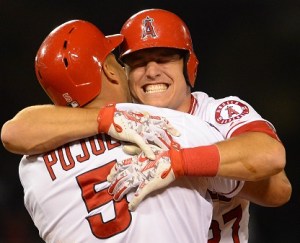
Albert Pujols, Mike Trout

This wasn’t just a celebratory hug after Pujols walked a win off with a sacrifice fly; Albert Pujols made Mike Trout a friend as well as a protege.

When the Angels decided it was time at last to let Albert Pujols go as gently as possible into that good gray baseball night, I wasn’t the only baseball observer to say it was heartbreaking. I’m sure I wasn’t the only one, either, to say his decline following his first Anaheim season was just as heartbreaking.

But I’m still astonished, if not sickened to my stomach, from seeing assorted social media denizens speaking as one such baseball group member did after the Dodgers dropped more than a few jaws by signing Pujols as a bench and very occasional role player for the rest of the season.

“Where are they going to put him? There’s [sic] no [designated hitter] in the NL, and hopefully there never will be one,” said one in particular. “He can afford a rocking chair with all the money he stole from the Angels.”

Stole?

Bad enough the gentleman writing those words clings to one of baseball’s most nebulous and negative traditions. (Pitchers overall have hit .158/.207/.199 from the end of the 1910s until the end of 2020, for a big fat .406 OPS. As of this morning, they’re hitting .102/.136/.137 in 2021, for a whopping .273 OPS.)

But “all that money he stole from the Angels?” Rest assured, this gentleman probably isn’t even close to the only fan who feels that way. He just so happened to put it into cold print,  and I just so happened to catch it in cold print.

What he and anyone else thinking like that is really saying is that a player ground down as Pujols was because of injuries is nothing but a common thief. Well, I heard and saw Yankee fans and observers say similar things about now-retired Jacoby Ellsbury, too. As if they held their teams at gunpoint for x number of seasons.

If you thought Joe and Jane Fan believe losing is practically mortal sin, there are times that seems nothing compared to what they seem to think about being injured on the job.

When the Yankees gave up the ghost and elected to pay Ellsbury the $26 million left on his contract not to play for them any longer, I wondered aloud what it might have done to a man knowing he couldn’t do his job because his body kept him from doing it no matter what his heart and mind desired—and, because it made him a hate object among the witless.

“It’s as if being injured on the job at all equals a character flaw, especially if you happen to be paid a phenomenally handsome salary,” I wrote then. “On the flip side, it’s as if being paid a phenomenally handsome salary equals some sort of immunity to earthly harm. Here’s a bulletin for you: Handing Clark Kent a nine-figure payday doesn’t make him Superman.”

Ellsbury was talented and tenacious (and a two-time World Series champion) when he could play. He wasn’t a Pujols-level talent, but he could and often did break a game open with his own skill set, too. Yet one of the reasons Ellsbury wouldn’t even think about returning to the Red Sox when he hit free agency was because, appropriately, he was fed up over incessant clubhouse whispers that he took too much of his own sweet time recovering from injuries.

“It’s hell if you do and hell if you don’t for a professional athlete,” I wrote then, too. “Return too soon from an injury and you risk re-injury; return not soon enough (in whose sound medical opinion?) and you risk being dismissed as a fragile goldbrick.”

For Joe and Jane Fan, the paradox which is borderline hypocrisy is that they put on pedestals ballplayers who play through injuries regardless of whether that might lead to further injury, as it usually does—but then Joe and Jane Fan become the first to denounce the big jerks for playing through the earlier injuries only to incur bigger and more costly ones.

Pujols’s problems in Anaheim began when he developed plantar fasciitis in one of his heels during spring training 2013. He’d had a first season with the Angels in 2012 that resembled a down season on his terms but a career year for mere mortals.

Then, in late July 2013, he suffered a tear to that bothersome area during a game against the Athletics, while running out a ninth-inning base hit off Grant Balfour. He rehabbed the foot and heel as best he could until the Angels, out of contention by then, shut him down for the rest of that season.

It never got better for him. What nobody outside the Angels clubhouse really knew was that if his feet and legs could drain him, nothing and no one could drain Pujols’s iron will.

“He could easily have shut down a couple of these years. But just the toughness is off the charts,” said Mike Trout to The Athletic‘s Fabian Ardaya in 2019. “A lot of guys would have shut it down for good. He plays banged-up, doesn’t complain. I think that’s what people don’t see.”

“I’ll remember,” said ESPN writer Alden Gonzalez, after the Angels finally designated Pujols for assignment, “that even though his lower half was shot and he wasn’t quick enough to get around on the devastating stuff pitchers throw these days, he still showed up early, still spent hours in the training room to get ready for games, still took batting practice with intent, still crouched really low on defense and still looked for any opportunity to take an extra base. He might not have been productive, but it wasn’t for lack of effort.”

Trout was right. Showing up at the ballpark early and spending hours in the training room despite the physical sappings is what Joe and Jane Fan didn’t see. Maybe they didn’t want to see. Maybe they couldn’t believe the guy who’d played as off the charts as Pujols did as a Cardinal was forced into a far steeper decline phase to his career than he should have been.

Maybe they still clung to the illusion that a nine-figure payday in and of itself could keep a man Superman despite his body turning him into Clark Kent.

In only one way did Pujols have himself to blame for the outside perception that he was just going downhill at warp speed no matter how much money he was paid. He wasn’t the type to lament continuously over his lower body’s continuing betrayals. So much so that, when he finally did speak up about it, in the same 2019 Athletic piece, Joe and Jane Fan didn’t and wouldn’t listen.

“It’s made my move here so tough,” Pujols said to Ardaya then. “I don’t wish that anyone would have had those lower-half injuries, because I know that when I’m healthy, I know what I can do. To come over here and just be pounded by injury after injury, year after year . . . This game is tough when you’re at 100 percent with no injuries. Then imagine dealing with knee, heel, elbow, everything. It’s just tough, man.”

Pujols isn’t the only baseball player who ever kept believing to his soul that all he had to do was return to reasonable health to be what he once was. He isn’t the only player who’s learning the hardest way possible that there comes a time when the badly compromised body married to your age just wouldn’t let you be that anymore.

But not all such players get paid $255 million over ten years, whether they’re future Hall of Famers or future Hall of Shamers.

Nobody held the Angels at gunpoint, either, to offer Pujols that deal in the first place when nobody else was considering it, including the Cardinals (who didn’t until Pujols was practically taking measurements for his Angels uniform), or to keep him on the field when his body was clearly and cruelly draining him faster than a proper decline phase should have done.

Writing in The Inside Game last year, Keith Law came right out and said the Angels were foolish to keep suiting Pujols up even as a designated hitter, despite that iron will, because his body compromised him too deeply.

“If you have already paid for something,” Law wrote, nodding toward the guaranteed deal, “your choice of whether to use it should be a function of whether you want or need to use it, not a function of the money that is already gone regardless of what you do.” Don’t even go there about “eating money” if that’s what the Angels had elected to do. “Major league baseball player contracts are guaranteed,” Law wrote. “[T]here is no way to un-eat that meal.”

It’s one thing to argue against guaranteed long-term baseball contracts in all but the most unique circumstances. It’s something else entirely to argue against one retroactively because the player who signed one got hit unexpectedly with one of the worst injury bugs in baseball history a year after he finished his first season under such a deal.

The clumsiness with which the Angels parted with Pujols speaks only further ill of a team whose administrative culture makes a pratfalling putz resemble Joe DiMaggio roaming center field. The Dodgers’ willingness to bring him aboard even as a part-time bench player, perhaps an occasional first base fill-in, would look a lot better if there wasn’t even the momentary sense that it was a concurrent chance to stick it to their down-freeway rival.

It won’t cost the Dodgers a dollar beyond the pro-rated minimum major league salary to give Pujols one more chance at possible postseason triumph and a possible third World Series ring that the Angels couldn’t. (The Angels’ chronic inability to build a viable pitching staff has harmed them several years; if the Pujols deal tied their hands financially, the Angels haven’t been brilliant at drafting pitching or even acquiring low-cost/high-enough-performance arms, either.)

Personally, I’d hoped Pujols would surrender to his body’s betrayals and call it a career sooner, if only because he wasn’t really Albert Pujols anymore and hadn’t really been for too long through no fault of his own. I wanted him to be as close to Hall of Famer Mike Schmidt as possible, Schmidt having retired in May 1989 because, essentially, he didn’t believe he was Mike Schmidt anymore.

Such Hall of Famers as Willie Mays and Steve Carlton couldn’t do it, either; we saw their baseball ghosts a little too long. Hall of Famer Sandy Koufax did do it when he was still ten dimensions beyond the top of his game: “I don’t regret one minute of the past twelve seasons, but I might regret the season that was one too many.” Even more so than Schmidt, Koufax left the world wanting more, not less.

Whether mere mortal or Hall of Fame immortal, not every player is as self-aware as Koufax and Schmidt. But there’s another kind of self-awareness that imposes a cruelty of its own. It’s the kind Pujols has, the kind that kept him grinding his way back in search of the trans-dimensional greatness he once evoked. The kind that guaranteed him a berth in the Hall of Fame before his body left him nothing but his will.

Knowing what we should know now of that stubborn will no matter what Mother Health and Father Time declared otherwise, we should accept that Pujols earned the chance to leave the field with whatever remains of his professional dignity intact. Maybe he has one more game- or set-changing swing left in him. Maybe he doesn’t.

But calling him the thief who stole all that money from the Angels, however, is way out of line, Joe and Jane Fan. It exposes you as the couple too witless to comprehend just what Pujols put himself through to live up to that contract no matter how often his body told his heart and mind where to shove it.

Tatis and Bauer continue defunding the Fun Police

Fernando Tatis, Jr.; Trevor Bauer

Trevor Bauer (27) wasn’t thrilled about surrendering bombs to Fernando Tatis, Jr.—but Bauer didn’t mind Tatis trolling him over them, either.

If the Dodgers and the Padres are really brewing baseball’s best rivalry since the Dodgers and the Giants, or the Yankees and the Red Sox, you can count on one less Fun Police officer overloading the Tabasco sauce. Turns out that the sense of humour of Trevor Bauer, Dodger pitcher, includes taking his lumps in the troll department.

Padres shortstop Fernando Tatis, Jr. accounted for the only two runs Bauer allowed Friday night with a pair of delicious looking home runs. He hit the first in the top of the first, sending a slightly hanging cutter clean over the left center field fence on the second pitch of the game.

After rounding first, Tatis put his right hand over his eye as he turned around toward the mound, then turned to continue running it out. When he hit the second bomb in the top of the sixth, following a six-pitch, full count wrestling match, Tatis crossed the plate with a move made familiar to UFC fans by Conor McGregor. It just so happens to be the move Bauer himself busts after he has a particularly controlling inning’s work.

By his own admission Bauer missed the hand-over-eye move, which referenced Bauer’s own one-eyed pitching against the Padres during a spring training contest, but he couldn’t help noticing the Padres dugout covering single eyes after Tatis’s second homer landed about three or four rows up the left center field bleachers.

Bauer didn’t mind any of the moves at all. In fact, talking to reporters after the game, which the Dodgers yanked out to win 5-4 despite Tatis’s mayhem, the righthander whose own trolling stones make him as controversial as he is colourful sent a message to every other pitcher on the third stone from the sun who thinks letting the kids play is tantamount to heresy.

“I like it. I think that pitchers who have that done to them and react by throwing at people, or getting upset and hitting people or whatever — I think it’s pretty soft,” Bauer told reporters after the game. “If you give up a homer, the guy should celebrate it. It’s hard to hit in the big leagues. So, I’m all for it. And I think it’s important that the game moves in that direction, and we stop throwing at people because they celebrated having some success on the field.”

Where was Bauer when the Cardinals got soft on Nick Castellanos a couple of days after Castellanos smashed a home run off Jack Flaherty? When Jack Woodford drilled him with a pitch, then bumped him as he crossed the plate beneath a sliding tag attempt, before Castellanos sprung up from his slide, barked a bit at Woodford, then started walking away from the plate area when Yadier Molina returned to the plate area and gave Castellanos a shove by his neck—when Castellanos wasn’t even looking behind him?

Rest assured, Bauer would have had a lecture to deliver Madison Bumgarner two years ago, after Max Muncy launched one of his first-inning services into McCovey Cove. “Don’t watch the ball—run!” Bumgarner barked. Rounding first and heading to second as he ran it out, Muncy by his own admission hollered back, precisely, “If you don’t want me to watch the ball, go get it out of the ocean.”

Perhaps if Bauer was a Dodger then, he’d have been the first to buy the blue T-shirt that hit the ground flying after that, with “Go Get It Out of the Ocean” emblazoned in white, over an upside-down reproduction of the flying baseball that’s part of the Dodgers’ official team logo.

Bauer knows Tatis has reasons enough to celebrate his handiwork lately. Friday night’s flogs came one night after the kid who’s must-see television did what no major leaguer had done before—hit a pair of bombs on the 22nd anniversary date of his father hitting a pair of salamis in the same inning against the same opponent.

Friday night also made Tatis the first player to hit a pair of bombs on back-to-back nights against Cy Young Award-winning pitchers, says the Elias Sports Bureau. On the anniversary of Pop’s pops, Tatis wreaked his two-bomb havoc on Clayton Kershaw’s dollar.

Tatis returned Bauer’s compliment, whether or not he’d actually heard Bauer say it immediately. “Payback time,” the lad told reporters, referencing Bauer’s one-eyed-jack pitching in that spring game.

It’s just fun. When you know you’re facing a guy like that — he’s doing his stuff, he’s having fun on the mound, and when you get him you get him, and you celebrate, too. He’s a hard guy to deal with.

Bauer didn’t even mind when Padres first baseman Eric Hosmer got even in the sixth for what Bauer did in the fourth. Hosmer struck out awkwardly in the fourth and Bauer delivered his pulling-the-sword-out bit, “sword” considered contemporary baseball lingo for the broken swing a hitter often delivers when he’s been fooled like a rookie on a pitch. In the sixth, though, Hosmer nearly drilled a hole in Bauer with a hard liner up the pipe, then pulled a sword of his own out after reaching first.

Once again, Bauer had no intention of ducking into a nearby phone booth and changing from your everyday not-so-mild-mannered pitcher into the Fun Cop ready to clunk all miscreants with his nightstick and drag them off to the hoosegow.

“That’s what it is to be a competitor,” the righthander said. “I’m gonna go at you. I’m gonna get you sometimes, and you’re gonna get me sometimes. We can have fun, we can celebrate it while we’re still competing at the highest level. I just thought that was important to note tonight.”

I’ve been saying for how long that pitchers need to start thinking, “Hey, you got me good this time. Have your fun. I’ll get you out the next time, and I’ll have my fun?” I’m not even close to the only one. There was Sean Doolittle two years ago, when he was still a hard-toiling and popular National. “If a guy hits a home run off me, drops to his knees, pretends the bat is a bazooka, and shoots it out at the sky, I don’t give a shit,” he said emphatically in an interview I cited at the time.

When you’re in the backyard as a kid playing and falling in love with the game and you crush the ball? You do a celebration. You stand and watch it like Ken Griffey, Jr. You don’t hit the ball and put your head down and run as fast as you can. That’s not fun. It’s okay to embrace that part of a game.

To which I wrote, myself, “I hope a lot of hitters drop to one knee and point their bats to the sky like bazookas when they hit one out. I hope a lot of pitchers start channeling their inner Dennis Eckersley and start fanning pistols after they strike someone out. I’d kill to see a hitter moonwalk around the bases after hitting one out. Let’s see more keystone combinations chest bump or make like jugglers after they turn a particularly slick and tough double play.”

The new Murphy’s Law ought to be, “Celebrate!” Said Dale Murphy himself, in one of his first essays as a contributor to The Athletic. It must have sent the Fun Police to the whiskey bottles when Murphy called out Bumgarner over that Muncy waterball:

Admiring a home run is OK. Bat-flipping is OK. Emotion is OK. None of that is a sign of poor sportsmanship or disrespect for an opponent. It’s a celebration of achievement — and doing so should not only be allowed, but encouraged. Pitchers can shout excitedly after an important out. They can pump their fist after a clutch strikeout. Players, fans—and basically any rational-thinking human—will understand that no harm is intended by these spontaneous expressions of joy.

Wouldn’t you love to know what Bauer thought, when the Rangers decided it was right and proper to wait, until near the end of the final game of their final season series against the Blue Jays in May 2016, to repay Jose Bautista for an epic bat flip the previous October?

Bautista hit a monstrous three-run homer in the seventh to give the Jays a 6-3 lead that held up to send them to the previous American League Championship Series. He flipped his bat whirlybird style as he left the plate to run it out. Rogers Centre went nuclear. The Rangers pitcher who surrendered that bomb, Sam Dyson, spoke as a Fun Policeman after the game.

“Jose needs to calm that down, just kind of respect the game a little more,” Dyson said after the game. “He’s a huge role model for the younger generation that’s coming up playing this game, and I mean he’s doing stuff that kids do in Wiffle ball games and backyard baseball. It shouldn’t be done.” (I couldn’t resist rejoining, “That’s how many kids playing Wiffle ball who grow up to hit postseason-advancing skyrockets?”)

Bautista was hit by a pitch late in that mid-May 2016 game. Then, he delivered a hard slide at second to let the Rangers know he didn’t appreciate the too-long-delayed “message.” Then he had to bear the brunt of the followup brickbats when Rougned Odor swung on him. Pretty soft? The Rangers were squishy cowards in tough guy clothing behind Mommy’s dress when Matt Bush—a relief pitcher who wasn’t even a Ranger in October 2015—delivered that seven-months delayed drill.

Bauer has his faults. Misogynistic harassment of women online is known to be one of them. But he’s never been accused of being physically abusive with any woman he’s dated or associated with. The Dyson who demanded Bautista “just kind of respect the game a little more” is the one who got suspended for this season for abusing his former girlfriend.

You can hear the Old Fart Contingent [OFC] who didn’t or don’t play the game fuming about Respect For The Game, too. Most of the same OFC want to see players treat baseball like Serious Business on the field or at the plate or around the bases—but they  become the first to scream, “It’s a [fornicating] game!” when it’s free agency contract time.

Bauer and Tatis have just fired off significant shots in what should be a continuing, baseball-wide campaign to defund the Fun Police. The defunding shouldn’t be limited to players alone.

Jack Smith, RIP: Haircut, shave, and pension throat cut

Jack Smith

Jack Smith, when he was a Dodger following seven years in their minor league system.

One of the last entries by longtime newspaper humourist Lewis Grizzard before his death in 1994 involved a haircut. Specifically, the one he received from “an old-school barber” whom he suddenly recognised as a one-time pitcher he’d seen with the 1960s Atlanta Crackers.

“THAT Jack Smith,” wrote Grizzard. “Hard to believe. There I was getting a haircut from a barber who was also a boyhood idol.”

Smith was a righthanded relief pitcher who’d bounced around the Dodgers system for seven years before he got a call-up in September 1962, when injuries sidelined reliever and former World Series MVP Larry Sherry temporarily. By his own admission, he was a hard thrower no matter what the pitch, but his number one issue was wildness.

He died at 85 on 7 April at the Westbury Health and Rehab facility in Conyers, Georgia, after a battle with Alzheimer’s disease. He was also one of the now 612 short-career major leaguers between 1949-1980 who were frozen out of baseball’s pension plan when the owners and the Major League Baseball Players Association re-aligned the plan in 1980.

That re-alignment changed pension vesting to 43 days major league time and health care vesting to a single day—excluding Smith and other short-career players during the time frame noted above. Their sole redress came by way of the 2011 deal between then-commissioner Bud Selig and then-players union director Michael Weiner: $625 per quarter for every 43 days major league time up to four years worth.

Weiner’s death in 2013 took further chances to get better redress for those players off the table, where the issue still remains, and where today’s players union director Tony Clark seems too little interested in revisiting it.

“Once again, I find it unconscionable and morally repugnant that [the MLBPA] is turning its back on older men and their families,” said A Bitter Cup of Coffee author Douglas J. Gladstone, whose book first exposed the pension freezeout. “I’d love to know if Frances Clark and her three kids, Kiara, Jazzin and Aeneas, know how badly Tony is treating the men who ushered in free agency?”

A year after he won the Southern Association (AA) earned run average title with the Crackers, Smith appeared headed for another such title with Omaha (AAA) when the Dodgers called him up after Sherry’s injury. He appeared in eight games, finished two, saved one, and posted a 2.42 fielding-independent pitching rate that belied his 4.50 ERA.

The lone save was part of the Dodgers’ effort to stay in the pennant race and, in due course, force a playoff with the Giants. Smith relieved Hall of Famer Don Drysdale for the ninth. After walking Cubs second baseman Ken Hubbs and giving up a single to Hall of Famer Ernie Banks, he retired Hall of Famer Billy Williams on a fly out, surrendered a run on pinch hitter Nelson Mathews’s ground force out to shortstop, and shook off a second walk to get George Altman out on a pop foul near third base.

The effort sealed Drysdale’s 24th credited win of 1962, en route his only Cy Young Award, which kicked off a streak of five straight Cy Young Awards (then strictly a major league award) awarded to Los Angeles pitchers: Drysdale, fellow Hall of Famer Sandy Koufax thrice (1963, 1965-66) and Angels righthander Dean Chance (1964).

Smith appeared in the first two of the three 1962 pennant playoff games. In the first game, he got the sixth inning-ending double play after Sherry surrendered back-to-back home runs by Hall of Famers Willie Mays and Orlando Cepeda and pitched a shutout seventh, in a game the Dodgers lost 8-0. (Still struggling for a rhythm after a long layoff due to a finger circulation issue, Koufax himself got hit for a two-run homer by Mays in the first and a solo by Jim Davenport in the second.)

But Smith wasn’t quite so successful in the second game despite the Dodgers’ win. With the Dodgers up 7-5, he took over for Ron Perranoski after back-to-back singles (Davenport and Mays) opened the Giants’ eighth. He surrendered an RBI single to Ed Bailey and lost Cepeda when Frank Howard playing right field misplayed Cepeda’s fly.

Smith yielded to Stan Williams, who walked Felipe Alou and surrendered a sacrifice fly to John Orsino with the run charged to Smith, before getting Jose Pagan to ground out to third and getting the Giants out in order in the ninth. Ron Fairly won the game with a sacrifice fly. (The Giants won the third game and the pennant, 6-4.)

Jack Smith

Smith as a Brave; when they sent him down to the Atlanta Crackers, he decided to trade pitching for barbering after a final baseball season in 1965.

He made the Dodgers out of spring training 1963 and posted his arguable best major league effort on 28 April, against the Cardinals, with 4.1 innings of shutout ball, after the Cardinals jumped Johnny Podres for two in the first and reliever Ken Rowe for five in the second. The Dodgers managed to close the deficit to 7-4 while Smith was in the game; the Cardinals went on to win, 9-5.

After he relieved Pete Richert for the sixth, with the Dodgers in the hole 8-0 to the Pirates, the Pirates tore four runs out of him before he got the side out, a sacrifice fly by Smoky Burgess and a three-run homer by Bob Bailey. It was the last inning Smith pitched in a Dodger uniform; he was sent back to the minors, where the Milwaukee Braves claimed him in the subsequent Rule V draft.

He had a decent 1964 with the Braves, making 22 appearances, finishing nine games, and posting a 3.77 ERA and 3.70 FIP, but the Braves sent him down to the Denver (AAA) in the Pacific Coast League. In 1965, the Braves moved him to the Crackers, who’d moved to the AAA International League and become a Braves affiliate since he’d pitched for them last.

Smith had a solid 1965 in Atlanta (the Braves themselves, of course, moved there for 1966), but he decided he was tired at last of flying around the country playing baseball. He’d gone to barber college in the off-seasons and even brought some of his gear to the Braves clubhouse.

Smith opened an Atlanta barber shop, Smitty’s Bullpen, in a Marriott hotel while with the Crackers his second time. The place was so successful (then-Braves manager Bobby Bragan was a semi-regular customer) he decided to stay with it full time, retiring from baseball after the 1965 season, and finally retiring as a barber in 2016.

Some of those who follow the short-career player pension issue believe one reason they were frozen out was that they were viewed as little more than September call-ups. Smith was one in 1962, but he was on Opening Day rosters with the Dodgers in 1963 and the Braves in 1964.

His major league life didn’t last long enough to be part of the players union’s emergence as a serious force in the game. His career ended before a committee led by Hall of Fame pitchers Robin Roberts and Jim Bunning, plus veteran pitcher Bob Friend and outfielder Harvey Kuenn, led to Marvin Miller’s hiring as their first independent executive director.

Smith wasn’t there to be part of the Players Association pushes and actions that led in due course to Curt Flood’s courageous but failed reserve clause challenge; the bidding war that followed Catfish Hunter’s free agency after Charlie Finley reneged on a contracted-for insurance payment; and, Andy Messersmith’s pitching without signing a 1975 contract, then taking it to arbitration and winning the end of the reserve era, finishing what Flood started.

But Smith and his fellow 1949-80 short-career players weren’t allowed to pass the monies provided by the Selig-Weiner deal of 2011 on to their survivors after their passings. Smith is survived by his wife, Susan, three children, two stepchildren, six grandchildren, and four great-grandchildren. He may not have received grand dollars from the Selig-Weiner deal but they were something, after all. If any remained yet to come, they stopped with his death.

“It’s worth contemplating a reassessment of this,” wrote New York Post columnist Ken Davidoff, in an early February profile of a Smith contemporary, former Yankee reserve outfielder Jack Reed, “because these guys are part of the game’s tapestry and history that make it so special.”

When Hall of Fame manager Casey Stengel skippered the calamitous Original Mets, he once told his barber, “Haircut, shave, and don’t cut my throat, I may want to do that myself.” Smith’s post-baseball success as a barber doesn’t change the fact that he and his fellow short-career pre-1980 players had their throats cut.