Opening Day: Cross it off the bucket list

Shohei Ohtani

Shohei Ohtani, shown on the Angel Stadium video board during his pre-game warmup as the teams lined up on the foul lines, on Opening Day. He pitched brilliantly but in a lost cause, the Angels losing 3-1.

The owners probably won’t stop by to see what I’m about to write, but their otherwise ill-advised 1 December-10 March lockout did me one solid. But only one.

After the World Series, and as soon as they went on sale, I’d bought tickets for what I thought would be the Angels’ home opener. They were scheduled originally to open the season on the road. But commissioner Rob Manfred’s cancellation of the regular season’s first series, in light of the owners’ further goalpost-moving shenanigans, turned the Angels’ home opener into Opening Day, after all.

It wasn’t enough to turn my thinking toward the owners’ side one iota, but it did enable me to cross something off my bucket list. Despite a lifetime of loving the game and watching countless games in the stands and on television, I’d never actually had the chance to be at the ballpark on Opening Day. Until Thursday evening.

The best part of the evening was that I got to do it with my now 28-year-old son, Bryan. The second-best part was being able to cross another item off the baseball bucket list within half an hour of us getting our pre-game food and drink, after putting replica 1972-1990 Angels hats onto our heads.

The Ball

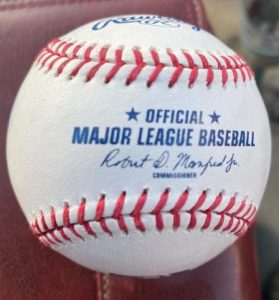
The foul ball, now crossed off my bucket list, sitting atop my notebook, before I handed it to my son.

While the visiting Astros took batting practise, a line drive sailed into our section down the right field line. Adjacent fans made it impossible for me to see just which Astro hit the ball, but the ball bounced around off seats in front of us, then under them, and riocheted off a fan two seats to our right, before rolling on the floor under us to where I could grab the ball before another fan reaching under the seat in front of me did.

I held the ball up to see for myself that I wasn’t seeing or imagining things, then handed it to my son. He’d only been asking to try to catch a ball at Angel Stadium since, oh, the first time I got to take him there—in 2000, when the Angels beat the visiting Yankees one fine evening by prying the winning run out of The Mariano himself. We’d gone to plenty of games since. Thursday night, it was pay dirt at long enough last.

Of course, there was now a game to play, and the Angels lost, 3-1. These are my ten takeaways:

1) Shoh-time! The good news for the Angels was Shohei Ohtani starting on the mound. I’m convinced that what looked to be a lockout-dejected, ho-hum crowd in advance, shot into a near-sellout once Ohtani was announced as the Opening Day pitcher. Lockout after-effect, I suspected: I’d checked the ticketing for the game just prior to the announcement and there were several thousand seats remaining for the taking.

Well, now. The day before I set out for southern California from my home in Las Vegas, I checked the ticketing again. The tickets seemed to have flown off the board once Angel fans knew it would be Shoh-time. And Ohtani didn’t disappoint, much. He pitched four and two-thirds innings of one-run, nine-strikeout, four-hit, one-walk baseball.

The best the Astros could do against him was the third inning, after he caught Martin Maldonado looking at strike three and blew Jose Altuve away with a swinging third strike: Michael Brantley banged a double off the right center field fence and Alex Bregman sent him home promptly with a base hit to left center.

As a matter of fact, when Ohtani wasn’t becoming the first player in Show history to throw his team’s first pitch of the season and make his team’s first plate appearance of the season (the Angels like to bat him leadoff), he manhandled Altuve for three strikeouts on the night, including the nasty slider that shot over Altuve’s hard swing for the third such strikeout in the top of the fiftyh.

2) The bad news: Astros starter Framber Valdez was just as effective in six and two-thirds innings. (The Angels planned to keep their starting pitchers on an 80-pitch limit for the time being, after the lockout-imposed too-short spring training.) He struck six out, walked one, and surrendered two of the Angels’ four hits on the night.

3) The worse news, for the Angels: They came to within inches of taking a 2-1 lead in the seventh. Mike Trout led off by beating out a throw from shortstop that should have been ruled an infield hit but was ruled an error. Then Anthony Rendon hit a high liner that sailed into the left field seats . . . but missed the foul pole on the wrong side by a hair.

“When I saw the ball flying in the air,” Valdez said post-game of his narrow escape, “I got mad with myself that I didn’t make my best pitch. I just took a deep breath and threw my best pitch.” That would be the hard sinkerball on which Rendon promptely dialed Area Code 4-6-3.

Matt Duffy promptly beat out an infield hit to third, which promptly moved Astros manager Dusty Baker to end Valdez’s night and bring Phil Maton in to strike Jo Adell out swinging for the side.

4) Cruising speed: Maton seemed on a bit of a cruise in relief until he hit Brandon Marsh with a pitch with two out in the bottom of the eighth and David Fletcher shot a 1-2 pitch through to the back of left center and gunned it for an RBI triple. That was the Angels’ first and last run of the game, alas.

5) The worse news, for baseball as a whole: That ridiculous three-batter minimum for relief pitchers. Under normal circumstances, if your reliever comes into the game and gets murdered right away—as Angels reliever Ryan Tepera was in the top of the eighth—you’d know he didn’t have it that night, right?

Father and son

Father (right) crossed Opening Day off his bucket list at last—and had the pleasure of doing it with his 28-year-old son.

Oops. Tepera’s first pitch to Alex Bregman sailed into the left field seats. The next Astros batter, Yordan Alvarez, hit a hanging slider on 1-1 over the center field fence. The Angels were lucky to escape with their lives after two prompt deep fly outs (Yuli Gurriel, Kyle Tucker) followed by a sinking liner up the middle (Jeremy Peña) that Trout caught on the dead run in from somewhat deep center to retire the side. (Trout also drew a loud ovation after he turned around and, from half-shallow center, winged the ball to fans halfway up the right center field bleachers.)

6) But there was good news on the relief front. Neither manager burned his relievers in the bullpens. If either Baker or Joe Maddon warmed a pitcher up, he either came into the game as soon as needed or he was handed what amounted to the rest of the night off. No Angels or Astros reliever was called upon to warm up more than once.

I paid as much attention to the relievers in the pen as I could, considering I was seated far opposite the pens behind the left field fence. The Angels used five relievers and the Astros, three. None of those eight pitchers threw any more than maybe 20-25 pitches before they were brought into the game. None of them could be called gassed going in.

Tepera simply didn’t have it Thursday night; Maton got vulnerable after ending one inning and getting two outs to open the next. The rest of the two teams’ bullpen corps (Hector Neris and Ryan Pressly for the Astros; Aaron Loup, Austin Warren, Jose Quijada, and Archie Bradley for the Angels) pitched clean-as-a-hound’s-tooth relief. Would that all major league managers were that judicious handling their pen men.

7) Memo to: Angel fans. Subject: The Wave. The 1980s called. They want their obnoxious, obstructive Wave back. One fan adjacent to our section kept calling for fans to do the Wave. I kept shaking my head, but I did notice that each of about ten attempts at it starting in our part of the park died before flowing to a fourth section of the field-level seats. Maybe there’s hope in such deaths, after all.

8) You were saying? The back-to-back Astro bombs to one side, this game wasn’t exactly the kind to send the old farts screaming to the whiskey shots. The game’s twelve total hits included three Astros doubles, Fletcher’s triple, and six singles. Altuve even stole second in the ninth, for whatever that was worth, since he ended up stranded.

9) Wasted Out Department: Altuve, the Astros’ pint-sized, gallon-hitting second baseman, also dropped a sacrifice bunt to third with one out in the seventh against righthanded reliever Warren, after Chas McCormick opened the inning with a double. Remember: A man on second with one out, and you have less chance of scoring a run after that bunt than you did before the bunt, even if you do exactly what Altuve did pushing McCormick to third.

Just what a man with a lifetime .512 Real Batting Average (total bases + walks + intentional walks + sacrifice flies + hit by pitches, divided by total plate appearances), and a .297 lifetime hitting average with a man on second and one out, is doing thinking sacrifice escapes. With his team leading a mere 1-0 at the time, the Angels brought Quijada in to pitch to Brantley, and Brantley flied out shy of the track in right center for the side.

That’s what a wasted out did. The righthanded-hitting Altuve might have been futile against Ohtani on the night, but he has a lifetime .301 hitting average against righthanded pitchers. The Astros would have had a better chance scoring McCormick if Altuve hit away.

10) When Bregman checked in at the plate in the top of the eighth, the Angel Stadium video boards flashed a graphic with Bregman’s head shot plus this: [He] donated over 200 iPads  w/protective cases and iTunes gift cards to several Houston-area elementary schools that have autistic classrooms. He does that through his Bregman Cares charity, with a particular focus upon autistic children.

It was almost as admirable for the Angels to show Bregman such respectful acknowledgement as it was for Bregman and his wife, Reagan, to take such an interest in lending hands to autistic children. Even if Bregman’s idea of saying thank you for such respect was to smash a leadoff homer in reply.

The Edgy Angels?

Shohei Ohtani, Mike Trout

I’m to a point now where I can speak up a little bit. That’s a new thing for me. I just go out there and play. But I think this team needs it . . . There’s a time and a place. If something needs to be straightened out, I’m going to take care of it. That’s a big step for me. I think that step needs to be taken for this team to win.—Mike Trout.

Ask manager Joe Maddon, as The Athletic‘s Ken Rosenthal has, how long he wants to keep managing, and he’ll smile when he says it even if he’s not kidding. “As long as Mick Jagger performs,” the skipper replies. Well, now.

Maddon’s Angels aren’t exactly the Rolling Stones of baseball, even if the team was created three years before the original Stones lineup cut their first record in England. The Angels have had disasters in their midsts, too, but nobody to the best of anyone’s knowledge has been killed during an Angels game. Yet.

There were times over the years when you might have thought the Angels might have wanted to kill a manager or two, if not each other, but no edition of the Angels was ever as willing to fight each other as the 1972-74 Athletics.

For several years, now, two themes have attached to the Angels: 1) They find everything they need except quality pitching. 2) It might be easier to pass the proverbial camel through the proverbial eye of the proverbial needle than to get the Angels back to the postseason before Mike Trout earns the last dollar on his contract. (In 2030, if you’re scoring at home.)

This is a team that’s had the single greatest player of his and many generations (Baseball Reference lists him as the number five center fielder of all time), a guy who plays a solid center field and whose five top comps as a batter through age 29 are, in descending order, Duke Snider, Willie Mays, Vladimir Guerrero (Sr.), Barry Bonds, and Frank Robinson.

And he hasn’t seen even a sliver of a postseason since his Rookie of the Year 2012, through no fault of his own. Trout exercised maybe baseball’s greatest sense of loyalty when he decided to forego his first entry into the free agency market to sign that $330.1 million contract extension just a sliver over two years ago. Questioning the Angels’ loyalty to him—as in, a team their and baseball’s best all-around player could be proud of—was wholly appropriate.

But Rosenthal now gives the Angels two cheers. Not just because the Angels in this abbreviated spring training look healthy and even happy, but because second-year general manager Perry Minasian has impressed the living daylights out of just about everybody in an Angel uniform, from the manager to Trout to all the way down the roster.

“It starts from the front office, the desire to win, the desire to be better every day,” says one of Minasian’s signature signings, former Mets pitcher Noah Syndergaard, a guy who’s been to the World Series and to two postseasons total. “I see a lot of what I saw in 2015, just the overall grit and badass persona, playing with a chip on our shoulder. It’s been a while since the Angels made the playoffs. This is my first year here. The overall tone is they’re kind of all sick of this s—.”

If anyone has credentials to discuss badass personae, it’s the guy who thought nothing of opening Game Three of the 2015 World Series by dropping Kansas City shortstop Alcides Escobar—who’d gotten a little too comfortable at the plate in the first two games—right onto his seat with the first pitch, before striking him out emphatically. Perhaps coincidentally, it was the only Series game those Mets won in a set during which their then-porous defense blew three other games they could have won.

That was then, this is now. Syndergaard isn’t the only Angels pitcher saying they’re sick of all that you-know-what. “I see a bunch of guys that are hungry, that know the pressure is on us,” says young starting pitcher Patrick Sandoval. “Everyone says the Angels’ rotation is a question mark every single year. The guys like me, Shohei [Ohtani] and [Jaime] Barría, we’ve heard it for three years now. We’re kind of sick of it.”

Minasian also did what was once thought unthinkable, never mind undoable in the recent Angels past. He overhauled the bullpen, $92.75 worth of overhaul, keeping closer Raisel Iglesias (2.83 fielding-independent pitching rate last year) on a four-year deal, and guaranteeing former Met/Ray/Padre/Phillie/Blue Jay Aaron Loup (2.45 FIP last year) plus former White Sox/Cub/Jay Ryan Tepera (2.56 FIP) two years each.

The Angels also think that a healthy Trout and Anthony Rendon married to Ohtani’s bat in the lineup makes them a little more formidable at the plate. They may not be wrong. Especially playing under the new rule that allows Ohtani, the defending American League Most Valuable Player, to stay in a game as the designated hitter when his starting pitching assignment ends for the day. Just as he did in last year’s All-Star Game.

Trout is even doing something a little more overtly now that he did only by example his first ten seasons: leading. What he began when he made himself the team’s public face in the shock of Tyler Skaggs’s death in 2019 he’s continuing more verbally than he ever has in the past.

He spoke often of what Skaggs meant as a person as well as a pitcher. (This was well enough before we learned sadly enough that Skaggs was badly hooked on painkillers, a hooking that may have gone back to his Tommy John surgery and may have been abetted by his own agent urging him to pitch through pain regardless.)

Maybe the most staggering and surreal recent memory for Angel fans was their first home game after Skaggs’s unexpected death. When Trout opened the evening’s proceedings against the Mariners with a mammoth two-run homer in the bottom of the first, launching a combined no-hitter (by Taylor Cole and Felix Pena) and a 13-0 blowout.

“When I first came up, I kind of just went out there and played my game, let my game speak for itself,” Trout admitted to Rosenthal.

I’m to a point now where I can speak up a little bit. That’s a new thing for me. I just go out there and play. But I think this team needs it. I’ve had a lot of talks with the front office and players. There’s a time and a place. If something needs to be straightened out, I’m going to take care of it. That’s a big step for me. I think that step needs to be taken for this team to win.

Trout’s coming-out party as a conscious leader came before this lockout-abbreviated spring training began. When commissioner Rob Manfred announced that first set of canceled games, Trout was distinctly unamused. The guy who did his talking with his bat, his glove, and his personal fan-friendliness fired back.

“I want to play, I love our game, but I know we need to get this [collective bargaining agreement] right,” he tweeted on 2 March. “Instead of bargaining in good faith-MLB locked us out. Instead of negotiating a fair deal-Rob canceled games. Players stand together. For our game, for our fans, and for every player who comes after us.”

Maybe it’s the Angels about to play their first full season since Albert Pujols’s departure last year, but Maddon thinks it’s just a question of Trout having the chance to lead. “He wants to lead,” the manager says. “To me, that means, on a daily basis, when you walk in the building to put everybody else before you. He’s definitely got that in him. He’s very empathetic. He wants to win. He’s willing to share his knowledge. He’s got all the ingredients. He just needed the opportunity.”

And he doesn’t mind pulling others up with him. When Ohtani hogged the headlines last year, after the calf tear put paid to Trout’s season prematurely, Trout enjoyed Shohtime as much as anybody else.

“Shohei’s season was nothing short of electric,” he said when Ohtani won the MVP. “At times, I felt like I was back in Little League. To watch a player throw eight innings, hit a home run, steal a base, and then go play right field was incredible. What impresses me the most about him, though, is the way he carries himself both on and off the field. With so much on his plate daily, he still manages to do it with a smile.”

Imagine that. The Smiling Angels. Whom FanGraphs projects to a seventh-best 82 wins among American League teams. Not so fast, Rosenthal warns:

Projections are largely pointless except as a discussion point, especially in a season when injuries might be more prevalent after a shortened spring training. But the Angels face so many “ifs,” it’s difficult to imagine them being better than the six teams ahead of them — the Blue Jays, Yankees, Astros, Red Sox, White Sox, and Rays. They also might not be better than the Twins and Mariners, the two teams immediately behind them.

I have more than the usual skin in this game. Somehow, I managed to score tickets for what was first the Angels’ mere home opener but, thanks to the owners’ lockout and Commissioner Nero’s first cancellations, is Opening Day, period, at Angel Stadium. Ohtani is already announced as their starting pitcher. My 28-year-old son and myself will be seated in our standard perch down the right field line.

We’ll look for two things at minimum: 1) Whether there will remain Angel fans willing to hammer the visiting Astros with inflatable trash can bangings and other signs, shouts, and sneers over Astrogate. 2) Whether these Smiling Angels, these Edgy Angels, these Fed Up With All That You-Know-What Angels, show just how fed up they are at the plate and in the field through those edgy new smiles.

Being an Angel fan has been many things in the decades since they were born in the American League’s first expansion. Dull hasn’t been one of them, though being dulled–if not sent to their nineteenth nervous breakdowns—has been something else entirely. And living on that 2002 World Series triumph got tiresome well before they wrapped their silks around a big fish named Trout.

The deeper issue at play in the Kay trial

Matt Harvey

Harvey admitting on the witness stand that he did coke as a Met shouldn’t be bigger than Harvey suggesting too many players still feel desperate to return to action despite not being recovered fully from injuries.

The Eric Kay trial—in which the former Angels communications director faces up to twenty years in prison on drug charges if convicted, stemming from the unexpected overdose death of pitcher Tyler Skaggs in 2019—seemed the sleeper of the week. Until it suddenly wasn’t, after sworn testimony from one-time Angels pitcher Matt Harvey.

Harvey, once a star in New York but still trying to rebuild a career compromised less by his once-notorious night life than by the aftermath of thoracic outlet syndrome surgery. Harvey, once the Dark Knight, but since struggling to find any semblance of the form that once made him what his old rotation mate Jacob deGrom has become.

You had to strain yourself, though, to hear anyone discussing what ESPN writer T.J. Quinn  tweeted Tuesday morning from the trial. “[Matt] Harvey is describing culture of MLB,” Quinn wrote, “guys desperate to stay on field and play through injuries.”

That was about as cryptic as a sledgehammer blow. Harvey wasn’t exactly revealing classified information he’d formerly flushed down the nearest precious-metal commode, either.

But for every one who got what Quinn described him saying during his testimony, there were probably a few hundred more interested in Harvey copping to doing coke as a Met and how many Angels were getting and gulping assorted painkillers from Kay directly or by way of others.

Joe and Jane Fan would rather just dump on the druggies than admit a big reason they get their meathooks on assorted painkillers and other naughty pills and powders in the first place is that too many team medical staffs—even today, even with everything we know about sports injuries that wasn’t known or ignored for generations preceding—could still be tried by jury for medical malpractise.

The Twitterpated are more titillated that the former Dark Knight had a few too many off-field nights partying than that he, too, felt all but forced to perform despite his body’s inner warnings. The talk about the “drug culture” on those Angels (and don’t think it doesn’t exist on other teams) seemed to override talk about the pressures placed upon the injured to get back onto the mound or onto the field like yesterday—no matter how fully they’ve recovered from their injuries.

Harvey wasn’t the only one of Skaggs’s teammates looking for pain relief. Pitcher Mike Morin, an Angel from 2014-2017 now with the Marlins, testified he sought Kay’s help after Skaggs mentioned Kay as someone who could provide painkillers like oxycodone to help Morin, too, deal with what turned out thoracic outlet syndrome. Former Angels relief pitcher Cam Bedrosian (now with the Phillies) and first baseman C.J. Cron (now with the Rockies) also said they got painkillers from Kay.

Harvey also copped to giving Skaggs one Percocet. Why? He thought he was doing his teammate in pain a favour and wanted to be a good teammate. That may still be enough to get him suspended under baseball’s drug policy. Now a free agent, after an up-and-down 2021 that ended almost a month early due to a knee injury, Harvey may have a harder time catching on when the current lockout ends.

In case you forgot or didn’t know in the first place, Skaggs himself had an injury history. He underwent Tommy John surgery after returning to the Angels in a trade from Arizona and starting eighteen games in 2014. Missing all 2015 recovering and rehabbing, he subsquently incurred oblique, adductor, and ankle injuries. And it’s not impossible that he was given something powerful enough coming out of TJ surgery to hook him.

When the Texas coroner’s report revealed fentanyl may have caused Skaggs’s accidental overdose death, USA Today columnist Bob Nightengale wrote of him as a young man in pain.

“Perhaps more physical than even the doctors and trainers knew,” he wrote. “Maybe more mental than even any team therapist knew. It will be a bigger tragedy if we never understand why. Prescription painkillers are a scourge in this country, and professional sports—with catastrophic injuries and the expectation to play through the pain they cause—are ripe for potential abuse.”

It’s not just a particular contingent among current players talking these things, on a witness stand or elsewhere. Hall of Famer Pedro Martinez is talking about those pressures, too. His freshly-published memoir, Pedro, includes a portion where Martinez says that, as a Met, then-chief operating officer Jeff Wilpon forced him to pitch despite a toe injury that affected either his push off the rubber or his landing as he threw—in September 2005, despite the Mets being out of the pennant race.

Before Joe and Jane Fan start barking ohhhhhh, he was forced to earn his keep when his itty bitty toesy hurt, they should try to remember Dizzy Dean. That Hall of Fame pitcher once forced himself to alter his delivery to compensate, after suffering a broken toe courtesy of an Earl Averill batted ball in the 1936 All-Star Game. Dean ruined his shoulder with the new motion, turning the second half of his career from Hall of Fame great to nothing special.

Maybe if Dean had been allowed to recover completely from the toe fracture it would have been a different story? “I was unable to pivot my left foot because my toe hurt too much,” the ever-locquacious Dean was quoted as saying, “with the result I was pitchin’ entirely with my arm and puttin’ all the pressure on it and I felt a soreness in the ol’ flipper right away. I shouldn’ta been out there.”

When the 1969 Cubs burned out and faded down the stretch as the Miracle Mets heated up to take the National League East en route their championship series sweep of the Braves and World Series conquest of the Orioles in five games, it turned out that manager Leo Durocher cowed too many of his players into not disclosing injuries for fear he’d denounce them—in the press as well as in clubhouse reamings—as quitters.

Now retired, Jacoby Ellsbury was oft injured even in his Red Sox years . . . and accused of malingering when he tried his best not to return prematurely. After shining in his contract walk-year during the Red Sox’s 2013 World Series conquest, Ellsbury signed big with the Yankees—and ran into the injury bug again.

And again. And again. Knee injuries, concussions, hip injuries, setbacks rehabbing. Joe and Jane Fan wrote him off as a waste of Yankeebucks. Some even called him a quitter, never mind that his injuries came from playing the game as hard as he could with what he had.

Was it Ellsbury’s fault he’d been injuried on the job, in honest competition? Maybe we should wonder that, so far as anyone knows, Ellsbury didn’t seek the kind of extracurricular pain relief others have, clearly enough.

Skaggs’s death at 27 “shines a harsh spotlight on the dark underbelly of playing professional sports,” writes FanSided‘s Gabrielle Starr. “Many players feel forced to go to extremes to be able to compete, and we’re now witnessing the worst possible outcome of that desperation.”

What is it with the Angels’ organisational culture that compelled several players including Skaggs to seek extracurricular pain relief? Were they, too, being pushed beyond reasonable expectation to come back from injuries? Do you really think they’re the only team who’d be guilty of that?

Could those Angels have been pushed unreasonably compared to the team’s Hall of Famer-in-waiting Mike Trout, who’s been injured often enough but was never pressured improperly so far as anyone knows to return before he was healed completely? As in were the Angels’ administrators sending the message Trout himself would never send, that, well, he’s Mike Trout and . . . you’re not?

Don’t dismiss the Kay trial as just another sports drug trial. It’s easy to denounce the druggies. It’s a lot harder to remember that a lot more of them than we might have thought went there not for kicks but for genuine pain relief. It didn’t have to take the death of a still-young major league pitcher, whose death provoked game-wide grief, to mean those issues might finally be addressed with the seriousness they deserve.

Unless you’re diffident or soulless, it makes you stop to ponder that maybe we shouldn’t be too swift to worship the players or teams who “grit” or “gut” or “grind” it out through various injuries of all dimensions. (The 2019 Yankees, the Broken Bombers, using 53 different players and sending thirty to the injured list that season, come to mind as a recent example.)

Maybe, instead, we should question the sanity lost when they push themselves or are pushed to play injured—with the reward now barely worth what might be lost to their futures. Think about that before you denounce the injured as gutless, heartless, useless quitters. Again.

What Syndergaard wanted most

Noah Syndergaard

Met fans won’t forget Noah Syndergaard dropping Alcides Escobar to open Game Three of the 2015 World Series. Now the talented but oft-injured Syndergaard will be an Angel because the Mets’ administration slept at the switch after making his qualifying offer.

Go ahead and cling to the surface look if that’s your preference. Cling to the Mets showing Noah Syndergaard a qualifying offer and Syndergaard electing instead to let the Angels seduce him for a couple of million dollars more for next year, if it makes you happy. Cling to the narrative that Syndergaard’s heart with the Mets could be bought, if you must.

But now you must ask yourself concurrently just why it was that Syndergaard’s Mets heart was abandoned while the Angels swept in and swept him off their feet. Your answer is no further than New York Post writer Joel Sherman, who says the Angels had a plan for the power-pitching righthander coming back from Tommy John surgery—and the Mets apparently lacked one.

Oh, sure, the Mets plan to win if they can help it. But that’s it. When they tendered Syndergaard his qualifying offer, that was it, too. They had no general manager at that moment. They had no manager. They still don’t. They’ve got a pitching coach, Jeremy Hefner.

But nobody in the Mets’ organisation talked much of anything yet about how they were going to shepherd a starting pitching staff going forward. They didn’t talk about how they were going to manage Syndergaard’s work load during his first full season back after Tommy John surgery, recovery, and rehab.

Enter Angels general manager Perry Minasian. He knew Syndergaard wanted a deal and the physicals done before today’s qualifying-offer deadline, just in case the physicals didn’t wash, leaving Syndergaard a Mets fallback after all. He also knew what Syndergaard wanted beyond a solid-enough, prove-it-year’s deal.

Syndergaard wanted a plan. Minasian high tailed it to New York to present him one. “[F]or the best organizations these days preparing pitchers physically, for the season and for each game, is a collective effort across multiple departments,” Sherman writes.

There were efforts in the first year under [Steve] Cohen’s ownership to bulk up these areas, but [the Mets] still pale in comparison to clubs such as the Dodgers, Giants and Blue Jays, among many others.

Minasian . . . came to New York armed with details on, among other things, how his club would have him pitch to individual players on each team in the AL West. He spoke of the success the Angels enjoyed last year with a six-man rotation, which helped get Shohei Ohtani through a season of hitting and pitching healthy. Minasian said the plan would stay the same and showed Syndergaard how pitching in a six-man rotation would give more time for recovery and lower his overall inning total when all he had in 2020-21 in the majors was two one-inning stints to close out the past season. Minasian brought data to show what the Angels liked about his delivery and pitch mix and how to make them even more effective.

In other words, Minasian caught the Mets sound asleep at the Syndergaard switch. While the Mets just slid a qualifying offer under the righthander’s nose with nothing substantial behind it to show him anything resembling love or respect, the Angels’ GM—who goes back with Syndergaard to the Blue Jays, having been part of their drafting team when they first picked him—brought all three. Love, respect, and substance.

Minasian also brought it with the most aggressive and committed push among several contenders for Syndergaard’s prove-it season, including the world champion Braves, the Red Sox, and the Jays.

Sherman notes that the Angels weren’t exactly thrilled about having to lose a draft pick for signing Syndergaard, but they were less thrilled than that about the prices in the free agency starters’ store—and starting with a Syndergaard whom Minasian knew well enough would give them decent odds in the upside department before pondering another starter or two on that market

The Angels’ seduction, Sherman writes, mattered as greatly as the Mets’ apparent lack of it: “Syndergaard is going to pitch at 29 this year. He recognizes how vital it is that he performs well to set himself up to re-enter the market next year at 30 to try to score a lucrative, long-term pact. And here were the Mets not even talking to him throughout this process. Here they were without an infrastructure in place. Here they were unable to provide a detailed plan to him beyond the big picture that Cohen wants to win now.”

The Mets hired former Angels GM Billy Eppler—Minasian’s immediate predecessor—as Syndergaard’s deal with the Angels came forth. This can be called crossing one end of the street without bothering to see who’s coming down the block from the other end. This can also be called too little, too late. This can be called, further, that’s still so Mets.

Leaving Mets fans with memories of a stout, tenacious pitcher who could be lights out when healthy and who gave them one whale of a performance in the 2015 World Series: Syndergaard dropping plate-crowding, plate-overcomfortable Royals shortstop Alcides Escobar to open Game Three, the only game in the Series that the Mets’ then-porous defense couldn’t cost them.

God knows the Angels themselves need a starting pitching overhaul—again. If a year’s worth of Syndergaard at minimum helps it begin, the deal will have been worth it. If Minasian’s plan for him works well enough, the Angels might think of extending Syndergaard or Syndergaard will have a solid market when he hits free agency next winter.

If losing Syndergaard now means a swift enough kick to the Mets’ posterior on behalf of shaking them further out of their funk before and after any possible lockout, it might be worth it, too. Eppler’s hiring to the contrary, with these Mets that’s a glandular if.

Will Eppler get to run the Mets unimpeded?

Billy Eppler, Mike Trout

Then-Angels GM Billy Eppler—seen with Mike Trout, whom he signed to a glandular Angel-for-life extension in 2019—now gets to run the Mets without a contradictorily heavy hand above and undermining him.

The good news (yes, it’s good news) is that the Mets finally have a new general manager. The bad news is that an awful lot of people may be shaking their heads and lamenting, “They put on that crazy hunt to end up with this?”

Billy Eppler wasn’t exactly a resounding success when he held the same job with the Angels from 2015-2020. Not overall, anyway. In isolated moments he looked like a budding genius. In the big picture, he looked like another one of Angels owner Arte Moreno’s designated fall guys.

The budding genius side: Eppler did the heavy lifting when it came to making Mike Trout an Angel for life and for making Shohei Ohtani an Angel at all after his Japanese splash. He secured the game’s best all-around position player and his three American League MVPs and landed this year’s two-way sensation who just might shake out as this year’s AL MVP.

The fall guy side: Moreno’s contradictory penchant for splash signings, low enough budgets otherwise, and moves he pushed out of sheer fury after failures to strike  designated targets. Moreno is a lot more like Eppler’s one-time boss George Steinbrenner’s bad side than Angel fans often dare admit outright.

Before Met fans continue shrugging their shoulders and lamenting that this, too, is so Mets, ponder if you will that when the Angels hired Eppler in the first place—after he’d spent copious time as Brian Cashman’s assistant with the Yankees after running their scouting system a few years—Eppler went in with an arm and a half tied behind his back before he could make his first phone call.

Perhaps insanely, Moreno gutted just about his entire scouting system. He made international scouting director Clay Daniels pay with his head after some of Daniels’s subordinates were caught skimming signing bonuses. He pinked his overall scouting chief Eddie Bane over a series of bad drafts and free agency signings, even if one of Bane’s last solid moves was pressing the Angels to sign a kid named Trout in the first place.

Several of Eppler’s moves blew up through no fault of his own. Zack Cozart struggled as a new Angel in 2018 before a torn labrum killed the second half of that season and neck and further shoulder surgery killed much of his 2019 before he was traded away and ultimately retired.

Eppler made a number of reclamation-project free agency signings that failed miserably enough, as in former Met Matt Harvey plus Cody Allen, Trevor Cahill, Tim Lincecum, and Julio Teheran. With the best intentions Eppler looked foolish for those deals, just as he would for extending outfielder Justin Upton.

But Upton points to Eppler’s better side as well. Left to half by Moreno’s big-sign/low-budget-otherwise style, Eppler did what he could with whatever he was left to work with, and it wasn’t exactly his fault that his penchant for sharp trading and a sharp waiver-wire eye was made to look foolish by subsequent events.

Trading for Upton in the first place looked smart at first—before the extension and before the unanticipated injuries that have throttled Upton since 2019. Eppler also made several trades that made useful Angels out of Dylan Bundy (pitcher), Tommy La Stella (middle infield), Andrelton Simmons (shortstop), Felix Pena (pitcher), Patrick Sandoval (pitcher), and Max Stassi (catcher), for short whiles, anyway.

Eppler was also deft enough to land Brian Goodwin, Blake Parker, Noe Ramirez, and Hansel Robles off the waiver wire, getting some success from the group before they, too, petered away.

None of those moves translated into postseason trips for the Angels, of course, but you can look closely at just about all of them and discover the issues and baggage of most of those players didn’t arise until well after they arrived in Anaheim. But just as a manager takes the fall for “underachieving” or “shortfalling” teams, GMs take the fall when their moves turn out disastrous even through no fault of their own.

Essentially, the Mets played that postseason song-and-dance GM hunt to end up with a guy who’s been in and out of the reputed New York incinerator. (Remember Sandy Alderson saying it was just that overwhelming Apple heat that kept the Mets from bringing the best and the brightest aboard?) A guy who may not be cuffed and stuffed by a contradictory owner with a reputation for hard meddling.

It couldn’t have come at a stranger time. This may be so Mets—the former Angels GM taking the Mets’ helm as one of their key pitchers signs with the Angels. All Noah Syndergaard had to do—following his recovery/rehab from Tommy John surgery—was show a little enough of his classic Thor form in a pair of token gigs at season’s end, plus reject a Mets’ qualifying offer after the season, and the Angels take a flyer on his recovered self for a one-year, $21 million deal . . . pending physicals.

So Eppler gets to go to work right away redressing the Mets’ pitching depth issues. With all-world ace Jacob deGrom a question mark until he actually gets back on the mound next year, and their most reliable non-deGrom starter Marcus Stroman now a free agent, the Mets’ starting corps isn’t exactly a finalised 2022 product just yet.

Eppler will also have to step into the Mets’ efforts to convince middle infielder Javier Baez to keep his defensive virtuosity and reviving bat in Queens next to his keystone partner Francisco Lindor. He’ll have to start pondering moves to fortify their outfield. He’ll also have to think swiftly enough before any possibility that, with the current collective bargaining agreement due to expire and the owners threatening a lockout, the game shuts down for enough of a winter chunk.

But you can almost picture Eppler looking back upon his Angels tenure, then looking out now from his new perch with the Mets, and thinking to himself, “Jeez, I thought it was going to be impossible!” He may yet think that, compared to where he was, he’s in the next best thing to a professional jacuzzi now. May.