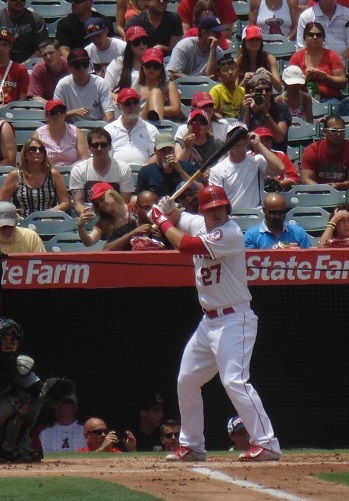
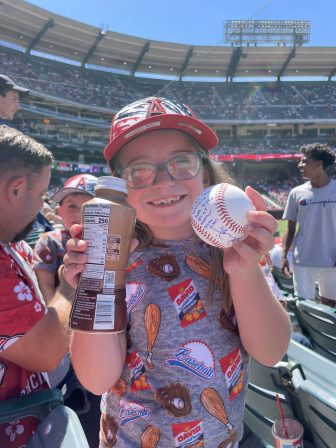
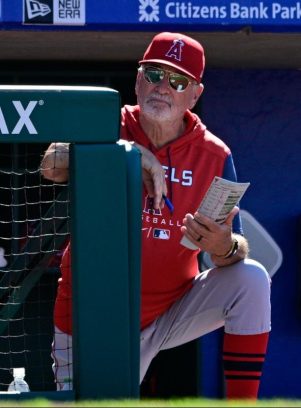
Hey, Joe, where you goin’ with your head in your hands?

Joe Maddon

The Angels’ lack of true depth wasn’t Maddon’s fault, but . . .

Let’s see. The Phillies dumped manager Joe Girardi last Friday morning. They went on a prompt five-game winning streak under interim Rob Thomson that began with three straight against the Angels. The Angels went from there to a 1-0 loss against the resurgent (we think) Red Sox and padded their losing streak to twelve.

It meant the Angels becoming the first team in Show history to go from ten games above .500 at 27-17 to a twelve-game losing streak. It also meant manager Joe Maddon, in the final year of a three-year deal, didn’t live long enough to finish the third year beyond which the Angels hadn’t even begun talking extension or new deal.

That’s what two straight sub-.500 season finishes plus the incumbent morass does even to a three-time Manager of the Year. The Angels executed Maddon Tuesday. Third base coach Phil Nevin, formerly a twelve-year corner infielder who spent one season as an Angel before becoming a longtime coach, was handed the job on an interim basis.

“Maddon appeared to have few answers” to the Angels’ sudden twelve-game cratering after such a staggering season’s start, writes The Athletic‘s Andy McCullough.

He praised the effort of his group, though his praise grew fainter in the wake of so many defeats. Maddon never found the footing he held in prior stops in Tampa Bay and Chicago. He was hailed as a pioneer with the Rays and adored for ending a curse with the Cubs. With the Angels, though, he was just another ineffective skipper unable to get a team with Mike Trout and Shohei Ohtani into the postseason. It wasn’t really his fault; the team lacked pitching depth and has been hurt by injuries. Even so, he wasn’t able to stop the skid, so the team stopped relying on him. It might not make a difference. It still shouldn’t come as a shock.

Once serving long-term as Mike Scioscia’s bench coach with the Angels, Maddon says he’d like to manage again. He won’t lack for those taking a deep look at the Angels and concluding he’s become the sacrificial lamb for a continuing failure above and beyond even still-freshman general manager Perry Minasian. Another Athletic writer, Marc Carig, has isolated the point:

Stop me if you’ve heard this before: what about the owner’s role in all of this? Arte Moreno has spent a ton of money on the big league roster in an effort to make his team a contender. That’s awesome. It’s what all of the owners should be doing. But Moreno has yet to find the right formula for building a winning culture . . . Front office turnover and, now, the firing of manager Joe Maddon shows that Moreno doesn’t seem to be any closer to building a sustainable winner. All managers know that being fired is part of the deal. This remains true even though skippers no longer occupy the same lofty perches that they once did within organizations. In this case, the Angels dismissed a manager with a World Series championship on his résumé in addition to a lengthy history with the organization. But all that experience wasn’t going to negate a dearth of arms and a banged up roster. Those issues could have only been overcome with depth, and that kind of thing falls outside of a modern manager’s purview.

There may also have been an increasing sense that Maddon was prone humanly enough to egregious mistakes but bent over in prayer at once hoping his players would bail him out. He got away with it the day he walked Corey Seager of the Rangers with the bases loaded and the Angels down; his Angels overcame a wider deficit to win at the eleventh hour. He still looked foolish for doing so.

More than all that: Maddon may have written his own execution order before last winter’s owners’ lockout ended, according to ESPN’s Buster Olney: The Angels’ administration had an idea on how to keep Trout healthier, and Maddon—whether inadvertently or carelessly—killed the idea in the proverbial crib.

The Angels wanted to talk Trout into moving from his longtime center field roost to one of the less-demanding corner outfield positions. They planned to talk to him about it once the lockout ended. The idea made sense. Trout’s past three seasons have been injury marred or injury-ended, and though he’s been a better than plus defender in center field (55 defensive runs above his league average) in his twelve-season career, those injuries have taken their toll. He’s also played 124 games in left field during his career and he’s been worth seven defensive run above league average for them.

The bad news, Olney writes: “Maddon changed the trajectory—telling reporters about it before anyone in the organization said anything to Trout. When Trout balked at the suggestion—he learned about it on Twitter, he said—that possibility was scrapped for 2022 out of respect for Trout, a future Hall of Famer.” If Trout heard it from the team first, the story might be different.

Did the Angels—who already declined to talk contract extension with Maddon—decide the manager simply couldn’t be trusted any longer to know how to mind his players’ health? Did they decide he couldn’t be trusted to keep certain key decisions from leaking before they’d had the chance to present them to the affected parties? Did they decide both? Will it mean Maddon may not get another chance to manage again too soon?

The injuries weren’t Maddon’s doing, of course. Neither was the lack of pitching depth, the Angels’ most constant and wounding flaw for just about as long as Trout’s been an Angel. But if the organisation came to see Maddon as even a tiny degree untrustworthy coming into the season, seeing him looking lost for ways to help the team snap that losing streak probably sealed the un-deal.

Nevin was the Yankees’ third base coach until after last fall’s American League wild card game. He took an inferno of heat for sending Aaron Judge on his way home, trying to score a tying run all the way from first on a ball that banged off the top of Boston’s Green Monster. Nevin misjudged a strong throw in to Red Sox cutoff man Xander Bogaerts, who fired a strike home so perfectly the diving Judge was out by two feet.

The Yankees ended up going home for the winter very early. Nevin ended up with a pink slip and a not too slow hiring to do the same job for the Angels. Now’s he’s the manager. Minasian says Nevin will hold the bridge for the rest of the season.

Tuesday night, Nevin watched his new Angels charges take a game to the tenth inning after blowing lead in the seventh inning or later for the sixth time during their now thirteen-game losing streak, a franchise record.

Trout continued coming out of his horrid slump and opened the night’s proceedings with a first-inning, two-run homer, but then had to leave with left groin tightness after he doubled in the third. The morning after, Trout said he felt something like a cramp leaving the batter’s box on the double but “a little achy” when he pulled up to second.

He came out for pinch runner Jo Adell, who came home on Max Stassi’s ground rule double to snap an early three-all tie, then doubled Luis Rengifo home to make it 5-3, Angels in the fifth. But the Red Sox made it 5-4 with a sixth-inning RBI single and tied it with an RBI infield hit—Trevor Story’s grounder bounding off Angel reliever Ryan Tepera’s glove—in the seventh. Making the sixth time in a now thirteen-game losing streak that the Angels let a lead disappear in the seventh or after.

Christian Vásquez sent what proved the winning run home when he drove tenth-inning-opening free cookie-on-second runner Story home with a single through the hole at second, and the Angels had nothing to say in the bottom of the tenth against Red Sox reliever Matt Strahm.

Trout and Shohei Ohtani said the morning after it was up to the players to re-horse themselves. Nevin said after the 6-5 loss that whatever else went wrong for the Angels during the franchise-record losing streak, morale wasn’t part of it. “I’m not worried about morale at all,” the new skipper told reporters. “You saw the effort from everyone. We had good at-bats. I thought there was a lot of great things. It was just a game where we ended up on the wrong side.”

From 27-17 after beating the Rangers on 24 May to 27-30 as of Wednesday morning, the Angels can’t afford to continue staying on the wrong side. It’s helped cost them one skipper this season already.

Bo knew, almost too late

Bo Belinsky

Bo Belinsky delivering during the 1962 rookie no-hitter that accelerated his Hollywood lifestyle.

The easiest supposition to make in the wake of still-rookie lefthander Reid Detmers’s no-hitter this past Tuesday is that the Angels hope he doesn’t go the way of the lefthanded rookie who pitched the franchise’s and southern California’s first major league no-hitter at age 25. They’re separated by a mere sixty years and five days.

The Angels pray Detmers is separated from Bo Belinsky by a lot more than time.

So far, Detmers seems the polar opposite of the fellow who preceded him all those decades ago. He seems grounded well and aware of himself, lacking the taste for the demimonde, the thirst for the high life (in more ways than one), the self-destruction that sank the Angels’ first no-hit pitcher.

“In short, within days after his no-hitter, Belinsky, a former pool hustler from Trenton, N.J., would be heralded as sport’s most original and engaging playboy-athlete,” wrote pitcher-turned-writer Pat Jordan, in a 1972 Sports Illustrated profile

His name would become synonymous with a lifestyle that was cool and slick and dazzling, one that was to be a trademark of those athletes who appeared later in the ’60s—Joe Namath, Ken Harrelson, Derek Sanderson. But, in time, the name Belinsky would mean something else. It would become synonymous with dissipated talent.

Belinsky became an Angel in the first place because the team picked him during the 1961-62 minor league draft; he’d been in the Oriole system for several years, showing on-and-off promise on the mound, before making a splash pitching winter ball in Venezuela, where he developed a nasty screwball to match his riding fastball.

“When Bo was on,” said his Angels catcher Buck Rodgers, “he had that electric kind of stuff.” In more ways than one. A Belinsky biographer, Maury Allen, recorded (in 1973’s Bo: Pitching and Wooing), recorded that the first thing Belinsky said to Rodgers, accepting congratulations for that 5 May 1962 no-hitter, “Hey, look at the blonde with the big tits!”

Belinsky began the game by striking out former longtime Reds second baseman Johnny Temple and future World Series-winning manager Dick Williams in order before getting future Hall of Fame third baseman Brooks Robinson to ground out on a ball deflected by Belinsky to Angels second baseman Billy Moran.

He ended it by striking out flaky Orioles outfielder Jackie Brandt, luring catcher Gus Triandos into a ground out to shortstop Joe Koppe, and getting right fielder Dave Nicholson to pop out to third baseman Felix Torres. When the game ended, Belinsky’s ERA stood at a sparkling 1.53 with a respectable 3.47 fielding-independent pitching rate.

Reporter: Bo, when did you start thinking about a no-hitter?

Belinsky: This morning at about five o’clock.

It was nothing compared to the sparkling that became Belinsky’s off-field lifestyle. As girl crazy as the night was long already, Belinsky’s date book now came to include such as Tina Louise, Ann-Margret, Juliet Prowse, Connie Stevens, and Mamie Van Doren, the fifth of whom became his fiancee for a spell. Hollywood embraced the street kid from New Jersey who’d made his way hustling pool before becoming a minor league pitcher.

Belinsky was as quick with a quip as he was with a wink and with bringing his roommate and fellow rookie Angels pitcher Dean Chance, an Ohio farm kid, along for the ride. He even got himself name-checked by then-popular song parodist Allan Sherman, on Sherman’s landmark 1962 album, Allan Sherman’s Mother Presents My Son, the Folk Singer.

The lefthander with the wicked screwball and the personality to match returned the embraces with a curious balance between enthusiasm and alienation. For the rest of 1962, Belinsky cavorted between the bright lights and beds of Hollywood and back-and-forth success on the mound; he finished that season with a 3.56 ERA/4.06 FIP, while the second-year Angels surprised observers by making pennant race noises.

He struggled enough in 1963 to be sent to the Angels’ Triple-A farm in Hawaii, posted a splended 2.53 ERA/3.14 FIP, and returned to finish a dismal major league season. Hawaii, though, proved a Belinsky haven. His engagement to Van Doren ended but he seemed inordinately happy there. His return to the Angels wasn’t successful at first but he seemed to have a new balance.

Dean Chance, Mamie Van Doren, Bo Belinsky

Belinsky (right) and Mamie Van Doren (center) on the town with Belinsky’s Angels teammate and best friend Dean Chance (left). “I’m returning his engagement ring,” Van Doren was quoted as saying after their engagement ended. “I’m afraid if I don’t, he’ll cut my finger off and take it—or worse, make me take over the payments.”

“Belinsky had fashioned a persona as both bon vivant and rapscallion,” Steve Oney would write in Los Angeles in 2005. “He possessed the brio of a Dean Martin, yet he also bore the antiestablishmentarian markings of a Jack Kerouac. In him, the lounge lizard and the free spirit commingled.”

In 1964 he rediscovered his better pitching side, too. He stood with a 2.86 ERA/3.25 FIP after a tough 11 August loss to the Indians . . . and after an interview he had no idea would change his career and his life irrevocably. Frustrated by the loss and the Angels’ faltering, Belinsky at 27 told wire service reporter Charlie Maher he was thinking seriously about leaving the game.

According to most who remembered the story, Maher wrote it up somewhat sympathetically, indicating as best he could that Belinsky’s thoughts were nothing more than out of frustration over a spell of solid pitching gone little-to-no reward. When the Angels landed in Washington after a long cross country flight, Belinsky learned the hard way that he wasn’t the only frustrated one.

Los Angeles Times writer/editor Braven Dyer, who wasn’t exactly a Belinsky admirer as it was, was furious over the Maher story. He demanded Belinsky give him a story about whether he was going to quit. He even went to Belinsky’s room at around 3 a.m., possibly drunk, to pursue it further. The confrontation ended with Dyer on his can after Belinsky flattened him with a punch.

The Angels suspended him at once. Belinsky’s celebrity back in Los Angeles seemed to heighten at first, but then when the offseason came the club traded him to the Phillies for first baseman Costen Shockley and pitcher Rudy May. After Phillies manager Gene Mauch—who actually coveted him—couldn’t convince him to abandon the screwball and lean on his fastball, he exiled Belinsky to the bullpen. Fatal mistake.

Bo Belinsky, Bud Furillo

Belinsky and Los Angeles Times writer Bud Furillo look at the headline announcing his trade to the Phillies after the ill-fated 1964 season.

The ’65 Phillies pen was riddled with the red juice amphetamine variant and Belinsky got hooked. Unadaptable to the regimen of long relief and spot starting as it was, Belinsky was sent back to the minors in early 1966. His career dissipated further (despite some minor league successes, including another no-hitter pitching for Hawaii), but the amphetamine addiction would stay along with his taste for alcohol.

Belinsky’s star dissipated likewise. He married Playboy‘s 1965 Playmate of the Year, Jo Collins but the marriage eventually ended in divorce. His final major league hurrah was a trio of relief appearances for the 1970 Reds after he’d worked hard to make the team out of spring training. Sent back to the minors yet again, Belinsky called it a career.

Two years earlier, turning 30 during a turn with the Astros, Belinsky observed, “It’s no fun knowing that in every home in America your birthday is celebrated as a day of infamy.” Jordan would remember the remark well enough when profiling Belinsky in 1972:

[T]he remark was telling. It was characteristically cute. It seemed to have been delivered more for its effect than its truth by a man more concerned with style than substance. It was tossed off, discarded really, with that ironic smile of disavowal—as if it were nothing but the surplus from a warehouse of such remarks, remarks he must unload whenever he felt the occasion deserved not truth but wit. Yet the annoying suspicion remained that Belinsky felt the remark contained more truth than wit. Whether this feeling was nothing more than the overblown self-pity of a too shallow man or the heightened perception of a too sensitive man was not clear. It was certain only that Belinsky had dissipated a promising career, that people had grown tired of him, and that most of his difficulty could be traced to his personality. He did not have the knack of later athletes—the Namaths, Harrelsons and Sandersons—of cultivating his personality precisely up to, but not beyond, that point at which the public becomes bored with it.

He eventually sobered up for keeps, especially after his second marriage (to lumber/paper products heiress Janie Weyerhaeuser) collapsed, and went to work helping other alcoholics and addicts sober up, including his former Angels teammate, pitcher Eli Grba. “Bo and I had never been that close,” Grba told Oney. “He was too Hollywood. But he came and got me and took me to an AA meeting. I was nervous, but Bo said, ‘Don’t worry, Eli, they’re all drunks just like you and me’.”

After a third failed, brief marriage, and continuing estrangement from the three children (one with Collins, two with Weyerhaeuser) his marriages produced, Belinsky finally ended his wandering ways to match his hard-won sobriety. By the 1990s he’d relocated to Las Vegas, where he worked in public relations for a pair of automotive dealership groups and became a born-again Christian involved deeply with Trinity Life Church.

That might have been the last thing his old Hollywood crowd would have predicted. “Can you imagine?” he said, almost typically, “I had to come to Las Vegas to find Jesus Christ.”

Bo Belinsky

Clean, sober, born-again, and looking a little wiser in Las Vegas.

Belinsky even reconciled to the Angels, appearing at Old-Timers Day events at the team’s invitation, his place in their early history secured at last. In due course, he would say of the Dyer incident that ended his Angels days and his days as a toast of Hollywood, “I screwed myself out of a job with the Angels.”

More than that, a son born out of wedlock in 1963 met and got to know him pleasantly after Belinsky settled in Las Vegas. Don Carroll not only resembles a less-dissipated version of his father but he even named his own son Beau, after the man he finally met and liked and understood.

Too much, too little, too late. Belinsky died at 64 in 2001. Almost a full year before the Angels won their only World Series to date.

“Bo was a one-of-a-kind guy and there won’t be another one like him,” said Dean Chance at a Dodger Stadium memorial he arranged for his old friend, fourteen years before his own death of heart failure. “He was full of cancer, his heart was bad and his hip was hurting him terribly at the end. He had slipped and fallen and it was really tough on him. But he made his peace with the Lord and he is probably better off today than he was last week. He’s not suffering terribly any more.”

“Nobody could ever figure me out,” Belinsky said years after his baseball career dissipated.

I wouldn’t show what was really inside me, inside Bo Belinsky I was just a facade I’d carried along all my life . . . I was born apart. My mother was Jewish, my father Polish Catholic. To Jews I was a Polack. To Poles I was a kike. I was removed—removed from people in my family, people in my school. Even in my youth, I didn’t know where to park myself.

By the time he could and did show enough of his real self, heart failure claimed him after he’d already been battling bladder cancer and diabetes, the net result of a baseball youth that brought him to the stratosphere but crashed him even more profoundly long before. In Las Vegas, Belinsky found a home, a purpose, and salvation at last.

Sixty years separate Angel no-hit rookies

Reid Detmers

Reid Detmers pumps a fist after finishing his no-hitter Tuesday night.

Justin Verlander is a 39-year-old Hall of Famer in waiting by general consensus, but he merely flirted with a fourth career no-hitter in his 460th major league start Tuesday night. Reid Detmers is a 22-year-old rookie who landed his first and his Angels’ twelfth no-hitter later in the evening during his eleventh career major league start.

The Illinois lad who’s a product of the University of Louisville isn’t Verlander’s kind of strikeout machine. But on a night when Verlander’s flirtation featured five strikeouts but was ruined by Gio Urshela’s one-out base hit, Detmers struck out a measly two taking it all the way to Yandy Diaz’s game-ending ground out to shortstop.

Verlander got help enough from his Astro friends hanging five runs on the board against the Twins before his evening ended after eight. Detmers got almost as much help from his Angel friends against the Rays as Taylor Cole and Felix Pena got almost three years ago when they combined for a no-hitter against the Mariners.

As if a good luck charm, Angels pitcher/designated hitter Shohei Ohtani was presented his hardware from 2021 before the game (including his Most Valuable Player award), and on Shohei Ohtani Bobblehead Night in the bargain. (He pitched in at the plate with a 2-for-5 night while he was at it.)

Then, the Angels blew the Rays out 12-0 Tuesday night while Detmers put his defense to the bulk of the work keeping the Rays hitless. Before the Angels’ first home game following pitcher Tyler Skaggs’s tragic death, they commemorated Skaggs’s memory. Then Cole and Pena enjoyed working in the warm jacuzzi of a 13-0 blowout at the Mariners’ expense.

In that game, Mike Trout merely opened the proceedings with a hefty two-run homer in the bottom of the first before going forth to account for almost half the Angels’ scoring on that night. Come Tuesday night, the future Hall of Famer smashed a pair of homers in the second and the eighth, and yanked himself back into the major league slugging, OPS, OPS+, and total bases leads.

While the Rays had nothing much to say against Detmers’s array of off-speed services, the Angels scored two in the first (a run-scoring ground out, an RBI single), then three in the second. (RBI double, sacrifice fly, and Trout’s first bomb.) Their abuse of Rays starter Corey Kluber continued in the third when Chad Wallach hit a three-run bomb into the bullpens in left.

And all stayed mostly quiet except for a few defensive gems that saved Detmers along the way, until Trout checked in with one out and Andrew Velasquez aboard off a leadoff single, squared up Rays reliever Brett Phillips’s first service, and drove it well over the center field fence. Ohtani followed immediately with a double down the rear of the right field line, before Anthony Rendon—often injured, but still a force when healthy—sent a 1-0 pitch into the same neighbourhood to where Trout’s smash traveled.

Oops. Did I mention Phillips is normally a Rays outfielder—and the man whose base hit set up the insane game-winning runs on a pair of Dodger errors in Game Four of the 2020 World Series—who was sent to the mound to take one for the team in that inning?

Kluber’s evening ended after three full. Sad. Especially since he threw a no-hitter of his own almost a year ago. The Rays sent four bona-fide relievers out to keep the Angels scoreless over four more innings’ work before manager Kevin Cash decided his bullpen needed a break with only an eight-run deficit. Apparently, Cash didn’t think his hitters could stage a Metsian eight-run comeback at the eleventh hour.

So with Trout due up as the third hitter of the inning, and Ohtani and Rendon right behind him in the Angel order, Cash chose Phillips to be the sacrificial lamb. Maybe Cash figured that, on a night a rookie lefthander kept his batters befuddled enough, the better part of valour might have been to bite the bullets. It turned out to be hard swallows upon two howitzer shells.

Detmers took the third-highest career ERA into a no-hitter since they started keeping earned runs as an official statistic in 2013, according to the Elias Sports Bureau. If the lefthander’s as decent a young man as he’s been portrayed, he’ll make damn sure to let it be known that his teammates did far more to achieve the no-hitter than he actually did.

A no-hitter with only two pitching strikeouts doesn’t look that dazzling in the box scores. And as it turned out Detmers got a lot of help from his friends on both sides—eighteen hits at the plate, then fourteen fly outs and eleven ground outs including the one that some cynics are going to say was a seventh-inning gift handed the rook on a plate.

Before Phillips went to the mound to serve those eighth-inning Angel gifts, he grounded one to the right side of Angels first baseman Jared Walsh who played him back and well enough off the line. Walsh reached for the ball on the move, seemed to have it, then it fell out of his mitt. Walsh overstepped the ball still moving right before he grabbed it and, with Detmers hustling to cover the pad, saw he had no chance to get the swift Phillips.

Everyone in Angel Stadium expected the tough enough play to be ruled an infield hit. Walsh admitted post-game he prayed for the ruling otherwise. “I literally knew. Everybody knew,” he told reporters. “I was just like, ‘Hell yeah, give me that error baby’.” Which is exactly what official scorer Mel Franks did.

Detmers did keep the Rays out of their comfort zone with his repertoire of off-speed breaking balls and expecially his well-regarded changeup, which he threw a career-high 24 times Tuesday night. But he threw 25 things the Rays hit that managed to find Angel gloves. He got eleven ground outs and fourteen fly outs. Giving Detmers exactly seven percent of the direct responsibility for the Rays going hitless Tuesday night. Well.

Bo Belinsky

Bo Belinsky—sixty years and five days earlier, he was an Angel rookie pitching the franchise’s first no-hitter.

Five out of 57 no-hitters prior to Detmers included the pitcher in question striking out five or less. The last one to do it with two strikeouts was Francisco Liriano in 2011. And there’s at least one perfect game on record with the pitcher striking out only two—David Palmer (Montreal Expos) in 1984.

Detmers can say at least that he did a little to help his own no-hit cause Tuesday night. He didn’t make his teammates do all the work getting all the outs the way Earl Hamilton (1912), Sam Jones (1923), and Ken Holtzman (1969) did. And he pitched his no-no sixty years plus six days after the first no-no in Angels history, Bo Belinsky’s notorious no-no against the Orioles in 1962.

That lefthander’s game was a nine-strikeout, four-walk affair that left him with a season-opening 1.53 ERA over his first four starts—and 33 percent direct responsibility for his gem. Except for a 1964 to come in which he had a 2.86 ERA, before an overnight brawl with Los Angeles sportswriter Braven Dyer (who triggered it with a drunken verbal assault at the pitcher’s hotel room in Washington) ended his Angels days, Belinsky would never again pitch that successfully.

He was a street kid from New Jersey who’d bounced around the Oriole system several years (speedball legend Steve Dalkowski was once a teammate) before the Angels lifted him in a minor-leaguers’ draft. He proved to have too much taste for the Hollywood demimonde, too little regard for his own talent, too much vodka, and (especially after a spell in the 1965-66 Phillies’ bullpen) too many amphetamines, before three failed marriages and desperation drove him to hard-fought sobriety and Christianity later in life.

When Belinsky retired Dave Nicholson on a pop out to third to finish his rookie no-hitter, as he eventually admitted in his inimitable way, his first words to catcher Bob Rodgers were, “Hey, look at the blonde with the big tits!” The first question he faced from reporters after the game was, “When did you start thinking about a no-hitter?” Belinsky’s answer: “This morning at about five o’clock.” Wink-wink, nudge-nudge.

Detmers seems too grounded to even think about spiraling into the Belinsky style. “There are times that it hasn’t really sunk in that he’s in the major leagues,” his mother, Erin, told a reporter. “Because he’s still our son. He’s only 22. It just seems so surreal. But it’s real.”

He’s known to only look relaxed before a start while pondering his game plan for the day. “It’s just something I’ve dreamed of ever since I was a little kid,” said post-game. “I didn’t think it’d ever happen. I don’t even know. I probably won’t even remember this tomorrow.” For this Angels rookie, it won’t be for the sort of reasons his Angels rookie ancestor from 1962 might have forgotten a few details, either.

Smarts in Houston, suicide in Cleveland

Shohei Ohtani

Ohtani took perfection into the sixth, where a bunt couldn’t do what a subsequent base hit did . . .

Shohei Ohtani didn’t just flirt with perfection Wednesday, he almost seduced it. A twelve-punchout performance on the mound; a two-run double to finish the first-inning carnage against Astros starter Jake Odorizzi; a perfect game broken with one out in the seventh. And his Angels in sole possession of the American League West’s penthouse. For now.

But right before Astros catcher Jason Castro fisted a base hit over second base into short center with one out in the Houston sixth, their own second baseman Niko Goodrum tried to break the would-be perfecto in a manner that usually brings the wrath of the Sacred Unwritten Rules chauvinists down upon the miscreant. On 0-1 leading the inning off, Goodrum tried to bunt an Ohtani slider up the third base line.

This time, the chauvinists didn’t rain acid down upon Goodrum. For one thing, the Angels put an overshift on against the lefthanded-hitting Goodrum. Just why the Angels thought a .133/.133/.200 slash line on the season to date required an overshift escapes for the moment.

But Goodrum did exactly the right thing receiving so much free, delicious real estate upon which to hit. His team down six, and knowing he wouldn’t be wasting an out with a bunt, Goodrum did absolutely nothing wrong sizing the scenario up and dropping a bunt toward that free territory—except the ball bounding over the chalk into foul territory halfway up the third base line.

Which was the spot to where Angels third baseman Anthony Rendon ran from his positioning adjacent to second base and grabbed the ball just in case, with Ohtani also bounding over from the mound. Back on the mound, Ohtani and Goodrum wrestled to a 2-2 count before Goodrum swung and missed at a nasty curve ball hitting the outer edge of the zone.

Maybe if Goodrum had pushed a successful bunt up the line and landed on first base practically on the house, the SUR chauvinists would have gone nuclear. Maybe. It’s become a little more acceptable according to the SURs to drop a bunt if the other guys are silly enough to think an overshift is a good way to keep a batter below the proverbial Mendoza Line from breaking it up the old fashioned way.

Come to think of it, Ohtani himself put on a demonstration of one of the only other times it’s wise to bunt—if you think you can get a base hit out of it without a full shift against you. With one out and nobody on in the Angels’ sixth, against Astros reliever Cristian Javier, the lefthanded-hitting Ohtani faced a slight overshift, slight enough to move Astros third baseman Alex Bregman to a more standard shortstop positioning but still leaving him room to move if he wanted to drop one.

On 1-2 Ohtani chopped a beauty toward the third base side of the mound and blasted out of the box. Javier pounced as best he could but he threw a rising sailer over and past the upstretched mitt of leaping Astros first baseman Yuli Gurriel. It was an exercise in futility, considering Ohtani would have beaten a cleaner throw by about a step on the play, and considering the Angels stranded him on first for the inning.

Goodrum and Javier have a teammate who understands, ahem, perfectly about perfecto-breaking bunts. Justin Verlander had it happen to him, while still pitching for the Tigers on 21 June 2017. He took a perfect game bid against the Mariners into the sixth, with the Tigers up 4-0 to that point.

With one out, Seattle’s swift center fielder Jarrod Dyson squared, bunted one between the mound and first base, and ran himself into a base hit. Unlike Goodrum’s attempt Wednesday, Dyson’s successful bunt that day kicked off a three-run Mariners inning that pushed Verlander out of the game. It also preceded a four-run Mariners seventh at the expenses of Tigers relievers Shane Greene and Alex Wilson.

That was the part that roiled Verlander far more than any perfecto-breaking bunt ever could. “It was a perfect bunt,” Verlander said of Dyson. “That’s part of his game. I don’t think it was quite too late in the game given the situation to bunt, especially being how it’s a major part of what he does. So I didn’t really have any issues with it. It wasn’t like I got upset about it.”

Goodrum played smart baseball, even if his bunt bid bounded foul before he finally struck out swinging. Even if the Angels finished what they started, a 6-0 shutout to take two of three from the Astros in Houston after losing three of four at Angel Stadium to open the season. At least neither manager, Dusty Baker (Astros) nor Joe Maddon (Angels), fell asleep at the proverbial switch Wednesday.

Dallas Keuchel

. . . but Keuchel looks to be praying for mercy amidst an unconscionable nine-run second/ten-run total beating before he was lifted too little/too late.

That dishonour belonged to White Sox manager Tony La Russa in Cleveland earlier in the day, in the first game of a doubleheader. Despite a well-enough rested bullpen thanks to a week-opening pair of rainouts, a pen that hadn’t exactly been overworked in a preceding set against the Rays, either, La Russa inexplicably left his veteran starter Dallas Keuchel in to take an early ten-run beating on a day Keuchel’s stuff didn’t exist from the outset.

Keuchel had enough trouble trying to shake off a first inning during which a pair of White Sox defensive miscues helped cost him a run before he surrendered a hit. He never got out of the second alive: a leadoff throwing error; four straight singles two of which pushed runs home with the bases loaded; a grand slam; three straight singles more, a wild pitch advancing the first of those Guardians to second and the third sending another run home; a run-scoring ground ball turned into another White Sox error; and yet another RBI single.

Finally, La Russa got Keuchel out of there and brought in Tanner Banks. He got a prompt step-and-throw double play at first and a ground out right back to the box for the side.

Joe and Jane Fan can bleat all they want, as one or two I saw aboard social media did, that sometimes you just have to take one for the team, sometimes you just have to try to  “save” your bullpen even if it means getting murdered, and it’s just one April loss against a long season to come, and the goal is to win two of three, innit?

“I’m 100% certain LaRussa knew Keuchel didn’t have it,” said one such fan, in fact. “Sometimes the decision to leave guys in or take them out is more about 162 games than 1 game. As is the case here. He was hoping Keuchel could survive that inning and make it thru an inning or two more.”

A Hall of Fame manager, even coming out of retirement for one more turn, knows he should be thinking of every game until or unless his team is eliminated mathematically from a pennant race. He should know well enough when his starter doesn’t have it. Knowing that, and knowing he had a reasonably rested bullpen, just how does a conscientious manager not get that poor starter the hell out of there before the game goes from a small leak to a flood?

Keuchel came into the game throwing little more than meatballs and matzo balls as it was, before Jose Ramirez—the Guardians third baseman flush with a yummy new contract extension—stood in in that second inning with the bases loaded, three Guard runs in, nobody out yet, and sent a hanging 1-1 cutter over the left field fence.

If La Russa “knew” Keuchel didn’t have it before that, it shouldn’t have been allowed to go there in the first place. Especially if he was going to go to Banks to clean up the mess. Banks hadn’t pitched since the previous Sunday. He also hadn’t surrendered an earned run in his three previous relief gigs. And what did he do when La Russa brought him in?

After getting that step-and-throw double play to end the second inning before the Guards could have made the case against their human rights violations any worse, Banks threw three more hitless, shutout innings, before Matt Foster and Anderson Severino finished with only one further Guards run to come—when Steven Kwan singled Myles Straw home off Severino in the ninth.

There was a time when La Russa would never have let a game get that far out of hand that soon if his starter didn’t have it going in. That’s part of how La Russa became a Hall of Fame manager with three World Series rings in the first place. “The manager didn’t get them ready to play,” La Russa said of his team after that blowout loss, and before the White Sox lost the nightcap, 2-1. “I take the heat for that.”

Lucky for him and them that there is still a long season to play yet.

“I felt like there was an angel by my side tonight”

Noah Syndergaard

The mighty Thor didn’t have to strike ’em out to get ’em out and help shut ’em out Saturday night.

About the only correct observation out of the Angels’ 2-0 shutout of the Astros Saturday night was this, about the starting duel between two returning Tommy John surgery patients, Noah Syndergaard (Angels) and Justin Verlander (Astros): it was a matchup of returning former aces. Vintage, it was not.

But it didn’t have to be. Especially so far as the Angels were concerned. “He’s just a strike thrower,” said Angels manager Joe Maddon of his new pitching toy. “The changeup is outstanding, and the slider, he’s willing to pitch inside . . . He was totally in command of everything that he’s doing out there.”

“It was fun to play behind him,” said Mike Trout, who accounted for the second Angels run with a mammoth late game home run. “He gets on the mound, throws strikes. He tries to get back in the dugout as quick as he can. You saw that tonight. He’s just out there grinding.”

Syndergaard entered the game with a lifetime 4.63 strikeout to walk ratio and 9.7 strikeout-per-nine rate. Verlander entered with a lifetime 2.33 strikeout-to-walk rate and a 12.6 strikeout-per-nine rate. Now, have a gander at their Saturday night special.

The former Met known as Thor struck nobody out, surrendered two hits and issued two walks, and lived mostly on the ground, with eleven grounders among the sixteen outs he got in five and a third innings’ work. Verlander struck seven out (including designated-hitting Shohei Ohtani thrice), walked three, and surrendered three hits while getting an even number of grounders and flies.

“It’s a long road, man,” Verlander said postgame. “Lots of nervousness and anxiousness leading up to it. Felt like my debut. Got some things to work on, but coming out of it feeling pretty good.”

One problem was Verlander feeding Angels first baseman Jared Walsh a fat enough fastball to open the bottom of the second and Walsh hitting it over the right center field fence. Another was no Astro except Kyle Tucker (in the top of the second, a single) and Chas McCormick (top of the third, single) hitting anything that didn’t find an Angel glove, though a third (Aledmys Diaz) reached on a throwing error opening the top of the seventh.

A third, for the Astros, anyway, was Trout serving notice that he’d had it with the slump that marked his first two games and the Astros demolition that accompanied it. The Astros had battered Angels pitching for eight home runs in those games. But while their contact wasn’t hard Saturday night, Trout’s was.

He smoked a fly out to the rear end of Angel Stadium in the first, a hard ground out to second in the fourth, a hard line out to center stranding two runners ending the fifth, and then—as if to prove practise makes perfect—he turned on a 1-2 fastball a little low and a little away, from Astros reliever Ryne Stanek, and yanked it off the rocks behind the left center field fence, 445 feet from the plate, in the eighth.

“Trout’s gonna get you,” observed Astros manager Dusty Baker postgame. After a 2021 ruined early enough by a torn calf muscle, and an owner-lockout-imposed short spring training this time around, one that included a short illness toward its end, Trout found a dramatic way to shake away his season-opening rust.

So did the Angels’ bullpen. Ryan Tepera entered Opening Night by surrendering prompt, back-to-back homers to Alex Bregman and Yordan Alvarez, but on Saturday night he got five straight outs in relief of reliever Aaron Loup—who’d gotten three in relief of Syndergaard but was hapless to prevent Diaz reaching aboard third baseman Anthony Rendon’s off-line throw. And designated closer Raisel Iglesias used only eight pitches to retire the Astros in order to finish it.

The bulls also struck four Astros out, three more punchouts in their 3.2 innings’ work than Syndergaard in 5.1.

Syndergaard had other things on his mind to accompany his manhandling of the Astros’ formidable lineup. Wearing the same number 34 he’d worn as a Met, the number had particularly sober significance for his new team.

No Angel had worn the number since 22-year-old pitcher Nick Adenhart, thirteen years to the day before—when Adenhart was killed by a drunk driver celebrating his successful Angels debut. The Angels didn’t retire 34 officially, but no player sought that number since, just as no Angel since the death of pitcher Tyler Skaggs almost three years ago has asked for Skaggs’s number 45.

By most accounts, Syndergaard asked the team to wear the 34 he’s worn all his life, after signing a one-year, $22 million deal with the Angels, and he was only too well aware of what Adenhart’s death meant to the franchise and its fans. “I felt like there was an angel by my side tonight,” Syndergaard said postgame. “That was really special to me.”

As athletes, I feel like our number—to the everyday person, it’s just kind of a number—but to us, it’s part of our identity. Growing up, my number was 34 because I was a huge fan of Nolan Ryan. But now it kind of means something a little bit different to me. I want to use that to lift up his name.

If Syndergaard continues lifting his team the way he did Saturday night, there could be more than a few angels on the Angels’ shoulders over the long, arduous season yet to come.