Two Bs and a Tuck

Alex Bregman

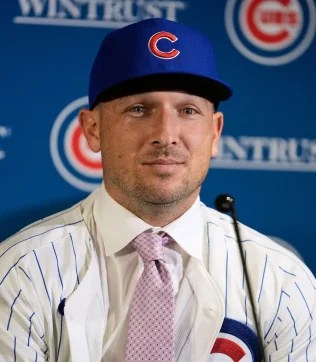
“There’s an excitement in the air about Cubs baseball,” said their new $175 million third baseman Alex Bregman after signing with the team last week.

What a week, right? Just like that, three of the more luminous members of this winter’s free agency class found new homes for varying dollars.

The usual suspects scream blue murder. A few unusual suspects pick up Dodger manager Dave Roberts’s expressed equal adoration for a salary cap and a salary floor. So, who’s coming out how, where, and why? Let’s look with sober eyes.

Da Bear Market Dept.—Think about it: On the same evening the NFL’s Chicago Bears shoved the Green Bay Packers to one side and out of the race for the Super Bowl, in Soldier Field, the Cubs made erstwhile Astro/Red Sox third baseman Alex Bregman a rather wealthy man.

With the Red Sox thought to be pushing a bit extra to bring Bregman back, the Cubs pushed enough to land Bregman on a five-year, $175 million that includes a mutually agreed-upon $70 million worth of deferred money.

You think Bregman’s new teammates weren’t enthused about the deal and their new mate? “I texted him when the news broke: ‘Dude, let’s freaking go’,” said pitcher Jameson Taillon, an Arizona neighbour of Bregman’s according to The Athletic. “He FaceTimed me. He was like, ‘Hey, we’re just finishing up dinner. Can I come over?’”

He wasn’t alone, wrote the journal’s Patrick Mooney: “Pete Crow-Armstrong, the All-Star center fielder, was in attendance at Soldier Field when he found out that Bregman would be a new teammate. Immediately after seeing the reports, Gold Glove shortstop Dansby Swanson called Bregman from a friend’s wedding.”

The Cubs made a run for the postseason last year. After a few years behaving like the big city kid who seemed to be seduced by the outskirts of Four Corners, Nowhere in Particular, they started behaving like the bigger market team they’re supposed to be once the postseason run ended.

“There’s an excitement in the air about Cubs baseball,” said Bregman while he made a bit of a whirl-around Chicago tour last week. “I can’t wait to get after it.” Pause. “After it” means “pennant race” and “World Series trip” for a man who now picked uniform number 3 to indicate he’d like a third World Series ring as well as stability for his family.

He’s known as a student of the game, a disciplined hitter, a sharp-fielding third baseman, and a clubhouse godsend. All Bregman has to do is live up to all that as best a 31-year-old with more than a few miles on him can, as he did when his body allowed in Boston last year. Da Cubs will make sure his appreciation is far, wide, and deep.

Tucker, the Man and His Team Dept.—Meanwhile, an erstwhile Cub lit the fuse on fresh screaming over the big, bad, behemoth Dodgers and their big, bad, behemoth platinum vault. The erstwhile Cub is Kyle Tucker, considered the number one free agent in the winter class by those who thought Bregman was the class’s second banana.

Tucker signed up for four years, $240 million, and opt-outs after years two and three. The deal also includes $30 million in deferred dollars. If Tucker helps the Dodgers to a third straight World Series title, Dodger City will consider it all very wisely spent. If he doesn’t or can’t, well . . .

That screaming won’t be limited to denunciations of the Dodgers as the new Evil Empire. It’ll include audible-in-the-Klingon-Empire demands for explanations as to why a no-doubt talent but with 27.3 wins above replacement-level in eight season is pulling down $17 million a year more than Aaron Judge, Yankee bombardier first class, who earned about 3.0 more WAR just over three of the past four years.

The Dodgers are betting on Tucker’s future coming somewhere near Judge’s present, of course. Aside from the dollars, the Dodgers could offer something far deeper to the low-keyed Tucker. He can do Tucker things without the floodlights baking him too heavily compared to the rest of the Dodgers’ star power.

He might have been the star of this free agency market, when Bregman and Bo Bichette weren’t, but that’s about as far as Tucker seems to care to go when it comes to attracting attention with anything beyond his still-growing bat and his virtuosity playing right field.

What’s Bo Know Dept.—Bo Bichette is a Met. Roll the rhyme around awhile, Metsropolitan New York. Savour the possibilities to come with a healthy Bichette helping the Mets ride all the way to a postseason. (Remember: He came off the injured list to be one of the shining time Blue Jays in last year’s World Series.)

Now, be afraid. Be very afraid. Because the Mets plan for their new $126 million infield toy is to move him from his normal shortstop to third base. Every Met fan since the day they were born will warn you. The Mets don’t have a sterling history of third base conversions. (Mets legend David Wright was born to the position, you may remember.)

Ask what happened when they traded a talented but still-erratic arm named Nolan Ryan to the Angels for a veteran elite shortstop named Jim Fregosi . . . and decided to turn that veteran elite shortstop into a third baseman. Case closed.

Bichette can hit. The only population that doesn’t know that might be a colony of Arctic walruses. But with the glove? He’s 36 defensive zone runs below his league average as a shortstop, and his range factors per game are below the average, too. He played a little second base in the minors but not a lick of third base in the Show.

The Mets turned toward Bichette more seriously (they’d been talking previously) when Tucker went California bound the night before. The Phillies saw the Mets embrace Bichette and elected to reunite with veteran catcher J.T. Realmuto after all.

Now all the Mets have to do is get a read on whether Bichette will be the second coming of poor Jim Fregosi or the first coming of Bo Bichette, third base maven. Not to mention whether Brett Baty, the incumbent third base Met, will have a reasonable future moving to the corner outfield, as some reports speculate.

Well, the Mets have been many things over the decades. Boring has rarely been one of them.

We’re in for one hell of a World Series ride

J.T. Realmuto

Realmuto’s leadoff launch in the top of the tenth held up for the Phillies to win opening this World Series. But he almost didn’t make it that far . . .

Listen up, you sore-losing Met, Dodger, and Yankee fans. At least, those among you who think that there’s nothing more worth watching until hot stove season since your heroes (anti-heroes?) got pushed, shoved, and slugged out of the postseason.

Yours aren’t the only heroes (anti-heroes?) who got turned aside. So you can just boil yourselves alive in your harrumphing that the World Series means nothing to you. Because if Game One was any indication, the rest of us—including this Met fan since the day they were born—are in for one hell of a Series ride.

For those of us who put aside our personal rooting disappointments and watched, we got to see a script flipped Friday night.

We went in knowing that assorted polls pretty much sketched the Phillies as America’s team this time around. We also went in knowing numerous oddsmakings sketched the Astros as liable to grind the brave little Philsies into hamburger, one way or the other.

But we came away from the Phillies’s 6-5 Game One upending knowing we’d seen a dogfight turned strategic bombing turned bullfight all in the space of ten must-see innings. And, with just a few little shruggings un-shrugged along the way.

Until Phillies catcher J.T. Realmuto hit an opposite-field home run leading off the top of the tenth, and Phillies reliever David Robertson shook off a one-out double and a two-out walk to make it stick, that is. And that’s when it might have hit, good and hard:

The ogres of the American League might have swept their way here in the first place, but they’re not exactly impenetrable or invincible. Last year’s Braves sure proved it, but some things need proving all over again. Come Friday night, the Phillies finally proved it. But it did take a little early survival to do so.

Astros right fielder Kyle Tucker got to within about a foot above several fans of pulling Realmuto’s drive back for what would have been a jaw-dropping out. He leaped, reached back, extended, everything short of a net springing from his gloves’ fingertips, but the ball eluded his reach by about a full visible foot.

“Honestly, I thought I got enough of it, but I kind of had flashbacks of the play that Tucker made on (Aaron) Judge’s ball [in the American League Championship Series],” Realmuto said postgame. “And once I saw him running back to the wall, I was thinking in my head, oh, please just don’t catch it, just don’t catch it. I knew it was going to be close.”

Nobody going in expected Game One itself to be that close.

I mean, admit it. Didn’t we think it was all but game over when Tucker took it upon himself to provide four-fifths of the Astros’ early scoring, staking future Hall of Famer Justin Verlander to a 5-0 lead after three innings?

Didn’t we think the Phillies might be a little demoralised after Aaron Nola—who’d pitched six and two-thirds perfect innings against the Astros to pull the Phillies towards their postseason berth clinch in the first place—got thumped by Tucker’s solo bomb halfway up the lower right field seats in the second and, when the game was still a manageable 2-0 Astro lead an inning later, his three-run blast a little further up those seatxs in the third?

Sure we did. We thought that, no matter how strong and deep would be the bullpen bulls for whom Phillies manager Rob Thomson would reach soon enough, the Astro machinery would either make that five-zip lead hold or pile another couple more on before the game was finally over.

We might even have thought Rhys Hoskins and Bryce Harper singling to set first and third up in the fourth, Nick Castellanos singling Harper home, then Alec Bohm lining a two-run double to left was just Verlander’s and the Astros’ way of toying with the Phillies, tossing them a couple of cookies before burying them alive.

Right?

We just didn’t quite bargain for Realmuto sending a two-run double of his own to the back of left center to tie it at five the very next inning. (For those to whom such things matter, in Minute Maid Park’s dimensions Realmuto’s double traveled 42 feet more than his tenth-inning bomb would.)

“No excuses,” Verlander said postgame. “I felt like I had some guys in good situations and just wasn’t able to quite make the pitches that I wanted to. A lot of credit to them as a lineup. They laid off some good pitches, and they were able to, when I did execute pitches, they were able to foul it off or put it in play and find a couple hits that way. Then when I did make a mistake, they hit it hard.”

“We knew they could hit when they came in here,” said Astros manager Dusty Baker. “They’re known for that. They just took it from us tonight.”

We didn’t quite bargain for five Phillies relief pitchers—including their scheduled Game Three starter Ranger Suarez—and four Astros relief pitchers keeping both sides scoreless, with a few hiccups along the way on both side.

We sure didn’t bargain for Castellanos, defying the Phillies’ season-long reputation as a defense-challenged team, running for his life in from deep right—where he’d positioned respecting Astros rookie Jeremy Peña’s power—to send the game to extras in the first place, taking it from Peña and the Astros with a past-textbook sliding, one-handed catch just short of the line.

“I felt like I read the swing pretty well,” Castellanos said postgame, “and as soon as I saw the direction of the ball I felt like I got a good jump on it. I just thought he had a better chance of trying to bloop something in there than torching something over my head. So that was kind of my thought process there, just thought of it on the fly.” Good thinking.

We didn’t quite bargain for Realmuto, either, squaring up Luis (Rock-a-Bye*) Garcia, usually a starter but pressed into relief duty this postseason—and a man Realmuto had never before faced in his life.

The count ran full. Then Garcia threw Realmuto a fastball reaching the outer edge of the strike zone. Realmuto reached, connected, and sent it on its way. Yet, for a few brief, shuddering moments four innings earlier, it was lucky for the Phillies he got that far in the first place.

Astros center fielder Chas McCormick foul-tipped a hard one straight back and straight into blasting Realmuto’s old school-style catcher’s mask right off his head. It also knocked the husky catcher backward and down. Those watching on the Fox Sports 1 telecast could hear plate umpire James Hoye say, “You all right? Stay there a minute.”

“Honestly, my head wasn’t the problem,” Realmuto said. “It just smoked my jaw pretty good. It’s probably not going to be very easy for me to eat dinner tonight, but as long as my head’s OK, I’ll be good to go.”

“I didn’t move,” said Phillies backup catcher Garrett Stubbs postgame. “That guy’s not coming out for anything.” He was right. He didn’t even move his pinkie as Thomson and Phillies trainer Paul Buchheit tended the temporarily fallen Realmuto.

These Phillies won’t come out for anything, either. Unless it’s for Game Two. And, maybe, another few steps toward their own October/November surprise. Listen up one more time, sore-losing Met/Dodger/Yankee fans. (Maybe even you, too, Padres fans.) You may end up missin’ a great Series.

————————————————————————-

* Just why is Luis Garcia’s rocking-the-baby motion while he does that little back-and-forth, samba-like step before delivering home just fine, while the Guardians’ Josh Naylor’s rocking-the-baby routine as he rounds the bases after hitting a home run is a capital crime

I don’t have an issue with either one, frankly. I’m still a big believer in letting the kids play and, if you want to see baseball played like Serious Business, find yourself a league where they play the game in three-piece suits.

But why isn’t Garcia accused of taunting the batters he faces with it while Naylor took heat for doing it to pitchers against whom he’s just gone the distance?

Opening Day: Cross it off the bucket list

Shohei Ohtani

Shohei Ohtani, shown on the Angel Stadium video board during his pre-game warmup as the teams lined up on the foul lines, on Opening Day. He pitched brilliantly but in a lost cause, the Angels losing 3-1.

The owners probably won’t stop by to see what I’m about to write, but their otherwise ill-advised 1 December-10 March lockout did me one solid. But only one.

After the World Series, and as soon as they went on sale, I’d bought tickets for what I thought would be the Angels’ home opener. They were scheduled originally to open the season on the road. But commissioner Rob Manfred’s cancellation of the regular season’s first series, in light of the owners’ further goalpost-moving shenanigans, turned the Angels’ home opener into Opening Day, after all.

It wasn’t enough to turn my thinking toward the owners’ side one iota, but it did enable me to cross something off my bucket list. Despite a lifetime of loving the game and watching countless games in the stands and on television, I’d never actually had the chance to be at the ballpark on Opening Day. Until Thursday evening.

The best part of the evening was that I got to do it with my now 28-year-old son, Bryan. The second-best part was being able to cross another item off the baseball bucket list within half an hour of us getting our pre-game food and drink, after putting replica 1972-1990 Angels hats onto our heads.

The Ball

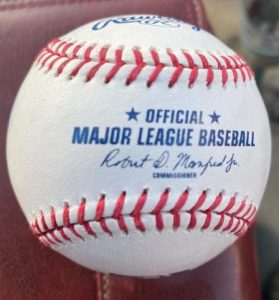
The foul ball, now crossed off my bucket list, sitting atop my notebook, before I handed it to my son.

While the visiting Astros took batting practise, a line drive sailed into our section down the right field line. Adjacent fans made it impossible for me to see just which Astro hit the ball, but the ball bounced around off seats in front of us, then under them, and riocheted off a fan two seats to our right, before rolling on the floor under us to where I could grab the ball before another fan reaching under the seat in front of me did.

I held the ball up to see for myself that I wasn’t seeing or imagining things, then handed it to my son. He’d only been asking to try to catch a ball at Angel Stadium since, oh, the first time I got to take him there—in 2000, when the Angels beat the visiting Yankees one fine evening by prying the winning run out of The Mariano himself. We’d gone to plenty of games since. Thursday night, it was pay dirt at long enough last.

Of course, there was now a game to play, and the Angels lost, 3-1. These are my ten takeaways:

1) Shoh-time! The good news for the Angels was Shohei Ohtani starting on the mound. I’m convinced that what looked to be a lockout-dejected, ho-hum crowd in advance, shot into a near-sellout once Ohtani was announced as the Opening Day pitcher. Lockout after-effect, I suspected: I’d checked the ticketing for the game just prior to the announcement and there were several thousand seats remaining for the taking.

Well, now. The day before I set out for southern California from my home in Las Vegas, I checked the ticketing again. The tickets seemed to have flown off the board once Angel fans knew it would be Shoh-time. And Ohtani didn’t disappoint, much. He pitched four and two-thirds innings of one-run, nine-strikeout, four-hit, one-walk baseball.

The best the Astros could do against him was the third inning, after he caught Martin Maldonado looking at strike three and blew Jose Altuve away with a swinging third strike: Michael Brantley banged a double off the right center field fence and Alex Bregman sent him home promptly with a base hit to left center.

As a matter of fact, when Ohtani wasn’t becoming the first player in Show history to throw his team’s first pitch of the season and make his team’s first plate appearance of the season (the Angels like to bat him leadoff), he manhandled Altuve for three strikeouts on the night, including the nasty slider that shot over Altuve’s hard swing for the third such strikeout in the top of the fiftyh.

2) The bad news: Astros starter Framber Valdez was just as effective in six and two-thirds innings. (The Angels planned to keep their starting pitchers on an 80-pitch limit for the time being, after the lockout-imposed too-short spring training.) He struck six out, walked one, and surrendered two of the Angels’ four hits on the night.

3) The worse news, for the Angels: They came to within inches of taking a 2-1 lead in the seventh. Mike Trout led off by beating out a throw from shortstop that should have been ruled an infield hit but was ruled an error. Then Anthony Rendon hit a high liner that sailed into the left field seats . . . but missed the foul pole on the wrong side by a hair.

“When I saw the ball flying in the air,” Valdez said post-game of his narrow escape, “I got mad with myself that I didn’t make my best pitch. I just took a deep breath and threw my best pitch.” That would be the hard sinkerball on which Rendon promptely dialed Area Code 4-6-3.

Matt Duffy promptly beat out an infield hit to third, which promptly moved Astros manager Dusty Baker to end Valdez’s night and bring Phil Maton in to strike Jo Adell out swinging for the side.

4) Cruising speed: Maton seemed on a bit of a cruise in relief until he hit Brandon Marsh with a pitch with two out in the bottom of the eighth and David Fletcher shot a 1-2 pitch through to the back of left center and gunned it for an RBI triple. That was the Angels’ first and last run of the game, alas.

5) The worse news, for baseball as a whole: That ridiculous three-batter minimum for relief pitchers. Under normal circumstances, if your reliever comes into the game and gets murdered right away—as Angels reliever Ryan Tepera was in the top of the eighth—you’d know he didn’t have it that night, right?

Father and son

Father (right) crossed Opening Day off his bucket list at last—and had the pleasure of doing it with his 28-year-old son.

Oops. Tepera’s first pitch to Alex Bregman sailed into the left field seats. The next Astros batter, Yordan Alvarez, hit a hanging slider on 1-1 over the center field fence. The Angels were lucky to escape with their lives after two prompt deep fly outs (Yuli Gurriel, Kyle Tucker) followed by a sinking liner up the middle (Jeremy Peña) that Trout caught on the dead run in from somewhat deep center to retire the side. (Trout also drew a loud ovation after he turned around and, from half-shallow center, winged the ball to fans halfway up the right center field bleachers.)

6) But there was good news on the relief front. Neither manager burned his relievers in the bullpens. If either Baker or Joe Maddon warmed a pitcher up, he either came into the game as soon as needed or he was handed what amounted to the rest of the night off. No Angels or Astros reliever was called upon to warm up more than once.

I paid as much attention to the relievers in the pen as I could, considering I was seated far opposite the pens behind the left field fence. The Angels used five relievers and the Astros, three. None of those eight pitchers threw any more than maybe 20-25 pitches before they were brought into the game. None of them could be called gassed going in.

Tepera simply didn’t have it Thursday night; Maton got vulnerable after ending one inning and getting two outs to open the next. The rest of the two teams’ bullpen corps (Hector Neris and Ryan Pressly for the Astros; Aaron Loup, Austin Warren, Jose Quijada, and Archie Bradley for the Angels) pitched clean-as-a-hound’s-tooth relief. Would that all major league managers were that judicious handling their pen men.

7) Memo to: Angel fans. Subject: The Wave. The 1980s called. They want their obnoxious, obstructive Wave back. One fan adjacent to our section kept calling for fans to do the Wave. I kept shaking my head, but I did notice that each of about ten attempts at it starting in our part of the park died before flowing to a fourth section of the field-level seats. Maybe there’s hope in such deaths, after all.

8) You were saying? The back-to-back Astro bombs to one side, this game wasn’t exactly the kind to send the old farts screaming to the whiskey shots. The game’s twelve total hits included three Astros doubles, Fletcher’s triple, and six singles. Altuve even stole second in the ninth, for whatever that was worth, since he ended up stranded.

9) Wasted Out Department: Altuve, the Astros’ pint-sized, gallon-hitting second baseman, also dropped a sacrifice bunt to third with one out in the seventh against righthanded reliever Warren, after Chas McCormick opened the inning with a double. Remember: A man on second with one out, and you have less chance of scoring a run after that bunt than you did before the bunt, even if you do exactly what Altuve did pushing McCormick to third.

Just what a man with a lifetime .512 Real Batting Average (total bases + walks + intentional walks + sacrifice flies + hit by pitches, divided by total plate appearances), and a .297 lifetime hitting average with a man on second and one out, is doing thinking sacrifice escapes. With his team leading a mere 1-0 at the time, the Angels brought Quijada in to pitch to Brantley, and Brantley flied out shy of the track in right center for the side.

That’s what a wasted out did. The righthanded-hitting Altuve might have been futile against Ohtani on the night, but he has a lifetime .301 hitting average against righthanded pitchers. The Astros would have had a better chance scoring McCormick if Altuve hit away.

10) When Bregman checked in at the plate in the top of the eighth, the Angel Stadium video boards flashed a graphic with Bregman’s head shot plus this: [He] donated over 200 iPads  w/protective cases and iTunes gift cards to several Houston-area elementary schools that have autistic classrooms. He does that through his Bregman Cares charity, with a particular focus upon autistic children.

It was almost as admirable for the Angels to show Bregman such respectful acknowledgement as it was for Bregman and his wife, Reagan, to take such an interest in lending hands to autistic children. Even if Bregman’s idea of saying thank you for such respect was to smash a leadoff homer in reply.

WS Game Two: Hunted, pecked, pricked, poked

Max Fried

Max Fried—getting stung repeatedly in the second hurt almost worse than if he’d been bludgeoned.

If you look purely at the line score of World Series Game Two, you’d think the Braves had their heads handed to them in the bottom of the second. But if you watched the game, you know the Astros dismantled them, almost too simply, and with some inadvertent help from the Braves themselves, to win 7-2 Wednesday night.

As a matter of fact, when the game began you could have been forgiven for thinking it might turn into a bit of a pitching duel despite the teams swapping a run each between the bottom of the first and the top of the second—one on a solo home run, one on a sacrifice fly.

Overall that’s about how the game shook out—if you didn’t include the Astros’ hunt-peck-prick-and-poke of four runs out of Braves starter Max Fried in the bottom of the second, after he fooled Carlos Correa into looking at a particularly nasty third-strike curve ball. Jose Altuve’s eighth-inning home run almost seemed a by-the-way insurance run.

“We didn’t want to go to Atlanta down by two,” Altuve said postgame. “So we left everything we had in there tonight. Obviously, very important win to tie the Series to keep going from there.”

“Obviously, I’m not happy about it.” said Fried. “Playoffs is a big momentum game. You’ve got to do everything you can to keep the crooked number off the scoreboard.”

It might actually have hurt less if he’d been bludgeoned than it did the way he was pecked in the second. And, if Astros starter Jose Urquidy hadn’t brought his A game to the mound, leaving the Braves mostly unable to hit him even if they’d swung warehouse gates.

Fooling Correa into the strikeout must have seemed aberrant even to a pitcher who struck out six in five innings’ work and walked only one batter. The second inning made Fried’s outing look far worse than it was in the long run, but a true shelling it wasn’t. It was like getting stung by angry hornets one after the other a few times before he finally slithered out of it.

It started with Kyle Tucker spanking a base hit up the middle and Yuli Gurriel punching one through the shift-opened right side for a base hit to follow up at once, sending Tucker to third. Fried jammed Jose Siri into a slow tumbling grounder to the far left side of the mound, but Tucker came home when they couldn’t get the swift Siri at first.

Then Martin Maldonado, a catcher so prized for his work behind the plate that Astro manager Dusty Baker bears with his pool noodle of a bat, punched one through the left side for a base hit. The problem now was the Braves’ usually sure-handed, sure-armed defense.

Left fielder Eddie Rosario came up with the ball and threw to third in a bid to stop Siri if they couldn’t stop Gurriel from scoring. Only third baseman Austin Riley came trotting down the line to serve as the cutoff man, and shortstop Dansby Swanson got caught unable to get to third covering in time because he was in short left. Rosario’s throw thus sailed wild and Siri sailed home with the fourth Astro run of the night. Ouch!

Maldonado went to second on that throw and took third when Braves catcher Travis d’Arnaud let one escape with Altuve at the plate in an 0-2 count. Altuve flied out with Maldonado having to hold at third, but Michael Brantley pulled a base hit to right on which Maldonado could have walked home safely, making it 5-1.

Innings like that are as common to the Astros when they’re swinging right as you might think the big bombing innings would be. But they were the best in the game this year at avoiding strikeouts at the plate and hitting in most directions out to the field.

They may also have picked up on Fried tipping pitches. No, they’re not pulling another Astro Intelligence Agency trick or three. The rules since Astrogate’s explosion and aftermath include maximum replay room security. But the Astros were known without and before any Astrogate shenanigans for picking up even the tiniest tells from opposing pitchers and exploiting them mercilessly.

Fried’s habit of wiggling his glove fingers around the ball in his hand rapidly as he prepares to throw to the plate, like an amphetamine-driven lobster clawing its dinner down to manageable bites, may well have handed the Astros inadvertent but invaluable pitch  intelligence. After the second, Fried quit the glove snapping for the most part—and retired the next ten hitters he faced.

When Yordan Alvarez walked and Correa sent a base hit to left opening the bottom of the sixth, Braves manager Brian Snitker hooked Fried in favour of Dylan Lee. After Tucker forced Correa at second with Alvarez taking third, the Braves’ defense faltered into the sixth Astro run.

Gurriel grounded sharply to Swanson at shortstop. He threw to second baseman Ozzie Albies hoping to start an inning-ending double play. Albies lost the ball as he turned to throw on to first. Tucker was ruled safe until a review was called—did Albies have control of the ball to get the out while losing it as he drew the ball out of his glove to throw on?

Several television replays showed Albies lost control of the ball after all, but not by as much as first surmised. The safe call held, and Alvarez scored, but Albies’s throw wasn’t in time to get Gurriel at first. Lee shook off a rather daring double steal to set up second and third by striking Siri out. Snitker brought in Jesse Chavez, and Chavez got Maldonado to fly out for the side.

The Braves got their second run in the top of the fifth when Freddie Freeman singled d’Arnaud home. Other than that, both bullpens kept each side behaving itself except for Altuve sending Drew Smyly’s first pitch of the bottom of the seventh into the Crawford Boxes, before the veteran reliever fell into and squirmed out of his own bases-loaded jam with no further damage.

Maybe the true shock of the evening was the Braves handing the ball to Kyle Wright for the bottom of the eighth. Wright’s a 26-year-old pitcher with a 6.56 fielding-independent pitching rate in four seasons. He had a 9.64 FIP and a 9.95 ERA in two brief starts on the regular season while up and down from the minors.

Throwing that against the Astros was something like offering to assure Hall of Famer Henry Aaron would face nothing but batting practise pitchers by decree, right? Wrong. Wright shocked the entire ballpark by striking the side out in order—including Maldonado and Altuve looking at third strikes after Siri opened with a three-pitch swinging strikeout.

“It was so encouraging to see Kyle tonight,” said Snitker postgame, even if he was thrown up as a sacrificial lamb in a lost game. “Just getting in there for that one inning and getting him out there and experiencing this atmosphere because he could play a huge part going forward. I thought he threw the ball extremely well.”

Wright lived on effective curve balls and sinkers Wednesday night. Snitker was inspired enough to ponder possibilities for Wright to spot start or even open a bullpen game during the Atlanta leg. With Charlie Morton gone thanks to that fibula fracture, Snitker needs to get even more creative with his pitching arrays now. Wright’s surprise may lift some of that burden a hair or two.

“He was locating,” said catcher d’Arnaud postgame. “His sinker was moving a lot. His curveball was moving a lot. He did a tremendous job. When I caught him in a rehab game for me, he looked exactly the same as he did that day. It was fun working with him, and it was great seeing him have the success today, especially in the World Series.”

With the tied Series moving to Atlanta for three possible games, thus switching the Braves to a home field advantage, it’s comforting to know that near the end of a night the Braves were pecked to death they might have found the Wright stuff, for however long.

ALCS Game Three: Rock and troll

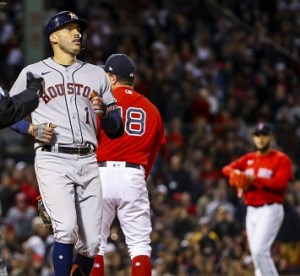
Carlos Correa, Eduardo Rodriguez

Rodriguez (right) couldn’t resist trolling Carlos (It’s My Time!) Correa as the top of the sixth ended . . .

Carlos Correa grounded out to end the Astros’s sixth Tuesday night. Red Sox starter Eduardo Rodriguez couldn’t resist pointing to his wrist, trolling Correa’s becoming-more-familiar “It’s my time!” gesture whenever nailing a key Astros hit. There was a birthday boy in the house who wasn’t necessarily amused.

“No, no,” Alex Cora hollered, as Rodriguez returned to the dugout during the sides changing. “Don’t do that!” The last thing the manager wanted on his 46th birthday was any of his Red Sox poking the Houston bear they were taking down, before the bear could even think about stealing their picnic baskets.

Not even the pitcher who’d just pitched six solid innings the only blemish of which was a three-run homer two innings earlier. Not even while the Red Sox still held a six-run lead that finished in a 12-3 demolition giving the Red Sox a 2-1 American League Championship Series advantage and the Astros a monumental migraine.

An inning and a half worth of three-up, three-down baseball that looked to shape into a pitching duel between Rodriguez and Astros starter Jose Urquidy got ripped into a Red Sox demolition in the bottom of the second after starting as a mere tear. Two walks sandwiching a J.D. Martinez one-out double merely loaded the bases for Christian Vazquez’s line single the other way to right field and kept them there.

Oops. Christian Arroyo ripped one off the mound and off Astros second baseman Jose Altuve to send Martinez home with a second Red Sox run. Falling into an early 2-0 hole with ducks still on the pond against these Astros still seemed surmountable. Until Kyle Schwarber told them otherwise.

After taking ball one inside, ball two downstairs, and ball three just inside, Schwarber took Urquidy’s fastball around the middle halfway up the right field seats. It was the third salami slice for the Red Sox in three ALCS games. As if slicing two in Game Two wasn’t precedent enough, the Schwarbinator’s blast made the Red Sox the first ever to slice three in any postseason series.

Kiké Hernández followed Schwarber at once with a base hit pulled up the left field line, and Xander Bogaerts ripped a single up the pipe one out later, and finally Astros manager Dusty Baker got Urquidy out of there before the Red Sox could cover his grave. Yimi Garcia shook off a second-and-third-making wild pitch to dispatch Alex Verdugo for the side at last, but aftershocks were still to come.

They started an inning later, when Hunter Renfroe drew a one-out walk, stole second, then took third when Astros catcher Martin Maldonado’s throw to second bounced away from Altuve, before coming home on Vazquez’s floating base hit into short center. Then Arroyo drove Garcia’s slightly hanging slide into the rear row of the Green Monster seats.

The Astros may have punctured the impenetrable when Astros center fielder Kyle Tucker parked one into the right field seats with Michael Brantley (leadoff single) and Yordan Alvarez (one-out single banged off the Monster but played perfectly by left fielder Verdugo to hold him) aboard in the top of the fourth.

Two innings and three Astro pitchers later, Rafael Devers took a leadoff walk and the Astros got two outs quick enough to follow, especially center field insertion Jose Siri’s sliding catch running in long to take Verdugo’s floater into shallow center. Phil Maton then relieved Brooks Raley for the Astros, and he arrived just in time to feed Martinez something to hit into the Monster seats about as deep as Arroyo’s blast traveled.

Kyle Schwarber

The Schwarbinator slicing salami in the second to start the Red Sox romp in earnest . . .

Before this ALCS ends, the Red Sox may need to put new tires on the laundry cart into which they dump their home run hitters to celebrate the blasts in each moment. They’re already down to the last millimeter of tread as it is.

As if making sure the sealant on the first puncture held fast, Devers turned on Astro relieve Ryan Stanek’s first one-out pitch in the bottom of the eighth and sent that into the Monster seats, too. Renfroe’s diving catch on Correa’s two-out, opposite-field drive in the top of the ninth must have felt like the first mercy shown the Astros all night long.

Astros pitching coach Brent Strom wondered aloud whether his charges might be tipping pitches. Not willing to commit to that quite all the way, he acknowledged that—between the Red Sox’s postseason plate discipline and all-fields approaches and Astro pitchers falling behind in counts so often now—he’s more than a little concerned.

“This is a very good hitting team,” Strom said of the Red Sox, “and they’re very adept at picking up little things, much more so than most teams,” Strom said. “We need to be very cognizant of the little things, tipping-type things, things like that, that they’re very astute at. We’ve just gotten behind hitters.”

Cora said the Red Sox approach began changing when Schwarber came aboard in a July trade with the Nationals. “We were expanding,” Cora said, meaning the strike zone. “We didn’t walk too much, and when he got here and when he started playing, it was different. It’s a different at-bat, and other guys have followed his lead, and right now, like I said, this is the best I’ve seen this team this season offensively.”

Correa thinks the Red Sox aren’t picking up Astro pitch tips so much as they’re just doing their jobs at the plate when the Astros’ pitchers aren’t doing theirs on the mound. As an Astro, it’s murder for Correa. But as a baseball fan, pardon the expression, it’s a blast.

“It’s fun to watch as a fan of the sport, see how everybody in the lineup has the same approach,” the shortstop said. “They’re not chasing. They’re staying in the zone. They’re not swinging at borderline pitches. It’s beautiful what they’re doing. We’ve got to find a way to throw more strikes and keep the ball in the ballpark.”

But as much talk came about Rodriguez giving Correa a taste of his own celebratory medicine as about the Red Sox’s thorough dismantling of the Astros’ balky pitching staff and shaky offense—particularly their big three of Altuve, Brantley, and Alex Bregman now standing a combined 5-for-36 in the set so far—after the game finally ended.

Cora didn’t exactly hold it against Rodriguez, making a point of embracing his pitcher when Rodriguez returned to the dugout. But he still didn’t want Rodriguez or any of his players re-awakening the suddenly sleeping Astro giants.

“We don’t act that way,” he said postgame. “We just show up, we play, and we move on, and he knows. I let him know. We don’t have to do that. If we’re looking for motivation outside of what we’re trying to accomplish, we’re in the wrong business. The only motivation we have is to win four games against them and move on to the next round.”

Correa didn’t exactly mind. The way he spoke postgame, you’d have thought the Astros forgot about such concepts as bulletin-board fodder. “He did my celebration,” said the shortstop liable to command a nice free agency deal this winter, no matter his Astrogate past.

“I thought it was kind of cool,” continued Correa, who’d done his “It’s my time” wrist-tap in Game One after breaking a three-all tie with an eighth-inning bomb. “It’s just the way baseball should trend. I loved it personally . . . I keep it real all the time and say how it is.”

Rodriguez admitted he was caught up in the moment after getting Correa to end the sixth. Cora was stern but not exactly harsh with his pitcher back in the dugout. His embrace fit perfectly with Rodriguez’s previous insistence that Cora was like a father or older brother to his players as well as a manager.

“He understands that we’re not that way.” said Cora, whose Red Sox almost got humbled out of the races in the second half between injuries, COVID sufferings, and a bullpen remake. “We talk about humble approach and humble players, and that’s who we are. We like to grind, and we like to play, but we don’t do that.”

Well, good Lord, a team hammering and blasting its way to a rout can’t be faulted for being just a little less than humble in the moment here and there. Can they?