Beltway bombshells—Soto, Mancini go west

Juan Soto

Juan Soto stole the show in Game One of the 2019 World Series and helped his Nats reach the Promised Land. That was then, this is now, and the still-top-flight Soto is a young man going west to San Diego . . .

The Big One dropped, in both directions on opposite coasts. The Nationals, who’ve gone from surrealistic World Series champion and National League East powerhouse to hell in a little over two and a half years, traded what should have stayed a franchise foundation to the Padres, the National League West contenders who often enough mistake splash for sustenance.

Juan Soto goes West the day after it turned out he’d end his Nats tenure with a bang, throwing Tomas Nido out at the plate to keep the Mets to a mere three-run top of the second, and crunching his former teammate Max Scherzer’s 1-1 fastball for a leadoff home run in the bottom of the fourth en route a 7-3 loss to the Mets. It won’t make it easier for Nats fans to swallow this.

Soto became expendable when he turned down a $440 million extension that looked stupid-fat on paper while packaged to deny him the thing he wanted most. He wanted ten years and got them. He wanted the total dollars and got them. He didn’t get the highest annual average value the way the packaged was packed.

Maybe Soto was foolish taking the all-or-nothing stance. But maybe the Nats were just as foolish, with or without a pending potential ownership change, to decline making even that small enough adjustment. Standing just as all-or-nothing, with Soto not due to hit free agency for the first time until 2025, the Nats decided even the next Ted Williams was expendable.

Stop laughing at the Ted Williams comparisons. Only five hitters through age 23 have higher OPSes than Soto does: Williams, fellow Hall of Famers Ty Cobb and Stan Musial, and Hall of Famers to be Albert Pujols and Mike Trout. The order from the top is Williams, Cobb, Trout, Musial, and Pujols. His June slump leaves his season so far not quite as good as his priors, but rehorsing himself last month restored Soto on the way back where he belongs.

But if he had a fat enough hand in the Nats’ 2019 in-season resurrection from the outhouse to the Promised Land, will it be fat enough to push the Padres to the Promised Land at last? Baseball’s worst kept secret is that Padres general manager A.J. Preller has a genius for trades equal to Soto’s big swings and nothing much to show for them.

Oh, he’s managed to land some of the bigger fish on the trade market in exchange for high-rated prospects who haven’t yet returned to take a big bite out of his hind quarters for the most part—if you don’t count Trea Turner. (Nat turned Dodger.) But there’s always a real first time. Isn’t there?

He’s run the Padres eight seasons, delivered such blockbuster trade acquisitions, at the in-season deadline or the offseason, as Mike Clevinger, Jake Cronenworth, Yu Darvish, Joe Musgrove, Blake Snell, and Fernando Tatis, Jr., the Padres haven’t yet gone to any full-season postseason. (They reached the National League division series during pan-damn-ic short 2020.)

And he may be lucky that his incumbent first baseman Eric Hosmer declining to waive his no-trade clause to move to Washington didn’t kill the Soto deal. Hosmer has declined so precipitously since becoming a Padre as a free agent that, if Preller wants to get the rest of his due salary off the San Diego books, he’ll have to move yet another good prospect to do it if he finds a team willing to take Hosmer on.

Then, again, as USA Today‘s Bob Nightengale notes, Soto locked in through 2025 has another upside: in the unlikely event the Padres still can’t cross the threshold, Preller can still find a way to flip him on behalf of bringing other delicious-looking prospects back for a team and organisational renewal.

If there’s good news for the Nats, it’s getting five prospects in return for Soto and Josh Bell, with all five rated somewhat higher than the haul they took back from the Dodgers in exchange for Max the Knife and Trea Twinkletoes. But if there’s worse news for the Nats, it’s the number one problem with prospects: No matter how highly rated, they’re just prospects who might or might not cut it fully as Show players.

If they do cut it, it’ll take the sting out of losing a bona fide franchise player only if their cutting it turns into another world championship or two. If they don’t, this one’s liable to sting for Nats fans as long and as deep as such historically notorious purgings as Brock for Broglio, Ryan for Fregosi, Seaver for a quartet that sounds more like a law firm—Flynn, Henderson, Norman, and Zachry—than team reinforcements.

This wasn’t even the top deal of the day when it comes to breaking fan hearts. It’s not that Nat fans weren’t wringing hands and drying tears once they first knew Soto became expendable, but Oriole fans in the throes of seeing an unlikely revival enough to put the team right into the wild card hunt from almost out of nowhere hurt even more losing Trey Mancini.

Hours before Soto moved west, Mancini’s ticket to the Astros was punched in a three-way deal sending promising but inconsistent outfielder Jose Siri from the Astros to the Rays, pitcher Chayce McDermott from the Astros to the Orioles, and pitchers Jayden Murray and Seth Johnson from the Rays to the Orioles.
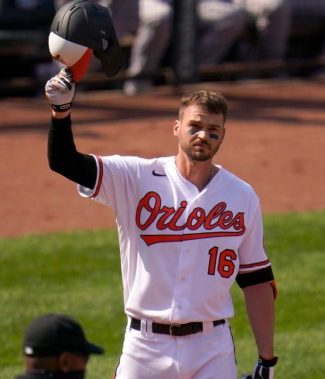
Trey Mancini

Trey Mancini tipping his cap to Oriole fans after what proved his final home game in Baltimore—he goes somewhat west now, to the Astros.

For Mancini it’s a terribly mixed blessing. One moment he goes from a home ballpark whose left field fence was moved back far enough to cut his power production at home to a ballpark with a short enough porch that he’d have hit over twice the ten bombs he has on the season so far. But he also says goodbye to a mutual love affair between himself and a city starving for the days when the Orioles were consistently great, year-after-year.

His agreeable personality and his courageous fight to beat colon cancer two years ago endeared him even further to Oriole fans than his live bat. As Baseball Prospectus observes, “Mancini . . . was the heart and soul of a franchise long depleted of either.”

The depletion may include Orioles general manager Mike Elias, who offered one of the most cacophonous explanations ever heard after a team struggling to return to greatness unloads a highly popular and franchise-valuable player:

The winning last couple of months that we have, the momentum we have, has made this a much more difficult decision and a much more complicated trade deadline than it would have been or that any of the past ones have been.But ultimately, I have to tether my decisions to the outlook and the probabilities of this year. We have a shot at a wild card right now but it is not a probability that we’re going to win a wild card.

Translation: In one deal and one bowl of word salad whose flavour no dressing on earth could improve, Elias as much as told Oriole fans he’s pushing the proverbial plunger on both this season whole and his team’s gallant, almost-from-nowhere re-entry into the postseason picture, however much distance the Orioles might still have to travel to get there.

Maybe Elias is still building for the nearest future after all. But maybe something could have been done without making the Orioles’ heart and soul the proverbial sacrificial lamb. Could, and should. “He’s the nicest human I’ve ever met,” says Orioles first baseman Ryan Mountcastle, a sentiment that seems to be common in the Oriole clubhouse and Baltimore itself.

Until today, people were even willing to bet on the Orioles having a phenomenal enough shot of reaching in. Now they’re uttering a couple of four letter words, one of which is the vulgar synonym for fornicate and the other a word meaning either a large receptacle for holding gas, an armoured attack vehicle, or taking a dive. Three guesses which meaning Orioles (and Nats) fans think applies.

“Teams liked to claim that captains were no longer necessary because one player shouldn’t be elevated above his teammates,” BP says, “but also, that same force made one player essentially untradable. If someone is designated the heart of a team, you can’t cut him out. Their value might go to waste.”

The region of the nation’s capital has taken enough blows that have knocked the wind out of its belly in the last few years. The Nationals and the Orioles, both of whom enjoy substantial capital followings, have told them, basically, “What’s two more sucker punches among friends?”

The Bronx Boneheads

This is what the Yankees were afraid of being exposed? After two years, accidentally turning up during a lawsuit’s discovery phase, and a few legal contortions on behalf of blocking it from anyone else’s sight, this is what the Yankeegate letter was all about? Their own 2015-2017 replay-room reconnaissance ring, a la the 2018 Rogue Sox?

No, we’re not going to argue that electronic cheating isn’t so terrible even if it doesn’t rise quite to the Astrogate level. Agree that neither those Yankees nor those Red Sox were behaving themselves, even if the Yankees didn’t get far enough in the postseason to try it in a World Series the way the ’18 Rogue Sox probably did.

But someone, anyone. Please.

Tell me the Bronx Boneheads aren’t that deeply full of themselves that they couldn’t have withstood whatever minor slings, arrows, brickbats, and bashings would have confronted them over mere replay room reconnaissance. Tell me they’re not that ridiculous about preserving the Yankee image no matter how little their sneaky little shoplifters resemble the grand theft felons.

About the only thing the Yankee prankees seem to have done a little differently than the Rogue Sox was use their dugout phone on the road to get the stolen signs from the road replay room and then transmit it to a baserunner to send home to the batter.

Cheating is cheating? Please. This was comparable only to teen comedians ordering pizzas for deliveries to unsuspecting chumps across town. It didn’t exactly amount to seizing the pizzeria and taking hostages.

Since there were unconfirmed numbers of other teams doing likewise with their free presents from MLB, those other teams are probably laughing their fool heads off over the lengths to which the Yankees spent time and money trying to keep the Yankeegate letter from escaping into the public eye.

Yes, I said free presents from MLB. It was MLB itself that laid the replay rooms on both clubhouses in all ballparks starting in 2014. They did it with the best intentions. Perhaps naively, they forgot that boys will be boys, and presents such as those were probably bound to inspire a little extracurricular chicanery.

Since Astrogate and Soxgate’s exposure in 2019-20, the rules now involve security personnel posted at all replay rooms. Before the December-March owners’ lockout, both sides were close enough to agreeing, too, on more stringent measures such as no one but a team’s designated operator plus an MLB security worker allowed in the rooms, and even blacking out catcher’s pitch signs on the replay room monitors.

But while you have your laughs-and-halves over the Yankees resembling the siblings scrambling to Watergate coverup lengths to keep Mom and Dad from learning one of them accidentally smashed the crystal pilsner glass, causing it to shatter into a trillion shards, try to remember that this does not and will not get the 2017-18 Astros off the hook.

The Yankees, the Rogue Sox, and other teams who merely turned the replay rooms into their versions of Spy vs. Spy didn’t go to even half the lengths those Astros did for intelligence gathering and transmitting.

Their general managers, so far as anyone knows, didn’t sanction sign-stealing algorithms developed by low-level interns and ignore the warnings that using them in-game was illegal. Now-former Astros GM Jeff Luhnow thought of that with the Codebreaker algorithm.

Their bench coaches and designated hitters didn’t dream up either an independent high-speed real-time camera or alter an existing delayed camera into illegal real-time transmission to deliver opposing signs to clubhouse monitors next to which a transmission person could signal Astro batters by banging the trash can, slowly or otherwise. Then-Astros bench coach Alex Cora and DH Carlos Beltran did. (Smile—you’re on Candid Camera!)

“These are different things. Very, very different things,” tweeted ESPN’s Jeff Passan after the Yankeegate letter was obtained by SNY.

Players have been trying to steal and relay signs from second base forever. That doesn’t excuse the Yankees and Red Sox, but context matters. Relaying pitches with such specificity as the Astros did was entirely new.

Now, if MLB comes down harder on the Yankees or Red Sox in 2017, does that change things? Perhaps. Maybe the Astros are scared straight. But let’s remember: Manfred warned the Red Sox in 2017 after using the Apple Watch. And they won the World Series in 2018 while cheating . . .

Using technology to steal signs was rampant in baseball. The Yankees, Red Sox and Astros — and others whose indiscretions have not been proven publicly — did it. It’s simply facile to treat them as the same. It’s factual to say that there are different levels of cheating.

The one true revelation in the Yankeegate letter is that commissioner Rob Manfred actually fined the Yankees $100,000 after they were caught using their dugout phone in September 2017. Seriously?

They spent two years and who knows how much money in legal costs to try to suppress . . . that their mere replay room reconnaissance ring of 2017-18 wasn’t even half the Astro Intelligence Agency and cost them in the end slightly less than half what they pay pitcher Gerrit Cole per day?

The Yankees feared “significant and reputational harm” if the letter was made public. That fear may have been well founded. But not for the reasons the Bronx Boneheads thought.

Smarts in Houston, suicide in Cleveland

Shohei Ohtani

Ohtani took perfection into the sixth, where a bunt couldn’t do what a subsequent base hit did . . .

Shohei Ohtani didn’t just flirt with perfection Wednesday, he almost seduced it. A twelve-punchout performance on the mound; a two-run double to finish the first-inning carnage against Astros starter Jake Odorizzi; a perfect game broken with one out in the seventh. And his Angels in sole possession of the American League West’s penthouse. For now.

But right before Astros catcher Jason Castro fisted a base hit over second base into short center with one out in the Houston sixth, their own second baseman Niko Goodrum tried to break the would-be perfecto in a manner that usually brings the wrath of the Sacred Unwritten Rules chauvinists down upon the miscreant. On 0-1 leading the inning off, Goodrum tried to bunt an Ohtani slider up the third base line.

This time, the chauvinists didn’t rain acid down upon Goodrum. For one thing, the Angels put an overshift on against the lefthanded-hitting Goodrum. Just why the Angels thought a .133/.133/.200 slash line on the season to date required an overshift escapes for the moment.

But Goodrum did exactly the right thing receiving so much free, delicious real estate upon which to hit. His team down six, and knowing he wouldn’t be wasting an out with a bunt, Goodrum did absolutely nothing wrong sizing the scenario up and dropping a bunt toward that free territory—except the ball bounding over the chalk into foul territory halfway up the third base line.

Which was the spot to where Angels third baseman Anthony Rendon ran from his positioning adjacent to second base and grabbed the ball just in case, with Ohtani also bounding over from the mound. Back on the mound, Ohtani and Goodrum wrestled to a 2-2 count before Goodrum swung and missed at a nasty curve ball hitting the outer edge of the zone.

Maybe if Goodrum had pushed a successful bunt up the line and landed on first base practically on the house, the SUR chauvinists would have gone nuclear. Maybe. It’s become a little more acceptable according to the SURs to drop a bunt if the other guys are silly enough to think an overshift is a good way to keep a batter below the proverbial Mendoza Line from breaking it up the old fashioned way.

Come to think of it, Ohtani himself put on a demonstration of one of the only other times it’s wise to bunt—if you think you can get a base hit out of it without a full shift against you. With one out and nobody on in the Angels’ sixth, against Astros reliever Cristian Javier, the lefthanded-hitting Ohtani faced a slight overshift, slight enough to move Astros third baseman Alex Bregman to a more standard shortstop positioning but still leaving him room to move if he wanted to drop one.

On 1-2 Ohtani chopped a beauty toward the third base side of the mound and blasted out of the box. Javier pounced as best he could but he threw a rising sailer over and past the upstretched mitt of leaping Astros first baseman Yuli Gurriel. It was an exercise in futility, considering Ohtani would have beaten a cleaner throw by about a step on the play, and considering the Angels stranded him on first for the inning.

Goodrum and Javier have a teammate who understands, ahem, perfectly about perfecto-breaking bunts. Justin Verlander had it happen to him, while still pitching for the Tigers on 21 June 2017. He took a perfect game bid against the Mariners into the sixth, with the Tigers up 4-0 to that point.

With one out, Seattle’s swift center fielder Jarrod Dyson squared, bunted one between the mound and first base, and ran himself into a base hit. Unlike Goodrum’s attempt Wednesday, Dyson’s successful bunt that day kicked off a three-run Mariners inning that pushed Verlander out of the game. It also preceded a four-run Mariners seventh at the expenses of Tigers relievers Shane Greene and Alex Wilson.

That was the part that roiled Verlander far more than any perfecto-breaking bunt ever could. “It was a perfect bunt,” Verlander said of Dyson. “That’s part of his game. I don’t think it was quite too late in the game given the situation to bunt, especially being how it’s a major part of what he does. So I didn’t really have any issues with it. It wasn’t like I got upset about it.”

Goodrum played smart baseball, even if his bunt bid bounded foul before he finally struck out swinging. Even if the Angels finished what they started, a 6-0 shutout to take two of three from the Astros in Houston after losing three of four at Angel Stadium to open the season. At least neither manager, Dusty Baker (Astros) nor Joe Maddon (Angels), fell asleep at the proverbial switch Wednesday.

Dallas Keuchel

. . . but Keuchel looks to be praying for mercy amidst an unconscionable nine-run second/ten-run total beating before he was lifted too little/too late.

That dishonour belonged to White Sox manager Tony La Russa in Cleveland earlier in the day, in the first game of a doubleheader. Despite a well-enough rested bullpen thanks to a week-opening pair of rainouts, a pen that hadn’t exactly been overworked in a preceding set against the Rays, either, La Russa inexplicably left his veteran starter Dallas Keuchel in to take an early ten-run beating on a day Keuchel’s stuff didn’t exist from the outset.

Keuchel had enough trouble trying to shake off a first inning during which a pair of White Sox defensive miscues helped cost him a run before he surrendered a hit. He never got out of the second alive: a leadoff throwing error; four straight singles two of which pushed runs home with the bases loaded; a grand slam; three straight singles more, a wild pitch advancing the first of those Guardians to second and the third sending another run home; a run-scoring ground ball turned into another White Sox error; and yet another RBI single.

Finally, La Russa got Keuchel out of there and brought in Tanner Banks. He got a prompt step-and-throw double play at first and a ground out right back to the box for the side.

Joe and Jane Fan can bleat all they want, as one or two I saw aboard social media did, that sometimes you just have to take one for the team, sometimes you just have to try to  “save” your bullpen even if it means getting murdered, and it’s just one April loss against a long season to come, and the goal is to win two of three, innit?

“I’m 100% certain LaRussa knew Keuchel didn’t have it,” said one such fan, in fact. “Sometimes the decision to leave guys in or take them out is more about 162 games than 1 game. As is the case here. He was hoping Keuchel could survive that inning and make it thru an inning or two more.”

A Hall of Fame manager, even coming out of retirement for one more turn, knows he should be thinking of every game until or unless his team is eliminated mathematically from a pennant race. He should know well enough when his starter doesn’t have it. Knowing that, and knowing he had a reasonably rested bullpen, just how does a conscientious manager not get that poor starter the hell out of there before the game goes from a small leak to a flood?

Keuchel came into the game throwing little more than meatballs and matzo balls as it was, before Jose Ramirez—the Guardians third baseman flush with a yummy new contract extension—stood in in that second inning with the bases loaded, three Guard runs in, nobody out yet, and sent a hanging 1-1 cutter over the left field fence.

If La Russa “knew” Keuchel didn’t have it before that, it shouldn’t have been allowed to go there in the first place. Especially if he was going to go to Banks to clean up the mess. Banks hadn’t pitched since the previous Sunday. He also hadn’t surrendered an earned run in his three previous relief gigs. And what did he do when La Russa brought him in?

After getting that step-and-throw double play to end the second inning before the Guards could have made the case against their human rights violations any worse, Banks threw three more hitless, shutout innings, before Matt Foster and Anderson Severino finished with only one further Guards run to come—when Steven Kwan singled Myles Straw home off Severino in the ninth.

There was a time when La Russa would never have let a game get that far out of hand that soon if his starter didn’t have it going in. That’s part of how La Russa became a Hall of Fame manager with three World Series rings in the first place. “The manager didn’t get them ready to play,” La Russa said of his team after that blowout loss, and before the White Sox lost the nightcap, 2-1. “I take the heat for that.”

Lucky for him and them that there is still a long season to play yet.

“I felt like there was an angel by my side tonight”

Noah Syndergaard

The mighty Thor didn’t have to strike ’em out to get ’em out and help shut ’em out Saturday night.

About the only correct observation out of the Angels’ 2-0 shutout of the Astros Saturday night was this, about the starting duel between two returning Tommy John surgery patients, Noah Syndergaard (Angels) and Justin Verlander (Astros): it was a matchup of returning former aces. Vintage, it was not.

But it didn’t have to be. Especially so far as the Angels were concerned. “He’s just a strike thrower,” said Angels manager Joe Maddon of his new pitching toy. “The changeup is outstanding, and the slider, he’s willing to pitch inside . . . He was totally in command of everything that he’s doing out there.”

“It was fun to play behind him,” said Mike Trout, who accounted for the second Angels run with a mammoth late game home run. “He gets on the mound, throws strikes. He tries to get back in the dugout as quick as he can. You saw that tonight. He’s just out there grinding.”

Syndergaard entered the game with a lifetime 4.63 strikeout to walk ratio and 9.7 strikeout-per-nine rate. Verlander entered with a lifetime 2.33 strikeout-to-walk rate and a 12.6 strikeout-per-nine rate. Now, have a gander at their Saturday night special.

The former Met known as Thor struck nobody out, surrendered two hits and issued two walks, and lived mostly on the ground, with eleven grounders among the sixteen outs he got in five and a third innings’ work. Verlander struck seven out (including designated-hitting Shohei Ohtani thrice), walked three, and surrendered three hits while getting an even number of grounders and flies.

“It’s a long road, man,” Verlander said postgame. “Lots of nervousness and anxiousness leading up to it. Felt like my debut. Got some things to work on, but coming out of it feeling pretty good.”

One problem was Verlander feeding Angels first baseman Jared Walsh a fat enough fastball to open the bottom of the second and Walsh hitting it over the right center field fence. Another was no Astro except Kyle Tucker (in the top of the second, a single) and Chas McCormick (top of the third, single) hitting anything that didn’t find an Angel glove, though a third (Aledmys Diaz) reached on a throwing error opening the top of the seventh.

A third, for the Astros, anyway, was Trout serving notice that he’d had it with the slump that marked his first two games and the Astros demolition that accompanied it. The Astros had battered Angels pitching for eight home runs in those games. But while their contact wasn’t hard Saturday night, Trout’s was.

He smoked a fly out to the rear end of Angel Stadium in the first, a hard ground out to second in the fourth, a hard line out to center stranding two runners ending the fifth, and then—as if to prove practise makes perfect—he turned on a 1-2 fastball a little low and a little away, from Astros reliever Ryne Stanek, and yanked it off the rocks behind the left center field fence, 445 feet from the plate, in the eighth.

“Trout’s gonna get you,” observed Astros manager Dusty Baker postgame. After a 2021 ruined early enough by a torn calf muscle, and an owner-lockout-imposed short spring training this time around, one that included a short illness toward its end, Trout found a dramatic way to shake away his season-opening rust.

So did the Angels’ bullpen. Ryan Tepera entered Opening Night by surrendering prompt, back-to-back homers to Alex Bregman and Yordan Alvarez, but on Saturday night he got five straight outs in relief of reliever Aaron Loup—who’d gotten three in relief of Syndergaard but was hapless to prevent Diaz reaching aboard third baseman Anthony Rendon’s off-line throw. And designated closer Raisel Iglesias used only eight pitches to retire the Astros in order to finish it.

The bulls also struck four Astros out, three more punchouts in their 3.2 innings’ work than Syndergaard in 5.1.

Syndergaard had other things on his mind to accompany his manhandling of the Astros’ formidable lineup. Wearing the same number 34 he’d worn as a Met, the number had particularly sober significance for his new team.

No Angel had worn the number since 22-year-old pitcher Nick Adenhart, thirteen years to the day before—when Adenhart was killed by a drunk driver celebrating his successful Angels debut. The Angels didn’t retire 34 officially, but no player sought that number since, just as no Angel since the death of pitcher Tyler Skaggs almost three years ago has asked for Skaggs’s number 45.

By most accounts, Syndergaard asked the team to wear the 34 he’s worn all his life, after signing a one-year, $22 million deal with the Angels, and he was only too well aware of what Adenhart’s death meant to the franchise and its fans. “I felt like there was an angel by my side tonight,” Syndergaard said postgame. “That was really special to me.”

As athletes, I feel like our number—to the everyday person, it’s just kind of a number—but to us, it’s part of our identity. Growing up, my number was 34 because I was a huge fan of Nolan Ryan. But now it kind of means something a little bit different to me. I want to use that to lift up his name.

If Syndergaard continues lifting his team the way he did Saturday night, there could be more than a few angels on the Angels’ shoulders over the long, arduous season yet to come.

Opening Day: Cross it off the bucket list

Shohei Ohtani

Shohei Ohtani, shown on the Angel Stadium video board during his pre-game warmup as the teams lined up on the foul lines, on Opening Day. He pitched brilliantly but in a lost cause, the Angels losing 3-1.

The owners probably won’t stop by to see what I’m about to write, but their otherwise ill-advised 1 December-10 March lockout did me one solid. But only one.

After the World Series, and as soon as they went on sale, I’d bought tickets for what I thought would be the Angels’ home opener. They were scheduled originally to open the season on the road. But commissioner Rob Manfred’s cancellation of the regular season’s first series, in light of the owners’ further goalpost-moving shenanigans, turned the Angels’ home opener into Opening Day, after all.

It wasn’t enough to turn my thinking toward the owners’ side one iota, but it did enable me to cross something off my bucket list. Despite a lifetime of loving the game and watching countless games in the stands and on television, I’d never actually had the chance to be at the ballpark on Opening Day. Until Thursday evening.

The best part of the evening was that I got to do it with my now 28-year-old son, Bryan. The second-best part was being able to cross another item off the baseball bucket list within half an hour of us getting our pre-game food and drink, after putting replica 1972-1990 Angels hats onto our heads.

The Ball

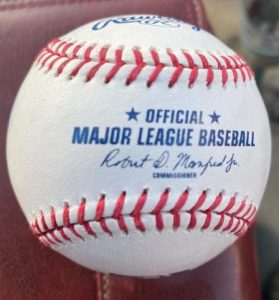
The foul ball, now crossed off my bucket list, sitting atop my notebook, before I handed it to my son.

While the visiting Astros took batting practise, a line drive sailed into our section down the right field line. Adjacent fans made it impossible for me to see just which Astro hit the ball, but the ball bounced around off seats in front of us, then under them, and riocheted off a fan two seats to our right, before rolling on the floor under us to where I could grab the ball before another fan reaching under the seat in front of me did.

I held the ball up to see for myself that I wasn’t seeing or imagining things, then handed it to my son. He’d only been asking to try to catch a ball at Angel Stadium since, oh, the first time I got to take him there—in 2000, when the Angels beat the visiting Yankees one fine evening by prying the winning run out of The Mariano himself. We’d gone to plenty of games since. Thursday night, it was pay dirt at long enough last.

Of course, there was now a game to play, and the Angels lost, 3-1. These are my ten takeaways:

1) Shoh-time! The good news for the Angels was Shohei Ohtani starting on the mound. I’m convinced that what looked to be a lockout-dejected, ho-hum crowd in advance, shot into a near-sellout once Ohtani was announced as the Opening Day pitcher. Lockout after-effect, I suspected: I’d checked the ticketing for the game just prior to the announcement and there were several thousand seats remaining for the taking.

Well, now. The day before I set out for southern California from my home in Las Vegas, I checked the ticketing again. The tickets seemed to have flown off the board once Angel fans knew it would be Shoh-time. And Ohtani didn’t disappoint, much. He pitched four and two-thirds innings of one-run, nine-strikeout, four-hit, one-walk baseball.

The best the Astros could do against him was the third inning, after he caught Martin Maldonado looking at strike three and blew Jose Altuve away with a swinging third strike: Michael Brantley banged a double off the right center field fence and Alex Bregman sent him home promptly with a base hit to left center.

As a matter of fact, when Ohtani wasn’t becoming the first player in Show history to throw his team’s first pitch of the season and make his team’s first plate appearance of the season (the Angels like to bat him leadoff), he manhandled Altuve for three strikeouts on the night, including the nasty slider that shot over Altuve’s hard swing for the third such strikeout in the top of the fiftyh.

2) The bad news: Astros starter Framber Valdez was just as effective in six and two-thirds innings. (The Angels planned to keep their starting pitchers on an 80-pitch limit for the time being, after the lockout-imposed too-short spring training.) He struck six out, walked one, and surrendered two of the Angels’ four hits on the night.

3) The worse news, for the Angels: They came to within inches of taking a 2-1 lead in the seventh. Mike Trout led off by beating out a throw from shortstop that should have been ruled an infield hit but was ruled an error. Then Anthony Rendon hit a high liner that sailed into the left field seats . . . but missed the foul pole on the wrong side by a hair.

“When I saw the ball flying in the air,” Valdez said post-game of his narrow escape, “I got mad with myself that I didn’t make my best pitch. I just took a deep breath and threw my best pitch.” That would be the hard sinkerball on which Rendon promptely dialed Area Code 4-6-3.

Matt Duffy promptly beat out an infield hit to third, which promptly moved Astros manager Dusty Baker to end Valdez’s night and bring Phil Maton in to strike Jo Adell out swinging for the side.

4) Cruising speed: Maton seemed on a bit of a cruise in relief until he hit Brandon Marsh with a pitch with two out in the bottom of the eighth and David Fletcher shot a 1-2 pitch through to the back of left center and gunned it for an RBI triple. That was the Angels’ first and last run of the game, alas.

5) The worse news, for baseball as a whole: That ridiculous three-batter minimum for relief pitchers. Under normal circumstances, if your reliever comes into the game and gets murdered right away—as Angels reliever Ryan Tepera was in the top of the eighth—you’d know he didn’t have it that night, right?

Father and son

Father (right) crossed Opening Day off his bucket list at last—and had the pleasure of doing it with his 28-year-old son.

Oops. Tepera’s first pitch to Alex Bregman sailed into the left field seats. The next Astros batter, Yordan Alvarez, hit a hanging slider on 1-1 over the center field fence. The Angels were lucky to escape with their lives after two prompt deep fly outs (Yuli Gurriel, Kyle Tucker) followed by a sinking liner up the middle (Jeremy Peña) that Trout caught on the dead run in from somewhat deep center to retire the side. (Trout also drew a loud ovation after he turned around and, from half-shallow center, winged the ball to fans halfway up the right center field bleachers.)

6) But there was good news on the relief front. Neither manager burned his relievers in the bullpens. If either Baker or Joe Maddon warmed a pitcher up, he either came into the game as soon as needed or he was handed what amounted to the rest of the night off. No Angels or Astros reliever was called upon to warm up more than once.

I paid as much attention to the relievers in the pen as I could, considering I was seated far opposite the pens behind the left field fence. The Angels used five relievers and the Astros, three. None of those eight pitchers threw any more than maybe 20-25 pitches before they were brought into the game. None of them could be called gassed going in.

Tepera simply didn’t have it Thursday night; Maton got vulnerable after ending one inning and getting two outs to open the next. The rest of the two teams’ bullpen corps (Hector Neris and Ryan Pressly for the Astros; Aaron Loup, Austin Warren, Jose Quijada, and Archie Bradley for the Angels) pitched clean-as-a-hound’s-tooth relief. Would that all major league managers were that judicious handling their pen men.

7) Memo to: Angel fans. Subject: The Wave. The 1980s called. They want their obnoxious, obstructive Wave back. One fan adjacent to our section kept calling for fans to do the Wave. I kept shaking my head, but I did notice that each of about ten attempts at it starting in our part of the park died before flowing to a fourth section of the field-level seats. Maybe there’s hope in such deaths, after all.

8) You were saying? The back-to-back Astro bombs to one side, this game wasn’t exactly the kind to send the old farts screaming to the whiskey shots. The game’s twelve total hits included three Astros doubles, Fletcher’s triple, and six singles. Altuve even stole second in the ninth, for whatever that was worth, since he ended up stranded.

9) Wasted Out Department: Altuve, the Astros’ pint-sized, gallon-hitting second baseman, also dropped a sacrifice bunt to third with one out in the seventh against righthanded reliever Warren, after Chas McCormick opened the inning with a double. Remember: A man on second with one out, and you have less chance of scoring a run after that bunt than you did before the bunt, even if you do exactly what Altuve did pushing McCormick to third.

Just what a man with a lifetime .512 Real Batting Average (total bases + walks + intentional walks + sacrifice flies + hit by pitches, divided by total plate appearances), and a .297 lifetime hitting average with a man on second and one out, is doing thinking sacrifice escapes. With his team leading a mere 1-0 at the time, the Angels brought Quijada in to pitch to Brantley, and Brantley flied out shy of the track in right center for the side.

That’s what a wasted out did. The righthanded-hitting Altuve might have been futile against Ohtani on the night, but he has a lifetime .301 hitting average against righthanded pitchers. The Astros would have had a better chance scoring McCormick if Altuve hit away.

10) When Bregman checked in at the plate in the top of the eighth, the Angel Stadium video boards flashed a graphic with Bregman’s head shot plus this: [He] donated over 200 iPads  w/protective cases and iTunes gift cards to several Houston-area elementary schools that have autistic classrooms. He does that through his Bregman Cares charity, with a particular focus upon autistic children.

It was almost as admirable for the Angels to show Bregman such respectful acknowledgement as it was for Bregman and his wife, Reagan, to take such an interest in lending hands to autistic children. Even if Bregman’s idea of saying thank you for such respect was to smash a leadoff homer in reply.