Masterpiece, then theater

2019-10-06 GerritCole

Gerrit Cole was the Dali of pitchers Saturday night . . .

You’d think a man who pitches like Bob Gibson in a postseason contest wouldn’t have to see his masterpiece turned into a hair raiser after he finally has to leave the game. But you can rest assured Gerrit Cole has seen a lot worse than the ninth inning Saturday night.

And you can rest assured further that he’d rather have seen his Astros survive that inning and come out one game from sweeping their way to the American League Championship Series than any known alternative.

Fifteen strikeouts. Five third strikes fastballs, five on curveballs, five on sliders. Missing by one measly walk an immaculate inning in which all three punchouts went swinging strike, foul, swinging strike. His lone walk being the one that ended his evening at last when his petrol ran empty at last.

Mentioned without apology in the same conversations as Gibson (with whom Cole shares uniform number 45), Howard Ehmke, Kevin Brown, and Gibson’s fellow Hall of Famers Sandy Koufax and Mike Mussina, among single postseason game punchout artists.

And what was Cole’s final reward for painting such a masterpiece as Dali himself would envy? Other than watching his Astros more or less sneak a run home in the seventh and eighth, to pad the lead Alex Bregman provided with a leadoff home run in the top of the fourth?

He had to watch his relief Roberto Osuna go from striking out Yandy Diaz—without whom the Rays wouldn’t even have been in the division series in the first place—on three pitches to end the eighth to stringing maybe the skinniest tightrope the Astros could possibly walk in the top of the ninth.

He had to watch Austin Meadows greet Osuna with a liner down the left field line that George Springer, moved over from center in a defensive re-alignment, couldn’t get to in time for a leadoff hit. He had to watch Tommy Pham stroke an immediate followup single right up the pipe. He had to watch Osuna walk Ji-Man Choi to load the bases once.

Then, he had to watch Bregman uncharacteristically bobble for just a moment Avisail Garcia’s bouncer to the left, settling for a force at second but no shot at a double play, and allowing Meadows to score. And, he had to watch Osuna wrestle Brandon Lowe to a full count before walking him to re-load the bases.

Exit Osuna, enter Will Harris, exit Rays catcher Travis d’Arnaud on a hard-earned swinging strikeout, exit Rays center fielder Kevin Kiermaier on a bouncer to first, and for the first time since the eighth Cole and the Astros could breathe without reaching for the oxygen tanks. And the 3-1 win put the Rays’s season on a respirator after all.

“Not the way we wanted to end it,” said Astros shortstop Carlos Correa after the game, “but we got it done and it’s a W.” Maybe the hardest-earned W of a season in which the Astros pushed 107 winning chips to the postseason table. Sometimes even the most powerful threshers in baseball don’t thank their mound lancers by finishing what he started simply.

If Rays manager Kevin Cash thought his team was Verlandered in Game One, they got even more Coled in Game Two. And the Astros’ bullpen got thatclose to throwing Game Two away. Astros manager A.J. Hinch must be feeling very fortunate that he has the kind of starters who make things like the Rays’ and others’ bullpenning a non-topic for him.

“Whether it’s about the new-age opener or pulling guys third time through, most of the people that support that haven’t had Verlander or Cole on their team,” the skipper said, and he’s speaking only the plain truth. Most teams would thank God and His servant Stengel for having just one superstud starter. He’s got three; Nationals manager Dave Martinez also has three.

“It’s hard for me to relate to having to pull guys early or wanting to pull guys early when these guys are putting up these kinds of performances,” Hinch continued. Right again, skip. “I’m going to roll with these boys while we have them.”

He may not yet have to get as creative with his boys as Martinez has had to with Stephen Strasburg relieved by Max Scherzer Friday night, but then Hinch normally doesn’t have a bullpen full of arsonists, either. Hinch has three stud relievers in Osuna, Smith, and Ryan Pressly. Make large room for all the bullpens who’d be grateful to have just one.

Pressly was a non-factor Saturday for having worked in Game One. It’s not scarifying just yet for Osuna to have one off-night, but even these finely tuned, well-oiled, near-perfectly calibrated Astros can’t afford another one too soon if at all. Because even superstud starters like Verlander and Cole have their absolute limits.

Let’s admit that for seven innings Cole didn’t know the meaning of the word “limits.” For seven innings he pitched like two Hall of Famers for the price of one, even as for six  innings the Astros pushed Rays starter Blake Snell—pitching gutsily after missing two thirds of the season on the injured list—and two Rays relievers but couldn’t quite break them except once.

Cole throttled the Rays with his mind almost more than his arm. His reputation in the game, very well earned by now, is that of a man who’ll throw a pitch in the first inning thinking it’s going to set up a pitch four or five innings later.

“He goes to areas of the strike zone whenever he needs to, whenever he wants to, whenever he sees something. That’s creative,” Hinch said after the game. “When we talk about creative, we often talk about guys that don’t have elite stuff like this. He can execute virtually any game plan for a reason . . . His mind and his ability to trust his adjustments set him apart.”

The only real breakage the Astros gave Snell opened the bottom of the fourth. Bregman worked  himself back from 0-2 with three straight solid takes on pitches low and away from him, fouled off an inside fastball, then sent the next fastball to the back of the Crawford Boxes to start what little scoring there’d be in the game.

Cash lifted Snell after he struck out Astros uber-rook Yordan Alvarez swinging right after the Bregman bomb. The Rays bullpen kept the Astros to just that run until the bottom of the seventh, while Cole looked more and more as though he’d go the entire distance without so much as a twitch of nerve or a flicker of exhaustion.

With the Rays’s usual closer Emilio Pagan opening the Houston seventh, Astros first baseman Yuli Gurriel grounded one hard to the hole at short and Willy Adames grabbed it, bobbled it, and threw in the dirt past first. Correa promptly ripped the first pitch down the left field line to the wall for second and third.

After rookie Kyle Tucker grounded out right back to the box, Astros catcher Martin Maldonado, Cole’s personal catcher who doesn’t hit well but handles pitchers like a symphonic conductor, checked in at the plate. He hit well enough this time, dumping a quail into left center enabling Gurriel to beat a throw home for a second Astros run.

It could have been worse for the Rays but somehow Pagan got George Springer to pop out to second and Jose Altuve, Game One’s co-hero, to fly out to the edge of the right field track to escape for the time being.

No such luck in the bottom of the eighth with Nick Anderson on the mound. Diaz knocked Bregman’s hard one-out grounder and threw wide of first enabling Bregman’s infield single. Alvarez then tore the first pitch into right for a base hit and first and second, and Gurriel flied deep enough to right to push Bregman tagging to third.

Then Correa slashed a 0-1 fastball into right to send Bregman home, before Colin Poche relieved Anderson and caught Tucker looking at strike three.

“We’ve got a lot more work to take care of,” said Cole after the game. “There’s a few months this winter that maybe we can sit back and have a drink about it. Right now, it’s on to the next one.”

That may come sooner than even the Astros think. And considering the results in New York—where the Yankees bludgeoned the Twins in the first two games of their division series, outscoring the Twins 18-6 over the two, with the crowning burial Didi Gregorius’s monstrous grand slam in a seven-run third Saturday—they’ve probably got the scouting reports on the Battered Bombers well enough studied.

An Astros-Yankees American League Championship Series would be a hell raiser. The league’s two most triumphant teams and their two most injury battered on the season, both of whom showed they were deeper than the Pacific Ocean when the casualties began. Gray’s Anatomy vs. House.

Says Cash: his guys know what’s at stake. Says Twins manager Rocco Baldelli: his guys know they can turn it around. Say the Astros and the Yankees, with Wade Miley (Astros) and Luis Severino (Yankees) due to start their Game Threes, and just as the man used to say on the radio: it ain’t gonna be easy, Clyde.
 

Previous ejection was Justin time

2019-09-01 JustinVerlander

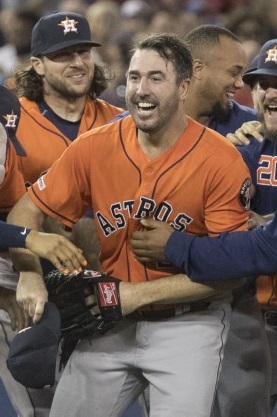
Justin Verlander celebrates after pitching his third career no-hitter Sunday.

If anyone else has thrown a no-hitter in their first outing after one during which he was ejected, I have no record of it. So it’s entirely possible that, in that sense, Justin Verlander’s Sunday afternoon special in Toronto’s Rogers Centre was unprecedented.

Can you just picture some pitcher somewhere arguing with an ump and answering, if and when the ump in question asks why he’s trying to get himself an early trip to the clubhouse, “Nothing personal, but I’d kinda like to throw a no-hitter in my next start, too.”

Or some umpire answering when a pitcher asks why the unexpected or undeserved ho-heave, “Relax, kid, I’m doing you a favour, now you got a good chance of throwing a no-hitter your next time out.”

That assumed those pitchers have anything resembling Verlander’s ability and intelligence. And you can line those who do up on one surfboard. With a little room to spare.

If anyone else’s no-hitter was consummated by an obscure rookie third baseman hitting a two-run homer in the top of the ninth for the game’s only score, then throwing out a far less obscure rookie for the game’s final out, I’m also unaware of it as I write. So Verlander better not have been kidding when he said Abraham Toro was due for a big reward.

Toro ought to get at least a new car (Verlander can afford to buy a dealership, after all, we think) for going above and beyond to make Verlander only the sixth man in Show history to throw at least three no-hitters. Maybe from a Canadian dealership, since Verlander’s the first to throw more than one no-no in the same visitors’ park.

The company he joins? Four Hall of Famers (Bob Feller, Cy Young, Sandy Koufax, Nolan Ryan) and a nineteenth-century deadballer. (Larry Corcoran.)

But I’m pretty sure none of Corcoran’s, Young’s, Feller’s, Koufax’s, or Ryan’s no-hitters featured having to dispatch three sons of former major leaguers (Bo Bichette, Cavan Biggo, and Vladimir Guerrero, Jr.), including two sons of Hall of Famers (Biggio, Guerrero), at the very top of the enemy batting order.

Verlander did. He struck Bichette and Biggio out twice, walked Biggio once, and rid himself of Guerrero on a pair of ground outs to third base and a foul pop to first.

Joining the deadballer may be the most appropriate for Verlander considering he did his Sunday work with a fastball that barely reached 90 mph if at all but a curve ball with more bite than a piranha in danger of missing its three squares on the day. He worked up and down the zone like an elevator operator, back and forth like a vacuum cleaner, and the only thing he had to worry about was whether the American League West-leading Astros would ever get a run on the board for him before his day was finished.

The Blue Jays went to a bullpen game beginning with former Met Wilmer Font, acquired in the Marcus Stroman trade, striking out three with one hit in two innings. Then two more Jays bulls, Sam Gaviglio and Zack Godley, worked three runless innings each, Gaviglio working three perfect with three punchouts and Godley shaking away two Astro hits while punching out two, plunking one, and surviving first and third in the seventh.

Then the Jays turned it over to Ken Giles, the closer and former Astro, having a renaissance season until he hit the injured list for a brief spell around the trade deadline, but who took a staggering 1.67 ERA into Sunday’s contest. And this was a day after he struck out the side to end a 6-4 Blue Jays win.

But Astros third baseman Alex Bregman opened Sunday’s top of the ninth with a double dunked into shallow right field. Giles flicked it off more or less with a three-pitch, swinging strikeout on the Astros’s explosive rookie outfielder/DH Yordan Alvarez, followed by a third-pitch fly out to center by Astros first baseman Aledmys Diaz.

Then came Toro, the switch hitter batting left.. Then came two Giles sliders, the first fouled off and the second ball one down and inside. Then came a four-seam fastball right down the pipe. And there it went the other way into the left field seats. Leaving Verlander to finish what he started, sandwiching a nasty swinging fourteenth strikeout between a pair of ground outs.

And leaving him to history.

“I can’t put it into words,” said the righthander who had four previous shots at a third no-hitter broken up in 2011, 2012, 2015, and last year. “I’ve come so close to the third one so many times.”

Maybe he should have been ejected in the starts immediately preceding those bids, too.

Greinke makes the ‘Stros trade winners

2019-08-01 ZackGreinke

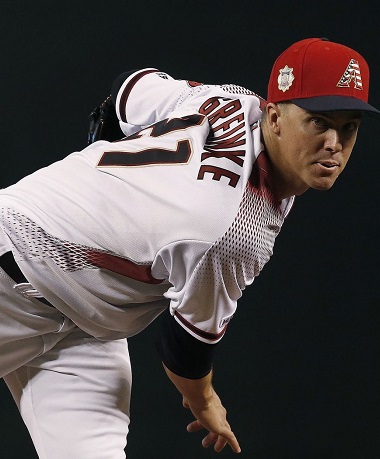
Zack the Knife makes the Astros the big trade winners. Will he help make them World Series winners?

No questions asked. The Astros slipped in at the eleventh minute, practically, and not only stole the new single trade deadline show but they did the absolute most to fortify themselves for the postseason run nobody doubts is theirs this season. Barring unforeseen disaster, of course.

With Gerrit Cole looking at free agency after the season it made sense for the Astros to seek a top-of-the-line starting pitcher with at least another full season of team control to line up with (don’t doubt it) future Hall of Famer Justin Verlander, so far the new ageless wonder of baseball.

So it came forth after the deadline passed that the Astros sent a quartet of prospects—good, promising, but not quite platinum-rated prospects—to the Diamondbacks for Zack Greinke, who isn’t exactly a slouch on the mound and who’s having a solid season in his own right so far.

They’ll get the rest of this season plus the final two seasons on the gigadeal Greinke signed with the Diamondbacks. The Snakes also sent the Astros a reported $24 million to help cover the rest of Greinke’s contract, on which the Astros will be responsible for the other $53 million. They’re not exactly complaining.

General manager Jeff Luhnow knew only two things about Greinke before he pulled the trigger on the big deal of the day: Zack the Knife has been a consistent pitcher who’s on the borderline of a Hall of Fame case; and, the righthander isn’t exactly one of the most combustible personalities in baseball.

“I don’t know him personally,” Luhnow told reporters, “but I think he’s not a guy that seeks the limelight, and that actually works well for us here in Houston. And slotting in with Verlander and Cole, he’s gonna not have to be the guy that’s in front of the camera the whole time.”

The Astros weren’t exactly over-occupied on doing the Greinke deal. Before that deal hit the news running Wednesday, they did a little bullpen fortification, getting Aaron Sanchez and Joe Biagini from the Blue Jays. The Jays also sent the Astros minor league outfielder Cal Stevenson. The Astros sent the Jays outfielder Derek Fisher.

Greinke was last seen striking out seven Yankees in five innings Wednesday. He left the park without talking to reporters, which may or may not have been an indication that he suspected or was told it was time to re-pack his bags.

On the same day, the Astros got flattened by the Indians, 10-4, in Cleveland; they finish with the Tribe Thursday before a weekend hosting the Mariners, but Greinke may not have his first Astros start until the Rockies hit town starting Monday.

“I know he’s really good. I don’t know him personally, but I’m going to get to know him,” said Astros manager A.J. Hinch. “We acquired him because of how good he is. Certainly we expect him to be a big part of our push to win the division and keep winning into October. He’s an incredible pitcher.”

He has been, and he still is when all is said and done. His new teammates won’t disagree. “What a pickup!” Cole himself crowed. Referring to the front office, he added, “They nailed it. They did a fantastic job.”

Landing Greinke shot the Astros into being World Series co-favourites with the Dodgers at Caesar’s Palace Sports Book. But the Astros are smart enough to know Berra’s Law is immutable. Zack the Knife increases their odds of a return to the Series, but so is Andujar’s Law, as uttered by a long-ago Astro, the late Joaquin Andujar: “In baseball, there’s just one word—you never know.”

What we do know, though, is who were really the big winners and the big losers of major league baseball’s first single mid-season trading deadline.

THE WINNERS

Braves—Another starting pitcher wouldn’t have hurt them, necessarily, but what the National League East leaders really needed was a back-of-the-bullpen retooling. And, they got it, in an almost rapid fire series of deals.

They landed Shane Greene from the Tigers. They landed Chris Martin from the Rangers. They landed Mark Melancon from the Giants. As CBS Sports’s Matt Snyder observes, if the prices were too high for such reported availables as Edwin Diaz (Mets) and Felipe Vasquez (Pirates), the Braves did well enough shopping the sale aisle.

None of the new pen trio are anything near the most glittering names in the relief world, but neither are they slouches or pushovers. Changes of scenery from nowhere land to pennant contention do wonders for such pitchers, and it would be absolute gravy if the Braves get something out of Melancon resembling his final years in Pittsburgh and his only spell in Washington.

Greene, of course, was an All-Star this year and was wasted on a Tigers team in the middle of a rebuild. When the Braves can turn to him near the end of a game, either as the sure ninth-inning option or if things get a little dicey in the eighth, the sight of Greene warming up with his 1.18 ERA should be enough to make their division and the rest of the league quake.

Throw in Martin’s 10+ strikeout-to-walk ratio and 10.2 K/9 rate, and all of a sudden the Braves’ bullpen doesn’t look like it’s full of bull anymore.

Indians—So Trevor Bauer turned out to be a bigger pain in the you-know-where than his otherwise solid pitching was worth. Doesn’t mean the Indians dealt from weakness. Not with Corey Kluber on the threshold of returning from the injured list.

And the Tribe managed to address their biggest weakness in the deal: their corner outfielders weren’t hitting anywhere near the same area code as their new toys Yasiel Puig (from the Reds) and Franmil Reyes (from the Padres) put together. Add Puig’s mostly plus throwing arm in right field, and all of a sudden the Indians outfield isn’t just going to roll over and play dead.

The Indians also landed lefthanded pitching youth Logan Allen (also from the Padres), and when you consider how well they develop or re-tool starting pitching this is an upside acquisition for them, too.

But the real key was the impact bats. Puig secures them in right field for the rest of the season, and perhaps if he continues doing well enough the Indians would think of pursuing him when he hits free agency in the fall. Reyes, though, secures a DH spot for them for the foreseeable future while giving them an outfield platoon option in the bargain.

Suddenly it’s not to laugh about the Tribe’s outfield anymore.

Mets—Don’t laugh. Not only are they on a six game winning streak at this writing, the formerly left for dead Mets—and even I thought they were just awaiting the nails to be hammered into their coffin after that terrible weekend in San Francisco—are 12-7 since the All-Star break.

And maybe it’s an illusion since, aside from the Giants, they faced only real contender during the string. But they did take both games against the Twins in Minnesota, including a 14-4 blowout. All of a sudden, these Mets can play as well as they can pitch.

And while the world seemed to be sure only that either Noah Syndergaard or Zack Wheeler would have a change of address after Wednesday’s deadline, it took the Astros landing Greinke to knock the Mets’ landing Marcus Stroman well enough before the deadline out of the park.

Maybe Stroman wasn’t thrilled at first to go to what he thought was a non-contender. And maybe someone ramped up for kicks a rumour that the Mets had ideas about flipping Stroman to the Yankees post haste for some of the Yankees’ top farm produce. But the Mets wasted no time ridding themselves of Jason Vargas—who should have been cashiered over a month earlier—sending him to the Phillies almost as soon as Stroman’s acquisition was a done deal.

The Mets rotation now looks like Jacob deGrom (who pitched brilliantly against the White Sox Wednesday night only to get his almost-usual no-decision, the poor guy), Stroman, Syndergaard, Wheeler, and Steven Matz. And with Matz putting on a deadly off-speed clinic shutting out the Pirates last Saturday night, looking as though he’s finally found the secret to pitching without the power of a deGrom or a more disciplined Syndergaard, it gives the Mets a rotation with two number-ones, a two, and a pair of threes.

Nationals—Like the Mets, the Nats were left for dead a few times before the All-Star break. Like the Mets, too, the Nats are riding resurgent, sort of: 10-9 since the break. And the Nats needed a bullpen remake in the worst way possible.

Not at the absolute rear end, where closer Sean Doolittle remains effective when he has something to save. It’s getting the games to Doolittle that caused one after another National migraine. But then the Nats landed Jays reliever Daniel Hudson and Mariners reliever Roenis Elias.

All of a sudden, the Nats seemed to find relief in the best way possible for that beleaguered bunch of bulls. And then they got really surreal—it turned out that they also got an old buddy (ho ho ho) from the Mariners, Hunter Strickland.

Strickland—who carried an almost three-year grudge over then-Nat Bryce Harper taking him deep twice in a division series, the second time awaiting whether his fresh blast straight over the foul line would leave the yard fair but misinterpreted as admiring the shot. (It flew fair into McCovey Cove.)

Strickland—then a Giant, who somehow hadn’t gotten the chance to face Harper until 2017, then entered a game with Harper leading off an inning and threw the first pitch right into Harper’s hip. Triggering Harper’s charge to the mound and the very delayed Giants pouring out of their dugout, during which pour former Nat Michael Morse’s career ended up being sealed when he collided with Jeff Samardzija and suffered a concussion.

Harper, of course, now wears the Phillies’ silks. But it would have been intriguing if Harper was still a Nat with Strickland coming aboard. Strickland’s coming back from a lat strain that disabled him for almost three months. And the Nats don’t see hide nor hair of the Phillies again until a four-game home set beginning 23 September.

By which time, the Nats may or may not be in the thick of the NL East race (the Braves suddenly started looking human enough the past couple of weeks), securing a wild card berth, or hoping they’ve got a leg up on 2020. A lot rides on the new bulls. But for now, the Nats took their number one need and addressed it respectably enough.

THE LOSERS

Red Sox—Like the Braves and the Nats, the Red Sox needed bullpen help badly. Unlike the Braves and the Nats, the Red Sox landed nothing. Not even a calf, never mind Diaz, whom the Mets were making available and who probably could have been had for a little less than they were said to have demanded for Syndergaard and Wheeler.

The Red Sox bullpen ERA in June: 4.92. The Red Sox bullpen ERA in July: 5.18. Letting some reasonably effective pieces make their ways to Atlanta and Washington instead does not portend well for the Olde Towne Team.

Dodgers—I know, it sounds funny to apply “losers” in any context to the National League’s 2019 threshing machine. But the threshing machine has one monkey wrench looming: the Dodger bullpen isn’t as formidable as it used to be.

Kenley Jansen isn’t really pitching like the Kenley Jansen of old this year. What’s behind him in the pen depends on whose description you read: mess, disaster, toxic waste dump, landfill, take your pick.

If the Mets and the Pirates were asking the moon for Diaz and Vasquez, the Dodgers if anyone had the moon to give in return. They’re loaded with prospects on the farm, and money in the vault, enough to have dealt a package of them for either reliever and still have a bountiful harvest to come.

Good luck holding leads against postseason lineups with that kind of pen. And the Dodgers won’t be able to hit themselves beyond their pen’s capability eternally. They won’t lose the NL West, necessarily, not with a fifteen-game lead at this writing, but their chances at a third consecutive World Series appearance and just one Series ring since 1988 just got a lot more thin.

Brewers—The pre-season favourites to defend their NL Central title aren’t exactly that good anymore. Losing Brandon Woodruff and Jhoulys Chacin to the injured list has left their rotation in tatters, and with the Giants yanking themselves back into the wild card play there went their ideas of maybe adding Madison Bumgarner for a stretch drive.

But they also needed some pen help, and what they brought aboard (Ray Black, Jake Faria, Drew Pomeranz) is serviceable but not quite as serviceable as what the Braves and the Nats brought aboard. The Brew Crew is liable to spend the rest of the season watching the Cardinals’ and the Cubs’ rear ends, but then with the NL Central as it’s been this year there could be a surprise in store. Could. Remotely.

Because the Brewers can’t live by Christian Yelich alone.

Twins—The AL Central leaders have gone from a double-digit division lead to looking only human at three games up on deadline day. They needed a little rotation help and a little bullpen help.

And they got only a little in the pen. Sam Dyson (from the Giants) and Sergio Romo (from the Marlins) are solid but not overwhelming. Maybe not for lack of trying, but the Indians’ blockbuster suddenly puts the Twins close enough to the Tribe’s mercy to make for a too-interesting stretch drive for them when they once looked like the division’s runaway train.

They can hit all the home runs they want, but if their pitching is compromised the Twins have a big problem coming. Like the Yankees, the Twins should have been more aggressive trade deadline players. Like the Yankees, they weren’t, for whatever reasons. And it could come back to haunt them down the stretch.

Yankees—Even Yankee haters won’t understand this one. The number one need for the injury-battered Bombers was rotation help. Especially after they’d just been flattened by the Twins and the otherwise-troubled Red Sox. And they did nothing to fix it.

The question may be why, or why not. If Bumgarner was off the market, they could have played for Stroman or for Mike Minor, even allowing for Minor’s rough July after a sterling June. They didn’t seem to play for any of the above. They didn’t even seem to be a topic if the Diamondbacks—knowing their own chances were still none and none-er—were looking to move Greinke to a contender.

And since their number one American League competition overall did land Greinke, the Yankees may ride a weakening AL East into October but they’re not liable to get past round one again, even if it may not be the Red Sox shoving them to one side this time.

Jim Bouton, RIP: The grip

2019-07-10 JimBoutonCommissionersOffice

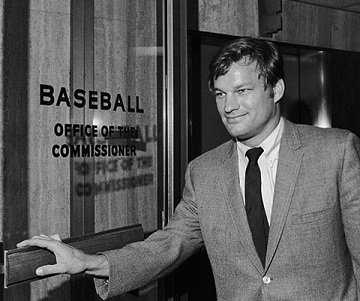
Jim Bouton steps forth from Commissioner Bowie Kuhn’s office and the meeting in which Kuhn tried to suppress Ball Four—based entirely on a magazine excerpt.

Fifty years ago Jim Bouton pitched the season he would record to write Ball Four. Once a glittering Yankee prospect reduced to relief pitching thanks to arm trouble that arose after the 1964 World Series, Bouton’s wryly candid notes, asides, and observations while pitching for the expansion Seattle Pilots and the Astros both humanised and scandalised baseball and enough of its actual or reputed guardians.

By now, of course, Ball Four is the only sports book included on the New York Public Library’s list of 20th Century Books of the Century. And Bouton died Wednesday at 80, at the Massachussetts home he shared with his second wife, Paula Kurman.

A 2012 stroke left Bouton to suffer cerebral amyloid angiopathy, a brain disease linked to dementia that compromised his ability to speak and write. Making it worse: the stroke occurred on the fifteenth anniversary of his daughter Laurie’s death in a New Jersey automobile accident.

Baseball may have gone ballistic when Ball Four hit the ground running in 1970, and Bouton could never be certain whether the Astros sent him down that year because he wasn’t pitching well or because the book was driving the front office and others out of their gourds. But he out-lived enough of his critics, most of the time the living and breathing evidence of the maxim about living well and the best revenge.

And Ball Four keeps company on the New York Public Library list with the likes of T.S. Eliot, James Joyce, William Faulkner, Virginia Woolf, Edith Wharton, Ralph Ellison, Jack Kerouac, John Dos Passos, Albert Camus, Agatha Christie, Grace Metalious, and Tom Wolfe.

Go ahead. Say if you must that Bouton didn’t exactly write The Waste Land, Light in August, Invisible Man, On the Road, or The Bonfire of the Vanities. But then T.S. Eliot, William Faulkner, Ralph Ellison, Jack Kerouac, and Tom Wolfe never had to try throwing to Harmon Killebrew, Carl Yastrzemski, Frank Robinson, Lou Brock, Frank Howard, or Willie Mays and living to tell about it, either.

To say Ball Four was received less than approvingly around baseball is to say Baltimore needed breathing treatments after the Mets flattened the Orioles four straight following a Game One loss in the 1969 World Series. “F@ck you, Shakespeare!” was Pete Rose’s review, hollered while Bouton had a rough relief outing against the Reds. All things to come considered, it was a wonder Rose knew Shakespeare wasn’t something the tavern served on tap.

Nicknamed Bulldog in his pitching days, Bouton would have been the first to say how fortunate he was to have met and married Kurman, an academic and speech therapist who holds a Columbia University doctorate in interpersonal communications, and who has worked with brain damaged children during her career. She worked with her husband carefully and helped him re-gain much of his speaking ability despite his illness.

“Together we make a whole person,” Kurman once told a Society for American Baseball Research panel, to laughter that was sad as much as approving.

But Bouton struggled concurrently with what Kurman told Tyler Kepner of the New York Times was “a pothole syndrome: Things will seem smooth, his wit and vocabulary intact, and then there will be a sudden, unforeseen gap in his reasoning, or a concept he cannot quite grasp.”

Teammates were divided mostly over Ball Four; they seemed less offended by Bouton’s vivid descriptions of the lopsided contract talks too many players experienced before the free agency era than by his candid descriptions of their clubhouse, off-field, and road off-field activities.

“The first thing I have to tell people,” said his Seattle roommate and fellow pitcher Gary Bell, with whom Bouton maintained a lifelong friendship to follow, “is that you’re not [fornicating] Adolf Hitler.” Bouton wrote in his book that being Bell’s roommate helped make him slightly more tolerable amidst teammates who weren’t exactly forward-looking or thinking. “Every year,” Bouton said of Bell, “I receive a Christmas card addressed to ‘Ass Eyes’.”

Bouton long believed fellow pitcher Fred Talbot (who died six years ago) was the teammate who was quoted anonymously as saying Bouton’s prose “would gag a maggot.” (“When I asked Fred how he was doing,” Bouton would remember in Ball Four‘s tenth anniversary edition’s postscript, “Ball Five,” after a where-is-he-now call to Talbot, “he said, ‘Well, I’m still living,’ and hung up. I didn’t even get a chance to tell him I was glad.”)

And before the Astros sent him to the minors, where he entered what proved a first retirement, unknown members of the Padres left a burned copy of Ball Four on the Astros’ dugout steps.

He got a delicious chance to write about the reaction/overreaction to Ball Four in the just-as-delightful I’m Glad You Didn’t Take It Personally, from then-commissioner Bowie Kuhn’s active attempt to suppress Ball Four to New York Daily News sportswriting legend Dick Young ripping him as a “social leper” for having written the book. When Bouton met Young in the clubhouse after that column, Young said hello and Bouton couldn’t resist replying, “Hi Dick, I didn’t know you were talking to social lepers these days.” Young replied genially, “Well, I’m glad you didn’t take it personally.” Little did Young know.

Bouton’s most famous words may well be the ones with which he ended Ball Four: “You spend a good part of your life gripping a baseball, and it turns out that it was the other way around.” But in I’m Glad You Didn’t Take It Personally, it may have been an exercise in futility for him to write, ““I think it’s possible that you can view people as heroes and at the same time understand that they are people, too, imperfect, narrow sometimes, even not very good at what they do. I didn’t smash any heroes or ruin the game for anybody. You want heroes, you can have them. Heroes exist in the mind, anyway.”

2019-07-10 JimBoutonPaulaKurman

Bouton enjoys a dance with his wife, Paula Kurman, at their Massachussetts home; the couple once competed as ballroom dance partners.

It took a very long time for baseball people to get it. Even longer than it took them to get that the late Jim Brosnan, a decade earlier, wasn’t trying to smash heroes or ruin a game when he wrote The Long Season and Pennant Race, and Brosnan didn’t go half as far as Bouton went in revealing baseball’s inner sanctum even if Brosnan incurred comparable wrath.

“I had . . . violated the idolatrous image of big leaguers who had been previously portrayed as models of modesty, loyalty and sobriety — i.e., what they were really not like,” Brosnan wrote on the 40th anniversary republication of Pennant Race. “Finally, I had actually written the book by myself, thus trampling upon the tradition that a player should hire a sportswriter to do the work. I was, on these accounts, a sneak and a snob and a scab.”

Bouton wrote and recorded Ball Four by himself, too, his editor Leonard Shecter doing nothing much more than knocking it into book-readable condition, as he would for I’m Glad You Didn’t Take It Personally. It didn’t stop Kuhn from hauling Bouton into his office and trying to jam down the pitcher’s throat a statement saying he hadn’t meant it and the whole thing was Shecter’s fault.

Both pitchers were very aware of the worlds around them, and both wrote about the periodic spells of boredom, racial tensions, off-field skirt chasings, and self-doubts endemic in their professional baseball lives. Brosnan saved them for his books and articles; Bouton was less reluctant to speak his mind about things like politics, Vietnam, and civil rights when asked or when a conversation left him the opening.

Bouton bought even less into the still-lingering press representations of athletes as heroes. Teammates didn’t always hold with that or other things, like calling them out on it when they made mistakes that cost the Yankees games he pitched.

“After two or three years of playing with guys like [Mickey] Mantle and [Roger] Maris,” he wrote in I’m Glad You Didn’t Take It Personally, “I was no longer awed. I started to look at those guys as people and I didn’t like what I saw. They were fine as baseball heroes. As men they were not quite so successful. At the same time I guess I started to rub a lot of people the wrong way. Instead of being a funny rookie, I was a veteran wise guy. I reached the point where I would argue to support my opinion and that didn’t go down too well either.”

“He stands out,” Shecter wrote of Bouton in Sport, “because he is a decent young man in a game which does not recognize decency as valuable.” Much the same thing was said of Brosnan no matter what particular writers did or didn’t think of his two books.

For decades Bouton believed Ball Four got him blackballed from the Yankees in terms of Old-Timer’s Days and other such events involving team alumni, and that Mantle was the instigator. When one of Mantle’s sons died in the mid-1990s, Bouton left a message of sympathy on Mantle’s answering machine. To Bouton’s surprise, Mantle himself called to thank Bouton and, by the way, say that it wasn’t Mantle who put Bouton in the Yankee deep freeze.

Laurie Bouton’s death prompted her oldest of two brothers, Michael, to write an astonishing op-ed piece in The New York Times calling for the Yankees to reconcile with both his father and with Hall of Famer Yogi Berra, estranged ever since George Steinbrenner fired him as manager through an intermediary in the 1980s. Michael Bouton got what he asked for. In both regards. (Yankee Stadium rocked especially with a section occupied by Laurie’s friends, holding a banner hollering LAURIE’S GIRLS!)

When Bouton retired the first time in 1970, he assembled another book, a splendid anthology of writings about baseball managers and managing called “I Managed Good But, Boy, Did They Play Bad,” then became a sportscaster for New York ABC and CBS. As his first marriage was falling apart, Bouton also tried a baseball comeback. He slogged the minors a couple of years before then-Braves owner Ted Turner abetted his September callup in 1978. After a start that prompted such comments as, “It was like facing Bozo the Clown,” as Bouton eventually recorded (in “Ball Five”), “In his next start, Bozo the Clown beat the San Francisco Giants. The pennant-contending San Francisco Giants.”

Then he tangled with Astros howitzer J.R. Richard. “The young flamethrower and the old junkballer,” Bouton described them. On the same night the towering Richard broke the National League’s single-season strikeout record for righthanded pitchers, the old junkballer fought the young flamethrower to a draw, somehow. In the interim, Bouton and a Portland Mavericks teammate named Rob Nelson cooked up the concoction that became Big League Chew gum, the kind that looked shredded like chewing tobacco, and its success made some nice dollars for Bouton and Nelson.

Bouton ended his brief baseball comeback, satisfied that he’d proven what he tried to prove, and also became a motivational speaker who also continued writing as well as joining his second wife administering a recreational 19th century-style baseball league, helping preserve an old ballpark (about which Bouton wrote Foul Ball), and becoming a competition ballroom dancing team. The Renaissance Bulldog.

Whenever one of Bouton’s former Ball Four-season teammates went to his reward, Bouton was genuinely saddened. “I think he came, over the years, to love them,” Kurman told Kepner. “As each one died, he got really teary about it. He realized how deeply they were part of him.” (The Pilots, of course, were sold and moved to Milwaukee for the 1970 season, becoming the Brewers. “The old Pilots are a ghost team,” Bouton once wrote, “doomed forever to circumnavigate the globe in the pages of a book.”)

Ball Four‘s true success, wrote Roger Angell himself (one more time: Angell isn’t baseball’s Homer; Homer was ancient Greece’s Roger Angell), “is Mr. Bouton himself, as a day-to-day observer, hard thinker, marvellous listener, comical critic, angry victim, and unabashed lover of a sport. What he has given us is a rare view of a highly complex public profession seen from the innermost side, along with an ironic and courageous mind. And, very likely, the funniest book of the year.”

Baseball didn’t collapse. The world didn’t implode. That Star Spangled Banner yet waves. Things have happened in baseball since that make any outrage over Ball Four resemble the kindergarten style debate most of the original hoopla really was. “If Mickey Mantle had written Ball Four,” Bouton once wrote, “it wouldn’t have been a big deal. A marginal relief pitcher on the Seattle Pilots had no business writing a book.” Or, implicitly, exposing the foibles and more of the reserve era’s abuses than anyone suspected existed within the Old Ball Game.

The marginal relief pitcher, once a Yankee World Series star, ended up meaning far more than that. If you want to call Bouton part of the conscience of baseball, then you must admit with more than a single tear that baseball lost something precious with his illness and, now, his death. So has his wife. So have their children and grandchildren. So has America. May the Lord and his beloved daughter welcome him home gently but happily.

Cervelli, Lucroy, and baseball’s most vulnerable beasts

2019-07-07 JonathanLucroy

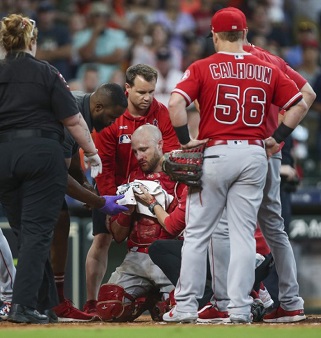
Hours after Francisco Cervelli surrendered the “tools of ignorance” Sunday, Angels catcher Jonathan Lucroy (center, kneeling) was blasted near the plate by Astros baserunner Jake Marisnick. Angels outfielders Kole Calhoun and (hidden, mostly) Mike Trout join team health personnel checking their man . . .

Baseball’s single most dangerous field position is probably behind the plate. Catchers are in on the beginning of each play, receiving the pitcher’s delivery unless its struck by the hitter. But catchers can also be men one minute made mincemeat the next, depending.

They risk being concussed into brain damage by anything from a foul tip, a violent backswing, an unforgiving wall or rail or fence while trying to catch a foul popup, or a baserunner steaming from third base and flying home in a near-perfect impression of a cruise missile. The luckier ones retire from baseball without their bodies becoming their own quislings or their minds lost in the liquefying of their brains.

Their field equipment was nicknamed “the tools of ignorance” by ancient catcher Muddy Ruel, who hoped to highlight the irony, as baseball’s very own Website points out, “that a player with the intelligence needed to be effective behind the plate would be foolish enough to play a position that required so much safety equipment.”

Ruel played generations before catchers took to wearing helmets that are the next best thing to those employed by hockey goalies. Thomas Boswell once called the catcher “half guru, half beast of burden.” It’s the latter that often means a catcher sliced, diced, and pureed, Bigfoot turned to Blue Bonnet margarine.

Baseball changed the rules a few years ago to get catchers a little further out of the line of collision than was reasonably healthy for them to remain. There were those mourning the further snowflaking of the grand old game. But maybe we ought to wonder instead how such men as Hall of Famer Yogi Berra lived as long as they did with their marbles unspilled. (Berra died at 90.)

Nothing specifically says baseball must be excessively dangerous for those who play it or those who watch and love it. Nothing suggests concurrently that even the thinking person’s sport that baseball is must be immune at all times to physical injury. But players have been known to play as though in the youthful and naive belief that they are eternally invulnerable. Until they’re not.

Hall of Fame catcher Roy Campanella once said, famously, that for a man to play baseball well a lot of him had to be a little boy. Boys will be boys, but there’s nothing written or implicit mandating that they absolutely have to destroy themselves or each other to be boys, or young men.

On baseball’s final Sunday before the All-Star break, one major league catcher decided six concussions per twelve major league seasons was quite enough, and it was time to set the so-called tools of ignorance to one side. Francisco Cervelli, Yankee turned Pirate, got number six thanks to a broken bat hitting his chin on 25 May. “That’s enough,” he told DKPittsburghSports.com’s Dejan Kovacevic. “This time is different. I can’t live like this.”

What a difference almost a month and a half makes. When first knocked down and out, Cervelli was determined to get back behind the plate as soon as feasible, which seemed to unnerve Pirates general manager Neal Huntington.

“We care about this man. We care about this person and want him to have a great post-playing career . . . You have to respect the player’s wishes,” Huntington said then. “Francisco has been adamant that he wants to continue to catch. I think he would be quite unhappy if we told him he was never going to catch for us again.”

Kovacevic says Cervelli changed his mind gradually but surely and with no instigation from the Pirates. He talks of switching to the outfield, perhaps. Barring any frequent collisions with fellow outfielders, it’s a far less dangerous place to play, assuming Cervelli can recover his batting stroke enough to justify the Pirates letting him fall in out there.

And lo! Just hours after the news of Cervelli discarding the tools of ignorance came forth, there came a play in Houston that gave his alarm too much credence.

Astros outfielder Jake Marisnick, inserted into the game against the Angels as a pinch runner for left fielder Yordan Alvarez, attempted to come home from third on a long bases-loaded fly to right by Astros center field star George Springer. Angels right fielder Kole Calhoun fired a strike home.

Marisnick came booming down the line as Angels catcher Jonathan Lucroy awaited the Calhoun throw. Mindful of the oncoming Marisnick, Lucroy moved out front and slightly left of the plate, which (read carefully) opened the lane for Marisnick to stay on a straight line, with Lucroy, a well-seasoned catcher, leaving himself concurrent room to apply a tag.

Except that Marisnick jinked left, right into Lucroy, blasting Lucroy into a heap, the impact compelling Marisnick to double back to touch the plate, before he bent over Lucroy in obvious alarm for the veteran’s health as the Angels’ training staff arrived at the plate.

The play was reviewed out of New York and Marisnick was ruled out. He would have scored the go-ahead run in a ten-all tie; the Astros ultimately won the game 11-10 in the tenth inning.

Social media seemed to bristle with Astros fans fuming over the out call, but the call was indeed correct according to the rule that’s been in place since 2014, when the Giants and most of baseball became fed up over how much playing time injuries and plate collisions cost their star catcher Buster Posey:

A runner attempting to score may not deviate from his direct pathway to the plate in order to initiate contact with the catcher (or other player covering home plate). If, in the judgment of the Umpire, a runner attempting to score initiates contact with the catcher (or other player covering home plate) in such a manner, the Umpire shall declare the runner out (even if the player covering home plate loses possession of the ball).

I watched as many replays of the play as I could. My conclusion:

1) Lucroy did indeed move to allow Marisnick a more proper lane, just before Lucroy took Calhoun’s throw to the plate on the short hop about a foot forward left of the plate. (The longtime rule was that catchers were not allowed to block the plate, a rule rarely enforced, but Lucroy acted within the letter of the current rule, too.)

2) Marisnick did indeed move left and into Lucroy’s way in a bid to move him off the play when he was indeed given a clear, straight line to the plate. If you see the play from the camera angle behind the plate, you see Marisnick look as though making a quick turn left, the pivot on his right leg, and into Lucroy.

3) Read this very carefully, too: From all appearances, Marisnick had no intention of relieving Lucroy of his limbs or his brains on the play. He wanted simply to knock Lucroy off the play and relieve him of the ball he speared seconds before impact. The ball was indeed knocked right out of Lucroy’s mitt at the moment Marisnick turned him into the high priced spread.

4) The foregoing said, Marisnick was very remorseful over Lucroy’s injury, as he tweeted subsequently: Through my eyes I thought the play was going to end up on the outside of the plate. I made a split second decision at full speed to slide head first on the inside part of the plate. That decision got another player hurt and I feel awful. I hope nothing but the best for [Lucroy].

5) Properly remorseful but momentarily blinded. Full speed or otherwise he couldn’t possibly miss Lucroy moving forward to allow him a proper lane, which, I repeat, would still give Lucroy a fair shot at tagging him out and Marisnick a fair shot at scoring.

The Angels sent Lucroy to a local hospital for a CT scan and concussion evaluation, not to mention to determine whether his nose was broken on the play. Lucroy’s week already included mourning the unexpected deaths of his Angels teammate Tyler Skaggs and his coach at Louisiana-Lafayette College, Tony Robichaux. Crowning such grief by being blown to smithereens wasn’t exactly on Lucroy’s radar.

It soiled both the Astros’ otherwise splendidly hard earned win and the afternoon on which Mike Trout, the Angels’ and baseball’s Mr. Everything, bombed his way into his team’s record book, his two launches making him the Angel with the most home runs prior to an All-Star break, ever. (The previous record, 26, was shared by Trout, future Hall of Famer Albert Pujols, and former Angels star/World Series hero Garret Anderson.)

It also spoiled such Sunday milestones as Mets rookie Pete Alonso, one of the few bright lights in a Mets season described at best as grotesque, breaking the National League’s record for runs batted in by a rookie before an All-Star break and tying the Mets’ team record for home runs before the All-Star break. (Dave Kingman set it in 1976.)

And it punctuated Francisco Cervelli’s decision with an exclamation point that might as well have been fashioned into a stake.