Astrogate messages at last?

2020-07-28 JoeKellyCarlosCorrea

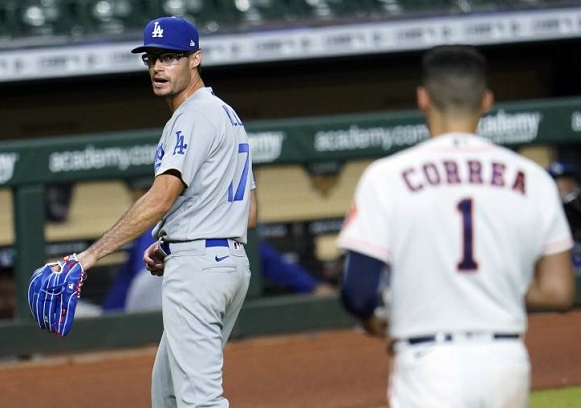
Joe Kelly (left) jawing with Carlos Correa, whom he brushed back twice in the same plate appearance Tuesday night. Should the Astros be shocked that somebody sent them post-Astrogate messages at last?

It’s not that you didn’t expect it to happen, but no matter how you feel about the Houston Astros and their extralegal electronic cheating you merely hoped it might not happen. Even if Tuesday night was the first time the Astros and the Los Angeles Dodgers met since that now-tainted 2017 World Series.

They weren’t expected to meet again unless they might tangle in another World Series. Then, the coronavirus world tour happened. When the Show returned at last, the pandemic and its mandate for extraordinary health and safety protocols prompted its governors to sketch regional scheduling featuring the Dodgers and the Astros in Houston this week, in Los Angeles come September.

You might think things are tough enough playing coronaball (reference, especially, the afflicted and drydocked-for-now Miami Marlnis) without the Dodgers having to face the team now believed to have cheated their way to that World Series title.

You might think things were tough enough without other Astro opponents still thinking in the backs of their minds that the Astros need to be taught a few little lessons in manners and in accepting responsibility in the sometimes-forgotten Astrogate wake.

You might have thought so until Joe Kelly relieved fellow Dodger reliever Brustar Graterol for the bottom of the sixth in Minute Maid Park Tuesday night.

With one out, Kelly had Houston third baseman Alex Bregman 3-0 when he decided ball four should be a fastball sailing up and past Bregman’s shoulders. The next batter, outfielder Michael Brantley, forced Bregman at second on a ground ball but made a point of stepping on Kelly’s foot as the pitcher covered first base on the play.

Kelly lingered just a little bit near the base after Brantley’s step-on and a voice was heard in the empty ballpark. It may or may not have been Astros manager Dusty Baker, but it hollered, “Get back on the mound, [maternal fornicator].” Kelly did return and go back to work.

Known to be erratic at times, and un-allergic to brushback pitches when he thinks they’re mandated, Kelly walked Astros first baseman Yuli Gurriel on four straight pitches, then opened to Astros shortstop Carlos Correa with a breaking ball behind Correa’s head and all the way to the backstop.

Officially, of course, it was ruled a wild pitch. Unofficially, even the cardboard cutouts in the otherwise empty stands knew good and bloody well that Kelly wanted to remind the Astros once again that it wasn’t nice to set up a furtive closed-circuit, off-field-based television network for stealing opposing pitch signs and think they could get away with it.

Commissioner Rob Manfred helped them think they could get away with it. Foolishly or otherwise, Manfred handed all Astro players immunity from discipline in return for spilling about the Astro Intelligence Agency after former Astro/current Oakland Athletics pitcher Mike Fiers finally blew the whistle on the AIA to The Athletic‘s Ken Rosenthal and Evan Drellich last November.

The AIA cost three managers (the Astros’ A.J. Hinch and two 2017 Astros-turned managers, Alex Cora in Boston, Carlos Beltran in New York, before he had a chance to manager even one Mets game) and one general manager (the Astros’ Jeff Luhnow) their jobs. (Any thought of Hinch possibly returning for 2021 was vapourised when the Astros exercised Baker’s 2021 club option.)

Astros owner Jim Crane was asked for no accountability beyond being fined for what amounts to maybe a year’s worth of tip money for him. Called upon to stand when spring training opened, Crane and assorted Astros players weren’t exactly apologetic for the AIA’s operations. Numerous opposing players fumed that, one way or the other, they’d find ways to administer justice, and no official edict was going to stop them.

2020-07-29 AlexBregman

“That’s dirty baseball,” Astros manager Dusty Baker fumed over this pitch to Alex Bregman from Joe Kelly. Would Baker call the Astros’ electronic sign-stealing  good clean baseball?

After Kelly struck Correa out swinging for the side, with a couple of more inside pitches in the mix, Correa was distinctly and, apparently, vocally unamused as Kelly walked off the mound and crossed the third base line to his dugout. Prompting Kelly to shoot a couple of mock crybaby faces and choice words Correa’s way.

That may have been the specific flash point under which both benches emptied and milled around the plate area. They forgot some of the social distance protocols, meaning a fine or three might be forthcoming. The dispute was bark, no bite, unless the Astros and the Dodgers were willing to dissipate the tension with some six-feet-apart pantomime boxing, but neither side was in the mood for comedy.

Baker was quoted by USA Today‘s Bob Nightengale thus: “What really enraged everybody was what he told Carlos when he struck him out, ‘Nice swing bitch!”’ Not nice. Send the message, sure. Taunt them no matter what they did or didn’t jaw your way, not so fast. Naturally, one of the Twitterpated couldn’t resist defending Kelly’s taunts thus: “Should have said something along the lines of ‘hard to hit when you don’t know what’s coming’.”

The warnings were handed to both sides after the second Correa duster. Perhaps naturally, Kelly said of the Bregman shoulder kisser, post-game, “It was a ball, obviously. It wasn’t my best pitch. Ball four, I walked him, never good to put a guy on when you’re leading the game.”

Of the breakers bending Correa, he said, “I guess he didn’t take too kind to a curve ball [inside]. It is what it is. I finally made one good pitch for the punchout . . . I pitch competitively, but with the no fans here it’s easy to hear some stuff.”

You stick to that story, son.

Some observers seemed to think, too, that the Astros were more infuriated by the buzzer  off Bregman’s shoulders than the two breakers dusting the otherwise non-entertained Correa. For his own part, Bregman merely shrugged it off when Kelly’s heat ricocheted off his shoulders and took his base. Almost as if he was well enough prepared for the incoming messages Tuesday and yet to come.

“The history obviously is out there,” said outfielder Joc Pederson before the series began. “Everybody knows what’s at stake and what happened. For being no fans, maybe sometimes the energy could be lacking a little bit. I don’t think that will be the case for this series.”

That doesn’t necessarily mean Pederson urged or condoned any message from any Dodger pitcher to any Astro hitter. Nor does it mean the Astros went into the game expecting nothing more than balls, strikes, hits, and outs, considering the jawing between the two teams before spring training was cut off at the coronavirus pass.

Recall: Dodger center fielder Cody Bellinger saying the Astros cheated for longer than affirmed and that their second baseman Jose Altuve stole the 2017 American League Most Valuable Player award from New York Yankees right fielder Aaron Judge. Recall, too: Correa rejoining that Bellinger thus spoke recklessly.

Just don’t kid yourselves that the Astros forgot for even a moment that a brushback or a knockdown was liable to come from any arm, at any time, in any game, no matter how much it seemed the pandemic pushed the long toxins of Astrogate to one side.

Until Tuesday night, only Gurriel and Correa were hit by pitches, both in the second game of the truncated season, at home against the Seattle Mariners. Until Kelly decided to lay down the law, however, all anyone thinking clearly probably thought was that the Astros were so thoroughly roasted in the immediate public Astrogate wake that throwing brushback or knockdown pitches would be as foolish as it would be unnecessary.

Like the Rogue Sox and their 2018 Replay Room Reconnaissance Ring, the Astro Intelligence Agency wear the stain of their extralegal cheating all season long, however long the season, whenever the season began. There but for the lack of grace of the coronavirus would fans and commentators alike remind both teams, good and strong, that crossing the proper gamesmanship line is filthy pool.

Only three Rogue Sox have been plunked on the truncated season thus far. But don’t fool yourself that they’re immune to thoughts that a little extra payback might be coming, too. It may not be quite as pronounced as any the Asterisks face, since they merely used what was available, predicated it with a man on base to transmit the pilfered intelligence, and didn’t install an illegal camera to begin their dirty work.

Baker himself seemed more enraged at the Kelly bullet that almost grazed the back of Bregman’s shoulders. “You don’t throw at a guy’s head,” the manager said. “That’s playing dirty baseball.” Baker’s in the unenviable position of having to help his team past the  Astrogate mess he wasn’t part or parcel of, but what would he call the AIA—good clean baseball?

Kelly wasn’t a Dodger when the AIA’s espionage operated. But he was one of the 2017 Red Sox downed by the Astros in the American League division series and the 2018 Red Sox who beat the Astros in that ALCS. You bear in mind that neither Astro nor Red Sox pitchers were co-operators of those teams’ Spy vs. Spy operations.

Kelly was also the hapless Dodger who served the pitch Washington Nationals second baseman Howie Kendrick destroyed for a tie-breaking, Dodger-burying, National League division series-winning grand slam in the Game Five top of the tenth. The last thing he needed even in abbreviated spring training was his Dodgers and the Astros getting into an Astrogate-inspired jawing contest.

Otherwise, Kelly was a pitcher in need of some kind of redemption, any kind of redemption in the eyes of Dodger fans in Los Angeles and elsewhere. The taunts were more than a little out of line. Perhaps Kelly didn’t need to send more than one brushback Correa’s way, but those weren’t half as juvenile. Well, boys will be boys, even in a time of pandemic.

Still, somewhere in that fan base they’ll remember the Dodgers beat the Astros, 5-2, to open this series, but it’ll be a by-the-way remembrance. One that has to be rushed into the conversations, swiftly, amidst the hot take that Kelly made himself something nobody in Los Angeles thought he’d become to Dodger fans after last October. A hero.
From scandal to Opening Night carnage

2020-07-25 AstroTheGrouch

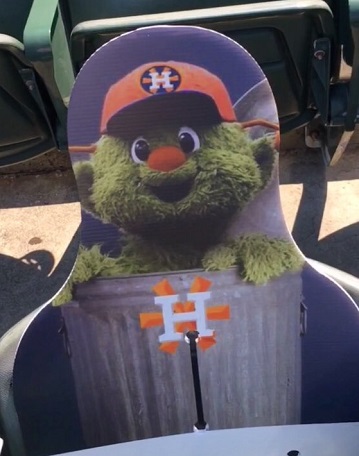
The only trolling of either the Asterisks or the Rogue Sox on their Opening Nights was this cutout fellow . . . in the Oakland Coliseum.

Regular-season day one of the Houston Astros’ post-Astrogate era came in with a bang. Not the kind that indicates transmitting signs stolen off an illegally-installed camera by way of a clubhouse monitor, but the kind that means a five-run inning and an 8-2 win over the Seattle Mariners.

Their fellow sign-stealing criminals, the Boston Red Sox, saw and raised on day one of their post-Red Sox Replay Room Reconnaissance Ring era. Even if, considering their opposition, you could accuse them this time of doing it the easy way, blowing the Baltimore Orioles out 13-2.

The best news for the Asterisks other than their Opening Day win? Not a single batter faced a knockdown pitch. The best news for the Rogue Sox likewise? Not a single batter got plunked, either—but Red Sox relief pitcher Phillips Valdez did hit two Orioles, one each in the eighth and the ninth. Quite unintentionally.

Neither the Astros nor the Red Sox looked good when they were exposed and affirmed as high-tech cheaters during the seasons of their recent World Series championships and barely brought themselves to own it, man up, and apologise properly this past winter. Leaving many, even their own die-hards, wondering whether retribution would be swift and sure.

The coronavirus world tour that suspended the Show until delayed “summer camp” training opened up may or may not have knocked those thoughts out, even if three Astros got hit very unintentionally during an exhibition game against the Kansas City Royals last week. Baseball in the age of pandemic isn’t very likely to put cheaters’ retribution high on its priority list.

Don’t even think about it, conspiracy theorists. Whatever the origin of the virus that launched out of China, it wasn’t anybody’s idea of giving either the Asterisks or the Rogue Sox cover for their crimes, either. Public humiliation sometimes beats a pestiferous pestilence for humbling the formerly haughty.

Just ask Orioles manager Brandon Hyde. His pitching staff was so futile Friday night that social media wags suggested the Orioles needed (and were about) to sign Dr. Anthony Fauci. The epidemiologist whose stiff-armed ceremonial first pitch, before the Washington Nationals’ season opener against the New York Yankees, sailed far enough past the home plate circle that the same wags also said controversial home plate umpire Angel Hernandez called it a strike on the corner.

“For me,” Hyde said balefully after the carnage ended at last, “I’d like to flush this one.” He’ll need the Ty-D-Bol Man to clean the commode after that one.

In a way, the Astros could have been accused of winning the easy way too on Friday night. They met the Mariners nineteen times in 2019 and won eighteen. For the Astros, no matter what they’re coming away from, competition like that is the next best thing to summer camp.

Justin Verlander, their future Hall of Famer starting pitcher, worked six innings, struck out seven, walked only one, and surrendered both Seattle runs by way of the solo long ball, from Kyle Lewis in the second and Korey Seager in the fourth. Just another night at the office.

But he was in a sober mood after the game, and not because of the two long balls he surrendered after surrendering 36 last season. (He averages 23 homers surrendered per 162 game lifetime, by the way. Turn off the alarm bells, there are Hall of Famers who surrendered a little more. Robin Roberts lifetime surrendered two fewer [503] than Eddie Murray hit. [505.])

“Obviously guys are risking a lot here,” Verlander said post-game, “myself included with a young daughter at home, to bring America’s pastime back to people and hopefully cheer them up and give them a little bit of a reprieve from a lot of the stuff that’s been happening.”

Peculiarly, considering the net result, Michael Brantley was the only Astro to collect more than one hit on a night that only George Springer and Yuli Gurriel went hitless for them. And they were down 2-0 when the fifth inning arrived and the fun began for them.

Aledmys Diaz opened with a base hit to somewhat deep center field, then took third as Martin Maldonado’s shot to third was thrown off line enabling Maldonado himself to have first on the house, before taking second on Springer’s ground out back to Seattle starting pitcher Marco Gonzales.

Jose Altuve dumped a single to left to send Diaz home and chase Gonzales in favour of Zac Grotz. The new and dubious three-batter minimum rule bit Grotz and the Mariners right in the kishkes right off the bat, when Alex Bregman singled Maldonado home and Brantley drove one into the right field seats, before Grotz got Gurriel to ground out to third and Carlos Correa to pop out to second.

The Astros tacked single runs on in the sixth and the seventh and let the bullpen finish what Verlander started. No muss, no fuss, and no known shenanigans. And it was nothing compared to what the Red Sox detonated against the Orioles. Their 10-0 lead after five innings was enough to tempt the Orioles to petition the Hague lodging human rights violations charges.

The Red Sox scored four in the third and six in the fourth, and their starting pitcher Nathan Eovaldi—who opened the game with a 100-mph fastball to Austin Hays—found himself in the unusual position of having such a comfort zone he could have let each Oriole batter know what was coming and still gotten rid of them fast enough.

Three RBI doubles including a two-runner by Kevin Pillar hung up the third-inning four-spot. Well enough into the Oriole bullpen in the fourth, Andrew Benintendi walked the fifth Red Sox run home to start that inning’s fun and prompt a pitching change. Fat lot of good that did the Orioles. J.D. Martinez promptly scored Jackie Bradley, Jr. and Jose Peraza with a ground-rule double.

Rafael Devers then hit into the first Red Sox out of the inning. That relief lasted long enough for Xander Bogaerts to single Benintendi home, Pillar to single Martinez home, and Christian Vazquez to single Bogaerts home. And Bradley and Peraza had more destruction to offer the Orioles in the sixth, Bradley hitting a two-run double and Peraza hitting a single-run double right after that.

Somewhere, the Orioles snuck two runs home on a sixth-inning double (Renato Nunez) and a seventh-inning homer. (Rio Ruiz.) They may still be trying to figure out how those happened, when they’re not trying to figure out just how the Red Sox mustered the burial without Mookie Betts, who’s now the Los Angeles Dodgers’ $396 million man after the Sox sent him and David Price out west in an unlikely salary dump.

For the Astros’ new manager, Dusty Baker, it was his 3,500th game as a major league manager. “That,” he said about Friday night’s flogging, “was the strangest opener of my career.”

Maybe playing in their home playpens helped, and likewise the lack of live fans in the stands, but the only thing trolling either the Astros or the Red Sox over their high-tech cheating scandals was in the Oakland Coliseum, where the Athletics—whose pitcher Mike Fiers (a 2017 Astro) blew the whistle on Astrogate last November—hosted the Los Angeles Angels to open the season.

One of the fan-financed cutouts in the Coliseum seats showed Oscar the Grouch in an Astros hat in a trash can marked with the Asterisk logo that went viral as Astrogate unfurled last winter. The Astros travel to Oakland for the first time for a series beginning 7 August. Bet on Oscar the Astrogrouch being among the cutouts then. That should be the least of their problems.

At last, an Astrogate apology

signstealingscandal.com

A video capture made infamous by Jonboy after the first Astrogate revelations: Evan Gattis at the plate in 2017, about to face a pitch from Danny Farquhar just before Farquhar called his catcher to the mound to switch signs . . .

Maybe Evan Gattis felt a little too much heat last week, when he snarked about being the last to land a nasty drinking cup with Mike Fiers’s face and the caption “Snitches Get Stitches.” And, when he hastened to walk it back after his boast got him a small firestorm (including “Cheaters Get Heaters”) of snark-back.

Maybe, too, the former Astros backup catcher was reminded that was him at the plate in a 2017 game against the White Sox, on preserved and notorious video, getting electronically stolen signs banged his way until White Sox pitcher Danny Farquhar smelled the proverbial rat, called his catcher out to the mound, and changed signs posthaste.

Whatever compelled him, the now-retired Gattis isn’t feeling too snarky about Astrogate anymore. He unloaded to The Athletic‘s podcast 755 is Real this week. He unloaded a no-holds-barred apology for the Astro Intelligence Agency’s illegal, off-field-based electronic sign-stealing of 2017-18, even while acknowledging that by now no apology on earth will untaint or restore the Astros’ image.

And he’s also more than willing to give Fiers—the original Astrogate whistleblower, the only one among four 2017 Astros who was willing to put his name on the record to The Athletic‘s Ken Rosenthal and Evan Drellich last November—his props, rather than saluting even a just-kidding threat against the now-Athletics pitcher.

“I don’t think I can win the hearts over of anyone right now at all, or maybe ever,” Gattis told 755 is Real. “I don’t know how to feel yet. I don’t think anybody—we didn’t look at our moral compass and say, ‘Yeah, this is right.’ It was almost like paranoia warfare or something. But what we did was wrong. Like, don’t get it twisted. It was wrong for the nature of competition, not even just baseball. Yeah, that was wrong. I will say that.”

Retired since the end of the 2018 season, Gattis didn’t stop there. “If our punishment is being hated by everybody forever, then (so be it),” he said, after saying he hated to see general manager Jeff Luhnow and manager A.J. Hinch fired almost the moment their suspensions for 2020 were handed down by commissioner Rob Manfred.

“And I don’t know what should have been done, but something had to be [fornicating] done,” the former catcher continued. “And I do agree with that, big time. I do think it’s good for baseball if we clean it up. But I really don’t know to this day, and I’ve thought about it a [spit] ton, know what I mean? And I still don’t know how to feel.

“I’ll get ripped by somebody—‘That’s not an apology’—and if I do apologize, that’s still not going to be good enough. No [spit], it’s not going to be good enough. I understand that it’s not [fornicating] good enough to say, sorry. I get it.”

Luhnow and Hinch may have been suspended from baseball through the end of the 2020 season, whenever the season might be played if it’s played thanks to the coronavirus pandemic, but they’d be free to seek other baseball employment afterward. Even if 2020 ends up canceled entirely. There are those who say nobody should even think about hiring them even as concession hawkers.

Luhnow fostered the victory-uber-alles culture within the Astros organisation that too often operated according to Major Strasser’s law (expressed in a memorable line in Casablanca), “You’ll find that human life is cheap.” A culture that allowed Luhnow to dismiss internal alarm when he dealt for a relief pitcher still under suspension for domestic violence and call for an internally-developed sign-stealing algorithm that paved the way to the AIA.

Hinch didn’t exactly look the other way when he caught onto the AIA, but he did nothing to stop it other than smashing one or two of the monitors in the clubhouse from which the opposing signs picked up by an illegal camera were transmitted for translation to pass on to Astro hitters. He fiddled while the plot apparently led by his then-bench coach Alex Cora and his then-designated hitter Carlos Beltran—both of whom eventually lost managing jobs over their Astrogate culpability—burned opponents with little to no idea they walked into a stacked Astro deck.

“For some players that we faced, that I’d never faced before or something like that, even selfishly we didn’t get to find out how good those people are—and they didn’t either,” said Gattis to 755 is Real. “I think that was the one cool thing about playing in the big leagues, was just to find out how good you are, which I think is valuable. Everybody wants to be the best player in the [fornicating] world, man, and we cheated that, for sure. We obviously cheated baseball and cheated fans. Fans felt duped. I feel bad for fans.”

Gattis may have handed ammunition, inadvertently, to former major league pitcher Mike Bolsinger’s legal team, in Bolsinger’s lawsuit arguing that—when he was trying to hang in as a remade relief pitcher with the 2017 Blue Jays—the Astros’ illegal sign-stealing operation destroyed him in what proved his final major league appearance.

In that game, the Astros got more stolen signs banged on the can to their hitters than in any other game for which banging-the-can-slowly could be determined. They also got more when Bolsinger was on the mound than when they faced any other Blue Jays reliever that day. Bolsinger was torn apart for five runs when he entered with two out in the bottom of the fourth, escaping only when he managed to get Alex Bregman to fly out.

The Blue Jays sent Bolsinger to Triple A right after the game. He might have been a former starter reduced by injuries to a journeyman trying to remake himself as a reliever, and I’ve said this before elsewhere, but it’s worth a reminder: Even a marginal relief pitcher has the right to know that his major league career got torpedoed straight, no chaser.

The Astros have had the original Los Angeles judge in the Bolsinger lawsuit removed for “prejudice,” never mind that the judge was chosen at random. They followed that by filing to have the suit either thrown out or moved to Texas in the name of “fairness.” They also face a lawsuit back east from a group of fantasy baseball players arguing that the AIA tainted the games through which they played their fantasy ball.

Aside from handing both lawsuits’ plaintiffs valuable close air support, Gattis isn’t so willing to be snarky about Fiers anymore, either, if his comments to 755 is Real are any indication.

“With Fiers, he had something to say, dude,” the former catcher continued. “It probably started out with him saying exactly what he said—some of these guys coming into the league, they don’t [fornicating] know yet that this [spit] goes on. And I respect that. And he had something to say. So he had to [fornicating] say it. And then we had to get punished. Because if not, then what? It’ll get even more out of control.”

Gattis acknowledged that previous reports citing an anonymous 2017 Astro had it right that Brian McCann, the longtime Brave who joined the Astros for 2017-2018, who retired after a final tour with the Braves last season, objected to the AIA “and made his feelings known at least a couple of times,” as Athletic writer David O’Brien phrases it.

“I could tell it was eating him up,” Gattis told the podcast. “He didn’t like it one bit . . . He’s played so long, and he just understands what it takes to get to the big leagues, and he’s got a lot of respect for ballplayers. You could just tell.”

But you can also just tell that a man making his objections known at least a couple of times isn’t quite the same thing as a man in McCann’s position—a veteran with respect in the clubhouse, whose voice would be heeded assuming he puts more weight into it than a couple of objections made known—pushing a little further within his particular boundaries to turn mere objections into a needed confrontation.

And Gattis isn’t exactly ready to lay the Astrogate onus as heavily as others upon Beltran, whose standing as so respected a veteran, with a Hall of Fame-worthy playing resume, is said often enough to have felt just a little omnipotent among his younger teammates.

“[N]obody made us do [spit] — you know what I’m saying?” Gattis said. “Like, people saying, ‘This guy made us do this’ . . . That’s not it. But you have to understand, the situation was powerful. Like, you work your whole life to try to hit a ball, and you mean, you can tell me what’s coming? What? Like, it’s a powerful thing. And there’s millions of dollars on the line and shit? And what’s bad is, that’s how people got hurt. That’s not right; that’s not playing the game right.”

The Astros weren’t exactly overcome with remorse when Manfred’s Astrogate report was released in January. They weren’t exactly allergic to (depending on your viewpoint) non-apologetic apologies or apologetic non-apologies when spring training opened. Owner Jim Crane persists in his delusion that the Manfred report “exonerated” him and his ignorance that, when you lead, you assume responsibility for what’s done by your subordinates.

Now it’s only to lament that Gattis couldn’t have said upon his retirement what he finally said to 755 is Real. It might have made a far larger difference. Still, the fact that Gattis was willing to go on the public record as he now has to 755 is Real is staggering enough. Whether he saw the light, felt the heat, or came up somewhere in between.

Now it’s Soxgate, too?

2020-01-07 AlexCora2018RedSox

2017 Astros bench coach turned 2018 Red Sox manager Alex Cora hoists the 2018 World Series trophy. The ’18 Sox are now believed having used their replay room for off-field sign-stealing, amplifying suspicions around Cora himself.

Long before he became a major league coach then manager, Alex Cora endeared himself to me when he was a Dodger hitting a seventh-inning home run on 12 May 2004. It wasn’t the home run itself but what led to it—Cora hit the eighteenth pitch of a plate appearance against Cubs pitcher Matt Clement into the right field bullpen. The Iliad, The Odyssey, and Ben-Hur weren’t that epic.

I watched that game live on television from my then-home in Huntington Beach, California. Cora wasn’t exactly a power hitter, of course; Sammy Sosa hit as many home runs in 2004 (35) as Cora hit in his entire fourteen-season playing career. He was a clever utility infielder whose best work was with his glove on either side of second base and his brains otherwise, and he was valuable enough as a utilityman to play on the Red Sox’s 2007 World Series winner.

As Cora checked in at the plate on that May night, the Dodgers’ still-very-much-missed voice Vin Scully noted he’d hit a couple of fly balls earlier in the game, “but if you don’t have power, a couple of fly balls is wasted opportunity.” He batted with nobody out in the bottom of the seventh and a short-career left fielder named Jason Grabowski aboard with a leadoff walk.

Cora looked at ball one up and away to open. He took a strike near the outside corner, then took ball two away, then fouled one off. And then the fun really began without once going to ball three. Cora fouled eleven more off. We’ll let Scully take it from there:

. . . The crowd now is really into the pitches . . . and still two and two. Nobody out. Big foul . . . wow! . . . It’s a sixteen-pitch at-bat, and the crowd loves it, and look at Dave Roberts. They’re all enjoying this battle. Matt Clement and Alex Cora. Coming into the game, Cora was hitting .400 against Clement, he is oh for two tonight. So the game within the game here. So here’s the sixteenth pitch. What an at-bat! . . . [foul ball] . . .  Seventeen pitches . . . it is the rare time that you can be in the ballpark and everyone is counting the pitches, and it’s gonna be a seventeen-pitch at-bat, now, at least. We, I don’t know, you know, they don’t keep records of pitches in at-bats, but it’s kind of special. This will be the seventeenth pitch. Grabowski’s exhausted, and Mike Ireland reminds me how about if Grabowski had been running on every pitch? Time . . . ohhh, the crowd is loving it . . . Ever see so much excitement? And nothing’s happened, that’s what’s really funny about it. All right, here’s the seventeenth pitch—and, it’s foul. Foul ball by a hair! So that means that it will be at least an eighteen-pitch at-bat . . . Clement has made more pitches to Alex Cora right now than he has made in any inning but the third . . . the eighteenth pitch—high fly ball into right field, back goes Sosa, way back to the gate, it’s gonnnne!! Home run, Alex Cora, on the eighteenth pitch, and the Dodgers lead, four to nothing. What a moment! 9:23 on the scoreboard if you want to write it down for history . . . what an at-bat! And Dusty Baker says, “We’re gonna stop the fight.” And Dusty’s going to bring in a fresh horse. That’s one of the finest at-bats I’ve ever seen. And, then, to top it off with a home run, that is really shocking. Yeah, take a bow, Alex, you deserve it and then some. Oh, by the way, that also means the Dodgers have homered in six straight, but it took a whale of a job to do it. Stay where you are, four-nothing Dodgers, and look at the ball club.

Cora would have been remembered for that surrealistic plate appearance if nothing else had his baseball career ended when his playing days did. Even if the Los Angeles Times didn’t remember; their game coverage the following day said not a lick about Cora’s seventh-inning stretcher.

The paper called it the way you see it now in the box scores: Cora, home run. Baseball Reference, bless them, gives you a little more: it notes the pitch count up to and including Cora’s loft just into the right field bullpen. An edited YouTube video clip from the original Dodger broadcast including the Scully call is preserved by MLB, the editing dropping out in favour of the full coverage as Cora was about to face his fifteenth pitch.

Brainy as he was it was no wonder Cora parlayed himself into coaching and, in due course, managing. Except that now it appears more certain than suspected that Cora—whose inaugural season as the Red Sox manager finished with beating his former Dodgers (managed by his May 2004 Dodger teammate Dave Roberts) in the 2018 World Series—knows something more about fouls than just whacking them away to set up an unlikely two-run homer.

Cora was the Astros’ bench coach during their run to the 2017 World Series conquest. Before that postseason ended he’d agreed to become the Red Sox’s next manager. And one of the first things he was quoted as telling his new team, whom the Astros pushed aside in the 2017 division series, was, “You guys were easy to game plan against. Too many bad takes.”

Those were nothing compared to the bad take now surrounding Cora. Because Ken Rosenthal and Evan Drellich, who seem to be for The Athletic with Astrogate what Carl Bernstein and Bob Woodward were considered to be to the Washington Post for Watergate, now say the 2018 Red Sox had a little espionage operation of their own in play during that year’s regular season. And, that unlike the Astros’s engagement of an off-field live-feed camera for sign-stealing, the Red Sox thought of something they could try at home and on the road:

Three people who were with the Red Sox during their 108-win 2018 season told The Athletic that during that regular season, at least some players visited the video replay room during games to learn the sign sequence opponents were using. The replay room is just steps from the home dugout at Fenway Park, through the same doors that lead to the batting cage. Every team’s replay staff travels to road games, making the system viable in other parks as well.

Rosenlich (well, the combination worked for Woodstein, right?) are careful to clarify that nobody including whomever the Red Sox three might be thinks the Red Sox tried it during that postseason, if only because they would have been caught as red-handed as the original five Watergate burglars:

Red Sox sources said this system did not appear to be effective or even viable during the 2018 postseason, when the Red Sox went on to win the World Series. Opponents were leery enough of sign stealing — and knowledgeable enough about it — to constantly change their sign sequences. And, for the first time in the sport’s history, MLB instituted in-person monitors in the replay rooms, starting in the playoffs. For the entire regular season, those rooms had been left unguarded.

This wasn’t exactly as “egregious” (Rosenlich’s word) as the Astro Intelligence Agency’s underground television network, contravening baseball’s rule mandating eight-second camera feed delays to send stolen signs to a monitor near the dugout steps from where someone, who knows whom just yet, sent the stolen opposition signs to the batter with bang-the-can-slowly. But it’s no less beyond the ordinary bounds of on-the-field gamesmanship, even if the Red Sox system did involve at least one man on the field.

The Red Sox operation was workable only with a runner on base. They simply took the burden of catch-and-release away from the baserunner who’s usually the one who engages the on-field gamesmanship of sign stealing. Someone, who knows whom, would be in the Red Sox replay room at home or on the road, catch the sign from catcher to pitcher, and send it to the runner to send to the hitter. You’ve got to be a lot more swift to do it that way, and apparently the 2018 Red Sox were during the regular season.

Not that Rosenlich lack for a caution or two. “It’s impossible to say for certain how much this system helped the Red Sox offense,” they write. “But their lineup dominated in 2018, when they led the league in runs scored.” And, like the Astros, the Red Sox—who got caught flatfoot in 2017 when one of their people was caught using an AppleWatch to try stealing Yankee signs—were convinced enough that others were doing likewise that they weren’t above a little creative against-the-rules espionage themselves.

“You got a bunch of people who are really good at cheating and everybody knows that each other’s doing it,” Rosenlich quote “one person with” the ’18 Sox. “It’s really hard for anybody to get away with it at that point . . . If you get a lion and a deer, then the lion can really take advantage of the deer. So there’s a lot of deers out there that weren’t paying attention throughout the season. In the playoffs, now you’re going against a lion.”

Using the replay room for sign-stealing didn’t exactly begin with the 2018 Red Sox. “It was also similar,” Rosenlich write, “to one the Yankees and other teams had employed before MLB started its crackdown. (Hitters can legally visit the replay room during games to study some video.)” The trick was to be swift enough afoot to make it work without using further electronic devices.

Rosenlich also exhume a three-page March 2018 memo to team presidents from MLB’s chief baseball officer, Joe Torre (himself a former major league catcher), in which he emphasised just how much against the rules high-tech off-field sign-stealing is: “To be clear,” the memo said, “the use of any equipment in the clubhouse or in a Club’s replay or video rooms to decode an opposing Club’s signs during the game violates this Regulation.”

And sometimes the replay room monitors weren’t always immune to being compromised themselves, with Rosenlich observing, “Some would stay in the video replay room the entire game, while others would disappear for periods of time.” The duo go on to cite an unnamed video scout, not with the Red Sox, directly:

Some acted like they were your best friend, root you on. Others would tell on you for the littlest things that weren’t even real,” the scout said. “It was very inconsistent how each person took their job and what they were actually doing . . . You knew this guy was a stickler, and with this guy you could get away with some stuff. How does it stop cheating? The teams that were going to cheat were going to cheat, no matter what.

Whither Alex Cora? Rosenlich are already on record as reporting that Cora and new Mets manager Carlos Beltran (a designated hitter with the ’17 Astros who was often approached by teammates as having the mind of a coach himself) had an as-yet-undetermined hand in at least devising the Astro Intelligence Agency. Nobody knows yet just how Cora and Beltran helped devise it if indeed they did.

But Cora going from the Astros’ world champion as their bench coach to the ’18 Red Sox as their first-year manager taking them all the way to a 108-win regular season preceding a World Series triumph now looks a little too suspect. Did he know about and/or sanction the ’18 Red Sox’s replay room rompering? Did he suggest, based on any direct knowledge of the Astros’ slightly more arduous technique, that the replay room just might be a slightly simpler way to steal signs and get away with it?

No, Astroworld. The Red Sox’s replay room rompering doesn’t get the Astros off the hook. The everybody’s-doing-it defense isn’t going to wash for the Astros, and it won’t for the Red Sox, either. Red Sox Nation, of which I’ve been a member since that thriller of a 1967 pennant race in hand with being a Met fan since the day they were born (ask not my October 1986 pharmaceutical bills), is about to join Astroworld in having to come to terms with at least some of their heroes being cheaters.

“The issue . . . extends beyond individual teams, encompassing the league’s enforcement and upkeep of its own rules,” Rosenlich write. “Many inside the sport believe there is cheating and then there is cheating-cheating. In this view, the Astros undertook the latter, while more indirect video-room efforts—at least before late 2017—counted as the former.”

If and when the actual Astrogaters are revealed in full, Astroworld will be anything but amused, just as I wasn’t amused to discover that a team whose reconstruction into a powerhouse I admired turned out to be riddled with a human factor-challenged front office and field personnel who weren’t above extralegal espionage. According to ESPN’s Jeff Passan, the Astros should learn within the next two weeks just who’s going to be taken to the Astrogate woodshed and whether they come out bruised, battered, or broken.

It doesn’t amuse me that Alex Cora, a player whose tenacity I cheered one fine May 2004 evening and whose intelligence I always admired, may well have gone from helping to devise one elaborate cheat to at least fostering a second that was less elaborate if not less egregious. It amuses me even less that the Red Sox had to do it the new old fashioned way, too.

Short of posting armed Pinkerton guards inside the replay rooms, how baseball’s government handles Astrogate, Soxgate, and any other -gates yet to be affirmed should prove at least as intriguing as Cora’s once-upon-a-plate-appearance foul mastery. The kind he’s suspected of now, involving two teams, is more liable to end not with a two-run homer but a called strikeout.

It makes a fellow not so proud to be an Astro

2019-12-10 AJHinch

A.J. Hinch, looking as though at minimum he’s been sent to the principal’s office.

Once upon a time a very different generation of Astros amused themselves on team buses and planes by singing a randy song to the tune of legendary musical humourist  Tom Lehrer’s “It Makes a Fella Proud to Be a Soldier.” The late Jim Bouton, an Astro from August 1969 until his aging arm plus the hoopla over Ball Four farmed him out to stay in 1970, said every new Astro received a copy almost at once. Then, he recorded the complete lyrics including this verse:

Now our pitching staff’s composed of guys who think they’re pretty cool,
with a case of Scotch, a greenie, and an old beat-up whirlpool.
We’ll make the other hitters laugh
then calmly break their bats in half,
it makes a fellow proud to be an Astro.

Those Astros hung on the fringe of the National League West race in divisional play’s first season. Today’s Astros, long since moved to the American League (they were the team to be named later in former commissioner Bud Selig’s move of his formerly owned team, the Brewers, to the National League), are three-time American League West winners in the midst of which also came two pennants and a World Series conquest.

Now the Astros have lost a pitcher who didn’t necessarily make the other hitters laugh while he broke their bats in half: Gerrit Cole, who served them better than well for two seasons and proved off-the-charts magnificent down this year’s stretch and in the first two postseason rounds. Reaching his first career free agency, Cole couldn’t resist the Yankees’ extending him a deal for nine years at $324 million, the highest ever to be paid to any major league pitcher.

Which tells you something about what can happen when a good pitcher in sound condition finally became a great pitcher in sound condition in 2019, after joining a team with deeper knowledge of the art and its array of correctives than his former team (the Pirates) ever seemed to allow. And Cole joins the team he helped defeat in this year’s American League Championship Series, the team he would have faced in Game Seven if not for Jose Altuve’s stupefying, game-set-and-pennant winning two-run homer in the bottom of the ninth in Game Six.

Everyone including myself ponders the immediacy of the winners and losers on this winter’s market after Cole’s signing. Including the Astros themselves, whose owner Jim Crane, as CBS Sports’s Dayn Perry observes, “is pointlessly worried about staying under the Competitive Balance Tax threshold. According to multiple reports, the Astros are even shopping star shortstop Carlos Correa in the name of payroll efficiency. The Astros are one hundred percent in win-now mode, and the idea of trading Correa and not bidding vigorously to retain Cole should have fans calling Crane to account.”

For that and a few other things, of course. And some of us including myself ponder, too, whether Cole will bring the Yankees such knowledge as he might have, intimate or otherwise, as regards, you know, the other stuff buffeting the Astros now. The Astrogate probe is now said looking beyond 2017, into both the seasons during which Cole suited up and pitched for the Astros, and you’d be less than human if you didn’t contemplate whether Cole would enlighten his new teammates on the Astro Intelligence Agency as did Mike Fiers when he signed with the Tigers, and subsequently joined the Athletics, after 2017.

Hours before the Cole signing detonated the world in general and the Twitterverse in particular, Astros manager A.J. Hinch discovered his presence at this week’s winter meetings in San Diego meant the press finding it impossible to resist asking him about Astrogate. It was certain that he wouldn’t answer questions about it because the commmissioner’s is an ongoing investigation. And far be it for Hinch to break the rules in this instance, one of which enjoins against speaking up or forth while such an investigation proceeds and progresses.

The cynic would chew on the continuing strain of accepting those rules you’re comfortable accepting and breaking those you’re comfortable breaking, on the assumption that Hinch was surely well aware of the AIA, since the concurrent presumption is that a baseball manager a) is responsible for the doings or undoings by those under his command and b) unlikely under most such circumstances to have disapproved above or beyond the customary “just don’t get caught, boys” admonition.

But still . . . but still . . . “If I was in your shoes, I would be on the other side of this table,” Hinch told the gathering in response to a question. “And I would want to ask questions and find answers and get some more information on the investigation and all the allegations and things like that. I know you’re probably expecting this, but I can’t comment on it. It is an ongoing investigation.”

Associated Press reporter Jake Seiner translated thus that Hinch “is eager to tell his side of the story regarding allegations Houston used electronics to steal signs en route to a 2017 World Series championship, but he is going to let Major League Baseball talk first.” The Athletic‘s Spink Award-winning Jayson Stark (presented his award in Cooperstown this past July) tweeted at about 5:34 p.m. Pacific time Tuesday, “”AJ Hinch just finished 19 uncomfortable minutes of meeting with the media. Mostly declined comment on anything related to the cheating investigation. Said he’s talked to MLB ‘a couple of times’ and now is just ‘waiting’ for a verdict. ‘Everything is in their hands’.”

If you’ve lost the track of the AIA flow chart, it’s this: Live, real-time camera operated from somewhere behind the center field playing area transmits live, real-time signs to the opposing pitcher, which transmission is seen on a large enough, duly connected monitor in the Astro clubhouse adjacent to the steps from the clubhouse to the dugout, in front of which someone, who knows whom just yet, deciphers the signs and transmits them to an Astro hitter with one or two bangs on a large plastic or vinyl trash can, dependent upon which pitch the victimised catcher called.

“I’ve committed my time and energy to cooperate with MLB,” Hinch went on to say Tuesday evening. “I’ve talked to them a couple times, and we continue to work with them as they navigate the investigation, and now we’re waiting with everything in their hands. So I know there’s still going to be questions. I hope there’s a day where I’m able to answer more questions, but I know today’s not that day. I know it will disappoint some people.”

In some other words, Hinch may be anxious to lay it down about Astrogate but any time you need Hinch—heretofore considered one of baseball’s most sensitively intelligent managers—don’t just whistle, and he won’t blow the whistle himself until he has some sort of official dispensation or pang of conscience to do so. If the rules of his profession enjoin against commenting publicly about an ongoing investigation, his immediate answer still leaves Hinch with a dubious look, though not even close to the one left to Crane when, at last month’s owners’ meetings, he, too, dismissed Astrogate questioning.

“If you want to talk about baseball, I’ll talk about baseball,” was Crane’s dismissal, as if electronic cheating from off the field, violating baseball’s specific rule against such espionage, and the likelihood that the Astros aren’t the only team operating such spy operations, had absolutely nothing to do with the game. The painfully few Astrogate comments from within the Astros’ apparatus have included hopes that the Astros don’t become the poster children for something not restricted to themselves, and that’s very much to do with baseball.

If Hinch and Crane were employed instead in the business of the government, answers like theirs might harry reporters and investigators toward exhuming a cover-up almost as ardently as they already harried to the original crime, misdemeanour, or contra-constitutional mischief. Reporters and investigators alike on the Astrogate trail are doing just that, surely. The safest assumption is that more than a handful of Astros knew about and availed themselves of the AIA that sauntered far past the accepted bounds of on-the-field gamesmanship.

Believing Hinch knew nothing of or ignored the operation particularly when the bangs! or the bang-bangs! on the can went booming forth insults our own intelligence. What could he believe they were? Teammates rooting? Between-turns batting practise by players anxious not to be more than a few hops from stepping in as a pinch swinger and thus not repairing to the underground batting cages? Practise for banging a drum slowly during a victory parade?

Commissioner Rob Manfred and his bloodhounds may discover very well that the Astros aren’t the only major league team with a taste for espionage—if they haven’t discovered that already. (Published reporting suggests that as of this writing almost sixty witnesses and over seventy thousand e-mails have been gathered with more, much more to come.) But Hinch is in a position that can’t hold very long, and he may yet experience a pang of conscience akin to that of his former pitcher Fiers, who blew the whistle on and pulled the covers off the AIA in the first place.

Hinch heretofore earned a reputation as one of baseball’s most sensitively intelligent managers, a reputation in danger of being very badly vaporised. His face Tuesday evening showed every suggestion of the schoolboy who knows his trouble has only just begun after he’s finished in the principal’s office. Like Fiers, his conscience pang wouldn’t necessarily mean naming or implying suspects. But Hinch would be to baseball as Alexander Butterfield to the Nixon White House, exposing its sophisticated in-house taping system under Senate questioning during the early Watergate peaks.

Butterfield installed the White House system and owned up. Hinch may or may not have conceived the AIA himself. If he didn’t but he was genuinely unaware, his looks could well become those of a man whose smarts were invaded by incompetence that would strike some as cruelly comic and others as tragic. It makes a fellow not so proud to be an Astro.