The Great Escape

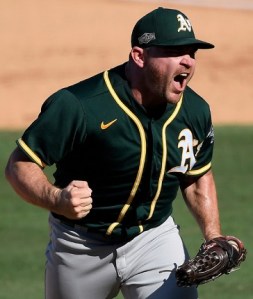
Liam Hendriks, who just might be able
to bust his way out of a double-chain-
locked footlocker if asked to do it.

Postseason baseball is littered enough with mishaps, mistakes, and acts of God (we think, often as not) that turn certain triumph into disaster in less than the proverbial New York minute. The Oakland Athletics got thatclose to seeing for themselves in the bottom of the eighth Wednesday afternoon.

When A’s catcher Sean Murphy’s glove was hit by the bat of Houston Astros right fielder Kyle Tucker with Carlos Correa aboard and nobody out, the catcher’s interference call stood an excellent chance of standing as the arguable worst postseason moment in A’s history.

That’s because it happened immediately after the A’s sacrificed their way back to a two-run lead in the top of the inning, with a pair of sac flies, one inning after Chad Pinder yanked them back from the dead and into a fresh tie with a long distance call.

The interference suddenly turned Oakland closer Liam Hendriks’s day’s work from somewhat routine with a three-up, three-down seventh into an eight-inning wrestling match. That was not what the A’s needed with a tenuous late, re-claimed lead, in a game they had to win to stay alive in the division series the Astros threatened to sweep.

It also could have made A’s manager Bob Melvin go from looking like a genius for bringing Hendriks in so soon in the first place to looking like a nut for . . . bringing him in so soon. But it turns out that Hendriks doesn’t like leaving his manager looking like a straitjacket candidate.

The husky righthander also isn’t averse to a hard wrestling match. Not even against these Astros whose 29-31 irregular season record belied their postseason batting revival thus far.

Not when Hendriks could get Yuli Gurriel to pop out to first, Aleidmys Diaz to ground out to second, and Josh Reddick to strike out so violently on a pitch that barely missed the middle of the plate that Reddick—pinch hitting for Astros catcher Martin Maldonado—fumed and broke the bat over his knee angrily as he left the plate area.

A’s fans might have a difficult time deciding the day’s biggest hero. Was it Pinder nailing Astros reliever Josh James’s first pitch after seventh inning-opening back-to-back singles for that game re-tying three-run homer into the right field corner cutouts? Was it Hendriks making Harry Houdini resemble a clumsy Watergate burglar in that 19th-nervous-breakdown eighth?

In a Game Three that featured seven home runs, a 4-2 Oakland lead turned into a 7-4 Houston lead with a five-run fifth, and five lead changes before Pinder launched—who would have wagered that the day’s heaviest drama would be an eighth inning like that? Even on a day George Springer, who treats Dodger Stadium like his personal batting cage, struck out three times and didn’t hit a lick?

Finish the Astros off in the ninth? Child’s play. Strike out Springer, lure Jose Altuve into popping out to first, and get Michael Brantley to fly out to left? Simpler than shaving in the morning, right? There’s a clearance sale on bathing suits at the North Pole waiting for you.

The Atlanta Braves throwing their third shutout in four postseason tries at the Miami Marlins earlier in the day? Ho-hum. Pending whatever came between the New York Yankees and the Tampa Bay Rays in another ALDS, plus the Los Angeles Dodgers and the San Diego Padres in another NLDS, the A’s and the Astros claimed Thursday’s Alfred Hitchcock Prize for High Drama.

To think that it looked like just another routine long distance exchange before the bottom of the eighth arrived.

Tommy LaStella, who had to leave the game in the eighth after he was hit on the arm by an Andre Scrubb pitch (and when will they change the name of the bone away from “humerus,” since LaStella thought it was as funny as a vampire managing the blood bank) opened the barrage with a first-inning, one-out launch over the center field fence.

Altuve faced Oakland starter Jesus Luzardo in the bottom of the first with one out. He caught hold of a changeup hanging a little off the middle of the zone and hung it to the same real estate but about 25 feet farther out. Brantley coming home on an infield ground out later in the inning merely made for a 2-1 Astro lead. Big deal.

A’s left fielder Mark Canha said “not so fast” leading off the top of the second and sent Astros starter Jose Urquidy’s 1-2 dangling slider dangling over and into LaStella’s and Altuve’s real estate—but landing at a mere 394 feet.

A’s first baseman Matt Olson decided the three half innings preceding him leading off the top of the fourth were a little too quiet. He hit Urquidy’s first pitch into the right field bleachers for a 3-2 A’s lead. Shortstop Marcus Semien decided the A’s punished Urquidy enough for one day, chasing him with one out in the top of the fifth with yet another launch over the center field fence.

Houston reliever Blake Taylor then put first claim on the day’s Houdini award, when he worked his way out of the subterranean chains slapped around him by LaStella’s walk and Pinder’s single by getting Khris Davis to fly out to center and—after walking Olson to load the pillows—getting Canha to fly out to center for the side.

Then it was the Astros’ turn to make up for lost time. They chased Luzardo in the bottom of the fifth when Diaz made him pay for walking Yuli Gurriel to lead off by hitting one into the left field bleachers. Luzardo rid himself of Maldonado when the Houston catcher bunted a line out to third before coming out.

But A’s reliever Yusmeiro Petit hit Springer with a first-pitch fastball, allowed Altuve to beat out an infield hit up the third base side, and served Brantley a pitch good enough to drive Springer home with a base hit. The good news for the A’s: Altuve got thrown out at third trying an extra advance. The bad news: Alex Bregman whacked an RBI double to the back of left center field.

Melvin let Petit put Correa aboard before lifting him for Jake Diekman. Tucker swatted an RBI single to short center before Diekman got Gurriel to ground out to third with the 7-4 Astros lead looking only too ominous for A’s fans’ comfort.

But when it was all over and the A’s lived to play a Game Four, the first thought would be how Melvin might have to shuffle his bullpen after Hendriks worked three innings Thursday, making him most likely unavailable until a Game Five if the set gets that far.

The second thought was who the Astros might send out to start if ailing Zack Greinke’s arm still isn’t ready to take a chance. Not to mention the sudden realisation that the Astros’ bullpen—which shut the A’s out in the first two games—may not be as invincible as Games One and Two made them look.

The third thought? Easy enough. If the A’s hang in there to overthrow the Astros, they’ll have a hard time deciding which Game Three moment was the one that lit the turnaround’s powder keg, Pinder’s seventh-inning solar plexus punch, or Hendriks’s eighth-inning escape.

They may debate that even longer than they would have debated where the interference call rated for postseason calamity.

California bombs, California rough stuff

The pandemic-mandated empty house aside, 5 October might as well be Alex Bregman Day . . .

Mr. October Fifth? What’s up with that?

It’s not Alex Bregman’s birthday. (For the record, that’s 30 March.) It’s not his engagement date. (He popped the question to a Colorado lady named Reagan Howard in January.) It’s not his future wedding date. There seems nothing significant elsewhere for him about that date.

Except when he plays postseason baseball. For a fourth consecutive 5 October Bregman found a pitch meaty enough to send long distance. Mark your 2021 calendar accordingly if you must.

He led off the top of the fourth against Oakland starter Chris Bassitt Monday afternoon, starting an American League division series, and sent a 1-2 service into the pandemically-required unoccupied left field bleachers.

It put his Houston Astros on the board after the Athletics helped themselves to a 3-0 lead on long balls themselves. It gave his infield teammate Carlos Correa thoughts about not wanting to be left out of the action after Kyle Tucker followed with a single through the left side of the infield, Correa hitting a 2-0 pitch over the center field fence.

And—with no small assistance from Oakland’s normally vacuum-handed shortstop Marcus Semien’s boot on Josh Reddick’s two-out grounder in the top of the sixth—the Astros seized the chance at new life, not letting something like a subsequent 5-3 deficit spoil the day, and finished with a 10-5 Game One win.

It almost figured.

There are far worse talismans to attach to a team than 10-5. Especially to a team who got into this convoluted postseason with a losing record and who spent 2018 and 2019 doing not even once what they did Monday—come back from a pair of multi-run deficits.

Especially when several signature Astro bats returned to life at last. Let’s see. George Springer going 4-for-5 after an irregular season in which he had no four-hit games. Correa dialing nine twice and sending four runs home, after an irregular season in which he didn’t send four home or homer twice. The quartet of Bregman, Correa, Springer, and Jose Altuve each driving in at least one run in the same game after not having done that together even once on the irregular season.

And, thanks to the bubble concept putting postseason teams from the division series forward into neutral parks, the Astros’ three postseason wins have now happened in ballparks not their own.

The third, of course, happened in . . . Dodger Stadium. The home of a team with whom they have, ahem, some recent history. The division series home for Games One, Two, and (if necessary) Five of an A’s team that includes the former Astro who blew the whistle on Astrogate at last, last November, after those too well aware of their illegal, off-field-base, altered or extra camera transmitting sign stealing schemes couldn’t convince anyone else to expose it.

“As the game got deeper, the at-bats got better,” said Springer of the Astros’ Monday breakout. “They played the later innings better than we did. We just didn’t have the at-bats we typically do at the end of the game,” said A’s manager Bob Melvin.

How much of a pitcher’s park is Dodger Stadium still, even if it’s not quite the equal of its first two decades? In 91 previous postseason games played there, not once were six home runs hit there. Bregman’s one and Correa’s two were joined by Oakland’s Khris Davis, Sean Murphy, and Matt Olson.

“I’ve never seen the ball carry like that here,” said Astros manager Dusty Baker, who played eight seasons for the Dodgers from the 1970s to the 1980s.

Bregman’s 5 October long-distance mastery has also broken the three-straight-same-date postseason strings of Hall of Famer-to-be Albert Pujols (17 October 2004-05-06) and Francisco Lindor (6 October 2016-17-18). But he’ll have to wait ’till next year for a shot at equaling the five-streaks of Pujols (five straight 30 Mays) and Ryan Braun (five straight 24 Julys) among still-active players.

What’s the regular-season record? Seven. Who holds it? Hall of Famer Lou Gehrig (8 June 1932-38) and former Astros mainstay Lance Berkman. (21 September 2001-07.)

Then the doings down the freeway in San Diego, in Petco Park, had to go steal the show. The Padres had nothing to do with it. The New York Yankees did. Their winning score against the AL East champion Tampa Bay Rays was a measly 9-3, but oh what a show the Yankees made of it.

Somehow, some way, the Yankees find ways to make history just when you think there isn’t a single piece of history left for that franchise to make. It only began with this: Not since 1956 (when Moose Skowron and Hall of Famer Yogi Berra did it in that World Series) had the Yankees hit two grand slams in a postseason at all—but Monday night they sliced salami for a second straight postseason game. No other American League team has ever done that.

Score nine or more runs in three straight postseason-opening games? Nobody did that before the Yankees did it this year. Score 31 runs in its first three postseason games? Nobody did that, either, until this year’s Yankees delivered.

So who the hell needed Gerritt Cole pitching six, striking out eight, and not letting a measly three runs shake him out of his skin before turning things over to Chad Green, Zack Britton, and Luis Cessa?

. . . but John Curtiss knocking down Gio Urshela (29) and Gleyber Torres after his salami was sliced was an uncalled-for and terrible look.

Luis who?

Simple: with a 9-3 lead, Yankee skipper Aaron Boone—with the spectre of no division series days off looming—wasn’t going to burn Aroldis Chapman unless the Rays got ornery in the ninth, which they didn’t. And Cessa got rid of the Rays with no interruption but a mere two-out walk.

Monday’s delicatessen slicer was Giancarlo Stanton in the top of the ninth against Rays reliever John Curtiss. It wasn’t as if Stanton was unfamiliar with Petco Park—he won the Home Run Derby there four years ago. Batting now on 2-2, Stanton caught hold of Curtiss’s slider just off the middle of the plate, and drove it just beyond Rays center fielder Kevin Kiermaier’s glove-extended leap and over the center field fence.

Then Curtiss just had to make the Rays look even worse, didn’t he? The next batter was Yankee, third baseman Gio Urshela—whose second-inning defense would have made ancient Yankees Clete Boyer and Graig Nettles plus Hall of Fame Oriole Brooks Robinson proud, with his leaping stab to pick Manuel Margot’s high hopper and throw him out, then his rolling seat-of-the-pants throw to nail Joey Wendle off a hard smash into the hole.

Curtiss sent Urshela sprawling on an up and in 0-1 pitch, with Urshela finally wrestling his way to popping out to the infield. Then Yankee shortstop Gleyber Torres checked in at the plate. Curtiss waited until 2-2 before playing Torres a little chin music. No wonder Torres couldn’t resist stealing second while Brett Gardner batted next.

Oops. Apparently, an awful lot of people called Torres out for the ninth-inning theft. “I don’t like seeing disrespectful things in the game,” crowed Hall of Fame pitcher Pedro Martinez on a TBS postgame show. Forget that the Yankees went 2-8 against the Rays on the irregular season and might be thinking that, no matter the score or the inning, every run counts.

Martinez might be the wrong man to ask, of course, but if you don’t like Torres stealing second with his team up by six in the ninth, did you like Curtiss making the usually likeable Rays—those unknown soldiers, who can normally beat you with the same aplomb as the big boys with the big names and the bigger paychecks—resemble unsportsmanlike sore losers?

Curtiss also made the Yankees look the way the beasts of the Bronx rarely look—sympathetic. And that’s over a month after Chapman nearly decapitated Michael Brousseau with a 101 mph fastball. But that was then, and Chapman’s been a little wild most of his career, anyway. He doesn’t have quite the control required to plan an execution. Not even with the Rays pitching inside tight to a few too many Yankees on the season before that head scratcher.

You’re embarrassed when a guy slices salami on your dollar? You man up, tip your hat, shake it off, and get the next guy out. You don’t knock that next guy and the guy following him down, off, back, or through just because your ego was sent into half orbit, with or without the bases loaded. (It would also help if you don’t surrender a leadoff single, a walk, a one-out RBI single, and a bases-loading walk to set it up, too.)

Things were notoriously tense enough between the Yankees and the Rays on the irregular season. Then, both sides tried to indicate going in that they were going to do their level best to play nice and no rough stuff. Then Curtiss had to deliver a little un-called for rough stuff anyway. No more Mr. Nice Guys?

Don’t be terribly shocked if Monday’s proceedings make Yankee rooters out of even those to whom rooting for the Yankees otherwise flouts family tradition. For this postseason, anyway, depending on whether the Rays behave reasonably from here on out.

Here’s what enough are gonna say now, Astros

Carlos Correa hitting a tiebreaking homer to put the Astros up to stay and win Wednesday? Good. Carlos Correa challenging Astrogate critics after winning one sneak-in wild card set? Not so good.

So the Houston Astros bumped the Minnesota Twins to one side almost in a blink in their American League wild card series. They swept the Twins in the best-of-three in the Twins’ own playpen. Their 4-1 and 3-1 wins weren’t exactly overpowering but they don’t have to be bombing raids or ground massacres to be wins.

Not only does it make for the Twins losing eighteen straight postseason games they’ve played since 2004, it makes for losing them at home after being the best in Show at home this irregular season. When you beat a team in their house when their irregular season winning percentage was .774, you earn a couple of days’ bragging rights.

What you haven’t earned yet, you Astros who snuck into this overcompensating sixteen-team postseason with a 29-31 irregular season record, is the right to call out your Astrogate critics after this early two-game uprising by asking, as shortstop Carlos Correa—whose home run in the top of the seventh Wednesday busted a one-all tie—did post-game, asking, “What are they gonna say now?”

Let’s see. They’re gonna say the Astros haven’t even reached the World Series yet. They’re gonna say the Astros haven’t even played a division series yet, and don’t know at this writing whether they’ll face the Oakland Athletics or the Chicago White Sox in that set. The A’s regrouped after losing their Game One to beat the White Sox and former Astro Dallas Keuchel, 5-3, Wednesday.

Like it or not, whatever the reasons that got them there, they’re gonna say the Astros are still one of the two losing teams that got into this postseason thanks to Commissioner Nero and his ownership minions deciding the pandemically-irregular season required eight teams per league starting the postseason even at the risk of losing teams winning any of the six designated wild cards.

Like it or not, some of them are gonna say the Astros are still evoking the old maxim that even the worst teams in baseball can heat up, stand up, and iron up to win in a short burst. We’re still waiting for the likewise 29-31 Milwaukee Brewers to show if they’ll do likewise, since I sat down to write before they played so much as a single out against the Los Angeles Dodgers Wednesday.

And, as much as we’d love to see the Astros and the Brewers iron up enough to meet each other in the Series, the better to make Commissioner Nero think twice (if he can think) about making permanent the prospect of losing teams going to the postseason, it’s not going to make Astrogate just an unpleasant memory just yet.

What else are they gonna say now? It’ll take a lot more than one shortstop throwing down such a gauntlet, and one not-yet-likely 2020 World Series appearance, to eradicate the stain.

Don’t even go there, Astros. The Boston Red Sox getting caught sign-stealing with an AppleWatch in the dugout and, in due course, with deciphering signs in the video rooms to relay to runners to signal hitters, isn’t even close to what you did.

The AppleWatch coach was foolish enough to do it in plain sight and get caught by the New York Yankees. That was his own bright idea. But the video rooms were provided all teams by MLB itself. Do I have to say it again? It was Mom and Dad giving the teenagers the keys to the liquor cabinet while they went out of town for the weekend.

The only shock would have been if the Rogue Sox and any other team (including the Yankees, apparently) availing themselves accordingly had resisted the temptation to accept MLB’s gift horses without developing and operating their reconnaissance rings.

So far as we know for dead last certain, those teams didn’t either alter an existing ballpark camera off its mandatory eight-second transmission delay or install a second camera to transmit in real time. Nor did MLB provide second cameras or give exemptions allowing them to alter the first.

Nor did those teams tie such cameras to monitors in the clubhouse for translators to decipher opposing signs and transmit them by banging the can none too slowly depending on which pitch they wanted hitters to expect.

Those cameras, those monitors, and that trash can drumming were the Astros’ own ideas. They were above and beyond boys being boys and figuring out how to get away with unlocking and indulging the liquor cabinet.

What else are they gonna say now? How about that the Astros haven’t yet proven how elite they are at the plate this postseason. They’ve still got the horses no matter how feebly too many of them swung during the irregular season. The one thing they do have in common with the Rogue Sox is that they had (and have) too many talented hitters (still) for them to have needed a surreptitious intelligence agency.

But when they muster a mere seven runs on thirteen hits over two wild card games, they’re not exactly earning an image as this postseason’s Murderer’s Row II just yet. Zack Greinke, Jose Urquidy, and the Astros’ bullpen deserve more credit for stopping the Twins’ thumpers than their bats deserve for delivering close enough to the bare minimum.

Remember, too, that most of the rest of baseball and most of baseball’s fans were outraged not only that the Astros were exposed as extra-legal sign-stealing cheaters but that Commissioner Nero for various reasons saw fit to give the cheating players immunity in return for spilling.

The spilling didn’t outrage people, the getting off the hook did. So did owner Jim Crane and since-deposed general manager Jeff Luhnow trying to blame everyone else for the poisonous organisational culture they brewed that opened the passway through which the Astro Intelligence Agency passed.

A.J. Hinch—the hapless manager, who couldn’t or wouldn’t muster enough strength to do more to stop his high-tech cheaters except smashing a couple of the clubhouse monitors, and maybe telling them if he caught them doing it again he’d be . . . very, very angry at them—is long enough gone. Of any Astrogate figure Hinch, whose Astrogate suspension from baseball ends when the World Series does, probably deserves a second chance the most. But he’s liable to find it elsewhere. Sadder but, hopefully, wiser.

Alex Cora and Carlos Beltran, the 2017 bench coach and designated hitter who co-masterminded enough of the Astro Intelligence Agency’s operating apparatus, are also gone. So are all but eight members of the 2017-18 players’ roster.

It’ll probably take the final, complete remake of the roster and overhaul of the organisation for the Astros to lose the entire Astrogate stain. Even that may not remove all of it. Just as history renders the 1951 New York Giants forever not as a daring thirteen-game-out comeback team but as off-field-based, illegal telescopic cheaters (The Giants stole the pennant! The Giants stole the pennant!), history renders the 2017 (Astros) and 2018 (Rogue Sox) World Series winners as tainted forever.

Because Astrogate took until late 2019 to expose, this year’s Astros were going to take their lumps no matter what. Their mealymouthed pre-pandemic shutdown February presser just compounded the outrage.

But the Giants got past the ’51 cheaters in due course. So did several other pennant-winning teams whom history has long since exposed as comparable cheaters.

The Philadelphia Athletics got past 1910-14, never mind periodic suspicions that their off-field-based sign-stealing had almost as much hand as economics in Connie Mack’s first notorious fire sale. The Detroit Tigers got past their 1940 cheaters. So did the 1948 World Series-winning Cleveland Indians. So did the 1961 Cincinnati Reds. So, too, will the Astros and the Red Sox in due course.

Just a World Series presence this year—as unlikely as it might still seem now, but achieved straight, no chaser—would be a flood of Febreze removing a lot more of the Astrogate stain. Until it does, Correa may want to remember God gave him two eyes, two ears, two nostrils, and only one mouth for a very good reason.

Mediocrity might get World Series representation

Yes, let’s root-root-root for the 29-31 Brewers to meet the 29-31 Astros in the World Series. Stop snarling, there is a method to such madness.

Almost half a century ago, U.S. Senator Roman Hruska of Nebraska offered a defense for Richard Nixon’s dubious Supreme Court nominee G. Harrold Carswell. It proved that with friends like Hruska the hapless Carswell didn’t need enemies. Just the way baseball proves that with friends or commissioners like Rob Manfred, it doesn’t need enemies, either.

“Even if [Carswell] were mediocre,” said Hruska, “there are a lot of mediocre judges and people and lawyers. They are entitled to a little representation, aren’t they? We can’t have all Brandeises and Frankfurters and Cardozos.”

Hruska, meet Manfred and today’s major league baseball owners. For the first time since 1981’s strike-resolution postseason experiment, at least one team with a losing record enters the rounds that will end in someone winning the World Series. This time, though, it turns out to be two such teams.

Ladies and gentlemen, your 29-31, final wild card-holding Houston Astros and Milwaukee Brewers. Whose joint appearance in the World Series to come (baseball law: anything can happen—and usually does) might be less hazardous to the nation’s health than a questionable Supreme Court justice.

Manfred and the owners dreamed up this sixteen-team/twelve wild-card postseason as a way to take the financial sting out of the owners agreeing to any sort of baseball season during a pandemic that’s stung the economy overall. So far as most of us knew, it would be a one-time thing.

Well, so was the postseason resolution of the 1981 strike. It put first-and-second-half division winners against each other in division series. But it also put the overall 50-53 Kansas City Royals (second-half American League West winners) into the postseason and kept the 66-42 Cincinnati Reds (neither-half National League West winners) and the best overall season record out.

Who knew then that, a decade and a half later, the owners and the players union alike would go all-in on three-division leagues and a wild card that took the first bite of championship dilution, allowing teams who didn’t finish in first place to play into the postseason in the first place?

Manfred’s predecessor, Bud Selig, then pushed for and got the second wild card in each league starting in 2012. Until this season, only two World Series featured combatants who got into the postseason by way of the wild card, in 2002 (the Anaheim Angels beat the San Francisco Giants) and 2014. (The Giants beat the Royals.) There’s an excellent chance of it happening again next month.

Almost two weeks ago, Manfred let slip that he’d like to see this sixteen-team postseason format stick past the anomaly of the pandemic-shortened season. That happened five days after Sports Illustrated writer Stephanie Apstein said she hoped as many losing teams as possible got here this time only.

The reasonings between the two couldn’t be more opposed. Manfred told a Hofstra University virtual panel that “there was a lot to commend” this setup “and it is one of those changes I hope will become a permanent part of our landscape,” adding that “an overwhelming majority” of the owners agree.

Apstein called the setup a disgrace: “This setup dissuades teams from trying to be good. The clearer that is this year, the more likely it is that we can go back to normal next year.” She dares to dream, as does her SI colleague, Emma Baccalieri, who said, “In a non-pandemic-restricted year, ‘tolerable weirdness’ shouldn’t be the bar.”

In absolute fairness, assorted teams this year didn’t look good for assorted reasons running the spread from aborted spring training and near rush-designed “summer camps” with a three-month-plus interruption to assorted injuries, health-related opt-outs, a few COVID-19 test panics and postponements, and the usual assortment of foul balls.

But assorted teams looked good in spite of those, too. More than a few teams made baseball fun and feel-good again. Atlanta’s Freddie Freeman went from scared to death that COVID might wipe him out to likely winning the National League’s Most Valuable Player award. The Reds, the Chicago White Sox, and the Slam Diego Padres made friends and fans all over.

Well, at least the White Sox did until they went from letting the kids play (Tim Anderson especially) to Fun Police, drilling Willson Contreras for the bat flip of the century last Friday night. Must be something in the franchise water. The White Sox may have an apparent institutional genius for going from fun-fun-fun to phooey-on-you in practically a blink.

So why on earth should we pray for a World Series featuring a pair of losing season records?  There’s still the outside chance that the very sight of two losing records playing for the Promised Land might yank even Commissioner Nero’s head out from being so far up his ass he can give you the live play-by-play of his own root canal procedure. Might.

With identical losing records, and assuming they both get past the earlier rounds on the theory that even the also-rans can and do go nuclear for short spells, the Astros and the Brewers could make real that once-infamous observation that mediocrity deserved “a little” representation, too.

The Supreme Court can’t have all Brandeises, Frankfurters, and Cardozos? Well, baseball can’t be all the A’s, the Braves, the Chicago Cubs, the Los Angeles Dodgers, the Minnesota Twins, and the Tampa Bay Rays, to name this pandemic season’s division winners, either.

They can’t even be all the White Sox, the Padres, the Cleveland Indians, or whoever—under normal two-card circumstances—might win a playoff game between the Reds and (surprise!) the Miami Marlins. (They’d have done it tying for the second National League wild card if this had been a normal season.)

Under normal conditions the rest of the pack, never mind the bottom of it, wouldn’t be entitled to play for a little representation before baseball’s highest court. Except in their wait-till-next-year dreams.

This year’s Astros and Brewers sank from winning 2019 teams (the Astros winning the AL West, the Brewers going to the NL wild card game) to 2020 also-rans. They were compromised predominantly by the injured list, particularly as it riddled their pitching staffs and a few key position players. If mediocrity deserves representation, their pandemic season’s records mean these two playing in the World Series would be as representative as it gets.

What if it leaves Manfred still giving the live play-by-play of his own root canal work? What if it doesn’t awaken him, and those owners he says are all-in, to the abject degeneracy of a baseball postseason that invited the mediocre to play on the same field (to open, anyway) as the teams who did overcome any and all pandemic or other disruptions to rise and shine?

What if Commissioner Nero and those supporters lack the brains to ask themselves, “What’s wrong with this picture? Why did the Dodgers, the Rays, the Twins, the A’s, the Braves, and the Cubs fight tooth, fang, claw, and coronavirus to finish on top, just to have to run through most of the rest of the lesser pack all over again to play in the World Series?” And, “Why did we remove the real incentives for teams to compete just so we could still make money and lots of it?”

It’s tempting to pray that the Astros and the Brewers do find ways to meet in the Series. (Tough openings: the Astros face the Twins in this wild card round; the Brewers have to survive the Dodgers. David had better odds pitching to Goliath.) Just for the outrage factor alone. An outrage factor that would be multiplied exponentially considering the scandal-ridden Astros in Year One following the exposure and non-disciplines of Astrogate.

It might make the Brewers—who haven’t been in the World Series since Epcot opened, Marvin Gaye released the final album of his lifetime, Cats started an eighteen-year run on Broadway, and then-Communist Poland barred the Solidarity labour union—objects of affection far beyond the Milwaukee that made Schlitz famous.

The Astros may have only eight men left (Justin Verlander, pitcher, is gone to undergo and recuperate from late-life Tommy John surgery) from the Astrogate teams of 2017 and part of 2018. But that hasn’t stopped the brickbats, catcalls, and stadium seat cutout punkings from reminding them it’s not nice to commit espionage above and beyond the temptations handed down by MLB itself in the replay rooms.

Maybe an Astros-Brewers World Series would leave Manfred and his minions to answer why they thought mediocrity deserved a little postseason representation, too. Big maybe. And maybe I’ll win the Nobel Prize.

But maybe it should also make you pray that the Indians find a way through this mess to play in and win the Series at long enough last. If 2020 were a normal season, the Indians—whose tenacious righthander Shane Bieber looks like the absolute lock for the American League’s Cy Young Award this pandemic season—might have played a 163rd game against the White Sox to see who got wild card numbers one and two. (The Yankees, the Buffalonto Blue Jays, and the Astros would have been out.)

Well, as Casey Stengel once said, now wait a minute fer crissakes. Suppose this pandemic postseason shakes out to the Indians playing the Padres in the Series. The Indians haven’t won the Series since the Berlin Airlift. The last time they got to try, they lost a Game Seven thriller to the Cubs—who hadn’t won a Series since the Roosevelt Administration. (Theodore’s.)

The Padres have yet to hoist their first piece of World Series metal. The last time they got to try, Jose Samarago became Portugal’s first Nobel literature laureate, Richard Pryor won the first Mark Twain Prize for humour, Bill Clinton faced impeachment, and the Yankees weren’t anywhere near as inclined to roll over and play dead for the Padres as the Senate was for Clinton.

These words appear after Yom Kippur, the Jewish Day of Atonement. It almost figures that the first entry into baseball’s book of life for the year to come could make the Mad Hatter’s tea party resemble a Social Register cotillion. This time, if the proverbial cream rises to the top, a Dodgers-Rays World Series would likely do nothing but compel Manfred to proclaim validation. Told ya!

So let’s root, root, root for an Astros-Brewers World Series, no matter how you feel about the Astros otherwise. Not because mediocrity deserves a little representation, but because it might re-awaken the owners. Maybe enough to stop Commissioner Nero from consecrating the poisonous precept that a franchise doesn’t even have to try to be particularly good to earn the right to play for the Promised Land.

The Athletics have it—and how, potentially

This is not the Oakland Athletics and Houston Astros in a handshake line after a game. This is the social distance-defying debate triggered when Astros coach Alex Cintron insulted A’s outfielder Ramon Laureano after Laureano took his third plunk in the same series including two this day in August.

Ladies and gentlemen, your American League West champion Oakland Athletics. The first team in this pandemic-truncated, pandemic-weirded season to clinch their division. Hands up to everybody who thought the National League West-owning Los Angeles Dodgers would be 2020’s first division clincher.

Now, hands up to everyone who thought the A’s division clinch would happen on a day off for them while the Houston Astros spent the same day losing to the Seattle Mariners, 6-1. To those who did, hands up to every A’s fan whispering to themselves or to each other, with the appropriate social distancing, that karma’s indeed a bitch.

The last time the A’s ruled the AL West was 2013. Since then, they’ve had three second-place finishes including last year and three fifth-place finishes. Detractors over those seasons, including the young man/Los Angeles Angels fan in southern California who grants me the honour of him calling me Dad, referred to them gleefully enough as the Chokeland Athletics.

That was then, this is now, and this is also two weekends after their arguable best player, third baseman Matt Chapman, went down for the rest of the season facing hip surgery. Chapman hadn’t been quite the overall hitter this year that he was in 2018-19, but his third base play remained top of the line. Late season free agent pickup Jake Lamb has proven a pleasant surprise in just six games (1.144 OPS over them) prior to this week.

That’s good, because the A’s will need all the pleasant surprises they can get. As if going 19-8 in August and 11-8 this month, following a 3-4 July, aren’t pleasant enough. They may still have a pleasant surprise coming in round one of the intolerably tolerable weirdness of the postseason to come.

This will also be the first time since 2015 that the Astros finish any season without the AL West crown on their heads. The Astros could still claim the final of six American League wild cards. Guess who’d tangle with them in the opening round if they do?

Hint: It’s the team whose pitching staff includes the former Astro who finally blew the Astrogate whistle last November, after he and plenty of others in the know couldn’t find sportswriters who could convince their editors to expose it without someone in the know going on record.

The entire Show gunned for the Astros this season once the Astros’ illegal, off-field-based electronic sign-stealing scandal’s depth plus the organisation’s seeming shortage of remorse became manifest in full. Nothing would have pleased the Show more than seeing the Astros humbled. Nothing would have pleased Astro fans—already coming to heartsick terms with their team’s subterfuges—less.

The A’s certainly did their part, taking the truncated season’s series against them 7-3, including a five-game set earlier this month in which they beat the Astros four out of five with two of the four decided by a single run and a third by two. The most satisfying of the five had to be when A’s center fielder Ramon Laureano singled trade deadline pickup Tommy La Stella home off Ryan Pressly in the bottom of the ninth, the day after the two teams split a doubleheader.

Earlier this season, the Astros spent a weekend drilling Laureano thrice, including twice in the final game of the set, the last of which provoked Laureano into a social distance-defying dugout confrontation when—after Laureano merely pantomimed a slider grip at Astros reliever Humberto Castellanos—Astro coach Alex Cintron threw him an insult that Latino men (Cintron himself is Latino) often answer with justifiable homicide at minimum.

In maybe the only instance in which commissioner Rob Manfred seemed to be whacked with the smart stick all year long, Cintron earned a twenty-game suspension to Laureano’s six. Cintron was offered no right of appeal; Laureano was. Appropriately.

At that point of the season the A’s had been hit by fourteen pitches. That weekend, Laureano wasn’t the only A to take three for the team; left fielder Robbie Grossman also took three drills from Houston pitching. The flip side: as of Monday, the Astros have taken twenty drills, led by utility infielder Abraham Toro’s six.

When the Astros tried mealymouthing their way through that February spring presser, during which the world hoped they’d own their 2017-18 espionage, practically seven eighths of players not wearing Astro uniforms swore their ranks would administer the justice Manfred didn’t.

Toro leading the Astros with six plunks isn’t right. He wasn’t even an Astro until down the stretch last year. Hitting him six times in the interest of Astro justice is rather like suing a new surgical intern for malpractise because of what his or her attending surgeon did two years earlier.

When Los Angeles Dodgers pitcher Joe Kelly decided to send his own messages, at least he targeted two Astros (Alex Bregman and Carlos Correa) who’d been there and, unfortunately, done at least some of that. In a way, the Astros merely showing up to play— knowing they were the single most hated team in baseball, knowing they could have targets on their backs at any given time—showed character enough.

There were those, including Kelly, who pondered whether Manfred’s immunity in return for Astro players spilling their Astrogate secrets made them the snitches too many accused Fiers of being. When Astros pitcher Lance McCullers, Jr. lamented that nothing would be enough to satisfy Astrogate’s critics, he harrumphed concurrently, “By the way, there was only one snitch. And that’s the person who spoke to The Athletic.”

The pandemic also kept real fans out of the stands on the regular season, handing the Astros a big enough break. They didn’t have to try playing through live catcalls and boos and nasty banners in the stands. Road ballpark DJs were probably under orders not to even think about playing canned booing or nastygrams, never mind trash-can banging noises, whenever the Astros batted.

About the worst the Astros might have dealt with this season was the occasional cutout in the stands referencing their 2017-18 cheating. From what I’ve seen, trash can references were the most popular. When the Astros traveled to Los Angeles for a set with the Dodgers, fans outside Dodger Stadium’s entrance road let the Astros aboard their team bus have it. Trash can bangers abounded there. (One sign: “You’re lucky there’s a pandemic!”)

Even the independent league St. Paul Saints joined in the fun. They prepared an Astro the Grouch souvenir—showing a variation on the Sesame Street character in a trash can, with two baseball antennae on the lid, and a push-botton voice box calling the pitch or banging a can—as a late July giveaway and also for general sale. The demand overwhelmed their supplier.

The Saints issued an e-mail earlier this month saying Astro the Grouch would be on his way to his buyers at last, starting this week. (I’ll let you know when mine arrives.)

The A’s have resisted joining in the Astro trolling fun this year. Mostly. About the only team-delivered troll was a late July game in which the A’s didn’t play the Astros but did put a cutout in the stands of the Astros’ team mascot, Orbit . . .in a trash can. In early August, though, some A’s fans hired an airplane to fly around above the Oakland Coliseum towing a banner saying “Houston Asterisks.”

Of those who haven’t resisted Astrotrolls, maybe none was more relentless than Cincinnati Reds pitcher Trevor Bauer. He’s waged troll war against the Astros all year. His latest salvo: wearing cleats festooned with trash can images when he started against the postseason-bound Chicago White Sox this past Saturday. God only knows what Bauer has planned if some now-undetectable alchemy has his Reds meeting the Astros in the World Series. Big “if.”

Fiers proved himself made of tougher stuff than suspected after he spent a winter surviving everything from mere opprobrium to death threats. The A’s have proven themselves made of tougher stuff than suspected when coronaball finally got underway. Purely by dint of his rotational schedule, Fiers hasn’t faced the Astros on the mound this year just yet.

That could change if the Astros hold on to make the postseason and draw the A’s in round one. Add the likelihood of most of baseball world rooting for these much-burdened A’s to (sorry, can’t resist) can the Astros early, and that could make that round-one set must-listen radio or must-see TV.