The continuing reach of Astrogate

If there is one thing I am absolutely sure of, it is that it was not a two-man show. We all did it. And let me be very clear that I am not denying my responsibility, because we were all responsible . . . Everyone who was part of the team from around mid-May until the end of the season, we are all responsible.

—Alex Cora, bench coach for the 2017 Houston Astros.

Would you believe a high school baseball game unwittingly inspired major league baseball’s first known extralegal sign stealer? An 1899 Phillies utility player turned third base coach was playing the ponies in New Orleans, watching the nags through binoculars, when he spotted something in the distance through them: the hands of a catcher flashing signs in that high school game.

From there, Pearce Chiles devised a system whereby one man would post behind the outfield fence with binoculars to decipher signs, then tap pulses to a device embedded below Chiles’s third base coaching line. After Reds shortstop Tommy Corcoran smelled the proverbial rat and unearthed the rig, the Phillies’ team batting average sank by 44 points.

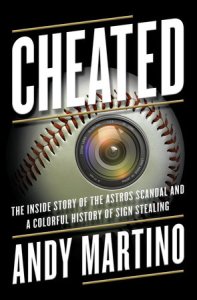
If you must, call Chiles the great-great-great grandfather of Astrogate. SNY writer Andy Martino just about does, in his sober, engaging, and freshly troubling Cheated: The Inside Story of the Astros Scandal and a Colourful History of Sign Stealing. (New York: Doubleday; 270 p, $28 [$25 on Amazon].) It’s a freshly published reminder that, whether or not Astro fans or anyone else like it, Astrogate will not disappear soon into history’s recesses.

Nor should it. And this is while the forthcoming Winning Fixes Everything: The Rise and Fall of the Houston Astros—by Evan Drellich, one of the two Athletic writers (Ken Rosenthal was his partner) who sent Astrogate to the point of no return, when they finally had a player with direct knowledge (pitcher Mike Fiers) go on public record—may be delayed from its original planned August publication.

“Were the Astros part of a long tradition of sign stealing? Or were they outliers, worse than anyone else in history?” asks Martino, a ten-year veteran of baseball journalism now an SNY reporter. Then, he answers—yes, and no: “The answer is, well, both. What Houston did was the logical extension of more than a century of teams looking for an edge on the fringes of legality. But it was also new and different than anything that came before it.”

It also soiled irrevocably a championship run that gave a Houston battered badly by Hurricane Harvey an immeasurable spiritual lift. The team who put its collective arms around the ravaged city made it resemble fools for rooting for a team whose high-tech cheating came from the amoral front office down.

“[T]he team had access to technology that no other generation of cheaters could use,” Martino writes. ” . . . This was a twenty-first-century scam, pulled off by a group of people with the right blend of intelligence and moral flexiblitiy.”

Then, he quotes a baseball legend I’ve quoted a time or two through the entire Astrogate aftermath, a legend often accused of his own amorality until that and much else was almost completely debunked—Ty Cobb, who wrote in 1926 that “mechanical devices worked from outside sources” was “reprehensible and should be so regarded.”

The time-tested ways and means of legitimate (if only slightly unethical) on-base, on-field sign decoding have always had their experts. They’ve caught onto anything, not just the signs from catchers to pitchers, but assorted little hints in assorted moments, from catcher positioning when receiving certain pitchers to pitchers’ gestures when preparing to throw certain pitches.

In this century, Martino writes, they’ve included such men as Hall of Famer Roberto Alomar plus Carlos Beltran, Carlos Delgado, Joe Carter, Alex Cora, Shawn Green, Alex Rodriguez, and others. As Blue Jays teammates, Delgado and Green learned from manager Cito Gaston and from Alomar and Carter; Beltran learned from Delgado when they were Mets teammates. They were only too happy to pay it forward and teach teammates to come such intelligence arts.

Those men would use that kind of intelligence on the bases and even compile their own post-game logs (Delgado especially was such a player) on the various tells and reveals they’d discovered. So long as they did nothing in-game other than basepath espionage, all they had to do was hope the opposition didn’t catch on right away and switch signs or correct tells.

They weren’t operating the kind of high-tech cheating that came from Astros front-office intern Derek Vigoa, who convinced cold-blooded, results-before-humanness general manager Jeff Luhnow about a computer algorithm he’d developed for sign decoding called Codebreaker—but who warned to no avail that using it pre- and post-game was one thing but in-game was illegal.

The kind that gave Cora—now the Astros’ bench coach, with Beltran aboard as the team’s designated hitter and unofficial player mentor—an unexpected a-ha! when he discovered the high-speed, thousand-frame-a-minute Edgertronic camera. Until that discovery, Cora and Beltran were merely well-oriented, long-experienced students of what Paul Dickson’s study of the craft and its abusers alike called The Hidden Language of Baseball.

By the time Cora and Beltran began brewing their side of the Astro Intelligence Agency, more than a few other teams figured out a way to help baserunners send stolen pitch intelligence to their teammates at the plate: the replay room. The Astros weren’t wrong when they spoke publicly about those.

But the Astros played the whatabout game to deflect from their having gone above and beyond even the replay room reconaissance rings. Even after rumour and speculation graduated to fact and they were exposed for all time as transdimensional high-tech cheaters.

Those who still don’t get the difference between using established replay rooms to augment old-school gamesmanship (remember: the 2018-19 Red Sox’s replay room reconnaissance ring still depended on having a baserunner to send a batter the purloined numbers) and an illegal real-time camera sending signs should be ignored roundly.

MLB finally accepted instant replay, and installed replay rooms in the first place with the best of intentions, Martino reminds us. The entire sport was mortified by first base umpire Jim Joyce making a wrong safe call to deny Tigers pitcher Armando Gallaraga a perfect game on what should have been the final out. The result was both a helpmate and an unintended headache.

Boys will be boys, even in the 21st Century. Even the best-intentioned of newfangled solutions to immediate or time-worn problems find themselves at the mercy of boys being boys. When they’re the highest of high-tech solutions, there will be and there were boys being boys figuring out how to put them to nefarious service.

Martino insists quickly and supports in detail that that the most notorious illegal, off-field-based sign stealers who preceded or accompanied the 2017-19 Astros didn’t and still don’t justify the AIA. Quickly enough that it’s Cheated‘s second chapter, titled “No, the 1951 Giants Don’t Justify the Astros.”

Not those Giants, whose manager Leo Durocher installed a coach with a hand-held Wollensak spyglass in the clubhouse above the Polo Grounds’ center field to steal signs, enabling their stupefying comeback from thirteen games out of first place and, in due course, the pennant playoff triumph.

Neither do such telescopic cheaters as the 1910 New York Highlanders (exposure of which cost manager George Stallings his job), the pennant-winning 1940 Tigers (using a hunting rifle scope to steal signs from the outfield seats) or the 1948 World Series-winning Indians. (Courtesy of Hall of Famer Bob Feller’s Wollensak-like spyglass, brought inside the Municipal Stadium scoreboard to steal signs down the stretch.)

Those already went above and beyond the time-honoured ways and means of on-field sign stealing and discoveries of pitch tipping and other “tells” and “reveals” exploitable by the excessively observant. The AIA made the ’10 Highlanders, the ’40 Tigers, the ’48 Indians, and even the ’51 Giants resemble kids playing Spy vs. Spy.

This was a genuinely talented, well-built team surrendering hook, line, and stinkers to the high-tech temptations. With pliant, “conflict-averse to a fault” manager A.J. Hinch—burned by his first managing job in Arizona, where he clashed with veterans suspicious of his contemporary, information-augmented style—bent on fostering “a largely positive environment” with vets and youth alike in his clubhouse.

Enough that he felt without power to stop the high-tech cheaters in his own dugout.

Not every Astro was completely on board. Martino argues that second base star Jose Altuve objected vocally after hearing banging while he batted, even yelling at teammates in the dugout to knock it off. Neither did Altuve wear any kind of buzzer on his body. Veteran reserve catcher Brian McCann (since retired) and right fielder Josh Reddick (now with the Diamondbacks) also demurred.

Those who accused Mike Fiers of just keeping his mouth shut until he was an ex-Astro  might be surprised to discover Martino recording very plausibly what other reporting since has affirmed: Fiers actually did object to the AIA while he was an Astro, before passing warnings to beware on to his eventual Tigers and Athletics teammates.

We’ve known long enough that the A’s filed complaints with the commissioner’s office about their suspicions that the Astros were up to things above and beyond old-school on-field gamesmanship. We’ve also known long enough that Fiers finally went on the record  after too many other writers couldn’t convince their editors to let them run players’ suspicions without disclosing their identities.

Rob Manfred has earned most of the criticism he’s garnered during his term. But Martino records that he hoped he could get the deep Astrogate story without giving players immunity. When that proved implausible, Martino writes, the commissioner finally resigned himself and, with the players union’s agreement, got AIA players and personnel past and incumbent to talk—so long as the players got blanket immunity.

That was then, this is now. Manfred, the owners, and the players union have since agreed that players caught performing Astrogate-like electronic espionage can be suspended without pay and without credit for MLB service time.

Manfred’s January 2020 report, of course, named only one player publicly—Beltran, whose involvement cost him his new job managing the Mets . . . before he got to manage even a spring training game. Cora resigned before he could be fired as the Red Sox’s manager—but was brought back after last season. His confessional to ESPN reporter Marly Rivera a year ago probably went a long way toward rehabilitating him enough to get that second chance.

Hinch sat out his suspension, then got a second chance managing the rebuilding (and next-to-last-place) Tigers. Some say that’s cruel and unusual punishment for Hinch, who spoke candidly to Sports Illustrated‘s Tom Verducci last year about his failure to contain and dissipate the AIA.

A year after the infamous break-in, Richard Nixon gave a speech in which he insisted, a little testily, “One year of Watergate is enough.” Nixon was wrong then. Those who think a little over a year and a half of Astrogate is enough are wrong now.

Even with only five members of the Astrogate teams remaining on the club, their facing  pan-damn-ically delayed fan fury over the tainted champions is one example. Martino’s book is another. Drellich’s will be a third. With apologies to Professor Berra, when it comes to Astrogate literature it won’t be over until it’s over.

Rockiegate v. Astrogate? Try Our Gang v. the James Gang

Colorado Rockies

The Rockies lined up on the foul line on Opening Day 2019. A former Brewer reserve says the 2018 Rocks were aspiring Astrogate-like sign stealers . . . but . . .

No one with a modicum of intellgence ever suggested the 2017-18 Astros were baseball’s only high-tech off-field-based sign-stealing cheaters. They were just the most sophisticated, top-down, and apologetically unapologetic of the known lot. Not to mention that they either altered a real-time-delay center field camera or installed a second non-delayed one to make their Astro Intelligence Agency work.

Now, former Brewers reserve catcher Eric Kratz has pointed a flying fickle finger of fate at the Rockies. The Rockies, who’ve seen enough of their best players leave for greener pastures administered by less brain-damaged administrations. The Rockies, now accused of being some of baseball’s more inept cheaters.

A couple of days ago, Kratz told the YES Network’s Curtain Call podcast (Kratz also did time with the Yankees, who own the YES Network) the Brewers caught the Rockies banging to relay signs stolen “from a television” in 2018. What were the Rockies banging? Kratz said it was—wait for it—a massage therapy gun.

“I can tell you that a team that has been to the World Series, often, recently, we caught them doing something almost similar,” said Kratz to Curtain Call hosts John J. Filipelli and Kevin Sullivan. Kratz didn’t specify that team, but then he dropped the quarters on the Rockies.

And I can also tell you, because I don’t really care, I don’t know anybody over there, the Colorado Rockies were doing the exact same thing in 2018, and we caught them, and we played them in the playoffs. You know how many runs they scored in a three-game playoff series in 2018? Not many people watched the NLDS. They scored two runs in the ninth inning of Game 2. They used to take a Theragun and bang it on their metal bench. And they were doing the exact same thing, from the TV.

So, there you go. If you think no one else was doing it, you are wrong. The difference is, the Astros may have taken it a little too far. Maybe a little bit too far. Maybe continued to do it. Or maybe it’s just the fact that they won the World Series and everybody’s pissed about that.

Theragun

The Theragun. The ball extension does the rapid-movement massaging at the push of a button. This is what the 2018 Rockies used to send batters stolen signs, reputedly. They only massaged themselves out of that postseason early.

Take careful note of all Kratz’s phrasings. “From the TV” can mean the Brewers caught onto the Rockies likely trying to steal signs the same way the Red Sox were caught doing the same year: deciphering signs from the video replay rooms provided to home and road teams in all major league ballparks, then relaying them forward.

The 2018 Rogue Sox relayed them by hand signs to baserunners to send to the batters. It was a slightly more sophisticated version of the kind of gamesmanship played on the basepaths for over a century. Unlike the Astros, they didn’t install a new camera somewhere in Fenway Park to set up a new underground television network.

Nobody’s yet accused the Rockies of fostering the kind of win-at-all-costs culture that came top down from the former Jeff Luhnow administration in Houston. There, what began as a conscious front-office effort to apply elaborate algorithims on behalf of sign-stealing continued with the development of the AIA Network, the altered/installed camera to the clubhouse monitors to the trash can bangs sending the stolen signs forward.

If you think that inspired rounds and rounds of can gags and signs since, what would the Rockies’ Theragun ineptitude inspire? “If Theraguns are Outlawed, Will Only Outlaws Have Theraguns?”

Kratz has a further point. If the 2018 Rockies really were using that massage gun for such a sign-stealing variant, it didn’t bring them a happy ending. They finished tied with the Dodgers for the National League West but lost a single-game playoff for the title, and the Brewers rousted the Rockies out three straight in the division series to follow.

Kratz mis-remembered the Rockies scoring in the set, though: they scored two in the Game One ninth (on an RBI single and a sacrifice fly) to tie the game at two, before the Brewers won in the tenth inning. Then the Brewers shut them out despite allowing them ten hits over Games Two and Three; the Rockies went 4-for-19 with men in scoring position without a single cash-in in those games.

If the Brewers caught the Rockies stealing signs in that division series, they’d caught one of the most inept bands of bandits since the wiseguys Jimmy Breslin satirised in The Gang That Couldn’t Shoot Straight. It’s almost not even worth calling the Rockies to account.

Almost.

Break into a bank with larceny on your mind, come away with nothing because you and/or your confederates didn’t have a clue about how to dismantle the alarms and decipher the vault’s combinations.You’re still going to face federal charges when you get caught red-handed and flat-footed. Even if you have la policia laughing their fool heads off because they’d just busted Our Gang, not the James Gang.

Just because the Rockies got slapped out of the 2018 postseason fast enough to equal a blink, just because they were the apparent Maxwell Smarts of sign-stealing, it doesn’t make them any less guilty if Kratz is right. The Rockies being petty criminals doesn’t acquit or mitigate the Astros’ grand theft felonies, either. Neither did the 2018 Rogue Sox.

You might not have been the only high-tech cheaters on the block, but you’re not off the hook just because they weren’t as sophisticated or successful as you. Especially when your gang might yet have won a World Series because of it.

Astrogate by the coming book

Astrogate Protest

If the Astros think (erroneously) that winning will fix everything, they ain’t seen nothing yet—one of the reporters who helped Mike Fiers blow the Astrogate whistle is about to publish a book about the plot.

The Astros can talk all they wish about winning fixing everything, including and especially Astrogate. They’re finding out the hard way that it doesn’t, and it probably won’t. Not until the last Astro standing from the Astrogate team isn’t in Astro fatigues anymore.

Like it or not, Astrogate isn’t going gently into that good gray night. Especially not when one of the two Athletic writers who took Mike Fiers’s whistleblowing and went excavating deep is on the threshold of publishing an Astrogate book.

Once an Astros beat writer himself, Evan Drellich is calling his book Winning Fixes Everything: The Rise and Fall of the Houston Astros. It comes forth from Harper Books on 17 August. Both the publisher and Amazon are taking pre-orders now.

Count on it: Drellich’s book is unlikely to resolve any serious question to the Astros’ overall liking. It remains to be seen whether he convinced any of the players who escaped formal Astrogate punishment to cop to even small avail of the infamous illegal, off-field-based, electronic sign-stealing Astro Intelligence Agency.

The ones upon whom you should really take pity are today’s Astros who had nothing whatsoever to do with Astrogate because they weren’t there, including manager Dusty Baker. And, Astro fans who’ve lived for over a year with the stings, arrows, and ramifications of the team they loved as the lords of the American League West being exposed as almost unapologetic cheaters.

Drellich’s book will arrive in the stores on and off-line at approximately the seventieth anniversary of the first act in baseball’s most notorious Astrogate precursor. There’s a splendid book still in print about that one, too, Joshua Prager’s 2006 book The Echoing Green: The Untold Story of Bobby Thomson, Ralph Branca, and the Shot Heard Round the World.

It finished the job Prager began in The Wall Street Journal four years earlier. It affirmed what was mostly just whispered or spoken of back-door for decades—that the pennant race comeback against which all future arise-from-the-living-dead comebacks would be measured (the 1964 Cardinals, the 1973 Mets, the 1978 Yankees, the 1995 Mariners, the 2019 Nationals) was tainted.

For the final ten weeks of the 1951 season the New York Giants cheated their way back from thirteen games out of first place to a final-day tie with the Brooklyn Dodgers to force a three-game pennant playoff. And the Giants probably cheated their way through the playoff, right down to the moment Bobby Thomson awaited Ralph Branca’s 0-1 pitch with second and third and one out.

For decades to follow, Branca epitomised grace in defeat and Thomson modesty in triumph. The Giants went on to lose the World Series in six games to the imperial Yankees, but the two protagonists in the Shot Heard Round the World rose above the occasion. As Branca himself once put it, “I lost a ball game, but I gained a friend.”

The whispers turned to shouts and screams when Prager confirmed the decades-old speculation.

Giants manager Leo Durocher discovered his new utility infield acquisition Hank Schenz owned a hand-held Wollensak spy glass he’d acquired during his World War II military service. He also discovered Schenz wasn’t averse to using the spy glass to steal signs for the Cubs by perching himself up and inside the scoreboard behind the Wrigley Field bleachers.

So Leo the Lip, ever on the lookout for any and every edge he could find, fair, unfair, clean, dirty, or downright criminal, had an idea.

He dispatched catcher-turned-coach Herman Franks to the clubhouse high enough above and beyond the deepest Polo Grounds center field region. A buzzer would be wired from the clubhouse to the Giants’ bullpen in deep right field. Franks would see the enemy catchers’ signs through the Wollensak and signal the pen accordingly. The designated signaler in the pen, usually reserve catcher Sal Yvars, would relay the pilfered intelligence to the batters.

According to Prager, Yvars or others would do nothing if it was a fastball sign but do something, from tossing a ball to standing up or raising a hand or an arm, if the sign was breaking ball. All a Giants batter had to do was see past the opposing second baseman to see the signal or lack thereof.

Those who wanted such stolen intelligence, that is. According to Prager, Durocher asked his players who wanted it—but Hall of Famer Monte Irvin was one of those who rejected it. Prager has written that Irvin told him in 2001, when the outfielder was 81, “I told [Durocher] no. He said, ‘You mean to tell me, if a fat fastball is coming, you don’t want to know?’ ”

And if Irvin said no, so did fellow Hall of Famer Willie Mays, a rookie on the ’51 Giants. Don’t delude yourself. Irvin took to Mays as a kid brother and Mays took to Irvin as a big brother. He followed Irvin’s leads to the letter and the final syllable. No matter Mays’s actual or mythologised fealty to Mister Leo, he wasn’t that eager to let Mister Leo lead him into a life of crime.

Monte Irvin, Willie Mays

Monte Irvin (left) refused to accept stolen signs in 1951. His protege Willie Mays (right) surely followed Irvin’s lead to the letter no matter how much Mister Leo also meant to him.

The Dodgers themselves suspected Durocher was up to some sort of no good down that stretch. “In September ’51, Brooklyn coach Cookie Lavagetto took binoculars to the Dodgers’ bench to try to dope out the Giants’ system,” wrote Thomas Boswell in a column reviewing Prager’s original Journal essay. “Umpires took the binoculars away immediately. Why, it would be unfair for the victims to use binoculars to expose the telescopic cheaters!”

Branca may have learned for certain that the Giants were playing spy games when he was a short-term Detroit Tiger and heard a few whispers from pitcher Ted Gray, who was friendly with ’51 Giants reserve Hal Rapp—who told Gray about Durocher and Franks’s spy operation, enabling Gray to tell a Branca who didn’t know what to believe just yet, if at all.

When Associated Press sportswriter Joe Reichler published a 1962 story discussing the Giants’ 1951 sign-stealing, it came and went quickly enough, despite then-Commissioner Ford C. Frick’s threat to declare the Branca/Thomson game forfeit if he had absolute proof of the plot. Reichler was tipped off by utility infielder Danny O’Connell; Thomson himself called it “the most ridiculous thing I ever heard of.”

“Over the years, when interviewing Thomson and Branca,” Boswell wrote, “I’ve been struck that Thomson seemed a bit ambivalent about his Moment while Branca never seemed the least ashamed. I took it that Thomson felt apologetic because he’d caused Branca a lifetime of nagging questions . . .

“Whether Thomson took the stolen sign, Branca has been a man of honor for fifty years. He has never raised the cheating issue without proof or tarnished the game’s most replayed moment. Even now, Branca says, ‘He still had to hit the pitch’.”

Prager’s first Journal missive and then The Echoing Green put paid to all speculation once and for all and stamped “case closed” that the Giants cheated their way back from oblivion to the pennant playoff—and even to the pennant. Interviewed by a Utah newspaper in the post-game bedlam, Franks said, “Maybe we caught the sign for a fastball.”

Nobody paid attention in ’51. They did now. Once and for all time, the Miracle of Coogan’s Bluff should be known forever after as the Mugging at Coogan’s Bluff.

Thomson was cited in Prager’s book as telling New York Daily News writer Jim McCulley that Branca’s 0-1 fastball “was a pitch that [Hall of Famer Stan] Musial or any other good hitter would have taken. It was high and inside. I didn’t deserve to do a thing like that.” Prager also cited Branca telling New York Times writer Roscoe McGowen that the pitch “wasn’t a bad pitch . . .”

I didn’t think he hit it too well. It was sinking when it went into the stands. I guess we weren’t meant to win it. The ball was high and inside, not a good pitch [to hit], and it only cleared the wall by [a very few inches].

In fact, when Prager caught up to Franks shortly before the old catcher-coach-manager died in 2009, Franks described the spy glass spy—in the third person—as “tilt[ing] his scope up to the eyes of the batter.”

The spy did so to watch the batter glance toward right field, where a player in the bullpen relayed the stolen sign. The eyes of the batter also filled the scope’s field of view. And at 3:57 p.m. on October 3, 1951—with two on and one out in the bottom of the ninth inning, and the Giants down 4-2 in the third and final game of the playoff—Franks had just spied Brooklyn catcher Rube Walker call for an 0-1 fastball when he looked up at the eyes of Bobby Thomson.

“For 50 years,” wrote Boswell in 2001, “Thomson has been baseball’s ideal clutch hero and Branca the game’s most symbolic goat. Now it seems that Branca, the Dodger who gave up the homer that lost the pennant, may be a victim and Thomson less than a hero.”

Bums author Peter Golenbock cited a longtime Dodger fan leaving the Polo Grounds for pizza . . . and seeing the pizza joint displaying rolls of toilet paper marked “Dodger Crying Towels,” plus a rope tied into a noose and with the sign, “Dodger fans, hang yourself [sic] here.” You thought today’s road fans showing and banging inflatable trash cans when the Astros come to town is rough stuff?

But Golenbock also got Branca to re-tell a story once circulated well enough, Branca’s fiancee taking him to see her cousin—a Catholic priest, who told the stricken pitcher, “God chose you because He knew your faith would be strong enough to bear this cross.” Branca died in 2016, six years after Thomson. “He carried the cross of the Thomson home run,” said Vin Scully, “with dignity and grace.”

Neither the snarking Giants fans nor the stricken and suspicious Dodgers and their fans knew for dead last certain in that hour that the Giants got there in the first place with a plot as underhanded then as the Astro Intelligence Agency was in 2017-18.

The Astros weren’t baseball’s only electronic cheaters when they won the 2017 World Series, but they were the only ones known to have altered an existing camera off mandatory eight-second delay or to have installed a furtive new and illegal camera, either of which sent stolen real-time pitch signs to clubhouse monitors and a trash can banger.

The only thing left is to await Drellich’s book. (Try to imagine what Boswell snarked sadly—The Giants stole the pennant! The Giants stole the pennant!—happening in the Internet social media era.) Stay tuned. It could make the original Astrogate revelations resemble mere flickers through the spyglass darkly.

On self-appointed Yankee security censors

Yankee Stadium

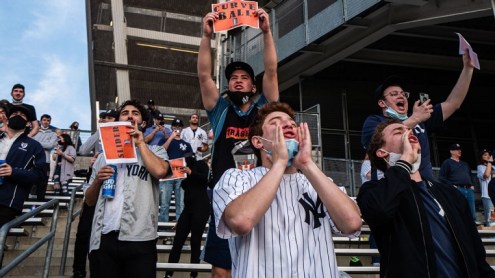
Yankee fans let the Astros have it Tuesday night. Did stadium security eject some protesting fans under false pretenses?

The worst kept secret in baseball opening this week was Yankee fans liable to let the visiting Astros have it, but good, when they visited Yankee Stadium for the first time since the 2019 American League Championship Series. The second-worst thing about that worst-kept secret was Yankee Stadium censorship.

The first-worst thing was this not-so-little red flag raised in the account by Sports Illustrated writer Stephanie Apstein, about a fan costumed like Oscar the Grouch in a trash can, and who only thought he’d gotten assurance from stadium personnel that there’d be no issue with him wearing it at Tuesday’s game:

When [David Taub] arrived wearing the costume and carrying a sign reading YOU AIN’T STEALING THIS COSTUME TRASHTROS, he drew laughs and cameras. Unfortunately, he also drew attention from security. “Our policy changed,” he said the guard told him. He said the guard added that the Astros had complained to MLB about fans in other cities, and MLB had told the Yankees to tighten their rules. (Officials from the Astros and the commissioner’s office said they were unaware of any such complaints or directives.)

Censorship at Yankee Stadium isn’t exactly virgin territory. Ask any frustrated Yankee fan present in the 1980s who had an anti-Boss placard or sheet banner confiscated under George Steinbrenner’s orders. Or, such frustrated Yankee fans who had their placards and banners confiscated before they were ejected from the stadium themselves.

Ask especially the Yankee fan who won a Banner Day contest by wearing the garb of a monk and carrying a Grim Reaper’s scepter from the scythe of which hung a large placard pleading, “Forgive him, Father, for he knows not what he does.”

If Yankee Stadium personnel purging David Taub for a non-destructive demonstration against Astrogate and its most questionable net result (no players disciplined in return for spilling about the scheme) is bad enough, what would you suggest we call the possibility that stadium security lied through their teeth while censoring him and other fans?

“I hope the Yankees fans smell blood tonight,” Taub told a reporter. “I hope we don’t do anything irresponsible, but I hope we give our shares of boos and let them hear it. We definitely got robbed of a World Series. There’s no question about that.”

Other fans brought inflatable trash cans to the park, similar to the one that fell onto the right field warning track at Angel Stadium when the Astros played a set there last month. Two of them were confiscated by stadium security, too.

Apparently, Astros manager Dusty Baker is a little more sanguine and a lot less censorious about the reception he knows his team can expect when they’re on the road this year. “It sounded like a packed house tonight even though it wasn’t,” he told reporters after the Yankees trashed the Astros, 7-3. “We kind of expected that reception. We’ll probably get more of that tomorrow and the next day.”

“I wouldn’t want to be on the other side of that,” said Yankee outfielder Giancarlo Stanton of the fans’ night-long booing, catcalling, and occasional swearing (F– Altuve! F–Altuve!) after the game. “They brought some heavy.” (And, a lot of funny, including a placard depicting Altuve the Grouch in a somewhat battered metal trash can.)

Stadium security brought heavier. This was a look no better than that ancient Banner Day ejection.

Last year’s pan-damn-ically inspired, cutout-occupied stands kept legions of fans from letting the Astros know just how they felt about the Astro Intelligence Agency’s singular take on sign stealing. Unless they bought cutouts showing imagery against it, there was little they could do other than whoop, holler, and catcall if they saw the Astro team bus pulling up to the ballpark.

But fans are back at the ballparks now to whatever limited extent continuing safety protocols allow. Unless their racket includes true violence, or throwing debris on the field (as a few reckless Angel fans did throwing a real, not inflatable trash can onto the right field warning track), or attacking Astro players or personnel physically, Yankee Stadium’s security was way out of line.

Whether they like it or not, the right to protest comes with the purchase of a ticket. Fans can boo truly bad plays, truly bad plate appearances, truly bad umpiring to their hearts’ content. They can even boo visiting teams verified for all time as barely-apologetic illegal  high-tech cheaters.

Even if their own team got caught trying a little high-tech hijacking once upon a time? Not so fast. The Yankees got caught only with someone in the dugout using an AppleWatch to steal signs. They weren’t accused of or proven to have either a) altered an existing camera off its mandatory eight-second transmission delay, or b) installed another, illegal, real-time camera to steal signs.

Realistically, the Yankee fans made one mistake that everyone else continues to make. There are only five actual Astrogate team members left on this year’s edition: Altuve, Alex Bregman, Carlos Correa, Yuli Gurriel, and Lance McCullers. Chanting “Mother Tucker!” at hapless outfielder Kyle Tucker isn’t fair to a guy who wasn’t even there to be part of the 2017-18 can can.

Unfortunately, if it isn’t fair to hold the entire 2021 Astro roster responsible for what the 2017-18 edition did, it’s also unlikely that the Astros will be done hearing the protests until the last man standing from the Astrogate team doesn’t wear their uniform any longer.

Not every security force in every ballpark practises fan censorship at all. Never mind claiming the visiting team complained to baseball’s government and baseball’s government told the home team “to tighten their rules.” I suspect Apstein meant that to mean, “to quash the anti-Astrogate protests.”

The Astros have had enough bad looks since Astrogate’s exposure and official consequences. Would they really be stupid enough to compel baseball government to strong-arm road teams into censoring road fans bent on letting them have it over a script they and nobody else wrote in the first place?

It was one thing when the worst Yankee fans rained nasty upon Astros pitcher Zack Greinke during the 2019 ALCS—based on Greinke’s very well known battle with clinical depression. Those fans were ejected properly for assaulting a human being verbally over an illness for which he takes prescribed medication and through which he works and lives with courage his assailants probably lacked.

Ejecting fans protesting a team’s well-exposed and (in more ways than one) institutionalised cheating? That demands a formal MLB investigation. Post haste. No waiting. The Yankees themselves should have no issue with cooperating. If they do, they should be sanctioned heavily.

The House That Ruthless Built isn’t private property. The ballpark’s official ownership is listed as the New York Industrial Development Agency, a subsidiary of the city’s Economic Development Corporation whose board is appointed by the city’s mayor. Government or government-overseen agencies at any level, from the village up to the nation, have no business trucking with or allowing censorship.

If Yankee Stadium security people spoke out of line while confiscating Yankee fans’ properties and/or ejecting them from the stadium, because they took it upon themselves to neutralise or silence Astrogate protests, they need to be held accountable. Strictly.

The first five days

Stop me if you’ve heard it before: Jacob deGrom pitched like a Hall of Famer, but the new Mets bullpen puked the bed like the old one did.

The fans are back in the stands, however limited by ongoing COVID-19 safety protocols, but the Nationals have yet to play a regular-season game thanks to a few players and a staffer or two testing positive. There went that Opening Day must-see match between Max Scherzer and the Mets’ Jacob deGrom.

With their opening set with the Nats thus wiped out, deGrom had to wait until the Mets went to Philadelphia Monday. Oops. That and everything else seemed to play a support role to the horrid news out of San Diego.

The news that Fernando Tatis, Jr., the Padres’s new bazillion dollar shortstop, suffered a partial left shoulder dislocation on a hard third inning swing at the plate during a Monday loss to the Giants.

Padres manager Jayce Tingler told reporters he thinks team trainers and medical people were able to pop the shoulder back together, but the team isn’t taking chances. At this writing, MRI results aren’t available and nobody knows yet whether Tatis will spend significant time on the injured list.

If it’s more than a small shoulder dislocation, it may not be significant time. If it’s something like a labral tear, Tatis could miss six months—essentially, the rest of the season—according to one doctor who knows such shoulder troubles and spoke to the Los Angeles Times. Don’t fault the Padres if they’re saying to themselves, “Thank God for insurance.”

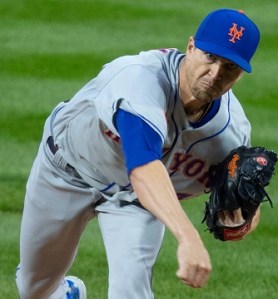
DeGrom could use a little extra insurance himself, alas. The good news for the Mets: deGrom was his usual self Monday night. Six shutout innings, seven punchouts, three hits, three-figure speed on his fastballs. The bad news, alas: the Mets are gonna Met, so far. At least out of the bullpen.

Their on-paper impressive offense found nothing more than two runs to support their ace. They got an inning of shutout relief from Miguel Castro relieving deGrom for the seventh, but the bullpen puked the bed in the eighth—including hitting Bryce Harper with the bases loaded. Not exactly a Rhodes Scholarship move there.

The Old Fart Contingency thundered aboard social media that Mets manager Luis Rojas blew it lifting deGrom after six strong—until they were reminded the added layoff after the Washington postponement put both deGrom and the Mets into caution mode.

“If that was [last] Thursday and I’m on normal rest,” the smooth righthander said postgame of the early hook, “I don’t think there is any chance I’m coming out of that game. We discussed it before what was the right thing to do. Long season and talking to them coming in, it felt like was the right decision.”

It was neither deGrom’s nor Rojas’s fault that, after Garcia took care of the Phillies in the seventh with just one infield hit within a fly out and two ground outs, the Phillies loaded the bases on the Mets’ new relief toy, Tyler May, in the eighth with one out, before Rojas went to another new Met bull, Aaron Loup. And Loup promptly hit Harper to push Miller home, before J.T. Realmuto singled home pinch runner Quinn, Mets late third base replacement Luis Guillorme threw home off line allowing Harper and Rhys Hoskins to score, and Didi Gregorius pushed Realmuto home with a first-pitch sacrifice fly.

The Mets had nothing to answer except a two-out ninth-inning stand that came up two dollars short against Phillies closer Alvarado. Kevin Pillar singled up the pipe, Francisco Lindor—the Mets’ own new bazillion-dollar lifetime shortstop—dumped a quail into shallow right that landed just in front of and then off the glove on oncoming, diving Harper, and Michael Conforto singled Pillar home while setting up first and third.

Pete Alonso, their 2019 Rookie of the Year bomber, hit one to the back of right field that looked as though it had a chance to ricochet off the top of the fence if not clear it. It wasn’t quite enough to stop Harper from running it down, taking a flying leap with his back against the fence, and snapping it into his glove to stop a game-tying extra-base hit and end the game with the Phillies on the plus side, 5-3.

Marry the foregoing to deGrom going 2-for-3 at the plate including an RBI single, and no wonder May himself said post-game, “Jake shouldn’t have to do everything himself. That’s not what teams are, and frankly Jake did almost everything today.”

Just don’t marry that to things such as the Angels’ Shohei Ohtani hitting 100+ mph on the mound and hitting a mammoth home run that flew out 100+ mph in the same inning last Friday night. Ohtani the two way player is an outlier among outliers; deGrom’s merely an outlier.

As of Tuesday morning— with the National League’s pitchers having to bat because Commissioner Nero simply couldn’t bring himself to keep the universal designated hitter this year at least, and Ohtani batting second in the Angel lineup the night he started on the mound, among other things—the pitchers have a .131/.157/.192 slash line and a .349 OPS.

The pitchers at the plate from Opening Day through the end of Monday night collected thirteen hits in 149 plate appearances: nine singles, three doubles, and Ohtani’s Friday night flog a third of the way up Angel Stadium’s high right field bleachers. They also walked three times and struck out 56 times. And the OFC still insists the National League just say no to its own invention.

All around the Show, too, there was one home run hit every 35 plate appearances and fourteen percent of all 928 hits the season’s first five days cleared the fences. It took five outs to create a single run, with 5.3 average runs created per game and 631 runs created while 559 scored.

It was fun to hear the fan noises even in limited capacities, too, though the limits in Angel Stadium made Ohtani’s blast sound even more explosive at the split second he hit it. If only things had been more fun for the home crowds: the many themes for the Show’s first five days could include, plausibly, the blues classic “On the Road Again.”

The home teams’ slash lines: .225/.313/.374/.687 OPS. The road teams: .245/.328/.403/.731 OPS. The road teams drove in fifteen more runs, hit thirteen more home runs, seven more doubles, and had seventy more hits overall. They also took eleven more walks, though they struck out fifty more times and grounded into fifteen more double plays. The road rats also had a +29 batting average on balls in play over the home boys and 108 more total bases while they were at it.

Maybe the shocker among the opening road rats were the Orioles. The Woe-rioles. Taking three straight from the Red Sox in Fenway Park. Out-scoring the Olde Towne Team 18-5, including and especially an 11-3 battering on Sunday afternoon. Even those paranoid about ID cards might want to insist the Orioles show theirs, even after the Orioles got a brief return to earth from the Yankees beating them 7-0 Monday in New York.

Unless it was the Reds, taking two out of three from the Cardinals to open, including and especially a 12-1 battering Sunday afternoon that proved the best revenge against abject stupidity is to slap, slash, scamper, and smash your way to a six-run seventh when you’re already up three runs—thanks to Nick Castellanos ripping Cardinal starter Carlos Martinez for a two-out, three-run homer an inning earlier.

Castellanos got drilled by Cardinals reliever Jack Woodford Saturday . . . two days after he bat-flipped a home run. Then, when he dove home to score on a wild pitch, Castellanos got bumped by Woodford sliding in to bring down the tag Castellanos beat. Castellanos sprung up, barked at Woodford, and began walking away before trouble could arrive. Oops. Trouble arrived—when Yadier Molina shoved him from behind to spark a bench-clearing brawl.

Baseball government myopically suspended Castellanos two games for “provoking” the brawl. Who’s baseball’s official optician? Who couldn’t see what everyone else with eyes saw? And how long has Molina—handed only an “undisclosed fine” along with a few others in the scrum—been so privileged a character that he can get away with the actual kickoff of a brawl that was seeded in the first place because the Cardinals are one of the game’s self-appointed Fun Police precincts?

“I was pleased,” Cardinal manager Mike Schildt told the press after that game. “Our guys came out there. We’re not going to take it. I know Yadi went immediately right at him, got sidetracked by [Cincinnati’s Mike Moustakas]. Woody, to his credit, got up and was like, ‘I’m not going to sit here and be taunted.’ Good for him.”

Taunted? All Castellanos said when he sprang up, by his own admission, was “Let’s [fornicating] go!” Anyone who thinks Woodford lacked intent didn’t see that ball sailing on a sure line up into Castellanos’s shoulder and rib region. Nor did they see Molina very clearly shoving Castellanos without Castellanos having the benefit of a rear-view mirror.

Castellanos appealed the two-game suspension. The final result wasn’t known at this writing. But the Cardinals should be getting a message of their own: Defund the Fun Police. Pronto.

How about the Astros, who went into Oakland and swept four from the Athletics before ambling on to Anaheim and losing 7-6 to the Angels Monday night? That was despite dropping a three-run first on Angel starter Jose Quintana and yanking a fourth run out of him in the top of the fourth, before the Angels finally opened their side of the scoreboard with Mike Trout (of course) hitting Luis Garcia’s 2-2 meatball about twelve or thirteen rows into the left field seats.

The Angels pushed a little further back, the Astros pushed a little further ahead, until the Angels ironed up and tore four runs out of the Astros in the bottom of the eighth with an RBI single (Dexter Fowler), a run-scoring force play (David Fletcher), a throwing error (on Jared Walsh’s grounder to first), an intentional walk (to Trout, of all people), and a sacrifice fly (Anthony Rendon).

Kyle Tucker’s ninth-inning solo bomb turned out more a kind of excuse-us shot than a last stand. The game left both the Astros and the Angels at 4-1 to open the season and what could be very interesting proceedings in the American League West. Now, if only the Astros could finally get past Astrogate.

They’ve been playing and winning through numerous catcalls, howls, and even a few inflatable and actual trash can sightings in Oakland and Anaheim. Jose Altuve—who’s looked more like his old self at the plate so far—seemed mildly amused when an inflatable trash can fell to the warning from those high Angel Stadium right field bleachers.

Astrogate was and remains anything but amusing. The Astros could keep up their torrid opening and overwhelm the AL West this season, but the scandal won’t go away entirely (nor should it) until the absolute last Astrogater standing no longer wears their fatigues. Yes, you’ve heard that before. That doesn’t make it any less painful for Astro fans or less true for everyone else. The Astros, nobody else, wrote the script that made them pariahs. Bang the cans slowly, fans.

Will off-field-based illegal electronic sign stealing disappear at all? Players got same-game video access back this year. There are three security people in every team’s video room at home and on the road. League cameras have been installed in those video rooms. Maybe it wouldn’t hurt to add guard dogs?

The players union agreed last year: there’ll be no more players getting away with murder even in return for spilling the deets—the commissioner can drop a lot more than a marshmallow hammer on the cheaters from now on. All by himself. He can demand answers without plea bargaining. And he doesn’t need a permission slip.

“But one of the prevailing lessons from the electronic sign-stealing era is that even if a scheme sounds far-fetched, someone might give it a whirl if they believe they can get away with it,” writes The Athletic‘s Evan Drellich, one of the two reporters (Ken Rosenthal was his partner) who helped break and burrow deep into Astrogate. “This holds true no matter what MLB does. Even a total ban on electronics, which the players would never agree to, would not be enough. In that case, a player or staffer could simply go rogue.”

In other words, boys will be still be boys, if they can-can.