ALCS Game One: The world didn’t implode

Jose Altuve

Jose Altuve’s two-run homer tied Game One and turned the game’s momentum to the Astros . . . (Fox Sports screen capture.)

Before the American League Championship Series began, it was easy to remember but so hard to forget. The elephant still lingered in the room.

The American League West-winning Astros. The American League wild card-winning Red Sox. Electronic sign-stealing cheaters versus electronic sign-stealing cheaters. Right?

Not quite that simple. Not even if Red Sox fans and others still cringe over the 2017-18 Astro Intelligence Agency. Not even if Astro fans and others still think the 2018 Rogue Sox Replay Room Reconnaissance Ring proved the Astros weren’t alone in high-tech cheating.

Those Red Sox got nailed using their replay room as a sign-stealing helpmate. But they didn’t install the video apparatus in there, MLB did—for them and all thirty teams, behind all home and visitors’ dugouts in all thirty ballparks. Their way, and they probably weren’t the only team doing it, depended on having men on base to relay stolen signs to their batters.

I’ve said it before, I’ll say it one more time: With the best intentions, MLB in essence were Mom and Dad leaving the keys to the liquor cabinet behind expecting the kids were mature enough not to open up and party while they were out of town for the weekend. The 2018 Rogue Sox opened up and partied. The 2017-18 Astros built their own distillery.

Their front office used an in-house-designed computer algorithm devised for sign stealing during games, despite the designer’s warning that doing it in-game was illegal. They used a high-speed, real-time camera to abrogate the mandatory eight-second transmission delay and send opposing signs to clubhouse monitors, next to which someone sent the hitters the dope via the infamous trash can bangs.

Both teams cheated then. Both teams seemed like deer frozen in the proverbial headlights when asked to show public accountability and contrition. The Astros were far, far worse. They went far, far above and beyond both the traditional on-the-field, in-the-dugout gamesmanship and the sort of boys-will-be-boys thing the Rogue Sox and others did with the MLB-gifted replay rooms.

Commissioner Rob Manfred may have erred in granting players from those teams immunity in return for the details, but his investigation did at least turn up and discipline the key overseers.

He suspended then-Astros general manager Jeff Luhnow and manager A.J. Hinch before owner Jim Crane fired the pair. He suspended then-Astros bench coach Alex Cora over Astrogate, but determined the 2018 Rogue Sox’s prime culprit was video room operator J.T. Watkins while manager Cora, his coaches, the front office, and maybe half the Red Sox’s players weren’t in on the replay room reconnaissance ring.

Nobody can redeem those Astros or Red Sox, even if the Red Sox did re-hire a contrite-enough Cora to manage them this year. But we can remind ourselves that, today, only five Astrogate players remain with the team. We should remind ourselves that at least one such suspect, second baseman Jose Altuve, actually demurred from accepting stolen signs and even told his teammates and others to knock off the trash can banging while he was at the plate.

Only nine Rogue Sox members remain in uniform today, too. And, the rules against electronic sign-stealing were tightened in Astrogate’s aftermath. Video room security is now three people deep. Video feed delays are now fifteen seconds over the previous eight. Players caught stealing signs electronically can be suspended without pay or credited major league service time.

This year’s Astros and this year’s Red Sox got to this year’s ALCS regardless. Remove their former taints, and you have two opponents who entered the set with suspect pitching (particularly the Astros, losing Lance McCullers, Jr. to a forearm issue) but very strong offenses. Then, you watched Game One Friday night, even if in spite of yourselves.

You watched Red Sox center fielder Kike Hernandez strike long twice but Altuve strike once to change the game’s momentum toward the eventual 5-4 Astros win.

You watched Astros starting pitcher Framber Valdez and Red Sox starter Chris Sale unable to get out of the third inning alive. You watched the ordinarily suspect Astros bullpen hold the Red Sox to four hits, one walk, and one measly run, when Hernandez—who tied the game leading off the top of the third by hitting a Valdez curve ball far over the left center field seats—caught hold of a Ryan Pressly slider and send it deep into the Crawfords in the top of the ninth.

You watched the Red Sox take a 3-1 lead in that third a ground out, a walk, and a base hit up the pipe later, when designated hitter J.D. Martinez’s hopping grounder bumped off Altuve’s glove to send shortstop Xander Bogaerts (the walk) home, before right fielder Hunter Renfroe ripped an RBI double past Astros third baseman Alex Bregman and down the left field line to score Bregman’s Red Sox counterpart Rafael Devers (the base hit).

You watched Altuve ruin that lead in the bottom of the sixth, with Astros center fielder Chas McCormick aboard on a one-out single, when he hit the first pitch he saw from Red Sox reliever Tanner Houck into the Crawfords.

You watched another Red Sox reliever, Hansel Robles, fire sub-100 mph bullets in the bottom of the seventh to get rid of Bregman on a grounder to short and left fielder Yordan Alvarez on a hard-swinging strikeout, before offering Astros shortstop Carlos Correa a changeup that hung up enough for him to yank into the Crawfords to break the three-all tie.

You watched a Red Sox reliever who hadn’t pitched in almost two weeks, Hirokazu Sawamura, surrender a leadoff walk to Astros first baseman Yuli Gurriel before McCormick bounced a base hit in front of Red Sox left-field insertion Danny Santana (a top-of-the-eighth pinch hitter). You saw Martin Maldonado take a pitch off his right wrist to load the pads with nobody out.

And you saw Altuve hit a sacrifice fly to center to send Gurriel home with the fifth Houston run, though a slightly more on-line throw might have gotten Gurriel at the plate to keep things within a single run for Hernandez’s second launch of the night.

Kike Hernandez

Hernandez’s dive-and-roll catch of Michael Brantley’s second-inning-ending, bases-loaded sinking liner wasn’t enough to stop the Astros Friday night. Neither were his two long home runs. (Fox Sports screenshot.)

Hernandez’s mayhem—the two homers on a 4-for-5 night (the first such leadoff hitter in the Show to do it), bringing him to fourteen hits in 28 postseaon at-bats this time around, his MLB-record third lifetime postseason game of ten total bases—may not have been quite enough for the Red Sox to take Game One. But it was more than enough to impress Astros manager Dusty Baker.

“I haven’t seen a hitter this hot in the last week than Kike Hernandez,” the skipper said post-game, after Hernandez’s first launch came during Baker’s brief turn talking to Fox Sports broadcasters Joe Buck and Hall of Fame pitcher John Smoltz. “Boy, when I saw that ball go up, I was like, oh man, that was a blast. Then he blasted another one. It’s not a good feeling when you know you’re live on air and you see that ball leaving the ballpark.”

Hernandez wasn’t the only one dancing with the record books. Altuve and Correa became the first teammates to homer in the same postseason game for a fourth time. “He is just so dangerous,” said Correa of Altuve post-game. “His track record in the playoffs is insane, and he just inspires me. He inspires me without saying much.”

That track record includes tying Hall of Famer Derek Jeter for number three on the all-time postseason bomb roll with his 20th such launch Friday night. But you should have heard Altuve speak of Correa, too. “He is amazing,” the compact second baseman said of his keystone partner at shortstop. “He likes this kind of game. He wants to go out there and hit big homers. It seems like he expects to go out there and do it, so if you’re expecting something, eventually you’re going to make it happen, and that’s him.”

Hernandez also impressed the Astros and maybe even some of their home crowd Friday night with a few defensive gems, particularly his dive-and-roll catch of designated hitter Michael Brantley’s bases-loaded, sinking line drive to end the bottom of the second. But he’d have swapped all that for a Red Sox win.

“I think overall we played a good game,” he said postgame. “Once again, we didn’t do a good job of adding on to the lead, and at the end of the day, that’s why we lost. We weren’t able to add any more runs.” That was in large part because the usually suspect Astro bullpen managed to keep them to a measly four hits and a walk in the unexpected bullpen game.

With Nathan Eovaldi starting Game Two, and the still-fresh memory of being shut out by the Rays to start a division series in which they won the next three straight, the Red Sox don’t exactly have reasons to cringe just yet. Even Sale admitted Eovaldi was their best foot forward to launch Saturday.

“We’ve got the right guy on the right mound, and that’s all we can say,” he said. “Our lineup is going to bang with the best of them. There’s no doubt about that. We’ve got to do the little things right, and with Nate taking the ball, that’s everything we could ask for.”

So guess what didn’t happen when the two teams still recovering from their own Astrogate and Rogue Sox scandals—yes, listed in the order of true gravity—tangled in Game One? Knowing that no one will be comfortable with either one wholly, but the Astros especially, until the last Astrogater or the last of the Rogue Sox no longer wears either uniform?

The world didn’t implode. The flora didn’t wilt. The fauna didn’t commit mass suicide. The moon didn’t fall into the river. The sun didn’t awaken before its appointed time. The nations didn’t fall from the earth. The earth didn’t go flat.

Unless there comes fresh contravening evidence, the Astros and the Red Sox played it straight, no chaser, in a game that would have classified as a bit of a thriller had it not been for that still-lingering elephant. The one aboard which the Astros, like it or not, still look far, far worse than the Red Sox or their fellow unverified-but-certain replay room rogues do.

J.R. Richard, RIP: Redeemed

J.R. Richard

It was easier to square off against a Boeing 747 than to face J.R. Richard at his peak.

You couldn’t resist wondering when you saw him at his peak. Suppose 6’8″ James Rodney Richard’s career began early enough to give him a shot at pitching to 6’8″ Frank Howard. Paul Bunyan at the plate versus the Leaning Tower of Houston on the mound. Accompanying music, John Coltrane’s classic “Giant Steps.”

There might have been one of two outcomes. Either Howard was going to hit Richard for a home run making first contact with the Delta Quadrant, or Richard was going to bust three strikes through Howard as casually as the Lou’siana fisherman Richard loved to be on his free time.

“(I)f you beat me,” J.R. Richard said in 2012, remembering his attitude on the mound, “I’m gonna die trying. I was willing to give my life for it.” He damn near gave his life for it.

What National League hitters couldn’t do once Richard finally harnessed his outsize ability, a stroke did, while he was on the disabled list after he’d started the 1980 All-Star Game by striking out three American League batters including Hall of Famers Reggie Jackson and Carlton Fisk.

It embarrassed everyone in baseball, too many of whom including his own team accused Richard—who died at 71 Wednesday night—of dogging it when he began complaining about feeling excess fatigue in his arm and shoulder areas before the All-Star break.

Not even renowned surgeon Dr. Frank Jobe could pinpoint the sources, after Richard visited him complaining of numbness in his fingers and ringing in his ears. Jobe and other doctors discovered obstructions in his arm and neck arteries—but decided they weren’t serious enough for surgery.

With the Astros on the road Richard gave himself a private workout at the Astrodome on 30 July 1980—and collapsed. The CAT scans to follow showed he’d actually suffered three strokes and also had thoracic outlet syndrome present thanks to his over-developed shoulder muscles. The strokes left his left side useless long enough.

Richard recovered enough to attempt a career comeback or two but it was futile. Now-retired Washington Post writer Thomas Boswell caught up to him during one of those comeback bids. “Richard is more pleasant, more outgoing, more generous with other people than ever before in his life,” Boswell observed.

Once he was the most forbidding Astro. Now he may be the least, signing autographs and seeking out chitchat. After a lifetime as the Goliath overdog, he is now everybody’s underdog, and he enjoys it. Richard may even have become the symbol of a decent, long-out-of-fashion idea: mutual tolerance.

““(W)hen people don’t understand who you are, when people can’t control you,” Richard told radio interviewer Bill Littlefield in 2015, promoting his memoir Still Throwing Heat, “they have a tendency to want to destroy you. But see, you got to realize this: Sports is a business. Nothing more or nothing less.”

Richard had signed a four-year, $3.2 million contract with the Astros the year before the trio of stroke took him down. His career ended for keeps in 1984 and he returned to his native Louisiana. He spent lots of time between there and Galveston fishing as if his life depended on it. He won a $1.2 million malpractise action against the Astros’ medical staff. He sold cars and recreational vehicles for a spell or two.

But then Richard, unlike his television namesake J.R. Ewing, discovered he had as much ability to navigate the oil business as hitters once had navigating his cruise-missile fastballs and his sweeping sliders. He lost $300,000 in what turned out an oil investment scam. Then he lost over $600,000 in his first divorce.

That led to a series of further business problems, a second failed marriage, and the loss of his home, finally bringing Richard so low that he lived homeless under a Houston bridge—until former teammates Jimmy (The Toy Cannon) Wynn and Bob Watson intervened.

Wynn called Watson, then the Astros’ general manager, some time in 1994. They reached out to the Baseball Assistance Team and together helped Richard back onto his feet. So did Richard’s church minister, Rev. Floyd Lewis, helping him stay on his feet and become a minister himself.

J.R. and Lula Richard

Richard with his wife, Lula: “My life is now better than ever because of the love of my life.”

He drew on his own homeless experience to help the homeless in particular, when not working with Houston donors to set up assorted children’s baseball programs where he’d teach the kids the game and a few hard-earned lessons of life, too.

“You see,” Richard told Littlefield, “a man could eat a whole whale, but it takes one bite at a time. Or he can walk a mile, but it takes one step at a time. So if you’re willing to take that step, [God] will make a way out of no way. See, God is the only one I know who can take a mess, go in a mess, clean up a mess and come back out and don’t be messy. Now you figure that out.”

Health and fate made that harder to figure out than he figured out how to strike fifteen Giants out in his first major league start—tying the rookie record set by Dodger legend Karl Spooner in 1954—or how to smash Hall of Famer Tom Seaver’s single-season National League record for righthanded pitchers.

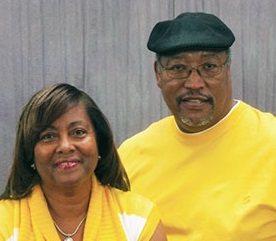
Richard figured it out enough, too, to remarry happily. He met his third wife, Lula, when they shared a bus on a church trip. Maybe a little impulsively, Richard wrote his telephone number inside the cover of Lula’s Bible, and shared a steak dinner for their first date. They “courted” (Richard’s word) two years before marrying in 2010.

“She helped with a lot of stability, in every way,” Richard once said of her.

The man who once said he was the only man in baseball who could throw a ball through a car wash without the ball getting wet never lost his laconic wit, either, no matter what. Fans meeting him in later years and remembering their shock over his strokes often drew such replies as, “I couldn’t believe it, either.”

The Astros inducted Richard into the team’s Hall of Fame two years ago. They haven’t yet conferred the one thing Richard wanted most dearly when all was said and done, retiring his uniform number 50.

Nobody could believe what might have been the oddest game of Richard’s career. On 19 September 1978—the night he broke Seaver’s record—his mound opponent was Jim Bouton, Ball Four author, one-time Astro, attempting a quixotic comeback with the Braves. “The young flamethrower and the old junkballer,” Bouton described the matchup. Others called it David vs. Goliath.

Richard surrendered two earned run on three hits and three walks in seven inning; his money punchout came at the expense of Braves third baseman Bob Horner. Bouton surrendered two earned runs on five hits, walking five, striking out one. Lopsided as that looks, David and Goliath still fought to a draw. (The Braves won the game in the ninth.)

It wasn’t half as impressive as the battle Richard won after his career, the battle of life, after the kind of buffetings that would send lesser men into the Phantom Zone of walking death. May his beloved Lula, his family, all those who loved him for himself and respected his self resurrection, take comfort that the Lord in whom he devoutly believed welcomes him home with gentleness and kindness.

And, maybe, with a gentle joke Richard himself would appreciate—“About that car wash, J.R. . . . “

Max the Knife comes up aces

Max Scherzer

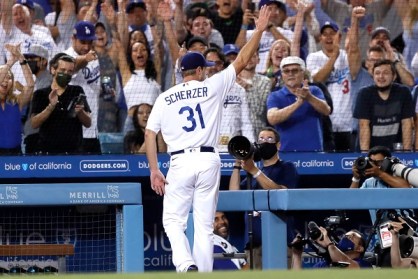
Dodger fans asked Max the Knife for something he’d never had in his career before Wednesday night—a curtain call.

Nothing could spoil Max Scherzer’s mound premiere in a Dodger uniform Wednesday night. And it wasn’t for lack of trying by the Astros. Not even for lack of trying by one particularly brain dead Dodger fan down the right field line.

The Astros made a grand enough effort after Scherzer left the game following seven stellar innings and ten strikeouts marred only by a solo home run and an RBI single. They had to settle for losing by two runs instead of five.

The Dodger bullpen made a grand enough effort, too, letting the Astros pry three runs out of them including a two-run homer in the top of the ninth off Kenley Jansen before he finally struck out the side to end the 7-5 Dodger win without any further self-immolation.

The aforesaid meathead in the stands did his best to contribute to a potential overthrow, too. With two out in the top of the eighth, struggling Cody Bellinger playing right field, and Carlos Correa at the plate against his old buddy Joe Kelly, Correa on 1-0 lifted a long foul down the line. Bellinger had a running bead on the ball and a certain side-retiring catch ready and waiting.

Until he didn’t.

Bellinger jumped just enough to make the catch. Except that the idiot in a Mookie Betts jersey with a glove on his left meathook reached up to snatch the ball right before it would have landed in Bellinger’s glove. Some of the fans surrounding the jerk congratulated him. Others surrounding him looked as though they wanted to brain him.

Technically, the jerk didn’t quite cross the line into obvious fan interference. But you’d think even the most profit-hungering souvenir hunter would be smart enough to back down when the right fielder has a chance to end an inning with a catch just above the edge of the fence padding.

Instead of side retired, Correa got extra life against Kelly. He swung and missed for strike two immediately after the stolen foul out, fouled another off, then turned on a hanging slider and sent it almost halfway up the left field bleachers for the third Astro run of the night.

Dodger Stadium security removed the miscreant after Correa finished his trip around the bases. A few of the fans in the same region let the security people know just how happy they weren’t over that removal. They’d better be grateful that this wasn’t another World Series game.

They’d also better be grateful that not even jerks being jerks could spoil Scherzer’s first outing as a Dodger.

The packed, roaring house just gave Scherzer even more incentive to go forth and do what he tends to do best, refusing to let even Michael Brantley’s one-out bomb in the top of the first, or Kyle Tucker singling Yordan Alvarez home with two outs in the fourth keep him from his appointed ten punchouts thanks to an effective curve ball setting up the fastest fastballs he’s thrown all season.

“You live for this,” Max the Knife said after the game. “You live to pitch in front of 50,000 people going nuts.”

They went nuts enough that still-ailing Clayton Kershaw, his fellow three-time Cy Young Award winner, nudged Scherzer back out of the dugout after his outing ended to take what he’d never taken in his entire career to that point—a curtain call.

“With everything on the line, the way the crowd was, that was a high-adrenaline start, coming here,” the righthander continued. “Try not to do too much. Just pitch my game, go out there and do what I can do, and just try to navigate the lineup. The offense tonight went off.”

“Went off” was a polite way to put it. The Astros barely had time to let their opening 1-0 advantage sink in when Betts turned on Jake Odorizzi’s slider and sent it over the center field fence to lead the bottom of the first off. A walk, a swinging strikeout, and a Jose Altuve throwing error later, Will Smith turned on Odorizzi’s fastball and drove it into the right field bleachers.

One inning and one out after that, Betts struck again, hitting a 3-1 heater into the left field bleachers. An inning, two outs, and a walk after that, A.J. Pollock hit one over the left field fence and Odorizzi must have thought by then that he could have pulled an automatic pistol out of his pocket, fired toward the plate, and still watched the bullet travel out of the yard off the end of a Dodger bat.

The Astro righthander blamed poor mechanics since the All-Star break, but with a 4.95 ERA and a 5.06 fielding-independent pitching rate on the season you could almost wonder whether the Astros threw him up as a sacrificial lamb Wednesday night.

“My fastball has been flat,” Odorizzi said after the game. He could have said “flat-tened” and it wouldn’t have made a difference. “There are a lot of things I am working on between outings, but then I am reverting back to bad form.”

The bad news for the Dodgers was that such reversion threatened to ruin Jansen and them in the top of the ninth. He surrendered a leadoff single to Aledmys Diaz before Tucker sent a hanging cutter into the right field bullpen. Then Jansen re-horsed to strike Robel Garcia, Jason Castro, and pinch-hitter Meyers out swinging.

Nothing, though, could diminish Scherzer’s impact. Especially with the Dodgers in straits desperate enough in the starting pitching department. Walker Buehler and Julio Arias have had to hold fort while Kershaw’s forarm inflammation hasn’t subsided yet, and it’s already kept the lefthander out since early July.

Tony Gonsolin’s shoulder is inflamed likewise. Still-ailing Kansas City import Danny Duffy isn’t likely to be ready before September. And the execrable Trevor Bauer remains on administrative leave while MLB and the Pasadena police continue investigating sexual assault accusations against him.

The Dodgers hogged the headlines on trade deadline day when they swept in and snatched Scherzer (plus star infielder Trea Turner) from the Nationals and right out from under their downstate rival Padres’s noses. Now Scherzer had to live up to the headlines—just the way he forced himself to live up to the biggest noise of 2019 and pitch on nothing but fumes and will to keep the World Series-winning Nats in Game Seven just long enough to give them a chance to win it in the first place.

Manager Dave Roberts almost wasn’t worried. Almost. Buehler and Urias must have felt as though thousand-pound iron blocks were removed from both their shoulders after Scherzer’s evening’s work finished.

“From the moment I got to the ballpark, we got to the ballpark, you could just see that elevation, anticipation from our guys,” Roberts said post-game. “The buzz in the crowd from the first pitch, him taking the mound, donning the [Dodgers’ home uniform] for the first time—he delivered. He delivered. Just the intensity. It was so much fun. And it was just really cool to see the crowd smell it and want him to finish that seventh inning.”

“I mean, it’s Max Scherzer,” the Mookie Monster said post-game. “I think that kind of speaks for itself.” (In case you were curious, Betts had one hit—a double—in six lifetime plate appearances against Scherzer before they became teammates.)

For Scherzer, coming off the only mid-season trade of his distinguished career, and to the team he’d helped beat in the 2019 National League Division Series, the hardest part’s over. For now. “I’m a Dodger,” Max the Knife said. “It feels a lot more normal when you just go out there and pitch and win. Winning kind of cures everything.”

It might even get him the final home address of his career. Might.

If he keeps pitching the way he did Wednesday night, even at age 37, and nobody including Scherzer shouldn’t be shocked if the Dodgers decide to make it worth his while and his bank account to keep him in the family. At least until his arm finally decides to resign its commission a couple of years from now. Maybe with a couple of more World Series triumphs to its credit before he’s done.

Keep it in the stands, Astrogate protestors

Dodger Stadium

This Dodger ball girl is not rushing to take out the trash—she’s disposing of an inflatable trash can thrown on the field Tuesday night when the Astros hit town. (USA Today photo.)

Dodger fans finally had their chance to let the Astros have it over Astrogate Tuesday night. Over the Astro Intelligence Agency very likely remaining in operation during the 2017 World Series. Over the hapless Rob Manfred forced to issue immunity to Astro player culprits in return for their spilling the deets—then having to walk back his temporary-insanity dismissal of the World Series trophy as a hunk of metal.

Over what Mike Fiers finally blew the whistle on about the Jeff Luhnow-era Astros’ systemic, illegal, off-field-based electronic cheating, opening the way to further exposure of Luhnow’s amoral results-before-people operating ways. Over the Astros’ failure to own up at the notorious spring 2020 presser before the pan-damn-ic shut spring training down and delayed what proved the 2020 irregular season.

Over owner Jim Crane putting his foot in his mouth repeatedly. (This didn’t impact the game; we won the World Series; I didn’t say it didn’t impact the game.) Over Astro players doing everything in their power not say flat-out that they and the organisation cheated.(We’re not going into details. Never mind how many details were exposed over almost three months preceding.)

Last year the pan-damn-ically mandated fan-less stands deprived one and all of letting the Astros have it live and in person. They had to settle as Dodger fans did for milling outside the ballparks, social distancing properly enough, but heckling, hollering, and banging when the visiting Astros’ team bus arrived for the games.

This year, different story. The returning fans began making up for lost time. The bad news is that no few of those fans took things a few steps too far. Maybe not as far as the Astros took high-tech sign stealing, but far enough.

For one thing, the Astro roster is whittled down to only five remaining members of the 2017 World Series roster. For another thing, it’s been demonstrated plausibly since that Astros second baseman Jose Altuve, the arguable face of the franchise, objected to the trash can bangings that sent the pilfered intelligence to the batter’s box while he was at the plate.

For a third, protesting fans have crossed the line too often from heckling, booing, and catcalling to throwing things on the field. Things from the harmless enough stuff such as inflatable play trash cans to honest-to-God real trash cans and other none-too-soft projectiles. Astros reliever Ryne Stanek swore that fans near the right field bullpen threw “basically full beers at people for a half an inning” when the game was two-thirds done.

Dodger fans Tuesday night threw down hollers of “cheaters,” rounds of expletives in English and Spanish, and rather impassioned booing when Dodger Stadium’s public address announcer threatened the sellout crowd with ejections for throwing things onto the field, possibly even including any foul balls or home runs the Astros hit into the seats.

Somewhere in the middle of the racket the Astros and the Dodgers played a baseball game. Somewhere in the middle of it, the Astros won, 3-0, despite Dodger starter Walker Buehler pitching six stout innings with only one run against him, courtesy of Michael Brantley’s RBI double in the third.

Somehow, another Astro relief pitcher, Blake Taylor, still thought it took “a special player” to wear an Astro uniform still bearing the taint of the 2017-2018 cheaters.

“If you’re not willing to withstand the criticism you’re gonna get at every stadium we walk into, you can’t handle it — it’s tough. It’s tough thing to ask a lot of guys to do,” he told reporters.

But the crew that we have right now, they’re all in on this. They know that they’re not the only ones going through this. Every single person in this clubhouse gets booed every time we walk on the field and just gets called “cheaters” and things like that. So at the end of the day we’re just one big family and we have each other’s backs, no matter what.

Even leading the American League West by five games, it isn’t always a thrill to be an Astro these days. I say again: Fair or not, the Astros will wear the Astrogate stain until the last member of that tainted 2017-18 team no longer wears the uniform. Even if it’s patent nonsense to hold the entire 2021 roster responsible for what Alex Bregman, Carlos Correa, Yuli Gurriel, and Lance McCullers, Jr. were part of in 2017 and couldn’t own up to in pre pan-damn-ic shutdown spring 2020.

(Why let Altuve off the hook? There also turned out to be not a shred of real evidence, after all, that Altuve wore any kind of wire device under his uniform, as suspected after he ducked the jersey shredding following his pennant-winning walkoff bomb in the 2019 American League Championship Series.)

I say again, further: Go ahead and make all the racket you want denouncing the Astros. Boo them if you must. Insult them if you must. Wear those Oscar the Grouch costumes if you wish. (The independent league St. Paul Saints couldn’t keep up with the demand for “Astro the Grouch” figurines playing recorded trash can bangs last year.) Hoist the inflatable trash cans, bang your plastic ones loud and long if you must, sing anything from “Secret Agent Man” to “The Spy Who Loved Me.”

But keep it in the stands and quit throwing things onto the field. Manfestly, Joe and Jane Jerk-fan, that makes you look at least as bad as the Astros made themselves look when they got exposed as illegal off-field-based electronic-and-algorithmic cheaters and then—given the chance to own up and man up—told the world the dog ate their homework.

Knuckleballer meets knuckleheads

Mickey Jannis

TV broadcast screen capture shows 33-year-old rookie knuckleballer Mickey Jannis’s MLB debut interrupted by a naughty-sauce frisk. Seriously?

“In putting the [naughty sauce crackdown] plan together,” said commissioner Rob Manfred to The Athletic‘s Brittany Ghiroli on Wednesday, “we tried to come up with a plan that was as unobtrusive as possible given the practicalities of the game and the need to move the game along. We thought the checks between innings was a good way to de-escalate them, maybe is the right word (to use).”

The knucklehead didn’t bank on a knuckleballer being stopped and frisked in a cop stop so ridiculous the most corrupt police department alive wouldn’t find any graft opportunity in it.

“When do you figure we can say for sure that this mid-season crackdown on foreign substances has gone from the ridiculous to the knuckleheaded?” asked Tortilla Fats, with appropriate indignation.

He called me this morning after watching the Astros—whom he doesn’t care about, emphatically—demolish the Orioles 13-0 Wednesday. And, after reading Commissioner Nero’s Athletic comments.

“What are you talking about?” I answered. “Isn’t provoking a couple of pitchers into near-stripteases on or around the mound enough evidence, if you’ll pardon the expression?”

“Go look up what happened after Mickey Jannis pitched the top of the sixth for the Orioles,” Fats said. “You won’t believe it.”

These days, when it comes to baseball in the Age of Manfred, I’d believe just about anything. Fats knows it, too. So when he tells me now that I won’t believe what I’m about to see, I take him at his word.

I knew Jannis was one of those guys who scuffled (not scuffed), shuffled, and shouldered along in the minors as best he could for a long enough time. He’d only been doing it since he was 22 in 2010. Finally, at 33 in 2021, he got the break he’d only been praying for since he went from somewhat low-level Rays prospect to independent leaguer to Mets minor league asset to out of the game, seemingly, until the Orioles took a minor league flyer on him this spring.

I also knew Jannis’s aspiring money pitch was the knuckleball. The pitch that floats like a butterfly and stings just about the same if you happen to get hit by one at the plate. Thrown right, it relies almost entirely on the elements to make its way to the plate doing anything from a line dance to the cha-cha-cha and back to a break dance, before it arrives snickering into or around or within a parking space of the strike zone.

Thrown wrong, it tends to hover like a rescue helicopter. That’s the only thing it has in common with the whirlybirds. Rescue helicopters don’t get hit into the next area codes.

Thrown at all these days, it’s as much of a genuine novelty as baseball people only thought it was back in the so-called Good Old Days of the Grand Old Game.

“You got it yet?” Fats asked impatiently.

“I got it,” I said. I watched Jannis in the fifth strike Yordan Alvarez out, get Carlos Correa to fly out to right, walk Kyle Tucker, and then escape in advance when Oriole catcher Austin Wynns threw Tucker out trying to commit grand theft second. The Orioles might still be down 6-0 at that point but the Camden Yards crowd sure did show the old rookie some new appreciation.

Then I watch Jannis in the sixth. He got Abraham Toro—who was at the plate when Tucker was cuffed and read his rights to end the fifth—to ground out to second. He got Myles Straw to fly out to center. He threw a knuckler with about as much rhythm as a garden slug to Martin Maldonado, and Maldonado swatted the little slimer into left for a base hit. He walked Jose Altuve on five pitches, two of which were four-seam fastballs that couldn’t out-race a horse-drawn produce wagon. But he threw Michael Brantley a nasty little butterfly that Brantley might have been lucky to send to left for an RBI single before Yuli Gurriel flied out for the side.

Then I got what agitated Fats.

The umps decided side retired after one run on two hits and a walk was the perfect moment to stop and frisk Jannis for naughty sauce. It was almost as Twilight Zone as the umps who stopped to frisk Yankee relief pitcher Jonathan Loaisiga—who isn’t a knuckleballer—after he was spanked for four runs on five hits in an inning.

“Knuckleballer searched by knuckleheads,” Fats fumed. “You ought to make that your column headline.”

“I don’t believe it either, Fats,” I said. “That pitch has about as much spin as a windmill. Matter of fact, I’ve seen windmills with more spin rate. What were those umps thinking?”

“You assume they were thinking.”

“My mistake.”

“Anyone with a third grade education can tell you there’s no reason on earth a knuckleball pitcher wants anything on his hands except flesh and fingernails.”

“Have you seen Jannis’s grip?” I said. “He doesn’t use the seams. He’s got his first two fingertips on the meat between the seams. He has his other two fingers inside the turn on one seam and the ball of his thumb under the ball just up against that seam. So why the hell do the umps want to have him checked for naughty sauce?”

“You tell me,” Fats replied. “You’re the expert. I’m just a guy who doesn’t care about the Astros.”

“Jannis isn’t an Astro, remember? That run made the game 7-0, Astros.”

“It’s the Astros, so I don’t care.”

Astros starter Jose Urquidy shook off a leadoff single to rid himself of the Orioles on back-to-back popups and a ground out in the bottom of the sixth. Jannis went out for the seventh. It didn’t exactly go well for him. It only began with Alvarez fouling off two knuckleballs before he got one that didn’t even side step and drove it over the left center field fence.

From there, it was double to the back of center field (Correa), walk (Tucker, again), and Toro catching hold of another knuckler with cement shoes for dancing shoes and hitting a three-run homer. Poor Jannis also had to work the seventh and surrender a one-out solo bomb (to Alverez’s late left field replacement Chas McCormick); then, single, double, RBI single, before he escaped on a ground out and a called strikeout sandwiching another walk.

And, before his evening ended mercifully enough. Something just doesn’t seem right when a guy who waited 33 years to throw major league innings gets left in one inning past his evening’s shelf life.

Did the very absurdity of umpires checking the knuckleballer for naughty sauce squat inside Jannis’s head rent free? Even very well seasoned veterans up from the long days’ journey into the major league night can be leveled by a knuckle sandwich from just about any source.

Did the umps themselves think of how absurd the very idea of it is? Even if most umpires haven’t seen too many knuckleballs since the middle of the Obama Administration, the crew stopping and frisking Jannis had to think the commissioner’s orders now put them smack dab in the middle of a routine that ended up in Sam Kinison’s discard pile.

“The one kind of pitcher you could say doesn’t have problems going in with all these experimental baseballs the last few years should be knuckleballers,” Fats said. “They’re rare enough as it is. Unless this new dead fish ball is so dead that even their fingertips lose a grip.”

“I couldn’t tell you for dead last certain,” I replied. “But it still doesn’t make any sense on earth. Unless there’s some law of physics that doesn’t show up in the usual books, I’d think the only thing the real naughty sauce would do with a knuckleballer is keep the ball stuck in his fingertips.”

“Balk one,” Fats said.

“Only if men are on base,” I said.

“Well, let’s not get technical.”

Technical I can live with. A knuckleballer getting his knuckles rapped on shakier ground than that above an earthquake isn’t all that livable.