It wasn’t as simple as Kaline made it look

2020-04-08 AlKaline

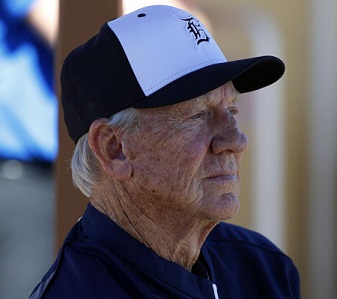
Hall of Famer Al Kaline, observing a spring training 2014 Tigers workout. “I have to work as hard if not harder than anybody in the league,” he once said of playing the game he made look simple.

The late Al Kaline was twenty years old when he won his only American League batting championship, in 1955. In wins-above-replacement-level-player terms, it’s the third best season by any twenty-year-old, with only Alex Rodriguez (9.4 WAR, 1996) and Mike Trout (10.5, 2012) passing Kaline’s 8.3.

In earthier terms, that season planted such extreme expectations upon him that Mr. Tiger eventually said it was the worst thing that could have happened to the man who finally became a Detroit icon for his play and his accommodating personality. Neither of which came simply to him, no matter what you think of the flood of tributes pouring forth upon and since his death at 85 Monday.

“Detroit’s Al Kaline looks like a man who plays with consummate ease as well as rare skill,” said Sports Illustrated in a 1964 profile, “but he is finding it hard to follow baseball’s toughest act: himself.” Kaline was the cover story in that issue, and the headline attached to a photograph of Kaline following through on a swing said, simply, “Enigma of the Tigers.”

By then the Hall of Famer struggled with injuries that kept him from posting many more than 140 games a season. Even in one of his eighteen All-Star seasons, this one during the period when fans were still bereft of the vote following the Cincinnati ballot box-stuffing scandal of 1957, this was a time when some sportswriters and enough Tiger fans called for the team to trade the right fielder who’d retire as a franchise demigod.

“This put the pressure on me,” Kaline told SI writer Jack Olsen of the beginning that culminated in that batting title. “Everybody said this guy’s another Ty Cobb, another Joe DiMaggio. How much pressure can you take? What they didn’t know is I’m not that good a hitter. They kept saying I do everything with ease.

“But it isn’t that way,” Kaline continued. “I have to work as hard if not harder than anybody in the league . . . I don’t have the kind of strength that [Mickey] Mantle or [Willie] Mays have, where they can be fooled on a pitch and still get a good piece of the ball. I’ve got to have my timing down perfect or I’m finished . . . I’ll tell you something else: I’m not in the same class with players like Mays or Musial or Henry Aaron, either. Their records over the last five seasons are much better than mine.”

There have always been those players who make baseball look so simple that Joe and Jane Fan become deluded enough to think they can play it even half as well as Kaline did. Kaline himself was the first to admit that making baseball look simple required work, and lots of it. Marry that to the expectations a talent showing itself early inspires, and you might find a player despairing of ever being what he thinks people want him to be.

“In the first few years after he won the batting championship,” Olsen wrote, “Kaline went into frequent depressions over his inability to give the fans what he knew they expected. He would come into the clubhouse after a game and slump in front of his locker, speaking to no one.”

That actually earned Kaline a reputation for difficulty for awhile. But Kaline himself—who once earned Hall of Famer Ted Williams’s respect and a tip to use hand weights to strengthen his wrists for hitting—told Olsen he wasn’t exactly being a sulk during those first few post-title seasons.

“I was just quiet, and when a newspaperman came up to me and said, ‘Nice game,’ or something like that, I’d just say, ‘Thank you’,” he said. “I would never prolong the conversation, and the guys who didn’t know me would say, ‘Look at this stuck-up kid.’ But it was just my way. I don’t talk much. I don’t like to make people mad at me, and if you talk too much you’re gonna put your foot in your mouth sooner or later.”

When Kaline had a terrific 1956 followup to his batting title season and pressed for a salary raise that might bring him at least next to then-Tiger Harvey Kuenn’s income neighbourhood, then-Tigers president Spike Briggs put his foot into his own mouth.

Briggs told a Detroit advertising club meeting, “Kaline thinks he’s as good as Mickey Mantle, and wants as much money as Mantle.” Except that Kaline thought and said nothing of either sort. It took the intercession of player development director John McHale to get Briggs to back off and hand Kaline $30,000 for 1957.

Under misinterpretation Tiger fans began booing Kaline and the sharp right fielder was, understandably, none too thrilled. He merely clammed up for a good while. Especially when the Tiger front office tried to impress upon him the idea that a little flash out on the field might go a long way. Asking Al Kaline to become a showman would have been something like asking Casey Stengel to become an undertaker.

“They told me to be more colorful, that I could bring more people into the ballpark if I was more colorful,” Kaline told Olsen. “But how could I do that? I could jump up and down on the field and make an ass out of myself arguing with umpires, but I’m not made up that way. I could make easy catches look hard, but I’m not made that way, either.”

He merely made himself a ten-time Gold Glove winner, and it wasn’t by reputation alone. Only two right fielders—Hall of Famer Roberto Clemente and sometimes-forgotten Jesse Barfield—finished with more fielding runs above average. He made near-impossible catches look simple, if not painless. He made throwing runners out look routine. He made hitting tough pitches look as natural as eggs on a breakfast plate.

His early 1964 slump didn’t worry his then-manager, one-time Brooklyn icon Charlie Dressen, one lick. “He’s not hitting now, but what does that mean? Nothing,” Dressen said then. “When a man is an established hitter like Kaline, you know what he’s gonna do. The pitchers are getting him out now, but later on in the season somebody’s gonna suffer.”

Kaline’s injury issues only began with an osteomyelitis-plagued left foot that led to small bone removal surgery which compelled him to develop a way to run on the side of the foot. “On top of that,” Olsen wrote, “he has suffered more than the average number of injuries, among them depressed fractures of both cheekbones, two beanings and a broken collarbone. Baseball has not been a frolic through sylvan glades for Al Kaline.”

The Tigers’ 1964 general manager knew it. “Al Kaline has had more reason to jake it than almost any ballplayer I know, but I have never seen him give less than everything he had,” Jim Campbell told Olsen. “That’s the way he learned to play baseball, and that’s the only way he knows how.” Campbell also said oh, sure, he’d think about trading Kaline—for Hall of Famers Mays, Juan Marichal, and Orlando Cepeda of the Giants in the same deal, that is.

Olsen’s piece was titled inside the magazine, “The Torments of Excellence.” “Talking to Kaline,” he observed then, “is like making funeral arrangements.” The longer he played, the farther behind he left the old expectations and front-office animosities, the easier it became for him to be himself, around fans and players in his and opposing uniforms.

The only funeral arrangements Mr. Tiger ever made were in the 1968 World Series. His seventh-inning, bases-loaded shuttlecock of a single turned a 3-2 deficit into a 4-3 Tiger lead, jerking them to a win, and they never looked back. Especially after Kaline flattened a service from Hall of Famer Steve Carlton into a two-run homer on a 3-for-4 day during a 13-1 Game Six rout, before Mickey Lolich out-pitched Bob Gibson to win Game Seven.

He’d also smash an eleventh-inning bomb off Hall of Famer Rollie Fingers in the 1972 American League Championship Series to break a one-all tie in a game the Athletics won in the bottom of the inning; then, in Game Four, his tenth-inning single set him up to score the tying run in what became a 4-3 Tigers win. It wasn’t enough to stop the A’s from winning Game Five.

Two years later, in his native Baltimore, Kaline swatted a leadoff double the other way, into the right field corner, against Dave McNally in the fourth inning for his 3,000th hit. His next time up, he smacked a game-tying RBI single off McNally.  (The Tigers eventually lost the game.) Then he made good on a promise he’d made to retire after he got the hit. If he didn’t get it in 1974, he’d get it in 1975.

“I’ll retire now,” he said simply after the game.

Meaning after the season. Kaline took a year to get the game out of his system, then re-joined the Tigers as a broadcaster, which he’d remain for a quarter century to follow before moving into the front office as an advisor. In the interim, the ancient and short-lived battles dissipated completely. Kaline made fans feel warm and Tigers who followed him feel well enough endowed.

When the Tigers played their final game in Tiger Stadium (“Character, charm, and history,” Kaline once said was the Old Girl’s strength), on 27 September 1999, Kaline gave a rookie Tiger named Robert Fick the pre-game word: Fick would hit one out that night. In the bottom of the eighth, facing Kansas City reliever Jeff Montgomery with the bases loaded and one out, Fick ripped one off the right field roof.

A year earlier, while traveling around the country and spending some time outside Detroit with a friend, I got to take in a game at Tiger Stadium, copping a field-level seat down the left field line next to the foul pole, on a night the Tigers and the Reds wore throwback tribute Negro Leagues uniforms. I looked across to the right field roof on the facade of which were four retired uniform numbers: 2 (Hall of Famer Charlie Gehringer), 5 (Hall of Famer Hank Greenberg), 6 (Kaline), and 16 (Hall of Famer Hal Newhouser).

Kaline’s 6 stood out especially because I’d seen him play often enough growing up, as a Met fan who’d watch the occasional Yankee game just to see the other teams and their big men, remembering how easy Kaline made baseball look—whether running a ball down and throwing a runner out from right field, whether stroking a hit or three with men on base (he has a lifetime .322 batting average in high-leverage situations and .311 with men in scoring position)—but not knowing how much work he did to make it that way.

I thought of that night in Tiger Stadium again when learning of Kaline’s death. Somehow, having the chance to see just one live game in the Old Girl, it felt like Kaline’s house, we were his guests, that Tiger fans were comforted knowing that he was there (still in the broadcast booth at the time), and that he might make even a traveling fan in his first and only Detroit visit feel at home.

“This fellow is amazing,” Stengel said of Kaline during the 1950s. “You ask yourself four questions. Can he throw? And the answer is yes. Can he field the ball? And you answer yes. Is he active on the bases? Yes, you’d have to say yes. And then, can he drive in the runs? The real test. And again you say yes. So he is an amazing fellow.”

Tell Kaline to his face that he was amazing and he’d have denied it under oath. And he’d have gone on trial for perjury.

Al Kaline, RIP: Mr. Tiger was a pussycat

2020-04-06 AlKalineFredHutchinson

Hall of Famer Al Kaline (left) with Fred Hutchinson, his first major league manager. Hutch introduced the lad to Hall of Famer Ted Williams, who introduced him to wrist strengthening that enhanced his formidable enough hitting–but Kaline’s glove and arm were equal.

Hall of Fame outfielder Al Kaline, whose career ended before Andy Messersmith shattered the reserve era once and for all, once turned down a salary raise because he believed he didn’t earn it. He still became the first Tiger to sign a six-figure single-season contract in due course.

A year ago, a teammate of Kaline’s on the 1973 Tigers told me during a telephone interview about how Kaline—who died today at 85—became a team leader without big talk or big noise.

“Al Kaline was extremely soft spoken,” said Bill Denehy, the former Mets pitcher whose third of three major league seasons was in Detroit. “Any time we had a team meeting, any time we had anything that, you know, caused the team to get together to give their opinion . . . Al would sit at his locker and vote just like he was—Bill Denehy. He wasn’t someone who would complain, he wasn’t someone who really wanted to put his opinion out there, he was the ultimate team player.”

Kaline signed with the Tigers right out of high school for a $35,000 bonus. Under the once-infamous Bonus Baby rule of that era, such players had to be kept on major league rosters for two seasons before they could be farmed out for real seasoning. Of all the players impacted by that bonus rule, Kaline was one of only three to become Hall of Famers. (The others: Sandy Koufax and Harmon Killebrew, though Killebrew was the only one of the three to see minor league time after his bonus period expired.)

The son of a Baltimore broom maker and a scrubwoman, Kaline used his bonus to pay off his parents’ mortgage and for his mother to undergo eye surgery. “They’d always helped me,” he once told a reporter. “They knew I wanted to be a major-leaguer, and they did everything they could to give me time for baseball. I never had to take a paper route or work in a drugstore or anything. I just played ball.”

Kaline was in a Tiger uniform the week after his high school graduation. By the time he became eligible to be sent to the minors, in 1955, it was the last thing on the Tigers’ mind: he was about to become the American League’s batting champion. He developed a near-picture swing, partially on Hall of Famer Ted Williams’s advice, Williams having suggested he try squeezing rubber balls and moderate small weight lifting to build his wrists.

What Denehy considered the ultimate team player on the Tigers proved it on the final day of his major league career, against the Orioles. Coming in having hit in thirteen of his previous eighteen games, including the one that gave him 3,000 lifetime, Kaline also hadn’t hit one out since that September 18. His next home run would be the 400th of his career.

It never came.

Kaline batted twice against the Orioles’ Mike Cuellar, striking out and flying out, while also playing through a badly ailing shoulder. When his next turn to hit arrived in the fifth, Kaline put baseball ahead of a notch on his resume. He told manager Ralph Houk to take him out, which Houk did, sending Ben Oglivie up to pinch-hit against Baltimore reliever Wayne Garland.

The tiny Tiger Stadium crowd booed lustily. “I was sitting there in the clubhouse,” Kaline remembered, “and I could hear them booing. I really felt sorry for Ben. It wasn’t his fault.” Houk, for his part, empathised with Kaline. “With a hitter as great as he is,” he told reporters, “you don’t send him back out there when he says he’s had enough. I think I owed Al that much.”

When Kaline became the (still) youngest batting champion (at 20), he tied for second with Hall of Famer Mickey Mantle in the American League’s Most Valuable Player voting. That wasn’t the only thing he had in common with the Yankee legend. Kaline dealt with osteomyelitis, too, but in his left foot, requiring removal of some bone and forcing him to learn to run on the side of the foot, something that plagued him along with numerous other injuries in his career.

Writing The Cooperstown Casebook, Jay Jaffe ranked Kaline the number seven right fielder who ever played the game, including that his 155 defensive runs saved lifetime are second only to fellow Hall of Famer Roberto Clemente among right fielders. Yet when Kaline became a first-ballot Hall of Famer in 1980, fans and the Detroit press hammered the Tigers yet again over Kaline’s early exit in that final game.

Kaline also faced questions over it even then. “That was one of my most embarrassing moments,” he said long afterward. “But you have to understand that I didn’t realize at the time the fans came out to see me in my last time at-bat.”

He had nothing for which to apologise. A man who puts baseball ahead of his own potential milestone and knows when it’s time to sit down is entitled to dispensation.

“When you talk about all-around ballplayers, I’d say Kaline is the best I ever played against. And he’s a super nice guy, too,” said the Orioles’ Hall of Fame third baseman Brooks Robinson, during Kaline’s final season, Robinson just so happening to be a super nice guy himself. (“Around here,” Brooks Robinson Day MC Gordon Beard said, “people don’t name candy bars after Brooks Robinson—they name their children after him.”)

“There aren’t too many guys who are good ballplayers and nice guys, too,” Robinson continued. “Your attitude determines how good you’re going to be — in life as well as in baseball. He’s got a great attitude.”

So much so that Kaline began getting applause in opposing ballparks around 1969-70, something that didn’t go unnoticed by him. “This makes a guy feel good,” he told The Sporting News in 1970. “Most of it is for being around so long. I’ve stood the test of time. And I haven’t done anything to embarrass the game or myself.”

Kaline’s humility was as legendary in Detroit as his playing consistency. He missed five weeks in 1968 with a fractured forearm, then saw limited time when he returned. He even questioned whether he belonged in the World Series when Mickey Stanley and Jim Northrup, who’d gotten most of Kaline’s plate appearances in the interim, had run the distance.

That’s when then-manager Mayo Smith devised his gambit of moving Stanley from center field to shortstop, displacing good glove/spaghetti bat Ray Oyler, and shifting Northrup to center field, enabling Kaline to take his usual post. Kaline’s two-run single in Game Five yanked the Tigers from the brink of elimination and he finished the Series with a 1.055 OPS.

That was the man who said after the Tigers clinched the pennant in the first place, “I don’t deserve to play in the World Series.”

Kaline became a respected commentator on Tigers’ game telecasts, working with play-by-play man George Kell and then, after Kell retired from the booth, Ernie Harwell. He did that for two decades to follow before he was moved to the Tigers’ front office in an advisory role. More than that, making friends among just about everyone who met Mr. Tiger seemed to come second nature to him.

He had numerous admirers even among his opponents. “I like to watch him hit,” said Hall of Fame pitcher Jim Palmer once. “I like to watch him hit even against us. He’s got good rhythm, a picture swing. Other hitters could learn a lot just by watching him. The thing about Kaline is that he’ll not only hit your mistakes, he’ll hit your good pitches, too.”

Yet the Tigers honoured him with one of only six statues around Comerica Park by having him seen with a glove, rather than a bat in his hand. It depicts Kaline making a leaping, one-handed catch, very much like the catch he made scaling above the old Yankee Stadium right field, field-level scoreboard, to take a homer from Mantle in 1956.

Kaline was as elegant an assassin shooting down runners from right field as he was at the plate. “He was the only fielder,” tweeted actor/baseball fan Jeff Daniels, “who could make the ball come to him.” Not long ago, though, Kaline lamented contemporary outfielders doing less work on their throwing than he and his contemporaries did.

“The outfielders really need to be practicing making long throws because sometimes you can go several games before you have to make a long or hard throw,” he told a writer.

They don’t do it at all. Today the outfielders play long catch before the game, and they work on the outfield walls when they go to another ballpark but they don’t regularly practice throwing home like we did when I played. They just don’t do it. Throwing in game conditions is a lot different then just playing long catch in the outfield. In a game you have to move your feet a lot faster and you don’t have time to set up and throw . . . I don’t know why they don’t practice throwing home at least once every series just to get used to game situations as you possibly can.

Two years before that robbery against Mantle, Kaline threw White Sox baserunners out in three straight innings. The bad news was the White Sox still slapping the Tigers silly in that game, a 9-0 win with sixteen White Sox hits. Typically, Kaline refused to call for fireworks on his own behalf. “That was a pretty fair day,” he said of his three kills in three innings. “I liked it.”

Kaline had only one more enduring marriage than with the Tigers—with his wife, Louise, his high school girl whom he married after the 1954 season and whom he loved for her beauty, her brains, and for her ability to talk baseball. One of their two sons played in the Tigers organisation briefly.

When baseball changed the name of its annual sportsmanship/community involvement award to the Roberto Clemente Award, Kaline was the first to win the award under that name. Fittingly. Both men had 3,000 hits or more and howitzers for throwing arms. But Kaline has just one up on Clemente: his was the first uniform number (6) retired by his franchise.

Such a kind and generous man who meant so much to so many,” tweeted longtime Tigers pitcher Justin Verlander. “I hope you knew how much I enjoyed our conversations about baseball, life, or just giving each other a hard time. I am honored to have been able to call you my friend for all these years.”

Always felt that to be a slam-dunk HOFer you had to have an ego and be selfish, always knowing how many W’s or HRs you were away from Cooperstown,” tweeted Claire Smith, a Hall of Fame baseball writer herself. Then I met #AlKaline Billy Williams, Sandy Koufax, Phil Niekro — gentlemen & gentle men. “R.I.P. Mr. Tiger.”

In numerology, 6 means, basically, family, home, harmony, nurturing, and idealism. It sounds like a thumbnail sketch of Kaline himself. If we have to say farewell on the day this gentleman and gentle man went to the Elysian Fields, the date is only too appropriate, too. The sixth.

No tank you very much

2017-07-27 HoustonAstrosWS

So far, the 2017 Astros are one of a couple of  exceptions to the rule thus far that tanking is not a world championship guarantor.

When February got underway in earnest, I asked what you’d say if you knew each major league baseball team, rich and poor alike, is guaranteed about $60 million into its kitty before the regular season even begins. And without having to do a blessed thing to earn it other than existing in the first place.

Not to mention that each major league team would pull down about an average additional $100 million during a season through sources that only include the gate.

At that time the Major League Baseball Players Association thought aloud about pushing for imposing a tax on teams that seemed not to care less about putting even a mildly entertaining product on the field, a product showing the teams had even the mildest concern about trying to win. The MLBPA pondered such a tax costing tankers prime draft pick positions if they continued losing, or at least not trying to win all that much, beyond particular thresholds over certain periods.

Everybody with me? So far, so good. Because the redoubtable Thomas Boswell, the Washington Post‘s longtime baseball sage, has things to say about it. When tanking teams call their tanking “strategy,” Boswell calls it fan abuse:

The idea of trying to lose 100 to 115 games, while claiming it’s a long-term plan for glory, always has been a long-shot notion, seldom born out in actual baseball experience. Of the current 30 teams, 20 have never in the past 50 years lost more than 200 games in consecutive seasons, at least not after you exclude their early expansion-team days. Yet those 20 teams have won 33 of the past 50 World Series, exactly the ratio you’d expect if there was no difference between having a Horror Era and never being truly awful at all.

In other words, the back-to-back 2016 and 2017 World Series winners, the Cubs and the Astros, were outliers when they went into the tank to rebuild from the guts up, over three or four seasons previous, rather than retool on the fly and continue trying honest competition along the way.

Reality check: Unless you’re certain comic-opera teams of legend, or the Washington Generals, losing isn’t entertaining. Boswell notes six teams at this writing on pace to lose 98 games or more this season. In ascending order: the Mariners (98), the Marlins (101), the Blue Jays (101), the Royals (103), the Tigers (111), and the Orioles (111).

They’re about as entertaining as root canal work, southern California traffic jams, and today’s politics of demeaning. Actually, I’ll walk that back a little bit. Southern California traffic jams have occasional amusements.

Among other things the tankers are competing for that ever-popular number one draft pick. “[W]e’re watching a bull market in stupidity,” Boswell writes, perhaps unintentionally offering the emphasis on bull. “And cupidity, too, since all those teams think that they can still make a safe cynical profit, thanks to revenue sharing, no matter how bad they are.”

Since the draft began in 1965, there’ve been 55 number one overall picks. Four became Rookies of the Year, seventeen became All-Stars even once, and three became Hall of Famers. Historically, the draft more often becomes a case of good things coming to those who wait, on both sides of the draft tables.

In today’s terms it only begins with the game’s greatest player. Mike Trout waited until round 25 before the Angels chose him in 2009, and it took him two years to become listed by anyone as a number one prospect. And they’re already trying to figure out the language on his Hall of Fame plaque even though he has one more season to become minimally eligible.

His aging but no-questions-asked Hall of Fame teammate Albert Pujols waited until round thirteen before the Cardinals pounced in 1999. Guess who else went from the thirteenth round of the draft (in 1989) to the Hall of Fame? Does Jim Thome ring as many bells for you as he rung pitchers’ bells?

Those aren’t the only Hall of Famers incumbent or to-be who went well enough below the first round: Wade Boggs (1976)—seventh round. Goose Gossage (1970)—ninth. Andre Dawson (1975)—eleventh. Nolan Ryan (1965)—twelfth round. Ryne Sandberg (1978)—twentieth. John Smoltz (1985)—22nd.

Not to mention a passel of All-Stars who made distinguished careers even if they fell shy of being outright Hall of Famers, including but not limited to: Sal Bando (sixth, 1965), Tim Hudson (sixth, 1997), Jamie Moyer (sixth, 1984), Willie Randolph (seventh, 1972), Jim Edmonds (seventh, 1988), Eric Davis (eighth, 1980), Fred McGriff (ninth, 1981), Jack Clark (thirteenth, 1973), Dave Parker (fourteenth, 1970), Jake Peavy (fifteenth, 1999), Orel Hershiser (seventeenth, 1979), Kenny Lofton (seventeenth, 1988), Don Mattingly (nineteenth, 1979), Andy Pettitte (22nd, 1990), Roy Oswalt (23rd, 1996), and Mark Buehrle (38th, 1998).

And don’t get me started on the number one overall draft picks who barely (if at all) made the Show or didn’t quite survive for assorted reasons. Steve Chilcott (injured severely in the minors), David Clyde (rushed to the Show for two box office-minded starts, then mal-developed and injured), Al Chambers (couldn’t hit with a garage door, couldn’t field with a vacuum cleaner), Brien Taylor (injured defending his brother in a fight), call your offices.

While you ponder all that, ponder something else Boswell points out: A complete team dismantling and rebuilding is only justifable now and then, when it “may be the best of the available rotten options.” But even that runs a risk any team looking to put an honest product on the field should duck: “Rebuild in a few seasons — well, maybe . . . if you’re very lucky. But more likely, you’ll just stink for years and pick the public’s pocket.”

Once upon a time the Red Sox were as long-suffering as the season was long. The cause wasn’t any curse (of the Bambino or otherwise) but boneheaded (and, once upon a time, bigoted) organisational management. But even they’ve had only one season since 1934 in which they lost more than even 93 games.

Even the Cubs—the just-as-long-suffering Cubs, once upon a time—have only three 100+ loss seasons in their history. The third one happened in 2012. Three years later, they were division winners; a year after that, they won a World Series; they’ve since remained pennant competitive if not without a few hiccups that haven’t come within the same solar system as their formerly star-crossed past.

The incumbent Reds franchise has only one 100-loss season to show since they joined the National League—in 1882. Between them, Boswell reminds you, the Dodgers and the Angels have 121 seasons in or near Los Angeles . . . and only two squads between them (the 1968 and 1980 Angels) that ever lost more than 95 in a season. The Yankees haven’t had a 100-loss season since the year the Titanic sunk. The Cardinals haven’t lost more than 95 in a season since Grand Central Station’s first rebuild—a year after the iceberg.

The fictitious New York Knights of The Natural once employed a carnival hypnotist whose sole qualification seemed to be telling the hapless players, hypnotically, “Losing . . . is a disease.” In baseball, it doesn’t have to be terminal, no matter what today’s tankers do or don’t think. Though it seems that way in a place like Baltimore, where the Orioles went unconscionably from an organisation with one of the game’s most admirable cultures to one with one of the game’s most abhorrent.

As Boswell reminds us, the Orioles lost 202 in 1987-88 and went into complete rebuild; practically the only surviving incumbent proved to be Hall of Famer Cal Ripken, Jr. They’ve only won 90 or more games in any season three times since that teardown and had a fourteen-season streak of losing seasons. The franchise that was once the truly hapless St. Louis Browns only ever had a losing-season streak as high as twelve in their St. Louis decades.

The Oriole brand, Boswell knows, became so badly battered that it was no wonder major league baseball finally returned to Washington: “[T]here was nothing for MLB’s other 29 owners to protect by keeping a team off Baltimore’s doorstep.”

“Now it is all different,” wrote one-time New York Post sportswriter and recent editor of Ball Four, Leonard Shecter, after the crazy Mets were crazy enough to win a division, pennant, and World Series in their mere eighth season of play. “Casey Stengel is gone. The players, who try no harder than the old Mets, succeed more often and as a result are indistinguishable from baseball players all over. There is stuffiness in the front office. There is great concern about unimportant things . . . And, worst of all, when the Mets lose, there is nothing funny about it at all.”

Beware the tanking teams saying they’re just looking to the future. They’re nowhere near as entertaining in defeat as the 1962 Mets, the last era of the Browns (when Bill Veeck owned the team), or the 1930s Dodgers.

Ask any Mariners, Marlins, Blue Jays, Royals (never mind the rude interruption of their 2015 World Series conquest), Tigers, or Orioles fans. They’ll tell you. Losing is about as funny as a screen door on a submarine.

Don Mossi, RIP: Ugly is as ugly does

2019-07-26 DonMossi

Don Mossi, who proved ugly was only in the eye of the beholder on and off the mound.

“He could run ugly, hit ugly, throw ugly, field ugly, and ugly for power,” wrote Bill James about pitcher Don Mossi in The New Historical Baseball Abstract. “He was ugly to all fields. He could ugly behind the runner as well as anybody, and you talk about pressure . . . man, you never saw a player who was uglier the in clutch.”

Wrote the late Jim Bouton in Ball Four, while musing how players loved to choose up all-ugly lineups to pass time, “he looks like a cab coming down the street with the doors open.”

Hall of Famer Yogi Berra, the all-ugly receiver, once said, “It don’t matter if you’re ugly in this racket. All you have to do is hit the ball. And I never saw anybody hit one with his face.” Mossi, a brainy lefthander who made Berra resemble Cary Grant by comparison, could have said the same thing, with the codicil that he’d never seen anybody pitch one with his face.

Mossi, who died Friday morning at 90 in an Idaho hospital, had nothing on the mound but his brains, an unusual three-finger grip on his fastball, which didn’t travel like a speeding bullet but came to enough forks on the way to the plate and took them to keep hitters off balance, and a deadly enough curve ball. And it gave Indians manager Al Lopez a smart idea when Mossi made the team in 1954.

Lopez used Mossi’s wits and righthander Ray Narleski’s power as an effective bullpen counterweight whenever one of the Indians’ effective starters—Hall of Famers Bob Lemon and Early Wynn, Mike (The Big Bear) Garcia, and aging but still capable Hall of Famer Bob Feller—needed to be spelled, with elder veteran Hall of Famer Hal Newhouser the long man out of that pen.

Used so judiciously, that bullpen helped the 111 game-winning Indians whistle past the 103 game-winning Yankees and into the World Series, with Mossi rolling a 1.94 ERA and a staggering 194 ERA+, then pitching four innings in the World Series without surrendering an earned run or a walk.

If only the Series equaled Mossi’s performance: the Giants swept the Indians in four straight, and it only began with Willie Mays’s stupefying catch in Game One to rob Vic Wertz of a likely extra base hit at the Polo Grounds’s cavernous rear end. In due course, Mossi would admit he was scared to death as a rook until veterans such as Feller and Lemon put him more at ease.

A year later, Mossi was deadlier. He struck out 69 against only eighteen walks, posted a 2.42 ERA and a 2.01 fielding-independent pitching rate, and even drew a few Most Valuable Player votes while he was at it. Who knew that Narleski would begin experiencing elbow trouble and put an end to that skin-tight rear end of the Indians’ bullpen?

Perhaps inexplicably, the Indians moved Mossi and Narleski into the starting rotation for most of 1957. Perhaps also inexplicably, Mossi earned his only All-Star berth. Perhaps even more inexplicably, the Tribe traded both Mossi and Narleski to the Tigers after the 1958 season—for Billy Martin, well along the way to his second career of wearing out his welcome swiftly enough, wherever he landed, after Yankee general manager George Weiss got fed up with him in 1957.

As a Tiger, Mossi became a starter, mostly, and a reasonable back-of-the rotation option. In 1961, Mossi became a curious trivia element when he surrendered only one home run to Roger Maris but none to Mickey Mantle while that pair of Yankees chased ruthsrecord all season long. Mossi also started a 1 September game against the Yankees in which a near-flawless performance was ruined when, with two out, Elston Howard and Berra singled back to back before Moose Skowron drove home Howard with the winning run.

The loss kicked off an eight-game losing streak that knocked the Tigers out of the 1961 pennant race. And that was the last season Mossi pitched before incurring arm trouble that began slowly decreasing his starting assignments and increasing his bullpen options until the Tigers sold him to the White Sox during spring training 1964.

The White Sox put him back into the bullpen permanently, and Mossi responded with a 2.94 ERA over forty innings before the Sox released him after the season. The Kansas City Athletics took a flyer on him in May 1965, but he called it a career after the season.

His comparatively late major league start may have shortened his career a bit; he was 25 when the Indians brought him up in 1954 and one year removed from discovering that odd three-finger fastball grip. He was a good if unspectacular pitcher who married his mind to his arm and did the best he could with both.

Teammates appeared to have loved and respected Mossi. Once upon a time, according to a fan posting on Mossi’s Legacy.com obituary page, Rocky Colavito—dealt to the Tigers controversially in 1960 (Indians fans were ready to arrange the execution of general manager Frank Lane over that and other trades that essentially broke up the Indians’ perennial contenders)—drove a white Cadillac convertible and picked Mossi up in it on the way to Tiger Stadium as long as they were teammates.

But his distinctive (shall we say) appearance stuck in the minds of opponents and fans more than his ways and means on the mound. Beneath eyes similar to those of Edward R. Murrow, Mossi also wore a proboscis that made Danny Thomas’s look like a bob and ears that rivaled the batwing flaps of legendary Hollywood censor Will Hays, earning him the nicknames “The Sphinx” and “Ears.”

Well, now. The Sphinx with Ears ended up having a last laugh. He returned to his native California with his wife, Eunice, and their three children; he’d married his lady on the field at Bakersfield’s Sam Lynn Ballpark while pitching for the Indians’ farm in 1950. Mossi’s baseball afterlife included running several motels in California successfully, not to mention becoming a twelve-time grandfather and a 25-time great-grandfather.

A few years after Mrs. Mossi passed away, her husband retired to Idaho, where much of their family had relocated, and took up an active life indulging his passions for gardening, hunting, and camping. The Mossis were animal lovers to the point that the pitcher’s family declined a funeral service and asked instead that contributions be made to a pet hospital in nearby Oregon.

Clearly enough, ugliness was in the eye of the beholder, and Mossi’s was only skin deep. (Admittedly, you wonder, if Mossi had gone to medical school, he’d have put up with tons of needling about becoming an ear, nose, and throat specialist.) Beneath the ears and the schnozz there rested a competitor on the mound and a gentleman off it.

So laugh, clowns, laugh. This Donald had the last laugh known as a life lived very, very well. Call it winning ugly if you must. But emphasise winning.


Dr. Pujols and Mr. Hydes

2019-05-10 AlbertPujols2000thRBI

Albert Pujols flips his bat heartily after hitting the solo home run that meant RBI number 2,000 Thursday . . .

Sometimes it just doesn’t pay to catch history in your hands. Even when you’re not trying to get paid for it.

Albert Pujols cranked a hefty solo home run in Comerica Park Thursday to land his 2,000th career run batted in. The blast put the future Hall of Famer into some very distinguished company as it was.

Cap Anson drove in his 2,000th run at the end of the 1896 season, but unless the Hall of Fame has an online-accessible library I couldn’t discover just how he drove it in. And the run batted in wasn’t counted as an official statistic until 1920.

But Henry Aaron drove his 2000th in in July 1972 with a three-run homer and Alex Rodriguez drove his 2000th in in June 2015 with a two-run homer. Babe Ruth is in the 2,000 RBI club, too. Yes, you might think the Big Fella did it with a big blast but, yes, you’d be wrong: he worked out a walk with the bases loaded against the St. Louis Browns in May 1932 to do it.

A 33-year-old Tigers fan named Ely Hydes just so happened to catch Pujols’s bomb in the top of the third, after Pujols turned on a Ryan Carpenter fastball right down the pipe and drove it into the left field seats, right into Hydes’s waiting hands.

Along came baseball government to prove that no good deed goes unpunished. When its representatives at the game refused to authenticate the ball, it crowned Hyde’s indignation not over the milestone sphere but things in general at Comerica Park involving the Tigers, as he sees it.

“I am not rich. I am a broke-ass law student,” Hydes wrote in a Facebook post. “I did not do this out of any sort of  ‘entitlement’ . . .  I had the best of intentions. This ball will most likely end up in the Hall of Fame. I’m sorry if no one can ‘authenticate’ it, but the only reason I ended up with it is because Tigers management treated me so terribly.”

Detroit Free Press reporter Aleanna Siacon writes that the Tigers and the Angels each made “generous efforts” to retrieve the milestone ball but Hydes didn’t much like being treated like an opportunist. You know, the sort of fan who can’t wait to cash in a history-making baseball for prolific pelf. Giants fans brawled in the stands over who’d get to leave the park with the ball Barry Bonds smashed for his 600th career home run in 2002.

And sometimes such opportunists try stealing souvenirs with less history attached to them. In 2014, a Minute Maid Park fan wearing a Derek Jeter shirt in the field boxes on Opening Day—Jeter’s last as a player—was spotted by Jeter himself. But when the longtime Yankee captain tried to hand the girl a ball, a woman in an Astros jersey sitting in front of her in the seats tried to steal the ball. Jeter wouldn’t have it. He leaned up against the rail and put the ball in the girl’s hands despite the woman’s upstretching.

Hydes wasn’t exactly in the frame of mind to brawl over the Pujols bomb, nor did he steal it from any adjacent fans.

“I considered it an honor to catch Pujols’s ball,” Hydes wrote in his Facebook post, “and tried to act all day with the honor I thought it obligated me to.” Indignant about current Comerica Park policies such as refusing to allow ballpark ushers to be tipped, which he said compelled him to put tips right into their pockets physically, Hydes tore into the younger generation of Illitches and how callously he thinks they’ve behaved since the death of Tigers owner Mike Illitch.

But his indignation with MLB is just about equal. “Honestly, if they were just cool about it I would’ve just given them the ball,” he told WXYT interviewer Kyle Bogenschutz. “I don’t want money off of this, I was offered five and ten thousand dollars as I walked out of the stadium, I swear to God . . . I just couldn’t take being treated like a garbage bag for catching a baseball.”

Pujols himself took a sanguine attitude about the ball and Hydes.

“I think he was given a little hard time and I told the guys, just you know, just leave it,” Pujols told reporters. “Just let him have it, I think he can have a great piece of history with him, you know. When he look at the ball he can remember . . . this game, and I don’t fight about it. You know, I think we play this game for the fans too and if they want to keep it, I think they have a right to. I just hope, you know, that he can enjoy it . . . He can have it . . . He can have that piece of history. It’s for the fans, you know, that we play for.”

Hydes was aware of Pujols’s comment. “You’re a class act,” he wrote, addressing Pujols. “You wouldn’t pay me a penny for the ball and I wouldn’t take a penny.”

When Roger Maris finally hit his 61st home run on 1961’s final day, busting Ruth’s single-season record, a 19-year-old Yankee Stadium fan, Brooklyn truck driver Sal Durante, caught the ball with one bare hand in the right field seats. Stadium ushers came to Durante for the ball. Durante asked only one thing—to hand it to Maris personally.

The ushers agreed. They brought him to the Yankee clubhouse and Durante—who later admitted he’d had to borrow the money from his future wife, Rosemarie, to get his ticket for that game in the first place—handed it to Maris saying, “Here’s the ball, Roger.”

With his family and some team officials around him, Maris surprised Durante by signing and dating the ball and handing it back to him. “Keep it, kid,” Maris said genially. “Put it up for auction. Somebody will pay you a lot of money for the ball. He’ll keep it for a couple of days and then give it to me.”

Somebody did. California restauranteur Sam Gordon paid Durante $5,000 for the ball and then turned it over to Maris. Gordon also paid for the honeymoon when Durante married Rosemarie, with whom he raised three children as a Coney Island bus driver.

Durante was subsequently offered another $1,000 to catch the ball on the street after being dropped from the top of a giant Seattle World’s Fair ferris wheel (the Space Needle was ruled out for safety reasons)—by Tracy Stallard, the Red Sox pitcher who’d thrown the ball Maris hit out for the record. Durante wore a catcher’s mitt for the stunt and the ball hit the mitt and bounded right to the pavement. He got the $1,000 anyway.

Maris died in 1985. Rosemarie Durante died in 2014. Sal Durante is still alive at 77. He once admitted that he, like a lot of Yankee fans and other baseball people at the time, hoped originally that Hall of Famer Mickey Mantle and not Maris would break Ruth’s record. He once said meeting Maris and his family made him glad it turned out to be Maris.

Sometimes giving a player a milestone ball hurts in the aftermath. When New York cell phone salesman Christian Lopez caught the ball Jeter clobbered for a home run that was also his 3,000th major league hit, in 2011, Lopez happily gave Jeter the ball, and Jeter and the Yankees happily gave him season tickets for the rest of that season and a pile of signed memorabilia. The guesstimated value was $80,000.

The bad news was that Lopez would be hit with a hefty tax bill for his effort. A number of companies ponied up to pay it for the generous fan.

Alex Rodriguez remembered. When A-Rod homered off Justin Verlander for his 3,000th major league hit, a fan named Zack Hample—notorious as an all-but-professional souvenir hunter (his trophies are said to include Mike Trout’s first major league home run)—refused to turn the ball over.

“The thing I was thinking about is, where’s (Jeter’s) guy?” Rodriguez said after Hample refused to hand over ball—which was authenticated almost on the spot, by the way. “The guy that caught (Jeter’s) ball? That’s the guy that I needed here. Where is that guy? I wasn’t so lucky.”

“A-Rod will not be in possession of this ball tonight,” Hample harrumphed, “unless he personally mugs me outside on 161st St.”

Hydes says the Pujols ball now reposes on his coffee table. But not for long, perhaps. “I don’t know it’s been a rat race so far, but I’ve got a brother who’s a huge St. Louis Cardinals fan,” he says, referring to the club where Pujols shone for so long, “so I might give him the best gift ever.”

Pujols’s milestone mash made 4-0 a game that ended with the otherwise struggling Angels blowing the Tigers out, 13-0. He would have been overtaken after awhile by Angels second baseman Tommy La Stella hitting two out, one in the second and one in the seventh, if baseball government hadn’t been so cavalier about the milestone mash.

In a career that’s seen a glandular share of headlines and bombs, married to an equal reputation for being one of the game’s most humane players, Pujols probably never figured to achieve a milestone with controversy attached to it, even as his career has had a sad decline phase provoked mostly by injuries since becoming an Angel.

But, typical of the man, he’s handled this one with the class baseball government lacked.


UPDATE: Several hours after I published the foregoing essay, Ely Hydes changed his mind, agreeing to give the ball to either Albert Pujols or the Hall of Fame.

“All I ever wanted was to sleep on it,” he told the Detroit News. “I slept on it and I woke up and I think [Pujols] is a class act. He’s not my player, he’s not my guy, I don’t deserve the ball. I reconsidered. One-hundred percent, I’m either going to give it to Pujols or to the Hall of Fame.”

Hydes still refuses to accept money for the ball, too.