It’s Miller time . . . for retirement

Andrew Miller

The Cubs won the 2016 World Series but, until they did, Cleveland relief pitcher Andrew Miller may have been that postseason’s biggest star.

Andrew Miller’s mother once hoped he’d parlay his high 1500s SAT results into a college degree from Masschussetts Institute of Technology. Mrs. Miller would just have to settle for her brainy son becoming a lefthanded pitcher who helped revolutionise relief work, and who helped articulate the folly of the owners’ lockout from December through almost mid-March.

Miller had long proven that the best, most valuable relief pitcher in the bullpen isn’t necessarily your “closer” earning “saves,” particularly with the team then known as the Indians (now the Guardians) in the 2016 postseason plus the second half of 2016’s and most of 2017’s regular seasons.

But during the foolish lockout, the 36-year-old Miller also helped clarify that the players refused to suffer tanking any more gladly than tanking teams’ fans do.

“All during these negotiations,” Peter Gammons wrote in The Athletic as the lockout finally came to its end, “Miller drove home the players’ insistence that tanking and ideas that diminished competition were contrary to their beliefs. He consistently called ‘increased competition a core goal’ of the negotiations. ‘Anything that points towards mediocrity is the antithesis of the game and what we’re about as players,’ he said.”

Miller announced his retirement Thursday, after a considerably distinguished sixteen-season pitching career, in which he shifted himself from a nothing-special starting pitcher who couldn’t harness his repertoire into a game-changing relief pitcher who used his stamina and his wipeout slider to show both the uselessness of the save-centric mindset and resurrect an ancient—and then-controversial, too—idea about relief work.

Hall of Fame manager Casey Stengel thought nothing of bringing prime relief (Joe Page, Allie Reynolds, Bob Turley, to name three) in earlier than the latest innings when he managed the Yankees. He hammered the point that the time to reach for a stopper happens any time, even in the earliest innings. Miller’s Indians manager Terry Francona, whose new toy came from the Yankees in a non-waiver trade deadline deal, used Miller in just that way the rest of 2016 and all the way through the postseason.

It finished what Miller’s four-year/$36 million deal with the Yankees in December 2014 started: making a mostly non-closing relief pitcher into a star. He stayed with the Yankees until that trade deadline. For the second half of 2016, right up to the moment he ran out of petrol in Game Seven of the 2016 World Series (an RBI single, plus David Ross’s last major league hit–a leadoff home run), Miller was the Indians’ best relief pitcher.

According to fielding-independent pitching, which accounts for the things within a pitcher’s control as traditional earned-run average doesn’t, it wasn’t even close: his 1.53 FIP was 80 points below the next-lowest in the pen, Dan Otero’s 2.33 . . . and 1.78 below designated closer Cody Allen.

The ancient beer commercial proclaimed, “Now—it’s Miller Time.” The skipper for team known then as the Indians proclaimed, “Now—it’s Miller Time,” whenever he needed a stopper in that postseason. Quick: Name the only two relief pitchers ever to win a postseason Most Valuable Player award without being their teams’ primary closers. Answer: Miller, in the 2016 American League Championship Series; and, Rob Dibble, in the 1990 National League Championship Series.

Miller was just as deadly in 2017 (1.99 FIP) until he developed patellar tendinitis in his right knee, his landing knee, in early August, returning that September. He ran out of fuel again in the postseason, this time against his former team, the Yankees, in the Indians’ division series exit.

In due course he signed with the Cardinals, but he fought injuries and the inconsistencies they provoked. He never really looked like the force of nature he was in 2016-17 again, except during three brief postseason trips with the Cardinals. In fact, his entire posteason relief FIP—seven postseasons, 29 games, and one trip to the World Series—is more sparkling than his regular-season career marks as a reliever and as the starter he first was before he discovered life in the bullpen with the 2011-12 Red Sox:

Andrew Miller—Fielding-Independent Pitching (FIP), Career
As a starting pitcher 4.78
As a relief pitcher 3.02
As a postseason reliever 2.43

He’d shortened his delivery into a partial slide step to help him put more bite on that slider. He also paid close attention to just how he and his fellow relief corpsmen were handled, fuming over an early-season set in Chicago during which then-Red Sox manager Bobby Valentine seemed almost indifferent to how the April chill affected their pen preparation.

“The Red Sox returned home . . . and when Miller got to the park, he was upset about the usage of Rich Hill—who had already worked through a couple of operations in his career,” Gammons wrote.

Miller talked about how Hill had gotten up “close to eight times” and finally got in to face one lone batter in the bottom of the eighth inning, and Miller said, “there ought to be some kind of punishment for doing that to a pitcher, particularly someone with a medical history.” Miller turned a corner in his career that season under [2012 Red Sox manager Bobby] Valentine and there were no public issues. But he felt a teammate had been jeopardized and for 24 hours remained in that window.

“The problem still seems to be,” I wrote in the 19 March edition of the Internet Baseball Writers Association of America’s Here’s the Pitch newsletter, “that enough managers pay too little attention to the pitch volume relievers throw in the pen before they come into games . . . if they come into games. Some of those managers still think a relief pitcher hasn’t “pitched” unless he’s been in a game. Those men may well throw more innings’ worth of pitches in the pen than they’ll ever throw on the game mound.”

Apparently, there was at least one relief pitching thinking along the same lines in 2012. Rest assured, Miller’s probably not the only such reliever with the only such thoughts. The need to monitor relief pitchers’ warmup work carefully and manage it prudently remains profound if rarely appreciated.

Miller’s Cardinals teammate Adam Wainwright, himself now approaching the end of a splendid pitching career, appreciates Miller as both a relief pitcher and an advocate for the greater good of the game as one of the players’ union’s main negotiators.

He changed the game and he kind of took that relief role back to when it first started, guys who could do two, three innings–and he was the guy who did it in the postseason. I have an appreciation for what he did for the entire game of baseball. As many hours as that guy put in for the union over these past few years is kind of staggering. He may retire and that means this whole offseason he still spent sixteen hours on the phone a day, for us, for who’s next–that means a lot.

Miller is also the kind of young man who appreciates such things in life as fine wines and (this endears him to my guitar playing heart even more) the woods used to make guitars. The relief force who has worn the uniforms of the Tigers, the Orioles, the Red Sox, the Yankees, the Indians, and the Cardinals also has a calm appreciation for baseball’s history and signatures.

“I’m usually pretty quick to be able to step back though and see how lucky I have been,” Miller told the Post-Dispatch. “The hard times were necessary for me to grow and to be able to appreciate the highs along the way. Ultimately, I was able to play for many great franchises, wear historic uniforms, and play in some amazing ballparks.”

Pondering such appreciation causes me to ponder that I’d love to find a way to suggest Miller in retirement could bring his considerable weight to bear, as a baseball thinker as well as pitcher, on behalf of a forgotten player class: the now 504 pre-1980, short-career major leaguers who were frozen out of a 1980 pension realignment that made pension vesting possible after 43 days’ major league service time

All those players have received since is an annual stipend negotiated by former Players Association director Michael Weiner and former commissioner Bud Selig. The original stipend was $625 per 43 days’ major league service time, up to $10,000 a year. Somewhere during the lockout, the stipend—whose February payment was delayed pending the lockout settlement—was hiked fifteen percent. Now, it’s $718.75 per 43 days’ major league service time.

It’s hardly close to what those pre-1980 short-career men deserve, but it’s something. The further bad news is that those monies still can’t be passed to those men’s families upon their deaths.

Many of those men were active union members supporting the battles for players’ rights and respect, which compounds the original injustice. Several of those players have said they believe a perception that most were mere September callups factored in their original freeze-out. Well. I’ve been looking it up. So far, the majority of such players either made even one of their teams’ rosters out of spring training or appeared on rosters as early as later in April, or May, or June, or July, or August.

Articulate, intelligent, sensitive Andrew Miller, entering a richly-earned retirement, would be an invaluable voice of influence on behalf of those men, if he could be made further aware of such an injustice.
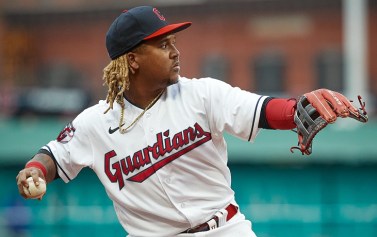
The Guardians are coming

Jose Ramirez

The Cleveland Plain-Dealer imagines Indians third baseman Jose Ramirez as a Cleveland Guardian.

Cleveland’s Hope Memorial Bridge is named for stonemason William Henry Hope. He helped to build the Guardians of Traffic sculptures into the pylon columns at either end of the bridge that marries Lorain Avenue (west side) and Carnegie Avenue (east side). He helped build all eight such statues around the city.

He was also the father of comedy legend Bob Hope, once a partial owner of the Indians.

The bridge born as the Lorain-Carnegie Bridge was renamed for the elder Hope—and listed in the National Register of Historic Places—after local engineer Albert Porter threatened but failed to get the pylons and guardian statues removed as “monstrosities . . . we’re not running a May Show here.”

Naturally, the social media swarms who think they know an awful lot more than what they actually do know were unamused to learn that the Indians—wrestling with the name change several years, from almost the moment they decided Chief Wahoo needed to go—decided to rename themselves the Guardians starting in the 2022 season.

They’re keeping the team colours. The Cleveland Plain-Dealer published a rendering of Indians third baseman Jose Ramirez as a Guardian. The new look is not unattractive. Neither is the new logo of a baseball with the stylised G on the meat of the ball and a wing flapping from the rear.

With exceptions you could fit in your living room, or maybe even in the Indians dugout, the swarms couldn’t figure out exactly what “guardians” had to do with Cleveland. It’s to wonder what they thought when they finally accepted that “guardians” have a singular meaning that isn’t confined to just the two on either end of the bridge leading traffic past Progressive Field.

Some of the swarms agonised that the team hadn’t renamed themselves the Spiders, as a different, ancient Cleveland franchise once did. Well, now. The Spiders existed in the National League from 1887 through 1899. Their franchise record: 827 wins, 938 losses. The Indians have been star-crossed quite enough without being renamed for a team that never won a single pennant. (And, for a team whose record in its final NL season was—wait for it!—20-134.)

Others thought the renaming should be after the Cleveland Buckeyes, who played in the Negro American League from 1942-1950. That might have been more plausible, not just to honour Cleveland’s entry into the game that is now recognised (long overdue, and by everyone except either recalcitrant racists or witless purists) as part of major league baseball. The Buckeyes played two Negro Leagues World Series and won one. (They beat the legendary Homestead Grays in the 1945 set.) If you must rename your team for another old, defunct team, best to rename it for a winner.

Still others thought the new name should be the Cleveland Rockers, tipping the beak toward the Rock and Roll Hall of Fame which is in Cleveland. (A song by rock and roll legend Ian Hunter, “Cleveland Rocks,” was the theme song of television’s The Drew Carey Show.) There were also those who thought the Colorado Rockies might have had an issue or three with that. But never mind.

Enough of the swarm thought the team’s introductory video for the new name had little enough business being narrated by Tom Hanks. Never mind that Hanks once featured in the baseball film hit A League of Their Own. Never mind, too, that Hanks started his acting career in Cleveland in the first place and has a particular affinity for the city.

“Cleveland natives are very defensive of their city,” writes Jim Swift of The Bulwark. “While I may have preferred the Indians, I will gladly be a Guardian against posers like [Senator] Ted Cruz, [National Review editor] Rich Lowry, [and former president] Donald Trump (who tried and failed to buy the Indians). Sad!”

It’s not as though the team just pulled a Guardian rabbit out of its hat. “We heard things like loyalty, pride and resiliency in being from Cleveland,” Indians president Brian Barren said to Plain-Dealer writer (and author of The Curse of Rocky Colavito) Terry Pluto. “They’re protective of our city. They’re protective of the land and everything about it. Those all became part of what Guardians really started to evoke from an emotional standpoint.”

Do we have a candidate for the single most asinine alternative name suggestion? Unfortunately, I do. Unless I see one even more ridiculous, the dubious winner goes to Don Wardlow. Renowned as the first successful blind broadcaster in professional baseball history, Wardlow is an active social media denizen, a still-irrepressible baseball fan and commentator, and a personally engaging man who’s prone now and then to demonstrating wisdom by walking the other way from it.

After acknowledging that “Guardians” make sense to people who live in Cleveland (“I guess”), Wardlow wrote this: “Everybody_ of a certain age, even people who don’t live in Cleveland has heard of Dime Beer night which is why I thought the name Dime Beers would be great. I don’t know if the phenomenon of the burning river is as memorable as Dime Beer night is.”

My first reply was, “Something tells me people have been trying to FORGET Ten-Cent Beer Night for decades. But I suspect you knew that.” To which Wardlow rejoined a) not everybody; b) “many” minor league teams continue “Thirsty Thursday” dollar-or-two beer promotions; and, c) that the irrepressible humourist P.J. O’Rourke “coined a name for the kind of people who want to forget and destroy fun pursuits like dime beer night. He calls them ‘The FunSuckers’.”

Wardlow wrote like a man who didn’t remember what fun pursuits really made the original Ten-Cent Beer Night on 4 June 1974 so “memorable.” (It just so happened to be my late younger brother’s birthday in the bargain.)  It was a not-so-regular riot, Alice. The Indians might have done better to postpone the event for a different game.

The Indians hosted the Rangers in the old but hardly forgotten Municipal Stadium. (Known colloquially as the Mistake on the Lake.) A week earlier, the two teams played in Arlington and included a bench-clearing brawl among the festivities. Rangers infielder Lenny Randle plowed Indians pitcher Milt Wilcox coming to tag him on the first base line while running out a bunt to trigger the scrum; Randle steamed over nearly being hit by a pitch prior to the bunt.

Lingering bad blood between the two teams was probably not the best condition to proceed with a promotion bound to get around 25,000 people (the night’s attendance) bombed out of their trees before the second inning.

The Rangers led the game 5-1 in the middle of the sixth. When Indians left fielder Leron Lee hit a liner up the middle that nailed Hall of Fame pitcher Ferguson Jenkins in the breadbasket and laid him out on the ground, the already-bombed fans began chanting, “Hit him again! Hit him again!” That may have been the most benign behaviour of the night.

A woman hit the field and flashed in the on-deck circle. A naked man ran out to second base right after Rangers designated hitter Tom Grieve hit his second of two home runs on the night in the fourth. Fans ran onto the field continuously during the game, at one point firing hot dogs at mid-game Rangers first base insertion Mike (The Human Rain Delay) Hargrove. The plague of the locusts didn’t drive the ancient Egyptians half as crazy.

In the bottom of the ninth, the Indians tied the game at five, with two out and the potential winning run on second, and Indians second baseman Jack Brohamer due to hit. And all hell broke irrevocably loose.

A fan ran out to Rangers left fielder Jeff Burroughs bent on stealing Burroughs’s hat, and the hapless Burroughs tripped and fell trying to prevent the theft. Rangers manager Billy Martin thought Burroughs had been attacked and hustled his team out to help him. A larger mob of fans swarmed out to the Rangers, prompting Indians manager Ken Aspromonte to order his team out to help the under-siege Rangers.

Some of the rioters began throwing steel chairs and seats somehow ripped away from the stands. One of the chairs hit Indians relief pitcher Tom Hilgendorf in the coconut. Another rioter picked a fist fight with Hargrove. Other rioters were determined to be carrying knives and other weapons.

Finally, both teams helped each other off the field before they could have ended up like massacre victims. The drunks continued their mayhem, tearing up the bases, tearing up the field, and throwing cups, rocks, bottles, radio batteries, hot dogs, food containers, and folding chairs around. Even umpire crew chief Nestor Chylak was a victim: he was hit in the head when a rioter threw a stadium seat at him.

That game-long mistake on the lake resulted in the game forfeited to the Rangers. Indians outfielder Rusty Torres, who’d pinch hit safely in the ninth and stood as that potential winning run, had just survived his second of three fan riots during his playing career. He’d been a Yankee when heartsick Senators fans broke RFK Stadium in the top of the ninth, causing a forfeit to his team near the end of the final Senators game ever; he’d be with the White Sox for their equally infamous Disco Demolition Night in 1979.

Some fun. Wardlow’s thought that the Indians changing their name to the Dime Beers would have been “great” was written to a group devoted to baseball nostalgia. Forgive me if I simply can’t be nostalgic about the arguable most chaotically decadent and destructive night in major league history. If there’s a proper word for that kind of nostalgia, I probably can’t say it in civil company.