Justice at last for high-tech cheaters?

2020-07-30 JoeKellyFightClub

While such “Joe Kelly Fight Club” T-shirts became popular instantly, MLB and the players union finally agreed to let the commissioner hammer electronic cheaters. But are there catches?

Well, what do you know. Joe Kelly’s Tuesday night messages to Alex Bregman and Carlos Correa may have proven more than just worth an eight-game suspension (being appealed) and his canonisation as a saint in Los Angeles and elsewhere.

They have gotten both MLB’s dubious commissioner and the Major League Baseball Players Association on board with punishing future Astrogaters and Soxgaters. If they’re caught taking or transmitting such electronically-pilfered intelligence, they can be suspended without pay and lose the days of those suspensions in service time.

The news comes from one of the most unimpeachable sources—Evan Drellich, one of two writers for The Athletic (Ken Rosenthal was his teammate on it) to whom former Houston Astros pitcher Mike Fiers, an Oakland Athletic since August 2018 (after a stop in Detroit), blew the whistle on the Astro Intelligence Agency in the first place.

“MLB’s rules on the use of electronics and video grew significantly in the wake of penalties for the Astros and [Boston] Red Sox, according to a review of the document by The Athletic and conversations with officials familiar with it,” Drellich writes in an article published Thursday morning.

The league has newly hired an outside security firm to police the video replay room entrance and no later than next year plans to edit out the signs from the footage players look at in-game.

But no alteration may be as significant as the league’s ability to discipline. Commissioner Rob Manfred has the hammer, although the union can always appeal his decisions.

. . . Kelly was said by some to be delivering the justice to Astros players that MLB did not.

Whether MLB could have effectively administered that justice previously is a complicated question.

Technically, Manfred could have attempted to suspend Astros players had he not granted them immunity during his office’s investigations. But the punishments might not have stood up to expected grievances from the MLBPA because the league and union never before agreed how these specific issues would be handled. In fact, Manfred had declared in 2017, well before the Astros and Red Sox investigations, that he would hold club officials, not players, accountable for sign stealing.

No one condoned throwing at a batter’s head, as Kelly appeared to do when he threw such a pitch to walk Bregman with one out in the bottom of the sixth Tuesday, when they knew without being told that Kelly did only what it seemed at least half of major league baseball’s players—knowing how un-contrite both the Asterisks and the Rogue Sox seemed in spring training after the verdicts—thought was going to be done this season.

(It didn’t exactly take forever for a rash of T-shirts celebrating Kelly’s knockdown of Bregman and subsequent breaking-ball dustings of Carlos Correa, not to mention protesting his suspension, to go on sale online. “Free Joe Kelly” and “Joe Kelly Fight Club,” with or without Kelly’s image answering Correa’s huffing with a mock-crybaby face, seem the most popular.)

Until the coronavirus world tour knocked baseball as inside out as the rest of the world, Astrogate especially and Soxgate concurrently were the number one topic and scandal around the game. At times it was tough to determine which was more scandalous, the AIA and the Red Sox replay room reconnaissance ring, or Manfred having given players immunity instead of using his office’s powers to order them, “Spill, or be spilled.”

Not only did Chicago Cubs third baseman Kris Bryant say this was worse than the prior scandals around actual or alleged performance-enhancing substances, Dodger pitcher Alex Wood said, “I would rather face a player that was taking steroids than face a player that knew every pitch that was coming.”

Wood faced such players in the 2017 World Series. He had the lowest ERA (1.17) of any Dodger pitcher who pitched five or more innings in the set. He started Game Four in Minute Maid Park and surrendered George Springer’s two-out solo home run to break a scoreless tie and end his evening; he relieved Kenley Jansen for the Game Seven eighth and retired the side in order in Dodger Stadium.

Because the AIA’s apparatus involved either installing an additional and illegal real-time camera in Minute Maid Park, or taking an already-installed camera off the mandatory eight-second transmission delay, the 2017-18 Asterisks couldn’t run their sign-stealing scheme on the road. (In due course, it developed that Asterisk administrators tried but likely failed to urge scouts on the road to steal signs from the stands with cameras or field glasses.)

The 2018 Rogue Sox could operate their replay room reconnaissance ring in Fenway Park and elsewhere, anywhere, because it didn’t depend on altered or extra equipment. Basically, MLB handed them the keys to the candy store. Who knows how many other teams did as the Rogue Sox did, posting someone to decipher enemy pitch signs and signal them to a baserunner who’d then signal them to the hitter.

Remember: Sign-stealing on the field is as old a brand of gamesmanship as baseball itself. That’s why nobody went more than boo when New York Yankees right fielder Aaron Judge was recently seen as a runner on second looking as though sending a stolen sign to the hitter.

The 1951 New York Giants posted a coach in the clubhouse/offices above center field in the ancient Polo Grounds to steal signs telescopically and relay them to the bullpen from where signs were sent to hitters who wanted them. (The Giants stole the pennant! The Giants stole the pennant!) The verdict on their spectacular pennant race comeback forcing that fabled pennant playoff was left to history, alas.

The Red Sox married classic gamesmanship to off-field assistance handed to them (and anyone else who might have done likewise) in a gift-wrapped box. They didn’t install an extra camera and monitor in the room so far as is known. The new protocols now include prohibiting video room operators from communicating with players, coaches, and managers; and, outside security hired by MLB to guard the rooms, one guard for now and perhaps two after the coronavirus restrictions can be lifted.

Was Kelly punished too harshly for doing only what everyone with the proverbial two brain cells to rub together knew was likely to happen sooner or later, especially when the delayed season’s schedule included the surprise of the Astros facing the Dodgers in two sets? Another Athletic writer thinks so.

“When Manfred declined to punish the Astros, whether you agree with retaliation or not, he all but ensured opposing players would take matters into their own hands,” writes Molly Knight.

The Astros escaped their first series of this pandemic-shortened season against the Mariners without incident. But did anyone really expect none of the Dodgers to seek revenge?

MLB confirmed the Astros cheated their way through the 2017 World Series, and it still took them seven games to beat the Dodgers. It was as close as Los Angeles has come to winning it all since 1988. The scars from that series three years ago are still fresh for Dodgers fans, no matter how often Astros fans tell them to get over it. It’s hard to see how Astros fans would be over it if the trash can had been banged by the other team.

Considering that Kelly has a history as an erratic pitcher who rarely lets an actual or perceived offense go unanswered, it practically figured that he’d be the Dodgers’ version of the Green Hornet, flirting with crime to take down the grand theft felons. But keep in mind, too, that an eight-game drydock in a sixty-game season equals a 22-game suspension for a full 162-game season.

“Manfred may have thought he was sending a message about vigilante justice by giving Kelly an eight-game ban,” Knight writes. “But all he did was draw attention back to the absurdity that Astros players cheated to win a World Series and justice wasn’t served.”

Now Commissioner Nero has a hammer to swing on the high-tech off-field-based cheaters. Even if he catches another such intelligence/reconnaissance operation in the act—or another Fiers blows the whistle—and swing, and the Players Association files grievances on behalf of the hammered. He’d still send the message loud and strong that any more AIAs or Rogue Sox Reconnaissance Rings are verboten.

The question is whether he really will. And, whether the hammer will be a mallet or a marshmallow.
 

From scandal to Opening Night carnage

2020-07-25 AstroTheGrouch

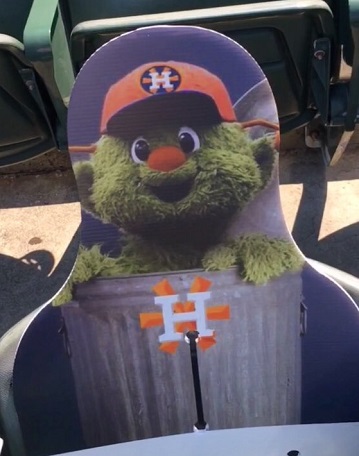
The only trolling of either the Asterisks or the Rogue Sox on their Opening Nights was this cutout fellow . . . in the Oakland Coliseum.

Regular-season day one of the Houston Astros’ post-Astrogate era came in with a bang. Not the kind that indicates transmitting signs stolen off an illegally-installed camera by way of a clubhouse monitor, but the kind that means a five-run inning and an 8-2 win over the Seattle Mariners.

Their fellow sign-stealing criminals, the Boston Red Sox, saw and raised on day one of their post-Red Sox Replay Room Reconnaissance Ring era. Even if, considering their opposition, you could accuse them this time of doing it the easy way, blowing the Baltimore Orioles out 13-2.

The best news for the Asterisks other than their Opening Day win? Not a single batter faced a knockdown pitch. The best news for the Rogue Sox likewise? Not a single batter got plunked, either—but Red Sox relief pitcher Phillips Valdez did hit two Orioles, one each in the eighth and the ninth. Quite unintentionally.

Neither the Astros nor the Red Sox looked good when they were exposed and affirmed as high-tech cheaters during the seasons of their recent World Series championships and barely brought themselves to own it, man up, and apologise properly this past winter. Leaving many, even their own die-hards, wondering whether retribution would be swift and sure.

The coronavirus world tour that suspended the Show until delayed “summer camp” training opened up may or may not have knocked those thoughts out, even if three Astros got hit very unintentionally during an exhibition game against the Kansas City Royals last week. Baseball in the age of pandemic isn’t very likely to put cheaters’ retribution high on its priority list.

Don’t even think about it, conspiracy theorists. Whatever the origin of the virus that launched out of China, it wasn’t anybody’s idea of giving either the Asterisks or the Rogue Sox cover for their crimes, either. Public humiliation sometimes beats a pestiferous pestilence for humbling the formerly haughty.

Just ask Orioles manager Brandon Hyde. His pitching staff was so futile Friday night that social media wags suggested the Orioles needed (and were about) to sign Dr. Anthony Fauci. The epidemiologist whose stiff-armed ceremonial first pitch, before the Washington Nationals’ season opener against the New York Yankees, sailed far enough past the home plate circle that the same wags also said controversial home plate umpire Angel Hernandez called it a strike on the corner.

“For me,” Hyde said balefully after the carnage ended at last, “I’d like to flush this one.” He’ll need the Ty-D-Bol Man to clean the commode after that one.

In a way, the Astros could have been accused of winning the easy way too on Friday night. They met the Mariners nineteen times in 2019 and won eighteen. For the Astros, no matter what they’re coming away from, competition like that is the next best thing to summer camp.

Justin Verlander, their future Hall of Famer starting pitcher, worked six innings, struck out seven, walked only one, and surrendered both Seattle runs by way of the solo long ball, from Kyle Lewis in the second and Korey Seager in the fourth. Just another night at the office.

But he was in a sober mood after the game, and not because of the two long balls he surrendered after surrendering 36 last season. (He averages 23 homers surrendered per 162 game lifetime, by the way. Turn off the alarm bells, there are Hall of Famers who surrendered a little more. Robin Roberts lifetime surrendered two fewer [503] than Eddie Murray hit. [505.])

“Obviously guys are risking a lot here,” Verlander said post-game, “myself included with a young daughter at home, to bring America’s pastime back to people and hopefully cheer them up and give them a little bit of a reprieve from a lot of the stuff that’s been happening.”

Peculiarly, considering the net result, Michael Brantley was the only Astro to collect more than one hit on a night that only George Springer and Yuli Gurriel went hitless for them. And they were down 2-0 when the fifth inning arrived and the fun began for them.

Aledmys Diaz opened with a base hit to somewhat deep center field, then took third as Martin Maldonado’s shot to third was thrown off line enabling Maldonado himself to have first on the house, before taking second on Springer’s ground out back to Seattle starting pitcher Marco Gonzales.

Jose Altuve dumped a single to left to send Diaz home and chase Gonzales in favour of Zac Grotz. The new and dubious three-batter minimum rule bit Grotz and the Mariners right in the kishkes right off the bat, when Alex Bregman singled Maldonado home and Brantley drove one into the right field seats, before Grotz got Gurriel to ground out to third and Carlos Correa to pop out to second.

The Astros tacked single runs on in the sixth and the seventh and let the bullpen finish what Verlander started. No muss, no fuss, and no known shenanigans. And it was nothing compared to what the Red Sox detonated against the Orioles. Their 10-0 lead after five innings was enough to tempt the Orioles to petition the Hague lodging human rights violations charges.

The Red Sox scored four in the third and six in the fourth, and their starting pitcher Nathan Eovaldi—who opened the game with a 100-mph fastball to Austin Hays—found himself in the unusual position of having such a comfort zone he could have let each Oriole batter know what was coming and still gotten rid of them fast enough.

Three RBI doubles including a two-runner by Kevin Pillar hung up the third-inning four-spot. Well enough into the Oriole bullpen in the fourth, Andrew Benintendi walked the fifth Red Sox run home to start that inning’s fun and prompt a pitching change. Fat lot of good that did the Orioles. J.D. Martinez promptly scored Jackie Bradley, Jr. and Jose Peraza with a ground-rule double.

Rafael Devers then hit into the first Red Sox out of the inning. That relief lasted long enough for Xander Bogaerts to single Benintendi home, Pillar to single Martinez home, and Christian Vazquez to single Bogaerts home. And Bradley and Peraza had more destruction to offer the Orioles in the sixth, Bradley hitting a two-run double and Peraza hitting a single-run double right after that.

Somewhere, the Orioles snuck two runs home on a sixth-inning double (Renato Nunez) and a seventh-inning homer. (Rio Ruiz.) They may still be trying to figure out how those happened, when they’re not trying to figure out just how the Red Sox mustered the burial without Mookie Betts, who’s now the Los Angeles Dodgers’ $396 million man after the Sox sent him and David Price out west in an unlikely salary dump.

For the Astros’ new manager, Dusty Baker, it was his 3,500th game as a major league manager. “That,” he said about Friday night’s flogging, “was the strangest opener of my career.”

Maybe playing in their home playpens helped, and likewise the lack of live fans in the stands, but the only thing trolling either the Astros or the Red Sox over their high-tech cheating scandals was in the Oakland Coliseum, where the Athletics—whose pitcher Mike Fiers (a 2017 Astro) blew the whistle on Astrogate last November—hosted the Los Angeles Angels to open the season.

One of the fan-financed cutouts in the Coliseum seats showed Oscar the Grouch in an Astros hat in a trash can marked with the Asterisk logo that went viral as Astrogate unfurled last winter. The Astros travel to Oakland for the first time for a series beginning 7 August. Bet on Oscar the Astrogrouch being among the cutouts then. That should be the least of their problems.

A scapegoat for the Rogue Sox

2020-04-22 2018RedSox

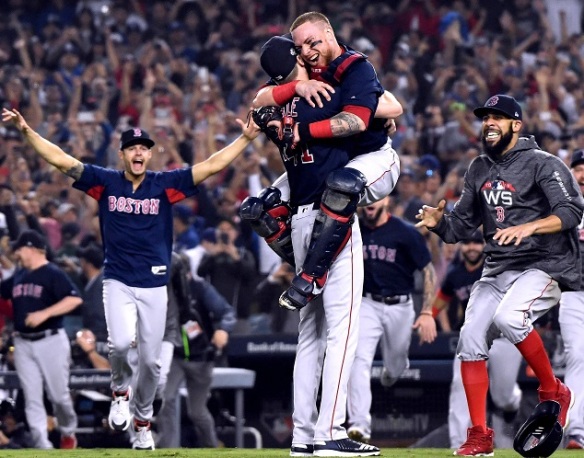
The Red Sox whoop it up after nailing the final out of their 2018 World Series conquest in Los Angeles. Is that title tainted now?

So the Red Sox Replay Room Reconnaissance Ring was the masterwork of a rogue video room operator. Not then-manager Alex Cora, not the front office, and not any of the players who transmitted stolen opposition signs to Red Sox baserunners who’d send them on to Red Sox hitters.

Sure. And the iceberg obstructed the Titanic with malice aforethought. The Hindenburg was a kid playing with matches. World War II was a backyard argument. Apollo 11 was an episode of Star Trek. The renegades working with Richard Nixon’s re-election campaign broke into Dunkin’ Donuts. Bill Clinton perjured himself over an Oval Office quickie with his wife.

After an investigation that included interviews with 65 witnesses including 34 incumbent or former Red Sox players, say The Athletic‘s Ken Rosenthal and Evan Drellich, those plus “scores of e-mails, text messages, video clips, and photographs” led commissioner Rob Manfred in a report issued Wednesday to declare it was all J.T. Watkins’s fault.

Manfred suspended Watkins from baseball without pay for this year and barred from working as a video operator for 2021’s regular season and postseason. The Red Sox got docked a second-round 2020 draft pick. If you even think about trying this kind of espionage again we’re going to be . . . very, very angry at you.

Thanks to the same promises of immunity that Manfred gave the rogue Astros in return for spilling about Astrogate, we may not know for a long time if at all which Red Sox players took Watkins’s stolen signs and ran with them.

The key to the RSRRR was that—unlike the illegally installed or altered real-time center field camera that anchored the Astro Intelligence Agency in Minute Maid Park—the Red Sox’s espionage could be done at home or on the road . . . but it depended entirely on whether the Red Sox had a man on base.

Nobody banged the can slowly to send the pilfered intelligence to the Red Sox hitters availing themselves thereof. Watkins simply let someone, who knows whom, make life a little easier for Rogue Sox baserunners. In Fenway Park and elsewhere.

Usually, if you’re on the bases and of a mind to gamesmanship, you’ve got to decipher and transmit from your own eye and in as quick a blink as possible. Watkins merely allowed the Red Sox to save their baserunners a little extra sight and brain work. How very thoughtful.

The video rooms behind the dugouts were supposed to be helpmates for managers in challenging close or errant umpire calls once replay was introduced in 2014. Hitters also use them for help correcting swing mistakes, pitchers to correct mound mistakes, or both to look again quick at opposing hitters or pitchers to see where they missed unexpected weaknesses or got beaten when they should have known better.

They weren’t installed to enable spy operations on the other guys’ pitch signs or to make life simpler for baserunners who now didn’t have to figure out how to steal signs the old-fashioned way within about a minute’s worth of time. You want to steal signs on base the old-fashioned way? Do your homework. No crib sheets, answers on your wrist, or cameras on the teacher’s answer keys.

Even before Manfred handed down his Soxgate finding and decision, a few 2018 Red Sox were saying, essentially, Who, us? Remember Steve Pearce? 2018 World Series hero, and how. He was practically a one-man demolition derby late in Game Four and through most of Game Five. It landed him the World Series MVP award.

Last week, Pearce decided to call it a career. He also decided to say Who, us? “That’s such a joke to us,” he told WEEI. “When it came out we were all kind of joking about it. We just want this to pass us. We won it fair and square. Whatever they accused us of, we were all kind of like, ‘I can’t believe this is even an issue.’ Once the report comes out we’re all going to be free.”

All but one scapegoat, so far.

“[W]e have this floating over our head when we just had such an unbelievable season,” Pearce continued. “We had the perfect team and great camaraderie with everybody and then this gets thrown out here. We’re just like, ‘What the heck?’ . . . We just want this to pass us. We just want to play some baseball. Another bump in the road, I guess.”

In fairness, one of the key moments that bumped the 108 game-winning Rogue Sox into the 2018 World Series in the first place—left fielder Andrew Benintendi’s man-on-the-flying-trapeze catch of what would have been Astro third baseman Alex Bregman’s game-winning three-run extra-base hit to deny the Astros an American League Championship Series tie at two each—had nothing to do with the RSRRR.

But what about the rest of the set? What about the Series? Not long after Pearce spoke up, Joe Kelly—then a Red Sox relief pitcher, now with the Dodgers in coronavirus limbo with everyone else in baseball—delivered his own who, us? “Whenever the investigation is done, I’m interested in seeing what is in the investigation,” he, too, told WEEI last week. “If there is cheating involved with how good our team was, we should have won every single out.

“We should have not even lost an inning if there was some good cheating involved, which would have been a lot more fun because we would have won in four,” he continued. “We would have swept through the playoffs and made it really, really fast and been able to go to Hawaii or go to Mexico and go on vacation a lot sooner than we did.”

You can almost hear the 1919 White Sox culprits, who won three games during their scandalous World Series loss, thinking, “We should not have even won a single inning if there was some good profitable tanking going on, either.”

Some Red Sox fans hit social media to denounce Kelly’s pompous arrogance or arrogant pomposity, depending upon whom you read where and in which language. The man who surrendered Howie Kendrick’s tenth-inning grand salami to lose Game Five and a trip to the National League Championship Series for his Dodgers knows enough about public humiliation and humility.

In all fairness, baseball government did monitor the replay rooms more arduously to guard against postseason espionage. Baseball’s chief disciplinarian Joe Torre warned both the Red Sox and the Astros before the 2018 ALCS that if they were up to electronic no good it needed to stop tootie-sweet before (are you ready?) the press picked up leaks about it.

Unlike Astrogate, which had a whistleblowing genie named Mike Fiers come out of the bottle last November, Soxgate may not have had a signature whistleblower. Rosenthal and Drellich, the Woodward and Bernstein of Astrogate, reported shortly before Manfred’s Astrogate finding and ruling that the 2018 Red Sox weren’t just ducking into their replay room to fix mistakes, correct batter’s box or mound mechanics, decide on challenging close calls, or watch Cheers reruns.

Rosenthal and Drellich dropped this curlicue into that report:

Three people who were with the Red Sox during their 108-win 2018 season told The Athletic that during that regular season, at least some players visited the video replay room during games to learn the sign sequence opponents were using. The replay room is just steps from the home dugout at Fenway Park, through the same doors that lead to the batting cage. Every team’s replay staff travels to road games, making the system viable in other parks as well.

Red Sox sources said this system did not appear to be effective or even viable during the 2018 postseason, when the Red Sox went on to win the World Series. Opponents were leery enough of sign stealing — and knowledgeable enough about it — to constantly change their sign sequences. And, for the first time in the sport’s history, MLB instituted in-person monitors in the replay rooms, starting in the playoffs. For the entire regular season, those rooms had been left unguarded.

So it’s entirely likely that the Rogue Sox played the 2018 postseason straight, no chaser. But there’ll always be suspicion. Would playing the postseason straight let them off the hook for reconnaissance cheating during the regular season when Watkins’s replay room was about as heavily guarded as an angry drunk?

Give Manfred this much: If he thought Cora had anything to with the RSRRR, would it have been shooting fish in the barrel to discipline him? He suspended Cora for this year—-over his Astrogate co-mastermind role. For which the Red Sox either let him quit, fired him outright, or strong-armed him to quit—never mind how well-liked he remains around the team and organisation—before he could be executed when the Astrogate report came forth.

If Manfred thought Cora was part and parcel of Watkins’s roguery, would he have thrown mercy to the wind and banned Cora for half a decade? Full decade? Life? And does anyone really believe the man who cahooted with Carlos Beltran in the AIA was entirely innocent? Or did he remember his Houston boss, A.J. Hinch, smashing a monitor or two but otherwise fiddling while the AIA turned?

Letting the Rogue Sox escape with nothing more than a docked second-round draft pick and a scapegoat video room operator is at least as bad a look as Astrogate’s been for the Astros. It also contravened Manfred’s threat, when the Red Sox’s AppleWatch and the Yankees’ extra dugout phone inspired it, to fine any team caught playing CIA against the other guys.

So whom among the 2018 Soxgaters will be the first to stand up and own up? You may sooner strike oil with safety pins.

Now it’s Soxgate, too?

2020-01-07 AlexCora2018RedSox

2017 Astros bench coach turned 2018 Red Sox manager Alex Cora hoists the 2018 World Series trophy. The ’18 Sox are now believed having used their replay room for off-field sign-stealing, amplifying suspicions around Cora himself.

Long before he became a major league coach then manager, Alex Cora endeared himself to me when he was a Dodger hitting a seventh-inning home run on 12 May 2004. It wasn’t the home run itself but what led to it—Cora hit the eighteenth pitch of a plate appearance against Cubs pitcher Matt Clement into the right field bullpen. The Iliad, The Odyssey, and Ben-Hur weren’t that epic.

I watched that game live on television from my then-home in Huntington Beach, California. Cora wasn’t exactly a power hitter, of course; Sammy Sosa hit as many home runs in 2004 (35) as Cora hit in his entire fourteen-season playing career. He was a clever utility infielder whose best work was with his glove on either side of second base and his brains otherwise, and he was valuable enough as a utilityman to play on the Red Sox’s 2007 World Series winner.

As Cora checked in at the plate on that May night, the Dodgers’ still-very-much-missed voice Vin Scully noted he’d hit a couple of fly balls earlier in the game, “but if you don’t have power, a couple of fly balls is wasted opportunity.” He batted with nobody out in the bottom of the seventh and a short-career left fielder named Jason Grabowski aboard with a leadoff walk.

Cora looked at ball one up and away to open. He took a strike near the outside corner, then took ball two away, then fouled one off. And then the fun really began without once going to ball three. Cora fouled eleven more off. We’ll let Scully take it from there:

. . . The crowd now is really into the pitches . . . and still two and two. Nobody out. Big foul . . . wow! . . . It’s a sixteen-pitch at-bat, and the crowd loves it, and look at Dave Roberts. They’re all enjoying this battle. Matt Clement and Alex Cora. Coming into the game, Cora was hitting .400 against Clement, he is oh for two tonight. So the game within the game here. So here’s the sixteenth pitch. What an at-bat! . . . [foul ball] . . .  Seventeen pitches . . . it is the rare time that you can be in the ballpark and everyone is counting the pitches, and it’s gonna be a seventeen-pitch at-bat, now, at least. We, I don’t know, you know, they don’t keep records of pitches in at-bats, but it’s kind of special. This will be the seventeenth pitch. Grabowski’s exhausted, and Mike Ireland reminds me how about if Grabowski had been running on every pitch? Time . . . ohhh, the crowd is loving it . . . Ever see so much excitement? And nothing’s happened, that’s what’s really funny about it. All right, here’s the seventeenth pitch—and, it’s foul. Foul ball by a hair! So that means that it will be at least an eighteen-pitch at-bat . . . Clement has made more pitches to Alex Cora right now than he has made in any inning but the third . . . the eighteenth pitch—high fly ball into right field, back goes Sosa, way back to the gate, it’s gonnnne!! Home run, Alex Cora, on the eighteenth pitch, and the Dodgers lead, four to nothing. What a moment! 9:23 on the scoreboard if you want to write it down for history . . . what an at-bat! And Dusty Baker says, “We’re gonna stop the fight.” And Dusty’s going to bring in a fresh horse. That’s one of the finest at-bats I’ve ever seen. And, then, to top it off with a home run, that is really shocking. Yeah, take a bow, Alex, you deserve it and then some. Oh, by the way, that also means the Dodgers have homered in six straight, but it took a whale of a job to do it. Stay where you are, four-nothing Dodgers, and look at the ball club.

Cora would have been remembered for that surrealistic plate appearance if nothing else had his baseball career ended when his playing days did. Even if the Los Angeles Times didn’t remember; their game coverage the following day said not a lick about Cora’s seventh-inning stretcher.

The paper called it the way you see it now in the box scores: Cora, home run. Baseball Reference, bless them, gives you a little more: it notes the pitch count up to and including Cora’s loft just into the right field bullpen. An edited YouTube video clip from the original Dodger broadcast including the Scully call is preserved by MLB, the editing dropping out in favour of the full coverage as Cora was about to face his fifteenth pitch.

Brainy as he was it was no wonder Cora parlayed himself into coaching and, in due course, managing. Except that now it appears more certain than suspected that Cora—whose inaugural season as the Red Sox manager finished with beating his former Dodgers (managed by his May 2004 Dodger teammate Dave Roberts) in the 2018 World Series—knows something more about fouls than just whacking them away to set up an unlikely two-run homer.

Cora was the Astros’ bench coach during their run to the 2017 World Series conquest. Before that postseason ended he’d agreed to become the Red Sox’s next manager. And one of the first things he was quoted as telling his new team, whom the Astros pushed aside in the 2017 division series, was, “You guys were easy to game plan against. Too many bad takes.”

Those were nothing compared to the bad take now surrounding Cora. Because Ken Rosenthal and Evan Drellich, who seem to be for The Athletic with Astrogate what Carl Bernstein and Bob Woodward were considered to be to the Washington Post for Watergate, now say the 2018 Red Sox had a little espionage operation of their own in play during that year’s regular season. And, that unlike the Astros’s engagement of an off-field live-feed camera for sign-stealing, the Red Sox thought of something they could try at home and on the road:

Three people who were with the Red Sox during their 108-win 2018 season told The Athletic that during that regular season, at least some players visited the video replay room during games to learn the sign sequence opponents were using. The replay room is just steps from the home dugout at Fenway Park, through the same doors that lead to the batting cage. Every team’s replay staff travels to road games, making the system viable in other parks as well.

Rosenlich (well, the combination worked for Woodstein, right?) are careful to clarify that nobody including whomever the Red Sox three might be thinks the Red Sox tried it during that postseason, if only because they would have been caught as red-handed as the original five Watergate burglars:

Red Sox sources said this system did not appear to be effective or even viable during the 2018 postseason, when the Red Sox went on to win the World Series. Opponents were leery enough of sign stealing — and knowledgeable enough about it — to constantly change their sign sequences. And, for the first time in the sport’s history, MLB instituted in-person monitors in the replay rooms, starting in the playoffs. For the entire regular season, those rooms had been left unguarded.

This wasn’t exactly as “egregious” (Rosenlich’s word) as the Astro Intelligence Agency’s underground television network, contravening baseball’s rule mandating eight-second camera feed delays to send stolen signs to a monitor near the dugout steps from where someone, who knows whom just yet, sent the stolen opposition signs to the batter with bang-the-can-slowly. But it’s no less beyond the ordinary bounds of on-the-field gamesmanship, even if the Red Sox system did involve at least one man on the field.

The Red Sox operation was workable only with a runner on base. They simply took the burden of catch-and-release away from the baserunner who’s usually the one who engages the on-field gamesmanship of sign stealing. Someone, who knows whom, would be in the Red Sox replay room at home or on the road, catch the sign from catcher to pitcher, and send it to the runner to send to the hitter. You’ve got to be a lot more swift to do it that way, and apparently the 2018 Red Sox were during the regular season.

Not that Rosenlich lack for a caution or two. “It’s impossible to say for certain how much this system helped the Red Sox offense,” they write. “But their lineup dominated in 2018, when they led the league in runs scored.” And, like the Astros, the Red Sox—who got caught flatfoot in 2017 when one of their people was caught using an AppleWatch to try stealing Yankee signs—were convinced enough that others were doing likewise that they weren’t above a little creative against-the-rules espionage themselves.

“You got a bunch of people who are really good at cheating and everybody knows that each other’s doing it,” Rosenlich quote “one person with” the ’18 Sox. “It’s really hard for anybody to get away with it at that point . . . If you get a lion and a deer, then the lion can really take advantage of the deer. So there’s a lot of deers out there that weren’t paying attention throughout the season. In the playoffs, now you’re going against a lion.”

Using the replay room for sign-stealing didn’t exactly begin with the 2018 Red Sox. “It was also similar,” Rosenlich write, “to one the Yankees and other teams had employed before MLB started its crackdown. (Hitters can legally visit the replay room during games to study some video.)” The trick was to be swift enough afoot to make it work without using further electronic devices.

Rosenlich also exhume a three-page March 2018 memo to team presidents from MLB’s chief baseball officer, Joe Torre (himself a former major league catcher), in which he emphasised just how much against the rules high-tech off-field sign-stealing is: “To be clear,” the memo said, “the use of any equipment in the clubhouse or in a Club’s replay or video rooms to decode an opposing Club’s signs during the game violates this Regulation.”

And sometimes the replay room monitors weren’t always immune to being compromised themselves, with Rosenlich observing, “Some would stay in the video replay room the entire game, while others would disappear for periods of time.” The duo go on to cite an unnamed video scout, not with the Red Sox, directly:

Some acted like they were your best friend, root you on. Others would tell on you for the littlest things that weren’t even real,” the scout said. “It was very inconsistent how each person took their job and what they were actually doing . . . You knew this guy was a stickler, and with this guy you could get away with some stuff. How does it stop cheating? The teams that were going to cheat were going to cheat, no matter what.

Whither Alex Cora? Rosenlich are already on record as reporting that Cora and new Mets manager Carlos Beltran (a designated hitter with the ’17 Astros who was often approached by teammates as having the mind of a coach himself) had an as-yet-undetermined hand in at least devising the Astro Intelligence Agency. Nobody knows yet just how Cora and Beltran helped devise it if indeed they did.

But Cora going from the Astros’ world champion as their bench coach to the ’18 Red Sox as their first-year manager taking them all the way to a 108-win regular season preceding a World Series triumph now looks a little too suspect. Did he know about and/or sanction the ’18 Red Sox’s replay room rompering? Did he suggest, based on any direct knowledge of the Astros’ slightly more arduous technique, that the replay room just might be a slightly simpler way to steal signs and get away with it?

No, Astroworld. The Red Sox’s replay room rompering doesn’t get the Astros off the hook. The everybody’s-doing-it defense isn’t going to wash for the Astros, and it won’t for the Red Sox, either. Red Sox Nation, of which I’ve been a member since that thriller of a 1967 pennant race in hand with being a Met fan since the day they were born (ask not my October 1986 pharmaceutical bills), is about to join Astroworld in having to come to terms with at least some of their heroes being cheaters.

“The issue . . . extends beyond individual teams, encompassing the league’s enforcement and upkeep of its own rules,” Rosenlich write. “Many inside the sport believe there is cheating and then there is cheating-cheating. In this view, the Astros undertook the latter, while more indirect video-room efforts—at least before late 2017—counted as the former.”

If and when the actual Astrogaters are revealed in full, Astroworld will be anything but amused, just as I wasn’t amused to discover that a team whose reconstruction into a powerhouse I admired turned out to be riddled with a human factor-challenged front office and field personnel who weren’t above extralegal espionage. According to ESPN’s Jeff Passan, the Astros should learn within the next two weeks just who’s going to be taken to the Astrogate woodshed and whether they come out bruised, battered, or broken.

It doesn’t amuse me that Alex Cora, a player whose tenacity I cheered one fine May 2004 evening and whose intelligence I always admired, may well have gone from helping to devise one elaborate cheat to at least fostering a second that was less elaborate if not less egregious. It amuses me even less that the Red Sox had to do it the new old fashioned way, too.

Short of posting armed Pinkerton guards inside the replay rooms, how baseball’s government handles Astrogate, Soxgate, and any other -gates yet to be affirmed should prove at least as intriguing as Cora’s once-upon-a-plate-appearance foul mastery. The kind he’s suspected of now, involving two teams, is more liable to end not with a two-run homer but a called strikeout.

The pangs of the Yankee reaper

2019-11-21 JacobyEllsburyRundown

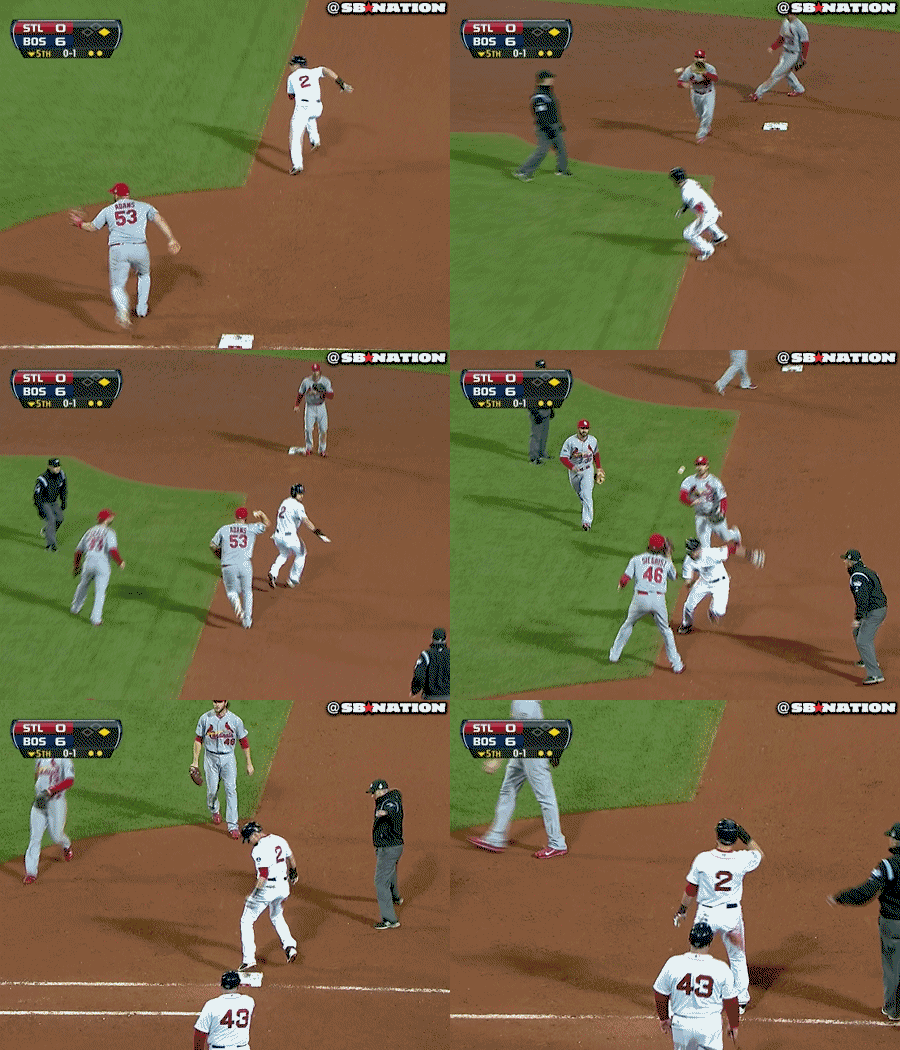
Jacoby Ellsbury (2), here Houdini-ing a rundown in the 2013 World Series, before the injuries finally started sapping the talent. (SBNation gif.)

Things got this bad for Jacoby Ellsbury: when he announced his daughter’s birth on the Fourth of July, on Instagram, he got hammered by Yankee fans indignant over the big contract to the too-often-injured outfielder. Well, nobody said Joe and Jane Fan were immunised completely against the stupid virus.

Such Yankee fans can breathe now. Ellsbury is still the first of Navajo descent (courtesy of his mother) to play major league baseball, but  he isn’t a Yankee anymore. The Yankees finally decided to cut him loose and eat the remaining $26 million Ellsbury’s owed on his original seven-year, $153 million deal. Contrary to what too-popular belief still says, neither side is to blame for Ellsbury’s none-too-fantastic voyage.

What does it do to a man to know that not only could he not perform his duties at his line of work because his body kept telling him “not so fast, dude,” but that people observing his particular company made him a hate object for no crime worse than the injuries he incurred on the job?

It’s as if being injured on the job at all equals a character flaw, especially if you happen to be paid a phenomenally handsome salary. On the flip side, it’s as if being paid a phenomenally handsome salary equals some sort of immunity to earthly harm. Here’s a bulletin for you: Handing Clark Kent a nine-figure payday doesn’t make him Superman.

And one of the reasons Ellsbury wouldn’t even think about listening to the Red Sox about staying in the family when he reached free agency after the 2013 World Series conquest was because he was alienated in the clubhouse after he heard one too many whisperings that he wasn’t exactly in a hurry to get back on the field after previous injuries.

It’s hell if you do and hell if you don’t for a professional athlete. Return too soon from an injury and you risk re-injury; return not soon enough (in whose medical opinion?) and you risk being dismissed as a fragile goldbrick.

The 2019 Yankees were so injury riddled that it was easy to joke that their yearbook was probably The New England Journal of Medicine, but Ellsbury was probably one Yankee who wasn’t laughing. Not even like Figaro that he might not weep. He’d been so often injured for so long that he might be tempted to name his memoir, should he write one, The Pangs of the Yankee Reaper.

Sooner or later, too, you suspected injuries would sap Ellsbury’s baseball talents even before he became a Yankee. Red Sox Nation at least had the pleasures of Ellsbury’s talents helping them noticeably enough to a pair of World Series rings including in his rookie season. Including but not limited to his magnificent Game Six rundown dodge in the 2013 Series.

Maybe that’s why Yankee fans showed as much empathy for his on-the-job slings, arrows, and whatever other medicals he had to bear as the empathy a barracuda shows for its prey. But now, let me count the ways Ellsbury didn’t get injured on the job.

He didn’t get a bite in the ass sliding into second thanks to having left the false teeth he doesn’t have in his back pocket. (An otherwise nondescript pitcher, Clarence Bethen, thought of that in 1923.)

He didn’t turn his knee into bone meal chasing Jill St. John down the ski slopes. (Freshly-crowned Cy Young Award winner and chairman of baseball’s Future Dentists of America, Jim Lonborg, was rumoured to have done just that when he tore his knee apart in a winter skiing accident after the 1967 season.)

He didn’t get the brilliant idea to demonstrate his slam-dunk technique on a storefront awning, catch his ring in the mechanism, and cost himself a season with shredded hand ligaments for his trouble. (Braves relief pitcher Cecil Upshaw slam dunked his way out of the 1970 season that way.)

He didn’t adopt an exercise routine that included running backwards and thus running into a gopher hole causing himself a back injury. (Pitcher Jamie Easterly did, however, in the 1980s.)

He didn’t break a toe running from his kitchen back to his living room because he couldn’t bear to miss watching a buddy at the plate on television. (Hall of Famer George Brett was so desperate not to miss a Bill Buckner at-bat that he ran from his kitchen and busted his toe.)

He didn’t strain or shred his back pulling his cowboy boots up. (Hall of Famer Wade Boggs once did.)

He didn’t fall asleep with a bitter-cold ice bag on his foot and awaken with a case of frostbite causing him to miss a few games—in August. (Hall of Famer Rickey Henderson stone cold did.)

He didn’t get his face badly sunburned on a tanning bed. (Marty Cordova was the genius who forgot the Coppertone.)

He isn’t known to have attended motivational speeches, necessarily, but if he did he probably had too much sense not to think after hearing one that he could tear the world’s thickest telephone book in half without dislocating his shoulder. (Relief pitcher Steve Sparks had to learn the hard way.)

He never once thought, we think, that he could haul a full heavy side of deer meat up a flight of stairs until the venison-to-be won the weight division by sending him flying downstairs and into a broken collarbone. (Clint Barmes, alas, lost that fight in 2010.)

He was part of no few on-field celebrations, we’re sure, but he never tore his left meniscus by smooshing a pie in a teammate’s face during a postgame interview. (Not the way Marlins utilityman Chris Coghlan did nailing Wes Helms in 2010.)

He’s not the genius who forgot to look all ways while reaching for a fallen sock before the suitcase his wife fiddled with fell over and landed on his hand, causing the injury he tried to hide until even the blind saw he couldn’t grip his bat right. (Jonathan Lucroy was such a genius, in 2012.)

And, he didn’t dislocate his ankle while trampolining with one of his children. (Joba Chamberlain jumped into that while with his then five-year-old son in 2012.)

Ellsbury once broke the Red Sox’s consecutive-game errorless streak record. He also once scored on a wild pitch—from second base. He was once so swift on the bases and in the outfield that he could have challenged the Road Runner to a foot race and won by a neck. He hit four doubles and stole a base in the 2007 World Series; he looked like he’d secure himself as one of the Red Sox’s all-time greats.

At least, he did until he ran into a human earth mover named Adrian Beltre at third base in an April 2010 game. He came back too soon from four hairline rib fractures, felt enough soreness to see a thoracic specialist who recommended more rest and rehab, rejoined the Red Sox early that August, and re-injured the ribs on a play against the Rangers later that month.

Then Ellsbury won the American League’s Comeback Player of the Year for 2011, not to mention both a Gold Glove and a Silver Slugger and a second-place Most Valuable Player finish, while being practically the only Red Sox player who didn’t collapse during that September and thus invite the Bobby Valentine nightmare of 2012.

Ellsbury smashed his shoulder up trying to break up a double play early in the nightmare. He returned in July, then almost made it injury free through 2013. Oops. Compression fracture in his right foot from fouling a ball off the hoof in late August. Returned in time to shine in that run to and through the World Series.

Fed up enough with the false whispering that he just didn’t like to rehab his injuries fast enough (for whom, folks?) that when the Yankees reached out to him with a yummy contract he couldn’t possibly say no.

In Year One of his Yankee tenure he performed, well, the way Jacoby Ellsbury was supposed to perform, including leading the American League with his 22.7 power/speed number. And it was the last season in which being injury free enabled him to perform that well.

Injuries, unfortunately, sap and catch up to players little by little. The Ellsbury Dough Boy had more than his share before becoming a Yankee. And then . . . and then . . . and then . . . and then along came:

2015—Right knee sprain on 20 May; out two months, rest of the season nothing to brag about, unfortunately.

2016—Uninjured but production falling further, including his lowest total stolen bases to that point during a healthy season.

2017—Smashed his head against the center field wall while making a highlight-reel catch. Concussion. Missed 29 games and lost his center field job to Aaron Hicks, but somehow managed to break Pete Rose’s career record for reaching base on catcher’s interference, doing it for the thirtieth time on 11 September, which also happened to be his 34th birthday.

2018—Strained his right oblique at spring training’s beginning. Turned up in April’s beginning with a torn hip labrum. Missed the entire season (and underwent surgery in August) because of it.

2019—Started the season on the injured list with a foot injury; also turned up with plantar fasciitis in the foot (the same injury plus knee issues that reduced Albert Pujols as an Angel to a barely replacement-level designated hitter) and another shoulder injury. Took until September for the Yankees to admit Ellsbury was lost for the year.

Not one of those injuries was caused by anything other than playing the game or performing other baseball-related activity. Remember that before you continue condemning Ellsbury the man or the Yankees as a team over him. He didn’t come to the Yankees believing his previous injuries began draining the talent that was once so electrifying, and he didn’t put on the pinstripes expecting to become an orthopedic experiment, either.

The 36-year-old is said to be finishing rehab and preparing to play in 2020 if there’s a team willing to have him. Ignore the jerk brigades and wish him well. Maybe even wish that he decides at last that his spirit may still be willing but his body’s already had notarised, “Don’t even think about it.”

It’s not easy for baseball players to get the game out of their systems, but if Ellsburry chooses to retire at last, instead of offering up any further sacrifices to the Elysian Field gods, who can blame him?

“Some people give their bodies to science. I gave mine to baseball,” Ron Hunt once said after a career in which his most notable accomplishment was teaching himself to be hit by pitches and taking every one of his 243 plunks. (Hunt led the Show in such plunks six straight during his twelve seasons.)

Ellsbury gave a lot more of his body to baseball than even Hunt did. He has three stolen base championships (two of which led the Show), one total bases championship (364 in 2011), one triples championship (ten in 2010), and a few million dollars in the bank for it. It’s the least he could have gotten for his sacrifices.

But if they ever come up with a surefire immunity to the stupid virus, fans who think on-the-job baseball injuries equal character flaws or teams whose brain trusts have suffered aneurysms should be first to get the shots.