Freeman frees the Braves to await their NLCS opponent

Freddie Freeman

Jubilant Freddie Freeman approaches the plate to finish the eighth-inning bomb that held up to win the NLDS for the Braves Tuesday night.

Maybe it didn’t have quite the last-split-second hair raising quotient that the Red Sox’s final two American League division series wins had. But it wasn’t any less dramatic for Freddie Freeman and his Braves in winning their National League division series Tuesday.

Freeman’s eighth-inning tiebreaking home run off Brewers relief ace Josh Hader turned out the finishing blow in a set during which both teams scored as many runs in the first three games as they ended up scoring in Game Four alone.

What made the bomb so luminous, too, was that it was only the second time in the whole 145-year history of the franchise that any Brave delivered what proved a postseason series-winning hit in the eighth or later. It took one season shy of three decades for Freeman’s homer to join Francisco Cabrera’s National League Championship Series-winning base hit. (The fabled Sid Bream mad-broken-bodied-dash.)

“I’ve had a lot of cool moments in my career,” Freeman said postgame, “but so far I think that’s going to top them right there. But hopefully that’s not the last cool one.” Right now, nobody’s willing to bet too heavily against either Freeman or his Braves. Yet.

You heard all season long about this or that team being wracked by injuries and surrealities? Few had to compensate as heavily as the Braves did. Too many teams losing their number-two franchise player, one of their best young pitchers, and a reliable other power bat might have collapsed like a blimp.

The Braves lost Ronald Acuna, Jr. thanks to a torn ACL making a play in center field. They lost Mike Soroko after his Achilles tendon blew out in May—after nine months’ rehab following its initial 2020 tear. They looked as though their season had paid put to hit without once seeing .500.

They lost Marcell Ozuna when the outfielder/bombardier was arrested for domestic violence in July—charged first with felonious aggravated assault and attempted strangulation, charges reduced to misdemeanor simple assault and battery, on administrative leave through the end of the Braves’ season, after he entered a diversion program.

When Acuna went down, and the Braves more or less sputtered into and past the All-Star break, general manager Alex Anthopoulos made his first move, bringing former Dodger Joc Pederson aboard from the Cubs in exchange for a minor league prospect.

That was Pederson pinch hitting for Braves reliever Luke Jackson in the Game One eighth and hitting a solo home run off Brewers reliever Adrian Houser for the only Braves run in the only series loss. That was also Pederson in Game Three, pinch hitting for Braves starter Ian Anderson, facing Houser again, and launching the three-run homer that proved the only Game Three scoring.

Houser may start seeing Pederson in his sleep. The Braves just want to keep seeing him mash. Even if he got the Game Four start as his reward and had to settle for pushing home the first of the two runs that tied things at four with a ground out to second base.

Freeman thinks landing Pederson merely began the Braves’ reversal. “When Alex went out and got Joc,” he said, “it brought a sense of energy that it just showed us that they still believed in us, to go add at the deadline.” Which is exactly what Anthopolous did. He nailed three 30 July trades to bring Jorge Soler from the Royals, Adam Duvall from the Marlins, and Eddie Rosario from the Guardians-to-be.

The NL East wasn’t a powerful division to begin with. But the longtime-leading Mets imploded, the Nationals hit the reset button, and the Phillies proved just short of being able to hold on. In Atlanta, as proverbially and poetically as feasible, that which didn’t destroy the Braves only made them stronger.

They went 36-19 to finish the regular season, including a too-simple-seeming sweep of the Phillies opening the final week to keep them from finishing what they threatened awhile to do and overthrow the Braves. They even shook off Soler’s COVID diagnosis entering the postseason. Now they’ve dispatched a Brewers team that won seven more regular-season games to lead an only slightly stronger NL Central.

They’re waiting to see who’ll be the last men standing between the Dodgers and the Giants, after the Dodgers tied that division series in Los Angeles Tuesday night in an all-Dodgers/all-the-time 7-2 win.

The game was a still-manageable 2-0 Dodger lead, with the Giants compelled to a bullpen game against a short-rested but deadly effective Walker Buehler, when Mookie Betts checked in in the fourth against Jarlin Garcia—after Buehler himself led off by reaching on an infield error.

“It’s not something we want to do all the time,” said Buehler about going on only three days rest, “but I felt that if things didn’t go our way [in the third game], I would feel really weird not pitching a game that we could lose a series.”

He didn’t have to worry. Until he surrendered a leadoff single to Evan Longoria and a one-out walk to Steven Duggar in the fifth, Buehler pitched stoutly and had to shake only one previous first-and-second spot of trouble away in the second. He even had the Giants slightly flummoxed when he went to his changeup a little more often than they were accustomed to seeing from him.

When the Mookie Monster parked an 0-1 pitch into the right center field bleachers, it suddenly seemed a question not of whether but by how big the Dodgers would take the game. An inning later, Betts sent Cody Bellinger home with a sacrifice fly deep to left center field. But Dodger catcher Will Smith—just call him the Fresh Prince of Dodger Stadium—squared off against Giants reliever Jake McGee with Corey Seager aboard (leadoff line single) and hit the first pitch over the left center field fence.

The Giants looked so overmatched in Game Four that their only two runs scored on ground outs, one with the bases loaded. That was Evan Longoria scoring on Darin Ruf’s grounder to second. The other was Brandon Crawford coming home in the eighth when Kris Bryant grounded one to the hole at third.

Buehler’s short-rest deliverance plus the Dodgers’ bats ensured Julio Urias on regular rest starting Game Five against Logan Webb in San Francisco Thursday. For the Braves, that’s going to be very must-see television. Which is what it already was on the left coast and elsewhere.

For the Brewers, it’s a too-early winter vacation after their pitching virtuosity proved futile against the disappearance of their bats. Christian Yelich’s back injury-abetted struggles continued in the division series, and while the Braves didn’t exactly bring the walls crumbling down the Brewers hit a measly .192 in the set—32 points below the Braves.

They did get beaten in the end when the Braves’ best batter launched against their best pitcher in the Game Four eighth. Starting Eric Lauer for Game Four because ace Corbin Burnes said he wasn’t feeling one hundred percent proved a mistake, and so did manager Craig Counsell not bringing Brandon Woodruff in earlier in higher-leverage.

But then here’s where the Brewers’ best bats fell too short. Avisail Garcia? Eight strikeouts, only two hard-hit balls, and two singles in fifteen at-bats. Kolten Wong? Five strikeouts, likewise only two hard-hit balls, and one single in fifteen at-bats. Willy Adames? Five hits in seventeen at-bats—four singles and a double, plus nine strikeouts and only three balls hit hard.

That’s why the Brewers pitched the division series like Hall of Famers—their three starters Burnes, Woodruff, and Luis Peralta showed a collective 1.56 ERA and 0.92 walks/hits per inning pitched rate, not to mention nineteen strikeouts in 17.1 innings pitched—but the Braves still took them out sweeping three after a Game One Brewers win.

“The vibe is the best that we ever had in this series,” Adames said before Game Four. “Today, the guys, I guess they woke up in a great mood. They came with energy. And I feel today we had the best vibe that we’ve had so far this series so far.”

The trouble was that the Brewers went in with the best vibes but the Braves played them as if they were jazz vibes legend Milt Jackson hammering out another virtuoso chorus of “Bags’ Groove.” Now the Braves wait to see who gets bagged in San Francisco Thursday night.
The Phillies look a gift Brave in the mouth

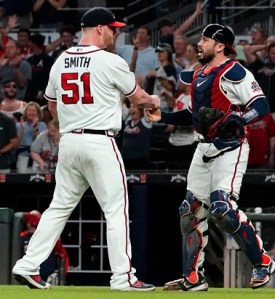
Will Smith, Travis d'Arnaud

Will Smith and Travis d’Arnaud, after the Phillies somehow declined the gift Smith tried to give in the ninth Tuesday.

Until the top of the ninth Tuesday night the Phillies hadn’t scored a single run in their previous twenty innings. Then the Braves all but gifted the Phillies a run in that ninth. They’d even gifted the Phillies the potential go-ahead run and then the bases loaded with one out.

The problem was the Phillies picking the wrong way to say thank you. All that got them was elimination from the National League’s wild card race with a 2-1 loss. It’s win the NL East or wait till next year for them now.

But the ninth-inning high-wire routines of lefthanded relief pitcher Will Smith—with a rather remarkable ability to get himself into hot water—got a little too high on the wire Tuesday night.

It wasn’t so much that he and the Braves escaped as that the Phillies sent a helicopter overhead to lift him to safety when they should have left him and the Braves wiring mad. The Braves won’t always find the opposition that willing to bail them out.

Thanks in large part to their grand old man Charlie Morton’s seven-inning, ten-strikeout, shutout-ball gem, while managing to pry only two runs out of Phillies starter Zack Wheeler in seven otherwise-strong innings, the Braves may have been lucky to take a 2-0 lead into that ninth.

But with Smith having the opening advantage against lefthanded Bryce Harper, the major leagues’ OPS leader, Smith found himself in a wrestling match that ended with Harper wringing himself aboard with a leadoff walk. Phillies catcher J.T. Realmuto now represented the potential game-tying run at the plate.

Realmuto hit one on a high line to right center that ninth-inning center field insertion Guillermo Heredia had to run down long to catch on a high backhand. That spot of Braves fortune lasted just long enough for Phillies pinch-hitter Matt Vierling to hit a high liner to left, where Braves left fielder Eddie Rosario ran over, extended his glove, and watched the ball carom off its fingertips, setting up second and third for the Phillies.

Now the Phillies had veteran Andrew McCutchen—a long way from his days as a center field gazelle and a 2015 NL Most Valuable Player for a better array of Pirates—coming to the plate. McCutchen isn’t the danger he was once seen to be anymore, but he’s a veteran who still knows what he’s doing at the plate, and the Braves had no intention of letting his righthanded bat lay them to waste.

So the Braves ordered McCutchen walked intentionally, putting the potential second go-ahead run aboard, even while it looked as though Smith fooled nobody at the plate. The problem was that putting McCutchen aboard also put the Phillies’ fate into two bats described best as balky.

Phillies shortstop Didi Gregorius continued playing through a bothersome elbow and a shrunken ability to handle pitching from the same side as which he swings, lefthanded. Third baseman Freddy Galvis, lately pressed into everyday service, simply keeps proving why the Phillies unloaded him in the first place four years ago—he’s not truly an everyday player, and though he switch-hits he’s not exactly a game-breaker at the plate.

The Braves now had only to pray that Smith could survive. The Phillies had only to pray that Gregorius and Galvis had a few more unexpected surprises in their bats. Every Braves fan in Atlanta’s Truist Park had to pray that Smith could put his own fire out with a real retardant, not with gasoline.

He served Gregorius a 1-1 offering, and Gregorius hit a high liner that looked for a few seconds as though it would find a way off the right field wall—but Braves right fielder Adam Duvall ambled back in front of the track to haul it in for the critical second out even as Harper was able to tag and score from third.

Now Smith went to work against Galvis. Two balls in the dirt, ball three high, a grounded foul for strike one, a called strike right down the pipe, and a hard line foul down the left field side out of play. Then, Smith threw Galvis a meatball so fat it could have been hit with a cardboard paper towel tube.

Galvis swung right through it. Strike three and the game.

The Cardinals won their seventeenth straight behind the aging arm of their own grand old man Adam Wainwright and a trio of home runs in a 6-2 win over the Brewers Tuesday night. The Phillies’ postseason hopes shrank to a hair in their none-too-formidable division.

“We have to win out,” said Phillies first baseman Brad Miller postgame. Easier said than done. They have to beat the Braves tonight and tomorrow and hope the Mess (er, Mets) beat the Braves over the coming weekend.

That’s what happens when you open a game the way the Phillies did, with back-to-back singles in the top of the first, but you can’t cash them in after a force out, a swinging strikeout, and an infield ground out—two days after the Phillies were shut out by the NL Central bottom-feeding Pirates, of all people.

That’s what happens when Morton—the last man standing on the mound when the Astros won their now-tainted 2017 World Series title—all but toyed with them the rest of the way, the 37-year-old righthander making the Phillies’ lefthanded lineup stack look silly in going 2-for-15 with a walk before his evening ended.

“The moment doesn’t get too big for him, I know that,” said Braves manager Brian Snitker about Old Man Morton, who kept the Phillies off-balance on a deftly blended diet of curve balls, changeups, and fastballs. “I think he does a really good job of just staying with the next pitch and doesn’t get caught up in the big picture. And it’s just about making the next pitch, which is really, really good. That was, gosh, seven really good innings.”

That’s what happens when Wheeler, the National League’s strikeout leader among pitchers entering Tuesday, could manhandle the more formidable portion of the Braves’ lineup but couldn’t quite contain their lower-leverage bottom of the order in the bottom of the third—a leadoff double (Travis d’Arnaud, hitting seventh), an immediate first-pitch single (Dansby Swanson, hitting eighth) put Braves on the corners with nobody out.

Morton then bunted a high chop off the plate that pushed Swanson to second on the out, but Jorge Soler, the Braves’ leadoff hitter in the lineup, ripped a hard single down the left field line to send both runners home easily enough, before Wheeler retired Freddie Freeman and Ozzie Albies on grounders to second baseman Jean Segura.

That was the game until that too-close ninth. But the game put the Phillies’ core flaws into stark light, too. Even before the Phillies and the Braves squared off, The Athletic‘s Matt Gelb isolated the point: “[T]hey have too many holes right now.”

Didi Gregorius is tough to play against lefties. Andrew McCutchen is tough to play against righties. They love what Brad Miller has done, but he won’t start against lefties. Matt Vierling has provided a surprise boost for the Phillies in September, but he hasn’t gained the full trust of [manager] Joe Girardi.

The Phillies also lack the one thing that’s enabled the Braves to hang in and stand now on the threshold of wrapping an NL East that wasn’t exactly a division of baseball terrorists in the first place. Sure, the Mets spent 103 days leading the division—deceptively, as things turned out—but nobody in the NL East looked that much like a powerhouse.

What the Phillies lack that the Braves proved to have in abundance is depth. Their Harpers, Realmutos, and Wheelers all but willed them to stay in the race in the first place, but it may not have been enough. They just weren’t deep enough to hang in without major effort. A coming off-season overhaul may not shock anyone.

The Braves were deep enough in system and in the thought process of general manager Alex Anthopoulos that they withstood the full-season loss of their best young pitcher (Mike Soroka) and the rest-of-season loss of franchise center fielder Ronald Acuna, Jr. to serious injuries.

But they still have to find ways to neutralise that ninth-inning high-wire act.

Don’t let the 36 saves fool you. Smith’s 3.55 ERA and 4.28 fielding-independent pitching (FIP) should tell you the real story. So should 28 walks against 84 strikeouts in 66 innings’ work so far, not to mention 3.8 walks per nine innings. He seems too much to play with matches.

Snitker has two far-superior pen men to send forth when the game gets late and dicey, Luke Jackson (1.90 ERA) and Tyler Matzek (2.66 ERA). Between them, Jackson and Matzek pack a 3.34 FIP, a lot more comfortable than Smith’s. They should be considered more than in passing as viable ninth-inning options.

If these Braves want to get past postseason round one, they may want to consider how much less Jackson and Matzek like to tempt fate or challenge for baseball Darwin Awards. The last thing the Braves need now is to be the cobra with its own ninth-inning mongoose.

There’s another nice Mess they’ve gotten themselves into

Jacob deGrom

Losing Jacob deGrom for the season was the key blow, but the Mets lacked the ability to overcome that the Braves and the Phillies—squaring off critically this week—really had.

This is what 2021 became for the Mess (er, Mets). As MLB Network’s Jon Heyman points out rather cruelly, this year’s Mets have done what no Show team ever has done: spent the most days in first place (103) in a year they’ll finish with a losing record.

Look to your non-laurels, every St. Louis Brown ever, every Washington Senator before and after 1924, every Indian since the Berlin Airlift, every 1964 Phillie, every 1980s Brave, every 1987 Blue Jay, and even every 2007 Met.

Feel just a little better about yourselves, fellow 2021 collapsers in San Diego. Maybe you both fell out of contention officially and once and for all on the same day. But that exhausts whatever you actually had in common.

Well, ok. You both spent lavishly last offseason to augment, fortify, and strengthen. “It is a familiar formula,” the New York Post‘s Joel Sherman reminds us. “The teams that spend the most and/or add the most famous players are cheered and crowned in winter, often followed soon after by dismay in summer.”

Dismay? How about deflation? How about disaster? How about formerly gleeful prognosticators and impatient fan bases who feel again as though they’ve been walked up to the mountaintop, shown the Promised Land, and given a swift kick in the tail with a jackboot to crash on the rocks below?

Joe and Jane Padre Fan should count their blessings. They’re not half as accustomed to great expectations turning to gross vaporisations as are Joe and Jane Met fan. Joe and Jane Padre Fan adjacent to the pleasant, embracing San Diego waterfront expect no miracles but merely hope.

Joe and Jane Met Fan inside the belly of the New York beast, adjacent to the rumbling East River, expect everything—until they don’t. Even when the Mets held fast at the top of the none-too-powerful National League East heap this year, there was always the sense that, somewhere in New York or beyond, there was at least a minyan worth of Met fans thinking to themselves, “OK, when’s it going to happen?”

If you don’t know what “it” is, you haven’t watched the Mets for half as long as I have. And I was there to see them born with Abbott pitching to Costello and Who the Hell’s on first, What the Hell’s on second, You Don’t Want to Know’s at third, You Don’t Even Want to Think About It’s at shortstop, the Three Stooges in the outfield, the Four Marx Brothers on the bench, the Keystone Kops in the bullpen, and Laurel and Hardy on the coaching lines. I’m still not sure whether it was Casey Stengel or Ernie Kovacs managing that team.

Even by the standards of this year’s NL East, the division was the Mets’ for the taking—and they let the tellers reach for their own pistols to stick them up at the bank window. Meanwhile, the Braves and the Phillies open a series today in Atlanta. A measly two games separate them at the top of the division.

Too many Met injuries? Well, yes. But let’s look around.

The Braves lost a franchise player (Ronald Acuna, Jr.) trying for a leaping outfield catch dead middle through the season. One day later, they sat at 44-45. Since the All-Star break: 39-27. The Phillies almost lost a franchise player (Bryce Harper) at April’s end, hit in the face and wrist hard with a pitch, watched him struggle to get back into his full form through a wrist injury. At the All-Star break: 44-44. Since the All-Star break: 37-31.

Braves general manager Alex Anthopoulos simply reached out, plucked a few spare outfielders at or around the trade deadline, and found the unforeseen gems in Jorge Soler and (after wearing out his welcome in Los Angeles and Chicago) Joc Pederson.

Phillies general manager Sam Fuld might have shocked more than a few observers (and a lot more than a few Phillies fans) when he went trolling for pitching at the deadline—but he came away with Ian Kennedy for the bullpen and Kyle Gibson to augment the rotation.

As in, the rotation that already included Zack Wheeler pitching his way into this year’s Cy Young Award conversation after spending last year only beginning to make the Mets wish, possibly, that they hadn’t given up his ghost just yet. In case Joe and Jane Met Fan need it rubbed in a little further, Wheeler to date has a 2.63 ERA, a 7.14 strikeout-to-walk ratio, and a .216 opposition batting average against his former team.

Entering this week’s just about do-or-die set with each other, the Braves are fifth in the National League for team OPS to the Phillies at sixth. The Braves are sixth in the league with a team 3.95 ERA against the Phillies tenth with 4.41. They both play in home parks hitters love, but the Braves as of Tuesday morning were a .500 team at home while the Phillies as of Tuesday were seven below .500 on the road.

They’re both in better shape than the deflated Mess in New York. Losing deGrom for the season, after he dropped a few more jaws despite earlier injury interruptions, was a blow that couldn’t be cauterised or treated simply. That goes without saying.

But the Mets’ pitching staff not named deGrom got reminded rudely and the hard way that they could even pitch no-hit ball and still discover themselves betrayed. The Mets turned up lost or terribly inconsistent at the plate, almost with or without men in scoring position and showing a distinct knack for bats coming back to life only after it mattered the most.

Marcus Stroman in particular pitched like an ace among the remaining starters; Aaron Loup turned into the Mets’ most dangerous bullpen weapon; Javier Baez shook off his early shakes upon arrival in New York to perform according to his previous notices.

But Francisco Lindor remained a textbook and casebook study at shortstop while struggling to live up to his glandular extension at the plate for the first two-thirds of the season. Michael Conforto in his walk year may or may not have pressed too furiously under the weight of his hopes for either a Met future or a free agency pay day. Pete Alonso re-learned the hard way that his bomb sight meant too little when there wasn’t always someone for him to drive in or someone behind him to drive him in.

That was how the Mets collapsed in August, entered September on a roll showing 10-5 from 28 August-12 September, then went 1-10 from there through Tuesday morning.

It’s one thing to give the boo birds a taste of their own medicine. To this day too many sports fans and too many sports commentators alike equate defeat with moral and character failure. Too many sports fans and too many commentators alike think a loss, or even a losing record (with or without spending 64 percent of the year in first place), equals the end of what’s left of the free world.

But from the top down, these Mets also seemed more interested in blaming the outside than looking inward when trouble arose. It’s something else entirely to say it’s all the fans’ or the press’s fault that a genuinely talented team didn’t know how to overcome the injury bugs the Braves and the Phillies overcame—in a division that looked so modest most of the season that any team ironing up for it could steal it in broad daylight.

Still-new owner Steve Cohen’s growing pains must end after the season does. The end must only begin with finding a new general manager and president of baseball operations. (Preferably, men or women who have verifiable allergies to scandal.) Possibly a new manager, though incumbent Luis Rojas hasn’t been a bad manager so much as he’s been a befuddled one as often as not.

But the most important acquisition the Mets can make to begin their revival should be an unfogged, unclouded mirror. The kind that enables them to see clearly, without alternative, where the issues lay. The kind that might have them unwilling to break the dubious record this year’s model’s collapse enabled them to set.

Good luck trying to “replace” Acuna

Ronald Acuna, Jr.

Three Braves trainers help Ronald Acuna, Jr. onto a medical cart, after Acuna landed awkwardly and tore his ACL trying to catch Jazz Chisholm’s high liner Saturday.

It can happen any time, any place. There’s no particular rule about when a simple running down of a drive to the back of right field will turn into a completely-torn anterior cruciate ligament that takes you out for the rest of a major league season.

It happened to Ronald Acuna, Jr. in Miami’s Ioan Depot Park Saturday. All he did in the bottom of the fifth was draw a bead on and run down Marlins second baseman Jazz Chisholm’s one-out, high liner toward the back of right field, take a leap trying to catch it before it hit the track near the wall, and land on his right knee hard and awkwardly enough to tear that ACL.

Acuna hit the track and the wall after the ball that eluded him by inches ricocheted back to the outfield grass as Chisholm finished running out an inside-the-park home run. Chisholm was anything but thrilled about getting it that way.

“For it to come at that expense, it kind of sucks for me and him, because the way that I got my home run is because he got hurt,” Chisholm told reporters following the 5-4 Braves win—and that was before he knew just how badly Acuna was injured on the play. “The baseball world is going to miss him if he’s out for long.”

The baseball world in general, and the Braves in particular. So sit down and shut up, you social media miscreants who think the same as one poster who said, ignorantly, “Sorry don’t feel sorry for any injury everyone gets them, next man, up.

If you think it’s that simple, let’s see you try to replace an effervescent clubhouse presence, and a guy who actually has as much fun playing the game as the Braves are going to sweat trying to replace a .900 OPS at the plate and twelve defensive runs saved above the National League average for right fielders this year so far.

Three Braves trainers tended Acuna on the track. He tried to get up and walk but could barely limp before the pain became too much. The trainers plus first base coach Eric Young, Sr. helped Acuna aboard the medical cart that drove out to him. Teammates talked to him like a fallen brother.

“It was more just trying to let him know that we love him and that we care about him, and we’re obviously with him throughout it all,” said shortstop Dansby Swanson post-game. “He didn’t really have anything else to say other than thank you for those words.”

This wasn’t a case of a player getting himself badly hurt doing what he wasn’t supposed to be doing. This wasn’t a baseball player attacking the game with a football mentality or playing the outfield as though the fences either didn’t exist or were there purely to surrender when he came barreling through.

This was a right fielder, maybe the best in the game this season, running down and leaping for a high liner he thought he had a chance to catch, landing with unexpected awkwardness followed at once by disaster.

This is also the game’s most dynamic leadoff hitter now gone for the year. Not to mention one of the classic current examples of reminding the Old Fart Contingent how foolish they look demanding players play the game like a business but remember it’s only a game when it comes down to its business.

“In his case,” writes The Athletic‘s David O’Brien, “there is even more substance than style, which is saying a lot considering he has style and swagger coming from his pores every moment he’s on the field . . . Though Freddie Freeman has been the undisputed captain of the Braves and the face of the franchise since Chipper Jones’ retirement, Acuna rivals him not just in terms of popularity among Braves fans but also in all-around performance and standing in the baseball world.”

Before Saturday night the only issue for Acuna seemed to be the Marlins having a particular penchant for hitting him with pitches. Acuna may like to take a couple of liberties with his batter’s box positioning, but the Marlins who’ve hit him with pitches twice this year and six lifetime—the most by any opponent in his career—have looked like headhunters when facing him.

It couldn’t possibly be that Acuna has more total bases against the Marlins (147) than any other team he’s played against in 50+ games, could it? It couldn’t possibly be that Acuna has a lifetime .736 real batting average (RBA: total bases + walks + intentional walks + sacrifice flies + hit by pitches, divided by total plate appearances) against the Marlins versus his .617 career mark to date, could it?

“This is actually the fourth time Acuna has had to make an early exit from a game this season due to an injury,” writes MLB Trade Rumors‘s Mark Polishuk, “but while those previous instances resulted in just a couple of missed games, [Saturday’s] injury appears to be much more serious in scope.”

That was just before how much more serious in scope came to pass. With a recovery time up to ten months, the Braves may well begin the 2022 season without Acuna for a spell, too.

“The only thing I can say,” Acuna himself said on a Sunday Zoom call, “is that I’m obviously going to put maximum effort to come back stronger than ever. If was giving 500 percent before, I’m about to start giving 1,000 percent.” The spirit is certainly willing. Unfortunately, the body may have other things to say about that. May.

“Acuna will be missed throughout baseball and especially by the Braves and their fans,” O’Brien writes. “Those fans scooped up Acuna jerseys and stood in line for Acuna bobbleheads and celebrated his every home run and bat flip, every stolen base and blazing dash from first to third—or home—and every cannon-armed throw to cut down a runner trying to take an extra base.”

Good luck trying to “replace” all that.

Stickum up!

Jacob deGrom

Jacob deGrom sets an unexpected precedent: first pitcher searched under baseball’s new rulebook crackdown against that new-fashioned medicated (and otherwise) goo . . .

History won’t quite record Jacob deGrom as the first pitcher in baseball history to be patted down on or departing the mound. Rare as it’s been, it’s happened before. Still-living Hall of Famer Gaylord (K-Y) Perry, the late Hall of Famer Don (Black & Decker) Sutton, and the late Hall of Famer Whitey (The Chairman of the Board) Ford could tell you from experience.

But on Monday afternoon, deGrom was the first to be stopped, stood for inspection, and also ordered to open his belt as though he was a holding-cell suspect about to be placed on suicide watch.

The fact that he beat the Braves in game one of a doubleheader seemed incompetent, irrelevant, and immaterial.

Welcome to Day One of the Show’s official crackdown on that new-fashioned medicated goo. Purely by an accident of timing, deGrom’s Mets were due to host the Braves in the first of Monday’s games. Purely by the same accident, deGrom himself had the dubious honour of first come, first frisked.

It almost seemed a by-the-way kind of thing when the tall righthander spent the rest of his working hours deGromming as usual. He struck six Braves out in five innings, surrendered one two-out double in the fifth inning that was good enough to let him lure Pablo Sandoval, that early-season pinch-hitting sensation, into a pop out to third for the side.

While he was at it, deGrom speared a leadoff line drive back up the pipe in the third with a swipe of his glove that looked so effortless he might as well have been swatting a pestiferous fly.

It makes you wonder how insect repellant escaped entry on baseball’s contraband list.

“I’m only surprised the umps didn’t think about having his glove checked for Krazy Glue right then and there,” said my friend Kenny Keystone, long-retired sub-minor league infielder, who rang my cell phone right off—well, I can’t say the hook with a cell phone, can I?

Kenny blew up my phone the moment home plate umpire Ben May flagged deGrom down as he strode off the mound after punching two out of three Braves out in the first.

“You seeing this?” he hollered wildly.

“I’m seeing it, Ken,” I replied. “I’m not exactly believing it, but I’m seeing it.”

“Whaddya mean, you’re not exactly believing it?”

“Easy,” I said as the frisking began. “How many times has baseball government threatened a crackdown on this, that, or the other thing? How many times have those crackdowns amounted to, ‘If we catch you doing that again, we’re going to be . . . very, very angry at you’?”

Ken was about to answer when I cut him short. “Wait,” I said. “Here it is.”

There it was. DeGrom strode off the mound, and May flagged him down. It looked at first as though May tossed the last ball deGrom pitched in the inning to either one side or to third base umpire and crew chief Ron (Mea) Kulpa, whichever came first.

May said something illegible to lip readers watching on television. DeGrom waved his right arm away, flashing the kind of grin that in another time and another place might have been the grin of a guy whose well-timed hotfoot was about to explode right up the victim’s heel—not to mention his Achilles tendon and his calf.

Then Kulpa arrived. “Never mind the dental work, buster,” he seemed to say, “hand over the glove.”

Kulpa had his back on the camera view, but we’ll give him the benefit of the doubt that too many indignant fans wouldn’t know the meaning of when real cheaters get caught on the spot and then cuffed and stuffed. He inspected deGrom’s glove almost as though he’d found the tape that fell off the lock at the Watergate.

The only thing missing was the Citi Field P.A. people cuing up and playing the famous theme from The Pink Panther.

“Glove, hat, and belt,” is what turned out to be the instructions to deGrom from the men in blue-black and gray. In the moment, if you weren’t in the ballpark, a half educated guess might have the exchange like this as deGrom handed his gear over:

DeGrom: Here. Nothing to see here, Ron.

Kulpa: Don’t tempt me to say you had nothing upstairs.

DeGrom: You’d have laughed your head off saying it.

Kulpa: Then you’d have been tempted to throw one at me upstairs!

DeGrom: Where it has plenty of room to bounce around?

I did say half educated. DeGrom’s not one of those guys who’s going to let a little thing like baseball’s government imposing and enforcing on-the-spot inspections and searches kill the mood.

For all anybody knows, behind that prankish looking grin of his deGrom was humming the theme to CSI: Crime Scene Investigation: “Who are you? Who? Who? Who? Who?”

Next, Kulpa moved a little to his right. Then, deGrom moved his right hand to the front of his almost non-existent stomach. And the next thing anybody saw, deGrom loosened his belt.

“Are you seeing that?” Kenny whooped. “Why the hell don’t they just have him drop his drawers right then and there while they’re at it?”

At the same moment, May moved left and deGrom had his hat back. After re-fastening his belt and accepting his glove back, too, deGrom moved to his own left, toward the dugout, and never once stopped grinning big and wide—except when he was laughing his own not-so-fool head off.

I had to laugh, too.

“Kenny,” I said, “You know better than me that if they drop his drawers there, it’s going to be tough to decide which is worse—the umps strip-searching a player right there on the field, or that Citi Field audience going you-know-what-shit nuts. And nobody will be able to tell if they’re going you-know-what-shit nuts because of the outrage of the strip search or because the women in the park think deGrom’s got the best legs in baseball.”

“If they were gonna frisk him and search him,” Kenny replied, “why the hell didn’t they just march him into the dugout, move him up against the wall, and pat him down the old fashioned way?”

“Because they were making history, too.”

“History?”

“Purely by an accident of timing,” I said, “deGrom’s the first pitcher to get searched for syrup, stickum, SpiderTack, or other kinds of blends we don’t even know were invented yet. Even if half of baseball world thinks half or better of the pitchers out there today spend as much time in their private laboratories as watching the videos of their most recent pitching turns.”

“Yeah?”

“Well,” I said, “May and Kulpa have become the first umpires to perform searches for syrup, stickum, SpiderTack, and other kinds of blends we don’t even know were invented yet.”

“Who cares about those guys” Kenny asked indignantly.

“I’ll name you two,” I said. “I’m willing to bet half deGrom’s salary that Joe West and Angel Hernandez are steaming mad because the Elysian Fields gods couldn’t bring themselves to arrange it so that one of them would be the first to approach some pitcher with a search warrant.”

Rookie Braves pitcher Kyle Muller was stopped and frisked likewise after working the bottom of the first. Over in Texas, Rangers starter Kyle Gibson and Athletics starter Frankie Montas got stopped and frisked after working each half of the second.

By then it was about as funny as a strip search warrant for a nudist colony. And who cared about them, anyway? They didn’t get to make history. The guy with the 0.50 ERA on the season after his day’s work was done did. He passed inspection with flying colours. Who says deGrom isn’t leading a charmed life this season?

“You can’t bet half deGrom’s salary,” Kenny shot back.

“It’d be the easiest $17.75 million I ever made.”

“I’m coming to Vegas on the morning plane,” he said. “I’ve got two words for you and I’m saying them to your face.”

“And what might those two words happen to be?”

“Stickum up!”