The first five days

Stop me if you’ve heard it before: Jacob deGrom pitched like a Hall of Famer, but the new Mets bullpen puked the bed like the old one did.

The fans are back in the stands, however limited by ongoing COVID-19 safety protocols, but the Nationals have yet to play a regular-season game thanks to a few players and a staffer or two testing positive. There went that Opening Day must-see match between Max Scherzer and the Mets’ Jacob deGrom.

With their opening set with the Nats thus wiped out, deGrom had to wait until the Mets went to Philadelphia Monday. Oops. That and everything else seemed to play a support role to the horrid news out of San Diego.

The news that Fernando Tatis, Jr., the Padres’s new bazillion dollar shortstop, suffered a partial left shoulder dislocation on a hard third inning swing at the plate during a Monday loss to the Giants.

Padres manager Jayce Tingler told reporters he thinks team trainers and medical people were able to pop the shoulder back together, but the team isn’t taking chances. At this writing, MRI results aren’t available and nobody knows yet whether Tatis will spend significant time on the injured list.

If it’s more than a small shoulder dislocation, it may not be significant time. If it’s something like a labral tear, Tatis could miss six months—essentially, the rest of the season—according to one doctor who knows such shoulder troubles and spoke to the Los Angeles Times. Don’t fault the Padres if they’re saying to themselves, “Thank God for insurance.”

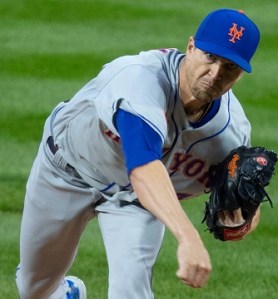
DeGrom could use a little extra insurance himself, alas. The good news for the Mets: deGrom was his usual self Monday night. Six shutout innings, seven punchouts, three hits, three-figure speed on his fastballs. The bad news, alas: the Mets are gonna Met, so far. At least out of the bullpen.

Their on-paper impressive offense found nothing more than two runs to support their ace. They got an inning of shutout relief from Miguel Castro relieving deGrom for the seventh, but the bullpen puked the bed in the eighth—including hitting Bryce Harper with the bases loaded. Not exactly a Rhodes Scholarship move there.

The Old Fart Contingency thundered aboard social media that Mets manager Luis Rojas blew it lifting deGrom after six strong—until they were reminded the added layoff after the Washington postponement put both deGrom and the Mets into caution mode.

“If that was [last] Thursday and I’m on normal rest,” the smooth righthander said postgame of the early hook, “I don’t think there is any chance I’m coming out of that game. We discussed it before what was the right thing to do. Long season and talking to them coming in, it felt like was the right decision.”

It was neither deGrom’s nor Rojas’s fault that, after Garcia took care of the Phillies in the seventh with just one infield hit within a fly out and two ground outs, the Phillies loaded the bases on the Mets’ new relief toy, Tyler May, in the eighth with one out, before Rojas went to another new Met bull, Aaron Loup. And Loup promptly hit Harper to push Miller home, before J.T. Realmuto singled home pinch runner Quinn, Mets late third base replacement Luis Guillorme threw home off line allowing Harper and Rhys Hoskins to score, and Didi Gregorius pushed Realmuto home with a first-pitch sacrifice fly.

The Mets had nothing to answer except a two-out ninth-inning stand that came up two dollars short against Phillies closer Alvarado. Kevin Pillar singled up the pipe, Francisco Lindor—the Mets’ own new bazillion-dollar lifetime shortstop—dumped a quail into shallow right that landed just in front of and then off the glove on oncoming, diving Harper, and Michael Conforto singled Pillar home while setting up first and third.

Pete Alonso, their 2019 Rookie of the Year bomber, hit one to the back of right field that looked as though it had a chance to ricochet off the top of the fence if not clear it. It wasn’t quite enough to stop Harper from running it down, taking a flying leap with his back against the fence, and snapping it into his glove to stop a game-tying extra-base hit and end the game with the Phillies on the plus side, 5-3.

Marry the foregoing to deGrom going 2-for-3 at the plate including an RBI single, and no wonder May himself said post-game, “Jake shouldn’t have to do everything himself. That’s not what teams are, and frankly Jake did almost everything today.”

Just don’t marry that to things such as the Angels’ Shohei Ohtani hitting 100+ mph on the mound and hitting a mammoth home run that flew out 100+ mph in the same inning last Friday night. Ohtani the two way player is an outlier among outliers; deGrom’s merely an outlier.

As of Tuesday morning— with the National League’s pitchers having to bat because Commissioner Nero simply couldn’t bring himself to keep the universal designated hitter this year at least, and Ohtani batting second in the Angel lineup the night he started on the mound, among other things—the pitchers have a .131/.157/.192 slash line and a .349 OPS.

The pitchers at the plate from Opening Day through the end of Monday night collected thirteen hits in 149 plate appearances: nine singles, three doubles, and Ohtani’s Friday night flog a third of the way up Angel Stadium’s high right field bleachers. They also walked three times and struck out 56 times. And the OFC still insists the National League just say no to its own invention.

All around the Show, too, there was one home run hit every 35 plate appearances and fourteen percent of all 928 hits the season’s first five days cleared the fences. It took five outs to create a single run, with 5.3 average runs created per game and 631 runs created while 559 scored.

It was fun to hear the fan noises even in limited capacities, too, though the limits in Angel Stadium made Ohtani’s blast sound even more explosive at the split second he hit it. If only things had been more fun for the home crowds: the many themes for the Show’s first five days could include, plausibly, the blues classic “On the Road Again.”

The home teams’ slash lines: .225/.313/.374/.687 OPS. The road teams: .245/.328/.403/.731 OPS. The road teams drove in fifteen more runs, hit thirteen more home runs, seven more doubles, and had seventy more hits overall. They also took eleven more walks, though they struck out fifty more times and grounded into fifteen more double plays. The road rats also had a +29 batting average on balls in play over the home boys and 108 more total bases while they were at it.

Maybe the shocker among the opening road rats were the Orioles. The Woe-rioles. Taking three straight from the Red Sox in Fenway Park. Out-scoring the Olde Towne Team 18-5, including and especially an 11-3 battering on Sunday afternoon. Even those paranoid about ID cards might want to insist the Orioles show theirs, even after the Orioles got a brief return to earth from the Yankees beating them 7-0 Monday in New York.

Unless it was the Reds, taking two out of three from the Cardinals to open, including and especially a 12-1 battering Sunday afternoon that proved the best revenge against abject stupidity is to slap, slash, scamper, and smash your way to a six-run seventh when you’re already up three runs—thanks to Nick Castellanos ripping Cardinal starter Carlos Martinez for a two-out, three-run homer an inning earlier.

Castellanos got drilled by Cardinals reliever Jack Woodford Saturday . . . two days after he bat-flipped a home run. Then, when he dove home to score on a wild pitch, Castellanos got bumped by Woodford sliding in to bring down the tag Castellanos beat. Castellanos sprung up, barked at Woodford, and began walking away before trouble could arrive. Oops. Trouble arrived—when Yadier Molina shoved him from behind to spark a bench-clearing brawl.

Baseball government myopically suspended Castellanos two games for “provoking” the brawl. Who’s baseball’s official optician? Who couldn’t see what everyone else with eyes saw? And how long has Molina—handed only an “undisclosed fine” along with a few others in the scrum—been so privileged a character that he can get away with the actual kickoff of a brawl that was seeded in the first place because the Cardinals are one of the game’s self-appointed Fun Police precincts?

“I was pleased,” Cardinal manager Mike Schildt told the press after that game. “Our guys came out there. We’re not going to take it. I know Yadi went immediately right at him, got sidetracked by [Cincinnati’s Mike Moustakas]. Woody, to his credit, got up and was like, ‘I’m not going to sit here and be taunted.’ Good for him.”

Taunted? All Castellanos said when he sprang up, by his own admission, was “Let’s [fornicating] go!” Anyone who thinks Woodford lacked intent didn’t see that ball sailing on a sure line up into Castellanos’s shoulder and rib region. Nor did they see Molina very clearly shoving Castellanos without Castellanos having the benefit of a rear-view mirror.

Castellanos appealed the two-game suspension. The final result wasn’t known at this writing. But the Cardinals should be getting a message of their own: Defund the Fun Police. Pronto.

How about the Astros, who went into Oakland and swept four from the Athletics before ambling on to Anaheim and losing 7-6 to the Angels Monday night? That was despite dropping a three-run first on Angel starter Jose Quintana and yanking a fourth run out of him in the top of the fourth, before the Angels finally opened their side of the scoreboard with Mike Trout (of course) hitting Luis Garcia’s 2-2 meatball about twelve or thirteen rows into the left field seats.

The Angels pushed a little further back, the Astros pushed a little further ahead, until the Angels ironed up and tore four runs out of the Astros in the bottom of the eighth with an RBI single (Dexter Fowler), a run-scoring force play (David Fletcher), a throwing error (on Jared Walsh’s grounder to first), an intentional walk (to Trout, of all people), and a sacrifice fly (Anthony Rendon).

Kyle Tucker’s ninth-inning solo bomb turned out more a kind of excuse-us shot than a last stand. The game left both the Astros and the Angels at 4-1 to open the season and what could be very interesting proceedings in the American League West. Now, if only the Astros could finally get past Astrogate.

They’ve been playing and winning through numerous catcalls, howls, and even a few inflatable and actual trash can sightings in Oakland and Anaheim. Jose Altuve—who’s looked more like his old self at the plate so far—seemed mildly amused when an inflatable trash can fell to the warning from those high Angel Stadium right field bleachers.

Astrogate was and remains anything but amusing. The Astros could keep up their torrid opening and overwhelm the AL West this season, but the scandal won’t go away entirely (nor should it) until the absolute last Astrogater standing no longer wears their fatigues. Yes, you’ve heard that before. That doesn’t make it any less painful for Astro fans or less true for everyone else. The Astros, nobody else, wrote the script that made them pariahs. Bang the cans slowly, fans.

Will off-field-based illegal electronic sign stealing disappear at all? Players got same-game video access back this year. There are three security people in every team’s video room at home and on the road. League cameras have been installed in those video rooms. Maybe it wouldn’t hurt to add guard dogs?

The players union agreed last year: there’ll be no more players getting away with murder even in return for spilling the deets—the commissioner can drop a lot more than a marshmallow hammer on the cheaters from now on. All by himself. He can demand answers without plea bargaining. And he doesn’t need a permission slip.

“But one of the prevailing lessons from the electronic sign-stealing era is that even if a scheme sounds far-fetched, someone might give it a whirl if they believe they can get away with it,” writes The Athletic‘s Evan Drellich, one of the two reporters (Ken Rosenthal was his partner) who helped break and burrow deep into Astrogate. “This holds true no matter what MLB does. Even a total ban on electronics, which the players would never agree to, would not be enough. In that case, a player or staffer could simply go rogue.”

In other words, boys will be still be boys, if they can-can.
It’ll take more than winning . . .

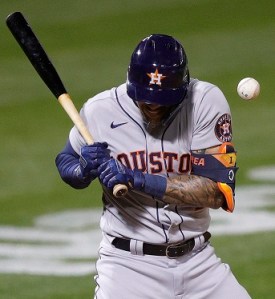
What Carlos Correa took on the shouhlder from Chris Bassitt on Opening Night isn’t likely to be the last such drill—not until the absolute last Astrogater isn’t an Astro anymore.

“Got to hear some boos, finally,” said Astros righthander Zack Greinke after Opening Night in Oakland. “That wasn’t fun to listen to, I didn’t think, but we played good so it didn’t matter. Hopefully we’ll keep playing good and it won’t be as big of an issue.”

Greinke wasn’t a member of the Astros in 2017. The season-opening roster now has only five remaining from that World Series-winning team: second baseman Jose Altuve, third baseman Alex Bregman, shortstop Carlos Correa, first baseman Yuli Gurriel, and pitcher Lance McCullers, Jr.

But there’s a reasonable enough suspicion that the Astros won’t stop hearing boos and catcalls until every last member of the 2017-18 team is gone, either to other teams or from the game itself. The pan-damn-ically truncated, fan-less, irregular 2020 season kept the Astros shielded from anything beyond fans outside the parks serenading their team bus.

Lucky them. Until now. With fans returning even in limited numbers this season, the Astros won’t be immune to road fans letting them have it. If Greinke thinks wins will neutralise them—wins such as their 8-1 Opening Night win over the Athletics—he may be guilty of wishful thinking.

That’d be a far less grave offense to be guilty of than the one over which the Astros remain convicted by the evidence and in the eyes of the rest of the game and its fans. The stain won’t leave for a long enough time. The pan-damn-ic didn’t really amputate the long arm of Astrogate after all.

Fair? Probably not to the 89 percent of the Astro roster who weren’t there and had nothing to do with Astrogate. More than fair to the eleven percent remaining.

Limited though it was by safety protocols, the Oakland crowd wasted no time. During pre-game introductions they booed the Astros loudly, accompanied by a few who carried assorted trash cans to bang just as loudly. The Astros should consider themselves lucky if lusty booing and can banging on the road are all they get.

“That’s fine,” said outfielder/designated hitter Michael Brantley of the Oakland crowd. “This is a veteran team. We’ve been in the World Series, we’ve been in the playoffs. The guys know how to compete day in and day out. They can boo, they can yell, they can do whatever they want. But at the end of the day we have each other’s backs, and that’s all that matters.”

Having each other’s backs is one thing. Genuine contrition for the worst cheating scandal major league baseball saw since the at-long-last-affirmed exposure of the 1915 New York Giants as pennant race comeback telescopic cheaters seems not to be Astro policy. That non-apologetically apology at last year’s spring-opening presser, pre-COVID shutdown, was no act, apparently.

They still don’t seem to get it so far. They still don’t seem to get just how terrible a look it was when commissioner Rob Manfred handed all 2017 players blanket immunity from discipline in return for spilling the deets about the Astro Intelligence Agency—the ones who either took an existing center field camera off its mandatory eight-second delay, or installed a new and illegal real-time camera, to steal signs from a clubhouse monitor and signal the stolen intelligence to their hitters with bangs on a large vinyl trash can nearby.

They still don’t seem to get, so far, that the AIA went a lot farther than went any team (the 2018 Boston Rogue Sox for certain, others quite possibly) who merely used existing video rooms at home and on the road to steal signs and relay them to baserunners to send the batters.

They still don’t get what then-Dodger pitcher Alex Wood meant when he said he’d rather face a batter using actual or alleged performance-enhancing substances than an AIA-like sign stealer, because the former still doesn’t know what’s coming and lacks the 50 percent or better chance of hitting it before he even sees the pitch.

They still don’t get why Astrogate team member Correa inspired lusty cheering when A’s starter Chris Bassitt drilled him in the fourth inning despite a runner being aboard. Or why Correa, Altuve, Bregman, and Gurriel are liable to be ongoing targets for brushbacks and knockdowns so long as they’re Astros.

Former Astrogater George Springer, now a Blue Jay, opened the season on the injured list. Will he face the catcalls from Blue Jay opponents unable to forget he was one of the Astrogate team? Time will tell, though other former Astrogaters haven’t really felt it in the hips or on opposing fans’ lips. Yet.

Remember: When Astrogate exploded from mere revelation in November 2019 to Manfred’s final report and limited discipline—the team fined and stripped of draft picks, general manager Jeff Luhnow and manager A.J. Hinch suspended for the season, then Luhnow and Hinch fired by owner Jim Crane who seemed himself barely able to grok the outrage—it wasn’t just fans outraged by the AIA.

Long ago, the father-in-law of convicted killer Jeffrey MacDonald, fearing his son-in-law might yet remain free on appeal in the deaths of his pregnant wife and two young daughters, proclaimed publicly, “If the courts of this country won’t administer justice, I most certainly will.” More players than you may remember said much the same thing about administering to the Astros the justice Manfred truly denied, though they didn’t quite have murder in their hearts for the unjudged.

Dodger relief pitcher Joe Kelly showed such players weren’t kidding, late last July, when he got his chance and sailed ball four past Bregman’s shoulder and subsequently threw one behind Correa’s head. For every one soul a little put-off by Kelly’s dusters, there were probably three who thought he didn’t go far enough administering Astrogate justice.

Too many fans would love nothing better than to see every last being in Astro fatigues pay such prices as Bregman and Correa. I observed one social media poster writing, and probably speaking for too many “Bean balls, mound charging, spiking, spitting, fighting, punches, headlocks, punches to the face hard and often. Umpires should call every pitch against them a strike.”

And then we should get really mad?

Actually, we should have Wednesday night—at home plate umpire Brian Gorman. He called strike on a wide outside pitch to Brantley early in the game, called balls on two more strikes so obvious Helen Keller could have seen them, and then Brantley slashed a single more or less into center field on one of the upper strikes that Gorman might have called a ball if taken. Brantley should have been out on strikes in that plate appearance.

Gorman was an equal opportunity offender. He called strike three on the A’s Matt Olson on a pitch that was far enough off the outside corner to slide a bat through without it touching either side. All night long Gorman’s strike zone was more improvisational than music legends John Coltrane, Cream, and Miles Davis. Robby the Umpbot may be closer to arriving at last than people think or might like.

You can search the archives of this journal and see precisely where I stood (and continue to stand) on Astrogate. So you know I’m not just looking to take the culprits off the hook when I say there’s a limit to how much Astrogate justice their opponents can administer and road fans can demand.

I get the urge and itch to send messages to Altuve, Bregman, Correa, and Gurriel. (McCullers being a pitcher won’t be batting unless he’s in the game and the Astros are playing a National League team on the road, thanks to Commissioner Nero forcing the absence of the universal designated hitter for this season at least.) They were members of the Astrogate team and they got away with murder.

But Brantley didn’t join the Astros until 2019. The rest of the roster had nothing to do with Astrogate. Joe and Jane Fan don’t always draw the proper distinctions, but the players can, do, and should. Save the return messages for the real culprits. Right?

Sort of. Nobody held a gun to the Astros’ heads to compel them to extend Gurriel another year with an option for next year. Nobody held guns to their heads to compel them to try for an extension for Correa, who now says he’s looking forward to the free agency market he’ll hit after this season.

Altuve and Bregman are locked in as Astros until 2024. Nobody will hold guns to the Astros’ heads and force the team to extend or re-sign them further. If any team reads the appropriate tea leaves and decides to make a trade play for either one, nobody will hold the Astros hostage until they agree to retain the pair.

It’s not fair to blame the entire 2021 Astro roster for the crimes of the eleven percent remaining Astrogaters. But it’s entirely understandable. The Astros will have to live with the continuing ramifications of their cheating and the continuing outrage of opponents and fans until the absolute last Astrogater no longer wears their fatigues.

The A’s re-up the whistleblower

Mike Fiers—the A’s re-sign the Astrogate whistleblower.

Under ordinary circumstances a team signing a good pitcher who’s a worthy number-four man in a starting rotation isn’t extraordinary. But then there’s Mike Fiers, whom the Athletics have re-upped for 2021 on a one-year, $3.5 million deal. There’s also San Francisco Chronicle baseball writer Susan Slusser dropping a troublesome suggestion.

Now the Giants’ beat writer and a former president of the Baseball Writers Association of America, Slusser was a longtime A’s beat writer for the Chronicle. So when she says, “The A’s were the only team to make Fiers an offer, I’m told. Interesting – was he being blackballed for being a whistleblower? I certainly hope that’s not the case,” it ought to sound an alarm or two.

Lots of teams have been in need of third and below starters. It shouldn’t have been that difficult for an innings-eating righthander with fourth-starter solidity to find a job even in this winter’s somewhat surreal market. Except that Fiers, who did say his preference was to stay in Oakland, isn’t just an ordinary fourth starter.

Whistleblowers don’t fare as well as some people think after their whistles blast cases of wrongdoing to smithereens. When Fiers blew his on the Astros’ illegal off-field-based electronic sign-stealing cheating of 2017 and some of 2018 (at least) to The Athletic, it seemed as though half of baseball considered him a hero and half a rat bastard.

He moved to the Tigers for 2018 and to the A’s later that season. He warned both collections of new teammates that the Astros were playing with a stacked deck. He and others suspecting the Astros of extracurricular pitch intelligence also tried futilely to convince members of the press to run with and investigate it; those writers couldn’t convince their editors to let them run without a name willing to go on public record.

That’s when Fiers finally put his name on it to Athletic writers Ken Rosenthal and Evan Drellich in November 2019. From which point it swelled toward Commissioner Rob Manfred’s marshmallow hammer, the hammer constructed when he handed Astro players immunity in return for spilling, suspended a GM and a manager, voided two key draft picks and fined owner Jim Crane pocket money.

The Astros likely weren’t the only team in the Show using extracurricular off-field-based sign stealing, just the most sophisticated. They took an existing center field camera off the mandatory eight-second delay or installed a surreptitious new such camera, set monitors up in the clubhouse, and translators would decode the pitch signs and signal hitters with bangs on an adjacent trash can.

The 2018 Red Sox turned out to have enlisted their video rooms at home and on the road for a little extra aid to old-fashioned gamesmanship: the signs would be decoded off the feeds and sent to baserunners to signal batters. They—and anyone else thinking and doing likewise (would you be shocked?)—didn’t install anything extra.

Essentially, the Show handed those Rogue Sox and others, who knows how many yet, the keys to the liquor cabinet and dared them not to imbibe while Mom and Dad high tailed it out of town for the weekend.

Some looked at Fiers’ membership on the 2017 Astros and discovered a rank hypocrite, never mind that if he’d blown his whistle then he’d also have been denounced most likely as a backstabber on the spot. (Fiers wasn’t on those Astros’ postseason roster.) It’s called hell if you do and hell if you don’t.

“Even in cases of obvious right and wrong,” wrote The Athletic‘s Marc Carig last year, “crying foul on family is easy to call for in retrospect and hard to do in real time.” Remind yourself if you will how often you learned of egregious wrongdoing and lamented the lack of a whistleblower. Now ask how simple it really is to blow the whistle in the moment or even a comparatively short time later.

It took New York police legends Frank Serpico and David Durk several years’ futility trying to get that police department to attack graft before they finally went to the New York Times and launched the largest New York police scandal since Brooklyn-based bookie Harry Gross was found to have enough police on his payroll to staff half his borough’s precincts.

Cheating may be sports’ oldest profession, but affirmations don’t always happen concurrent to the instances, for the reason Carig enunciated. When Joshua Prager finally affirmed what was long just suspected—that the 1951 New York Giants cheated their way back into the pennant race to force the fabled playoff with an elaborate telescopic sign-stealing operation—it was half a century after the fact, with the surviving principals willing to talk long retired.

Prager eventually expanded his expose into The Echoing Green: The Untold Story of Bobby Thomson, Ralph Branca, and the Shot Heard Round the World. “A spitballer or corker can be caught by an umpire, who has the right to examine or confiscate equipment,” wrote the Washington Post‘s Thomas Boswell when Prager first hit The Wall Street Journal running.

Both teams play on the same damp base paths and inclined foul lines, even if they’ve been doctored a bit for home-field advantage.

But an elaborate system of sign stealing—with an old pro in the art of signs in a hidden space—is almost impossible to catch. Umps and foes are defenseless. The game becomes fundamentally unfair because knowing what’s coming is a big deal.

If revealing the Astros’ elaborate 2017-18 system at last made Fiers a criminal, maybe baseball needs more such criminals. If other teams needing fourth starters refused to even think about him because he blew a whistle instead of a ball game, after two years worth of trying futilely to get others to investigate without a blown whistle, something’s worse than a hanging slider driven out of sight.

Slusser doesn’t know for dead last certain. Neither does anyone else, possibly including Fiers. To those who still think blowing the whistle is worse than the crime, perhaps you’d like to ask what might have been, instead, if Alexander Butterfield hadn’t suffered a pang of conscience and an inability to lie under oath enough to expose Richard Nixon’s White House taping system.

Alex Cora, prodigal manager

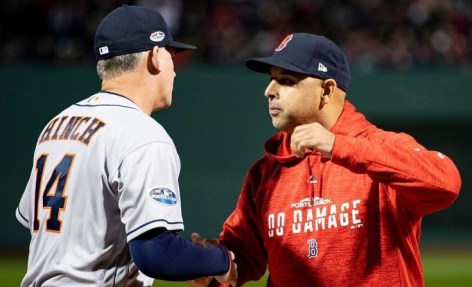
Red Sox manager Alex Cora (right) in a 2018 ALCS handshake with his Houston counterpart A.J. Hinch. Cora’s been re-hired by the Red Sox, while his fellow Astrogater Hinch gets his second chance in Detroit.

Well, I was wrong. About Sam Fuld possibly having the faster track to the job and Alex Cora finding a new one elsewhere. The Red Sox rehired Cora to manage them Friday. Have they let a cheater come back to the scene of the crime?

Cora’s Astro Intelligence Agency culpability was deep enough it was too easy to believe he had a hand or at least a fingertip in the 2018 (and maybe 2019) Rogue Sox Replay Room Reconnaissance Ring. It’s also a truism oft repeated (including by me) that when you lead you take responsibility for what’s done by the troops.

But baseball’s government pinned that replay reconnaissance responsibility on Red Sox video room operator J.T. Watkins. Pinned it on him or scapegoated him for it, depending on your point of view. Either he or someone he allowed decoded opposing signs and signaled them to Red Sox baserunners to send home to the hitters at the plate.

Watkins took the fall. The MLB investigation that discovered the Astros went above and beyond just using what MLB itself provided in the replay rooms behind all dugouts but that the Rogue Sox just got caught doing what a few other teams at minimum must have been doing likewise.

“I know J.T. and how he works,” Cora said when Watkins was taken on the perp walk. “I trust the guy. Was I surprised at what came out? Yes, I was.”

Whether Cora beat the Rogue Sox rap on a technicality, or really didn’t have any clue as to what Watkins and who knows which Red Sox players were up to, Cora has his old job back. His Astrogate suspension ended the moment the World Series did. Officially, anyone with the opening was free to hire him.

If he was in it up to his neck in Houston he was found caught pants down with everyone else in Boston, officially. Unofficially, suspicions will cling. That’s the nature of the human beast. Begging the question for many as to why the Red Sox elected to bring back someone who’d been caught dead to right cheating above and beyond in one town even if he just might have been innocent enough in theirs.

“Forgiveness comes a little easier,” writes The Athletic‘s Chad Jennings, “when there’s a [World Series] ring involved.”

In that sense, Cora was the Red Sox safest choice. Any other manager would have faced an inevitable comparison. Early losing streak? Cora could have stopped it. Under-performing player? Cora would have known what to say. Disappointing season? Not on Cora’s watch. He maintains some benefit of the doubt, even beneath the weight of his past transgressions.

In other words, the hapless Ron Roenicke—handed the bridge after Cora’s exit, but helpless to keep the Red Sox together following their winter trade of franchise player Mookie Betts, the ownership’s greater concern for staying beneath the luxury tax threshold over fortifying the team’s compromised pitching staff, and several key injuries (Andrew Benintendi, Eduardo Rodriguez, Chris Sale)—didn’t stand a chance.

According to Jennings, Roenicke might have felt Cora’s “spectre” hovering overhead—except that he denies it. “No, never,” the skipper who’d been Cora’s bench coach said. “And the reason I can say that is because Alex should be managing . . . I’m hoping he does this again, whether it’s here or somewhere else, he should be managing.”

“At the time that we parted ways with Alex,” says Chaim Bloom, the Red Sox GM/chief baseball officer, whose longtime knowledge of Fuld—former outfielder turned Phillies player information coordinator—helped drive speculation of Fuld taking the bridge, “we were clear that that was a result of his role and what happened with the Astros and everything the investigation over there revealed. It had nothing to do with what may or may not have occurred in Boston.”

It’s enough to make you wonder whether bringing Cora back was Bloom’s ultimate choice or whether—the way then-GM Ben Cherington had Bobby Valentine jammed down his throat after the 2011 collapse—the Red Sox ownership likewise stuck Cora down Bloom’s throat.

Valentine, of course, took on a fragmented team and detonated a season-long bomb worth of divide-and-conquer dissipation. His firing after that 2012 disaster practically detonated block parties around New England. Cora’s departure practically detonated mass mourning that a guy with his brains and his ability to keep his players on board had to go.

Players and others within the Red Sox organisation couldn’t bear to let Cora go entirely even as the Red Sox leadership pushed him away with little choice following the affirmation of his Astrogate culpability. For those players partaking of Watkins’s replay room espionage, it must have felt like Dad going to the calaboose unfairly for the kiddies’ breaking the neighbourhood.

Hinch was popular with his Astros players, too, but once the Astros fired him and GM Jeff Luhnow upon their Astrogate suspensions the Astros showed little inclination or longing to bring him back. Even as the Red Sox put distance between themselves and Cora, they kept their eye on him a little longingly in the distance, ultimately re-narrowing it.

“[O]nce he departed,” writes NBC Sports Boston’s John Tomase, that opened the door for Bloom to make his own hire, since the manager-GM relationship is the most important in baseball operations”

And Bloom sent consistent signals that he planned to look elsewhere, a point reinforced by the process that ultimately led us back where we started.

With Cora available and ready to be rehired, Bloom still conducted a lengthy search, interviewing multiple candidates and eventually identifying five finalists. The choice reportedly came down to Cora vs. . . . Fuld, whom Bloom knew from Tampa.

The Red Sox will insist that at the end of this process, Bloom and Bloom alone chose Cora, and that had better be true. Because otherwise it means that ownership either tacitly or explicitly overruled its baseball boss on his most consequential hire . . . Imagine bypassing a beloved figure for a first-timer like Fuld? The last thing a rookie manager needs to be greeted with is resentment.

Surely Tomase isn’t alone in pondering what might have been if the White Sox had reached out for Cora instead of Hall of Fame manager Tony La Russa, who was only too clearly an ownership move instead of their GM’s. Would Bloom have felt free to hand Fuld the Red Sox bridge after all? We’ll never know.

It’s not that cheaters haven’t been forgiven before. The New York Giants’ leadership may have been well aware of Leo Durocher’s telescopically-buzzing cheating scheme down the 1951 stretch, but it was a third-place finish the year after they swept the Indians in the World Series that got Durocher fired.

Fred Hutchinson may or may not have sanctioned scoreboard-based sign-stealing by his pennant-winning 1961 Reds, but it took 1964’s courageous but fatal battle with lung cancer, not 1961’s telescopic cheating, to seal Hutch’s fate.

Cora’s culpability in the Rogue Sox Replay Room Reconnaissance Ring isn’t even close to being as cut and dried as his Astro Intelligence Agency activities proved to be. For now, no matter. Officially, Watkins paid for any and all Rogue Sox sins. Unofficially, Lucy, they’ve still got some splainin’ to do.

Every baseball eye in and away from Boston will put Cora and the Olde Towne Team under the most acute microscope since Zachariah Janssen invented the thing—in the year Urban VII became the shortest-reigning Pope (three months) in the history of the Catholic Church. It won’t necessarily be inappropriate.

Does Luhnow still not get it?

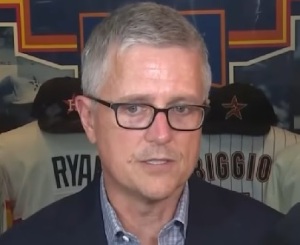
Jeff Luhnow, in front of the uniforms of two Astros Hall of Famers about whose baseball counsel he couldn’t have cared less—but probably should have.

Deposed and disgraced former Houston Astros general manager Jeff Luhnow wants you to know that those who brewed what became Astrogate went rogue on him. He also wants you to know that nobody told him a blessed thing about the off-field-based, illegal sign-stealing scheme, and things would have been different if they had.

Where have I heard that before?

Oh, yes. Once upon a time, in 1971, I heard it from deposed New York City police commissioner Howard Leary. He’d either looked the other way, or denied what was in front of him for years, as graft ran even more rampant in his department than a decade earlier, when bookie Harry Gross had almost as many New York cops on his payroll as the city did.

Luhnow gave an extensive interview Monday to Vanessa Richardson of KPRC, Houston’s NBC affiliate. “Whether it’s the players or the video staffers, they just decided on their own to do it and that’s a shame,” Luhnow told Richardson, “because had they come and asked me for permission I would have said no. Had they gone and asked Jim for permission, he would have said no. There’s just no reason why that should have happened.”

When Leary in 1971 was hauled before the Knapp Commission empaneled to get to the depths of what clean cops Frank Serpico and David Durk exposed to The New York Times, the ex-commissioner told the panel wearily that nobody told him anything, either, and by God things would have been different if anybody had.

The original Times story actually prompted Leary to denounce the paper for McCarthyism of the worst sort (his words). Serpico biographer Peter Maas revealed in due course that, when one of the few superiors Serpico trusted suggested to Leary that the plainclothesman was due a promotion and commendation for trying to expose rampant corruption, Leary snapped, “He’s a psycho!”

“In that case,” the superior rejoined dryly, “maybe the department needs more psychos.”

The Astros don’t need psychos to move past Astrogate. But they could use a lot better than their former general manager continuing to throw people under the proverbial bus while insisting falsely enough that it wasn’t him or didn’t begin with him.

Richardson asked Luhnow for a kind of timeline of the Astro Intelligence Agency’s operation. After beginning his reply by mentioning “a cabal” of video staffers and “coaches” executing the sign-stealing scheme via illegal camera operation—and saying they actually opened for business in 2016—Luhnow said, “It was pretty blatant. They were assigning duties, ‘Who’s on codebreaker duty tonight’.”

Pay close attention to “codebreaker.” Now, remind yourself that last February Wall Street Journal reporter Jared Diamond exposed a front office-developed algorithm called  Codebreaker, and shown to Luhnow in September 2016, brought to him by an Astros front-office intern who told him the algorithm could steal opposing catcher’s signs.

That was already far above and beyond traditional on-field gamesmanship, baserunners or coaches catching and deciphering opposition pitch signs to transmit to batters. (Or, catching pitchers tipping pitches.) That also preceded whoever it was that decided to either take an existing center field camera off mandatory transmission delay or install an additional camera transmitting real-time to clubhouse monitors.

If Luhnow wants you to believe nobody told him a bloody thing about any such espionage, beware the for-sale sign on whatever North Pole beach shop he owns.

Former longtime St. Louis Post-Dispatch sportswriter Jose de Jesus Ortiz pounced at once. “If Luhnow wants to say [Astros] players & [former manager] AJ Hinch didn’t tell him, he can go there,” Ortiz tweeted angrily enough. “Some might even believe him, but in my 23 years of covering ball I’ve found that players rarely spill info outside of the group. You can think you know, but you don’t. But he hired the ‘code breakers’.”

That was after Ortiz fumed, “Here’s the [fornicating] truth about Jeff Luhnow & baseball ops under him. They didn’t take into consideration what Nolan Ryan, Craig Biggio, Reid Ryan & Enos Cabell had to offer on baseball ops. It’s quite rich of him to [be] wondering why they didn’t know” about the Astros’ extralegal sign-stealing.

Luhnow didn’t mention a specific name, and Richardson hadn’t even prompted him to go there, but when he said, “one of the people who was intimately involved, I had demoted from a position in the clubhouse to a position somewhere else, and after I was fired he was promoted back into the clubhouse,” the assumption quickly became that he referred to Reid Ryan—the son of Hall of Famer Nolan.

Craig Biggio, of course, is a Hall of Fame second baseman. Enos Cabell was a corner infielder/outfielder for the 1972-80 Astros. They may not be the only baseball people whose counsel their baseball employers ignore, but the Astros’ apparent ignorance thereof hurt worse than any of the 285 pitches that hit Biggio during his long playing career.

Reid Ryan was the president of the Astros’ business operations for seven years until he was re-assigned in November 2019. (And, replaced by Crane’s son, Jared.) He was known if anything for applying himself to enhancing the fan experiences at Minute Maid Park.

When he was demoted his father quit the organisation outright at once. (Reid also insisted after his reassignment that the Astros’ 2017 World Series title wouldn’t really be tainted by the AIA cheating operation.) That wasn’t exactly part of the future Nolan Ryan had in mind after he threw his final major league pitch and accepted his plaque in Cooperstown.

Luhnow was the president of baseball ops. Jim Crane made clear Reid Ryan handled business & Luhnow handled baseball ops,” Ortiz reminds us. “It was Luhnow’s culture. I wish him well, but he exits Houston as he arrived, [defecating] on people who devoted their lives to the Astros.”

Luhnow’s Astro “culture” was long exposed as a result-oriented culture in which human relationships were cheap and too often disregarded.”Luhnow had all year to speak,” Ortiz continued. “But as was the case throughout his tenure Luhnow is as calculated as ever. That’s why baseball folks throughout the country say he’s dismissive of traditional baseball folks, scouts, players, etc. He sees them as assets, people to manipulate.”

He practised what legendary football coach Vince Lombardi is still misquoted as saying, even today: Winning isn’t everything, it’s the only thing. He denied responsibility when the Astros were exposed and caught in the first place. He barely flinched when it turned out the most apologetic Astros for Astrogate were such former Astros as J.D. Davis, Tony Kemp, Dallas Keuchel, and Jake Marisnick.

But he said little to nothing about the former Astro who blew the Astrogate whistle in the first place. Mike Fiers’s revelations included that he and several other players tried convincing sportswriters to expose the AIA only to discover those writers couldn’t convince their editors to let them run with it without even a single player willing to put his name on it.

The Oakland Athletics, for whom Fiers has pitched since mid-2018, filed formal complaints with Manfred’s office. So, apparently, did a few other teams. Manfred made a point of saying his office investigates any and all such complaints, yet nothing really seemed to move until Fiers spilled to Athletic reporters Ken Rosenthal and Evan Drellich almost a year ago.

When Hinch spoke to Sports Illustrated‘s Tom Verducci after his own firing, he, too, was remorseful over his Astrogate role, which was kind of a non-role of sorts: aside from destroying a couple of the clubhouse monitors receiving the illegally-pilfered intelligence, he did nothing much if anything.

“I should have had a meeting and addressed it face-forward and really ended it,” he admitted. “Leadership to me is often about what you preach. Your pillars of what you believe in. Leadership is also about what you tolerate. And I tolerated too much. And that outburst . . . I wanted to let people know that I didn’t like it. I should have done more. I should have addressed it more directly.”

That’s still a great deal more owning up than Luhnow has done. The former GM still thinks he was targeted specifically on behalf of Manfred needing a head or two on plates to show the commissioner meant business. He also still thinks it was just about everybody else’s fault.

“The reality is, the Astros cheated in 2017, and cheated a little bit again in 2018 using just the decoder method, and it was wrong, and it should never have happened, and I’m upset,” Luhnow told Richardson.

I’m really upset that it happened. I’m upset for our fans, I’m upset for players on other teams that gave up hits as a result of this that should never have happened. If we won games because of it, it should never have happened, and we didn’t need to do it. We had a great team. The team we put together in 2017, a lot of which is still together today is one of the best teams of the 21st century, and has had an incredible stretch. And there’s no reason why we needed to explore breaking the rules to gain an advantage, it made no sense to me.

Now he tells us. On the threshold of a World Series in which his former Astros won’t be appearing thanks to the Tampa Bay Rays.

If there was no reason for the 2017-18 Astros to break the rules to gain an advantage, why didn’t Luhnow kill it in its Codebreaker crib? The Los Angeles Dodgers and the Atlanta Braves may win their next World Series titles sooner than the answer arrives.

Luhnow would have done far better to heed not the actual or alleged Vince Lombardi credo but that of another sports legend, writer Grantland Rice:

When One Great Scorer comes
to write against your name,
He marks not that you won or lost,
but how you played the game.