Moreno won’t trade Ohtani? Let it be on his head

Shohei Ohtani

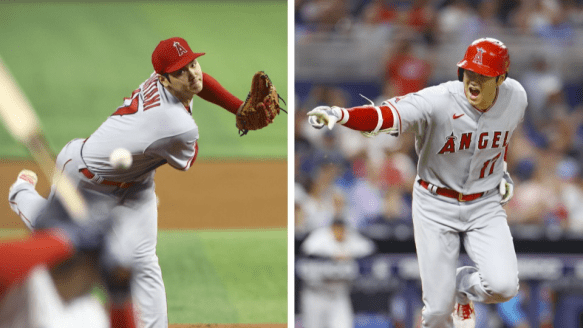
Shohei Ohtani could bring back a trade deadline haul that might push the Angels (and their trading partner, depending) into the postseason at last. But it would serve their owner right for failing to deal him and then letting him walk as a free agent bringing back . . . nothing.

Unless there is something festering in the deep background that nobody can expose, I have a contrarian thought for everyone insisting Angels owner Arte Moreno absolutely must trade Shohei Ohtani. I ask only that you save your ammunition until you read whole.

If Moreno’s that insistent upon keeping Ohtani until that very day when he becomes a free agent for the first time after the season ends, let him.

If Moreno insists upon remaining the kind of owner whose sense of marketing is more acute to the tenth power than his sense of baseball and of his team’s true competitiveness, let him.

If Moreno is that bent upon receiving nothing in return for Ohtani by letting him walk this coming winter, rather than receive the kind of value whose terms his baseball people can all but dictate, considering the prize Ohtani is, let him.

It would serve him right, even if it might serve long-enough-suffering Angel fans not so right.

Remember, this is the owner who was “exploring options” to sell the Angels almost a year ago. When that news broke, the sigh of relief from Angel fans could be felt from the Newport Beach coast to the farthest-planted lighthouse in Maine.

Moreno even let it slip that he had a pair of offers that would have eclipsed what Steve Cohen paid to buy the Mets. The problem was, Moreno let that slip this past March, when he also announced he simply couldn’t bear to part with the Angels just yet. Not while there was (ahem) “unfinished business” to tend.

“[We] feel we can make a positive impact on the future of the team and the fan experience,” he said in a formal statement when announcing his sale plans were done for who knew how long. “This offseason we committed to a franchise record player payroll and still want to accomplish our goal of bringing a World Series championship back to our fans. We are excited about this next chapter of Angels baseball.”

As of this morning, the Angels had gone from a season-opening 18-14 to a dead-even 48-48. The last time they had a four-or-more-games-over-.500 standing was when they were nine games over following a two-out-of-three winning stand against the Royals in mid-June. They’ve been 7-15 since.

The culprits have been the usual ones for this team—inconsistent pitching by one and all not named Ohtani; inconsistent hitting by one and all not named Ohtani (or Mike Trout); and, a near-consistent parade of patients for the injured list. Somehow, the Angels are four and a half games back in the American League wild card race, and nine out of first in the AL West.

That’s close enough for a major trade deadline deal to maybe make a difference, for the wild card hunt if not the division hunt. Right now, the biggest deal of deadline season could be Ohtani for whatever prime enough talent he’ll bring back, even if the acquiring team knows he might be just a rental for the rest of the way. (Even if that means a division, a pennant, maybe even a World Series ring.)

For a contending team loaded in surplus, that rental could still mean a deep postseason dive. For the Angels, it might mean surviving into the postseason, even through the back door, but just enough to give Ohtani (and Trout) a taste of postseason action neither has been granted to see since Ohtani became an Angel in the first place.

No, Ohtani won’t return a whole qualified starting rotation, a whole bullpen full of more than bull, or an entire additional lineup of Ohtanis (or Trouts). But he would return pieces solid enough to keep the Angels in this race and maybe, just maybe, a race or two to come.

“Ohtani is a once in a lifetime player, and moving off of him is akin to trading Babe Ruth,” writes Deadspin‘s Sean Beckwith. “You hold onto that kind of talent for as long as possible, and hope for the best.” And that last part, Beckwith knows, is the most problematic part:

Considering “hoping for the best” is the Angels’ entire organizational strategy — it’s why they’re in this current predicament — they will inevitably be crippled by indecision, or disillusioned by the “LA” on the hat, and stand semi-firm that Ohtani will stand by them.

This is, of course, an asinine strategy, and antithetical to the thinking of front offices, and sports media. The pleas for trade destination slideshows are being heeded everywhere you click, and all the big market teams are tallying their assets to see how much they could offer in a trade, because [general manager Perry] Minasian said he’s not going to trade Ohtani if they’re still in contention.

The thing is, contention is subjective, and four-and-a-half games back of the final wild card spot is more than enough for the Angels to grasp onto the belief that Shohei Ohtani will stay regardless of no tangible reason to do so.

It’s more than enough, too, to prevent Moreno—an owner who thought (erroneously) that his life’s success in marketing qualified him as a baseball man, when it only meant he could put (the old George Steinbrenner creed) “name guys who put fannies in the seats” on the field first and worry about rhyme, reason, cohesion, and performance (an awful lot of which his own capriciousness obstructed) second—from doing the sensible thing. Or, from letting Minasian do the sensible thing.

So let him cling to Ohtani until the two-way unicorn’s Angels deal expires this winter. Let him get less than nothing in return for the unicorn if that’s the way he wants it. Ohtani has been at least as sensational a baseball talent as Mike Trout was before the injuries became a near-annual thing for him. He (and Trout) deserve better than to be kept prisoners to merely hoping for the best.

Let Moreno explain why clinging to his unicorn to the very last was more important than letting his unicorn bring back what just might have pushed the Angels into their first postseason since they were swept out of a division series by the Royals, in the first of Mike Trout’s three Most Valuable Player Award seasons. Nine years ago, if you’re scoring at home.

That explanation should prove the funniest and saddest monologue since the Marvelous Mrs. Maisel first wandered onto the stage of a fleabag nightclub to schpritz about her husband dumping her for his secretary. Mrs. Maisel got laughs and a brilliant career out of it. It would serve Moreno right to get nothing back for the unicorn to whom he sold an illusion.

The end of an error?

Arte Moreno, Mike Trout

Angels owner Arte Moreno and future Hall of Famer Mike Trout were ecstatic when Trout became a wealthy Angel for life. But Moreno’s failure to reconstruct a team his and their greatest player can be proud of will be Moreno’s legacy if he sells the Angels.

For the first time since their team won their only World Series championship thus far, Angel fans have reason to believe there’s light at the end of a painfully long tunnel. Owner Arte Moreno exploring options to sell the franchise must resemble the liberation promise of Dwight Eisenhower telling Allied forces, “You are about to embark on the great crusade”—the night before D-Day.

Just months after Darin Erstad clutched Kenny Lofton’s fly out to center to finish their staggering seven-game 2002 Series conquest, Moreno bought the team from the Disney Corporation. He swelled with pride as the first Mexican-American major league owner. Angel fans swelled likewise over what seemed to be swelling as an era of dominance after what seemed a preceding snakebitten eternity.

It was too good to be true. The team finally shattered a near-forever of extraterrestrial collapses, failures, and tragedies that inspired things from a shortstop driving his bats through a cemetery to purge their evil spirits to a pitcher pondering a sage burning in the clubhouse and a general manager pondering engagement of a priest to exorcise their ballpark.

Now the Angels held the lease to the Promised Land and a new owner with pockets deep enough to rival a team (the Yankees) they beat three out of four in the division series that launched their championship run. Who knew? Two decades later, the Angels are a six-letter synonym for disaster. And Moreno has come to resemble the worst of the man who once owned those division series victims than he or his dwindling allies would ever admit.

From 2003 through 2009, the Angels won the American League West five out of seven tries. The team went from the second-most snakebitten AL franchise to powerhouse in what now seems a blink in time. In thirteen seasons since, the Angels have won the West once but finished the past five of six in fourth place in the five-team division.

Moreno’s Angels have gone from signing and continuing to win with Hall of Famer Vladimir Guerrero, Sr. to drafting the transcendent Mike Trout and signing the transcendent enough Shohei Ohtani . . . and becoming the team their future Hall of Fame center fielder and must-see-television pitcher/designated hitter can be anything but proud of.

With the uber-loyal Trout locked down in a gigabucks deal that makes him an Angel for life, baseball eyes knowing the Angels need a transfusion as drastically as a leukemia patient saw dealing Ohtani at this year’s trade deadline as the donor who’d deliver particularly rich blood.

“The greatest two-way player in baseball history will be eligible for free agency in the fall of 2023,” writes ESPN’s Buster Olney, “so some other teams communicated to the Angels that they would be open to trades—and willing to include their very best prospects . . . Word quickly reached the interested parties that Arte Moreno, the Angels’ owner, wouldn’t sign off on any Ohtani deal. No one was surprised.”

No one who’s watched the Angels in the Moreno era should have been.

Moreno made his fortune as an advertising executive who turned the Outdoor Systems ad operation into an enterprise that fetched billions when Moreno and his partner sold it to Infinity Broadcasting in 1998. His forte was and remains marketing. It didn’t exactly translate to baseball as opposed to Angel Stadium box office success.

Trout himself says he learned of Moreno exploring a team sale the same way the press did Tuesday, when the Angels made their formal announcement. And he hinted that, however grateful he is for Moreno believing in him and making him rich, it’s not exactly enough anymore. Some things matter more than money to competitors.

“I think once you find out who buys it, whenever that is,” Trout told the Orange County Register, “there are definitely conversations we’re going to have to have. Obviously, I want to win.”

Like many owners who ride the wild surf of their teams’ successes in the beginning, Moreno began to believe in his own baseball genius. Unlike many such owners, Moreno behaved as though his role model for baseball ownership was the 1980s version of George Steinbrenner without half the summary executions and humiliations with which that Steinbrenner tortured Yankee fans for a generation.

The 1980s Steinbrenner loved “name guys who put fannies in the seats.” Moreno has been much like that, particularly when it comes to hitters. So much so that he reeled in one after another name hitter but ignored his team’s real pitching needs, which have been somewhere between drastic and desperate for just about the whole of Trout’s career to date.

Fairness requires we acknowledge that not all those deals for all those hitters who ended up hurting far more than helping the club were bad going in. It wasn’t Moreno’s fault that Albert Pujols’s legs and feet reduced him to a barely-serviceable DH after that Hall of Famer-in-waiting’s first Angels season. It wasn’t Moreno’s fault that Josh Hamilton and Anthony Rendon were/would be throttled by injuries.

Nor was it Moreno’s fault that two prize pitchers he signed big enough, C.J. Wilson and Zack Cozart, would be hit hard enough with injuries that 1) Wilson would retire after a couple of good if not spectacular Angel seasons; and, 2) Cozart would pitch well for a third of a season before a) a torn labrum fielding a grounder cost him the rest of that season and b) shoulder and neck surgery would cost him 2019—and his career, after he was traded away.

And it’s certainly not as though Moreno anticipated Trout’s first decade worth of such play as to have him baseball’s fifth-best all-time center fielder at this writing, still, would turn into an injury-plagued second decade beginning. Say what you will about the owner’s clumsiness and hubris, but he’s not exactly the cause of Trout’s and others’ time-robbing injuries. Even Moreno isn’t that kind of jinx.

But it was Moreno’s ugly doing to run Hamilton out of town on the slickest rail he could find, after Hamilton incurred a drinking relapse while watching a Super Bowl, manned up and went right to baseball’s drug policy administration with it, but discovered his Angel bosses had different thoughts about manning up.

It was Moreno’s ugly doing, a couple of years before Trout came into his own, to gut the Angels’ scouting system almost completely. “First,” I wrote over three years ago, “they made international scouting director Clay Daniels the scapegoat for bonus skimming shenanigans by some of his subordinates; then, they pinked overall scouting chief Eddie Bane—one of whose last achievements was urging the Angels to sign a kid named Trout in the first place—as the scapegoat for a series of bad drafts and worse free agency signings and trades.”

Shohei Ohtani, Arte Moreno

The Angel Stadium faithful booed Moreno as he presented Shohei Ohtani his 2021 AL MVP award. Last month, Moreno blocked deals that would have brought serious prospects back for Ohtani (a free agent after next year) and further cemented Moreno’s reputation for putting box office too far above baseball.

It was Moreno’s ridiculous doing to order his then-general manager Tony Reagins—who couldn’t persuade Hall of Famer in waiting Adrian Beltre to sign with the Angels as a free agent—to make a deal for Toronto outfielder/basher Vernon Wells post haste and or else! Then the Angels discovered the hard way that Wells was damaged goods. And the guy they sent the Blue Jays for him, bat-first catcher Mike Napoli, was going on to pitch in big for a pair of World Series teams in Texas and Cleveland and help a Red Sox team win their third Series ring of the century.

It was Moreno’s ridiculous further doing to address the Angels’ dire pitching needs over several years, ignoring quality pitching on the markets in favour of one after another reclamation project that failed in Anaheim but found either revival or retirement elsewhere. Which points to another wounding Moreno flaw. Loving and enriching the name guys putting fannies in the seats is one thing. His budgets otherwise have been tighter than James Brown’s rhythm sections without yielding comparable fruit.

“Like a lot of billionaires before him,” Olney writes, “Moreno seemed to believe he knew more about building a baseball team than the folks he hired. But the strengths that made him an extraordinary success before he bought the Angels became a weakness once he stepped into a sport that has become increasingly competitive.”

Two former Angel GMs (Jerry Dipoto, now with the second-place Mariners; Billy Eppler, now running the National League East-leading Mets) found success enough after they escaped Moreno’s all-thumbs touch. The incumbent, Perry Minasian, likewise hamstrung enough, may or may not survive this season’s disaster.

Olney reminds us that Moreno selling the Angels would be baseball’s biggest sigh of relief since Frank McCourt was forced to sell the Dodgers to the Guggenheim Group and the Wilpon family finally elected to sell the Mets to Steve Cohen. The sigh’s breeze will be felt from sea to shining sea.

The timing may be telling enough. Moreno’s attempt to buy Angel Stadium and its surrounding land from Anaheim collapsed three months ago, after Mayor Harry Sidhu resigned amid an FBI investigation into whether Sidhu shared “privileged and confidential information” with the team while they negotiated with the city. (The FBI didn’t accuse Moreno or the Angels of wrongdoing.)

The Angels are also not off the hook just yet over the accidental overdose death of painkiller-addicted pitcher Tyler Skaggs in 2019. They face two wrongful death lawsuits by Skaggs’s family—one by his parents, the other by his widow—in the wake of former Angels communications director Eric Kay’s conviction in federal court for providing the fentanyl-containing drug that killed the popular lefthander.

It’s worth remembering, too, that only when George Steinbrenner was suspended for his nefarity in digging up dirt on his Hall of Fame outfielder Dave Winfield did the Yankees finally have room to rebuild themselves back to greatness. An end to the Moreno era might well produce likewise for an Angels franchise that’s had only one now-brief spell of greatness even if it has only one World Series trophy to show for it.

“Many executives,” Olney continues, “believe that the Angels have not come close to exploiting the potential of their market. ‘”Because that place might be the best to work in in baseball,’ one official said. ‘The weather is perfect. The conditions are perfect. You can live on the beach. Nobody bothers them. The fans are good’.”

With the best intentions but the worst approaches, Moreno’s Angels ownership made it possible to believe paradise was hell in disguise. By comparison, the freeway traffic chokes that so often stand between the Pacific Ocean and Angel Stadium are walks on the beach.