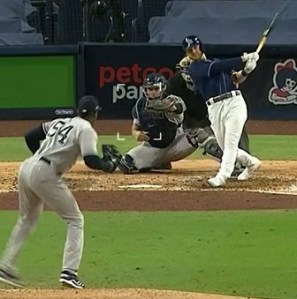
Off the wall in Fenway Park

Christian Vazquez

Christian Vazquez’s walk-off bomb should have been the co-story of Game Three with Nick Pivetta’s stout four extra innings’ shutout relief. But no . . .

You could hear the blue-murder screaming even before Christian Vazquez ended American League division series Game Three in the bottom of the thirteenth. You could hear furious Rays fans and sympathisers thinking Game Four deserves no shorter justice than the Red Sox getting killed to death.

They saw Vazquez hit a two-run homer, igniting a berserk celebration around all Fenway Park, and thought to themselves before hollering loud and long, We wuz robbed!!! They probably still think so.

They think the Rays should have come out of the top of the thirteenth with a 5-4 lead, the run scored from first by Yandy Diaz off Kevin Kiermaier’s two-out double against Red Sox reliever Nick Pivetta. That thought would have been wholly reasonable—except for the umpires calling for a rules review, ruling ground-rule double, and thus ruling Diaz back to third base.

The problem was Kiermaier’s drive bounced off the right field wall, off the track, then off Red Sox right fielder Hunter Renfroe and over the wall. Official Rule 5.05(a)(8) spells out the wherefore: If a fair ball not in flight is deflected by a fielder and then goes out of play, the award is two bases from the time of that pitch.

Rule 5.05(a)8 distinguishes between intent and lack of intent. Had Renfroe actually tried and succeeded in deflecting the ball over the wall, Diaz would have been awarded home because he’d passed second base just as the ball ricocheted off Renfroe’s thigh over the wall. But Renfroe never touched the ball with either hand.

Postgame, Kiermaier remained in abject disbelief. “I can’t believe that happened or we don’t get the chance to score right there,” the Rays center fielder said. “For one, I crushed that ball. I was hoping to leave the yard. I got a lot of snap and crackle but no pop. First and foremost, for that to happen right there, it just doesn’t make sense to me.”

Even the Red Sox didn’t know what to think at first.

“I’ve never seen that before in my life,” said center fielder Kike Hernandez, whose fifth-inning homer put the Red Sox up 4-2. “I wasn’t sure what was going to get called. I wasn’t sure if the runners had to return. I wasn’t sure if it was going to be like an errant throw where the runner would get two bags. Like I had no idea.”

It made sense to home plate umpire Sam Holbrook after the review mandated the ground-rule double ruling. “Very simple,” the ump said. “From an umpire’s standpoint, very simple textbook in the rule.”

Maybe the rule should be reviewed and changed, maybe it shouldn’t, if you consider intent paramount on a play that was so freakish in the first place. But within its strict letter, lacking verifiable intent on Renfroe’s part, Kiermaier indeed had to settle for the ground rule double and Diaz indeed had to return to third.

The game remained tied at four. Red Sox reliever Nick Pivetta recovered to finish his fourth inning worth of three-hit, no-run, seven-strikeout relief. Rays fans may consider it having added insult to insulting injury when Renfroe himself held on for the full-count walk with one out in the bottom of the thirteenth.

Then Vazquez—who’d only come into the game as a pinch-hitter for his catching predecessor Kevin Plawecki in the sixth—caught hold of Rays reliever Luis Patino’s first offering and sent it into the Monster seats above left center for the 6-4 Red Sox win. If the would-have-been Diaz run had held up, it would have meant the Rays losing by a single run instead of two.

In a game about which it was entirely fair to say it would be a shame for either side to lose, the Rays wrestled back from a 4-2 deficit in the top of the eighth off Red Sox reliever Hansel Robles. Wander Franco hit a 3-1 fastball down the chute for a leadoff homer over the Monster; Randy Arozarena with two outs doubled pinch-runner Manuel Margot home.

Before that, the Rays re-learned how stingy Red Sox starter Nathan Eovaldi can be after he gets touched up in the beginning. Once Austin Meadows parked a one-out two-run homer into the bullpens in the top of the first, Eovaldi went forward to pitch shutout ball the next four-and-a-third innings.

The Red Sox chased Rays starter Drew Rasmussen with three straight singles in the third, including Hernandez sending leadoff singler Christian Arroyo home with the tying run at two. Josh Fleming relieved Rasmussen and Rafael Devers greeted him with an RBI single up the pipe to put the Red Sox up, 3-2.

After Hernandez’s leadoff yank into the Monster seats off Rays reliever Pete Fairbanks to open the fifth, and the Rays tied things at four in the eighth, Game Three’s big story figured to be Pivetta. His stout extra-innings shutout relief reminded observers of Eovaldi’s own bullpen-saving, six innings stout relief in that marathon Game Three of the 2018 World Series.

Pivetta’s outing probably changed Red Sox manager Alex Cora’s plan to start him in Game Four. After Sunday night’s win Cora probably won’t complain too much. He’d said previously that whatever the plan going in the game itself would govern the moves and the changes. When he needed a stopper before the Rays got any more ornery than tying the game at four, he picked the right man for the job.

Don’t blame the ground-rule double for costing the Rays Game Three. The Red Sox led each of the first six innings off with a man reaching base. The Rays’ none-too-shabby lineup struck out twenty times and worked only four walks. They had one hit in nine opportunities with runners in scoring position.

Don’t use it to steal Vasquez’s big moment, either. The moment in which he became only the fifth catcher in Show history to end an extra-inning postseason game with a walk-off home run. The other three: Carlton Fisk (Game Six, 1975 World Series), Tony Pena (1995 AL division series Game One), Jim Leyritz (1995 AL division series Game Two), and Todd Pratt (1999 National League divison series Game One).

The moment, too, in which he hit the sixth postseason walkoff bomb in Red Sox history, joining Fisk, Manny Ramirez (Game Two, 2007 ALDS), David Ortiz (Game Four, 2004 American League Championship Series; Game Three, 2004 ALDS), and Trot Nixon (Game Three, 2003 ALDS).

“There’s no, ‘He would have done this, would have done that’,” Holbrook said. “It’s just flat-out in the rule book, it’s a ground-rule double.” Though even Holbrook couldn’t remember having seen any similar play in the quarter century he’s been a major league umpire.

But this was not Don Denkinger absolutely blowing what should have been an out call to start the bottom of the ninth of Game Six, 1985 World Series. A blown call that infuriated those Cardinals so much that, after the Royals forced Game Seven and the umpire rotation placed Denkinger behind the plate for it, the Cardinals imploded almost completely to lose that Series.

These Rays are made of far better stuff than that. These Red Sox know it. The Red Sox now stand on the threshold of going to the American League Championship Series, but they won’t kid themselves that the Rays will be pushovers. Neither should you.
Arozarobber

Randy Arozarena

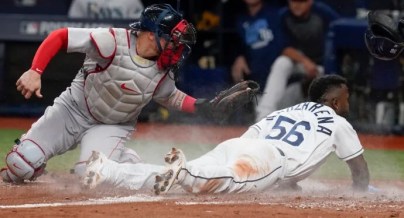
Quick on the overshift uptake, Randy Arozarena stole home straight up Thursday night. Yogi Bear never had it that simple stealing picnic baskets.

There are and have been men playing baseball who love their secondary skills almost more than they love what usually earns their keep. Randy Arozarena, Rays outfielder and batter extraordinaire, is one of those men. He can hit around the field and for distance, but he loves to run.

Give him an inch, or an abandoned side of an infield, and Arozarena’s more than happy do his part to turn a baseball game, even Game One of an American League division series, into a track meet. Give him almost all the third base side of the infield while he’s on third, and he’ll add grand theft home plate to his pleasures.

It’s not that he gets away with it every time he breaks out of his gates on the bases. He tied the Angels’ Shohei Ohtani for the American League lead in arrests for attempted theft with ten. As thieves go, Arozarena had a 67 percent success rate on the regular season. Rickey Henderson he ain’t. Yet.

The one that mattered most was the job Arozarena pulled in the bottom of the seventh Thursday night, after wringing a two-out, full-count walk from Red Sox reliever Nick Pavetta and taking third when Wander Franco doubled right behind him. Then the Red Sox shifted to the right side and brought lefthanded reliever Josh Taylor in to face lefthanded-hitting Rays second baseman Brandon Lowe.

With Red Sox third baseman Rafael Devers playing in the proper shortstop location dead center between second and third, Arozarena might as well have been wandering into the Next-to-Last National Bank and discovering security officers sound asleep before sliding his stick-’em-up demand through the teller window.

Taylor seemed almost wholly oblivious to Arozarena ambling almost halfway down the third base line as he concentrated on Lowe at the plate. Apparently, the Rays’ advance scouting secured that tendency to use as opportunity presented itself. But Arozarena also read the room on his own and smelled the opportunity in front of him.

Maybe with two outs Taylor also felt there was no way Arozarena would be that brazen. Lowe fouled a 1-2 pitch straight back out of play. Taylor leaned in for his signs, straightened back up to throw—and Arozarena bolted for home the split moment Taylor came set in the stretch.

Yogi Bear never had that simple a time stealing picnic baskets in Jellystone Park.

“I noticed that the pitcher wasn’t really watching for me or covering for me,” Arozarena said postgame, “and I saw the third baseman was pretty far away in respect to where I was at. I was looking over to [third-base coach Rodney] Linares, telling him, ‘Hey, I’m going to go. I’m going to go.’ Peeked over and saw Cash give him the green light as well, so that’s when I decided to take off.”

Lowe stepped back out of the box as Arozarena hit the jets, and Taylor just cranked and threw home fast and futilely. Red Sox catcher Christian Vasquez had no chance as he sprang afront the plate to take the throw, wheeling around back on his knees to tag.

He’d have had a better chance apprehending John Dillinger without a pistol and handcuffs than he had when Arozarena shot across the plate in a safe dive—almost like Michael Phelps hitting the pool for yet another Olympic gold medal.

What looked in the moment like Arozarena just showing himself off—this is his second postseason and he already had ten postseason home runs plus an American League Championship Series MVP on his resume—proved insurance after all in the 5-0 Rays win.

That’s because the Red Sox were barely recovered from Arozarena’s heist when they suddenly loaded the bases in the top of the eighth on a leadoff single and a pair of one-out base hits bringing Rafael Devers to the plate against Rays reliever J.P. Feyereisen. One swing and the Red Sox might have been back in business, at maximum with their deficit cut to a single run.

But Feyereisen struck Devers out swinging on 1-2. He got former Ray Hunter Renfroe to foul out to first for the side. Then both sides went quietly in the bottom of the eighth and the top of the ninth.

Taylor didn’t comment after the game but Red Sox manager Alex Cora did. ““I think JT was actually paying attention,” Cora said of Taylor and the Arozarena theft, “but probably two strikes, he had Lowe with two strikes and probably the concentration was with the hitter. Just put him away, and Randy had an amazing job.”

Rays manager Kevin Cash credited Arozarena’s room reading. “We don’t practice that,” Cash said of the theft. “The game has evolved to where defending the hitter is so important. We do the same thing. It’s not the most comfortable thing in the world to pull the third baseman off, certainly with a left-handed pitcher who can’t see everything. But it ultimately comes down to his decision-making and his ability to react.”

Except that, between such things as thinking players dropping bunts for free base hits onto the open expanses and thinking thieves like Arozarena accepting when handed that big a larceny invitation, maybe those defensive overshifts might begin dissipating at last.

The Red Sox erred in handing Arozarena that much leeway even trying to defend against Lowe. They couldn’t afford that on a night they swung futilely against four Rays pitchers including rookie starter Shane McClanahan, who went five scoreless scattering five hits while the Red Sox went 1-for-7 with men in scoring position on the night.

And, on a night the Rays pecked and powered their way to the division series-opening win against Red Sox starter Eduardo Rodriguez (who lasted only five outs) and Pivetta (Arozarena’s home steal went on Pivetta’s jacket), with three other Red Sox relievers plus the Rays’ stingy defense keeping them off the board despite more than a few hard hit balls.

My command wasn’t great at all on every pitch,” Rodriguez said postgame about Cora’s decision to pull him in the second inning. “So I’m not surprised. This is the playoffs. And you’ve got to go out there and do your job. If you don’t do it, you’re coming out of the game.”

It doesn’t look as good as you might think for the Red Sox in Game Two, either. Oh, you might think they’ll be back on track with Chris Sale scheduled to start, but Sale hasn’t prevailed against the Rays all year long.

With one theft of home Arozarena also came close to wiping out the memory of what he did to lead off the bottom of the fifth, swinging on a full count and sending Pavetta’s fastball just off the middle into the left field seats for the fourth Rays run. Making Arozarena the first man ever to hit one out and steal the plate in the same postseason game.

Pinocchio, you’re a real man now.

Arozarena’s come very far from that fateful October 2019 afternoon when, as a member of the Cardinals, he foolishly videoed Mike Schildt’s sore-winner rant and sent it viral enough, after those Cardinals blew the Braves right out of that postseason—only to get bludgeoned out themselves by the eventual World Series champion Nationals.

Three months later, the Cardinals traded Arozarena with Jose Martinez to the Rays for a couple of minor league spare parts. Martinez was supposed to be the big catch. But he faltered in the pan-damn-ically short 2020 season, after missing most of “summer camp” with COVID-19 himself, before the Rays dealt him to the Cubs at that year’s trade deadline.

I don’t know if the viral video—which he took down almost as fast as it went viral—helped compel the Cardinals to throw Arozarena in on that deal as much as their surplus of outfielders in the organisation did. But the Rays have no complaints yet.

He’s become their Mr. October. He’s picked up right where he left off last postseason. The only shock now would be if the Red Sox aren’t tempted heavily to swear out a warrant for his arrest on charges of grand theft.

The Yankees, only human after all

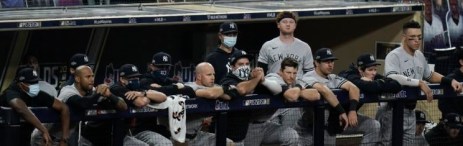
The Yankees watch their season dissipate in the three-up, three-down top of the ninth Friday night.

“Man,” tweeted a Yankee fan of my acquaintance after Friday night’s arms race between the Yankees and the Rays ended. “So sad. Every. single. year.”

Did you ever think you’d see the day when Yankee fans finally tasted what baseball’s hardest of hard luck franchise fans tasted for about as long as the Yankees once ruled the earth? Neither did I.

Did you ever think you’d hear Yankee fans talking the way Chicago Cub and Boston Red Sox fans spoke for decades before the 21st century arrived? Never mind the Red Sox—the Red Sox—owning more 21st century Series rings than the Yankees?

The team that owned most of the 20th century is finding the 21st century impossible to navigate. If it comforts Yankee fans any, their 20th century ancestors found the first two decades of that century tough to navigate, too.

From the birth of the American League through the end of 1919, the franchise finished as high as second place three times. The closest they got to a World Series then was finishing a game and a half behind (imagine that!) the Red Sox, then known as the Americans. When, you ask? The same year New York experienced a pair of firsts: its first underground subway, and its first New Year’s Eve blowout in Times Square.

The 21st century Yankees are actually a little more fortunate. They’ve been to sixteen postseasons, two World Series, and won one Series. Their ancestors of a century ago would have killed to take that kind of jacket into 1920.

Telling that to today’s Yankee fan might amount to wasted energy. There are more cliches attached to the Yankees for better or worse than to any other major league team, and the truest of those are 1) they don’t like to lose; and, 2) they define failure as any season in which they don’t win the World Series.

In most of the 20th century, once they got their bearings for keeps, it was a lot easier for the Yankees to live up to those type of self-imposed pressures. They owned the bulk of the reserve era, when they scouted the deepest of the deep bushes, traded or sold from strength, and plucked jewels suspected and unsuspected alike from the mere mortals.

The free agency era hasn’t been as kind to them as their adversaries thought at first. Turns out that buying pennants—which the Yankees haven’t been the only ones to accomplish, no matter what their riches and resources and Joe and Jane Fan lead you to believe—wasn’t going to be an annual Yankee accomplishment.

Since the Messersmith decision at the end of calendar 1975, the Yankees have been to 27 postseasons, won eleven pennants, and won seven World Series. That’s not exactly the same as their dynastic reserve era, but even the Yankees know there are 29 other major league franchises who’d sell their mothers and grandmothers to show even half that kind of success.

I haven’t heard of any groups of Yankee fans gathering yet to burn Aaron Boone or Aroldis Chapman in effigy after Game Five of the division series freshly lost. But any to come wouldn’t shock. If the truest cliche about the Yankees is that they don’t like to lose, the truest cliche about their fans this century is, “To err is human, to forgive is not Yankee fan policy.”

They’re not even burning longtime general manager Brian Cashman in effigy just yet. Not even if they’re fuming wrongly that Cashman invited too much analytics into the Yankee mindset. The only wonder about that might be what took the Yankees so long to dip into those waters in the first place.

Too much analytics? They just got shoved out of the postseason by a Rays team that lives on analytics. Analytics and assembling competitive teams out of painfully average players on annual budgets that don’t equal a third of Gerrit Cole’s entire nine-year Yankee contract.

Too much dependence on the home run? Well, now. They didn’t become the Bronx Bombers in the first place because they established a tradition of slap-hitting, scratch-hitting basepath pests. The Hitless Wonders, the Gas House Gang, the Go-Go Sox, and the Runnin’ Redbirds they ain’t.

News flash: When pitching doesn’t win postseasons, home runs do, more often than not. The Yankees lived and died by the bomb on the irregular season and hit fourteen more than the Rays. They just hit one fewer than the Rays in Game Five. (And, one fewer than the Rays all ALDS long, incidentally.)

Until Mike Brosseau ended a ten-pitch wrestling match with Chapman with a dramatic one-out home run in the bottom of the eighth Friday night, the Yankees and the Rays were enjoying and wrestling with their own Night of the Pitchers.

A game like that was the most appropriate way to honour the memory of Whitey Ford, the Yankees’ witty and popular Hall of Fame lefthander, who died at his Long Island home Thursday night while watching the Yankees and the Rays tangle.

Cole did exactly what the Yankees are paying him $324 million for nine years to do. The Rays’ and the Yankees’ bullpens did what top of the line bullpens are supposed to do, even though the key Yankee relievers weren’t quite as rested as the key Rays’ bulls.

Until the eighth those pitching staffs had only one run each torn out of them, both solo bombs. The pitching on both sides even shook off a few scattered defensive miscues on both sides.

What the Yankees missed all year—aside from a near-repeat injured list performance akin to 2019’s making the New England Journal of Medicine into the Yankee yearbook—was pitching depth.

They chugged, slugged, and bulled their way to second place in the AL East, blasted the Cleveland Indians to one side in the wild card round, but bumped into the AL East champion Rays. Discovering the Rays could take everything they could dish out from the comfort of their better-rounded bullpen depth and deployment.

The Yankees missed Luis Severino recovering from Tommy John surgery, they lost James Paxton to a flexor strain, and they lost Domingo German to a domestic violence suspension. They worked around Adam Ottavino’s fall from what’s considered the Yankees’ inner circle of bullpen trust.

And it blew up in their faces in Game Two, when Boone deciding to try out-Raying the Rays with an opener and a bullpen game blew up in the Yankees’ faces. That was the first of Boone’s two most egregious series mistakes.

The second was pinch hitting for Kyle Higashioka—establishing himself as the best Yankee option behind the plate—with slumping Mike Ford to open the top of the eighth, then sending Gary Sanchez out to catch the rest of the game. Sanchez’s bat was faltering and his plate work more so.

It was Sanchez who didn’t think that maybe Chapman should have served Brosseau a tenth-pitch splitter instead of a down-and-in fastball. It was Sanchez who may have forgotten that Chapman’s vaunted speed-of-light fastballs get more hittable the longer he works because they don’t climb the ladders or go out on the limbs as well as when he works his first few hitters.

And it was Sanchez and Boone who forgot Chapman nearly let that Game Seven thriller in the 2016 World Series get away from those Cubs with an RBI double and a game re-tying two-run homer. Not to mention failing to put Houston’s Jose Altuve aboard with two outs, George Springer on base, and a spaghetti bat on deck, the better to finish pushing last year’s ALCS to a seventh game.

Sanchez and Boone’s memory vapours disappeared over the left field fence. The only Yankee manager ever to lead his charges to back-to-back 100-plus win seasons in his first two seasons on the Yankee bridge has become Sisyphus in pinstripes.

Sooner or later, the jubilant Rays trolling the Yankees by singing along with Frank Sinatra’s version of “New York, New York” had to call it a night after a hard-earned hearty party. The questions around this Yankee edition won’t call it a night, or a day, too soon this winter.

Neither will the continuing humbling of Yankee fans, who are seen only too often, with too much justification, as among baseball’s most singularly arrogant. Their absolute lowest of the low might have been the subset who trolled Astros pitcher Zack Greinke over his longtime battle with clinical depression last October.

Their forebears were spoiled rotten by all those 20th century decades of Yankee imperialism but never that disgraceful. Now the sons and daughters of those old imperial Yankee fans have to learn, little by little, to live with the idea that the Yankees may be only human, after all.

The boundless world of Rays imagination

A TBS screen capture (including strike zone) as Michael Brosseau demolished Aroldis Chapman’s tenth-pitch fastball Friday night.

“The world of reality has its limits; the world of imagination is boundless,” wrote the French philosophe Jean-Jacques Rousseau. Baseball is so often like that. His near-namesake Tampa Bay Rays utility man re-proved that Friday night.

You’ve heard of the Year of the Pitcher, right? Until Michael Brosseau squared off against recent near-executioner Aroldis Chapman in the bottom of the eighth, Friday was the Night of the Pitchers.

Neither the Yankees nor the Rays wanted to hear any nonsense about re-juiced postseason baseballs. They made Game Five of their American League division series into an arms race. With only three rude interruptions and Brousseau delivering the one that mattered most.

Brosseau. The guy Chapman nearly beheaded with a 101 mph fastball late in the regular season. The guy facing now facing Chapman after entering the game as a sixth-inning pinch hitter. The guy Thomas Boswell says was “undrafted, bypassed 1,216 times–is a ‘utility man’ who played every position except SS & C this year (including pitcher).”

The guy who wrestled Chapman to a ten-pitch plate appearance, after beginning with an 0-2 count, and hit that tenth pitch over the left field fence. Meaning, ultimately, game, set, and a Rays date with the Houston Astros in the American League Championship Series to come.

“I was just trying to get a runner on and get the next guy up,” Brosseau said after the game. “We knew the hits were coming not very often tonight . . . Obviously, going up there, trying to find a barrel, thankfully it happened.”

Brosseau may not have to buy his own steak in Tampa Bay for a very long time to come.

These Rays and these Yankees threw the kitchen, bathroom, and laundry room sinks at each other from the mound and got through seven and a half innings tied at one, with both runs on home runs and twenty strikeouts between them. And the Rays managed practically to sneak a 2-1 win.

That’s the number 28 payroll in all the Show taking down the number one payroll, if you’re scoring at home. (The Yankees actually hadn’t been the number-one payroll since 2011.) The barely no-name Rays, full of excrutiatingly average major league baseball players, taking down the Empire Emeritus and its usual pack of high-priced, high-profile spreaders.

The Rays, who survived Gerrit Cole’s first short-rest outing in his major league life, who got no-hit by Cole until Austin Meadows found the screws on a 1-1 fastball and sent it over the right field corner fence in the bottom of the fifth.

The Rays, whose first reliever on the night, Nick Andersen, didn’t let Aaron Judge’s fourth-inning leadoff launch to about the same region over the same fence knock him into praying to find the nearest available mouse hole into which to crawl in anguish. He shook it off and worked two full innings’ shutout relief from there. Nothing to it, folks.

The Rays, who withstood everything Zack Britton threw at them, pried one base hit and reached on one abnormal error by Yankee third baseman Gio Urshela but cashed neither of them in, until Brosseau won that showdown with Chapman.

“I knew it felt good,” Brosseau said about the immediate contact with that triple-digit-speed fastball. “I haven’t had much playing time [in Petco Park], so it’s kind of hard to read the dimensions, to see from daytime to nighttime, but it felt good off the bat.”

Just don’t ask him about payback. Everyone else noted poetic justice and karma turning superbitch. Not Brosseau. “No revenge,” he said. “We put that in the past. We came here to try and win a series. We came here to move on, do what we do best, and that’s play our game.”

Re-juiced postseason baseballs took about more than a third of postseason talk with all the home runs interfering in bunches with airline flight patterns until Friday night. The Yankees and the Rays must have drained them before getting started. Three hits all night long, and all three were home runs that almost barely cleared the top of the fences.

On normal rest Cole has a 2.74 earned run average. On five or more days rest, it’s 3.73. On short rest, it could have gone either way Friday night. Especially with the Rays having won the ten straight previous games in which Tyler Glasnow was their starting pitcher, or opener if you prefer. Not to mention the Rays’ key bullpenners entering the game rested slightly better than the key Yankee bulls.

It didn’t start brilliantly for Cole. He walked Brandon Lowe after striking Meadows out impressively, then drilled Randy Arozarena on the first pitch—days after Arozarena took Cole over the fence—which he didn’t likely mean to do, but good luck convincing the Rays, who’ve been waging bad-blood war against the Yankees all year as it is.

The punchout of Meadows made Cole the fastest pitcher to reach a hundred postseason strikeouts, in 79 innings. He nudged the Los Angeles Dodgers’ Clayton Kershaw to one side with it. But he walked the bases loaded around a ground out before catching Joey Wendle looking at strike three for the side.

Cole struck out the side swinging in the second, with fastballs hitting just a hair’s breadth short of 100 mph and a generous helping of late movement, and off-speed breakers maybe two hairs’ breadth short of 90 but diving like paratroopers. And then, he struck out two out of three in a 1-2-3 third.

Why, he even made early mincemeat of a hitter who usually does likewise to him. He got rid of Ji-Man Choi twice on ground outs, after the husky Rays first baseman came into the game hitting .526 off Cole including four home runs.

Himself starting on two days’ rest, Glasnow could have ended up with two on and no outs to open the game if Choi hadn’t made a pair of acrobatic plays to turn a pair of bad throws into tight outs. Glasnow himself threw D.J. LeMahieu’s leadoff grounder back to the box offline, and shortstop Willy Adames did likewise with Judge’s followup hopper, before Aaron Hicks lined out to deep center for the side.

Pete Fairbanks and Diego Castillo finished what Glasnow and Andersen started. Castillo finished in reasonable style, striking Giancarlo Stanton and Luke Voit out before Urshela’s nasty liner up the third base line got snapped by third baseman Wendle as if having to catch a baby shot out of a cannon to save the little one’s dear life.

This wasn’t exactly the way the Yankees wanted to honour the memory of their Hall of Fame pitcher Whitey Ford, who died Thursday night at home while watching the Yankees and the Rays tangle in Game Four. (Both teams honoured a moment of silence in Ford’s memory before the game began.)

It was almost a year since Chapman surrendered Jose Altuve’s ALCS-winning two-run homer. When not burning up social media calling for manager Aaron Boone’s head post-game, Yankee fans wasted little time calling for Chapman’s. Determining whom to rage against more was tough enough.

What wasn’t tough was to remind yourself that to err is human but to forgive is not fan policy. The good news is that, even with social-distancing considerations, no groups of Yankee fans have opened street parties at which they can run over Boone, Chapman, or other shortfalling Yankees’ jerseys. Yet.

The Yankees probably wish Ford and his Hall of Fame battery mate Yogi Berra had brewed a little mad chemistry from their Elysian Fields positions Friday night. The Rays only hope that, whatever mad science of their own got them through the Empire Emeritus will be enough for them to turn the Astros aside in the coming week.

“They’ve been the team to beat the last few years,” said Brosseau of the team the Rays got thatclose to knocking out in another tight full-five division series last year. “They knocked us out last year so it will be fun to face them again.”

Don’t bet against these Rays just yet. If they could get rid of the Yankees and their bomb squad, they won’t exactly let the thought of the Astros’ suddenly revived long distance callers shake their gill slits.

The Astros in the ALCS? Relax.

Manager Dusty Baker gets a hug from catcher Martin Maldonado as the Astros celebrate bumping the Athletics off in their ALDS Thursday.

We just got one step closer to the possibility of at least one losing irregular season team turning up in the World Series, anyway. Maybe it’ll still be enough to make commissioner Rob Manfred’s hopes of too-far-expanded postseasons future, which may or many not involve as many as sixteen teams, disappear. Maybe.

The best way to make that disappearance happen would have been a Houston Astros-Milwaukee Brewers World Series, of course. Unfortunately, the Brewers didn’t keep their side of the bargain. The National League West champion Los Angeles Dodgers wouldn’t let them. If anything, the chance of an Astros-Dodgers World Series re-match got a lot bigger after Thursday’s doings.

On Thursday night, the Dodgers destroyed the plucky, exuberant, fun-fun-fun San Diego Padres 12-3, to finish a National League division series sweep in which only one game turned out close thanks to a near-imploding Dodger bullpen. At least they know who they’ll face in the National League Championship Series, thanks to the NL East champion Atlanta Braves wiping the suddenly-upstart Miami Marlins out 7-0 in a dissimilar sweep.

The Padres at least scored in each of the three games. The Marlins scored five in Game One but got shut out in Games Two and Three. By a Braves pitching staff that’s now pitched shutouts in four of their five postseason games. Maybe the chance of an Astros-Dodgers World Series re-match isn’t quite as powerful as you might think?

The Astros wrecked any Oakland Athletics comeback hopes by turning an early 3-0 deficit into an 11-6 Game Four demolition so profound that the A’s ninth-inning pushback resembled unanswerable cries for help from the bottom of the ocean after falling off the Bay Bridge just when they’d finally decided life was too precious to jump.

Admit it: When the A’s jumped Zack Greinke for three in the second it looked for awhile as though they’d force a Game Five. About a blink of awhile when all was said and done.

Matt Olson snuck a base hit through an Astro infield shift, Mark Canha hit one for which Astro shortstop Carlos Correa dove and barely missed for his first lifetime hit off Greinke, Ramon Laureano hit a full-count slider into the left field bleachers, and it looked like the Astros gamble with Greinke—sending him to start with his sore arm possibly not fully recovered—would fail.

Then the A’s starter Frankie Montas’s fortune ran cold in the fourth. How cold? Try Antarctic cold. Michael Brantley hit a two-run homer and Correa hit a three-run bomb, then Montas two more or less excuse-me outs while leaving first and second when manager Bob Melvin lifted him to go to his usually reliable bullpen.

This time, that bullpen didn’t have it. The Astros tore six runs out of that pen before they were finished. Between them, the Astros and the A’s finished setting a new division series record by hitting 24 into the seats all set long. Each team hit twelve. Including Brantley, Correa, and Laureano twice in Game Four. Altuve joined the Thursday bomb squad when he hit one out off Jake Diekman with Martin Maldonado aboard to complete the Astros’ scoring.

But there’s unfinished Friday business to come. The Astros don’t know yet whether they’ll meet the American League East champion Tampa Bay Rays or the AL East runner-up New York Yankees. The Yankees held the Rays off 5-1 on Thursday, somehow, some way, and they’ll open Friday with a distinct advantage named Gerrit Cole. Sort of.

The sort-of is that Cole has never pitched on short rest in his entire major league career. Ever. He’s pitched 106 games on four days’ rest, 67 on five days’ rest, and 31 on six or more days’ rest. It may be the first time in Cole’s sterling career when the phrase “roll of the dice” applies to him.

Can they get a miracle from Cole Friday? He faces Tyler Glasnow, credited with the Game Two win despite surrendering four Yankee runs. Glasnow hasn’t done it since he pitched nine games in relief for the 2018 Pittsburgh Pirates. They were the only nine relief gigs of his career to date. And the Rays will likely turn it over to their bullpen if Glasnow gets into trouble early enough.

Either way, Friday’s Yankees-Rays show will be must-see TV for baseball lovers in general but the Astros in particular. What a way to have to spend one of their only two days off before the ALCS begins—in San Diego’s Petco Park, under the pandemic-inspired semi-bubble/neutral-site plan.

As if the Astros didn’t have enough migraines this year. They lost Justin Verlander to Tommy John surgery and Cole to free agency. Greinke pitched better than his 4.03 irregular season ERA tells you before his arm soreness kicked over. (His 2020 fielding-independent pitching [FIP]: 2.80.) If their set with the A’s went to a fifth game, they’d have gone most likely to Framber Valdez to open and turned it over to their bullpen at the first sign of trouble.

Now they get to open the ALCS with Valdez—who beat the A’s with seven two-run innings in division series Game Two. Setting them up to work Greinke on his regular rest including a Game Seven if need be. Jose Urquidy will look to prove his ALDS Game Three outing—slapped silly for four home runs in four and a third innings—was an aberration, but beware: his irregular season 2.73 ERA was deceptive looking considering his 4.71 FIP.

They also get to show a little more that their 29-31 irregular season record just might have projected to an acquitting winning record, maybe even another AL West title, if the season had been full and normal. Might.

One key reason for that 29-31 record was being hit with an injury bug enough to rival the battered Yankees of the past two years. But, deeper reality check: this year’s Astros aren’t really as good as last year’s. Even if manager Dusty Baker finally overcame his lifelong prejudice and learned how to have as much faith in his youth as in his elder players.

They lost their best player of the future, 2019 Rookie of the Year Yordan Alvarez, to a season-ending injury. Altuve struggled early, found his stroke later in August, then hit the injured list with a knee sprain. They’ve lost key pitchers Chris Devenski, Brad Peacock, and Roberto Osuna to season-ending injuries. This postseason Astro staff could be called, plausibly, Greinke, Urquidy, and the Newer Kids on the Block.

Even with those compromises, this year’s Astro Core Five (Altuve, Correa, Alex Bregman, Yuli Gurriel, and George Springer) had a lower weighted on-base percentage than last year’s edition. It looked better for the Astros that they bombed twelve homers and averaged 8.3 runs a game against the A’s better-than-they-look pitching staff. Of course, the chatter about slightly deadened balls on the irregular season and slightly amplified balls for the postseason is entirely coincidental.

It bodes well for the Astros whether they get the Rays or the Yankees in the ALCS, and they know neither of those teams are pushovers. Scoring 33 runs against a crew of A’s that scored 22, knowing that often as not 22 runs are good enough to win a short set, gives the Astros a little extra comfort to take in.

It even bodes well for them that somehow, some way, they’ve managed to get this far even under the still-hovering clouds of Astrogate. They hit the irregular season running with only nine men left on the roster from the 2017-18 cheaters. They’re closer than you might think or accept to turning what’s left of that roster over and finally putting the Astrogate stain behind them.

Turning what’s left of that roster over? Well, Gurriel has re-upped for another season. But Springer and Reddick face free agency this winter. New general manager James Click has said he’d like to keep Springer on board even with young Kyle Tucker’s emergence, but whether the Astros have the dollars to do it (they’d like to avoid luxury tax penalisation if possible) is another question yet to be answered.

The pandemic did the Astros a huge favour in keeping them from normal ballpark crowds who surely would have let them have it long and loud, over both the scandal of their illegal electronic sign-stealing cheating and their more sad than sickening, mealymouthed non-apologies at that disaster of a February presser.

(Don’t even think about it. Once more with feeling: there’s a Grand Canyon-size difference between a team like the Boston Rogue Sox using what MLB itself provided already in video rooms to steal signs and send them to baserunners to send hitters—you know, Mom and Dad give the kiddies the liquor cabinet keys daring them not to drink unlawfully—and the Astros who a) took an existing outfield camera off mandatory transmission delay, or b) installed a second, illegal real-time camera to send enemy signs to extra clubhouse monitors.)

Now, let’s be absolutely fair about this. Continuing to bop this year’s Astros on the nose over Astrogate when they have only eight men left playing from that tainted 2017 edition is unfair. Unfair but unstoppable, unfortunately, human nature being what it is.

Human nature includes being aghast that genuinely great teams  who would have demolished the league regardless felt compelled to operating the 2017 Astro Intelligence Agency or the 2018 Red Sox Replay Room Reconnaissance Ring.

To too many people, cheaters once, cheaters always. Right? But nobody claimed the San Francisco Giants remained tainted for how their 1951 edition in New York cheated telescopically to pull off that dazzling pennant-race comeback and playoff force. Nobody really thinks the real curse upon the Cleveland Indians has to do with their 1948 telescopic cheating. (It doesn’t really have that much to do with trading Rocky Colavito at the end of spring training 1960, either.)

By all means hold the 2017-18 Astros to account in public opinion if Commissioner Nero didn’t, beyond a fine, a couple of stripped draft picks, and suspending their since-fired general manager, manager, bench coach (the Red Sox squeezed Alex Cora out as manager), and designated hitter. (The Mets squeezed Carlos Beltran out as manager before he even got to manage a spring training game for them.)

But don’t keep hammering this year’s Astros for it, until or unless someone discovers and produces proof of this year’s edition crossing to the dark side. (The Red Sox didn’t need anyone hammering them for their 2018 taint and similarly mealymouthed non-apologies. They plotzed this year all by themselves.)

You don’t have to root for or even like the Astros to give them whatever fair shake they deserve now. They’re a lot easier to like when you just watch them play baseball the way they normally play than they are when you have to listen to them talking to reporters. Which is what people have said about teams like the Yankees, the Dodgers, and even the St. Louis Cardinals for several generations, too, no?

Yet new manager Dusty Baker took their bridge and kept his and their marble (singular) through this season’s pandemic weirdness and Astrogate aftermath to sneak into the postseason at all. That has Baker in the Manager of the Year conversation and the Astros  on the brink of a possible third pennant in four seasons. The last team to go to three World Series in four seasons? Ladies and gentlemen, your 1998-2001 New York Yankees.

Consider this, too: With fans still kept out of the stands so far this postseason, it became too simple to hear every sound, noise, and utterance coming from the dugouts. Nobody heard anything this week that’s comparable to the Astrogaters banging the can slowly in 2017.

About the most suspicious sound coming out of Dodger Stadium during the Astros-A’s ALDS was the PA system DJ playing Booker T. & the MGs’ “Green Onions” at every opportunity. (That song was a huge hit—the year Dodger Stadium was born.) Some might wonder since when do today’s ballpark sound people have that kind of historic music sense. Speaking personally, it was music to my rhythm and blues ears.