The unsinkable Mariners

Jorge Polanco

Jorge Polanco shooting the game and ALDS-winning base hit for the Mariners in the bottom of the fifteenth . . .

“Life is what happens when you’re busy making other plans,” sang John Lennon on the last album he released in his lifetime. Instead of singing it in the middle of a sweet lullaby he wrote for his then five-year-old son, the former Beatle could have been singing about baseball.

He could have been singing, too, about such contests as the just-concluded American League division series between the Tigers and the Mariners. The one that came to a fifth game that came down to a fifteenth inning and, possibly, both teams wondering just whom was going to commit a fatal flub, flop, or faux pas, Phillies-like or otherwise.

“It felt the whole game,” said Tigers shortstop Javier Baez post-mortem, “like whoever made a mistake was going to lose.”

Well, nobody in either Tiger or Mariner uniforms made any truly grave mistakes Friday night. The Mariners punched their ticket to the American League Championship Series the old-fashioned way, a hair-raiser of a ball game they finished when Jorge Polanco slashed a single with two out and the bases loaded in the bottom of the fifteenth.

Until that half-inning, the Tigers and the Mariners threw everything at each other except the proverbial kitchen sink. The sink showed up in the bottom of the fifteenth. When Tommy Kahnle relieved a gutsy Jack Flaherty for the Tigers, and J.P. Crawford opened the proceedings with a base hit, the third Mariners leadoff runner in four innings.

But Kahnle followed that by plunking Randy Arozarena on the first pitch, before Cal Raleigh lined out but left Arozarena safe at second thanks to Tigers center fielder Parker Meadows’s errant throw. Then the Tigers ordered Julio Rodriguez walked on the house. In situations leaving first base open with a season on the line, it was the smart move after dodging a Raleigh artillery shell.

Now came Polanco. He and Kahnle fought to a full count with no place to put him. Then Kahnle threw a fastball Polanco shot on a line through the right side and into right field, Crawford racing home and jumping onto the plate and into the arms of teammates who might have been forgiven if they’d just been wondering how much longer this epic could play.

“The back half of that game is like a game in itself,” said Tigers manager A.J. Hinch post-mortem. “We dodged a few bullets, and so did they . . . I didn’t want it to end, certainly,  the way that it did, but I wanted to just keep giving ourselves a puncher’s chance, and they outlasted us.”

Until the bottom of the fifteenth, it was fair to say the Tigers and the Mariners outlasted each other.

From the brilliance of starting pitchers Tarik Skubal and George Kirby to the magnificence of both bullpens plus a pair of starting pitchers pressed into all-hands-on-deck relief service, this game made you wonder whether anyone from the big bats to the supporting cast really knew how to hit anymore.

Skubal in particular pitched like the Cy Young Award winner he seems destined to become this year. He surrendered one run but set a new postseason record with seven straight strikeouts, then set another one with thirteen total strikeouts in a postseason elimination game. He pitched six virtuoso innings and left with his tank below empty.

How could he have known at that moment that things would end up with him making grand, Hall of Famer-like showings in his two ALDS starts but his team ending up on the losing side?

Kirby was almost as brilliant as Skubal. In fact, the only run charged against him scored when he’d left the game in the bottom of the sixth, after surrendering Baez’s leadoff double. Gabe Speier took over and Tigers right fielder Kerry Carpenter hit a 1-0 service into the right center field seats.

That gave the Tigers a 2-1 lead lasting long enough for the Mariners in the bottom of the seventh to tie it up with a little shuck-and-shuffling on the part of skipper Dan Wilson.

He sent Dominic Canzone to pinch hit for Mitch Garver, whose second-inning sacrifice fly opened the scoring in the first place. Hinch promptly brought Tyler Holton in to relieve Skubal’s relief Kyle Finnegan. Wilson countered by sending Leo Rivas up to pinch hit for Canzone.

In the first postseason plate appearance of his major league career, measuring Holton for the cutters and changeups he was most likely to throw, Rivas took a strike, then lined a changeup for a base hit to left to send Polanco home with the tying run.

From that point forward, the bullpens, with or without starters pressed into emergency all-hands-on-deck duty, were brilliant, even when they were slithering, sneaking, or bludgeoning their ways out of jams you could charge were some of their own making.

“It was like (we) got them on the ropes, and then they wiggle out of it. They got us on the ropes, and we wiggle out of it,” said Finnegan postgame. “It was an absolute roller-coaster of a game. That’s the beauty of this sport.”

“A heartbreaker of a finish,” said Tigers first baseman Spencer Torkelson, who’d gone hitless in six Game Five plate appearances, “but an unbelievable baseball game to be part of.”

“My experience feels like the ground was shaking every inning,” said Rivas. He wasn’t exactly wrong. Especially over the extra innings, when it seemed nobody in T-Mobile Park dared to sit back down.

“We knew this was not going to be a football score, that it was going to be a tight pitchers’ duel,” said Mariners president of baseball ops Jerry Dipoto, himself a former major league pitcher, “and our general take was: keep it close until Skubal’s out of there and we’ve got a chance to win this game.”

Even if it took nine innings from Skubal’s exit to do it. But once Speier yielded to Matt Brash, what came out of the Mariners’ bullpen—including and especially starters who hadn’t relieved in either eons or since early minor league days, whichever came first—was magnificent.

Brash himself got six outs for the first time since 2003. Andrés Muñoz, the Mariners’ usual designated closer, walked a pair but escaped and then pitched a spotless ninth. Logan Gilbert, a starter, pitched a pair of scoreless innings. Eduard Bazardo landed eight outs, something he’d never done in his career until Friday night. Luis Castillo, who hadn’t relieved in almost a decade, got rid of all four batters he faced.

The problem was the group of people rooting and cheering even louder than the ballpark crowd: the Blue Jays. Broadcast announcers noted it until even they got sick of saying it, but as the extra innings accumulated the Blue Jays had to have been roaring with delight knowing that, whichever team would meet them in the ALCS, that team’s pitching might be depleted temporarily.

That’s not what you want to throw at the Blue Jays and their own howitzer offense in their own playpen to open. The ALCS may come down to first and second game survival for the Mariners before they can bring the set back to T-Mobile Park. But when they do, the Mariners have at least one comfort upon which to lean: the Blue Jays were a game below .500 on the road while playing .667 ball at Rogers Centre.

And both teams want to end pennant droughts expeditiously as possible.

The Blue Jays haven’t hit the World Series since they won their second of two straight in 1993. The Mariners haven’t hit the World Series at all in their 48 years of existence. The last time they showed up in an ALCS, they’d won 116 games on the regular season, had the 2001 Rookie of the Year in future Hall of Famer Ichiro Suzuki, another Hall of Famer in Edgar Martinez, and lost to the Yankees.

The Tigers haven’t reached a World Series since 2006 or won one since 1984. They wouldn’t mind ending a drought, either. But on a night when Carpenter went four-for-five while the rest of the Tigers managed only four hits, Carpenter becoming the first since Babe Ruth to reach base five times and homer in a winner-take-all postseason game probably made Tiger fans wish they could have run nine of him to the plate Friday night.

It’s hard to think, “What a year,” when thinking of the Tigers. Sure, they’re talented, likeable, and their own kind of resilient. But these are the same Tigers who became this year’s first to win thirty, then forty, then fifty, then sixty games . . . before the worst September win percentage of any postseason baseball team ever. They played September as if on crutches.

The Mariners won their division handily enough, playing September with controlled fury and rolling their best month’s record of the season, 17-8/.680, while earning a round-one bye in the postseason. They proved unbreakable when the Tigers took them to the bitter end Friday night.

And the game proved unbreakable without Manfred Man, the free cookie on second base to begin each half inning. Manfred Man’s extinction should not be restricted to the postseason alone. No mistake.

ALDS Game Four: The Yankees, running on empty

Toronto Blue Jays

Yankee Stadium became Blue Jay Way Wednesday night, as the Jays turned the Yankees aside to advance to the American League Championship Series.

So much for the Monument Park ghosts Aaron Judge cited when the Yankees won their American League division series Game Three. They come out to play only once per postseason series. Or, the Yankees fall asleep at the switch at the plate, on the mound, or in the field, the ghosts return to the Elysian Fields feeling somewhere between dismayed and betrayed.

Once upon a time, in a different Yankee Stadium, fans taunted a World Series opponent with “Mystique and Aura, Appearing Nightly,” after one of the opponent’s pitchers suggested the Yankee couple didn’t show up in their home ballpark. Now, Mystique and Aura haven’t been seen in that or the current Yankee Stadium in a very long time. In fact, that couple may just be so 20th Century.

Wednesday night, Yankee Stadium became Blue Jay Way. The Jays finished what they started, a 5-2 Game Four win that sent the Yankees from the American League division series to season’s oblivion.

Time was when the Yankees knew they were dynastic and knew accordingly how to finish what they started, whether it was the pre-divisional win-or-be-gone pennant race and World Series (most of the time) or the divisional era pennant and World Series, for a little while, anyway. That was then. This has been since 1978: The Yankees are good for occasional World Series wins.

But you have to get there, first. And even that’s no guarantee. The Yankees didn’t collapse as spectacularly in this division series as they did in last year’s World Series. Well, wait a minute. Getting out-scored by the American League East-winning Blue Jays 34-19? You can call it a collapse, even if the Yankees did manage to win Game Three by three runs.

These Blue Jays were a lot more formidable than this year’s Red Sox, whom the Yankees vanquished in the wild card set after losing the first game. These Blue Jays, who took the AL East by winning their season series against the Yankees, were no pushovers. Maybe the Yankees weren’t quite prepared to handle the onslaught the Blue Jays laid upon them.

Maybe nobody was. Not even the Jays themselves.

But any further thoughts about Yankee domination ought to be set aside for now and, perhaps, the foreseeable future. This is their 21st Century legacy to date: They’ll make noises in the pennant races, they’ll reach their postseasons, but other than 2009 they’re not going the distance without serious changes.

So Judge led all the Yankee regulars with his 1.618 division series OPS? Vladimir Guerrero, Jr. nearly equaled it with his 1.609. As Jayson Stark (The Athletic) reminds us, the Jays batted in 34 innings in this set and scored those 34 runs. That’s a run per inning average, folks. And would you like to know the only other time any Yankee team got yanked out of a postseason by an AL East team? Two words: 2004 Red Sox.

Whatever the Yankees sent to the mound, the Jays had answers when it counted. Stark is congenitally unable to miss the ironies or the humours, so he couldn’t resist adding that the Jays as a team in this ALDS had the same slash line, practically, as Miguel Cabrera when he won the 2012 AL Triple Crown: The ALDS Jays—.338/.373/.601. Cabrera 2012—.330/.393/.609.

The Jays didn’t exactly smother the Yankees in Game Four the way they did in Games One and Two; they won by a mere 5-2. But you couldn’t blame Guerrero for trolling the Yankees with the famous victory whoop by their now-retired longtime voice John Sterling, and with Hall of Famer-turned-broadcaster David Ortiz right by his side: DAAAAAA YANKEES LOSE! 

They do when they forget they can’t run nine Aaron Judges out to bat.

The Jays as a team slashed .338/.373/.601 (OPS: .974) for the set. That was without Bo Bichette (injury) in the lineup. The Yankees as a team slashed .250/.327/.404 (OPS: .731). That was with Judge in the lineup. In Game Four the Yankee bats slept and the Yankee defense had a hole in it.

Once again, as observers have hammered most of the year, the Yankees simply couldn’t find more than one or two ways to push runs across the plate without hitting for distance.

They had the grand opportunity of Game Four with the Blue Jays going to a bullpen game, the better to save Kevin Gausman to start a Game Five that proved anything but on deck. The Jays pen helped send the Jays forward. The Yankee bullpen, one of their most suspect parts, couldn’t quite contain the Jays’s more balanced hitters.

Now the Jays will have Gausman to pitch one of the first two American League Championship Series games. The series the Yankees won’t see except on television or with ballpark tickets.

Jazz Chisholm, Jr., who can play like either a superstar or a scrub and sometimes both in the same game, watched a likely double play ball bound off his glove and behind second base, into center field, in the top of the seventh. It set up first and third for the Jays and ended the evening of Yankee starting pitcher Cam Schlittler, whose ballsy performance against the Red Sox saved the Yankee season and who’d only surrendered a pair of earned runs to that point.

Oops. A stolen base (Andrés Giménez) before a strikeout (George Springer) later, Nathan Lukes lined a two-run single to left center to leave the Jays up 4-1. An inning later, Myles Straw made it 5-1 with an RBI single. The Yankees’ only answer to that was Jasson Dominguez’s leadoff double in the bottom of the ninth and Judge singling him home.

So it turned out Blue Jays broadcaster Buck Martinez wasn’t just smack-talking when he said before the postseason the Yankees weren’t that good a team. In Game Four the Yankees made him resemble a prophet. Mystique and Aura don’t live in the Bronx  anymore.

Now I’m going to make an ask of what’s possibly the least forgiving fan base in baseball this side of the Mets, the Cubs, the Red Sox, and the Phillies: Give the Yankees a little time before you start demanding summary executions.

Too-long-time general manager Brian Cashman’s time should be done. Long-enough-time manager Aaron Boone is a good, not necessarily great manager, but he’s never had a losing season since he took the Yankee bridge in 2018. If there are miracles in the Yankee firmament, they’re probably Boone landing eight straight winning seasons almost in spite of Cashman’s makings and unmakings.

Getting smothered by the Jays this time around isn’t quite the equivalent of the manner in which the Yankees smothered themselves ending last year’s World Series. Or the manner in which they got overthrown by the Red Sox in 2004. So give them a break. Maybe a month-long break.

That doesn’t mean anyone’s trying to take your fun away, Yankee fan. Forget for one month that to err is human but to forgive must never become Yankee policy. Forget that maybe this edition of the Yankees simply had nothing left in the tank for Game Four.

Then you’ll have plenty of time for the yelling, the screaming, and the demanding of executions on 161st Street. We promise.

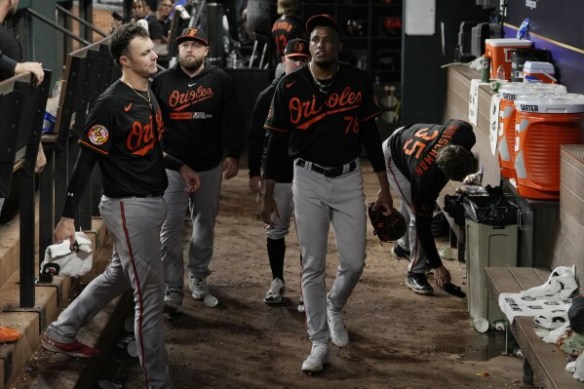
ALDS Game Three: Baltimore Agonistes

Baltimore Orioles

After their surprising and pleasing AL East conquest, the inexperienced, pitching-compromised Orioles found the AL West-winning Rangers too hot to handle.

Maybe it had to be this way, an inexperienced team of Orioles upstarts getting flattened by a better-experienced collection of Rangers in three straight. It might have been the team’s first postseason appearance in seven years, but they brought a collection of men with plenty of postseason time among themselves before becoming Rangers.

Maybe the Orioles were in over their own mostly young, 101 game-winning heads. Maybe the Rangers were too well primed by their Hall of Fame-bound manager who’d skippered three Series winners in five years on the Giants’ bridge.

But as joyous as it was to see the Rangers make too-easy work of the Orioles in this American League division series, it still hurt to see these Orioles swept away like flotsam and jetsam. It was the first time they’d been swept in any series since the May emergence of Adley Rutschman as both their regular catcher and their team leader. The first, and the worst, at once.

No matter how heavily tanking played a role in getting the Orioles to the point of winning the American League East, it hurt. No matter how stupid their administration looked censoring their lead television broadcaster—over a team-generated graphic meant to show a positive portion of their progress—it hurt.

No matter how further stupid that administration looked in doing practically nothing at the trade deadline despite having an upstart group of American League East conquerors on their hands—it hurt.

And, no matter how temporarily stuck Orioles manager Brandon Hyde might have looked  having to start a heavy-hearted pitcher in his fourth major league season but on his first postseason assignment in Game Three—it hurt.

“This is a really good group of guys,” said pitcher Kyle Gibson, a pending free agent, “and I think that adds to the sting of it too, because we knew we had something special. You want to try to capitalize on that whenever you can.”

“There’s no other way to put it,” said outfielder Austin Hays. “They kicked our ass. It sucks. Just couldn’t really get anything going, couldn’t get any momentum on our side to get things going. It hurts. It really hurts.”

The real-world motto of the real-world Texas Rangers: “One riot, one Ranger.” The motto of the American League West winners now could be: “Two postseason sweeps, thirty Rangers.”

The Rangers picked up where they left off Tuesday night against a flock of Orioles lacking veteran presence and, especially, veteran pitching, beating the Orioles, 7-1, in a game that was essentially over after two innings. Manager Bruce Bochy, in the conversation for Manager of the Year as it is, looked even smarter in this AL division series than he looked winning with the Giants in 2010, 2012, and 2014—and he looked like the Yankee version of Casey Stengel then.

Even more so because, until Tuesday night, the AL West-champion Rangers had to to their heaviest labours on the road. “We had our work cut out going on the road against Tampa and Baltimore,” Bochy said after wrapping the division series Tuesday night. “Just shows the toughness with this ballclub and the deal with having to fly to Tampa.”

Now they were home and happy in Globe Life Field, and Rangers shortstop Corey Seager didn’t give Orioles starter Dean Kremer a chance to continue collecting himself after second baseman Marcus Semien fouled out to open the bottom of the first. Seager smashed a 1-1 service 445 feet over the right field fence.

An inning later, it was one-out single (Josh Jung), two-out double (Semien), and an intentional walk to Seager. Kremer and the Orioles weren’t going to give him another chance to mash with first base open if they could help it. They took their chances with Mitch Garver, whose Game Two grand slam broke them almost in half—and Garver thanked them with a two-run double.

Up stepped Adolis García, the Rangers’ right fielder. Kremer had García down 1-2. The next fastball, a little up over the middle of the zone, disappeared over the left center field fence. Just like that, the Orioles were in a 6-1 hole out of which they wouldn’t get to within sight of the earth’s surface if the Rangers could help it.

They could. Their redoubtable starter Nathan Evoaldi, who’s been there and done that in postseasons previous, pinned them for seven innings and seven strikeouts, the only blemish against him an almost excuse-me RBI single by Orioles rookie star Gunnar Henderson in the top of the fifth. As if to drive yet another exclamation point home, Rangers first baseman Nathaniel Lowe greeted Gibson, the third of five Oriole pitchers on the night, with a leadoff homer in the bottom of the sixth.

“You’re not trying to do anything different,” said Seager, whose nine walks are a record for a three-game postseason span, according to MLB analyst Sarah Langs. “You’re just more focused. That’s not the right word, but it’s just more intense. Everything matters. It’s just a different game. It really is. There’s no way around it. So you have to have a different edge, different approach.”

Kremer’s heavy heart was thanks to the atrocity Hamas inflicted upon Israel, to which his parents are native and for which they both served in the Israeli Defense Forces before emigrating to California where their son was born. But he told Hyde when asked—this was discussed often on the game broadcast—that no matter what was in the back of his mind or the front of his heart, he could go for Game Three.

He still has extended family living in Israel. (He’s also said he do as Hall of Famer Sandy Koufax and decline to pitch if an assignment happens to fall on Yom Kippur, the Jewish Day of Atonement.) Anyone who thinks Kremer still didn’t take a heavy heart to the mound with him Tuesday night may be deluding himself or herself.

Perhaps if Hyde had more choices he might have told Kremer to forget the mound for now and focus upon his family. But the Orioles standing pat at the trade deadline, other than adding Cardinals comer-turned-injury-compromised righthander Jack Flaherty, who’d pitched his way out of their rotation to become a bullpen option, came back to haunt them horribly this series.

They were forced to hold veteran ace/post-Tommy John surgery patient John Means out of the division series because of late September elbow soreness—and had no reinforcements. They lost relief ace Felíx Bautista to a torn ulnar colateral ligament that took him to Tommy John surgery on Monday—and rode their bullpen a little too hard compensating for their lack of rotation depth down the stretch and in the division series after the AL East championship bye week off.

So their survival depended upon a young man with a temporarily compromised heart. Kremer went out courageously enough and found the Rangers a little too hot to handle after all. However the Rangers might have empathised with him, that didn’t mean they were going to let him off the hook.

That survival also depended upon an offense that dissipated near season’s end. Even when they awoke well enough in Game Two, turning what began as a 9-2 blowout in the making into an 11-8 squeaker of a loss. “Offensively, we weren’t at our best the last two, three weeks of the season,” Hyde said. “That carried into the postseason where we had guys scuffling. [The Rangers] rolled in with a ton of momentum. I don’t think we rolled in with a ton of momentum offensively.”

The Rangers had to dispatch the Rays in two straight wild card series games before taking the Orioles to school. Eovaldi pitched both series winners.

“I’ve never had a curtain call or anything like that,” said the veteran righthander whose six-inning relief in that eighteen-inning World Series Game Three marathon in 2018 really put him on the baseball map, and who took such a call after his Tuesday night’s work ended. “But our fans were bringing it all night long. When I walked out at 6:30 tonight, they were chanting, the ‘Let’s go Rangers.’ I knew it was going to be a really good night for us.”

He couldn’t have known just how good. For Eovaldi and his Rangers, it’s on to take on whomever wins the Twins-Astros division series in the American League Championship Series.

For these Orioles, it’s on to reflect upon how far they got in the first place despite almost nobody imagining them here when the season began. They have a core that can win again next year. All their administration has to do is refuse to hesitate on opening the trade lines and the checkbooks a little deeper. Knowing this Oriole administration, alas, good luck with that.

Nuke box music

Yordan Alvarez home run

Artist’s rendition of the nuke Yordan Alvarez dropped—covering Texas, half of Oklahoma, and a third of the Gulf of Mexico; and, enabling the Astros to take ALDS Game One. (Kidding . . . kind of . . .)

The one man in Astros silks nobody wants to face in the bottom of the ninth with men on base stepped in with two out in the bottom of the ninth in Minute Maid Park Tuesday afternoon. This lefthanded swinger had first and second and one out. He had a lefthanded pitcher to face on the mound.

It didn’t matter to Yordan Alvarez. But it came to matter phenomenally to the Mariners, who came into the half inning having seen an early 7-3 lead cut down to 7-5. And it came to matter even more to Robbie Ray, the defending Cy Young Award winner who usually starts but was brought in now for the lefty-lefty gambit.

First, Alvarez fouled off a sinker that arrived a little outside and just under the middle of the plate. Then, Ray threw him a second sinker, just under the middle of the plate but a little inside. In other words, right into one of Alvarez’s wheelhouse spots.

The two-out mushroom cloud from the warhead that won American League division series Game One for the Astros spread its umbrella over all Texas, half of Oklahoma, and maybe a third of the Gulf of Mexico. The Mariners might have sung a sailor’s lament, but the Astros probably thought it was the sweetest nuke box music this side of heaven.

We fear no team, the Mariners all but said entering this set, after a regular season surprise of finishing second to the Astros in the American League West, then sweeping the  Blue Jays out in a wild card series. They may fear no team, but they wouldn’t be the only ones to determine a little fear of Alvarez might be gentler upon their health. Short and long term.

Mariners manager Scott Servais had no reason to fear Ray faltering against a lefthanded hitter, since he kept them to a .212/.260/.347 slash line and a .647 OPS on the regular season. When his ninth-inning man Paul Sewald got a quick ground out to open but plunked rookie pinch-hitter David Hensley on a full count, then struck Jose Altuve out before Jeremy Peña singled, Servais went to the percentages.

He wasn’t going to let his righthander who’d already been bopped for the two-run homer by Alex Bregman that pulled the Astros back to within a pair an inning earlier stick around to incur further disaster. But as the mushroom cloud dissipated, the skipper was left to shake it off, remind himself it’s a best-of-five, and wait till Game Two for vengeance.

Servais may have forgotten the percentage that might have reminded him Alvarez is almost as deadly against lefthanded pitching as he is against righthanded pitching. He might have hit 17 more home runs against the starboard side, but his OPS against the port side is a deadly enough .947, and his on-base percentage is eight points higher.

Not to mention his Real Batting Average (total bases + walks + intentional walks + sacrifice flies + hit by pitches, divided by total plate appearances) against the port side (.651) is only 62 points lower than against the starboard—and would be a career year for a lot of batters no matter what side.

The data tells you what’s been. It only suggests what might be. But Alvarez’s data suggestion should have alerted Servais that, as tenacious a competitor as Ray is—and this was only the seventh relief appearance of Ray’s major league career—there was at least a 50-50 chance that Ray confronting Alvarez might not end well for his team.

Alvarez also started the Houston scoring with a two-run double in the third, cutting the early 4-0 Seattle lead exactly in half. Only nobody’s going to remember that cruise missile as vividly as they’re going to remember that ninth-inning hydrogen bomb.

Yordan Alvarez

Very well, this is the real look of Alvarez bombing the Mariners away Tuesday . . .

He didn’t just nuke the Mariners at Game One’s eleventh hour. He bombed his way into the history books. He’s only the second man in postseason history—after Kirk Gibson (Game One, 1988 World Series)—to walk it off with a home run when his team was down to their final out of the game. It was also the first postseason game-ending bomb hit with the bombardier’s team in a multiple-run deficit.

Alvarez also reminded the Mariners it’s not wise to assume that getting the early drop on a future Hall of Famer means it’s going to finish in their favour. The Mariners thumped Justin Verlander—who’d pitched a comeback season that has him in the Cy Young Award conversation—for six runs on ten hits in the first four innings, including a two-run double by Julio Rodríguez in the second and a solo blast by J.P. Crawford in the fourth.

Verlander’s final four batters faced, in fact, hit for the reverse cycle: Crawford’s homer plus Rodríguez’s immediate triple, Ty France’s immediate RBI double, and Eugenio Suárez’s single—that might have been an RBI job itself but for France being thrown out at the plate.

Yuli Gurriel cut another Mariners lead in half with his fourth inning solo launch, leaving the score 6-3, before Eugenio Suárez made it 7-3 with his own solo but Bregman—with Alvarez aboard on a one-out single— took hold of a Sewald sinker that didn’t sink quite far enough down and sent it over the left center field fence in the bottom of the eighth.

One inning later, Alvarez trained his bomb sight, pushed the button, and put a finish to one of the Astros’ more dubious streaks: until Tuesday, they’d been 0-48 in postseason play when they entered the ninth trailling by two runs or more.

It didn’t necessarily have to take the most monstrous home run hit in Minute Maid Park since now-retired, Hall of Famer-in-waiting Albert Pujols’s ICBM in the 2005 National League Championship Series. (The ancient days, before the Astros were the team to be named later in the deal making a National League franchise out of the Brewers.)

But it didn’t exactly hurt, unless you wore a Mariners uniform. And in that moment the number on Alvarez’s Astros uniform looked huge considering a little piece of baseball history involving that number. 44.

“Whatever it takes to win”

Kike Hernandez (center, hatless) surrounded by Red Sox teammates after his walk-off sacrifice fly sealed their trip to the American League Championship Series.

Well, the Rays only thought their rather decisive first-game win in this now-concluded American League division series meant the beginning of another deep postseason trip. Who knew it would prove to be just the last win of the year for the American League’s winningest regular season team?

Come to think of it, a lot of people only thought the Red Sox’s apparent disarray in enough of the regular season, including their final home set while the Yankees swept them, and in losing two of three to the Orioles before sweeping the also-ran re-tooling Nationals to finish the schedule?

The Rays won the AL East decisively, and with the best regular-season record in franchise history. The Red Sox had to wrestle their way into the wild card game before beating the Yankees in a game featuring the sort of thing happening to the Empire Emeritus that used to mean surrealistic disaster for the Olde Towne Team.

Lovely way to send the Yankees home, many must have thought, but oh, are they going to feel it when the Rays get hold of them.

The only thing the Red Sox must feel now is that their postseason work has only just begun. But if the ways they shook off that Game One 5-0 loss to take the next three from the Rays are any indication, they’re about as up to the task as any formerly buffeted team awaiting their American League Championship Series opponent can be.

They live by the team play motto to such a fare-thee-well that you can suggest any given one will sacrifice for the good of the team—which makes it so appropriate that they finally won this division series with . . . a sacrifice fly.

Lose a 2-0 top of the first Game Two lead to a grand salami in the bottom of that inning? “No panic,” said manager Alex Cora. No panic—and allow only one more Tampa Bay run while turning that quick-as-you-please 5-2 deficit into a 14-6 blowout.

Lose a 6-2 Game Three lead on an eighth-inning leadoff homer by Rays rookie star Wander Franco and a two-out RBI double by not-too-young Rays rookie star Randy Arozarena, then have to ride a Phillies throwaway named Nick Pivetta for four extra innings? No sweat—just let Christian Vazquez rip a one-out two-run homer into the Green Monster seats in the bottom of the thirteenth and win, 6-4.

Blow a 5-0 Game Four lead off a five-run third crowned by Rafael Devers sending a three-run homer over Fenway Park’s second-highest wall and into the center field seats? We do this kinda stuff to them all through the picture. Just let Kike Hernandez say thank you to the nice Rays for not putting him on to load the bases for an any place/any time/extra-innings ticket double play—by banging the game and set-winning sacrifice fly short of the left center field track.

“I mean, here we are surprising everybody but ourselves,” said Hernandez post-game, once he escaped drowning in the Red Sox celebration. “We knew in spring training we had the team to make it this far and here we are.”

Well, the Red Sox did lead the entire Show in comeback wins during the regular season. They also managed a rather impressive .591 winning percentage in one-run games. But they also suffered a 12-16 August that wasn’t necessarily as disastrous as some other Augusts by some other teams this year. (Hello, Mess—er, Mets.) Between injuries, COVID-19 illnesses, and assorted other mishaps. nobody else seemed to remember if they knew what Hernandez said the Red Sox knew last spring.

Surprising everybody but themselves? Sure. Let’s buy into that despite the Red Sox trailing in three of these four division series games. Let’s buy into that despite the Red Sox having to win twice in their final plate appearances. Let’s buy into that despite an ankle-compromised designated hitter, a second baseman getting his first daily plate appearances in around three months, and pulling a hutch of rabbits out of their hats.

Well, guess what? You’ve probably bought into more improbabilities than those in your lives as baseball fans, observers, writers. If you speculated on the Red Sox’s apparent pitching goulash out-pitching the Rays’ more obvious pitching depth going in? You ought to think about buying lottery tickets in every state that offers them.

If you bought into Garrett Whitlock, a find on the Rule 5 minor league draft heap, pitching no-hit, no-run relief for the final two Game Four innings and becoming the Red Sox’s highest-leverage bullpen bull, forget the lottery? You ought to be investing on Wall Street. You can’t lose. Yet.

If you bought into Jordan Luplow doubling and scoring in the fifth, Franco abusing Red Sox reliever Tanner Houck for a two-run homer in the sixth, and Kevin Kiermaier whacked an RBI double ahead of Arozarena whacking a two-run double to tie things at five in the eighth? You ought to seed the advent of Jetsons-style flying cars.

But if you bought into Game Three hero Vazquez leading off the Red Sox ninth with a base hit, Christian Arroyo sneaking a sacrifice bunt to the short right of the first base line, pinch hitter Travis Shaw slow bouncing a tough hopper toward third that wouldn’t get him in time at first, then taking second on defensive indifference with Hernandez at the plate? That’s beyond my pay grade, too.

Why didn’t Cash put Hernandez on with one out? He wasn’t really about to load the pads for Devers and be forced to prayer that he could get away with it. Devers already had three hits on the night. With the winning run already ninety fee from scoring, putting Hernandez aboard would have meant only the possibility of having put the insult-adding-to-injury run on base.

So Cash trusted his reliever J.P. Feyereisen to take care of Hernandez. The first pitch tied Hernandez up by sailing up and in tight on the Red Sox center fielder. The next pitch sailed into Austin Meadows’s glove in left center, too far back to keep pinch-runner Danny Santana from sailing home with the Red Sox’s ALCS tickets punched.

“It was quick,” Feyereisen said postgame, and he could have been talking the series as well as the end of Game Four. “I think that’s one of the main things when we sat down, like, ‘Wow, I didn’t think it was gonna be over this quickly’. We felt good. We played some good games. You come in here, especially with this atmosphere with these [Fenway] crowds and two walk-off wins, that’s tough.”

What was even more tough for the Rays is that, all series long, they struck out 46 times at the plate to the Red Sox’s 23—and that includes 20 Rays strikeouts in Game Three’s thirteen-inning theater. By contrast, the Red Sox picked up from being shut out in Game One to hit .364 with nine home runs in Games Two through Four and delivered 56 hits the entire set.

The Rays’ wounding offensive flaw, being Three True Outcomes enough all year long, bit their heads off in the division series. They hit seven homers and ten doubles but had a collective .211 team batting average all set long. They’ll have to figure out how to improve their overall contact without sacrificing their impressive power.

They’re young, they’re deep, they’re they’re tenacious, they’re a model of resourcefulness despite their limited dollars. Their championship window isn’t being boarded up just yet.

Their farm is considered deep and still promising. They’ve got their own kind of guts, playing and pitching rookies in the postseason as if it was the natural thing to do. Even if it was borne of the unpleasant necessities delivered by injuries, near-habitual turnover, and in-season moves that didn’t work. The rooks—shortstop Franco, pitchers Shane McClanahan and Luis Patino in particular—showed heart beyond their years even in defeat.

Yes, it’s tough to remember Arozarena was still a rookie this season, technically. His coming-out part last postseason took care of that, and he shone like a well-established veteran this time around. From homering and stealing home in Game One through two hits and that Game Four-tying hit in the eighth, Arozarena was a rookie in name only this year.

Losing righthander Tyler Glasnow to Tommy John surgery was probably the key blow to the Rays in the end. Free-agent veteran Michael Wacha took a 5.05 regular season ERA into the postseason . . . and allowed a mere two-run deficit to turn into that 14-6 Game Two blowout in two and two thirds innings. One more veteran other than Game Four opener Collin McHugh might have made a big difference.

The Red Sox are just as conscious of analytics as any other team so advanced, including the Rays who practically live by it. But they’re a lot better in balancing analytics to the moment. Cora is as much an advance information maven as any skipper in baseball, but he’s also unafraid to shift his cards and play to what’s in front of him when it’s demanded of him.

He doesn’t play October baseball like the regular season. If he did, he wouldn’t have gone to eight postseason series as a manager or a bench coach and been on the winning side in each of them. He’s not afraid to take risks, he doesn’t sweat it if and when they backfire.

“That’s our motto right now: Whatever it takes to win,” said Hernandez. “Just win today, and we’ll worry about tomorrow, tomorrow. Lineup, bullpen, starting rotation, like, it doesn’t matter. We’re a team, and we’re one. We’re not 26 dudes, we’re just one.” Lucky for them the Red Sox aren’t out of tomorrows just yet.

Cora’s Game Four starting pitcher, Eduardo Rodriguez—lifted after an inning and two thirds in Game One following that first-inning disaster, but pitching shutout ball until Luplow scored on a ground out in the fifth, then coming out after Kiermaier doubled to open the sixth—calls Cora “like a father, brother, manager, whatever. He trusts us. He trusts everybody in that clubhouse. He gives you the chance every time that he hands (the ball) to you, and you’ve just got to go out there and do your job.”

“He’s a guy you’d run through a wall for,” said Whitlock. “If he told me to run through that wall, I’d believe that he had something there to make sure it would fall for me.”

It turned out the Rays wall wasn’t quite as sturdy as everyone else thought going in. The Red Sox have sturdier walls to face going forward. Walls that won’t be as friendly to them as the Green Monster seems to be.