Arozarobber

Randy Arozarena

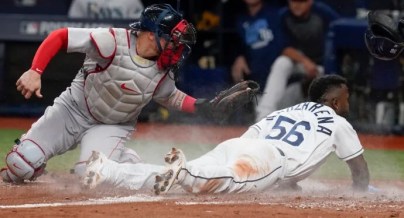
Quick on the overshift uptake, Randy Arozarena stole home straight up Thursday night. Yogi Bear never had it that simple stealing picnic baskets.

There are and have been men playing baseball who love their secondary skills almost more than they love what usually earns their keep. Randy Arozarena, Rays outfielder and batter extraordinaire, is one of those men. He can hit around the field and for distance, but he loves to run.

Give him an inch, or an abandoned side of an infield, and Arozarena’s more than happy do his part to turn a baseball game, even Game One of an American League division series, into a track meet. Give him almost all the third base side of the infield while he’s on third, and he’ll add grand theft home plate to his pleasures.

It’s not that he gets away with it every time he breaks out of his gates on the bases. He tied the Angels’ Shohei Ohtani for the American League lead in arrests for attempted theft with ten. As thieves go, Arozarena had a 67 percent success rate on the regular season. Rickey Henderson he ain’t. Yet.

The one that mattered most was the job Arozarena pulled in the bottom of the seventh Thursday night, after wringing a two-out, full-count walk from Red Sox reliever Nick Pavetta and taking third when Wander Franco doubled right behind him. Then the Red Sox shifted to the right side and brought lefthanded reliever Josh Taylor in to face lefthanded-hitting Rays second baseman Brandon Lowe.

With Red Sox third baseman Rafael Devers playing in the proper shortstop location dead center between second and third, Arozarena might as well have been wandering into the Next-to-Last National Bank and discovering security officers sound asleep before sliding his stick-’em-up demand through the teller window.

Taylor seemed almost wholly oblivious to Arozarena ambling almost halfway down the third base line as he concentrated on Lowe at the plate. Apparently, the Rays’ advance scouting secured that tendency to use as opportunity presented itself. But Arozarena also read the room on his own and smelled the opportunity in front of him.

Maybe with two outs Taylor also felt there was no way Arozarena would be that brazen. Lowe fouled a 1-2 pitch straight back out of play. Taylor leaned in for his signs, straightened back up to throw—and Arozarena bolted for home the split moment Taylor came set in the stretch.

Yogi Bear never had that simple a time stealing picnic baskets in Jellystone Park.

“I noticed that the pitcher wasn’t really watching for me or covering for me,” Arozarena said postgame, “and I saw the third baseman was pretty far away in respect to where I was at. I was looking over to [third-base coach Rodney] Linares, telling him, ‘Hey, I’m going to go. I’m going to go.’ Peeked over and saw Cash give him the green light as well, so that’s when I decided to take off.”

Lowe stepped back out of the box as Arozarena hit the jets, and Taylor just cranked and threw home fast and futilely. Red Sox catcher Christian Vasquez had no chance as he sprang afront the plate to take the throw, wheeling around back on his knees to tag.

He’d have had a better chance apprehending John Dillinger without a pistol and handcuffs than he had when Arozarena shot across the plate in a safe dive—almost like Michael Phelps hitting the pool for yet another Olympic gold medal.

What looked in the moment like Arozarena just showing himself off—this is his second postseason and he already had ten postseason home runs plus an American League Championship Series MVP on his resume—proved insurance after all in the 5-0 Rays win.

That’s because the Red Sox were barely recovered from Arozarena’s heist when they suddenly loaded the bases in the top of the eighth on a leadoff single and a pair of one-out base hits bringing Rafael Devers to the plate against Rays reliever J.P. Feyereisen. One swing and the Red Sox might have been back in business, at maximum with their deficit cut to a single run.

But Feyereisen struck Devers out swinging on 1-2. He got former Ray Hunter Renfroe to foul out to first for the side. Then both sides went quietly in the bottom of the eighth and the top of the ninth.

Taylor didn’t comment after the game but Red Sox manager Alex Cora did. ““I think JT was actually paying attention,” Cora said of Taylor and the Arozarena theft, “but probably two strikes, he had Lowe with two strikes and probably the concentration was with the hitter. Just put him away, and Randy had an amazing job.”

Rays manager Kevin Cash credited Arozarena’s room reading. “We don’t practice that,” Cash said of the theft. “The game has evolved to where defending the hitter is so important. We do the same thing. It’s not the most comfortable thing in the world to pull the third baseman off, certainly with a left-handed pitcher who can’t see everything. But it ultimately comes down to his decision-making and his ability to react.”

Except that, between such things as thinking players dropping bunts for free base hits onto the open expanses and thinking thieves like Arozarena accepting when handed that big a larceny invitation, maybe those defensive overshifts might begin dissipating at last.

The Red Sox erred in handing Arozarena that much leeway even trying to defend against Lowe. They couldn’t afford that on a night they swung futilely against four Rays pitchers including rookie starter Shane McClanahan, who went five scoreless scattering five hits while the Red Sox went 1-for-7 with men in scoring position on the night.

And, on a night the Rays pecked and powered their way to the division series-opening win against Red Sox starter Eduardo Rodriguez (who lasted only five outs) and Pivetta (Arozarena’s home steal went on Pivetta’s jacket), with three other Red Sox relievers plus the Rays’ stingy defense keeping them off the board despite more than a few hard hit balls.

My command wasn’t great at all on every pitch,” Rodriguez said postgame about Cora’s decision to pull him in the second inning. “So I’m not surprised. This is the playoffs. And you’ve got to go out there and do your job. If you don’t do it, you’re coming out of the game.”

It doesn’t look as good as you might think for the Red Sox in Game Two, either. Oh, you might think they’ll be back on track with Chris Sale scheduled to start, but Sale hasn’t prevailed against the Rays all year long.

With one theft of home Arozarena also came close to wiping out the memory of what he did to lead off the bottom of the fifth, swinging on a full count and sending Pavetta’s fastball just off the middle into the left field seats for the fourth Rays run. Making Arozarena the first man ever to hit one out and steal the plate in the same postseason game.

Pinocchio, you’re a real man now.

Arozarena’s come very far from that fateful October 2019 afternoon when, as a member of the Cardinals, he foolishly videoed Mike Schildt’s sore-winner rant and sent it viral enough, after those Cardinals blew the Braves right out of that postseason—only to get bludgeoned out themselves by the eventual World Series champion Nationals.

Three months later, the Cardinals traded Arozarena with Jose Martinez to the Rays for a couple of minor league spare parts. Martinez was supposed to be the big catch. But he faltered in the pan-damn-ically short 2020 season, after missing most of “summer camp” with COVID-19 himself, before the Rays dealt him to the Cubs at that year’s trade deadline.

I don’t know if the viral video—which he took down almost as fast as it went viral—helped compel the Cardinals to throw Arozarena in on that deal as much as their surplus of outfielders in the organisation did. But the Rays have no complaints yet.

He’s become their Mr. October. He’s picked up right where he left off last postseason. The only shock now would be if the Red Sox aren’t tempted heavily to swear out a warrant for his arrest on charges of grand theft.
Can’t we teach the thugs a real lesson?

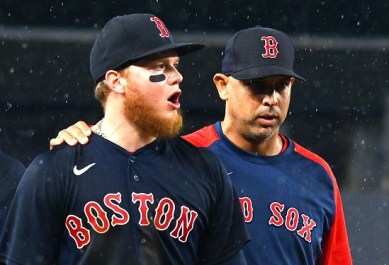
Alex Verdugo, Alex Cora

Alex Verdugo’s (left) generosity turned into a particularly nasty piece of Yankee fan foolishness.

If you want to know why baseball players come to see baseball fans with contempt, as some always have and always will, you can point to the Yankee Stadium doings Saturday night. Even knowing the eternal rivalry between the Empire Emeritus and the Olde Towne Team, this was above and beyond the call of insanity.

All Red Sox left fielder Alex Verdugo did before the bottom of the sixth started was see fit to toss a practise ball to a young Red Sox fan in the bleachers. The ball didn’t quite reach that young fan’s hands, but it did reach a Yankee fan to whom Red Sox generosity might just as well have been a home invasion leaving none alive.

That Yankee fan threw Verdugo’s should-have-been gift ball back to the field and hit Verdugo squarely in the back. Verdugo was anything but amused. He turned toward the bleachers hollering to the fans. Highly-touted Red Sox prospect Jarren Duran hustled over to pull Verdugo away. Umpires, stadium security, and Red Sox coaches sought only to find the miscreant.

Miscreant found. And ejected from the ballpark posthaste. Eliciting a few cheers and a few more boos among the fans in that section. Red Sox manager Alex Cora wasted no time pulling his team off the field after coach Tom Goodwin urged still-steaming Verdugo out of the outfield and toward the Red Sox dugout.

Cora even had to debate with the umpires over letting Verdugo have a few minutes to compose himself in the dugout. It shouldn’t even have been a debate point. This time, it was only Verdugo’s back. It could have been his head.

“I know my left fielder, I know Alex,” Cora said post-game. “He needed time to breathe and to get his thoughts.” Tell that to the umpires, as Cora ultimately did.

It seemed like nobody was listening to me. Like, imagine getting thrown at with an object in a sport and you’ve got to be out there right away because we have to continue to play the game — that part I didn’t agree. But Alex was OK with it. But you never know. What if he jumps the fence? What if he goes out there and attacks somebody? Whatever. That’s what I was telling them, just give us a chance to collect our thoughts, breathe a little bit and we’ll go out and play the game. That was the whole thing.

Verdugo knows the score only too well. Talk all the trash you want. Hammer all the family members you can think of. Chant your little heads off. Even holler “[Fornicate!] Verdugo” until your throat resembles a pair of sand blocks rubbing together. Throw a ball or other debris? Not so fast.

[T]he moment somebody throws — as players, we’re throwing balls in the stands to try to give people souvenirs, try to make little kids’ days and things like that. Just to hear people saying, ‘Throw it back’ and then someone actually throws it back and it felt like it was targeted towards me, it doesn’t sit right with me.

Throwing enemy home run balls back is a tradition almost as old as the live ball in some ballparks. Wrigley Field’s storied Bleacher Creatures have made it so much so that if you happen to watch a Cubs home game without a Creature throwing back an enemy home run ball (unless, of course, it’s a particular milestone mash with dollar value attached) it’s one step short of breaking-news bulletin time.

But no such Creature has ever been known to try separating an enemy outfielder from his assorted anatomy or his brains throwing a ball back. And not even the worst, most bombed out of his or her trees fan was ever been known (unless it just hasn’t been reported, until Saturday) to throw back a ball an opposing player tried to give a visiting fan as a souvenir.

Things weren’t hard enough between the Red Sox and the Yankees with the scheduled series opener last Thursday postponed after several Yankees—including right field star Aaron Judge—turned up COVID-positive? Things weren’t testy enough already Saturday, with a near-hour rain delay before the game and continuing rain during it?

Red Sox Nation should know that they now have an ally in Yankee manager Aaron Boone, who made no secret of his hope that the bleacher idiot ended up behind bars. Cora should also know that Boone would have acted the same as he did if the game had been in Fenway Park and a particularly brain-damaged Red Sox fan did likewise to one of his players.

It’s awful, embarrassing, unacceptable. My understanding is they did catch the guy. Hopefully he’s in jail right now. That’s just a bad situation. If I was Alex Cora, I would have done the same thing as far as going out and getting his guys off the field. There’s zero place for that in this great game, and in this great rivalry. Players should never feel like they have to worry about anything like that. I already reached out to Alex Cora, just to apologize, and to Alex Verdugo that, you know, that’s just a terrible, bad, sad situation. And sorry about that.

This during a season in which Reds first baseman Joey Votto—after getting ejected early in a game over an argument with an umpire, then learning a little girl named Abigail was heartbroken that she wouldn’t get to see her favourite Red play for just about all game long—reached out and sent Abigail a ball he signed, “I’m sorry I didn’t play the entire game. Joey Votto.”

Saturday’s game was supposed to be about Duran’s major league debut. (He went 1-for-2 with a base hit and a run scored, both in the top of the second.) And, about a pitching duel between Nathan Eovaldi (five innings, one earned run) and Gerrit Cole (six innings, one earned run, eleven punchouts).

The nasty weather ended the game after six in a 3-1 Yankee win. (Back-to-back solo bombs from Gary Sanchez and Gleyber Torres in the bottom of the sixth took care of that, on Red Sox reliever Hirokazu Sawamura’s dollar.) The nasty weather in the left field bleachers became the story of the game, unfortunately.

The Yankees travel to Boston for a set in Fenway Park starting this coming Thursday. Red Sox Nation, beware: don’t even think about trying any similar stupidity if any Yankee decides to toss a practise ball to a visiting Yankee fan before an inning begins.

Maybe the thing for baseball government and the players union to consider together is mandating a forfeit to the opposing team, when a team’s own fans get as thuggish as the thug who thought Verdugo’s reward for generosity to a visiting young fan should have been a ball attack upon the left fielder’s back.

Once upon a sad October 1971 time, umpires awarded the Yankees a forfeit after heartsick Washington Senators fans—with Second Nats reliever Joe Grzenda one out from saving what should have been a win, and the Senators playing their final game before moving to Texas—stormed the RFK Stadium field. Grzenda never got to throw a single pitch to Yankee second baseman Horace Clarke.

Those fans didn’t blame the Yankees or try to mangle, bangle, or dismember anything in a Yankee uniform. They’d have preferred decapitating duplicitous Senators owner Bob Short. (Banners with his initials proliferated in the stands.) Absent that, they took it out on RFK Stadium.

If you can forfeit to the visitors over breaking an entire ballpark, you ought to be able to forfeit to the visitors when a home fan decides a baseball offered a visiting fan should be the instrument for spontaneous back surgery upon the visiting player who offered it. Maybe (big maybe) that’ll teach the jackasses a few lessons.

Alex Cora, prodigal manager

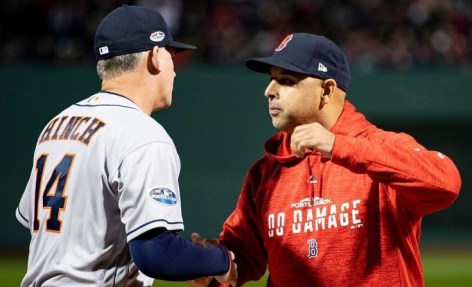
Red Sox manager Alex Cora (right) in a 2018 ALCS handshake with his Houston counterpart A.J. Hinch. Cora’s been re-hired by the Red Sox, while his fellow Astrogater Hinch gets his second chance in Detroit.

Well, I was wrong. About Sam Fuld possibly having the faster track to the job and Alex Cora finding a new one elsewhere. The Red Sox rehired Cora to manage them Friday. Have they let a cheater come back to the scene of the crime?

Cora’s Astro Intelligence Agency culpability was deep enough it was too easy to believe he had a hand or at least a fingertip in the 2018 (and maybe 2019) Rogue Sox Replay Room Reconnaissance Ring. It’s also a truism oft repeated (including by me) that when you lead you take responsibility for what’s done by the troops.

But baseball’s government pinned that replay reconnaissance responsibility on Red Sox video room operator J.T. Watkins. Pinned it on him or scapegoated him for it, depending on your point of view. Either he or someone he allowed decoded opposing signs and signaled them to Red Sox baserunners to send home to the hitters at the plate.

Watkins took the fall. The MLB investigation that discovered the Astros went above and beyond just using what MLB itself provided in the replay rooms behind all dugouts but that the Rogue Sox just got caught doing what a few other teams at minimum must have been doing likewise.

“I know J.T. and how he works,” Cora said when Watkins was taken on the perp walk. “I trust the guy. Was I surprised at what came out? Yes, I was.”

Whether Cora beat the Rogue Sox rap on a technicality, or really didn’t have any clue as to what Watkins and who knows which Red Sox players were up to, Cora has his old job back. His Astrogate suspension ended the moment the World Series did. Officially, anyone with the opening was free to hire him.

If he was in it up to his neck in Houston he was found caught pants down with everyone else in Boston, officially. Unofficially, suspicions will cling. That’s the nature of the human beast. Begging the question for many as to why the Red Sox elected to bring back someone who’d been caught dead to right cheating above and beyond in one town even if he just might have been innocent enough in theirs.

“Forgiveness comes a little easier,” writes The Athletic‘s Chad Jennings, “when there’s a [World Series] ring involved.”

In that sense, Cora was the Red Sox safest choice. Any other manager would have faced an inevitable comparison. Early losing streak? Cora could have stopped it. Under-performing player? Cora would have known what to say. Disappointing season? Not on Cora’s watch. He maintains some benefit of the doubt, even beneath the weight of his past transgressions.

In other words, the hapless Ron Roenicke—handed the bridge after Cora’s exit, but helpless to keep the Red Sox together following their winter trade of franchise player Mookie Betts, the ownership’s greater concern for staying beneath the luxury tax threshold over fortifying the team’s compromised pitching staff, and several key injuries (Andrew Benintendi, Eduardo Rodriguez, Chris Sale)—didn’t stand a chance.

According to Jennings, Roenicke might have felt Cora’s “spectre” hovering overhead—except that he denies it. “No, never,” the skipper who’d been Cora’s bench coach said. “And the reason I can say that is because Alex should be managing . . . I’m hoping he does this again, whether it’s here or somewhere else, he should be managing.”

“At the time that we parted ways with Alex,” says Chaim Bloom, the Red Sox GM/chief baseball officer, whose longtime knowledge of Fuld—former outfielder turned Phillies player information coordinator—helped drive speculation of Fuld taking the bridge, “we were clear that that was a result of his role and what happened with the Astros and everything the investigation over there revealed. It had nothing to do with what may or may not have occurred in Boston.”

It’s enough to make you wonder whether bringing Cora back was Bloom’s ultimate choice or whether—the way then-GM Ben Cherington had Bobby Valentine jammed down his throat after the 2011 collapse—the Red Sox ownership likewise stuck Cora down Bloom’s throat.

Valentine, of course, took on a fragmented team and detonated a season-long bomb worth of divide-and-conquer dissipation. His firing after that 2012 disaster practically detonated block parties around New England. Cora’s departure practically detonated mass mourning that a guy with his brains and his ability to keep his players on board had to go.

Players and others within the Red Sox organisation couldn’t bear to let Cora go entirely even as the Red Sox leadership pushed him away with little choice following the affirmation of his Astrogate culpability. For those players partaking of Watkins’s replay room espionage, it must have felt like Dad going to the calaboose unfairly for the kiddies’ breaking the neighbourhood.

Hinch was popular with his Astros players, too, but once the Astros fired him and GM Jeff Luhnow upon their Astrogate suspensions the Astros showed little inclination or longing to bring him back. Even as the Red Sox put distance between themselves and Cora, they kept their eye on him a little longingly in the distance, ultimately re-narrowing it.

“[O]nce he departed,” writes NBC Sports Boston’s John Tomase, that opened the door for Bloom to make his own hire, since the manager-GM relationship is the most important in baseball operations”

And Bloom sent consistent signals that he planned to look elsewhere, a point reinforced by the process that ultimately led us back where we started.

With Cora available and ready to be rehired, Bloom still conducted a lengthy search, interviewing multiple candidates and eventually identifying five finalists. The choice reportedly came down to Cora vs. . . . Fuld, whom Bloom knew from Tampa.

The Red Sox will insist that at the end of this process, Bloom and Bloom alone chose Cora, and that had better be true. Because otherwise it means that ownership either tacitly or explicitly overruled its baseball boss on his most consequential hire . . . Imagine bypassing a beloved figure for a first-timer like Fuld? The last thing a rookie manager needs to be greeted with is resentment.

Surely Tomase isn’t alone in pondering what might have been if the White Sox had reached out for Cora instead of Hall of Fame manager Tony La Russa, who was only too clearly an ownership move instead of their GM’s. Would Bloom have felt free to hand Fuld the Red Sox bridge after all? We’ll never know.

It’s not that cheaters haven’t been forgiven before. The New York Giants’ leadership may have been well aware of Leo Durocher’s telescopically-buzzing cheating scheme down the 1951 stretch, but it was a third-place finish the year after they swept the Indians in the World Series that got Durocher fired.

Fred Hutchinson may or may not have sanctioned scoreboard-based sign-stealing by his pennant-winning 1961 Reds, but it took 1964’s courageous but fatal battle with lung cancer, not 1961’s telescopic cheating, to seal Hutch’s fate.

Cora’s culpability in the Rogue Sox Replay Room Reconnaissance Ring isn’t even close to being as cut and dried as his Astro Intelligence Agency activities proved to be. For now, no matter. Officially, Watkins paid for any and all Rogue Sox sins. Unofficially, Lucy, they’ve still got some splainin’ to do.

Every baseball eye in and away from Boston will put Cora and the Olde Towne Team under the most acute microscope since Zachariah Janssen invented the thing—in the year Urban VII became the shortest-reigning Pope (three months) in the history of the Catholic Church. It won’t necessarily be inappropriate.

Could Fuld be the next Red Sox manager?

Sam Fuld, who fought the walls only too often as an outfielder, may have an immediate future as a manager—where he doesn’t have to bang his head on walls to make points.

Don’t look now, but someone is making a better impression upon the Boston Red Sox’s brass in the team’s managerial search than you might have thought. His name isn’t Alex Cora, either.

Sure, Cora’s still in the running to reclaim the job his Astrogate shenanigans cost him last winter. Sure, his squeeze-out happened even before we saw affirmed that his Rogue Sox turned out to be cheaters of a slightly less nefarious variety en route their own 2018 World Series conquest.

Like former Astros manager A.J. Hinch, Cora deserves another chance after having served the sentence that ended the moment the World Series did. But notice that Hinch is getting his in Detroit, not Houston. No matter how popular he was among his Red Sox players, Cora’s second chance cannot come in Boston.

You have to ask? Maybe Cora did or didn’t order, abet, or merely encourage his 2018 and maybe 2019 Rogue Sox to steal signs off the feeds in their video replay room. You don’t applaud cheating qua cheating when you say the Rogue Sox can be seen as led into temptation by MLB itself providing the apparatus. (Behind both dugouts in all parks, by the way)

But you don’t absolve Cora or his troops for giving in. Just because Mom and Dad left the keys to the hooch hutch lying around open before going out for the evening it doesn’t mean their short-of-legal-age kids have the license to get themselves swacked.

Let’s give the benefit of the doubt a moment and assume Cora didn’t order, abet, or merely encourage. No matter. The first responsibility of leadership is that you take responsibility for what your subordinates do. Or, undo. Hinch learned the hard way, too. He was a lot more forthcoming in the aftermath while he was at it. When he spoke of wishing for a second chance, he never exactly said it ought to be with the Astros.

To those Red Sox fans who were just as outraged over the Red Sox Replay Room Reconnaissance Ring as Astro fans outraged over the Astro Intelligence Agency, take heart. If Red Sox general manager Chaim Bloom gets his way, you might see a white knight riding in from Philadelphia soon enough.

MLB Network’s Jon Heyman says former outfielder turned Phillies coordinator for player information Sam Fuld has “a real chance” at landing the Red Sox bridge. “Fuld, who is from (New Hampshire) and is well regarded,” Heyman says, “can’t be ruled out here as Bloom is said to love him going back to their [Tampa Bay] Rays days.”

It’s not that Bloom’s unaware that previous Red Sox GMs found their ultimate managerial choices overruled by Red Sox ownership. Just ask now-Pittsburgh Pirates GM Ben Cherington. His choice after the infamous 2011 collapse, and Terry Francona walking subsequently before he could be booted, was anybody but Bobby Valentine.

Valentine wandered into a clubhouse already toxic from the 2011 collapse and played with matches. Even the 27 disabled-list trips Red Sox players made in 2012 weren’t half as detrimental as Valentine’s divide-and-conquer style. Questioning popular but aging Kevin Youkilis’s heart in hand with his physical health lost the skipper his clubhouse too early that season.

Valentine threw so many people under buses in Boston that Cherington probably sang “Happy Days Are Here Again” to himself when he got to fire Valentine after that season ended. The last thing Bloom should want now is to get an ownership boot in the backside by way of a forced hire he might have to can after 2021.

“Bloom may want a fresh start as he rebuilds this team from the ground up—in which case Fuld sounds like the man for the job,” writes Yahoo! Sports’s Darren Hartwell.

“The new chief baseball officer deserves his own hire, and Cora made his life miserable when he threw a managerial search on top of trading a franchise player last winter,” writes NBC Sports Boston’s John Tomase. Bloom’s public statements about Cora have been cool at best, suggesting the former skipper needed to undertake some serious soul searching and image rehabilitation following his central role in Houston’s cheating scandal. If Bloom wants to start fresh, why interview Cora at all?”

Why indeed. But Red Sox brass traveled to Cora’s home in Puerto Rico to talk to him. You might think that’s an exercise in futility, considering Cora isn’t exactly an unknown quantity to the Red Sox. You’d also think the Red Sox wouldn’t need to know anything—other than, perhaps, the depth of his contrition for his Astrogate role and Soxgate allowance—that they didn’t know already.

Fuld was a hustling outfielder who rarely met a wall or fence he didn’t think he could conquer on the run. His frequent spells on the disabled list reminded him there were more than a few walls and fences that didn’t suffer fools or outfielders gladly. If he studied baseball history formally, the one day he ditched was probably the day they taught the sad story of Pistol Pete Reiser.

He defied the still-lingering prejudice against players who weren’t six foot-plus galoots, yet he didn’t make his first team right out of spring training until he was 29. He was also a solid contact hitter who could extort his way on base and whose injuries—especially one to his wrist ligaments—probably eroded those skills far sooner than they should have.

Fuld was also as analytically-inclined as a player as he was the type who dared the outfield to blow him to Kingdom Come. When the Phillies hired him following his 2017 retirement, Fuld became so well respected that he was on the short list for several managerial openings including four last fall. The Cubs, the Mets, the Pirates, and the Giants gave him serious looks before Fuld turned them down to stay in his Phillies job.

But with the Phillies canning GM Matt Klentak and their next GM likely to look for his own people, Fuld is probably very available now. He’s not exactly alien to New England, either. He’s the son of a longtime University of New Hampshire dean and a former New Hampshire state senator, and he grew up an avid Red Sox fan, keeping posters of Nomar Garciaparra on his bedroom wall and visiting Fenway Park as often as he could.

Fuld once made a big day of his own at Fenway while playing for the Rays. On 11 April 2011, he went 4-for-6 and might have hit for the cycle except for his final plate appearance, where he needed a single to finish the cycle but hit the ball far enough down the line that he knew he had a shot at the clean double and had to take it.

Consummating the cycle would have made headlines, highlighted SportsCenter, and thrilled his visiting family even more. But baseball’s more than great theater, and Fuld knew it. “I never thought about stopping at first,” he told ESPN’s Tim Kurkjian post-game. “That’s not the right way to play the game. If you can advance to the next base, you advance. That’s the only way to play baseball.”

A guy who surrenders a cycle to play the game right is a guy who’ll take his marriage of right play and right analysis and get whatever rebuilding Red Sox are handed to him to play the game right. Assuming Bloom is allowed his head rather than unexpectedly bereft of it, Fuld should be more than just a little green dot on the Red Sox radar.

“They [screwed] it up twice”

2020-08-14 AJHinchAlexCors

Former Houston Astros manager A.J. Hinch and bench coach Alex Cora. Los Angeles Dodgers relief pitcher Joe Kelly fumes that Astro players tainted Hinch’s and Cora’s names to save their own.

With everything else buffeting major league baseball before delayed “summer camp” and the truncated season, it was easy enough to miss. But Alex Cora—considered an Astro Intelligence Agency co-mastermind and unproven shepherd of the Red Sox Replay Room Reconnaissance Ring—spoke out in June.

And Los Angeles Dodgers pitcher Joe Kelly, one of Cora’s Red Sox charges during their run to the World Series title in 2018, spoke up likewise in a podcast by Dodger teammate Ross Stripling days before his suspension—for throwing at Alex Bregman and Carlos Correa, the latter drawing Astros and Dodgers alike out of dugouts in social-distance violation—was cut from eight to five games.

Between them comes an alteration of the former Astrogate narrative, and it’s not likely to mitigate the AIA stain on the 2017 world champions. If anything, it’s liable to make the stain deeper. Upon the 2017-18 Astros’ players and upon commissioner Rob Manfred, who handed those players blanket immunity in return for spilling about the AIA’s off-field-based, electronic pitch sign espionage.

“The people who took the fall for what happened is nonsense. Yes, everyone is involved,” said Kelly aboard Stripling’s podcast.

But the way [the AIA] was run over there was not from coaching staff . . . They’re not the head boss in charge of that thing. It’s the players. So now the players get the immunity, and all they do is go snitch like a little bitch, and they don’t have to get fined, they don’t have to lose games.

Kelly’s remarks hark among others to Cora telling ESPN writer Marly Rivera in early June that he didn’t object to shouldering his own responsibility for the 2017 Astros’ chicaneries, having been their bench coach before becoming the Red Sox’s manager, but also wanting one and all to know that neither himself nor 2017 Astros designated hitter Carlos Beltran were the sole drivers.

When Manfred dropped his Astrogate hammer earlier this year, he fined owner Jim Crane the maximum-allowable $5 million, virtual tip money. He suspended general manager Jeff Luhnow and manager A.J. Hinch for all 2020. Crane fired the pair almost at once.

Then the Red Sox more or less forced Cora out as their manager before the Rogue Sox sign-stealing report emerged. And the New York Mets more or less forced Beltran out as their newly-hired manager—before Beltran got to manage even a single exhibition game for the team he once starred for as an outfielder.

“When you take someone’s livelihood . . . to save your own ass, that’s what I don’t like,” Kelly continued.

Cheating? They cheated. Everyone knows they’re cheaters. They know they’re cheaters. It’s over. That’s done with. But now they mess it up by ruining other people’s lives, so they [screwed] it up twice . . . When you taint someone’s name to save your own name, this is one of the worst things that you could probably do . . . That really friggin’ bugs me. I think I’ll be irritated forever.

In other words, the Astros players accepting Manfred’s immunity to throw Cora, Beltran, and even Hinch and Luhnow under the proverbial bus isn’t even close to being Mike Fiers—frustrated that attempts by himself and others in the know to get reporters to push for exposing the AIA previously—finally blowing the Astrogate whistle to The Athletic‘s Ken Rosenthal and Evan Drellich last November.

Kelly may have missed Cora telling Rivera it wasn’t only players who might have made himself and/or Beltran sacrificial lambs. “There has been a narrative out there of what happened,” Cora said.

Ever since mid-November until the commissioner announced the results of the Red Sox investigation, I have read many things that are true and many others that are not.Out of this whole process, if there is one thing that I completely reject and disagree with is people within the Astros organization singling me out, particularly Jeff Luhnow, as if I were the sole mastermind. The commissioner’s report sort of explained, in its own way, what happened. But the [Astros players] have spoken up and refuted any allegations that I was solely responsible.

If there is one thing I am absolutely sure of, it is that it was not a two-man show. We all did it. And let me be very clear that I am not denying my responsibility, because we were all responsible.

Manfred’s subsequent report on the Rogue Sox determined—after the commissioner handed 2018-19 players the same immunity to spill as he handed the Astros—that their replay-room sign-stealing scheme was actually executed without Cora’s direct knowledge of the operation.

Remember: The AIA involved either installing an illegal real-time camera or altering an existing camera off mandated eight-second transmission delays to send opposition pitch signs to a clubhouse monitor, where someone deciphered them and signaled them to hitters by way of banging a can slowly next to that monitor.

The Rogue Sox didn’t go that far. They married old-fashioned on-field sign-stealing gamesmanship to new-fashioned technology all but gift-wrapped for them. MLB itself handed them and anyone else so inclined the keys to the kingdom when it installed multiple-monitor replay rooms in both clubhouses in all ballparks.

Someone deciphered opposition signs on one of those monitors and transmitted them to a Red Sox baserunner who’d send it on to a batter. The key is that the Red Sox needed a man on base to execute the reconnaissance operation in the first place. They couldn’t and didn’t have stolen signs for every man in the lineup.

The AIA didn’t need baserunners to do its dirty work, though it could only operate in Minute Maid Park. Which made the scheme even more bizarre, never mind unnecessary, since the 2017-18 Astros actually won sixteen more games total on the road than at home.

Cora, remember, once made himself a Dodgers folk hero thanks to an epic eighteen-pitch plate appearance against Chicago Cubs pitcher Matt Clement that ended in a two-run homer into Dodger Stadium’s right field bullpen. Now he’s a pariah for being the bench coach of the ’17 Astros and the manager of the ’18 Red Sox, both of whom beat the Dodgers in back-to-back World Series.

Unlike those Astros who met the press as spring training opened (pre-coronavirus shutdown) and sounded as unapologetic as men offering apologies can sound, outraging about seven-eighths of MLB players, Cora did apologise for both the AIA and the Rogue Sox. “I understand why people think that our championship is not valid, and it’s our fault that they think that,” he told Rivera.

I am being honest and I apologize for what happened and for the mistakes we made as a group. I understand why people are disappointed. I am disappointed in myself. At the time, one doesn’t think about the consequences. It was something that kept growing and growing, and in the end, it was wrong. We made a mistake and I must pay for the consequences of my actions.

Kelly pondered aloud whether those Astros who spilled to Manfred called Beltran, Cora, Hinch, and even Luhnow—whose administration was controversial enough before Astrogate’s exposure, and whose departure may have been mourned the least—“and said, ‘Hey, I’m sorry’ . . . If they had said, ‘Hey, I’m super scared, I didn’t know what to do, I didn’t want to lose money, I had to rat’ . . . Grow a pair of balls and say that.”

Would that make any difference to Beltran, Cora, and Hinch now?

Beltran lost a job he’d barely begun to do but one for which he seemed qualified enough. Cora lost a job in which he’d become only the fifth rookie manager ever to win a World Series, after Bucky Harris (the 1924 Washington Senators), Eddie Dyer (the 1946 St. Louis Cardinals), Ralph Houk (the 1961 New York Yankees), and Bob Brenly (the 2001 Arizona Diamondbacks).

The hapless Hinch, who’d shown himself mostly as an ideal managerial marriage between smarts and sensitivity, was exposed as powerless to stop his charges from plunging deeper into baseball crime or to stop his superiors from fostering such an atmosphere in the first place.

Before you return to the false narrative of Kelly’s “hypocrisy” for scoring the Astros while being a member of the Rogue Sox, remind yourself: Red Sox pitchers catching on to baserunning teammates sending stolen enemy signs to hitters probably thought the runners got the signs the old fashioned way, catching on to and exploiting an enemy catcher’s inadvertent tells.

The Red Sox fell to the ’17 Astros in a division series but beat the Astros in five—abetted especially by Andrew Benintendi’s Game Four-ending, three-run-saving, series tie-thwarting catch in left field—in the ’18 American League Championship Series.

Six Astros regulars on the 2017-18 team remain with them today. How long before the AIA stain dissipates is anyone’s guess, never mind that there were those from the scandal’s birth who suggested the stain wouldn’t leave the Astros until all the 2017-18 players had either moved on or ended their career.

There’s little enough comfort for Astro and Red Sox fans still coming to terms with having rooted for two great teams who, obviously enough, lost enough faith in their own greatness. There’s also the distinct possibility that the bad blood between the Astros and the Dodgers won’t dissipate too soon, either. They meet again in Dodger Stadium in September.

“Just to say, ‘Oh, it’s done, it’s over with, move on,’ I don’t think is a reality for anyone,” Dodger third baseman Justin Turner told a Fox Sports pre-game show. “I think around the league, there are a lot of guys upset, who kind of feel like the punishment didn’t really fit the crime. I don’t know if that’ll ever go away for me.”

Millions of fans and an awful lot of players don’t know, either.