Two Bs and a Tuck

Alex Bregman

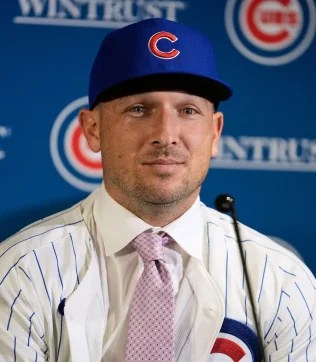
“There’s an excitement in the air about Cubs baseball,” said their new $175 million third baseman Alex Bregman after signing with the team last week.

What a week, right? Just like that, three of the more luminous members of this winter’s free agency class found new homes for varying dollars.

The usual suspects scream blue murder. A few unusual suspects pick up Dodger manager Dave Roberts’s expressed equal adoration for a salary cap and a salary floor. So, who’s coming out how, where, and why? Let’s look with sober eyes.

Da Bear Market Dept.—Think about it: On the same evening the NFL’s Chicago Bears shoved the Green Bay Packers to one side and out of the race for the Super Bowl, in Soldier Field, the Cubs made erstwhile Astro/Red Sox third baseman Alex Bregman a rather wealthy man.

With the Red Sox thought to be pushing a bit extra to bring Bregman back, the Cubs pushed enough to land Bregman on a five-year, $175 million that includes a mutually agreed-upon $70 million worth of deferred money.

You think Bregman’s new teammates weren’t enthused about the deal and their new mate? “I texted him when the news broke: ‘Dude, let’s freaking go’,” said pitcher Jameson Taillon, an Arizona neighbour of Bregman’s according to The Athletic. “He FaceTimed me. He was like, ‘Hey, we’re just finishing up dinner. Can I come over?’”

He wasn’t alone, wrote the journal’s Patrick Mooney: “Pete Crow-Armstrong, the All-Star center fielder, was in attendance at Soldier Field when he found out that Bregman would be a new teammate. Immediately after seeing the reports, Gold Glove shortstop Dansby Swanson called Bregman from a friend’s wedding.”

The Cubs made a run for the postseason last year. After a few years behaving like the big city kid who seemed to be seduced by the outskirts of Four Corners, Nowhere in Particular, they started behaving like the bigger market team they’re supposed to be once the postseason run ended.

“There’s an excitement in the air about Cubs baseball,” said Bregman while he made a bit of a whirl-around Chicago tour last week. “I can’t wait to get after it.” Pause. “After it” means “pennant race” and “World Series trip” for a man who now picked uniform number 3 to indicate he’d like a third World Series ring as well as stability for his family.

He’s known as a student of the game, a disciplined hitter, a sharp-fielding third baseman, and a clubhouse godsend. All Bregman has to do is live up to all that as best a 31-year-old with more than a few miles on him can, as he did when his body allowed in Boston last year. Da Cubs will make sure his appreciation is far, wide, and deep.

Tucker, the Man and His Team Dept.—Meanwhile, an erstwhile Cub lit the fuse on fresh screaming over the big, bad, behemoth Dodgers and their big, bad, behemoth platinum vault. The erstwhile Cub is Kyle Tucker, considered the number one free agent in the winter class by those who thought Bregman was the class’s second banana.

Tucker signed up for four years, $240 million, and opt-outs after years two and three. The deal also includes $30 million in deferred dollars. If Tucker helps the Dodgers to a third straight World Series title, Dodger City will consider it all very wisely spent. If he doesn’t or can’t, well . . .

That screaming won’t be limited to denunciations of the Dodgers as the new Evil Empire. It’ll include audible-in-the-Klingon-Empire demands for explanations as to why a no-doubt talent but with 27.3 wins above replacement-level in eight season is pulling down $17 million a year more than Aaron Judge, Yankee bombardier first class, who earned about 3.0 more WAR just over three of the past four years.

The Dodgers are betting on Tucker’s future coming somewhere near Judge’s present, of course. Aside from the dollars, the Dodgers could offer something far deeper to the low-keyed Tucker. He can do Tucker things without the floodlights baking him too heavily compared to the rest of the Dodgers’ star power.

He might have been the star of this free agency market, when Bregman and Bo Bichette weren’t, but that’s about as far as Tucker seems to care to go when it comes to attracting attention with anything beyond his still-growing bat and his virtuosity playing right field.

What’s Bo Know Dept.—Bo Bichette is a Met. Roll the rhyme around awhile, Metsropolitan New York. Savour the possibilities to come with a healthy Bichette helping the Mets ride all the way to a postseason. (Remember: He came off the injured list to be one of the shining time Blue Jays in last year’s World Series.)

Now, be afraid. Be very afraid. Because the Mets plan for their new $126 million infield toy is to move him from his normal shortstop to third base. Every Met fan since the day they were born will warn you. The Mets don’t have a sterling history of third base conversions. (Mets legend David Wright was born to the position, you may remember.)

Ask what happened when they traded a talented but still-erratic arm named Nolan Ryan to the Angels for a veteran elite shortstop named Jim Fregosi . . . and decided to turn that veteran elite shortstop into a third baseman. Case closed.

Bichette can hit. The only population that doesn’t know that might be a colony of Arctic walruses. But with the glove? He’s 36 defensive zone runs below his league average as a shortstop, and his range factors per game are below the average, too. He played a little second base in the minors but not a lick of third base in the Show.

The Mets turned toward Bichette more seriously (they’d been talking previously) when Tucker went California bound the night before. The Phillies saw the Mets embrace Bichette and elected to reunite with veteran catcher J.T. Realmuto after all.

Now all the Mets have to do is get a read on whether Bichette will be the second coming of poor Jim Fregosi or the first coming of Bo Bichette, third base maven. Not to mention whether Brett Baty, the incumbent third base Met, will have a reasonable future moving to the corner outfield, as some reports speculate.

Well, the Mets have been many things over the decades. Boring has rarely been one of them.
Manfred’s just thinking aloud. Isn’t he?

Rob Manfred

Manfred insists he’s done when his contract is. What manner of mischief might he wreak before then?

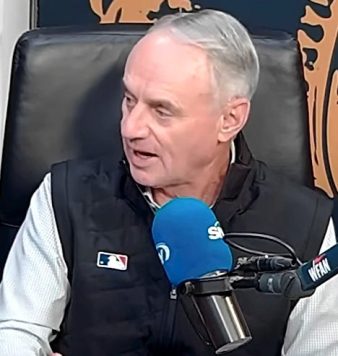
This is commissioner Rob Manfred’s story and he’s sticking to it. For now. Ask him whether he’s going to want to rethink his previously-enunciated intent to retire when his current contract expires in three years, and he digs in like a batter who knows he’s facing not Bob Gibson but Bobo Garglebargle.

“I’m done at the end of this contract. I’ve told [the owners] that, and I’m gonna stick to it,” Manfred insisted in a WFAN radio interview last week. “I’ll be 70. It is enough . . . You have a certain period of time when you have things that you want to accomplish, you take your best shot, you try to get as much done as possible. And then it’s sort of time for the next guy with his set of things. And I think that’s healthy and good for this.”

So far, so good. So, what does the most inveterate tinkerer who ever held the commissioner’s office want to get done before he moseys off into the sunset?

Without saying he’s committed to it—yet—Manfred mentioned discussions about inflicting a split season and in-season tournaments upon major league baseball. “We do understand that 162 (games) is a long pull,” he said. “I think the difficulty to accomplish those sort of in-season events, you almost inevitably start talking about fewer regular-season games.”

But not fewer postseason rounds and games, of course. Manfred isn’t that sensible. “It is a much more complicated thing in our sport than it is in other sports,” he continued. “Because of all of our season-long records, you’re playing around with something that people care a lot about.”

You’re playing around with a lot more than that, Commissioner Pepperwinkle.

Wait until it gets to the part where he speaks of bringing MLB to 32 teams. And, realigning baseball into eight divisions of four teams each. Presuming it’s going to be one new team in each league, would it do to suggest something a lot more sensible?

You guessed it. I’m going there again. Instead of eight divisions of four teams each, how about four divisions of eight teams each? How about two such divisions in each league? If you wish, you can keep them named the National League East and West, and the American League East and West. Goodbye three-division lunacy and wild-card whackadoodling.

Think of the benefits that would come forth. I’ve made the argument before, but it’s worth making it yet again. Four divisions, eight teams each, and you don’t get to play for a championship unless your butts were parked in first place at season’s end. Let’s not forget to put an end to the farce of regular-season interleague play, either. Save that for where it really belongs, the All-Star Game and the World Series.

And won’t it be fun to have something we haven’t really had in this century—namely, real pennant races again. No more of this Bizarro World nonsense of the thrills, spills, and chills of teams fighting to the last breath to finish the season . . . in second place.

Come to think of it, let’s be done at long enough last with those hideous All-Star and City Connect uniforms. They go from ugly to disgusting and back to repulsive before turning nauseating. Haven’t you missed seeing All-Stars wearing their own uniforms, the fatigues of the teams they represent in the game?

And we haven’t arrived until now at the truly fun part. You want to get rid of postseason saturation as much as I do? You want to make the postseason both meaningful and fun again? You want more World Series such as last fall, when a) the only combatants were teams who finished first in their divisions, anyway; and, b) those two went tooth, fang, claw, and anything else they could think of until somebody finally won it? You want to relieve Manfred’s discomfort over the long season?

Of course you do. So . . .

We’ve simplified the game’s alignment to two divisions each for each league. We’ve made for real pennant races again. Now we get to call for best-of-five League Championship Series. That’s the way they played it from divisional play’s birth in 1969 through 1984. Now, you restore the World Series’s primacy by keeping it a best-of-seven. Did I mention that it also means no baseball under snow or November watch anymore?

You also have postseasons of—maximum—seventeen games under the foregoing back-to-the-future remake/remodel. Meaning you have yearly totals of—maximum, again—179 major league games for each league. You can’t tell me that’s not plenty of baseball. And who says an earlier opening to the Hot Stove League won’t be a little more fun, either?

Speaking of which, beware. Maybe the only thing worse than Manfred pondering in-season tournaments would be landing a hard deadline for free agency signing. Athletics outfielder/designated hitter Brent Rooker called it the most anti-player idea Manfred could have. So, naturally, Commissioner Pepperwinkle started stumping for it harder the day after Rooker spoke against it.

“I think there’s going to be some more conversation about it, because I do believe that there’s a marketing opportunity,” Manfred told WFAN. “Let’s face it, we operate in a really competitive environment. Just put entertainment, generally, to one side—just sports, right? It’s really competitive. And I think that you make a mistake, particularly during the offseason, when you don’t take every advantage to push your sport out in front of your fans during that down period.”

Some think you make more of a mistake taking the fun out of the Hot Stove League. For owners and players alike. The owners aren’t saints, but they’re not wholly brainless. The ones who can (will) spend love the chase. The ones who can’t (won’t) spend love to bitch about the ones who can. Fans who kvetch one moment about swelling player dollars cheer the next when their team lands an Alex Bregman.

(By the way, don’t pity the Red Sox for failing to convince Bregman to stay. Not when they seem to have quaked over including a no-trade clause in his new deal but the Cubs had no problem giving him one. Well, there’s still Bo Bichette to whom the Red Sox might turn, within reason.)

“[W]hat they said back was, they thought that kind of [signing] deadline would work to the disadvantage of the players,” Manfred said of player reaction to the idea. “And you know, I just—I don’t put much credence in this.” Shocker.

At least, Manfred promised that any realignment would not include forcing two-team cities into the same division. But the bad news is that, historically, it was easier for pitchers to hold Hall of Famer Rickey (The Man of Steal) Henderson on base than it is to put most commissioners’s promises in the bank.

Opening Day: Cross it off the bucket list

Shohei Ohtani

Shohei Ohtani, shown on the Angel Stadium video board during his pre-game warmup as the teams lined up on the foul lines, on Opening Day. He pitched brilliantly but in a lost cause, the Angels losing 3-1.

The owners probably won’t stop by to see what I’m about to write, but their otherwise ill-advised 1 December-10 March lockout did me one solid. But only one.

After the World Series, and as soon as they went on sale, I’d bought tickets for what I thought would be the Angels’ home opener. They were scheduled originally to open the season on the road. But commissioner Rob Manfred’s cancellation of the regular season’s first series, in light of the owners’ further goalpost-moving shenanigans, turned the Angels’ home opener into Opening Day, after all.

It wasn’t enough to turn my thinking toward the owners’ side one iota, but it did enable me to cross something off my bucket list. Despite a lifetime of loving the game and watching countless games in the stands and on television, I’d never actually had the chance to be at the ballpark on Opening Day. Until Thursday evening.

The best part of the evening was that I got to do it with my now 28-year-old son, Bryan. The second-best part was being able to cross another item off the baseball bucket list within half an hour of us getting our pre-game food and drink, after putting replica 1972-1990 Angels hats onto our heads.

The Ball

The foul ball, now crossed off my bucket list, sitting atop my notebook, before I handed it to my son.

While the visiting Astros took batting practise, a line drive sailed into our section down the right field line. Adjacent fans made it impossible for me to see just which Astro hit the ball, but the ball bounced around off seats in front of us, then under them, and riocheted off a fan two seats to our right, before rolling on the floor under us to where I could grab the ball before another fan reaching under the seat in front of me did.

I held the ball up to see for myself that I wasn’t seeing or imagining things, then handed it to my son. He’d only been asking to try to catch a ball at Angel Stadium since, oh, the first time I got to take him there—in 2000, when the Angels beat the visiting Yankees one fine evening by prying the winning run out of The Mariano himself. We’d gone to plenty of games since. Thursday night, it was pay dirt at long enough last.

Of course, there was now a game to play, and the Angels lost, 3-1. These are my ten takeaways:

1) Shoh-time! The good news for the Angels was Shohei Ohtani starting on the mound. I’m convinced that what looked to be a lockout-dejected, ho-hum crowd in advance, shot into a near-sellout once Ohtani was announced as the Opening Day pitcher. Lockout after-effect, I suspected: I’d checked the ticketing for the game just prior to the announcement and there were several thousand seats remaining for the taking.

Well, now. The day before I set out for southern California from my home in Las Vegas, I checked the ticketing again. The tickets seemed to have flown off the board once Angel fans knew it would be Shoh-time. And Ohtani didn’t disappoint, much. He pitched four and two-thirds innings of one-run, nine-strikeout, four-hit, one-walk baseball.

The best the Astros could do against him was the third inning, after he caught Martin Maldonado looking at strike three and blew Jose Altuve away with a swinging third strike: Michael Brantley banged a double off the right center field fence and Alex Bregman sent him home promptly with a base hit to left center.

As a matter of fact, when Ohtani wasn’t becoming the first player in Show history to throw his team’s first pitch of the season and make his team’s first plate appearance of the season (the Angels like to bat him leadoff), he manhandled Altuve for three strikeouts on the night, including the nasty slider that shot over Altuve’s hard swing for the third such strikeout in the top of the fiftyh.

2) The bad news: Astros starter Framber Valdez was just as effective in six and two-thirds innings. (The Angels planned to keep their starting pitchers on an 80-pitch limit for the time being, after the lockout-imposed too-short spring training.) He struck six out, walked one, and surrendered two of the Angels’ four hits on the night.

3) The worse news, for the Angels: They came to within inches of taking a 2-1 lead in the seventh. Mike Trout led off by beating out a throw from shortstop that should have been ruled an infield hit but was ruled an error. Then Anthony Rendon hit a high liner that sailed into the left field seats . . . but missed the foul pole on the wrong side by a hair.

“When I saw the ball flying in the air,” Valdez said post-game of his narrow escape, “I got mad with myself that I didn’t make my best pitch. I just took a deep breath and threw my best pitch.” That would be the hard sinkerball on which Rendon promptely dialed Area Code 4-6-3.

Matt Duffy promptly beat out an infield hit to third, which promptly moved Astros manager Dusty Baker to end Valdez’s night and bring Phil Maton in to strike Jo Adell out swinging for the side.

4) Cruising speed: Maton seemed on a bit of a cruise in relief until he hit Brandon Marsh with a pitch with two out in the bottom of the eighth and David Fletcher shot a 1-2 pitch through to the back of left center and gunned it for an RBI triple. That was the Angels’ first and last run of the game, alas.

5) The worse news, for baseball as a whole: That ridiculous three-batter minimum for relief pitchers. Under normal circumstances, if your reliever comes into the game and gets murdered right away—as Angels reliever Ryan Tepera was in the top of the eighth—you’d know he didn’t have it that night, right?

Father and son

Father (right) crossed Opening Day off his bucket list at last—and had the pleasure of doing it with his 28-year-old son.

Oops. Tepera’s first pitch to Alex Bregman sailed into the left field seats. The next Astros batter, Yordan Alvarez, hit a hanging slider on 1-1 over the center field fence. The Angels were lucky to escape with their lives after two prompt deep fly outs (Yuli Gurriel, Kyle Tucker) followed by a sinking liner up the middle (Jeremy Peña) that Trout caught on the dead run in from somewhat deep center to retire the side. (Trout also drew a loud ovation after he turned around and, from half-shallow center, winged the ball to fans halfway up the right center field bleachers.)

6) But there was good news on the relief front. Neither manager burned his relievers in the bullpens. If either Baker or Joe Maddon warmed a pitcher up, he either came into the game as soon as needed or he was handed what amounted to the rest of the night off. No Angels or Astros reliever was called upon to warm up more than once.

I paid as much attention to the relievers in the pen as I could, considering I was seated far opposite the pens behind the left field fence. The Angels used five relievers and the Astros, three. None of those eight pitchers threw any more than maybe 20-25 pitches before they were brought into the game. None of them could be called gassed going in.

Tepera simply didn’t have it Thursday night; Maton got vulnerable after ending one inning and getting two outs to open the next. The rest of the two teams’ bullpen corps (Hector Neris and Ryan Pressly for the Astros; Aaron Loup, Austin Warren, Jose Quijada, and Archie Bradley for the Angels) pitched clean-as-a-hound’s-tooth relief. Would that all major league managers were that judicious handling their pen men.

7) Memo to: Angel fans. Subject: The Wave. The 1980s called. They want their obnoxious, obstructive Wave back. One fan adjacent to our section kept calling for fans to do the Wave. I kept shaking my head, but I did notice that each of about ten attempts at it starting in our part of the park died before flowing to a fourth section of the field-level seats. Maybe there’s hope in such deaths, after all.

8) You were saying? The back-to-back Astro bombs to one side, this game wasn’t exactly the kind to send the old farts screaming to the whiskey shots. The game’s twelve total hits included three Astros doubles, Fletcher’s triple, and six singles. Altuve even stole second in the ninth, for whatever that was worth, since he ended up stranded.

9) Wasted Out Department: Altuve, the Astros’ pint-sized, gallon-hitting second baseman, also dropped a sacrifice bunt to third with one out in the seventh against righthanded reliever Warren, after Chas McCormick opened the inning with a double. Remember: A man on second with one out, and you have less chance of scoring a run after that bunt than you did before the bunt, even if you do exactly what Altuve did pushing McCormick to third.

Just what a man with a lifetime .512 Real Batting Average (total bases + walks + intentional walks + sacrifice flies + hit by pitches, divided by total plate appearances), and a .297 lifetime hitting average with a man on second and one out, is doing thinking sacrifice escapes. With his team leading a mere 1-0 at the time, the Angels brought Quijada in to pitch to Brantley, and Brantley flied out shy of the track in right center for the side.

That’s what a wasted out did. The righthanded-hitting Altuve might have been futile against Ohtani on the night, but he has a lifetime .301 hitting average against righthanded pitchers. The Astros would have had a better chance scoring McCormick if Altuve hit away.

10) When Bregman checked in at the plate in the top of the eighth, the Angel Stadium video boards flashed a graphic with Bregman’s head shot plus this: [He] donated over 200 iPads  w/protective cases and iTunes gift cards to several Houston-area elementary schools that have autistic classrooms. He does that through his Bregman Cares charity, with a particular focus upon autistic children.

It was almost as admirable for the Angels to show Bregman such respectful acknowledgement as it was for Bregman and his wife, Reagan, to take such an interest in lending hands to autistic children. Even if Bregman’s idea of saying thank you for such respect was to smash a leadoff homer in reply.

WS Game Five: Winning in a walk

Martin Maldonado

Maldonado, you’re no longer the weakest link. For now.

The good news is, the Braves can win in Houston. They proved it in Game Two. The bad news is, they’ll need to win there to win the World Series now.

The Astros didn’t let a little thing like a four-run hole after a single Game Five inning on a single swing drive them into an early season’s grave Sunday night.

Not with manager Dusty Baker flipping his lineup a little bit. Not with proving there are times a bases-loaded walk and a well-timed single in the middle of a game are more powerful than a grand slam out of the gates.

Not with the Astros’ heretofore, mostly dormant longtime core finding their bats. And, not with the Braves’ heretofore impenetrable bullpen proving they’re only human, after all, while their own usually tenacious bats mostly went askew following their early slicing, slashing, and thundering.

Their early, incendiary Game Five lead turned into a 9-5 loss to the Astros—but doesn’t have them up against the wall just yet.

“When we won [Game Four], it made it easier, I guess, coming into this one — but we knew it was going to be tough,” said Braves manager Brian Snitker postgame. “That’s just a lot of innings to cover (by relievers) against a club like this that swings a bat so well. The good news is we’ll take a day off and be in good shape.”

Meaning, including and especially, a rested bullpen as well as a re-grouping lineup. But it’s the opposite now of where they stood after Game Five of the National League Championship Series, after the Dodgers flattened them 11-2 in Los Angeles and despite still holding a 3-2 lead in the set.

Then, the Braves’ longtime first baseman and leader Freddie Freeman said they were still in good shape, they still led the set, and they liked their chances going back home to Atlanta. Now, Snitker’s putting the Brave face on and saying, “I’ll take it anywhere. If we win the World Series, it doesn’t matter where it is.”

Two years ago the Nationals proved that in abundance against the Astros. The Braves won’t be winning all needed Series games on the road, but with their Series lead now they need to win only once. It sounds simple when you say it. It’ll be anything but simple when they play it starting Tuesday night.

You can’t get any more profound a reminder of how tough a World Series can be than the Braves got when they only thought they had the Astros buried alive in the bottom of the first Sunday night.

They loaded the bases on Astros starter Framber Valdez with a leadoff base hit by Jorge Soler, a two-out single by Austin Riley, and a 3-1 walk to Eddie Rosario. Then Adam Duvall couldn’t wait to drive Valdez’s first service to him into the seats above the right field wall.

Hindsight’s almost as wonderful as foresight. Snitker has both in abundance. This time, though, hindsight was his BFF. “I’d rather we scored those runs in the seventh inning when you don’t have so much time to cover,” the manager said postgame. “We knew we had a long, long way to go in that game and anything could happen.”

Anything did happen, right away.

Heretofore slumber bat Alex Bregman hit with first and second and one out in the second and lined Braves opener Tucker Davidson’s the other way, all the way to the right center field wall, scoring Yuli Gurriel (one-out, one-hop single to center). Heretofore macaroni bat Martin Maldonado sent Kyle Tucker (full-count walk) home with a sacrifice fly cutting the Braves’ lead in half.

The Astros might have gotten one more run home but for the next batter—Valdez himself. Two swinging strikes around a ball in the dirt, then looking frozen at strike three on the inside forner after a ball just low. You still don’t want the designated hitter in the National League’s parks, old farts? Imagine if the Astros didn’t have to bat Valdez there. They might only have had a one-run deficit to end the frame.

No matter. Their unraveling of the Braves began the very next inning, when Dansby Swanson at shortstop misplayed Jose Altuve’s leadoff hopper, bumping the ball from his glove, recovering too late to throw the swift Mighty Mouse out at first. The rest of the Series will prove whether or not that’ll be this postseason’s most egregious Braves mistake of all.

Davidson walked Michael Brantley on a 3-1 count and Carlos Correa—another of the formerly dormant-at-the-plate Astro core—doubled Altuve home. A fly out later, Brantley scored on Gurriel’s ground out to short. Tie game. The tie lasted long enough for Freeman to lead the bottom of the third off with a mammoth full-count, tiebreaking blast half way up the right center field seats.

The 5-4 Braves lead lasted until the bases loaded and two out in the top of the fifth. Checking in at the plate: Maldonado, the Astros catcher still vying for the title of the single most automatic Astro out, after the Braves ordered Bregman walked on the house to load the pads in the first place.

What came next may yet prove one of the ten most powerful walks of all time. Maldonado looked at ball four inside from Braves relief star AJ Minter, sending Correa (leadoff one-hop base hit to center) strolling home with the re-tying run. Martin, you’re no longer the weakest link. For now.

Not only did Maldonado get daring enough to stand right on top of the plate during the entire plate appearance, the better to get an edge against Minter’s cutter, he even showed bunt as ball four sailed in. He didn’t do it for a laugh, either.

“He came back to the dugout yelling at me, ‘You like my Little League bunt?'” said Astros hitting coach Alex Cintron postgame. “He was prepared before he stepped up to the plate. He was ready for that at-bat. That made the difference.”

“I thought of it in the moment,” said a grinning Maldonado. “I wasn’t going to swing until 3-2. Maybe it would throw him off.”

Then Baker sent Marwin Gonzalez—returned to the Astros after a detour through Minnesota and Boston when the Red Sox released him in August—out to pinch hit for Jose Urquidy, whose shutout fourth set him up to get the Game Five “win.” Gonzalez dumped a floating quail into left center that hit the grass with room enough to send Gurriel and Bregman home with a 7-5 Astro lead.

Maldonado lined Tucker home with a base hit off another Braves pen man, Drew Smyly, in the seventh, and Correa—perhaps sensing Smyly was really taking one for the team now—singled Altuve home with the ninth and last run in the eighth.

Baker made a few pre-game moves to shake his lineup a bit, particularly moving the previously slumping Bregman down to bat seventh. The third baseman’s struggles at the plate this postseason became that alarming—to the manager and to Bregman himself.

“I’ve got a really weak top hand right now,” he said. “I’m releasing the bat behind me, which is causing a ton of problems.” He spent pre-game batting practise all but forcing himself into a two-handed swing finish. It helped when he knocked that second-inning RBI double. It damn near helped him hit one out his next time up.

“The second at-bat, I just missed what would have been a three-run homer, just barely missed under it,” Bregman said. “I’ve got to fix a weak top hand. Normally I hold (the bat) tight and squeeze it, kind of. I’m not able to do that right now.” Missing more than two months of the regular season didn’t exactly do him many favours, either.

For Minter’s part, he credited the Astros with finding their swings when they looked pinned otherwise. “I felt my stuff was just as sharp tonight as it was in other outings,” the lefthander said postgame, denying any fatigue factor from his previous prominent presence. “I felt like I was 1-2, 0-2 on every hitter. Those guys made quality swings on two strikes.

“I guess I could have made some better pitches with two strikes,” he continued, “but with Correa, I got him 0-2, left a cutter up, base hit. Got a good strikeout against Alvarez. And then Gurriel — cutter, backdoor cutter. He stuck his bat out there and had a good hit as well.”

Minter and the Braves now have down time enough to regroup and refresh. They still have the Series lead, even if the Astros and their fans might prefer to think the Braves have the Astros right where the Astros want the Braves.

The better news is, at least we’re rid of that infernal, obnoxious, demeaning Tomahawk Chop for the rest of the calendar year and—barring unforeseen wisdom from baseball’s governors—at least until next spring’s exhibition games begin.

Now, if only we could get rid of the Big Ben tolling, bonging chime that rings in both Truist Park and Minute Maid Park for the rest of this Series. Ask not for whom the bell tolls. It tolls too early, too often, and it’s enough to drive a bat in the belfry bats.

Both parks’ public address people have a habit of sounding Big Ben before the home team has the win secured. It’s pretentious and presumptuous. Almost worse than the Truist Park organist’s too-insulting walk-up serenades to some Astro hitters. Good for perverse laughs among the home audience, good for Astro incentive at the plate. Brilliant.

Wise up, Braves and Astros. The Phillies’ people in Citzen’s Bank Park use Big Ben, too. But at least they have the brains to wait until the Phillies can take a win to the bank.

California bombs, California rough stuff

The pandemic-mandated empty house aside, 5 October might as well be Alex Bregman Day . . .

Mr. October Fifth? What’s up with that?

It’s not Alex Bregman’s birthday. (For the record, that’s 30 March.) It’s not his engagement date. (He popped the question to a Colorado lady named Reagan Howard in January.) It’s not his future wedding date. There seems nothing significant elsewhere for him about that date.

Except when he plays postseason baseball. For a fourth consecutive 5 October Bregman found a pitch meaty enough to send long distance. Mark your 2021 calendar accordingly if you must.

He led off the top of the fourth against Oakland starter Chris Bassitt Monday afternoon, starting an American League division series, and sent a 1-2 service into the pandemically-required unoccupied left field bleachers.

It put his Houston Astros on the board after the Athletics helped themselves to a 3-0 lead on long balls themselves. It gave his infield teammate Carlos Correa thoughts about not wanting to be left out of the action after Kyle Tucker followed with a single through the left side of the infield, Correa hitting a 2-0 pitch over the center field fence.

And—with no small assistance from Oakland’s normally vacuum-handed shortstop Marcus Semien’s boot on Josh Reddick’s two-out grounder in the top of the sixth—the Astros seized the chance at new life, not letting something like a subsequent 5-3 deficit spoil the day, and finished with a 10-5 Game One win.

It almost figured.

There are far worse talismans to attach to a team than 10-5. Especially to a team who got into this convoluted postseason with a losing record and who spent 2018 and 2019 doing not even once what they did Monday—come back from a pair of multi-run deficits.

Especially when several signature Astro bats returned to life at last. Let’s see. George Springer going 4-for-5 after an irregular season in which he had no four-hit games. Correa dialing nine twice and sending four runs home, after an irregular season in which he didn’t send four home or homer twice. The quartet of Bregman, Correa, Springer, and Jose Altuve each driving in at least one run in the same game after not having done that together even once on the irregular season.

And, thanks to the bubble concept putting postseason teams from the division series forward into neutral parks, the Astros’ three postseason wins have now happened in ballparks not their own.

The third, of course, happened in . . . Dodger Stadium. The home of a team with whom they have, ahem, some recent history. The division series home for Games One, Two, and (if necessary) Five of an A’s team that includes the former Astro who blew the whistle on Astrogate at last, last November, after those too well aware of their illegal, off-field-base, altered or extra camera transmitting sign stealing schemes couldn’t convince anyone else to expose it.

“As the game got deeper, the at-bats got better,” said Springer of the Astros’ Monday breakout. “They played the later innings better than we did. We just didn’t have the at-bats we typically do at the end of the game,” said A’s manager Bob Melvin.

How much of a pitcher’s park is Dodger Stadium still, even if it’s not quite the equal of its first two decades? In 91 previous postseason games played there, not once were six home runs hit there. Bregman’s one and Correa’s two were joined by Oakland’s Khris Davis, Sean Murphy, and Matt Olson.

“I’ve never seen the ball carry like that here,” said Astros manager Dusty Baker, who played eight seasons for the Dodgers from the 1970s to the 1980s.

Bregman’s 5 October long-distance mastery has also broken the three-straight-same-date postseason strings of Hall of Famer-to-be Albert Pujols (17 October 2004-05-06) and Francisco Lindor (6 October 2016-17-18). But he’ll have to wait ’till next year for a shot at equaling the five-streaks of Pujols (five straight 30 Mays) and Ryan Braun (five straight 24 Julys) among still-active players.

What’s the regular-season record? Seven. Who holds it? Hall of Famer Lou Gehrig (8 June 1932-38) and former Astros mainstay Lance Berkman. (21 September 2001-07.)

Then the doings down the freeway in San Diego, in Petco Park, had to go steal the show. The Padres had nothing to do with it. The New York Yankees did. Their winning score against the AL East champion Tampa Bay Rays was a measly 9-3, but oh what a show the Yankees made of it.

Somehow, some way, the Yankees find ways to make history just when you think there isn’t a single piece of history left for that franchise to make. It only began with this: Not since 1956 (when Moose Skowron and Hall of Famer Yogi Berra did it in that World Series) had the Yankees hit two grand slams in a postseason at all—but Monday night they sliced salami for a second straight postseason game. No other American League team has ever done that.

Score nine or more runs in three straight postseason-opening games? Nobody did that before the Yankees did it this year. Score 31 runs in its first three postseason games? Nobody did that, either, until this year’s Yankees delivered.

So who the hell needed Gerritt Cole pitching six, striking out eight, and not letting a measly three runs shake him out of his skin before turning things over to Chad Green, Zack Britton, and Luis Cessa?

. . . but John Curtiss knocking down Gio Urshela (29) and Gleyber Torres after his salami was sliced was an uncalled-for and terrible look.

Luis who?

Simple: with a 9-3 lead, Yankee skipper Aaron Boone—with the spectre of no division series days off looming—wasn’t going to burn Aroldis Chapman unless the Rays got ornery in the ninth, which they didn’t. And Cessa got rid of the Rays with no interruption but a mere two-out walk.

Monday’s delicatessen slicer was Giancarlo Stanton in the top of the ninth against Rays reliever John Curtiss. It wasn’t as if Stanton was unfamiliar with Petco Park—he won the Home Run Derby there four years ago. Batting now on 2-2, Stanton caught hold of Curtiss’s slider just off the middle of the plate, and drove it just beyond Rays center fielder Kevin Kiermaier’s glove-extended leap and over the center field fence.

Then Curtiss just had to make the Rays look even worse, didn’t he? The next batter was Yankee, third baseman Gio Urshela—whose second-inning defense would have made ancient Yankees Clete Boyer and Graig Nettles plus Hall of Fame Oriole Brooks Robinson proud, with his leaping stab to pick Manuel Margot’s high hopper and throw him out, then his rolling seat-of-the-pants throw to nail Joey Wendle off a hard smash into the hole.

Curtiss sent Urshela sprawling on an up and in 0-1 pitch, with Urshela finally wrestling his way to popping out to the infield. Then Yankee shortstop Gleyber Torres checked in at the plate. Curtiss waited until 2-2 before playing Torres a little chin music. No wonder Torres couldn’t resist stealing second while Brett Gardner batted next.

Oops. Apparently, an awful lot of people called Torres out for the ninth-inning theft. “I don’t like seeing disrespectful things in the game,” crowed Hall of Fame pitcher Pedro Martinez on a TBS postgame show. Forget that the Yankees went 2-8 against the Rays on the irregular season and might be thinking that, no matter the score or the inning, every run counts.

Martinez might be the wrong man to ask, of course, but if you don’t like Torres stealing second with his team up by six in the ninth, did you like Curtiss making the usually likeable Rays—those unknown soldiers, who can normally beat you with the same aplomb as the big boys with the big names and the bigger paychecks—resemble unsportsmanlike sore losers?

Curtiss also made the Yankees look the way the beasts of the Bronx rarely look—sympathetic. And that’s over a month after Chapman nearly decapitated Michael Brousseau with a 101 mph fastball. But that was then, and Chapman’s been a little wild most of his career, anyway. He doesn’t have quite the control required to plan an execution. Not even with the Rays pitching inside tight to a few too many Yankees on the season before that head scratcher.

You’re embarrassed when a guy slices salami on your dollar? You man up, tip your hat, shake it off, and get the next guy out. You don’t knock that next guy and the guy following him down, off, back, or through just because your ego was sent into half orbit, with or without the bases loaded. (It would also help if you don’t surrender a leadoff single, a walk, a one-out RBI single, and a bases-loading walk to set it up, too.)

Things were notoriously tense enough between the Yankees and the Rays on the irregular season. Then, both sides tried to indicate going in that they were going to do their level best to play nice and no rough stuff. Then Curtiss had to deliver a little un-called for rough stuff anyway. No more Mr. Nice Guys?

Don’t be terribly shocked if Monday’s proceedings make Yankee rooters out of even those to whom rooting for the Yankees otherwise flouts family tradition. For this postseason, anyway, depending on whether the Rays behave reasonably from here on out.