The Yankees aren’t “eating” Hicks’s remaining money

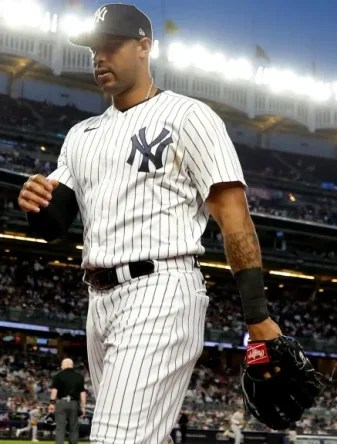
Aaron Hicks

The Yankees finally put the lime in the coconut over Aaron Hicks.

Extremely few things cause me indigestion. Talk about a team “eating” money to be rid of an unproductive or faded player is one of them. Such talk erupted again when the Yankees, come Saturday, designated outfielder Aaron Hicks for assignment. It isn’t just fans who don’t know better talking that way. It’s also professional analysts who should.

“You don’t have to understand or agree with the replacement-level concept to agree on this much: there are scores of minor-league outfielders who, given the opportunity, could provide the Yankees with more than Hicks has to date. Just eat the money already,” writes CBS Sports’s R.J. Anderson.

“It’ll be a costly move for the Yankees, with Hicks still owed $19.57MM by way of $9.8MM salaries in 2024-25, and a $1MM buyout on a $12.5MM club option for 2026. He’ll also be owed the remainder of his $10.8MM salary in 2023,” wrote MLB Trade Rumors‘s Simon Hampton. “Hicks will now be exposed to waivers, but his struggles this year and the remaining money owed make it a near certainty he goes unclaimed. Instead, the Yankees could offer to eat the remainder of his contract and try and trade him to another team, or he could be released once he clears waivers.”

Pass the Pepto-Bismol, please. For me. It’s too late for the Yankees regarding Hicks.

Remember when the Diamondbacks bit the bullet and released thoroughly collapsed pitcher Russ Ortiz? The Associated Press said flatly enough that the Snakes decided they’d rather “eat” the $22 million they still owed Ortiz than keep him taking up roster space. Remembering that, Keith Law (in The Inside Game) tried to remind us: they ate nothing.

“That salary was already somewhere in Arizona’s GI tract, likely causing indigestion but there nonetheless,” Law wrote. “Major League Baseball player contracts are guaranteed; there is no way to un-eat that meal.”

Notice that almost no one was talking about somebody eating Eric Hosmer’s contract after the Cubs designated the veteran but fading first baseman earlier the same week? Cynically, you could say it’s because $700,000+ (his MLB-minimum Cub salary) is a mere appetiser compared to the $144 million banquet to which the Padres signed Hosmer during spring training 2018.

That was an eight-year deal which has through the end of the 2016 to run. Some said the Padres elected to eat the rest when they traded Hosmer to the Red Sox last August and sent the Red Sox the last $44 million owed on the deal. Those with something more than mashed potatoes for brains could remind you: the Padres planted that meal down their tract the day they signed him in the first place.

The Yankees thought Hicks would be a good fit after landing him for the 2016 season because he looked like a solid hitter who didn’t strike out a lot compared to a lot of others at the time, and because he had a live-looking throwing arm in the outfield. They didn’t bargain on injury-disrupted seasons that came to bring forth the worst in Yankee fans still struggling with the presence of even more injury-battered Jacoby Ellsbury.

It didn’t help that Hicks wasn’t quite as good as his notices when he could play, though he did have his moments—and a 2018 season solid enough to encourage the Yankees to sign him to a seven-year, $70 million contract extension plus the aforementioned option years during spring training 2019. The fact that he had some pop, wasn’t shy about taking walks, and didn’t strike out in big volume didn’t hurt, either.

In the first three years of the deal, Hicks missed significant time with injuries (wrist, back, elbow) each of the three and, perhaps unsurprisingly, didn’t play particularly well when he could play. In center field he was about league average for run prevention and for getting to balls in the first place; at the plate, he might have prayed to improve all the way up to league average.

At 33 it might seem that history of injury and inconsistency might put paid to Hicks’s major league career soon enough. Unless he’s willing to accept a purely platoon role on a team needing inexpensive help against portside pitching. (Hicks is a switch hitter but he’s been a little stronger batting righthanded.)

The Yankees finally surrendered after swinging a trade with their most hated rivals (in Boston) to bring aboard outfielder Greg Allen and needing room for him on the roster. Allen isn’t much of a hitter but he’s considered a plus outfield defender and swift on the bases—if he gets there in the first place. (Lifetime on-base percentage: .299.)

The meal has been somewhere between the Yankee belly and the intestines since 2019. They finally, simply, put the lime in the coconut to relieve the bellyache.

The tip of the week

Aaron Judge

Judge shot this glance toward the Yankee dugout Monday night. On the next pitch—thrown by a Blue Jays reliever who admitted he’d handed the Yankees invaluable intelligence—the Leaning Tower of River Aenue hit the most powerful glancing blow of all time.

Say what you will about the Aaron Judge sideways glance Monday night in Toronto. You’re going to say it anyway, of course. But catcher-turned-Blue Jays broadcast analyst Caleb Joseph is way out of line suggesting that, if Judge was looking for a sign based on Blue Jays relief pitcher Jay Jackson tipping his pitches, the Yankee bombardier needs one thrown at his head post haste.

Because, you know, sign stealing the old-fashioned way—picking up on tipped pitches or signs from the field or the dugout, as opposed to an Astro Intelligence Agency off-field based espionage operation—is still a crime against nature. Never mind that that kind of sign stealing is almost as old as professional baseball itself. It may be a little unethical, but it doesn’t rise to the level of felonious grand theft.

Judge’s original response to questions after that game was that he’d heard more than a little chirping from the Yankee dugout, based on manager Aaron Boone being tossed over objections to plate umpire Clint Vondrak’s strike call on a low Jackson service. That bad call ran the count to 1-2.

That’s when Judge shot his now-infamous sideways glance toward the Yankee dugout. Before hitting a subsequent pitch 462 feet into the second deck behind the center field fence.

“I feel like after the manager does his thing, it’s like, ‘Fellas, our pitcher has still got to go out there and make some pitches’,” Judge said postgame. “We’ve got the lead, let’s just go to work here.’ I said a couple of things to some guys in the dugout and especially after the game. Hopefully it won’t happen again.”

The issue became compounded after Jackson admitted in due course that, yes, he just might have been tipping his pitches, a very common occupational hazard in his line of work. Players have sought little “tells” from pitchers from time immemorial. Even the greatest of pitch-shielding pitchers can be prone to giving one up from time to time without even realising it.

So what was with Judge speaking about Yankee dugout chirping? Easy enough. You don’t think he’s really going to give away how his mates picked up on Jackson’s tips, do you? Neither Judge nor the Yankees are going to commit treason if they can help it.

“From what I was told, I was kind of tipping the pitch,” Jackson told The Athletic. “It was  . . . the time it was taking me from my set position, from my glove coming from my head to my hip. On fastballs, I was kind of doing it quicker than on sliders. They were kind of picking up on it.”

Jackson didn’t sound even a fragment as outraged that the Yankees picked up on that tell as Joseph did during a pre-game show advancing Tuesday’s Yankees-Blue Jays contest.

“Everybody’s doing this, folks. Every team in the big leagues, they’re taking what’s handed to them,” Joseph began, giving what amounts to a confession that, yes, boys will still be boys and, so long as they’re not committing 2017-18 Astros-like black bag jobbing, it’s not exactly a call for outrage or vengeance.

Until it is, apparently.

“And it’s only bad until you get your hand caught in the cookie jar,” Joseph continued. “If I’m a mom or dad when I see my kid with their hand in that cookie jar, I’m slapping that hand. So I’m trying to send a message. And there was a time earlier in my career when, yes, messages were sent to me too. Right at my head when it wasn’t good. I would like to see Kevin Gausman come out and send a message.”

Gausman didn’t send any message Tuesday because none was called for. What he did do was get Judge to ground out and strike him out twice. The bad news for the Jays was Gausman’s relief Erik Swanson hanging a 1-0 slider that hung enough for Judge to send it almost as high past the center field fence as his glancing blast traveled Monday night.

Joseph was far less admirable demanding retribution than Jackson (optioned back to Triple-A afterward) was gracious when learning he’d handed the enemy a big break. “If they knew it was coming and he clipped me,” the righthander said, “he clipped me. I’m glad he hit it as far as he did.” The Yankees certainly were.

Jays manager John Schneider didn’t seem to think the Yankees committed Astrogate-style embezzlement, either. Even if he’d prefer his pitchers save their tipping generosity for the restaurant.

“If you’re doing things in plain sight,” Schneider said, “I think that you have to be able to correct them and you have to be willing to have the consequences be what they are. If it’s done fairly, yeah, that’s part of the game, everyone’s looking to help their teammates, everyone’s looking to pick up on tendencies, so anything that’s happening on the field in the right way, totally fair game.”

“In a very real sense,” wrote Paul Dickson in The Hidden Language of Baseball, “responsibility for tipping pitches or plays rests with the team, especially its coaching staff, so it amounts to a team error.” An unforced error at that. Something Mr. Joseph might want to ponder, before the next time he decides a tipped pitch caught, mugged, numbered, and murdered, deserves decapitation.

So what did Yankee pitcher Domingo German do on Tuesday night? He flunked a pre-inning sticky stuff test administered by umpire James Hoye and got himself tossed post haste and suspended ten games. This was after he’d already been warned, earlier in the season, about overdoing that good new fashioned medicated goo, and after he’d promised to use the rosin on the mound more.

“We all had the same opinion,” Hoye said of his umpiring crew about German’s suspect paw. “Shiny, extremely sticky, and it’s the worst hand we’ve ever felt during a game.” Worse than a busted flush.

Not brilliant, when the Yankees had to press Ian Hamilton into quick duty . . . and Hamilton ended up on the fifteen-day injured list after having to warm up too hastily. And when the Yankees just finished convincing those not disposed to believe them the root of all evil that there was nothing sneaky about catching and clobbering a tipped pitch.

Don Denkinger, RIP: Survival

Don Denkinger

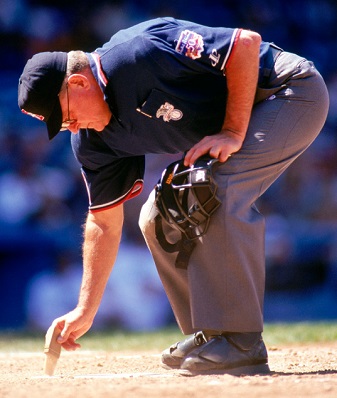
Don Denkinger, dusting home plate clean during a game. He owned his grave 1985 World Series mistake—you know, the one that really didn’t cost the Cardinals a Series championship.

Now-retired umpire Ted Barrett blew a call the first time he worked on a crew with Don Denkinger, in July 1995. Brewers pitcher Scott Karl threw to first looking to bag Mariners outfielder Rich Amaral. Amaral eluded the tag as he scrambled back to first and made it safely, except that Barrett called him out.

Reviewing video after the game, Barrett saw clearly enough he’d blown the call and felt as low as a man could feel. As he walked out of the Kingdome to his car, Denkinger caught up to him and asked what was wrong. Barrett said he felt terrible for having blown the call.

“[H]e looks at me with a grin,” said Barrett to ESPN about Denkinger, who died at 86 Friday, “and says, ‘Try (messing) one up in the World Series.’ I was like, whoa, respect this guy.”

Exactly. Denkinger’s moment of infamy in Game Six of the 1985 World Series made him public enemy number one in St. Louis and elsewhere. (In Kansas City, of course, Denkinger might have been seen as a blessing from the gods.) But once he got past the tumult, the screaming, the humiliation, and the worst of the foulness that followed him, he proved a man who not only learned from his worst mistake but knew how to get behind the proper answer for future such mistakes.

With the Cardinals up 1-0 going to the top of the ninth, calling Royals leadoff pinch hitter Jorge Orta safe on a slow bouncer off first base was a horror known at once to everyone in Kauffmann Stadium and viewing on ABC television. “Nobody wants to have the call that I did in the World Series,” Denkinger told a reporter nine years ago. “But I did. And now it’s part of history.”

Cardinals first baseman Jack Clark fielded the ball cleanly and tossed to covering relief pitcher Todd Worrell, who caught the toss with his foot on the pad well ahead of Orta. The Cardinals and their Hall of Fame manager Whitey Herzog fumed. The call stood, alas. Then a base hit, a bunt, a passed ball, an intentional walk, and a bloop two-run single later, the Royals stood having tied the Series.

Thanks to the normal Series umpire rotating, Denkinger was due to call balls and strikes for Game Seven. The Cardinals seemed more concerned with having been robbed the night before than playing the here and now, and their wheels came off early enough and often enough.

The fury got filthy enough that a regional radio host gave out Denkinger’s home address on the air. More than a few nasty death threats against the ump and his family prompted the FBI itself to investigate. Some way, some how, Denkinger managed to pick himself up, dust himself off, and start all over again to finish a career that shook out as far more distinguished than extinguished.

When Herzog himself started banging the drum none too slowly on behalf of bringing replay review at least to the postseason, Denkinger became an easy ally. Until the day baseball finally decided getting it right was imperative, especially when championship advance or finality was on the line, Denkinger was one of replay’s staunchest supporters.

“I’m not tired of talking about it,” he said in the aforementioned interview. “I mean, it happened. I just know that if the same thing happened now, they’d get it right on replay and it’d be over with.”

This wasn’t a C.B. Bucknor or a Laz Diaz or an Angel Hernandez or a Joe West type who was liable to harrumph “Tough you-know-whatties” whenever someone called him on a horrifically bad call. This was an earnest fellow who’d made the biggest mistake of his career and refused to let it define him or soil him. He blew it. He knew it. He owned it. He went back to finish an almost entirely honourable career.

He probably knew, too, that the Cardinals didn’t exactly have the Royals down to their final out; that they could still have found a way to get three outs before any Royal got anywhere near scoring; or, having failed to do that, come to Game Seven ready to play.

Instead, they saw Denkinger behind the plate and imploded while Royals righthander Bret Saberhagen manhandled them and the Royals manhandled Cardinal pitching for eleven unanswered runs. Anyone on earth, no matter how Game Six ended, would have been justified telling the Cardinals nobody trained artillery upon them and told them to fall flat on their own faces.

Even Denkinger. The closest he came was in the fifth inning, when Joaquin Andujar—normally a starter but now pressed into desperation relief—erupted over a close pitch and Herzog had to hustle out to keep Andujar from being run, while Cardinals third baseman Terry Pendleton and Hall of Fame shortstop Ozzie Smith kept Andujar from trying to tear Denkinger (who’d been a wrestler in high school) into strips.

“If you’d done your damn job last night, we wouldn’t be here!” thundered the White Rat.

“If your team were hitting better than .120 [in the Series],” Denkinger shot back, “we wouldn’t be here, either.” (The Cardinals finished that Series batting .185 as a team.)

Then he ran Herzog over an obscenity and Andujar a pitch or two later over another fury. The Cardinal implosion continued apace, and the upstart Royals finished what they started, an 11-0 Game Seven spanking to win their first of only two World Series championships.

Denkinger had good humour enough to accept Herzog’s own demonstration of good humour a couple of decades after the Hour of Infamy—mutual laughter when, at a dinner honouring the 1985 Cardinals, members of the team were presented spanking new Seiko wristwatches and Denkinger was presented a spanking new watch . . . in Braille.

How well did Denkinger survive otherwise?

When he ran into Dane Iorg the following spring, Iorg having been the Royal who blooped the Game Six-winning runs home, Denkinger joked, “You know, I just had the worst offseason of my life thanks to you.”

He survived well enough to work behind the plate for Hall of Famer Nolan Ryan’s sixth no-hitter, Hall of Famer Jack Morris’s ten-inning 1991 World Series shutout, and Kenny Rogers’s perfect game in 1994—making him one of seven arbiters to work two perfect games. (Denkinger also worked third base for Len Barker’s perfecto in 1981.)

Well enough to retire after the 1998 season because a balky knee was no longer tolerable for standing nine innings a day for six months a year. (The St. Louis Post-Dispatch headlined a story about his retirement thus: “Don Denkinger won’t miss any more calls at first base.” Put that headline writer into the Hall of Shame.)

“I’ll put on there whatever you want,” Denkinger told Sports Illustrated in 2015, when noting some autograph seekers asked him to sign “Oops” next to his name. “It doesn’t make any difference. Life’s too short to do that to yourself, let this dictate your life. I just took the other avenue. Life goes on. Enjoy it.”

“If anything,” his daughter, Denise, told the magazine, “it’s made me even more proud that he’s my dad. He didn’t hide from it. He didn’t say it was someone else’s fault. He took ownership of it.” Said his wife, Gayle, “He made one mistake, but that didn’t define him. Aren’t we all entitled to a second chance?”

The jerk contingencies among sports fans that proclaim human error to be moral degeneracy worthy of the death of ten thousand cuts (and threats) won’t like it, but the answer is yes. Especially if you own your mistake at once and continue by showing you learned everything you needed to learn from it and perform accordingly.

Come to think of it, the jerk contingency among umpires who think fans pay their hard-earned money to come to the ballpark to see them wield power could do to learn a lesson or three from Denkinger. Surely the Lord is reminding him of that, too, over a couple of tall ones in the Elysian Fields. May he get to call a perfect game or three there during his hard-earned eternal peace.

Vida Blue, RIP: “You deserve it. But I ain’t gonna give it to you.”

I’m talkin’ baseball—like Reggie, Quisenberry
Talkin’ baseball—Carew and Gaylord Perry
Seaver, Garvey, Schmidt, and Vida Blue
If Cooperstown is calling, it’s no fluke—
they’ll be with Willie, Mickey and the Duke.

Terry Cashman, “Willie, Mickey and the Duke (Talkin’ Baseball),” 1981.

Vida Blue

A Time cover star one season, Vida Blue became a poster child for Charlie Finley’s caprice and cruelty the next.

Out of 24 major league rookies to throw no-hitters, Vida Blue had the greatest sophomore season of the group—including the only Hall of Famer among them, Christy Mathewson. That sophomore season made him a national phenomenon, a Time cover star, a Cy Young Award winner, the American League’s Most Valuable Player . . . and a particular victim of then-Athletics owner Charlie Finley’s notorious caprice.

Blue died at 73 Sunday. He’d never again equal that surrealistic 1971, after his owner left him feeling worthless during offseason contract talks that took a turn called nasty even by Finley’s contradictory standards. He’d be a good pitcher who never again got anywhere near the greatness his 1971 promised.

On 21 September 1970, Blue struck nine Twins out (including Hall of Famer Harmon Killebrew twice), walked one, and landed a 6-0 gem supported by a run-scoring double play in the first and a five-run eighth, finished when A’s shortstop Bert Campaneris—in the middle of a very unlikely 22-homer season (he averaged five per 162 games lifetime)—yanked a three-run bomb with two out off the Twins’ Jim Perry.

Slightly over a year later, Blue finished that Time season credited with his 24th win, before what looked like a certain American League Championship Series Game One triumph turned into disaster: leading the Orioles 3-1 entering the bottom of the seventh, Blue and the A’s were torn for four runs, two scored by Hall of Famers Frank and Brooks Robinson, en route a 5-3 loss that led to being swept out in three.

Still, Blue sat atop baseball’s mountain. No Show sophomore sat higher. As Time put it with a corner banner on his cover issue, the 21-year-old lefthander put “new zip in the old game.” He’d posted a staggering 1.82 earned run average, a 0.95 walks/hits per inning pitched rate, and a 2.20 fielding-independent pitching rate. On the mound he looked taller than his six feet with his knee-up, arm-whip delivery. And, with a fastball considered the hardest that didn’t belong to Hall of Famer Nolan Ryan.

As would be said of another ill-fated child prodigy, Dwight Gooden, over a decade later, Blue was great before he’d even had much chance just to be good. He stood at 22 as the youngest man ever to win an MVP and the youngest (until Gooden over a decade later) to win a Cy Young Award. Analysts determined that one out of every twelve tickets to American League games were sold for his starts.

Even President Richard Nixon got into the act, when learning Blue’s 1971 salary ($14,500) was barely above rhe rookie minimum. Nixon called Blue “the most underpaid player in baseball.”

Then it came time to talk contract for 1972, in the days before Curt Flood lost his reserve clause challenge at the U.S. Supreme Court and well before Andy Messersmith pitched contract-less and prevailed to finish what Flood started. No player that offseason would better evoke the once-fabled malaprop of radio comedy legend Jane Ace: “You’ve got to take the bitter with the better.”

Audaciously, Blue engaged an agent and asked for a $100,000 salary for 1972. It happened, according to Jason Turbow’s Dynastic, Bombastic, Fantastic: Reggie, Rollie, Catfish, and Charlie Finley’s Swingin’ A’s, when Blue’s veteran teammate Tommy Davis—seeing him drowning in endorsement offers—introduced him to a California attorney named Bob Gerst, who agreed to represent Blue for a flat fee instead of percentages per.

You can only imagine how little Finley loved that idea. The same Finley who’d crowed during Blue’s sensational season, “Don’t you worry about him making money. He is going to make money. He is going to get more than money. He is going to get great things from this game. I’m going to see that he gets great things. I’m going to protect him.”

Come 8 January 1972, Finley proved just how much he’d protect Blue. Aghast as it was that Blue had Gerst in tow, Finley simply couldn’t resist talking down to the earnest lefthander.

Well, I know you won twenty-four games. I know you led the league in earned-run average. I know you had three hundred strikeouts. [Actually, 301, but let’s not get technical.—JK.] I know you made the All-Star team. I know you were the youngest to win the Cy Young Award and the MVP. I know all that. And if I was you, I would ask for the same thing. And you deserve it. But I ain’t gonna give it to you.

“He said it with a smirk,” Blue would say later, “and, man, it made me want to slide under the table.” This was the kid who’d gone on a USO tour of Vietnam with comedy legend Bob Hope and, when Hope asked how come he didn’t get more money from Finley, cracked, “Well, Mr. Finley claimed I was only using one arm.” Who knows how much of a strand of truth that crack contained?

The talks became contentious enough that Finley took them public while Gerst helped swing a profitable non-baseball job for Blue to prove he wasn’t kidding around. A’s players were torn between believing Blue should get every dollar he thought he was worth and wishing he’d sign for Finley’s proffered $50,000 just to be among them.

Gene Tenace, Vida Blue

Vida Blue (right) with catcher/first baseman Gene Tenace, at a 40th anniversary celebration of Oakland’s first of three straight World Series championships.

Blue even announced he would leave baseball for that job with a successful bathroom fixtures manufacturer. (Wags suggested Blue was going down the toilet.) Finley’s pressures included making Davis—maybe the team’s most valuable bench player in 1971—a scapegoat for introducing Blue to Gerst, and rather nastily. He ordered a very unwilling manager Dick Williams to wait until the A’s arrived at the ballpark, for a spring exhibition game three hours from home, before telling Davis he was released—and leaving Davis to find his own way home. (Turbow recorded that the A’s traveling seceretary loaned Davis his car.)

Blue got some relief from baseball’s first-ever players strike, over a 17 percent pension hike, the players finally agreeing to settle for a little over half that. Finley kept the pressure up, acquiring once-glittering but shoulder-ruined righthander Denny McLain and trading popular outfielder Rick Monday to the Cubs for pitcher Ken Holtzman. Finally, commissioner Bowie Kuhn interceded.

“It wasn’t that Finley’s $50,000 offer was outrageous, the Commissioner said,” Turbow wrote, “but that ‘Finley had a way of making it seem so’.” Blue finally came away with a $63,000 1972 salary. “He treated me like a damn coloured boy,” the lefthander told two California newspapermen when the deal was done. “Charlie Finley has soured my stomach for baseball. Tonight isn’t tell it like it is. Tonight is tell it like I feel.”

After being part of three straight A’s World Series titles, after being one of the players whose sales post-Messersmith Finley tried but Kuhn foolishly blocked*, and after a trade to the Giants that saw him become the first pitcher to start All-Star Games for each league, Blue would move on to the Royals—and become one of five teammates sent to the slammer on drug charges after the 1983 season.

Blue struggled with cocaine addiction until he retired before the 1987 season. He became a pre- and postgame television analyst for Giants games; he became known for philanthropy in the Bay Area and as a role model for children he worked with through a Giants’ outreach program. His marriage (the couple walked under a an arc of bats held by Giants players as they walked to the Candlestick Park mound) ended in divorce; he may have beaten cocaine but struggled further with drinking.

Maybe the Finley contract contretemps roots it. He became “bitter and withdrawn,” noted John Helyar in The Lords of the Realm, “eventually developing a drug problem that landed him in court.” Except that, somehow, away from the field, Blue remained likeable and magnetic.

“Vida’s such a wonderful guy,” said Hall of Famer Orlando Cepeda to the San Francisco Chronicle’s John Shea in 2005, after Blue was dinged for driving under the influence. “He’s been through a lot, but he likes to keep things inside. I went through some tough times myself, and sometimes you’ve got to open up and accept help from your friends.”

And, your children. Blue had a son and two daughters; the son, Derrick, told Shea, “He’s got great people skills, and I think that’s been a downfall. People have let him get away with more. People come to me and say, ‘He’s a great guy. He took us out drinking and partying.’ I cringe. That’s what’s wrong with being professional athletes, my dad included.”

A one-time A’s teammate, ill-fated pitcher Mike Norris—one of the early 1980s “Five Aces” said to be ruined by temperamental manager Billy Martin’s callousness toward pitchers and their workloads and by his own issues with drugs—wondered to Shea just how much substance abuse ruined Blue when Finley hadn’t.

I wanted to be the best black pitcher in the history of baseball, the first to win thirty games, but I screwed it up. So you kick yourself in the ass about it. Maybe I could’ve been in the Hall of Fame. It sounds cocky, but winning twenty games wasn’t hard for me. [Substance abuse] led to my arm injury. Being addicted, you’re not going to eat or sleep. You can’t play this game without eating or sleeping. Vida had the best fastball I’ve ever seen, and that includes [Hall of Famer] Nolan Ryan or anyone else. It was inevitable he’d go to the Hall of Fame. I believe . . . Finley turned him off to baseball. If he left him alone, there’s no telling what would have happened to this beautiful person.

Most recently, Blue took part in an A’s celebration marking the half-centenary of their 1973 World Series winners. Who knows what went through Blue’s mind and heart, riding in a classic, antique Thunderbird convertible, around a ballpark left gone to seed, hosting an A’s team left in ruins by an owner who might, maybe, make Finley resemble a kindly grandfather by comparison?

“I know he hung on for that last anniversary celebration like the absolute gamer he was,” tweeted Dallas Braden, another ill-fated A’s pitcher, whose Mother’s Day perfect game was the highlight of a career rendered brief by a shredded shoulder, and who’s since been an A’s game analyst for NBC Sports Bay Area. “Rest easy, Mr. Blue.”

We wish Blue’s family comfort in knowing the man will be remembered for what he was, for what his boss did to him, and for how he tried every time his addiction demons flattened him to flatten them right back. And we wish Blue nothing less than a deserved rest in the Elysian Fields, with the Lord’s embrace, forgiveness, and love.

———————————————————————————-

* In The New Bill James Historical Baseball Abstract, James probably said it best about Bowie Kuhn’s quash of the notorious Charlie Finley fire sale bid of 1976:

[It] was an ignorant, bone-headed, destructive policy which had no foundation in anything except that Kuhn hated Charlie Finley and saw that he could drive Finley out of the game by denying him the right to sell his [star] players.

What Kuhn should have done, if he had been thinking about the best interests of the game, is adopt the Landis policy: rule that players could be sold for whatever they would bring, but 30% of the money had to go to the players. Had he done that, the effect would have been to allow the rich teams to acquire more of the best players, as they do now. But this policy would have allowed the rich teams to strengthen themselves without inflating the salary structure, and would have allowed the weaker teams, the Montreal-type teams, to remain financially competitive by profiting from developing young players.

“The Landis policy” refers to longtime commissioner Kenesaw Mountain Landis’s suggestion—un-acted upon, of course—after Pacific Coast League star Earl Averill refused to report to the Cleveland Indians unless he got a percentage of the sale price the Indians paid the San Francisco Seals to buy him. It may have been the single smartest idea Landis ever had, and it fell on the proverbial deaf ears.

The players on Finley’s fire-sale market were Blue, Hall of Fame relief pitcher Rollie Fingers, and outfielder Joe Rudi.

The former Dark Knight, retiring with grace

Matt Harvey

Matt Harvey, young, a Met, and a Dark Knight.

Few baseball surges of the 2010s were as electrifying as Matt Harvey’s. Few baseball shrinkages were almost that electrifying. And, after a few years of trying and getting not even close to back to where he once belonged, Harvey elected to call it a career Friday.

The former Dark Knight, who’d provoked Mets fans to declare “Happy Harvey Day!” on the days he started, announced his retirement on Instagram. “With all the amazing memories came a lot of injuries and tough times,” the 34-year-old righthander wrote.

The realization that those amazingly powerful moments that make me thrive as a pitcher and help my teammates and city win are no longer possible. Believe me I wish I could have done more and brought more of those amazing moments back to life. I have to say this is my time to say thank you, and goodbye.

Asking Harvey to retire with no regrets would be asking him to be superhuman. That’s an ask he can’t possibly satisfy. He’d tried that earlier and too often in his career, on the mound and off it, and he nearly fried himself alive trying.

In the Show, Harvey was last seen trying a comeback with the Orioles two years ago. He started with three shutout innings followed by a dicey fourth in his first Oriole start. He went on to post for the season a modest 4.60 fielding-independent pitching (FIP) rate, a ghastly 6.27 earned run average, a 2.57 strikeout-to-walk rate, a 1.54 walks/hits-per-inning pitched rate (WHIP), and was hittable for 11.3 hits per nine innings.

That was double the transcontinental distance from his staggering second Mets season, 2013, when he led the Show with a 2.01 FIP, posting an 0.97 WHIP and a 6.16 K/BB rate, good enough to finish fourth in the National League’s Cy Young Award voting.

Those were the days when Harvey embraced New York and its white-hot heat as ardently as the city embraced him. “To the fans, most importantly the NY Mets fans: you made a dream come true for me,” he wrote in his retirement post. “A dream I never could have thought to be true. Who would have thought a kid from Mystic, [Connecticut] would be able to play in the greatest city in the world, his hometown. You are forever embedded in my heart.”

He’s had worse than that embedded in his heart. Harvey’s early ability to pitch like an executioner on the mound was equaled only by his ability to find and dwell among the demimonde as though it had his name on it.

He electrified the country when he started the 2013 All-Star Game and—having to shake off a leadoff double from future Hall of Famer Mike Trout followed by hitting Robinson Canó with a pitch—struck three out in two innings’ work and surrendering not a single run. (The American League went on to win, 3-0.)

He missed 2014 recovering from Tommy John surgery, but he electrified the country further when he all but ordered his manager Terry Collins to leave him in to pitch the ninth in Game Five of the 2015 World Series.

Uh-oh. Collins went with Harvey’s heart while misreading his fuel tank. He walked Kansas City’s Lorenzo Cain to open, then surrendered Eric Hosmer’s RBI double. Then Collins lifted him for Jeurys Familia. Two ground outs, one of which provoked Hosmer’s daring dash home while Mets first baseman Lucas Duda threw what should have been an easy double play ball offline to the plate (Hosmer would have been dead on arrival if the throw was accurate), tied a game the Royals won with a five-run twelfth as the rest of the Mets bullpen lost its wheels.

The Royals had bypassed Harvey in the 2010 draft. The guy they took instead, infielder Christian Colón, sent what proved the Series-winning run home. “I still have nightmares over that,” Harvey would tell the New York Post about the game. “One thing I’m most angry about is not getting it done.”

He’d have better reason to be angry the following season: he was hit with thoracic outlet syndrome in July 2016 and gone for the season. And, never again the same pitcher. TOS occurs when blood vessels and/or nerves between your collarbone and your first rib compress. That causes shoulder and neck pain and finger numbness.

“I had TOS,” Harvey’s former fellow Mets pitcher Dillon Gee once said. “I know how much that sucks. It definitely changes you. You start trying to tinker with things. It’s not natural anymore. You start being robot-ish. You start not trying to hurt one area and totally hurt another area. Your whole body is out of whack.”

Harvey’s body wasn’t the only thing going out of whack. Between TOS and a 2017 season interrupted nastily by another shoulder injury, Harvey melted down almost completely. The mound no longer elevated him; the city’s bright lights and demimonde no longer seemed to comfort him entirely.

Very publicly, he found himself dropped by a Brazilian supermodel with whom he thought a real romance was seeded—until she elected to return to her former beau, an NFL wide receiver, leaving a glittering party with the man. That was the night before he showed up late for a game against the Marlins claiming a migraine that was translated to mean a hangover.

Harvry had had such a big-timing attitude prior that now, when he needed empathy, aid, and comfort most, he had none. A year later, after refusing to try it out of the bullpen, perhaps out of stubborn lingering pride, Harvey’s days as a Met ended in a trade to the Reds. “Besides life on his fastball and bite on his slider, you know what was missing with Matt Harvey?” asked Joel Sherman of the New York Post after the deal. The answer:

Compassion. There was no empathy from a teammate or member of management for Harvey’s plight. They wanted him to rebound and do well, but that was about the team and their own selfish desire for success.

Matt Harvey

Humbled, Harvey pitched respectably for the Reds following his trade from the Mets. But he couldn’t reimagine his form successfully in stops at Anaheim, the Oakland system, Kansas City and Baltimore (above). 

Tom Verducci, the Sports Illustrated writer who first handed Harvey the Dark Knight nickname (picking up on Harvey’s boyhood love of Batman), advised one and all that Harvey’s taste for New York’s night life wasn’t the reason he’d collapsed on the mound. “The truth is, for all the times he wound up in the tabloids other than the sports section, Harvey failed because his arm failed him,” Verducci began.

. . . His arm likely failed him because of how he threw a baseball. And when his arm failed him, he knew no other way. He couldn’t pitch without an A-plus fastball, he couldn’t embrace using a bullpen role as a way back, and he couldn’t believe in himself again.

. . . The Mets cut Harvey because his once-fearsome fastball became the almost exact definition of a mediocre fastball (MLB averages: 92.7 mph, 2,261 rpm). Because he couldn’t find another way to get hitters out, because he could not change his mechanics and because he could not buy into the bullpen, the Mets could not keep sending [him] out to the mound as a starter.

The decline in his stuff was obvious. And there was no way his fastball was coming back with the way he throws.

As a Red, Harvey finished his walk year into free agency with a respectable if unspectacular enough performance that the Angels were willing to take an $11 million flyer on him for 2019. He lasted long enough to be designated for assignment that July. The Athletics signed him but he never saw Show action. The Royals took a chance on him for pan-damn-ically shortened 2020.

A free agent again, the Orioles took a chance on Harvey for 2021. He re-signed with the organisation for 2022 but he spent the season at three minor league levels around a sixty-day suspension after testifying in the Eric Kay trial that he’d used painkillers provided by Kay while with the Angels.

Kay was tried, convicted, and sentenced to 22 years in federal prison, having been the man who provided the drugs that killed popular Angels pitcher Tyler Skaggs. On the stand, Harvey admitted he’d given Skaggs (who was likely addicted to painkillers following early-career Tommy John surgery and subsequent other injuries), a few Percocets, perhaps unaware of the depth of Skaggs’s addiction. He didn’t shrink from it, he didn’t try to excuse it.

Harvey pitched in this year’s World Baseball Classic—for Italy, posting a 1.29 ERA in two starts before Team Italy lost to Japan and eventual WBC most valuable player Shohei Ohtani in the quarterfinals. It tempted him to try one more major league comeback. But it was just a temptation. Maybe the most important temptation Harvey resisted. He got to leave the mound permanently on a very high plane, at any level.

(For the record, his Team Italy manager, Hall of Fame catcher Mike Piazza, saluted Harvey upon his retirement announcement: “Look forward to teeing it up with you man..I want to Thank You for your awesome effort in the @WBCBaseball, You’re a warrior on the bump.”)

Back in 2020, he offered the Post something few who knew him as a Met might have accused him of having: introspection. “There are a lot of things I’d do differently,” he began, “but I don’t like to live with regret.”

There were just things I didn’t know at the time. Now, obviously, I’ve struggled the last few years. And what I know now is how much time and effort it takes to stay at the top of your game. I wouldn’t say my work ethic was bad whatsoever, but when you’re young, it’s not like you feel invincible, but when everything is going so well, you don’t know what it takes to stay on the field. It’s definitely more time consuming and takes more concentration.

Too many sports party boys don’t learn until their sports say goodbye to them first. Harvey learned soon enough, if sadly enough, that the party doesn’t always end on your terms. The Dark Knight who crashed and burned off the mound while his body betrayed him on it became something far more important before he retired: a man.