It’s déjà vu all over again

Four years ago, the Yankees were so injury riddled that I couldn’t resist (half) joking that the team’s yearbook would be an issue of The New England Journal of Medicine. And, that Yankee Stadium would have to feature a banner above its main entrance:2019-04-21 YankeeStadium02

It’s déjà vu all over again. The Yankees are . . . injury-riddled. Again. They’re also two games above .500 as of Thursday morning’s standings, but they’re also fifth in a deceptively tough American League East. Just as in much of the past few seasons, The New England Journal of Medicine could be mistaken for the Yankee yearbook. And fans of the Broken Bombers are getting restless. Yet again.

The defending American League single-season home run record holder, Aaron Judge, hit the infirmary list when he injured his hip. Happy 31st birthday, Your Honour. Giancarlo Stanton suffered a hamstring injury in mid-April that may keep him out until early June. Josh Donaldson, Tommy Kahnle, Jonathan Loáisiga, Frankie Montas, Carlos Rodon, Luis Severino, Lou Trivino—infirmary list.

And that was before Harrison Bader—sprung from the injured list Tuesday—went right back onto it, taking Oswald Peraza with him, when they collided Tuesday night on a ninth-inning play enabling the Guardians to break a two-all tie in a game the Yankees finally won, 4-3.

Oh, sure, manager Aaron Boone made a point of saying postgame that Bader was in good spirits and even laughing about the crossroad collision as he came diving from one way as Peraza came diving from the other way. But it had to be laughter like Figaro’s, that the Yankees might not weep. Yankee fans, of course, don’t know whether to weep or call for summary executions.

The Yankees had Thursday off. At the rate they’re going so far, off days may be the only days guaranteed not to feature yet another Yankee off to sick call. But the Rays—those guys who opened the season with a thirteen-game winning streak, and still have a Show-beat 25-6 record—own the AL East after the first month plus. The Orioles (!) have twenty wins and sit ten games above .500, close enough to the franchise’s good old days. The Blue Jays are 18-13 and already took two out of three from the Broken Bombers. The Red Sox are 18-14, still have some kinks, but little enough compared to the Bronx’s orthopedic ward.

Maybe the Yankees aren’t in the game’s worst shape. Certainly not compared to the usual tankers and especially those in Oakland who’ve been driven into the tanks by an owner who’s all Three Stooges at once without being even a tenth as funny. But all you have to do is listen to enough Yankee fans. You’d think it was the end of the world as you knew it and you shouldn’t feel fine.

Do I really have to repeat myself and say there are scads of fans all around the Show who’d just love to be able to think a season without their team in or winning the World Series is an illegitimate season? Can you name one other team whose fans remain—by dint of having been there, or handed down as a smug legacy—wedded to the battle cry, “Wait till last century!”

‘Tis true that without its Goliaths baseball’s Davids would have nothing toward which to aspire. The Yankees in this century are anything but Goliaths. Once upon a time you couldn’t tune your memory to times when the Yankees were less than baseball’s Huns. Today the Yankees are only human, but their fans are still spoiled rotten.

Look yonder to the National League Central, where the Pirates—who’d been in the tank longer than the town drunk—sit prettily enough atop that division. The NL Central isn’t exactly the Third Army of World War II, but a 20-11 record isn’t necessarily dismissable.

Never mind that they’re one game above .500 against other contenders real or reputed. These Pirates are for real, for now. Their fans have a few glories from last century on which to lean, but they certainly don’t behave as though they’re entitled to a bloody thing. Maybe too many years in the tank does that for you.

The Orioles were long thought left for dead by their own ten-thumbed owners, but lo! They, too, were 20-10 as of Thursday morning. Camden Yard has gone from a ghost yard to a party yard. Never mind that they were exactly .500 against actual or alleged contenders. Don’t spoil Oriole fans’s fun just yet. The song of the Birds is the sweetest it’s been for eons.

But look, too, toward such twisted reaches of crazy sorrow as Cincinnati and Oakland. The Reds remain in the tank. The Athletics would only like to be in the tank—it would be a major upgrade from the sewage mistreatment plant they’ve been in for too long.

For decades, it seemed, Cub fans were rather like the one who whipped up a placard in the Wrigley Field bleachers saying “Wait ’till next year!”—as the Cubs’ Opening Day starting pitcher turned to throw the first pitch to the plate. Today’s Met fan thinks the season is lost upon one bad inning—in April.

The Yankees’ seemingly eternal general manager, Brian Cashman, has pleaded, “Don’t give up on us, that’s all I can tell you. Don’t count us out.” Between the blinding lack of moves during the offseason, other than securing Judge to his gigabucks extension and dealing for Franchy Cordero, his plea may yet fall upon ears sewn shut or suffering tinnitus.

“I don’t think there was anything on the table that I could have pulled down that would make a difference,” Cashman said of the Yankees’ comparatively quiet offseason. “I don’t see any missed opportunities with everything that was in play.”

Thus have they come to rely on Cordero (.684 OPS thus far), Willie Calhoun (likewise thus far), Isiah Kiner-Falefa (hits the price of a cheap cigar though he has a decent outfield glove), Aaron Hicks (making IKF resemble Hall of Famer Dave Winfield at the plate but in the negative in the field for run prevention), and a gang of straw arms behind Gerrit Cole. (Cole: 2.16 fielding-independent pitching; the rest of the starters: 4.75 FIP. ) Major league-ready talent down on the farm? Don’t ask.

The good news is, the previous decade including this season thus far isn’t even close to the Lost Decade of 1965-75 for Yankee futility, and at minimum there isn’t even a hint of the sort of executive insanity that was the 1980s Yankee hallmark. Principal owner Hal Steinbrenner isn’t even within transcontinental distance of his father for pushing panic buttons, throwing out the first manager of the year, or demanding summary executions every other bad inning.

But that exhausts the good news for now. That and the Yankees somehow taking two of three from the Guardians this week. Tonight, the Yankees begin a three-game visit to Tampa Bay. The Guards may sit in second place in the AL Central, but they do it at 14-17. The Rays, remember, are nobody’s pushovers this year thus far.

This weekend may not break the Yankees for good, the season remains too young for that. But wait till next year? If things continue as they have thus far, Yankee fans may yet come to lament, perhaps as early as the end of this month, “This year is next year.”

Sure. Censor fans. That’s the way to solve the A’s.

RingCentral Coliseum

Ryan Noda’s two-run homer flew to this general location Friday night. MLB.com thought you didn’t need to see the protest banners by frustrated A’s fans when sending it forth as a highlight—until the censored clip went viral and howls forced the site to restore the original.

Not brilliant. MLB.com got caught with its censorship pants down all the way around its ankles Saturday. Apparently, someone at the network was not amused that a) the Athletics actually have fans at all; and, b) fans at Friday’s game against the Reds — all 6,423 of them — were likewise unamused at the condition into which their ten-thumbed owner John Fisher has rendered them.

The live game broadcast Friday had no funny business. When A’s first baseman Ryan Noda smashed a two-run homer in the bottom of the seventh, to shave a Cincinnati lead down to 8-5, the flight of the ball into the right field seats passed very visible protest banners draped from a railing.

The banners demanded Fisher sell the A’s, presumably to interests who’d be reasonable about building the A’s a new, hazard-and-poisons-free ballpark in Oakland rather than failing to strong-arm Oakland into all but handing them a new ballpark on a plate as a kind of by-the-way portion of a ritzy new real estate development.

But MLB.com decided those hunting game highlights didn’t need to see such nonsense. It allowed an awkward-looking edit of Noda’s blast to circulate without so much as a hint of the protest linens in sight. The edit probably made those who hadn’t seen the live broadcast wonder if they’d lost their ball-tracking skills. The edited footage went viral. Only then did MLB.com restore the original footage.

“We were unaware of the edit,” said an unnamed MLB.com spokesman to the San Francisco Chronicle‘s A’s beat writer Matt Kawahara. “When it came to our attention, we corrected it as it isn’t consistent with our policy.” If you buy that, my Antarctican beach club just shaved another couple of thousand off the sale price.

This is hardly the first time baseball’s government or an individual team’s administration has played the censor. Following are just some such examples:

In 1964, the White Sox tried to stick veteran relief pitcher Jim Brosnan with a contract clause prohibiting him from writing for publication without the organization’s prior approval of what he wrote. Brosnan already wrote a pair of somewhat controversial, from-the-inside best-sellers, The Long Season (about his 1959 between the Cardinals and the Reds) and Pennant Race (about the Reds’ surprise pennant), all by his lonesome, even. He’d also written other magazine articles since.

Brosnan essentially told the White Sox where to stick it and retired to a life of writing, advertising, and sportscasting, until his health declined and he died at 84 in 2014.

Censorship in baseball isn’t new by any means. The White Sox wanted Jim Brosnan to submit to team approval before writing for publication; then-commissioner Bowie Kuhn tried to suppress Jim Bouton based on a small magazine excerpt. Both pitchers told both overlords where they could plant it.

In 1970, commissioner Bowie Kuhn tried directly and clumsily to suppress another veteran pitcher’s book, Jim Bouton’s Ball Four, his deep diary of his 1969 between the expansion Seattle Pilots and the Astros to whom he was traded late that August. Having read nothing but a brief magazine excerpt from the book, Kuhn demanded Bouton sign a statement saying it was all the doing of his nefarious editor Leonard Shecter. Undeterred, Bouton all but demanded Kuhn plant it where the sun didn’t have a chance.

The sore-armed right-hander, who’d taken to throwing the knuckleball to keep his career alive, after arm issues began eroding him circa 1965, retired after a send-down to the Astros’ minors. Bouton became a sportscaster for local New York news, tried a comeback in 1977-78 that ended after a few gigs with the Braves, and re-retired to a kind of renaissance life of writing, co-creating Big League Chew gum, restoring an old ballpark here and there, and ballroom dancing with his second wife, before cerebral amyloid angiopathy took hold of him after a 2012 stroke. He died at 80 four years ago.

As the 1980s moved forward, Yankee fans became anywhere between more restless and more revolted over owner George Steinbrenner’s ham-handed rule. The Boss took to ordering Yankee Stadium security to confiscate protest banners for openers and their creators for continuers. And that was only for openers. As a 1989 Banner Day gathering began under the right field stands, it included a fan named Bob DeMartin, dressed in a monk’s robe and a Yankee cap, brown beads and sandals, carrying a Grim Reaper’s scythe from which hung the sign, “Forgive him, Father, for he knows not what he does.”

DeMartin was removed from the House That Ruthless Rebuilt post haste. According to the New York Times sports columnist Dave Anderson (the second sportswriter ever to win the Pulitzer Prize for distinguished commentary, after his colleague Red Smith), Yankee Stadium ops director Bill Squires removed DeMartin because his garb and sign were “sacriligious.”

“Maybe so,” Anderson wrote, “but if God is a Yankee fan, He had to be chuckling at that sign along with all those who saw it. To many, it was more charitable than sacrilegious.”

Early in the 1980s, Karl Ehrhardt, the crafty Mets fan known as the Sign Man for his well-made game-punctuating signs over the previous decade and a half, found himself on the wrong side of the Mets administration. He’d been critical of the Mets’ dissipation in the second half of the 1970s (WELCOME TO GRANT’S TOMB went one of his fabled signs, referring to imperious, patrician front office leader M. Donald Grant), and the Mets quit inviting him to team functions outside Shea Stadium. So Ehrhardt removed himself from the ballpark for most of the rest of his life.

And, when the 2021 American League Championship Series moved to New York, Yankee Stadium security decided a fan named David Taub—showing up for the game dressed as Oscar the Grouch in a trash can, referencing the Astros’ illegal, off-field-based electronic sign-stealing operation of 2017-18—didn’t need to be allowed into the park. The security guard who rousted Taub claimed the Astros complained to baseball government about protest signs and implements on the road. The Astros claimed neither they nor commissioner Rob Manfred were “aware” of any such complaints.

The price for that Antarctican beach club just dropped another couple of thousand.

No fans in baseball are as frustrated as A’s fans. Unless you count Angel fans who only thought they would be done with the Arte Moreno nightmare at last. A’s fans have more than enough reason to be, thanks to their owner willfully breaking the team in half during his tenure while trying and failing to get Oakland to hand him a new ballpark on a plate and casting his none-too-lonely eyes upon Las Vegas.

Las Vegas seems blind enough to go like lambs to the proverbial slaughter handing Fisher what he wants, a new home without it costing him one thin dollar either in its development or the A’s resurrection to competitiveness. And Manfred seems more interested in getting Fisher what he wants, fans and taxpayers be damned, than getting a true reading of the room—or should that be a funeral parlor?—in which A’s fans commiserate and mourn.

But MLB.com’s clumsy bid to censor those A’s fans still willing to come to their sewage mistreatment plant of a stadium shouldn’t go quietly, either.

This essay was written originally for Sports-Central.

Be careful what you wish for, Las Vegas

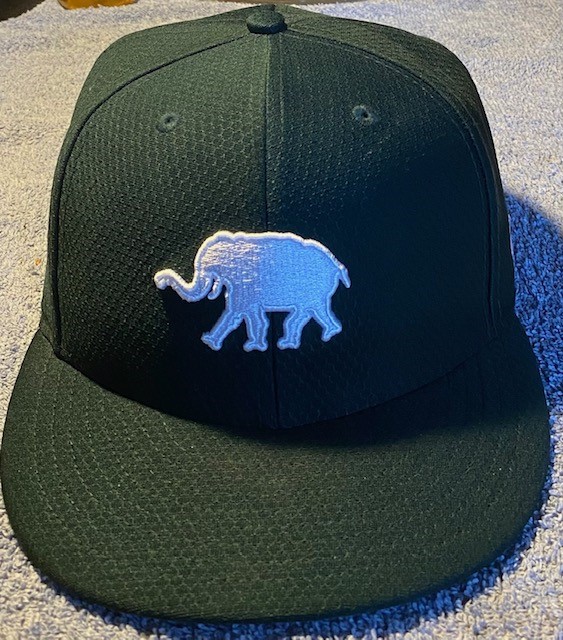
Once the white elephant was deployed in defiant pride by th Athletics’s Philadelphia ancestors. Today’s Athletics have been reduced to white elephants by more than just a spring training cap logo. Their indifferently clumsy ownership may want to do to Las Vegas taxpayers what Oakland finally wouldn’t let them do. 

Would I like to see a major league baseball team in Las Vegas, where I’ve lived since 2007? You might as well ask me if I’d like to play my guitar at the Village Vanguard. But something smells not. quite. right. about the Athletics saying they really weren’t kidding about getting the hell out of Oakland. Apparently, they’re buying 49 acres of Las Vegas Strip-adjacent land to prove it.

Talk to any A’s fan who hasn’t been alienated completely by their team in the past decade. Two themes seem to emerge above others: 1) The Oakland Coliseum—oops, RingCentral Coliseum—is a toxic waste dump disguised as a ballpark. 2) The A’s are owned and operated by a Gap heir and board member who’d move heaven, earth, and two adjacent planets to see issues solved at those stores but barely a pebble to see issues solved with his baseball team.

Sewage backups, feral cats, and now possums and their poopings in a Gap store? The sanitation, hazmat, animal control, and exterminator teams would arrive faster than a Nolan Ryan heater. Sewage backups, feral cats, and possums and their poopings in the Coliseum? Nine months might be a conservative time estimate. And that’s just the stadium.

The A’s themselves need work above and beyond containing waste and pests. You think you know the teams that have turned tanking into a refined dark art? You haven’t had as good a look at the A’s as you should have. John Fisher’s ownership group bought the A’s in 2005. The price: $180 million. Today, the A’s are worth a reported $1.18 billion. That value, writes Sports Illustrated‘s Stephanie Apstein, is six parts Fisher’s refusal to spend on O.co. and half a dozen parts his refusal to spend on his team or its brains.

Once upon a time the A’s under the command of Billy Beane were masters of living frugally without living in the dumps. Beane and his discovered players of low expense but high performance prospects and built a once-consistent American League West threat. That was then, this is now. From Moneyball to Funnyball. Except the A’s are as funny as a pickpocket in a nudist colony.

Apstein reminds us the entire A’s roster will earn $56.8 million. It’s MLB’s lowest 2023 player payroll. They also have only two players locked down for 2024. To most baseball fans, the off-season can be just as vigorous as the playing season. To A’s fans, the off-season can be, and usually is, the winter of their malcontent. A day without yet another Athletic swapping his green and gold for less toxic colours is considered a holiday.

Be careful what you wish for, Las Vegas.

Ancient history tells us that ancient Philadelphia Athletics owner Ben Shibe—observed by New York Giants legend John McGraw as being so in debt he had a white elephant on his hands—decided the A’s symbol would be a white elephant on its hind legs, as if climbing a ladder, defiant and determined. There would be periods when the A’s were a herd of elephants plowing the American League when the Yankees didn’t.

Three cities and eleven decades later, the A’s—who trampled the league in the early to mid 1970s, the late 1980s, and the West for much of the Aughts—are a white elephant once more. No matter what the pachyderm’s greenery shows on their uniform sleeves. A few years ago, the A’s put a strolling white elephant on the crown of their spring training caps. Their ownership now makes it a symbol not of defiant pride but defiant deviation down.

How far down? Can you think of another fan base willing to boycott a baseball game at which fewer people are expected to show than at a retro car show in a fast-food parking lot featuring Pontiak Azteks? A’s fans plan to turn up for a 13 June game with the Rays—they who opened the season 13-0, a winning streak that included three whacks and two consecutive bushwhacks (11-0 scores, back to back) on the Elephant—to show there remain A’s fans aplenty in the Bay Area.

They just don’t feel like being fleeced by an ownership unwilling to build them even an AAAA level team and unable to find ways to build a ballpark without further fleecing or, at least, having the incumbent dump upgraded to merely passable.

“We created this reverse boycott,” says the organising group, Rooted in Oakland, “to put a halt to the narrative that the A’s must leave Oakland and move to Las Vegas because there are no fans left in Oakland. This is simply untrue, given the A’s have the lowest payroll in MLB, the organization raised ticket prices after a losing season, and the ownership group has abandoned the current fans while focusing all attention on Las Vegas.”

Those with carrot juice for brains ask, “Where are all those mourning and outraged A’s fans now?” Those with brains for brains answer, “In which alternate universe do you expect fans to turn up at a sewage treatment plant to see a team that’s been unbuilt long enough to the point where they might challenge the 1899 Cleveland Spiders for the worst single-season winning percentage in major league history?”

(That would be .130, if you’re scoring at home. As of this morning’s standings, the A’s have a .157 winning percentage. They’re 3-16. Look to your non-laurels, 1962 Mets.)

The Fisher group wanted to soak Alameda County taxpayers for a brand new ballpark at Howard Terminal. County and city officials who don’t have carrot juice for brains said not so fast. Hence the A’s—who once employed the Yankees’ Hall of Fame legend Joe DiMaggio as a coach—turned their lonely eyes to Las Vegas, with the full faith and blessing of baseball’s attention-deficit commissioner to whom the good of the game is either making money for it or making somebody else pay for it.

Beware when you see the stories reading that the A’s plan to build a $1.5 billion retractable-roof, 35,000-seating capacity ballpark on the Vegas land they’re buying from Red Rocks Resorts. If the A’s and Commissioner ADD have their way, they’ll probably build none of it. The new ballpark—oh, for funsie sake, let’s call it the future Henderson Field (for Hall of Famer Rickey Henderson, not for Las Vegas’s growing suburb)—is likely to be financed by a hybrid of tax dollars, between Las Vegas’s hotel room taxes and such other local sources as fund the Las Vegas Stadium Authority.*

How many A’s dollars will go into it is unknown for certain at this writing. What’s known for certain: Just on paper, the ballpark land and plan is probably more valuable than the team. Fisher himself is said to be worth $2.5 billion. But indifference proves to be its own malignancy upon a baseball team. The A’s are in dire need of radical chemotherapy.

It’s not as though they have a consistently sterling Oakland legacy. For every season of triumph (the 1972-74 World Series winning streak; the late-1980s AL West ogreship, etc.) there’ve been seasons in hell. They only began with Charlie Finley treating his team like a father who delights in humiliating rather than guiding his children. They only continued with  Billyball’s blowing a young pitching staff out before their time.

But then their Philadelphia ancestors experienced repeated highs followed by repeated nadirs, too. En route Oakland, they stopped in Kansas City, first to become a virtual Yankee farm team (under Arnold Johnson’s ownership); then, to become a plaything to be kicked, beaten, shredded, and embarrassed, and also rebuilt to be a winner in due course—after Finley could get them out of Kansas City as soon as feasible.

Las Vegas may plunge eyes wide shut into building something state-of-the-art for a team about whom the state of its art is as artful (with apologies to a long-deceased political scientist named Willmoore Kendall) as the assassination plot in which everyone in the room is killed except the intended victim.

Perhaps if Commissioner ADD is as hell bent on getting the A’s the hell out of Oakland as its blithely clumsy ownership and administration has been for nigh on a decade, he might think to impose a single but profound condition upon them: “Sell this team to someone who actually knows baseball and believes a major league team requires major league talent on and off the field.” Well, Las Vegas is a city of dreams, isn’t it?

*  Update: Several hours after I wrote the foregoing, I learned the A’s may be asking Las Vegas, through whatever means, to kick at least $500 million toward a new ballpark. I won’t be shocked if or else! is implied there.

All stats were “made up,” once upon a time

Well, I asked for it. I spotted a social media thread asking people to pick the greatest baseball player of all time if Babe Ruth wasn’t available. (I didn’t respond to that opening, but I’ll repeat here: Ruth was only the greatest of the pre-World War II/pre-integration/pre-night ball players.)
The thread drew a decent volume of responses. The lady who opened it noted Barry Bonds and Pete Rose were the two most often mentioned, and asked if anyone agreed. That’s where I waded in, fool that I can be, to reply that Bonds is in that conversation but Rose isn’t quite there. “I’m curious,” replied one, “why you think Rose isn’t in the conversation.”

I linked the gentleman to a deep analysis I wrote shortly after Rose’s eightieth birthday two years ago. (Long story short: Without his other stuff, Rose would be a Hall of Famer, but not quite the greatest of all time with or without anyone else’s availability.) The good news is that he actually took the time to read it. The bad news is what he posted to me after reading it and, apparently, deciding my Real Batting Average metric was an apparent laugh and a half.

“So wait,” he began, “you made up your own stat to prove Pete isn’t the greatest hitter of all time and expect anyone to take it seriously?” Now it was my turn to enjoy a laugh and a half. “All statistics,” I began my reply, “were ‘made up’ once upon a time, over long periods.” That was over two hours before I sat down to write here and now.

Regarding RBA, I wanted something simpler than weighted runs created (wRC) to give me the best, deepest possible view of a player at the plate. My most recent dip into the deep RBA waters was a look at last year’s RBA leaders. (Hint: the top dog in Show broke Roger Maris’s single-season American League home run record.) It also includes a brief explanation of RBA and its component parts.

My astonished correspondent hasn’t yet responded to my last response. But if he were to ask me to prove that all stats were made up once upon a time, I’d refer him to Mr. Peter Morris’s two-volume baseball bible, A Game of Inches: The Story Behind the Innovations That Shaped Baseball.

The original volumes appeared in 2006; a single-volume edition which happens to be in my baseball library appeared in 2010. An entire chapter on statistics appeared in the original volume two, The Game Behind the Scenes. Read the chapter very carefully, and the fan with the widest of open minds should need very little to tell him that somebody invented just about every known baseball statistic once upon a time.

Let’s take the box score. The first one known showed up in an 1845 newspaper. The only things shown were the names of each team’s players, the total runs each scored, and the total outs each made. Fourteen years later, Henry Chadwick delivered the first box score expanded from there, adding total team runs plus hits, putouts, assists, and errors. That wasn’t quite the end of it.

Four months after the Republican Party named Abrahan Lincoln its 1960 presidential candidate, the Detroit Free Press delivered some new box score stats after the Detroit Base Ball Club’s loss on 7 August, by way of tables. One showed outs and runs. A second showed the outs made by each batter according to categories. A third showed the number and type of outs each fielder recorded.

In the interim between the 1845 box and Mr. Chadwick’s expansion, the line score began its passage through its birth canal. The birth took two years until the nine-inning game became the standard in 1857.

You may have noticed that in none of those did base hits turn up. Well, Mr. Morris filled in the gap: “Their absence [from the earliest box scores] seems shocking at first, but on reflection it becomes understandable. Much of baseball’s scoring system was borrowed from cricket, where a hit almost always meant at least one run. As a result, cricket scorekeepers understandably kept track only of runs. The early developers of baseball scorekeeping saw no reason to keep track of base hits in a sport where runs determined the victor.”

Chadwick didn’t begin including base hits until during the 1867 season. He “then began to campaign for the new statistic,” Mr. Morris wrote. “He repeatedly pointed out that run scoring depended on teammates while there could ‘be no mistake as to the feat of a batsman making his first base by a good hit or by an error of a fielder. This therefore becomes the only criterion of batting, and therefore in judging a batsman’s skill we should first look to his score of the number of times he makes his first base on a good hit or by an error of a fielder’.”

You made up your own stat and expect anyone to take it seriously?

In the same year Brahms’s Violin Concerto in D Major premiered in Leipzig (1879), the run batted in was born. (Born, but not baptized by the Show until 1920.) Seven years later, the stolen base was born—as a stat, not an act. Two years after that, along came the sacrifice hit as its own stat, if not an “official” at-bat—but it took six more years for that kind of sacrifice to be limited to the bunt.

Those babies had fathers, too. They probably also had to withstand those harrumphing that they had no business inventing stats out of whole cloth, thin air, or based on men appearing to them aboard flaming pies, and expecting anyone to take them seriously. Would you like to shoot them now, or wait until you get them home?

The deep stats which annoy the philistine as well as animate the thinking person required another half century or more to emerge. Somebody fathered the defensive putout and assist. Somebody fathered on-base percentage; arguably, it was Branch Rickey’s most important non-playing hire, the statistician Allan Roth. (Branch Rickey’s boy made up his own stat and expected anyone to take it seriously?) For further openers.

It took longer than that for such thinkers as Bill James, his protegé Rob Neyer, Jayson Stark, the minds and hearts at Baseball Prospectus, Jay Jaffe, Keith Law, and more, to deliver unto us the win share, the win above replacement-level player, the fielding-independent pitching rate, the win probability, and far more goodies than I have time or space to unfurl here.

All the better to give serious fans a way to see what they were unable to see. And, yes, to quadruple their fun.

You need more than anecdotal evidence to discover what the great players and teams before your own birth truly accomplished, even if the best written among it continues to instruct to a certain extent and delight to a greater one. Unless you’re blessed with compartmentalised viewing abilities and attention mechanisms, too, you can’t see every last baseball game played on given days, in given weeks or month, during given seasons. (But wouldn’t that be a wonderful idea?)

“Baseball emerged as a prominent part of the American experience in the mid-nineteenth century,” Mr. Morris reminded us, “at about the same time that statistics were also becoming a staple of American life.” He cited science historian Thomas Kuhn calling that period “the scene of a second scientific revolution that revolved around quantification” before continuing, “As baseball sought to appeal to adults instead of children, it made use of this emphasis on measurement and quantification.”

So I created my own stat to provide me a simpler but still multi-dimensional look at a player on his own and compared to his peers and predecessors. Would you like to shoot me now or wait until you get me home?

Hobie Landrith, RIP: Of Polo Grounds and oranges

Hobie Landrith

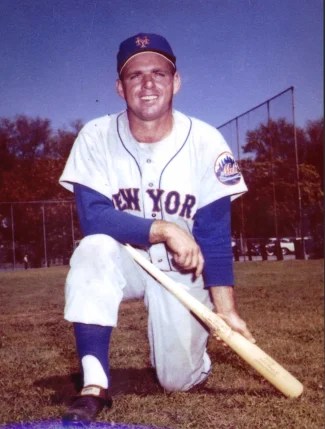
Landrith, the very first Met.

The plot was simple enough. Visiting my favourite aunt and uncle in their still somewhat new Poughkeepsie (NY) digs, a splendid colonial home that was actually the model for the development, my three cousins would awaken me promptly at seven the next morning. They wanted to see me and my twelve-year-old baseball brain win a local radio station’s “Sports Call” contest and whatever prize would come.

So there was Tommy drumming out the fabled climax of the William Tell Overture (or, the theme from The Lone Ranger, if you prefer) against the nightstand next to my bed. (And, specifically, my ear.) There was Bobby, ready to dial the “Sports Call” number with the phone to my ear. Not to mention Linda, the eldest of the trio, standing by with a grin I’d swear was caught between amusement and amazement.

And there I was, maybe a quarter awake, Bobby starting to dial the split second the host began asking the question: Who was the first player chosen in the National League’s expansion draft? (The draft creating the Montreal Expos and the San Diego Padres was yet to arrive.)

Great hitters can hit rice pudding thrown right into their wheelhouses for distance, even if they happen to be hung over. At age twelve I wasn’t exactly hung over, but I wouldn’t have said no to about two more hours sleep except for the “Sports Call” idea. (A 7 A.M. awakening when it wasn’t a school day was not my idea of paradise.) Sure enough, the other end of the line answered, the host’s voice asking the question again to me directly. Right into my wheelhouse.

I managed to croak, “Hobie Landrith, catcher, by the New York Mets.” Pay dirt. Minutes later, the station’s music finished and the host came aboard to say he’d just received the fastest correct “Sports Call” answer since he’d begun doing the feature on his morning show. A few hours later, there were Bobby, Tommy, Aunt Marge, and yours truly, in the station wagon, pulling up to . . . a pleasant stand-alone produce market, where my knowledge of Landrith’s expansion draft status landed me two large crates of freshly imported Florida oranges.

I left one of the two crates with Aunt Marge and Uncle Herb, now of blessed memory. (Their long, happy marriage ended only with their departures to the Elysian Fields a year apart in 2015-16.) Somehow, I managed to haul the other aboard the train to Marble Hill in the Bronx, where my mother met me for a night at my maternal grandparents before returning home to Long Beach. She almost collapsed when she saw me hauling the oranges with my small suitcase atop the crate.

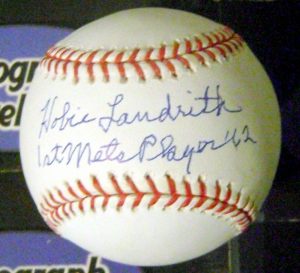
In later years, Landrith loved to sign autographs adding that he was indeed the first Met ever. 

“The first thing you have to have is a catcher,” said Original Mets manager Casey Stengel, explaining why the new team handed the first expansion draft pick chose the non-renowned veteran catcher from the Giants. “Because if you don’t have a catcher, you’re going to have a lot of passed balls and you’re going to be chasing the ball back to the screen all day.”

Stengel was probably too occupied managing and winning pennants with the 1949-60 Yankees to notice that, as a 1956 Cub, Landrith was charged with ten passed balls. But in the same season, he threw 23 would-be base larcenists out for a respectable 38 percent caught-stealing percentage. In three seasons as a Giant part-timer, before the Mets picked him, Landrith’s caught-stealing percentage was 41 percent.

“Thirty-one year old catcher who looked twenty-eight and played like forty,” wrote Leonard Shecter, in Once Upon the Polo Grounds, of Landrith, who died at 93 in California last Thursday. “Hobie always said he was 5’8″. He probably was 5’6″. It wasn’t his fault he wasn’t big enough to play this game.” (Baseball Reference actually lists Landrith as 5’10”, if you’re scoring at home.)

The Decatur, Illinois native was a perfect Original Met, until he wasn’t. On Opening Day 1962, he threw past second trying to arrest a base thief. He was charged with three passed balls in 21 games. But he spoiled the fun when the Mets swept a doubleheader from the Braves that May. He won the first game by pinch hitting a two-run homer off Hall of Famer Warren Spahn. Into the upper deck of the ancient Polo Grounds, the Original Mets’ home while awaiting Shea Stadium’s completion.

Remember: The Original Mets had Abbott pitching to Costello, with Who the Hell’s on frst, What the Hell’s on second, You Don’t Want to Know’s on third, and You Don’t Even Want to Think About It’s at shortstop. Clearly enough, Landrith didn’t really have what it took to animate the Original Met faithful. So the Mets made him do the only thing, really, that he could have done to help the anti-cause.

The next month, they sent him to the Orioles to complete a deal they made in May, a deal in which they sent cash plus a player to be named later for first baseman Marv Throneberry. Marvelous Marv himself. It may have been Landrith’s greatest contribution to the Original Mets’s unlikely grip upon New York’s heart. “The Mets were different, they were counterculture, they were fun,” Stengel biographer Robert W. Creamer would remember. “The worse they were, the more fun they were.”

The Orioles didn’t yet resemble contenders when Landrith was sent there. The Washington Senators, to whom the Orioles sold him later in 1963, weren’t exactly American League ogres, either. At least Landrith got to have a sort-of reunion before the Second Nats cut him loose after that season. His former Met teammate, Hall of Famer Gil Hodges, became their manager, after Mickey Vernon’s 14-26 ’63 start led to his execution and Eddie (The Walking Man) Yost’s running the team for one loss before Hodges came aboard.

“I was in the major leagues more because I was a good defensive catcher, and the fact that I was good at handling pitchers,” said Landrith, once upon a time, to This Great Game. The pitchers who threw to him lifetime had a respectable 3.92 ERA. His not-so-formidable bat was probably the thing that kept him from becoming a regular catcher over his early seasons with the Reds, the Cubs, and the Cardinals—even if he walked 253 times while striking out 188. (His lifetime Real Batting Average—total bases + walks + intentional walks + sacrifice flies + hit by pitches, divided by total plate appearances: .424.)

“I always thought I was a fairly decent hitter, but I realized that I wasn’t in the big leagues for my bat,” he continued in the same interview.  “I had what they called ‘warning track power.’ You know, I’d hit the ball pretty good, the fans would get up on their feet, and then they’d groan, because the ball would die at the warning track.”

Willie McCovey, Hobie Landrith, Tom Haller

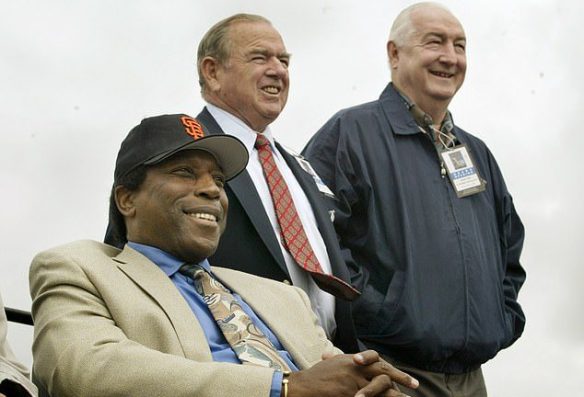
The San Francisco Chronicle captured Landrith (center), flanked by former Giants teammates Willie McCovey (left) and Tom Haller, watching a game in 2003.

As a Giant, Hall of Famer Willie Mays called Landrith “Honest John.” Landrith had no idea why. “He gave some of us strange nicknames. Folks would criticize Willie for being hard to talk to, but it wasn’t always that way. Willie got burned by the [San Francisco] press one time too many, and he got a little harder every time it happened. He was never that way with his teammates, though. I loved Willie and I had a great relationship with the man. I still do.”

Likewise Hall of Famer Willie McCovey: “People ask me all the time, what kind of a guy is Willie McCovey? And I tell them, if Willie walks into a room and smiles, everyone in that room smiles too. I was in the lineup for his first major league game when he went 4-for-4 against [Hall of Famer] Robin Roberts. I just feel fortunate that I was able to play with the man during my career. He’s just a wonderful person.”

That game, on 30 July 1959, featured three Original Mets to be (Landrith, Hall of Fame center fielder Richie Ashburn, and Phillies first baseman Ed Bouchee), plus two more eventual Mets: Mays, and Giants shortstop Ed Bressoud—who ended up becoming an Original Colt .45 (Astro) first, in the same expansion draft in which the Mets selected Landrith to kick things off.

After working as a Senators’ coach for 1964, Landrith left baseball and became a longtime public relations executive for Volkswagen. He and his wife, Peggy, had six children (three sons, three daughters), eleven grandchildren, and eleven great-grandchildren. If he just wasn’t made to be a true Original Met, he certainly was made for family and business success.

His roost in the Elysian Fields should only be that kind of serene. And I still can’t drink a glass of orange juice without remembering a certain phone call that landed me two crates of its source. Or, without remembering the catcher who helped make those crates plus Marvelous Marv possible.