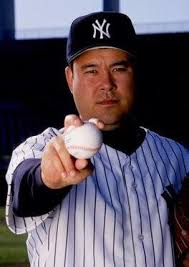
Matt Keough, RIP: Aces and aches

2020-05-03 BillyMartinMattKeough

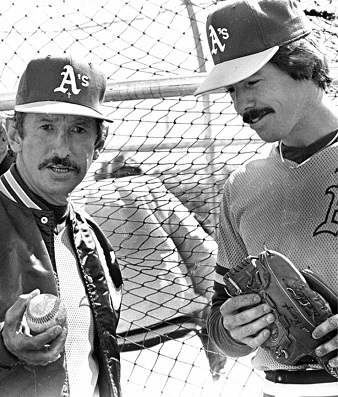
Matt Keough (right) with Billy Martin, who burned his Five Aces out with overwork and turned the A’s from sudden contenders to sudden basket case in a comparative blink.

It’s not every major league pitcher who goes from one-fifth of a heralded, overworked, and ruined young starting rotation to scout, coach, advisor, and occasional reality television figure. Nor is it every pitcher who passes away at 64 just weeks after his grandson dies during birth.

Of the five righthanders who once made up a youthful Oakland Athletics starting rotation Sports Illustrated brandished on a spring 1981 cover as the Five Aces, Matt Keough’s wasn’t one of the simpler baseball lives. He recovered well enough to rejoin the A’s in their front office as a special assistant; had his son, Shane, made it to the majors instead of playing an aborted minor league career, he’d have been the father of baseball’s twelfth third-generation player.

“Daddy,” Kara Keough Bosworth posted on Instagram upon Keough’s death Saturday, “please take care of my son. Teach him the circle changeup and how to find forever friends. You’re on grandpa duty in heaven now. Xoxo, Hammerhead.”

“My favorite place was always on your shoulders,” Shane Keough posted on Instagram upon his father’s death. “It makes me smile knowing [grandson] McCoy will be there with you; right there on your shoulders. It wasn’t always perfect but I wouldn’t change it for the world. You taught me more than you’ll ever know and I hope that I make you proud. Kick back and enjoy the eternal sunshine.”

Matt Keough was the son of former longtime major league outfielder Marty Keough and the American League’s Comeback Player of the Year winner for 1980. With Mike Norris, Rick Langford, Steve McCatty, and Brian Kingman, Keough helped yank the A’s from nothing special (and the league’s second-worst earned run average) in 1979 to the best ERA in the league in 1980 and a 29-win improvement to an 83-79 record.

And within an extremely short time to follow, the Five Aces came to represent something else: witless mishandling of pitching talent.

While the country sat in thrall to Billy Martin and his “Billyball” attack on the American League from the A’s bridge, they were unaware that if the Aces were the mound cobras then Martin was their own mongoose.

In 1980-81 the Aces pitched 152 complete games. In 1982, the A’s were 28-50 by the All-Star break, and almost every one of the Aces—who lived mostly on breaking balls that weren’t always kind to shoulders and elbows in the first place—had physical trouble, as Rob Neyer reminded one and all in 2006’s The Big Book of Baseball Blunders.

Keough himself suffered a shoulder issue after slipping on a wet Baltimore mound in 1981. In 1982 he was a mess, leading the American League in losses and posting a 5.72 ERA, not to mention leading the league in home runs surrendered and in earned runs allowed.

Langford went down with a sore elbow late in the year but he may have been pitching through the issue before that, considering the 4.32 ERA he posted after showing a 2.99 in strike-shortened 1981. (“He’s his own worst enemy,” McCatty once said of the stubborn Langford.)

Norris developed shoulder tendinitis, hit the disabled list, and finished with a 4.76 ERA—and he may have pitched through shoulder trouble the year before. That he also had issues with cocaine addiction may or may not have been secondary. (Norris recovered in due course and became an inner-city baseball advocate teaching youth the game and its pitfalls.)

McCatty left spring training with a sore shoulder and pitched only 129 innings after he returned for the season. Kingman avoided arm and shoulder issues but he was often left to continue in games where he was being murdered.

“Oakland’s starters, all of them,” Neyer wrote, “looked like they were pitching hurt, and as things turned out they probably were. In 1983, Keough pitched only 100 innings; Norris, eighty-nine; Langford, twenty; Kingman pitched five innings. McCatty wasn’t healthy in 1983, but he led the way with 163 innings and a decent ERA. After 1983, none of them ever won more than five games in a season again.”

For the one game you needed to win yesterday, there may have been few better than Martin; for the longer term, sustained success, alas, there may have been few worse. The only thing Martin compromised more profoundly than teams he led to almost instant success was himself.

His biographers often underestimate his carelessness about the pitchers he handled. One, David Falkner, in The Last Yankee: The Turbulent Life of Billy Martin, claimed the charge that Martin overworked his pitchers “probably carried more weight than substance,” going on to claim the Five Aces’ “low pitch count per game [often in the 90-100 range] was better than average and a better barometer of their actual work load.”

Falkner was dead wrong. Neyer discovered that the quintet threw 90-100 pitch games fourteen times in those two seasons but threw 120-140 pitch games 94 times in the span. They also threw 152 complete games among them and averaged 130 pitches per complete game. Keough, McCatty, and Norris each averaged 131 pitches per complete game; Langford averaged 129; Kingman, 126.

“They did not routinely throw in the ’90-100 range’ as Falkner claims,” Neyer wrote. “They routinely threw in the 120-140 range. There are certainly pitchers who can survive, or even thrive, under the yoke of such workloads. Most cannot.”

Among the Aces, Keough may have been the most charitable in retrospect, when Sports Illustrated caught up to the quintet in 1984—by which time Keough had been traded and was missing the season with rotator cuff inflammation and McCatty was the only one of the group still in the Show somehow.

“Ballplayers are never the best judges of what’s wrong with them. We were all such good athletes that we thought we could always go nine,” he said.

Billy never failed to ask us how we felt. He would always say there was no room for heroes. He just wanted you to tell the truth. But we had such egos. We felt if it’s just a soreness maybe we’re better at 75 percent than the others would be at 100. We have to share the blame for what happened to us. I know I’m sick and tired of hearing about Billy Burnout. Billy and [pitching coach Art Fowler] took an obscure ball club and taught it how to win. How could I object to that? We never pitched any more than pitchers did on other competitive teams, anyway. I completed 20 games in ’80, but I only pitched 250 innings. There are too many intangibles involved to place the blame on any one person.

Martin himself blamed the 1981 strike for the Aces’ downfall. He said in one of his books that without him and Fowler there “to see that my pitchers did their work, warmed up properly, did their running, wore a jacket when they were sweating, threw with the proper motion . . . I’m convinced the sore arms that came later were the result of improper training during the strike, not overwork.”

The thought that he could have engineered the A’s 1980-81 turnaround (including one postseason series win in 1981) without killing his starting pitchers’ futures was never programmed into Martin’s hard drive. (Especially when he failed to trust the viable enough bullpen behind them.) Like Leo Durocher before him, Martin wasn’t shy about dismissing the ailing or the injured as quitters.

The likely combination of the A’s 1982 collapse and assorted non-game issues—including the day he trashed his office when the team refused him a loan for a tax issue—got Martin [and Fowler] fired after that season.

“If Martin’s theory was correct,” Neyer rejoined in a Big Book aside, “wouldn’t there have been a rash of injuries to pitchers all around the majors” as a result of the strike? “I don’t recall that there was.” As Neyer observed earlier in the aside, Martin had one thing in common with semi-legendary Brooklyn Dodgers manager Charlie Dressen: he “never made a mistake he couldn’t blame on somebody else.”

Keough made an All-Star team before the Martin era in Oakland; he pitched in four other organisations and for a spell in Japan before working as a well-liked and respected roving pitching coach, scout, and special assistant for the A’s, the Angels, and the Rays, before returning to the A’s.

His try at a pitching comeback with the 1992 Angels ended when he took a hard line drive foul off his head—while sitting in the dugout waiting for his turn to pitch in an exhibition game. His attorney swore Keough wasn’t quite the same man again after that.

Keough’s marriage to former Playboy playmate Jeane Tomasino ended, though the couple’s divorce wasn’t finalised until last year. (The couple had another son, Colton.) He fought and finally overcame a battle with the bottle that included time behind bars for the second of two drunk driving incidents.

It said something for Keough, too, that his still-estranged wife—with whom he and his children appeared occasionally on The Real Housewives of Orange County—testified for him over his second DUI in 2009 and pleaded with the judge to give him probation.

Keough was respected as a pitcher and beyond for his mind. “Matt probably had the most well-thought out game plan of any of us,” Norris was quoted as saying Sunday. “He was a student of the game and had great knowledge.”

He was credited with helping the A’s to draft such 2000s talent as Huston Street, Joe Blanton, and Nick Swisher. “[O]ur talks–even a week ago–unforgettable,” J.G. Taylor Spink Award-winning writer Peter Gammons tweeted.

“He had an amazing mind for the game and incredible work ethic,” Kansas City Royals senior scouting director Gene Watson told San Francisco Chronicle writer Susan Slusser. “When you watched a game with him, it was impossible not to learn something new from him every time.”

But he knew what really counted in the long run. “I have three best days—when each of my children was born,” Keough once said. May the Lord give him nothing but best days eternally, on grandpa duty with little McCoy Casey Bosworth, the baby grandson who preceded him early in April, and now greeted Grandpa with two tiny but profound open arms.
Immortal handshake to be immortalised

2020-05-01 GeorgeShubaJackieRobinsonHandshake02

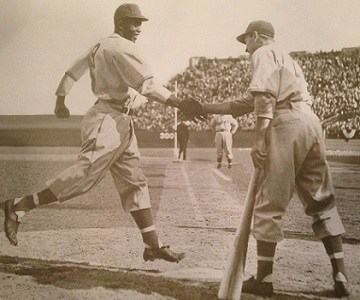
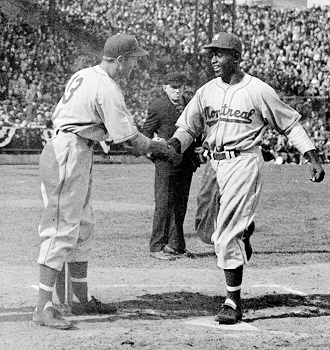
Jackie Robinson accepts George Shuba’s handshake as he finishes a three-run homer in his Montreal Royals debut in 1946. This photograph became known as “A Handshake for the Century,” and a statue in Shuba’s hometown will immortalise the handshake further next year. (Photograph courtesy of Michael Shuba.)

The late George Shuba is said to have kept only one memento from his professional baseball career. That was  the famous photograph of Shuba shaking Jackie Robinson’s hand—after two white teammates aboard ahead of him went to the sideline waiting to see what Shuba would do—as Robinson crossed the plate after hitting his first minor league home run, a three-run “screamer over the left field wall,” as Shuba would remember it.

Robinson and Shuba were Montreal Royals teammates in 1946, after Brooklyn Dodgers mastermind Branch Rickey sent Robinson there to break him into non-Negro Leagues professional baseball. Raised in a climate of racial tolerance in Youngstown, Ohio, Shuba didn’t realise for a long time the impact of what he’d done in that moment when Robinson hit the plate.

“I didn’t care if Jackie Robinson was blue, green, or yellow,” Shuba said in his memoir, My Memories as a Brooklyn Dodger. “He was my teammate and that was all I cared about because his home run just gave us the lead in our season-opening game.”

That Opening Day between the Royals and the Jersey City Giants in Roosevelt Stadium was Robinson’s Royals debut, a day on which he went 4-for-5 with two stolen bases and three runs scored—two after unnerving the opposing pitcher to balk while he was the runner at third base. But the homer handshake from Shuba reverberated long after the game settled into the International League record books.

There are two takes on the image. One is the famous shot from the third base line, Robinson’s Royals uniform number 9 visible on his back as his right hand meets Shuba’s and his left foot is a split second from hitting the plate. The other comes from a first base line view, at the split second Robinson’s foot hit the plate, his right hand still holding Shuba’s in the handshake, and Shuba’s number 13 is visible from behind the right side of his back.

In both Robinson has a big grin on his face and Shuba grins likewise. Neither man knew in the moment that the handshake would prove to transcend the home run. Shuba, the on-deck batter, was mildly astonished that the two teammates scoring ahead of Robinson didn’t stop to wait and shake his hand. So the modest Ohioan of solid Slovakian stock stepped forth from the on-deck circle and did it.

2020-05-01 GeorgeShubaJackieRobinsonHandshake01

As Robinson actually hit the plate to score on that three-run homer, an Associated Press  photographer caught the handshake with Shuba from the first base side.

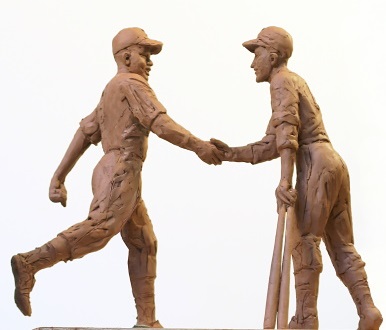
Next year, Robinson and Shuba’s home plate handshake will become even more immortal than a pair of photographs. It’ll be depicted in a life-size statue of the two men in Shuba’s native Youngstown. Shuba’s only son, Michael, says the statue’s work is proceeding as planned and mostly on schedule despite the coronavirus disruption of most of the nation’s life today.

“Everything seems to be going as planned,” the younger Shuba told me by telephone last week. He said Robinson’s half of the statue is life-size finished already, as is his father’s life-sized head, with the rest of his father yet to be complete. “We believe our goal that they have can still be met.”

Shuba and the committee in charge of producing, erecting, and dedicating the statue intend for that dedication to happen on April 18, 2021—the 75th anniversary of the game and the home run handshake. Asked whether Robinson’s widow, Rachel, would attend the dedication, Shuba said he only hopes so. “You know, I think she’s 97 now,” he said, “and I just don’t know if she’d be there, but maybe Sharon (the Robinsons’ daughter) will be there.”

The project began with Eric Planey, a New York financial executive who’s native to Youngstown. “He took it upon himself to get the project going,” Shuba said. “Out of the blue one day I get a call from him saying he was working on this and he wanted my blessing. That’s basically how I found out it was going on. I instantly knew that I had to honour Dad and Jackie to the best of my ability when I heard this was going to happen.”

Marc Mellon, the sculptor whose likeness of the late former president George H.W. Bush reposes in the Smithsonian Institute’s National Portrait Gallery, has designed and is building the Robinson-Shuba statue. He recently sat for a newspaper photograph showing the base of Robinson’s full body in front of a small wall of photographs . . . and the base of George Shuba’s head on a pedestal in front of another small wall of photographs.

One former major leaguer is involved directly in the project—Herb Washington, the Olympic-class sprinter who became the most talked-about among Oakland Athletics owner Charlie Finley’s 1970s experiments with designated baserunners, eventually a successful McDonald’s franchiser in Youngstown. Washington didn’t return queries for comment at this writing.

2020-05-01 GeorgeShubaJackieRobinson

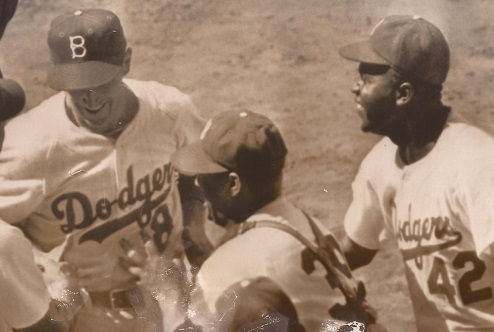
George Shuba’s reception at the plate after a home run includes Jackie Robinson (42) and fellow Hall of Famer, catcher Roy Campanella (39).

As a baseball player, George Shuba was known for a smooth, natural-looking swing delivering hard line drives that inspired Alabama sportswriter Bill Bingham to nickname him Shotgun. He was also known for being the first man in National League history to hit a pinch home run in a World Series. (Game One, 1953; Hall of Famer Yogi Berra was the first ever to do it, in the 1947 Series.) The bad news is that a combination of Rickey’s caprices and the outfielder’s knees conspired to keep his major league career a short one.

Raised a devout Roman Catholic, whose older brother became a priest and eventually a monsignor, the Shotgun learned tolerance at an early age. “George grew up as an altar boy, and he was taught as a young boy to treat all people equal,” his son said. “In high school they would play alongside black fellows all the time, so it was no big deal to him. It just seemed the right thing to do.”

Robinson and Shuba maintained a friendly relationship during their Brooklyn playing days. Like many ballplayers, though, they drifted apart in the years following their baseball careers. Shuba’s career ended after the 1955 season; Robinson retired before the 1957 season. “I think, just like the rest of the fellows, they got tied up in their lives,” Michael Shuba said. “They talked to each other a few times, but I don’t think very many of them would see each other during that period.”

Robinson became a personnel executive with Chock Full o’Nuts, the coffee company whose lunch restaurants were famous for black staffers, before trying his hand at other businesses aimed at furthering interracial economy and activity. The elder Shuba tried his hand in the sporting goods business, found it wanting, then joined the U.S. Postal Service, eventually becoming an inspector for over a quarter century.

He died at 89 in 2014, but he loved to teach school children about racial tolerance and Jackie Robinson’s significance whenever invited. He was the last living Dodger to have played in Game Seven of the 1955 World Series, the only one the Dodgers won in their Brooklyn years. His pinch hitting appearance for second baseman Don Zimmer in the top of the sixth inadvertently saved the Series for the Bums.

2020-05-01 GeorgeShubaJackieRobinsonHandshake03

A clay model of the in-progress Robinson-Shuba handshake statue, as designed by sculptor Marc Mellon. (From the Robinson-Shuba Commemorative Statue Project.)

After the Shotgun grounded out for the side, manager Walter Alston moved starting left fielder Junior Gilliam to second base and sent lefthanded thrower Sandy Amoros out to play left. Amoros’s running catch of Berra’s long opposite-field drive, and subsequent peg in to Hall of Fame shortstop Pee Wee Reese, enabled Reese to double up Gil McDougald at first and Brooklyn starting pitcher Johnny Podres to finish his 2-0 shutout.

For a long time, the Shotgun preferred to keep his baseball past quiet while raising two daughters and a son—his wife, Katherine, died two years after her husband—but in time he came to embrace that past, including happily re-enacting the Robinson handshake with children of all races who met him. (Other stories have said he preferred signing autographs for children almost exclusively for a very long time.)

“I took George to the Brooklyn Cyclones [minor league team], and I took him all over the country,” Michael said, “teaching young kids about this moment and what it represented. We went to the Cyclones and they had a re-enactment, one black kid and one white kid, meeting at home plate. George was there to help them and meet them when they met at home plate. To this day I have a baseball I had those two kids sign.”

The son considers his father to have been his best friend in life. “The last ten years of his life, I took him all over and made him enjoy himself,” said Michael, who encouraged his father to connect with Ohio writer Greg Gulas for the memoir after realising his father’s memories of his baseball life remained lucid and well intact.

“Today, I don’t think he would even believe the statue is happening,” the son said. “I’m glad it’s going on, but I wish he would have been here to see it.”

Steve Dalkowski, RIP: Lost and found

2020-04-24 SteveDalkowski

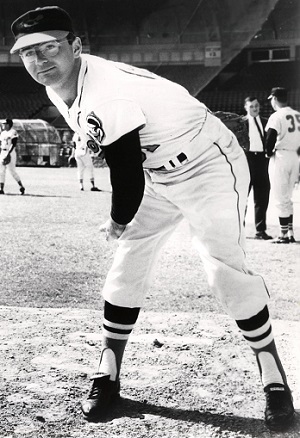
Steve Dalkowski, the minor league pitching legend, during an Orioles spring training. When he finally made the parent club his elbow blew out.

Steve Dalkowski didn’t look like a young man who struck inordinate fear on the mound. The kind of fear that legend says moved a fan behind the plate to say he was about to scoop up his children and get the hell out of there after Dalkowski told him yes, he’d be pitching that night.

He was 5’11” and looked like the prototype for Revenge of the Nerds. If you bumped into him in a supermarket, you might have mistaken Dalkowski for the president of Future Clerks of America. Those who knew him best knew him as a too-pliant young man who listened to everyone, rarely stood his own ground, and was too eager to please.

But if you had to face him on the mound, the legends have had it, you took your life into your hands. Either you were going to swing feebly through a fastball Superman couldn’t out-fly, or draw a walk with the distinct possibility of the ball going through your dome, but you weren’t going to hit him without ten percent timing and ninety percent fortune.

Remember Bull Durham‘s million dollar arm/five cent head phenom Nuke LaLoosh? Writer/director Ron Shelton sculpted LaLoosh entirely from the model of Dalkowski he’d seen in his youth. He walked eighteen. New. league. record. He struck out eighteen. New. league. record. He hit the sportswriters, the public address announcer, and the Bull mascot twice. Also new. league. records. But . . . Joe . . . he’s got some serious sh@t!

What was good for a laugh on screen is what Dalkowski was, essentially, in the Orioles minor league system. When he pitched for Stockton in the old C-level California League, he did set new. league. records. with exactly 262 strikeouts and 262 walks in 170 innings. Well, he tried, anyway. Gary Kroll actually led the league in strikeouts with 316.

“Most of the Dalkowski stories — throwing a ball through a wooden fence, throwing at hecklers in the stands, hitting hot dog vendors behind home plate, shattering an umpire’s facemask, Ted Williams asking to face him in the batting cage but changing his mind after watching Dalkowski throw — are unverifiable,” wrote pitcher-turned-writer Pat Jordan for Sports Illustrated in 1970, “passed and stretched like folk tales from one minor leaguer to another across the decades.”

Those who saw or played with Dalkowski swore he was wild up and down, never in and out. “If he had been wild inside,” said Frank Zupo, a former catcher in the Show who’d caught Dalkowski in the minors, “he’d have been arrested for murder.”

What was good for anything but laughs is what Dalkowski’s life became when he left baseball after 1965, without seeing a single day’s major league action. A too-heavy drinker during his playing days, who once admitted he did it trying to drown the frustrations he felt trying to make it in baseball, alcohol owned him for 28 years after he left the game.

The lefthander with speed to burn and as much control on and off the mound as a runaway subway train died at 80 last Sunday, after a month-long battle with the coronavirus. At the convalescent home to which his sister Patty Cain brought him in their native Connecticut after finding him at last following decades in alcohol’s wilderness. The miracle may really be not that Dalkowski left almost more legends behind through the minors than Babe Ruth left in the Show but that he lived as long as he did.

He came from the same Connecticut city (New Britain) that produced Rob Dibble, Carl Pavano, and George Springer. He quarterbacked and halfbacked for a pair of unbeaten high school teams while hitting prodigious home runs in summer leagues and pitching like a machine gun. When he graduated high school in 1957, all sixteen Show teams at the time wanted him.

He signed with the Orioles for a $4,000 bonus after graduation, the absolute ceiling under the absurd rule of the time that forced teams signing players to higher bonuses to keep them on their major league rosters for two full seasons. Another legend holds that the Orioles scout who signed him, Frank McGowan, handed him another eight large and a new car.

The apparent secret to the benign-looking lefthander’s power rested in a combination of his arm and wrist action. How else could a kid who looked like baseball’s Mr. Peepers throw the proverbial lamb chop past a pack of wolves, never mind one?

“Steve was able to rotate his shoulder for more leverage. And he just had great joint structure,” his boyhood friend Andy Baylock once told a reporter. “I call it `segmental acceleration.’ It’s almost like a chain reaction took place in his body every time he threw the ball. It was a free-flowing, smooth action. It was God-given.”

They didn’t have the radar gun when Dalkowski went from high school to Kingsport in the old Class D Appalachian League. But Cal Ripken, Sr., who caught Dalkowski at one point (when Dalkowski’s pitches weren’t rising above heads and sailing into screens or stands), once swore the kid threw 110 mph. If that was true, Herb Score was a junkballer by comparison.

The Orioles tried everything to harness the obvious talent and the too-obvious speed. When Birdie Tebbetts managed the Reds and his charges faced Dalkowski in a spring exhibition game, he called Dalkowski’s fastball the radio pitch: “You can’t see it, but you can hear it.”

They also tried harnessing Dalkowski’s taste for hijinks and girls. Emphasis on “tried.” Harnessing his taste for drinks was another matter. He’d learned about it only too well at home; in a New Britain full of hard drinking families Dalkowski’s baseball-loving father was a full blown alcoholic.

One of the lefthander’s minor league roommates was Bo Belinsky, a similarly flaky portsider with less than half Dalkowski’s pitching speed and twice as much street smarts when it came to the young ladies. (Belinsky, too, fought a long battle with the bottle until he dried up to stay a decade before his death in 2001.)

Belinsky’s biographer Maury Allen told of a particularly telling incident when, next door to their hotel room, there once roomed a very comely Miss Universe contestant whose mother wouldn’t let the hungering young wolves get to within a nautical mile of her. Allen swore (in Bo: Pitching and Wooing) that Dalkowski hatched the plot by which he, Belinsky, and their teammates could get a good uncensored look regardless.

Dalkowski procured a drill with a particularly thin bit and drilled several holes in the wall, tiny enough not to be detected but not so tiny that the players with their gimlet eyes couldn’t enjoy the show. Then one knucklehead decided the night time didn’t have to be the wrong time for the show to stop. He brought a flashlight for his evening’s viewing. When he hit the switch, enough of the light beam shot through the pinhole to cause the comely would-be Miss Universe to shriek.

In spring 1962, Belinsky and another Oriole minor league pitcher-playboy, Dean Chance, were gone to the Angels who’d plucked them in the minor league draft. But Dalkowski finally caught a break when eventual Hall of Fame manager Earl Weaver, managing the Orioles’ Elmira (NY) farm, got hold of him.

2020-04-24 SteveDalkowskiPattyCain

Dalkowski with his sister, Patty Cain, not long after she returned him to his New Britain home town.

Weaver wreaked a small miracle. He actually got the kid to pitch like a comer. The secret: Weaver told Dalkowski to get rid of every one of the hundreds of different suggestions thrown his way in the past and listen to just one idea and no more.

Throw it easy. Just play catch with the guy behind the plate. Relax. Throw to the glove. Just as Dodger catcher Norm Sherry translated a scout’s deciphering of the flaw that kept Sandy Koufax from becoming the Hall of Famer he finally became. Sandy, you don’t have to throw so hard. Steve, you don’t have to throw so hard, either. Except when Weaver whistles after you get the second strike—then you throw it like you’re a human howitzer.

Dalkowski posted the lowest earned-run average (3.04) of his minor league career while striking out 192 and walking a measly 114 in 160 innings. In spring training 1963, Dalkowski finally made the Orioles and was going to the Show when the team broke camp for Baltimore.

The legend would finally have the chance to put his money where the Orioles’ mouths were. (“They were always billing him as the ‘fastest pitcher alive’,” McGowan once said, “and I think the publicity hurt him.”) They hoped he’d become out of their bullpen what Dick Radatz was with the Red Sox—the guy you didn’t want to see even warming up when the game got late and close.

“Hearing [Dalkowski] warm up,” said Red Sox utility infielder/pinch hitter Dalton Jones, “was like hearing a gun go off.”

But pitching to Yankee second baseman Bobby Richardson in an exhibition game after learning he’d make the Orioles at last, Dalkowski fielded a bunt, threw to first, and felt his elbow go off. “They called it a pinched ulna nerve,” wrote the Hartford Courant‘s Don Amore in a remarkable profile last year. “If it happened today, Tommy John surgery would have fixed it. But it happened in the 1960s and Dalkowski was never the same . . . ”

He went back to the minors for 1963, bounced around two more organisations (the Pirates and the Angels) before one more try in the Orioles’s system, then left baseball for good after the 1965 season. He left baseball but the alcohol didn’t leave him. He wouldn’t let it yet.

He drifted. He worked on a San Joaquin Valley farm. He got into and out of barroom brawls that often got him jailed, though ESPN says Bakersfield police called it “nothing serious.” He tried and failed detox; he escaped from one such center. He married twice. Amore wrote that Dalkowski was once found by a southern California family one Christmas Eve and that the family took him in and traced him back to Connecticut.

Two years later, after his second wife died, his sister brought Dalkowski home to New Britain and placed him in a rehabilitation center where he lived the rest of his life. The locals accepted Dalkowski’s return with uncommon grace and affection, remembering the school legend who became a minor league legend, forgiving the inherited alcoholic self-destruction, loving him all over again.

“This is still Steve Dalkowski’s town, as much now as it was when he first left,” wrote the Courant‘s John Altavilla in 1996, “although his circumstances and surroundings are quite different. The people here are happy to see him, glad to know he’s back where they can finally care for him.”

Diagnosed with alcohol-related dementia after his sister brought him home, Dalkowski—who had practically no memory left of the 28 years between leaving baseball and her finding him again—was given a year further to live at best. He beat that projection by over 25 years, slowly coming to terms with his life and even making a few re-connections to baseball.

He threw out a ceremonial first pitch in Camden Yards in 2003 and—after his election to the Baseball Reliquary’s Shrine of the Eternals in 2009—at Dodger Stadium. He looked grizzled and bloated behind his salt-and-pepper beard as he rose from his wheelchair, but when he thrust his arms out in triumph after throwing the ball, he looked like a man who’d just pitched an immaculate inning.

“He’s fine. He’s comfortable. He’s happy,” Cain told Altavilla in ’96. “Right now, we just want to make sure that he’s able to move on with life. Sometimes, I think we’ve taken him to his limits here, but that’s still great, because there were times when none of us even felt we’d be able to get Steve this far.”

“Dave McNally, Cal Ripken Sr., Bo Belinsky and others from his generation in Orioles history have died,” wrote the Baltimore Sun‘s John Eisenberg in 2003, “but Dalkowski, the one everyone thought would go first, is safe at home.” May the angels of the Lord whose forgiveness is there for the asking now keep Dalkowski safe at home in the Elysian Fields.

A scapegoat for the Rogue Sox

2020-04-22 2018RedSox

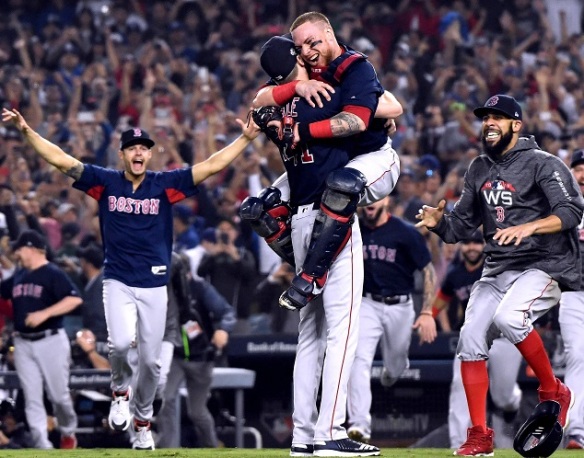
The Red Sox whoop it up after nailing the final out of their 2018 World Series conquest in Los Angeles. Is that title tainted now?

So the Red Sox Replay Room Reconnaissance Ring was the masterwork of a rogue video room operator. Not then-manager Alex Cora, not the front office, and not any of the players who transmitted stolen opposition signs to Red Sox baserunners who’d send them on to Red Sox hitters.

Sure. And the iceberg obstructed the Titanic with malice aforethought. The Hindenburg was a kid playing with matches. World War II was a backyard argument. Apollo 11 was an episode of Star Trek. The renegades working with Richard Nixon’s re-election campaign broke into Dunkin’ Donuts. Bill Clinton perjured himself over an Oval Office quickie with his wife.

After an investigation that included interviews with 65 witnesses including 34 incumbent or former Red Sox players, say The Athletic‘s Ken Rosenthal and Evan Drellich, those plus “scores of e-mails, text messages, video clips, and photographs” led commissioner Rob Manfred in a report issued Wednesday to declare it was all J.T. Watkins’s fault.

Manfred suspended Watkins from baseball without pay for this year and barred from working as a video operator for 2021’s regular season and postseason. The Red Sox got docked a second-round 2020 draft pick. If you even think about trying this kind of espionage again we’re going to be . . . very, very angry at you.

Thanks to the same promises of immunity that Manfred gave the rogue Astros in return for spilling about Astrogate, we may not know for a long time if at all which Red Sox players took Watkins’s stolen signs and ran with them.

The key to the RSRRR was that—unlike the illegally installed or altered real-time center field camera that anchored the Astro Intelligence Agency in Minute Maid Park—the Red Sox’s espionage could be done at home or on the road . . . but it depended entirely on whether the Red Sox had a man on base.

Nobody banged the can slowly to send the pilfered intelligence to the Red Sox hitters availing themselves thereof. Watkins simply let someone, who knows whom, make life a little easier for Rogue Sox baserunners. In Fenway Park and elsewhere.

Usually, if you’re on the bases and of a mind to gamesmanship, you’ve got to decipher and transmit from your own eye and in as quick a blink as possible. Watkins merely allowed the Red Sox to save their baserunners a little extra sight and brain work. How very thoughtful.

The video rooms behind the dugouts were supposed to be helpmates for managers in challenging close or errant umpire calls once replay was introduced in 2014. Hitters also use them for help correcting swing mistakes, pitchers to correct mound mistakes, or both to look again quick at opposing hitters or pitchers to see where they missed unexpected weaknesses or got beaten when they should have known better.

They weren’t installed to enable spy operations on the other guys’ pitch signs or to make life simpler for baserunners who now didn’t have to figure out how to steal signs the old-fashioned way within about a minute’s worth of time. You want to steal signs on base the old-fashioned way? Do your homework. No crib sheets, answers on your wrist, or cameras on the teacher’s answer keys.

Even before Manfred handed down his Soxgate finding and decision, a few 2018 Red Sox were saying, essentially, Who, us? Remember Steve Pearce? 2018 World Series hero, and how. He was practically a one-man demolition derby late in Game Four and through most of Game Five. It landed him the World Series MVP award.

Last week, Pearce decided to call it a career. He also decided to say Who, us? “That’s such a joke to us,” he told WEEI. “When it came out we were all kind of joking about it. We just want this to pass us. We won it fair and square. Whatever they accused us of, we were all kind of like, ‘I can’t believe this is even an issue.’ Once the report comes out we’re all going to be free.”

All but one scapegoat, so far.

“[W]e have this floating over our head when we just had such an unbelievable season,” Pearce continued. “We had the perfect team and great camaraderie with everybody and then this gets thrown out here. We’re just like, ‘What the heck?’ . . . We just want this to pass us. We just want to play some baseball. Another bump in the road, I guess.”

In fairness, one of the key moments that bumped the 108 game-winning Rogue Sox into the 2018 World Series in the first place—left fielder Andrew Benintendi’s man-on-the-flying-trapeze catch of what would have been Astro third baseman Alex Bregman’s game-winning three-run extra-base hit to deny the Astros an American League Championship Series tie at two each—had nothing to do with the RSRRR.

But what about the rest of the set? What about the Series? Not long after Pearce spoke up, Joe Kelly—then a Red Sox relief pitcher, now with the Dodgers in coronavirus limbo with everyone else in baseball—delivered his own who, us? “Whenever the investigation is done, I’m interested in seeing what is in the investigation,” he, too, told WEEI last week. “If there is cheating involved with how good our team was, we should have won every single out.

“We should have not even lost an inning if there was some good cheating involved, which would have been a lot more fun because we would have won in four,” he continued. “We would have swept through the playoffs and made it really, really fast and been able to go to Hawaii or go to Mexico and go on vacation a lot sooner than we did.”

You can almost hear the 1919 White Sox culprits, who won three games during their scandalous World Series loss, thinking, “We should not have even won a single inning if there was some good profitable tanking going on, either.”

Some Red Sox fans hit social media to denounce Kelly’s pompous arrogance or arrogant pomposity, depending upon whom you read where and in which language. The man who surrendered Howie Kendrick’s tenth-inning grand salami to lose Game Five and a trip to the National League Championship Series for his Dodgers knows enough about public humiliation and humility.

In all fairness, baseball government did monitor the replay rooms more arduously to guard against postseason espionage. Baseball’s chief disciplinarian Joe Torre warned both the Red Sox and the Astros before the 2018 ALCS that if they were up to electronic no good it needed to stop tootie-sweet before (are you ready?) the press picked up leaks about it.

Unlike Astrogate, which had a whistleblowing genie named Mike Fiers come out of the bottle last November, Soxgate may not have had a signature whistleblower. Rosenthal and Drellich, the Woodward and Bernstein of Astrogate, reported shortly before Manfred’s Astrogate finding and ruling that the 2018 Red Sox weren’t just ducking into their replay room to fix mistakes, correct batter’s box or mound mechanics, decide on challenging close calls, or watch Cheers reruns.

Rosenthal and Drellich dropped this curlicue into that report:

Three people who were with the Red Sox during their 108-win 2018 season told The Athletic that during that regular season, at least some players visited the video replay room during games to learn the sign sequence opponents were using. The replay room is just steps from the home dugout at Fenway Park, through the same doors that lead to the batting cage. Every team’s replay staff travels to road games, making the system viable in other parks as well.

Red Sox sources said this system did not appear to be effective or even viable during the 2018 postseason, when the Red Sox went on to win the World Series. Opponents were leery enough of sign stealing — and knowledgeable enough about it — to constantly change their sign sequences. And, for the first time in the sport’s history, MLB instituted in-person monitors in the replay rooms, starting in the playoffs. For the entire regular season, those rooms had been left unguarded.

So it’s entirely likely that the Rogue Sox played the 2018 postseason straight, no chaser. But there’ll always be suspicion. Would playing the postseason straight let them off the hook for reconnaissance cheating during the regular season when Watkins’s replay room was about as heavily guarded as an angry drunk?

Give Manfred this much: If he thought Cora had anything to with the RSRRR, would it have been shooting fish in the barrel to discipline him? He suspended Cora for this year—-over his Astrogate co-mastermind role. For which the Red Sox either let him quit, fired him outright, or strong-armed him to quit—never mind how well-liked he remains around the team and organisation—before he could be executed when the Astrogate report came forth.

If Manfred thought Cora was part and parcel of Watkins’s roguery, would he have thrown mercy to the wind and banned Cora for half a decade? Full decade? Life? And does anyone really believe the man who cahooted with Carlos Beltran in the AIA was entirely innocent? Or did he remember his Houston boss, A.J. Hinch, smashing a monitor or two but otherwise fiddling while the AIA turned?

Letting the Rogue Sox escape with nothing more than a docked second-round draft pick and a scapegoat video room operator is at least as bad a look as Astrogate’s been for the Astros. It also contravened Manfred’s threat, when the Red Sox’s AppleWatch and the Yankees’ extra dugout phone inspired it, to fine any team caught playing CIA against the other guys.

So whom among the 2018 Soxgaters will be the first to stand up and own up? You may sooner strike oil with safety pins.

The haunted Hideki Irabu

2020-04-22 HidekiIrabu

Hideki Irabu, too haunted to succeed—or live.

It took an unusual young man to forgive one of George Steinbrenner’s ugliest insults by giving The Boss a slightly unusual birthday present a few months later. If only Hideki Irabu’s sense of humour could have saved him from the lifelong haunting that finally ended in his 2011 suicide.

In a spring 1999 exhibition game, the righthanded pitcher failed to cover first base adequately on an infield play, and Steinbrenner denounced him as a “fat, pus-sy toad.” You don’t need me to tell you how that looked in cold print with the hyphen removed.

What you didn’t know, unless you read a jarring 2017 profile by Sports Illustrated‘s Ben Reiter, is that Irabu got a little good natured revenge a few months later. He sent Steinbrenner a birthday present: a large, mechanical toad delivering a rather pronounced ribbit when you punched a button. According to Reiter, The Boss appreciated it enough to keep it in his office for the rest of his life. (Steinbrenner died a year before Irabu’s suicide.)

Twenty years before Reiter’s profile, and 23 years ago today, the Yankees made a deal with the Padres to bring Irabu to the Bronx. The Yankees thought they were getting the anomalous “Japanese Nolan Ryan,” who threw white heat in contrast to most Japanese pitchers living purely on finesse. Neither the Yankees nor anybody else thought they were getting a walking, haunted, overly self-critical and self-analytical complexity who’d end up a suicide at 42.

A pitching star in Japan who chafed at the Japanese game’s continuing reserve system, who wanted only to decide his own future after a decade pitching in the Japan Pacific League, Irabu—whose purchase by the Padres roiled other American major league teams who wanted a shot at bidding for him—stood fast in his wish to play for nobody but the Yankees.

“Hideki and his agent are free to do and say whatever they want,” said then-Padres president Larry Lucchino, “but we will march ahead at our own pace.” Irabu and his agent Don Nomura said, “Company, halt!” Then, the Padres blinked. They sent Irabu, Jackie Boxobolts, and Jerry McJerryrig to the Yankees for Richie Rinkydink, Randy Matchbox, and three million bones.

That led to the creation of the posting system that has since allowed Japanese players without the required nine years for free agency to ask their teams to post them for bidding by MLB teams. Making Irabu a kind-of Nippon Professional Baseball equivalent to Curt Flood in the American major leagues.

But Irabu isn’t remembered that way half as often as he’s remembered for being the Japanese pitching virtuoso who self-dismantled during and after tortuous Show career. Even before he became an NPB fixture, Irabu’s was a life about which “complicated” doesn’t begin to fit.

Irabu didn’t insist on becoming a Yankee solely because he knew and respected the team’s history and larger-than-life image: as Reiter revealed, he believed that if he could succeed in a Yankee uniform his father—an American Air Force meteorologist, Steve Thompson, stationed in Okinawa, who’d met and dated a Japanese waitress and learned of his son when receiving word while in Vietnam—would have to find him.

Irabu’s mother birthed and raised him in Japan and, after marrying an Osakan restauranteur, told her son he’d been sired by an American who’d only seen him once after his birth. Only decades later would Irabu learn Thompson’s letters to his mother never reached them because they’d moved onward while Thompson was still in Vietnam.

Irabu’s mixed heritage, which happened to make him larger than other children as well as giving him brown hair and rounder eyes, didn’t go over well with other Japanese children who bullied him mercilessly. To Irabu, as Reiter revealed, baseball saved him from a life in the yakuza, the Japanese mafia, “which always found a way to use large, lost young men.”

His pitching talent made him the NPB’s top pitcher by 1997 at age 28. When Irabu insisted on having a say in his own American future and out-lasted the Padres into trading him to the Yankees, the Japanese media and his Japanese teammates accused him of disrespect. That was almost nothing compared to what hit the reserved righthander whose bulk hoisted a pair of sad-looking eyes but a smile that looked as though flashing it meant he’d defied someone a little too cheerfully.

When he arrived in New York, then-mayor Rudolph Giuliani helped shove curiosity and intrigue into hyperdrive hype. Giuliani presented Irabu a Tiffany apple and called his arrival symbolic of the American immigrant experience as a whole but that experience which often began in New York itself.

Irabu probably had no clue that American politicians were at least as talented as baseball people in forging unrealistic expectation.  When the pol in question was also the most unapologetically visible Yankee fan this side of George Constanza, Irabu would have had a better shot at getting away with the taking of Pelham 1-2-3—stark raving naked.

“Lay that upon the Japanese Nolan Ryan,” I wrote after Irabu’s 2011 suicide, “and anything short of a perfect game to open would have been considered a let down, if not the second coming of Pearl Harbour.”

The day after Guiliani handed him the Tiffany apple Irabu struck nine Tigers out in six-and-two-thirds. But he finished 1997, during which he had a turn in the minors, with a 7.09 ERA. The following spring he was considered “an out-of-shape bust,” as Reiter recalled it, nowhere more jarringly than in a Seinfeld series finale scene in which uber-fan Constanza bellowed, “How could you give 12 million dollars to Hideki Irabu?”

What nobody really knew was that Irabu’s surliness with the press and contrasting amiability in his clubhouse—upon his death, assorted teammates remembered his pleasantry and humour—disguised a still-young man still searching for a real home.

His battles with the Japanese press may have stemmed in part from being grilled, broiled, and basted by a press representing a home where he never felt accepted; his sense that America would never really accept him, either, was only partially thanks to the language barrier.

As a pitcher, as Reiter gleaned, Irabu was a constant self-questioner. The real source of his American lack of success probably rooted in his habit of constant change, from his exercise routines to his pitches and mechanics, even after his best outings. He also turned out to have a pronounced spiritual side, asking those few closest to him about faith and religion.

Reiter wrote that those few who were close to him knew what he really sought: a father figure and a place to belong. He thought he’d found the former in people like his agent Nomura, his translator George Rose, his fellow Yankee pitchers David Cone and David Wells, and even Steinbrenner; hence, the mechanical toad as the birthday present. The latter was even more tough. “There wasn’t a home for him,” Nomura told Reiter. “It’s almost like he was always at the visitors’ ballpark.

“There were so many different velocities—87, 89, 84, 95, 97,” Cone told Reiter about Irabu’s ability. “He was a big guy, strong, and you’d heard about the power—but it wasn’t all power. He seemed to have finesse as well . . . The day he pitched, we thought, Wow, if he’s on, he’s going to win the game for us. He could dominate an opposing lineup. That’s the way we saw him.”

Irabu was actually named the American League’s Pitcher of the Month twice, for May 1998 (he had a 1.44 ERA that month) and for July 1999. (4-0 with a 2.64 ERA.) The talent was clearly in place. (“When he was into it,” remembered longtime Yankee catcher Jorge Posada, “he threw the nastiest pitches in the league.”) It belonged to a still-young man who fought what proved an unwinnable war with himself.

Then Thompson finally sent his mother a note in spring 1999 and, after she revealed it to him, Irabu agreed to meet him. Though discovering they had much in common—including a pronounced taste for self-medicating through alcohol and a chain-smoking habit (Irabu was known to smoke half a cigarette between innings during his starts), and an equally pronounced stubbornness as children—Irabu couldn’t keep the connection.

Irabu accepted it when Thompson told him of those old, unanswered letters, but father and son couldn’t bond otherwise. A too-thick language wall, too much time past. “Irabu realized,” Reiter wrote, “that just as Thompson didn’t want anything from him, he didn’t want anything from Thompson.”

Thompson died of cancer at 81, five years after the suicide of the son he barely knew. Reiter wrote no one feeling remorse over Irabu’s suicide felt it deeper than Thompson did. His wife revealed to Reiter that he’d made and kept a photo album full of pictures of Irabu on the mound.

Two “uninspiring” seasons following a trade to the Montreal Expos, a brief comeback as a closer with the Rangers, a better comeback in the NPB a year after that, then a surprising two years’ trying in the American independent leagues, Irabu realised that baseball had given him up.

So did he. Whoever he really was.

The lawyer who worked with Nomura, Jean Afterman, told Reiter that Irabu “was fascinated by life. He was a kid philosophy major. He had a lot of questions about life. He had a lot of curiosity. He had a lot of, as we would say in this country, things to work out.”

When his professional baseball life finally ended, Reiter wrote, Irabu became obsessed with one thing despite trying a couple of businesses in southern California: baseball. He also sank further into depression, his former merely binge drinking becoming continuous and leading to a pair of unseemly arrests, as did his use of assorted antidepressants.

After his wife gathered their daughters and left him—they’d “become acculturated to American life,” the New York Times wrote, in ways he couldn’t and didn’t—Irabu seemed to lose whatever taste for life remained to him. “In the last year of his life, Irabu’s few remaining friends suspected that he was heavily medicated,” Reiter wrote.

The light had gone out of his eyes, they say. A rec-league teammate told police that Irabu had been despondent at a practice four days before his death—”I don’t want to live anymore,” he’d said—and he hadn’t been seen since the day after that. But no one thought to check on him until it was far too late.

A post-mortem search of his home turned up half a bottle of Paxil and two Ativan pills, the latter an antidepressant that’s believed tied to suicidal tendencies and even more dangerous when mixed with Irabu’s favourite self-medication, alcohol. His toxicology report showed he had three times the legal driving limit of alcohol in his system and Ativan in his liver when he hanged himself.

NBC Sports’s Craig Calcaterra wonders what if anything might have been different if Irabu had stayed with the Padres and not forced his trade to the Yankees despite its pioneering stature. Reiter wrote that tragedies aren’t as simple as toxicology reports, unexamined death wishes, or self-compromised talent.

They’re often deeper than even the pitcher who didn’t ask for the hype he was hit with and couldn’t live up to. The pitcher who spent his life seeking what was robbed from him originally. The pitcher who wanted one thing that the country where he grew up and first throve refused him but too much past denied him in the country he adopted.

More than anything or anyone, more than even the people who hyped him and then dismissed him when he couldn’t live up to it, he wanted and needed to know who Hideki Irabu really was.