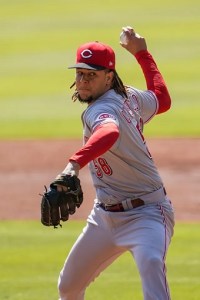
Put a meal and a stewardess on that flip

You’re not seeing things. That’s Willson Contreras’s bat in flight after the Cubs’ DH sent a three-run homer about that high en route the right field bleachers Friday night.

If you’re taking tallies to determine the bat flip of the year, Chicago Cubs designated hitter Willson Contreras should be among your top finalists. His Friday night flip in the ballpark formerly known as Comiskey Park, in the top of the third, was an absolute work of art. Enough to make Tim Anderson, Jose Bautista, Bryce Harper, and Tom Lawless resemble nursery school finger painters.

If you’re taking concurrent tallies to determine the most brain-damaged delayed over-reaction to Dali-esque flips, Chicago White Sox pitcher Jimmy Cordero should hold a place among the finalists likewise. He threw a pair of high inside pitches to Contreras and the second caught Contreras flush enough in the back, just off the C that begins the spelling of Contreras’s surname on his uniform back.

Flipped his bat high in the air? Contreras’s flip off the three-run homer he smashed on White Sox starter Dylan Cease (and Desist)’s dollar was the only flip yet where you were tempted to say what you used to holler watching a titanic home run fly out: “Put a meal and a stewardess on that one!”

If you’re going to be Fun Police enough to want retribution for a bat flip that looked as though it took off from O’Hare International and not Contreras’s hands, the time to go for it was Contreras’s next plate appearance in the top of the fifth. Cease walked Contreras on ball one up and a little in, ball two up and away, ball three inside middle, and ball four down and away.

There was no way Cease wanted to feed Contreras anything resembling the fastball that arrived just off the middle of the plate and flew the other way into the right field bleachers two innings earlier.

There was also no way Cease was trying to throw one through Contreras’s assorted anatomy, even if you could make a case that ball one up and in might have been a subtle nastygram reminding Contreras it’s not nice to channel your inner Michelangelo when you’ve already hit a ball through the equivalent of the Sistine Chapel ceiling. Might.

Maybe Cease got it when Contreras defended himself after the game. “I’m not going to change anything,” he told reporters. “I play hard for my team. I always want to do the best for my team. But if they don’t like me, that’s fine. I don’t play for other teams to like me, anyways. And if I have to do it again, I will do it again.”

But there was every way the White Sox—clinchers of a postseason berth at least, hopefuls toward snatching the American League Central title, even in this pandemic-truncated season of surreal—were feeling just a little over-punished on the night.

You tend to feel that way when Yu Darvish and company are shutting you out, Darvish not quite so nail driving as he’s been most of this season—during which he’s redeemed himself to the tenth power and into the Cy Young Award conversation—but effective enough to keep you to three hits and one walk and only two runners getting as far as second base under his command.

You feel even more that way, after Contreras’s bomb flip put the Cubs up 4-0 and Javier Baez’s leadoff launch over the left center field wall made it 5-0 in the top of the fourth, after Victor Caratini wrestled your relief option Gio Gonzalez to a seventh-pitch sinker that didn’t have enough weight to pull it quite to the bottom, and Caratini sunk it into the same bleachers Contreras reached three innings earlier. Not to mention Kyle Schwarber’s second-inning blast, making for the Cubs a four-bomb evening.

“The dog ate his homework,” pleaded White Sox skipper Rick Renteria. “Detention!” replied the umps.

When Contreras got drilled, the Cubs got riled. They hollered mightily from their dugout, enough to get the umpires into a confab that resulted in Cordero, White Sox manager Rick Renteria, and pitching coach Don Cooper the rest of the night off for bad behaviour.

Renteria tried the dog-ate-my-homework excuse after the game. A second-grade child had a better chance of making it stick. “The ball got away from him,” he insisted of Cordero’s cone job. “We couldn’t convince [the umpire] of that . . . There was no warning. They just gathered and ejected him.” As if a second straight up-and-in pitch was inadmissible evidence.

Cordero tried the same excuse. “It was just a bad pitch, a bad pitch to him,” he said after the game. “The ball sunk a lot, and that happened.” Sorry. Attempted sinkers that rise enough to get a man in the back don’t sunk a lot. Detention for you.

Understand that Cubs manager David Ross is just old school enough that it wasn’t programmed into his own playing software to deliver as Contreras did after hitting a hefty home run. But the man whose first major league home run came off an ex-Cubs first baseman named Mark Grace in Arizona late in a blowout, and whose last major league home run put the Cubs up by three in an eventual World Series-winning Game Seven, wouldn’t throw his man under the proverbial bus for his exuberance.

“It wasn’t to disrespect the other group,” Ross told reporters after the Cubs finished what they started, a 10-0 shut-and-blowout. “It was because we’ve been struggling offensively and he brought some swagger. He brought some edge. I loved every second of it. I don’t think he deserved to get hit at all.”

Why, Grandpa Rossy even had the pleasant audacity of comparing Contreras’s orbital flip to the one Anderson delivered a year ago April. When Anderson ripped Kansas City pitcher Brad Keller’s canteloupe over the fence and made of his bat a helicopter rotor while he was at it, got drilled in the rump roast by Keller his next time up, and objected vociferously. Drawing his teammates out of the dugout, getting both Keller and Anderson ejected by Country Joe West—who may or may not have remembered Anderson zapping him over an unwarranted ejection the previous season.

“All the hype is on the guy on the other side when he bat-flipped, right?” said Ross. “I thought Tim Anderson’s bat flip last year where he flipped it and looked in his dugout, that’s what you want. That’s what Willson did.”

Making the White Sox resemble hypocritical flip-floppers is also what Willson did. Their Andersons can flip until the flock flies home, but the opposing flock better not even think about it. The Fun Police are now reduced to the dog eating their homework. The dog looks better than the White Sox.

Down and out—but still looking up

Juan Soto and the Nationals hope to kick up their heels from 2020 deflation to 2021 redemption and beyond. Is it false hope?

Don’t look now, but baseball is about to wrap its twentieth season without a repeat World Series champion. What’s sadder about it is that last year’s world champions were so damn much fun but spent this year proving that no good deed goes unpunished.

Lots of teams get battered during any season, never mind truncated ones, but the Washington Nationals passed that practically before this one settled in through its early shakes, rattles, and COVID-19 rolls.

Until Daniel Hudson struck Michael Brantley out swinging on a full count, Washington hadn’t had a major league World Series champion since the Coolidge Administration or any kind of world champion since the final Negro Leagues World Series—during the Berlin Airlift.

Now the Nats have gone from baseball’s best between 23 May 2019 and the last men standing in the World Series toward the second-worst winning percentage ever for a defending Series winner. That was last year: They opened 19-31 and closed with the keys to the Promised Land. This was this year: They opened 19-31 and head for a closing with the keys to the tunnels beneath the sewers under the basement.

The worst, in case you wondered, were the 1998 Florida Marlins. (.333.) The team the Nats are about to push to one side in second place? The 2014 Boston Red Sox. (.438.) This is a very dubious elite club for which to aim at the top of the dubious the heap. NBC Sports Washington’s Chase Hughes reminds us that only 14.9 percent out of all 114 World Series winners had losing records. If you remove this year’s Nats from the picture, the dishonour roll looks thus:

1998 Marlins—.333.
2014 Red Sox—.438.
1991 Cincinnati Reds—.457.
1918 Chicago White Sox—.460.
1932 St. Louis Cardinals—.468.
Tie: 1986 Kansas City Royals; 2013 San Francisco Giants—.469.
1967 Baltimore Orioles—.472.
2003 Anaheim Angels—.475.
1994 Toronto Blue Jays—.478.
2007 St. Louis Cardinals—.481.

The Nats woke up this morning at .411. The good news, if you want to call it that: They get to finish this Alfred Hitchcock Presents Quiet, Please: The Inner Sanctum of the Outer Limits of the Twilight Zone of a season with four games against the New York Mess. (Er, Mets.) Who were supposed to be in the thick of this season’s races with or without the pandemic but had one thing in common with their comic 1962 ancestors: they never had a winning streak bigger than two games.

Assume for argument and humour’s sake that the Mets iron up and sweep the Nats to put paid to a season the Nats and the Mets would each love nothing more than to forget. Such a sweep would leave the Nats with a .383 winning percentage. Not quite enough to knock the Marlins off the highest of those low perches, but only the second defending World Champion to have a sub-.400 winning percentage trying to defend the title.

It’s not that the Nats lack for any remaining pride. Taking three out of four this week from even this year’s Philadelphia Phillies and especially their arsonic bullpen, including a doubleheader sweep Tuesday, shows they’ve got plenty enough of that left.

Maybe they don’t let themselves stay demoralised by the 12-3 smothering the Phillies dropped on them Wednesday night. Including and especially by old friend Bryce Harper—who’s been silly enough to play through back issues this year, and didn’t the Nats used to reach for the whiskey bottles over Harper trying to play through injuries when he wore their silks, too?— hitting a pair out on a night the Phillies sent five into the barren seats.

It’s what they didn’t have that picked these Nats up by the back of their necks and threw them downstairs this year. Last season, and especially last October, Sean Doolittle, Adam Eaton, Howie Kendrick, Tanner Rainey, and especially Stephen Strasburg owned numerous postseason conversations. This season they’ve owned too-choice seats on the injured list.

Last year, they had Anthony Rendon. Last winter, they decided (maybe foolishly, maybe not) that they couldn’t afford to keep both Rendon and Strasburg, and let Rendon walk into the Los Angeles Angels’ free agency arms—where, as of this morning, he leads the American League in on-base percentage.

The Nats thought signing Starlin Castro would ease that pain. Castro and his right wrist hit the IL in mid-August after he broke it on a diving play at second base. The Nats also didn’t expect that only three players would play up to even minimum expectations while the rest of the roster got injured, played at barely replacement-level, or just plain collapsed.

The three are Juan Soto, Trea Turner, and Luis Garcia. The third of that group is a rookie. The first is the young man who shook off what he still believes a false-positive COVID test to sport a 1.190 OPS as of Thursday morning and a real batting average (RBA: total bases + walks + intentional walks + sacrifice flies + hit by pitches, divided by total plate appearances) of .830.

It’s even more of a shame that this truncated season’s Nats deflated so profoundly. A performance like Soto’s over a full season might have “Most Valuable Player” stamped on the papers without that deflation.

Perspective: Atlanta’s Freddie Freeman, the presumptive MVP this season, has an RBA 101 points lower than Soto’s. (.729.) The Yankees’ D.J. LeMahieu, who leads the American League “batting race” as Soto does the National League’s, has a .635 RBA. Tim Anderson, second in the AL “batting race”: .596 RBA. Turner, who’s third in the NL “batting race”: .624 RBA.

The Nats also didn’t anticipate Max Scherzer and Patrick Corbin being only human this year, pandemic or no pandemic, disrupted spring training and bizarro summer camp or no disrupted spring training and bizarro summer camp. Hands up to everyone who expected the pair would combine for a 4.20 ERA and 3.59 fielding-independent pitching. Neither did they. Neither did I.

Nobody thought their up-and-comers would shrink when handed their opportunities to come forth and be counted in. Nobody thought so many veterans would look more ancient than merely veteran. And nobody thought the Lerner ownership would wait as long as they did to hand general manager Mike Rizzo his very hard-earned due of a contract extension.

But they still don’t have manager Dave Martinez’s situation resolved. Rizzo’s promised to sign Martinez to a long-term deal to keep him on the Nats’ bridge.The Lerners should at least think about atoning for keeping Rizzo in too-long-limbo and ordering Rizzo to get Martinez’s deal done the sooner the better.

Reality check: The Nats’ morale probably wasn’t helped by Rizzo’s long-enough lame duck status before he finally got his extension, and it probably isn’t helped by Martinez’s lack of new or at least extended deal. It’s no fun when two men you respect and admire and forgive their occasional hiccups and mishaps have to lead you through a season phantasmagoric going in with question marks instead of security on their heads.

They know Rizzo worked his tail off a very long time to make them winners and finally world champions, and they withstood Rizzo’s occasional stumbles on behalf of the bigger picture. They know Martinez didn’t let that 19-31 opening last year put premature paid to that season and bought into his “It’s a beautiful day, let’s win one” philosophy without waiting for it to go on sale.

They know this year’s an aberration. They hope.

“What I do like is our potential for 2021,” Martinez told reporters Wednesday. “I’ll say it again: Our starting pitching, the horses are coming back. The back end of our bullpen is shaped up and those guys will be fresh and ready to go. We have some really young talent; we’ve got some other young talent that hopefully we’ll see in spring training.”

All they have to do is a very mild re-tooling. (Six Nats either face free agency or option rejection, they’re not really keys to the future, and letting them go or just keeping one leaves room to sign, oh, a solid fourth starter, a decent bat, maybe even a bullpen fortifier.) Also, avoid the injury list and pray that 2021 will be a normal spring training and season.

Not to mention reminding themselves that World Series winners since 1995 also tend to get back to the postseason two years after slipping the rings onto their fingers. Those 2019 memories are eternal. But the Nats don’t have to think they’ll end up becoming outliers, either.

First some look for the curse

Eenie, meanie, chili beanie, the spirits are about to speak! (Photo: New York Yankees.)

Just when you think you’ve seen every last exercise in abject stupidity a sports fan can indulge, you get disabused swiftly and sickeningly. Case in point: the Twitter user (I won’t dignify him by mentioning him by handle) who offered up, quote, “if you could curse any MLB player for all of October who would you choose.” The lack of question mark is his.

He even had the temerity to use a once-famous portrait of Casey Stengel, freshly hired to manage the New York Yankees for 1949, gazing agape at a baseball backlit for the viewer, as if gazing into a job-appropriate crystal ball seeking his and the Yankees’ future. The concept of putting a hex on the Yankees’ opponents wasn’t exactly the idea.

At the very least, the Twitter twit in question must have a thing for provoking observers to think about flogging dead horses. I thought I’d written my last words for a very long time about baseball curses and goats, actual or alleged, and how truly un-funny the sports goat business really is. So much for that idea.

When the Dodgers gave Vin Scully a tribute night in his final season at the microphones, Hall of Famer Sandy Koufax addressed the Dodger Stadium throng. Koufax remembered Scully slipping into church the day before a World Series and praying—not “for a win, but there would be only heroes in the World Series, no goats. He didn’t want anybody in the future to be tarnished with the fact that they lost the World Series for their team.”

Whomever Scully affected over his long and impeccable broadcasting career, Twitter Twit couldn’t possibly have been among them. A man or woman who invites you to curse the MLB player of your choice for all October isn’t someone who’d pray that the postseason would have heroes and not goats.

Later the same day as that dubious invitation, the Los Angeles Dodgers clinched the National League West. They slapped the American League West champion Oakland Athletics 7-2 Tuesday after entering the game with a magic number of two. Their freeway rivals the Los Angeles Angels, who’ve clinched yet another losing season in Mike Trout’s all-universe prime, lent them a helping hand by beating the San Diego Padres, 4-2.

Thanks largely to home runs from Max Muncy, Chris Taylor, A.J. Pollock, and Corey Seager, that’s eight straight Dodger division titles. They’d like very much not to make it an eighth straight postseason of heartbreak. Heartbreak that includes back-to-back World Series losses to a couple of teams exposed in due course as illegal, off-field-based, sign-stealing cheaters.

Even their storied Brooklyn ancestors never had it that bad. Did they?

Will the Dodgers’ rotten postseason fortune continue? Will the worst among fans continue reveling in it when not abusing them for it? (Los Angeles Daily News photo.)

Things were smaller and somewhat simpler then, but the Boys of Summer’s final decade in Brooklyn shows six pennants and one World Series triumph. Before they were those bold, colour line-breaking teams, the Dodgers spent two decades plus between World Series appearances (1920, 1941) either in or around the old National League lower division.

Those were teams that inspired sports cartoon legend Willard Mullin to represent them as circus legend Emmett Kelly’s Weary Willie hobo, after a cabbie taking Mullin to Ebbets Field asked how those bums were doing this time. The Dodgers haven’t been called the Bums since moving to Los Angeles. But no World Series rings since the Reagan Administration leaves them stuck somewhere between the Bums of 1920-1941 and the Boys of Summer who seemed to assemble great teams unable to stop the Yankee wrecking balls.

And you’d be hard pressed to find another franchise winning eight straight division titles with nothing to show for them except two pennants. Even the Atlanta Braves winning eleven straight NL Easts won three pennants and a World Series during that 1995-2005 streak. The Yankees won nine straight American League Easts from 1997-2006 and have five pennants and three World Series rings to show for it.

The Dodgers have done what some people would have thought impossible once upon a time. They’ve become baseball’s most snakebitten 21st Century team.

Sure, it’s easy to look at the ones who don’t get to win even the occasional division title. Sure, it’s easy to look back at the legendary poor boys of the 20th Century. Sure, it’s easy to lament for every St. Louis Brown and Washington Senator ever, or for every Cub from 1945 forward, every Red Sox from 1946 forward, every Phillie from 1950 forward.

Futile, Greek-tragic, or star-crossed, none of them bear the Dodgers’ surrealistic iniquity. They even have a Hall of Fame-bound pitcher who’s been the best of his generation and who wrestles inside his own formidable baseball mind with the paradox of the pitcher who once owned the earth in the regular season but shone one moment only to be murdered the next in the postseason.

Sure enough, Clayton Kershaw was one of the suggestions proffered when Twitter Twit extended his nasty invitation. As if Kershaw doesn’t have enough to overcome entering this postseason.

Including his arguable darkest postseason hour last year, when his manager Dave Roberts—not content to give him a pat on the fanny for a well-done job striking Adam Eaton out to escape a seventh-inning division series Game Five jam—sent him out for the eighth instead of his admitted choice Kenta Maeda.

When, instead, Kershaw watched Anthony Rendon send one pitch just over the left field fence and Juan Soto send his very next pitch halfway up the right field bleachers. When Roberts then reached for Maeda—and watched as sickeningly as every Dodger fan in creation when Maeda struck out the side. Too much, too little, too late.

After that division series loss, indignant Dodger fans made a show of running over Kershaw jerseys in the parking lots. On Tuesday, at Twitter Twit’s invitation, there really were those now praying for the continuing postseason takedown of a man who’s been that rarity, an off-the-charts pitcher otherwise who also happens to be a decent, nice man hard pressed to deal with off-field catcalls and snark without entertaining thoughts of manslaughter.

Point out Kershaw’s 2.15 ERA and 2.94 fielding-independent pitching this truncated season—second on the club only to Tony Gonsolin’s 1.77/2.44—and the snarkers break out the October voodoo dolls. Kershaw may be tempted to forget his unostentatious Christian faith and go to the mound with a rabbit’s foot or a good-luck troll in his pocket.

Twitter Twit and his ilk probably don’t have much awareness that baseball’s presumed goats haven’t always been allowed to put the boos and catcalls behind them when leaving the ballpark, either. In some ways, Kershaw jerseys being run over by angry Dodger fans may be one of the more polite such exercises.

How would they like to have been Bill Buckner, playing catch with the young son not yet born when he had his rendezvous with ill destiny in Game Six of the 1986 World Series? When one of the boy’s throws bounced past and, thinking only that he was being polite, said, “That’s okay, Dad, I know you have trouble with grounders.”

That’s how Buckner learned the nastiest among long-suffering Red Sox fans extended their foul play to children. He packed his family up, high-tailed it out of New England, and made for Idaho, where he went into the real estate business. His eventual reconciliation to Red Sox Nation didn’t necessarily mean he’d forget while he forgave. Not until he was stricken with the Lewy Body dementia that took his life last year.

Another ill-fated Red Sox from the same Series, relief pitcher Calvin Schiraldi, struggled enough with his punishing self-criticism and his Games Six and Seven burdens without having to run into a father and son one day in the future, the son cursing Schiraldi to his face over that Series loss, and Schiraldi horrified that the father did nothing to discipline his son for it.

A year before that Series, Don Denkinger got his after he called Kansas City’s Jorge Orta safe at first when everyone saw clearly that Orta was out by two full steps or so on the play. The St. Louis Cardinals imploded from there, of course. But the outrage over that blown call included a mental case of a radio disc jockey revealing Denkinger’s address and phone number on the air and Denkinger dealing with vandalism and death threats enough to warrant FBI protection for a spell.

Mitch (Wild Thing) Williams blew a 1993 World Series save and spent a sleepless night with his rifle in his arms over death threats (not to mention assorted carpentry nails left under the tires of his and his wife’s cars in their home driveway)—and that was before he entered Game Six and served the pitch Toronto’s Joe Carter clobbered for game, set, and World Series.

Before Buckner and Schiraldi’s ill fates, California Angels relief pitcher Donnie Moore, already a deeply troubled soul as it was, surrendered a home run to Boston’s Dave Henderson when the Angels were a strike away from going to that World Series. The sensitive righthander finally cracked under continuing abuse from fans while his career from there dissipated under injury and his marriage cracked up. In 1989 he shot his estranged wife before shooting himself. His wife survived. He didn’t.

Hall of Famer Ernie Lombardi was handed the goat horns for the 1939 World Series after the Yankees’ Charlie Keller blasted him at the plate with the score tied in the bottom of the tenth. What they called Lombardi’s Snooze was Keller built like the tank Lombardi was but nailing his groin on the play, unwittingly knocking the hapless catcher out while Hall of Famer Joe DiMaggio scored behind Keller.

They also forgot Lombardi couldn’t have cost the Reds that Series—the Yankees were en route a sweep and it was Game Four. Lombardi was a gentle giant with a self-deprecating sense of humour about himself. He was also a lifelong depressive who eventually tried but failed to commit suicide in 1953.

You still think the curse/goat business is all that funny? It might have made for a small library worth of amusing and even semi-classic writing, but I’ve been to funnier muggings. (Including my own, in Washington, in December 1990.) It’s also made for unrealistic views of long-term futility. Curse of the Black Sox? Curse of the Bambino? Curse of the Billy Goat? Curse of Rocky Colavito? How about the curses of myopic or boneheaded management and administration?

Sometimes even the heroes learn the hard way that with certain brain-damaged fans achievement is a crime. Hall of Famer Babe Ruth’s two successful home run record pursuers learned the hard way. Roger Maris (single-season) and Hall of Famer Henry Aaron (career) dealt with death threats from miscreants who didn’t want either an “interloper” (Maris, as enough Yankee and other fans saw him) or a black man (Aaron) knocking the Sacred Babe to one side.

Let’s ask Twitter Twit what I often asked Joe and Jane Fan in general. Do you really think you could have done better? Do you really think you could go to your job every day with 55,000 plus at your office or your warehouse or your store or your farm surrounding you—and maybe 550 million watching you live on television?

Do you think you could make a fateful mistake or get beaten at the wrong time in front of crowds like that and just pick yourselves up, dust yourselves off, and start all over again? Would you like to go to work knowing that some other tweeter asked whom his followers would like to put a curse on at your place of business?

Don’t try telling me or anyone else you’re just going for a laugh. It isn’t all that funny to the poor soul who comes up short in the biggest of the big moment and knows his name will become synonymous with disaster for the rest of his mortal life.

We need a lot less Twitter Twit. And a lot more Vin Scully. Maybe there can’t be strictly heroes in any postseason, but maybe even today’s too-polarised Americans might think for once about putting their worst to one side and telling the Twitter Twits among us to wise up or clam up.

This bizarro postseason array to come means especially that the division champions still have to navigate—with no days off, yet—the lessers who might heat up suddenly and give them a war, if not a conquest. Once upon a time the dead-last New York Mets got thatclose to knocking the Cardinals out of a pennant on the final weekend. There’s still an outside shot of a team entering this postseason with a losing record . . . and the potential to knock a division winner out if not go all the way to the Promised Land. Funsie.

The Dodgers especially have excessive baggage to carry in without having to steel themselves for that. They’d love to make a postseason winner at last out of themselves and their Hall of Famer to be, but they know too well that one of baseball’s most irrevocable laws is, “Anything can happen—and usually does.”

So maybe the most polarised and least genial among us might yet summon up our better angel, congratulate the eventual winner, and offer the eventual defeated nothing more than, “Hey, you did your best, you came up short, it doesn’t mean we want you to have the next seat in the electric chair.”

Sure. And maybe I’ll be elected to succeed Rob Manfred.

The Athletics have it—and how, potentially

This is not the Oakland Athletics and Houston Astros in a handshake line after a game. This is the social distance-defying debate triggered when Astros coach Alex Cintron insulted A’s outfielder Ramon Laureano after Laureano took his third plunk in the same series including two this day in August.

Ladies and gentlemen, your American League West champion Oakland Athletics. The first team in this pandemic-truncated, pandemic-weirded season to clinch their division. Hands up to everybody who thought the National League West-owning Los Angeles Dodgers would be 2020’s first division clincher.

Now, hands up to everyone who thought the A’s division clinch would happen on a day off for them while the Houston Astros spent the same day losing to the Seattle Mariners, 6-1. To those who did, hands up to every A’s fan whispering to themselves or to each other, with the appropriate social distancing, that karma’s indeed a bitch.

The last time the A’s ruled the AL West was 2013. Since then, they’ve had three second-place finishes including last year and three fifth-place finishes. Detractors over those seasons, including the young man/Los Angeles Angels fan in southern California who grants me the honour of him calling me Dad, referred to them gleefully enough as the Chokeland Athletics.

That was then, this is now, and this is also two weekends after their arguable best player, third baseman Matt Chapman, went down for the rest of the season facing hip surgery. Chapman hadn’t been quite the overall hitter this year that he was in 2018-19, but his third base play remained top of the line. Late season free agent pickup Jake Lamb has proven a pleasant surprise in just six games (1.144 OPS over them) prior to this week.

That’s good, because the A’s will need all the pleasant surprises they can get. As if going 19-8 in August and 11-8 this month, following a 3-4 July, aren’t pleasant enough. They may still have a pleasant surprise coming in round one of the intolerably tolerable weirdness of the postseason to come.

This will also be the first time since 2015 that the Astros finish any season without the AL West crown on their heads. The Astros could still claim the final of six American League wild cards. Guess who’d tangle with them in the opening round if they do?

Hint: It’s the team whose pitching staff includes the former Astro who finally blew the Astrogate whistle last November, after he and plenty of others in the know couldn’t find sportswriters who could convince their editors to expose it without someone in the know going on record.

The entire Show gunned for the Astros this season once the Astros’ illegal, off-field-based electronic sign-stealing scandal’s depth plus the organisation’s seeming shortage of remorse became manifest in full. Nothing would have pleased the Show more than seeing the Astros humbled. Nothing would have pleased Astro fans—already coming to heartsick terms with their team’s subterfuges—less.

The A’s certainly did their part, taking the truncated season’s series against them 7-3, including a five-game set earlier this month in which they beat the Astros four out of five with two of the four decided by a single run and a third by two. The most satisfying of the five had to be when A’s center fielder Ramon Laureano singled trade deadline pickup Tommy La Stella home off Ryan Pressly in the bottom of the ninth, the day after the two teams split a doubleheader.

Earlier this season, the Astros spent a weekend drilling Laureano thrice, including twice in the final game of the set, the last of which provoked Laureano into a social distance-defying dugout confrontation when—after Laureano merely pantomimed a slider grip at Astros reliever Humberto Castellanos—Astro coach Alex Cintron threw him an insult that Latino men (Cintron himself is Latino) often answer with justifiable homicide at minimum.

In maybe the only instance in which commissioner Rob Manfred seemed to be whacked with the smart stick all year long, Cintron earned a twenty-game suspension to Laureano’s six. Cintron was offered no right of appeal; Laureano was. Appropriately.

At that point of the season the A’s had been hit by fourteen pitches. That weekend, Laureano wasn’t the only A to take three for the team; left fielder Robbie Grossman also took three drills from Houston pitching. The flip side: as of Monday, the Astros have taken twenty drills, led by utility infielder Abraham Toro’s six.

When the Astros tried mealymouthing their way through that February spring presser, during which the world hoped they’d own their 2017-18 espionage, practically seven eighths of players not wearing Astro uniforms swore their ranks would administer the justice Manfred didn’t.

Toro leading the Astros with six plunks isn’t right. He wasn’t even an Astro until down the stretch last year. Hitting him six times in the interest of Astro justice is rather like suing a new surgical intern for malpractise because of what his or her attending surgeon did two years earlier.

When Los Angeles Dodgers pitcher Joe Kelly decided to send his own messages, at least he targeted two Astros (Alex Bregman and Carlos Correa) who’d been there and, unfortunately, done at least some of that. In a way, the Astros merely showing up to play— knowing they were the single most hated team in baseball, knowing they could have targets on their backs at any given time—showed character enough.

There were those, including Kelly, who pondered whether Manfred’s immunity in return for Astro players spilling their Astrogate secrets made them the snitches too many accused Fiers of being. When Astros pitcher Lance McCullers, Jr. lamented that nothing would be enough to satisfy Astrogate’s critics, he harrumphed concurrently, “By the way, there was only one snitch. And that’s the person who spoke to The Athletic.”

The pandemic also kept real fans out of the stands on the regular season, handing the Astros a big enough break. They didn’t have to try playing through live catcalls and boos and nasty banners in the stands. Road ballpark DJs were probably under orders not to even think about playing canned booing or nastygrams, never mind trash-can banging noises, whenever the Astros batted.

About the worst the Astros might have dealt with this season was the occasional cutout in the stands referencing their 2017-18 cheating. From what I’ve seen, trash can references were the most popular. When the Astros traveled to Los Angeles for a set with the Dodgers, fans outside Dodger Stadium’s entrance road let the Astros aboard their team bus have it. Trash can bangers abounded there. (One sign: “You’re lucky there’s a pandemic!”)

Even the independent league St. Paul Saints joined in the fun. They prepared an Astro the Grouch souvenir—showing a variation on the Sesame Street character in a trash can, with two baseball antennae on the lid, and a push-botton voice box calling the pitch or banging a can—as a late July giveaway and also for general sale. The demand overwhelmed their supplier.

The Saints issued an e-mail earlier this month saying Astro the Grouch would be on his way to his buyers at last, starting this week. (I’ll let you know when mine arrives.)

The A’s have resisted joining in the Astro trolling fun this year. Mostly. About the only team-delivered troll was a late July game in which the A’s didn’t play the Astros but did put a cutout in the stands of the Astros’ team mascot, Orbit . . .in a trash can. In early August, though, some A’s fans hired an airplane to fly around above the Oakland Coliseum towing a banner saying “Houston Asterisks.”

Of those who haven’t resisted Astrotrolls, maybe none was more relentless than Cincinnati Reds pitcher Trevor Bauer. He’s waged troll war against the Astros all year. His latest salvo: wearing cleats festooned with trash can images when he started against the postseason-bound Chicago White Sox this past Saturday. God only knows what Bauer has planned if some now-undetectable alchemy has his Reds meeting the Astros in the World Series. Big “if.”

Fiers proved himself made of tougher stuff than suspected after he spent a winter surviving everything from mere opprobrium to death threats. The A’s have proven themselves made of tougher stuff than suspected when coronaball finally got underway. Purely by dint of his rotational schedule, Fiers hasn’t faced the Astros on the mound this year just yet.

That could change if the Astros hold on to make the postseason and draw the A’s in round one. Add the likelihood of most of baseball world rooting for these much-burdened A’s to (sorry, can’t resist) can the Astros early, and that could make that round-one set must-listen radio or must-see TV.

Hinch may get a second chance—in Detroit

A.J. Hinch (left) with Jeff Luhnow. Their Astrogate suspensions end after the World Series does.

Analysing a few scenarios such as general managers now on the hot seat (Billy Eppler, Los Angeles Angels, check the cushion temperature) and other off-field doings and possible undoings, The Athletic‘s Ken Rosenthal also ponders Ron Gardenhire’s possible successor. The Detroit Tigers manager elected to retire for his health’s sake over the weekend. Prospective successors, Rosenthal says, include A.J. Hinch.

A.J. Hinch?

Wasn’t he the manager who snoozed on Gerrit Cole in favour of Will Harris and got the rudest awakening when Howie Kendrick rung the Houston Astros’ bell in Game Seven of last year’s World Series? And didn’t it turn out he was the skipper who slept while the Astro Intelligence Agency burned his team’s legacy of three straight American League Wests, two pennants, and a city-healing World Series win?

The answers there are no, and yes.

It wasn’t even close to Hinch’s fault that the Astros couldn’t lay more glove on an obviously drained (by a long season and a barely-fixed neck and shoulder issue) Max Scherzer than a solo home run and an RBI single, before his own starter Zack Greinke ran out of fuel and into Anthony Rendon’s homer in the top of the seventh. Or, that their shortstop Carlos Correa would be the only Astro to hit safely with a man on second or better all night.

And while Cole manhandled the Nationals in Washington in Game Five, the Nats slapped him silly in Houston in Game One. Plus, with Cole never having entered a game in the middle of even the slightest jam in his entire professional pitching life, Harris—proud possessor to that point of a 1.50 regular season ERA and a postseason 0.93 entering Game Seven—really was Hinch’s best card to play in the moment. Even with Juan Soto on first.

Harris’s profession as a relief pitcher includes walking into the middle of fires running the scale from small trash can blazes to first-floor-and-climbing infernos. He threw the perfect retardant to Kendrick, a nasty little cutter off the middle of the plate and toward the low outside corner, and watched it bonk off the right field foul pole.

“It’s every reliever’s worst nightmare,” Harris said after game, set, and Series ended with the Dancing Nats dancing on the Astros’ Minute Maid Park graves. (They won, without precedent, entirely on the road.) “He made a championship play for a championship team.”

Soon enough, alas, we learned that Hinch was aware of but did nothing much to put the AIA out of business in 2017-18. A couple of cross words here, a couple of busted clubhouse monitors there, but otherwise Hinch couldn’t and didn’t summon up the authority to tell his already over-talented club and make it stick that they needed to cheat about as badly as Superman needed an airplane.

One of the game’s most sensitively intelligent managers got caught with his Astrogate pants down around his ankles.

But wasn’t Hinch thrown out of baseball over the AIA? Didn’t commissioner Rob Manfred—jolted out of his own slumber when Astro-turned-Tiger-turned Athletic pitcher Mike Fiers blew the whistle on Astrogate almost a year ago—hand the cheating players immunity in return for spilling and make Hinch, general manager Jeff Luhnow, and some choice draft picks to come, the sacrificial lambs?

Not quite. Hinch and Luhnow both were suspended merely for the 2020 season. Those suspensions end after the World Series does next month. Baseball’s official line will be that they did the crime, they did the time, they don’t get a do-over but they do get a fresh start if anyone’s willing to hand one to either or both.

If you’re going to ask whether they deserve second chances, period, you might say neither one of them considering the stain of the Astros’ level of illegal, off-field-based, electronic cheating. If you’re going to ask whom between them sooner deserves a second chance, you might pick Hinch in a heartbeat. Might.

No matter how far down his pants were, Hinch wasn’t even close to the one who fostered the atmosphere in which the cheaters could and did prosper. Luhnow is another story entirely. His win-at-all-cost atmosphere dehumanised his front office, and he was a lot more aware of his Astrogaters than he’s still willing to admit.

Hinch at least had the conscience and the grace to say in his own statement that “while the evidence consistently showed I didn’t endorse or participate in the sign stealing practices, I failed to stop them and I am deeply sorry.” Even a small handful of accountability goes long toward cleaning up your own mess.

It was more accountability than any Astro was seen to show during that notorious February presserunless they were ex-Astros. Then, Hinch sat down with Sports Illustrated‘s Tom Verducci.

In hindsight I would have a meeting. I should have had a meeting and addressed it face-forward and really ended it. Leadership to me is often about what you preach. Your pillars of what you believe in. Leadership is also about what you tolerate. And I tolerated too much. And that outburst . . . I wanted to let people know that I didn’t like it. I should have done more. I should have addressed it more directly.

Luhnow himself also declined full accountability in the immediate fallout of the Manfred report. In fact, he lied through his proverbial teeth in the formal statement he issued, saying he didn’t “personally” direct, oversee, or engage in any shenanigans and insisting, “I am not a cheater.” The revelation of the Codebreaker algorithim for extralegal sign decoding, about which Luhnow was aware enough, put the lie to it.

His mess is still considered so toxic that it likely forced Alex Rodriguez and his lady Jennifer Lopez out of the running to buy the New York Mets, after it became known A-Rod sought Luhnow’s baseball administration counsel even informally while Luhnow remained under suspension. It was like seeking family counseling from Charles Manson.

All that said and done, how strong are the chances of Hinch taking the Tigers’ bridge? He has a friend in the Tigers’ front office, Rosenthal says, namely vice president of player personnel Scott Bream.

But former Atlanta Braves/Florida Marlins manager Fredi Gonzalez—once thought the favourite for the Tiger job before they chose Gardenhire—has friends in high Tiger places, too. They are GM Al Avila and assistant GM David Chadd, all of whom go back with Gonzalez to his first managing gig with the Marlins in 2007-2010.

If the Tigers end up hiring Hinch, the public relations hit they’ll take would be a couple of water drops compared to the likely flood coming for any GM seekers hiring Luhnow. Hinch may be viewed as the hapless Astrogate fiddler but Luhnow is probably seen as the one who really allowed the joint to incinerate.

The Mets may be looking to get out from under GM Brodie Van Wagenen’s laughingstock lash. Cohen may want to bring in his own man no matter what. (Former GM Sandy Alderson has “a relationship” with him and might have a hand in a new GM pick.) If they were wary of selling to an Alex Rodriguez thinking nothing of engaging Luhnow even under the table, they’d have to be wary about handing Luhnow the front office.

The Phillies may make GM Matt Klentak pay for their shockingly arsonic bullpen doing the most to keep them with a very tenuous postseason reach. A man with an image as a misogynistic cheater—who once defied his entire front office’s outrage to trade for relief pitcher Roberto Osuna while Osuna remained under domestic violence investigation—won’t exactly be at the top of owner John Middleton’s wish list.

Hinch first took the Astros’ bridge as they re-emerged from Luhnow’s controversial introduction of rebuilding by tanking, leading a newly-youthful team with a few veteran pitchers to the 2015 American League wild card game to beat the New York Yankees but lose the division series to the eventual world champion Kansas City Royals.

Two seasons later, Hinch’s Astros stood as now-tainted world champions. Assuming the Tigers have no thoughts of underground intelligence chicanery, and Hinch truly has learned the hard way about fiddling while his dugout empire burns him, he might be just the man to take a Tiger team transitioning to youth back into contention and maybe beyond in a year or two.

Gonzalez wouldn’t exactly be a lame horse. Until they began aging and the front office lost its grip, Gonzalez took his Braves to a couple of postseasons (with early exits, alas) and kept them in contention until a 9-28 opening in 2016 took him to the guillotine. Both Gonzalez and Hinch know a few things about keeping young or young-ish teams in the races.

If the Tigers seek experience on the bridge, there’s another dark horse lurking. Former Astrogate bench coach-turned-Soxgate World Series-winning manager Alex Cora’s suspension ends after the World Series, too. Officially, baseball might say he, too, did the time after doing the crimes.

Notice it’s crimes, plural. Cora was definitely culpable in Astrogate and may or may not have been directly culpable in the Rogue Sox Replay Room Reconnaissance Ring. The Red Sox threw their video room operator under the bus to the unemployment line after they got bagged, and after Cora either resigned to keep from being fired or got fired anyway.

One more reminder: The Rogue Sox took the technology MLB provided them (and every other team) in the video rooms and clevered up the old-fashioned gamesmanship. The Astros either altered an existing camera off mandated transmission delay illegally, or installed another camera to operate in real time. Neither was right, but MLB handed the Rogue Sox (and probably others yet uncaught) the weaponry.

To avoid even a couple of days worth of PR fury, the Tigers might reach for Gonzalez. To show they believe in second chances and have enough kidney to survive the brief enough uproar—not to mention an experienced but still very young man with a balance between analytics and in-game eyes—they might reach for Hinch.

Someone once lost the presidency of the United States after not doing more to get to the bottom of the re-election committee crimes that caught him, too, with his pants down at first but joining their cover-up soon enough. However awkwardly, Richard Nixon admitted it in the statement with which he accepted his successor’s pardon.

Since it happened in his second term, Nixon was enjoined legally from seeking a do-over. Hinch doesn’t have that restriction. And he’s a far more sympathetic figure than Nixon was seen to have been.

He obeyed the mandate of his suspension to the letter. He didn’t show up near any team, at any ballpark or facility, either of which could have gotten him banned from baseball for life. If the Tigers reach out to him after the World Series, he would do well to tell them exactly what he told Verducci in February after he owned his Astrogate culpability:

I have to stand out front . . . [with] the message that we took it too far. And it didn’t need to happen . . . [I took] seriously the fact that I’ve been suspended based on the position I was in and what went on under my watch and I will come back stronger for it. I will come back a better leader, and I will be willing to do whatever it is to make the game better.

It would be further evidence that he deserves the second chance Luhnow doesn’t yet, if at all.