ACLS Game Five: Drill, brawl, and another drill

ALCS Game Five

The Rangers and the Astros scrum in the ninth in ALCS Game Five, after Adolis García (bottom-most left) went ballistic when hit by a first pitch from Astros reliever Bryan Abreu.

With one dazzler of an American League Championship Series Game Five play, Rangers second baseman Marcus Semien may have thought he’d saved their season. With one swing an inning later, Adolis García may have thought he’d guaranteed that save.

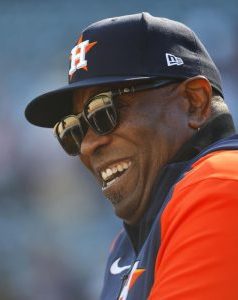
But that swing provoked a foolhardy act by an Astros reliever costing the team said reliever plus manager Dusty Baker for the rest of the game. And thus provoked, José Altuve sent the Rangers’ season onto life support with one swing in the top of the ninth, leading to a 5-4 Astros win.

The Astros did their level best to continue proving to the Rangers that they were the unmovable force on the road, which they were all season long. The Rangers did their level best to say, “not so fast,” on Friday afternoon. At least, until García inadvertently poked the Houston bear.

There was nothing wrong with García celebrating the moment he unloaded on Astro starter Justin Verlander with Corey Seager (one-out double, then to third on Sean Carter’s single) aboard in the bottom of the sixth, sending a first-pitch fastball over the left center field fence. There was everything wrong with Astro reliever Bryan Abreu drilling García on the first pitch in the eighth.

Abreu was ejected while both benches emptied. Astros manager Dusty Baker argued so vociferously with the umpires that he was ejected post haste. When order was restored, Astros finisher Ryan Pressly had to slither out of the first-and-second jam and did it with a force out and two strikeouts to follow.

Then, Pressly had to slither out of a jam of his own making, surrendering back-to-back singles to Mitch Garver and Josiah Heim, before a line out, a fly out, and a swinging strikeout banked a game the Astros could have lost almost as readily as they won it.

In between those jams, Altuve batted with two on (Yainer Díaz, leadoff single; pinch hitter Jon Singleton, wal), nobody out, and José Leclerc on the mound for the Rangers after relieving Aroldis Chapman to retire the side in the eighth. The delay may or may not have affected Leclerc. Altuve reached down for a down-and-in 0-1 pitch and sent it up and out, over the left field fence.

No one can really prove Abreu’s intent. Watch a replay of the pitch. Astros catcher Martín Maldonado is set for a pitch coming low under the middle of the zone. The pitch shot up and in and off García’s left tricep. García got right into Maldonado’s grille as if thinking Maldonado might have called for a duster but set up to make it look unintentional.

Six umpires called drilling García deliberate. If Abreu really wanted to drill him, he might have disguised it better (say, throwing the duster on the second or third pitch, assuming there would be one) instead of letting him have it on the first pitch. Abreu probably knows well enough to know that you should worry more about getting the man out than sending him messages about previous over-exuberance—especially when you weren’t the one at whose expense he was over-exuberant.

García isn’t exactly a green rookie. It took him long enough to make the Show to stay as it is. Had he just taken his base, he might have kept the Rangers in the game instead of triggering a bench-clearing brawl that ended up possibly harming Leclerc with the extra down-time.

“Everybody on their side is going to say it wasn’t [intentional],” said Rangers second baseman Marcus Semien. “Everybody on this side is going to say it was.”

“I was saying, ‘My bad, it wasn’t on purpose’,” Abreu said postgame. “He was like, ‘bullsh@t’.”

“We know it’s the playoffs,” said umpiring crew chief James Hoye. “We don’t want to make a mistake in a situation like that. So we’re going to make sure that everybody is on the same page, that we all felt the same way. And to a T, all of us felt like that pitch was intentional.”

It’s not impossible, too, that the umpires acted more upon the moment’s emotions when ejecting Abreu for the pitch, García for launching the scrum, and Baker for arguing as wildly as he did over Abreu’s ejection. Abreu did end up hit with a two-game suspension. He could wait until before Game Six to appeal, which would keep him available for Six and Game Seven if it goes that far, though it might keep him out of the World Series’s beginning if the Astros get there.

García probably escaped suspension because he was drilled and furious, but it would not have been out of line for baseball’s government to suspend him, either, for launching the brawl in the first place instead of just taking his base. Especially since his immediate target was Maldonado, not Abreu.

“My plan for [García],” Abreu said postgame, “was just to try to get the ball up and in. That’s my plan with him—up and in, and slider down and away. I just missed the pitch and he just overreacted.”

“I think the optics of the situation are really bad,” said Rangers first baseman Nathaniel Lowe. “It’s the playoffs. You’re allowed to get excited. He got excited. He celebrated because that was a huge swing for us. To have to wear 98 [mph] on the arm after something like that, it’s pretty disappointing.”

Altuve’s ninth-inning nuke made the optics a little bit worse for the Rangers now. The ALCS moves back to Houston. Granted the Astros weren’t a great road team this season, granted the Rangers took it to them in the first two games in Houston this set, but the Astros are not exactly pushovers. Especially not with someone like Mighty Mouse able to hit bombs when the eleventh hour is about to toll.

But it doesn’t keep Baker from a few trepidations over whether the García drill might linger in the minds of both teams if things get testy in Game Six, which is scheduled to pit Framber Valdez starting for the Astros against Nathan Eovaldi for the Rangers.

“I don’t have a crystal ball,” he said Saturday during a workout in Houston. “I mean, it’s going to be what it’s going to be. You have to wait and see, just like me. We don’t script it; it just happens.” That’s just about the last thing either team needs right now.

NLCS Game Four: Second verse, worse than the first?

Craig Kimbrel, Alek Thomas

Diamondbacks pinch hitter Alek Thomas hitting the game re-tying home run off Phillies reliever Craig Kimbrel in the bottom of the Game Four eighth.

“He’ll be available tomorrow,” Phillies manager Rob Thomson said of his just-chastened reliever Craig Kimbrel after National League Championship Series Game Three ended with Kimbrel surrendering a game-ending, game-losing RBI single, “and he’ll be ready to go.” Those may yet prove to be the nine most frightening words in the Phillies’ or their fans’ vocabularies. This week, this weekend, and maybe this year.

They may not necessarily bring Kimbrel himself much comfort in his heart of hearts, either.

Let’s be absolutely fair and say what we still can’t bring ourselves to say while we’re busy booing, hissing, and dreaming up new and snarkier insults to spread all over social media. There isn’t a professional baseball player alive who doesn’t go onto the field knowing that one mistake, one errant swing, one misstep, one missed pitch, could turn him into a fan piñata for life, or close enough to it.

Let’s also be absolutely fair and say Cardiac Craig didn’t cost his team the pennant yet. The game he allowed the Diamondbacks to tie so late, before his successor reliever José Alvarado served the RBI hit that broke the tie to stay, did nothing worse than tie this NLCS at two games each. Neither team’s season is over just yet.

But is Thomson just as willing to say after Game Four what he said of Kimbrel after he surrendered the Game Three-losing hit?

All Kimbrel had to do going out for the bottom of the eighth inning Friday night was keep the frisky young Diamondbacks from doing anything about a late and hard-earned 5-3 Philadelphia lead. He wasn’t even asked to finish the game. Just keep it there before Thomson could hand off to, say, José Alvarado for the ninth.

Groucho Marx would say it was “so simple a child of five could do it. Now, somebody send for a child of five.” It’s not impossible that a child of five could have come away with only a little singe. Kimbrel came away deep fried.

For all the gags about his high wire relief style, nobody pretends it’s fun to surrender a late, game-turning home run at all. There isn’t a child alive who dreams of going out to the mound in one of The Big Ones and getting his brains blown out. But it really becomes a microcosmic season in hell when it’s pinch hit by a spaghetti bat whose major league value over two seasons is plus defense in center field, enough to atone for the weak bat with nineteen defensive runs saved above the league average.

The fair supposition was that Diamondbacks manager Torey Lovullo sent Alek Thomas out to pinch hit for third baseman Emmanuel Rivera hoping only that a lefthanded bat against the righthanded Kimbrel might pick up enough of a hit to push Lourdes Gurriel, Jr. from second to third.

Kimbrel had opened by feeding Gurriel—who’d robbed J.T. Realmuto of at least extra bases with a leaping catch at the fence in the second—a 2-2 fastball to hit into left for a leadoff double. Then, after designated hitter Evan Longoria lined out to left, Kimbrel started behind Thomas, 3-1. It became 3-2 after Thomas fouled one off.

Then, Kimbrel served up a fastball just enough up and off the middle of the plate. It wasn’t a terrible pitch. Nothing on Thomas’s resume through that moment suggested he’d get anything better with it than a line drive base hit the other way, possibly to be stopped before it left the infield.

But the spaghetti bat pulled it, somehow, into the Chase Field pool behind the right field fence. Tying the game at five each. Tying the stomachs of Philadelphia fans in the ballpark and back in the City of Brotherly Love into knots. It wasn’t the game-losing hit by any definition, but those fans could only have thought, second verse, worse than the first.

A called strikeout later, Kimbrel threw Ketel Marte a meatball right down the pipe and Marte rapped it into left for a base hit. Only when Kimbrel plunked Corbin Carroll on the first pitch did Thomson reach for further relief and bring Alvarado in.

Too late. Alvarado fell behind Gabriel Moreno 3-1, then Moreno singled up the pipe to score Marte for the 6-5 Snakes lead the Phillies didn’t overthrow in the ninth. (Yes. It’s more than a little unfair to hang Kimbrel with the “loss” when he wasn’t even on the mound to surrender the hit that plated what proved the winning run.)

Maybe we should say couldn’t. Kyle Schwarber—who’d first put the Phillies on the scoreboard with a leadoff blast in the top of the fourth—hit Diamondbacks finisher Paul Sewald’s first two-out pitch into the right field corner for a double. But Sewald got Trea Turner to strike out swinging for the game.

What happens to Kimbrel in these moments during such postseasons? What happens to any relief pitcher whose line of work includes going into a game tasked with holding a tight lead, escaping a nasty jam, or just finishing off the opposition in the final frame, only to see it blow up in a single pitch?

The best of that profession had to have their moments of doubt. The best of that profession have been broken in the moment, even and especially the biggest moment. Even Mariano Rivera, the Hall of Famer whose closing career postseason statistics would equal a fluke regular season for a lesser talent, suffered the horror of losing a World Series with one pitch to an ancient Diamondback named Luis Gonzalez.

The Mariano shook that one off, picked himself up, and went on with his Hall of Fame career. Kimbrel generally does likewise after an outing, even if he leaves behind a trail of work that tells observers that, even when he comes out alive, it still feels as though his team lost instead of won.

If the moments are too big for Kimbrel, he almost never lets it show. If they’re too big for him, he probably wouldn’t go out there time and again risking a game, his reputation, and maybe his (and his team’s) nervous system. He’s known both off the charts success and off the charts faltering, regular and postseason alike. Since (and especially during) the 2018 postseason, Kimbrel outings leave people feeling often enough as though his teams lose even when they win.

At 35 years old, Kimbrel must wonder to himself how many more such moments (and how many dollars on his contract) are worth the strain. Others, of course, must wonder how many more such moments the Phillies are willing to risk. They’ll have a spiritual advantage getting the set back to Citizens Bank Park, of course. But they’d rather have a series advantage going home, too.

“We’ve got to talk about that,” Thomson said postgame, when the question became changing Kimbrel’s role to come. “Do you put him in a little lower-leverage spot? I don’t know. I’ll talk to him with [pitching coach] Caleb [Cotham], talk through it, and see where we’re at.” That was a far turn from Thomson’s pregame vote of confidence: “I trust [his bullpen]. Has [Kimbrel] scattered the zone at times? Sure. But if you look at our charts, everybody’s had a little bit of a hiccup, but they’ve bounced back. So you’ve got to trust that.”

Some social media mavens raised the name Mitch Williams, the zany and nerve-challenging Phillies lefthander who served up a World Series-losing home run to Joe Carter three decades ago. They thought the Wild Thing got too wild, too crazy, too reckless.

But it turned out that then-manager Jim Fregosi and then-pitching coach Johnny Podres forgot to tell Williams to back away from the slide-step—put on to keep Hall of Famer Rickey Henderson from as much of his usual basepath mischief as possible (a futile hope, of courae)—that altered and rushed his deliveries and his fastballs.

With Podres already having visited the mound, and neither he nor Fregosi finding a sign to send with the order, Williams was doomed when his slide-stepped fastball went into Carter’s wheelhouse instead of up and away where the Wild Thing wanted it and might have thrown it out of his normal delivery.

The three-legged mistake of Fregosi, Podres, and Williams lost the Phillies a World Series. Kimbrel’s high-wire mistake merely tied an NLCS game. “I rolled up in here and cost us two games,” said Kimbrel postgame, clearly not pleased with himself. “The bright side is we’re still tied at 2-2 and we’ve got a game here tomorrow, then we get to Philly.”

Forced to a bullpen Game Four in which the bulls ran short, Kimbrel ran out, and a few early defensive mistakes made life tougher for the Phillies than it should have been, they  need Zack Wheeler to pitch an even better Game Five Saturday than he did enabling the Phillies to win Game One.

They also need Aaron Nola to be his Game Two self in Game Six back home. Their bullpen, whose main men have worked 14.3 innings in this set, needs a huge break. They need to quit underestimating this tenacious crew of Diamondbacks, no matter how silly they’ve slapped Snakes starters Merrill Kelly and Zac Gallen, the latter of whom squares off against Wheeler on Saturday.

They can’t afford to risk Kimbrel tearing it even once more, either.

NLCS Game Three: Cardiac arrested

Craig Kimbrel

“Some days you get them, and some days you don’t.”—Phillies relief pitcher Craig Kimbrel, gotten but good by the Diamondbacks in Game Three.

Two League Championship Series Game Threes, two postseason juggernauts stopped. One night, the Astros slap aging and rusted Max Scherzer silly en route making the ALCS a 2-1 affair. The next afternoon, the Diamondbacks do what Cardiac Craig Kimbrel all but begs them to do and turn the NLCS likewise into a 2-1 affair.

Until both the Phillies and the Diamondbacks more or less snuck single runs home in each half of the seventh, their Game Three was mostly a pitching clinic. In fact, until Diamondbacks reliever Ryan Thompson wild-pitched Bryce Harper home in the top of the seventh, no scoreless postseason game ever ended its scoreless status that way.

Both starters, Ranger Suárez for the Phillies and rookie Brandon Pfaadt for the Diamondbacks, pitched into the sixth without so much as a peep across the plate on either side.

The bullpens took over and, while a few things got a little dicey between them, they held the tie and threatened to send the game to extra innings. Then Phillies manager Rob Thomson made his big mistake. He called upon Kimbrel to hold fort for the bottom of the ninth.

If this game was in Philadelphia, even the Phillies’s loud and loyal fans would have had the crash carts on double red alert. But in Chase Field, the Diamondbacks’s snake pit, the only thing anyone on that crowd wanted to hand Kimbrel was a loaded triple-decker hamburger smothered in heavy sauce.

This was a little too classic Kimbrel. He fell behind Lourdes Gurriel, Jr. leading off, 3-0, pumped two strikes called on the corner, watched Gurriel foul a pair off, then walked him low and away.

He fell behind Pavin Smith, a late game entry pinch hitting for the day’s designated hitter Evan Longoria two innings earlier, 2-0, Gurriel stealing second on the second pitch.

Then, a swinging strike, followed by a grounder up the middle that Phillies third baseman Bryson Stott grabbed on a slide but left himself no play. With Gurriel the potential winning run now on third.

Next was Emmanuel Rivera, playing third for the Diamondbacks. Kimbrel got his first first-pitch strike of the assignment while Smith took second on fielders’ indifference. A foul strike, a ball low, then a grounder toward third speared by Phillies shortstop Trea Turner, who threw home and nailed Gurriel at the plate.

Back in Philadelphia, the sigh of relief probably crossed three state lines—but the crash carts remained online and on double red alert. With good reason.

Kimbrel started Snakes shortstop Geraldo Perdomo with a ball way off the plate before Perdomo fouled the next pitch away and swung for strike two. This was the first time Kimbrel got ahead of a batter in the inning. That’d teach him. Two straight balls, low, to follow. Ball four to load the pillows. A first pitch strike to second baseman Ketel Marte. A second pitch fastball a little up . . .

Bing! It wasn’t up enough for Marte to miss shooting it back up the pipe for a base hit sending Smith home with the game winner.

Yes, it was only Game Three. Yes, the Phillies still have the NLCS advantage. But, yes, they may have to think twice before deciding they can live with the cardiac side of Kimbrel much longer.

“He just couldn’t find the zone consistently,” said Phillies manager Rob Thomson postgame, “and sometimes that happens to Kim,” Thomson said. “But he’ll be available [for Gamr Four], and he’ll be ready to go.”

Hear me out. This guy has been a great pitcher in the past. Somehow, he still holds a lifetime 2.47 fielding-independent pitching rate (FIP), a 0.99 walks/hits per inning pitched rate, and a 3.87-1 strikeout-to-walk ratio, not to mention a 14.2 strikeouts-per-nine rate. But his real greatness may well be behind him, even if he was an All-Star in his first Phillies season this year.

Now, let’s look at Kimbrel by dividing his career between his final of three regular seasons with the Red Sox and his seasons since:

Craig Kimbrel ERA FIP WHIP BB/9 K/9 K/BB
2010-2018 1.80 1.81 0.91 3.3 14.8 4.44
2019-2023 3.57 3.68 1.16 4.1 13.0 3.15

Yes, he can still strike the other guys out like a virtuoso. But since leaving Boston he’s walking about one more per nine than before and striking one less out. He’s allowing more to reach base in the first place since leaving Boston. His ERA/FIP were about dead even during those great first nine seasons of his career, but they’re two runs higher since that 2010-2018 term. And, from 2019-23, his FIP (kind of your ERA when the defense behind you is taken out of the equation) is eleven points higher than his ERA.

Since somehow earning six saves despite a 6.74 ERA in the 2018 postseason, Kimbrel has been up and down in October. In 2020, he pitched an inning and a third shutdown relief in the National League wild card game for the Cubs. In 2021, he appeared in three American League division series for the White Sox—and surrendered two earned runs in three innings.

Until Thursday afternoon, Kimbrel this postseason looked great if you didn’t look past the surface numbers. In division series Game One he got the side in order to finish the Phillies’ win—without a strikeout. But he needed Johan Rojas’s spectacular running catch in division series Game Four’s seventh to save him in the Phillies’ win.

He got the NLCS Game One save credit with a swinging strikeout and a game-ending double play—after he walked his second batter of the ninth. Entering Game Three, Kimbrel had an ERA of zero . . . but a 3.71 FIP. But after Game Three, they became 2.09/5.07.

A 5.07 FIP is not conducive to late-inning survival.

“Some days you get them, and some days you don’t,” Kimbrel said, too matter-of-factly, after the game ended. “Today just wasn’t my day.”

Remember: It wasn’t Kimbrel’s fault the Phillies’ usually formidable offense was kept to three hits on the day, or scored their only run of the game on a walk, an infield hit, a double play pushing Harper to third, and the wild pitch enabling Harper to score. But given the chance to push Game Three to extras tied at one, Kimbrel went cardiac once too often.

That may not be a thrill or a chill the Phillies can afford much longer. If at all.

He’ll be available tomorrow, and he’ll be ready to go. Which “he’ll”—the guy who can be as tight shutdown as they come, or the guy who can’t stop the high wire act until the cable snaps under his feet? These Phillies deserve to know, because these Diamondbacks won’t be kind if the wrong one’s ready.

ALCS Game Three: Max the Knifed

Max Scherzer

Max the Knifed watches José Altuve’s leadoff bomb disappear in the top of the Game Three third Wednesday night.

Which would be more treacherous a thought entering American League Championship Series Game Three? The Astros in the 2-0 hole, needing to win twice for any hope of taking the series home where the Rangers proved impossible to intimidate in the first two? Or Max Scherzer starting for the Rangers at all?

My guess going in was that it was even money. The Astros may have manhandled the Rangers on the regular season, including winning five of six in Globe Life Field. But they got out-wrestled by the Rangers in Houston to open this ALCS, neither team hitting with overwhelming force but the Rangers holding an ALCS ERA one full run lower.

That might or might not change in Game Three, I thought. Scherzer’s age began showing this season well before the Rangers made him their marquee trade deadline catch at July’s end, well before his arm (specifically, it turned out, his armpit) tried to resign on 12 September, knocking him out of the Rangers’ high-wire final stretch.

Scherzer was also once considered a non-factor for this postseason. He, of course, had other ideas. “When this injury happened, we were kind of in that four- to six-week window,” he said before Game Three. “I took one day to feel bad about it and the next day I was back to grinding because I knew we have a team that can compete with anybody . . .

“I’ve pressed all the buttons I can,” he continued. “I’m ready to go . . . I feel normal. That’s all I can say.  All I can do is describe what I feel like and if I have an issue, I have to let them know. But my arm feels fresher.”

On the surface, that sounded better than the 2019 World Series, when Scherzer was a National and had to miss his scheduled Game Six start because of a neck issue that called for a cortisone shot and Stephen Strasburg standing in to deliver heroic pitching. When Scherzer started Game Seven and kept things to a 2-0 Astro lead while he had nothing left in his tank but fumes.

The Nats, of course, went on to win that game and that Series. “We were all kind of making fun of him,” then-Nats catcher Kurt Suzuki said, “saying he was going to rise from the dead.”

Scherzer just might have had to do that again Wednesday night. Whether he’d be Max the Knife or Max the Knifed, he did have a history of sheer survival on the mound going in. But he also had over a month’s rest and rust. And these Astros aren’t quite the same Astros he held off four years ago, but they’re just as formidable—and they flayed him for a 6.55 ERA in two starts on the season.

Plus, Globe Life is a hive where big bops thrive, and Scherzer has averaged 25 home runs surrendered per 162 games lifetime. That won’t paralyse his Hall of Fame case, but there was always the chance that one, two, or even three Astro bombs might murder him and the Rangers in Game Three. And these Astros were a far better road (.630 win percentage) than home team (.481) on the regular season.

Well.

Scherzer and Astros starter Cristian Javier matched shutout innings in the first. But the slider that’s done slightly over half his lifelong lifting began disobeying his orders after that. Fatally. Scherzer said postgame that, while his arm feels good (“That’s the number one thing”), he doesn’t know how he’ll be used the rest of the postseason.

The Rangers may not know just yet, either. Not even if manager Bruce Bochy said he had decent stuff and made “some mistakes.” Scherzer did throw eleven first-pitch strikes and nailed fourteen called strikes. But a little over half his strikes were put into play. The wipeout slider deserted him. The Astros weren’t inclined to show mercy.

Scherzer plunked Yordan Alvarez on the back foot to open the second, then caught José Abreu looking at strike three—before he loaded the bases on a followup walk and a base hit with nobody out.

Then he got Jeremy Peña to pop out to short center, but he wild-pitched Alvarez home with Martín Maldonado at the plate. Seeking his first ALCS hit, Maldonado then nailed it with a two-run single past Rangers third baseman Josh Jung. Maldonado was thrown out at second trying to stretch, but Scherzer left the inning in a 3-0 hole. Which became a 4-0 hole when José Altuve sent a 1-2 service into the left center field seats.

Scherzer went back out for the fourth. Abreu said a rude leadoff hello with a double to the back of center field, and a ground out later Mauricio Dubón singled Abreu home for a 5-0 Astro lead. Getting ahead in the count on most of the Astros he faced did Scherzer no good in the end. The Rangers went to their postseason-surprise bullpen after four full innings.

Max the Knifed.

Javier (.119 batting average against him in his postseason life) kept the Rangers in check with location more than speed, until Nathaniel Lowe rapped a two-out single into left and Jung sent one into the right center field bullpen in the bottom of the fifth. With Cody Bradford on the mound for the Rangers, center fielder Leodys Taveras pulled a likely sixth-inning homer back against Alvarez.

In the bottom of that inning, Rangers rookie Evan Carter sent Javier out of the game and the Rangers’ hair with a two-out double. But Michael Brantley ran down a likely extra-base hit into an out with a running catch on the track off Adolis García’s followup drive and might have saved the game for the Astros.

It must have put a further jolt into the Astro lineup. Alvarez smacked a bases-loaded, two-run single off Rangers reliever Will Harris with two out in the seventh. Then Lowe and Jung delivered a rerun of their fifth-inning flogging—Lowe with a two-out single, this time to right, and Jung with another two-run homer, this time over the straightaway center field fence.

The Astros added an eighth in the eighth off Jon Gray with Peña’s bouncing single through the right side sending Tucker home. It might have been more but for Seager going into the hole at short to stop Altuve’s one-out smash and throw Dubón out at third, before Martin Perez relieved Gray and rid himself of Brantley on the ground for the side. It seemed off script when García singled Marcus Semien home in the bottom of the eighth.

After Alvarez got thrown out at home to end the top of the ninth, here came one final chance for the Rangers in the bottom—the numbers two and three scheduled hitters were Lowe and Jung, following Mitch Garver, even with Astros closer Ryan Pressly coming into the game.

Garver did his part, wringing his way to a full-count leadoff walk, before Lowe struck out swinging and Jung grounded into a game-ending double play. There went the Rangers’ postseason winning streak. The Astros still have an uphill climb ahead of them no matter how good a road team they were this year. Even if they’ve won six out of their last eight games in Arlington.

Scherzer’s competitiveness hasn’t abandoned him. But after the roughest regular season of his major league life, as Yahoo! Sports’s Hannah Keyser observes, “the problem is not rising to the moment but, rather, succumbing to his own physical limitations.” Succumbing to the very real prospect that he really isn’t Max the Knife anymore.

And, to the very real prospect that, however much the Rangers respect him, however much his teammates admire his undiminished need to compete, they may not be able to afford another chance to find out if there’s even one final quality start—never mind one more miracle performance—left in him this year.

“It comes down to execution,” said Max the Knifed postgame. “I know what I need to do.” He almost sounded like a chastened child who made a huge mistake trying to pass a mud pie off as a chocolate cake. That’s not the way a 39-year-old future Hall of Famer or his World Series-aspiring team wants him to sound.

NLCS Game Two: Was it loud enough?

Merrill Kelly

Arizona pitcher Merrill Kelly leaving NLCS Game Two in the sixth inning and hearing it from the Citizens Bank Park crowd whose sound he underestimated. He ended up bearing the least of the Phillies’ destruction on the night.

Maybe nobody gave Diamondbacks pitcher Merrill Kelly the memo. Maybe he missed the sign completely. Wherever Kelly happened to be, if and when he was warned not to poke the Philadelphia bear and his native habitat, he learned the hard way Tuesday night and the Diamondbacks whole were dragged into class.

Maybe the Braves sent him a message he never saw. You remember the Braves. The guys trolling Bryce Harper after their second division series game, when Harper got doubled up on a very close play following an impossible center field catch to end the game. They learned the hard way, too. They’re also on early winter vacation.

Before this National League Championship Series even began, Kelly was asked whether the heavy metal-loud Citizens Bank Park crowd might have a hand in the field proceedings. He practically shrugged it off, though in absolute fairness he wasn’t exactly trying to be mean or nasty.

“I haven’t obviously heard this place on the field, but I would be very surprised if it trumped that Venezuela game down in Miami [in the World Baseball Classic],” said Kelly, a righthander whose countenance bears a resemblance to comedian Chris Elliott and who’s considered a mild-mannered young man otherwise. “When Trea [Turner] hit that grand slam, I don’t think I’ve ever experienced—at least baseball-wise, I don’t think I’ve ever experienced an atmosphere like that so I hope that this isn’t louder than that.”

That grand slam jolted Team USA into the semifinal round. By the same Trea Turner who’d start Kelly’s Tuesday night with a jolt, hitting a one-out, one-strike pitch into the left center field seats in the bottom of the first. 

Kelly may not have been trying to be snarky, but The Bank let him have it early and often, first when he was introduced pre-game time and then when he took the mound for the bottom of the Game Two first. Loud, clear, and unmistakeable.

The only things Kelly faced louder and more clear than that were Turner’s score-starting blast, the one-ball, two-out laser Kyle Schwarber sent off Kelly’s best pitch, a changeup, into the right field seats in the third, and the 2-1 skyrocket Schwarber sent into the right center field seats leading off the bottom of the sixth.

“He’s really effective because he has a plus-plus changeup,” Schwarber said postgame. “He threw it 2-0 and kinda gave me the window. That’s what it looks like coming out of there. I think that was the first strike [on a] changeup I saw. [The home run pitch] was a little bit more down and away. But, I mean, it came out of the same height. So those are things that you look for.”

“They’re good big-league hitters,” Kelly said of the Phlogging Phillies postgame. “That’s what good big-league hitters do. They don’t miss mistakes.” Neither did The Bank’s crowd, serenading him with “Mer-rill! Mer-rill” chants at any available opportunity. But Kelly actually pitched decently despite the bombs. He only surrendered three hits, but walking three didn’t help despite his six strikeouts.

He’d also prove to have been handled mercifully compared to what the Phillies did to the Diamondbacks bullpen in a 10-0 Game Two blowout.

Once they pushed Kelly out of the game, with two out in the sixth and Turner aboard with a walk, they slapped reliever Joe (Be Fruitful and) Mantiply with a base hit (Bryson Stott), a two-run double (J.T. Realmuto), and another RBI double (Brandon Marsh). Just like that, the Phillies had a four-run sixth with six on the board and counting.

Then, Mantiply walked the Schwarbinator to open the Philadelphia seventh. Diamondbacks manager Torey Lovullo reached for Ryne Nelson. One out later, Harper singled Schwarber to third, Alec Bohm doubled them home with a drive that hit the track, Stott hit a floater that hit the infield grass between Nelson plus Diamondbacks third baseman Evan Longoria and catcher Gabriel Moreno, Realmuto singled Bohm home and Stott to third, and Nick Castellanos sent Stott home with a sacrifice fly.

This time they didn’t need Harper to provide the major dramatics. He’d done enough of that in Game One, hitting a first-inning, first-pitch-to-him, first-NLCS-swing, first-time-ever-on-his-own-birthday nuke one out after Schwarber hit his own first-pitch bomb. That game turned into a 5-3 Phillies win. On Tuesday night, they turned the Diamondbacks into rattlesnake stew.

They made life just as simple for Game Two starter Aaron Nola as for Game One starter Zack Wheeler. Wheeler gave the Phillies six innings of two-run, three-hit, eight-strikeout ball; Nola gave them six innings of three-hit, seven-strikeout, shutout ball. It was as if the Philadelphia Orchestra offered successive evenings of the Brahms Violin Concerto in D Major—featuring Isaac Stern one night and Itzhak Perlman the next.

“It’s a little more hostile and a little more engaging,” said Turner of the Bank crowd after the Phillies banked Game One. “I think [Kelly] can maybe tell you after tonight what it’s like, but I wouldn’t put anything past our fans. Our fans have been unbelievable. They’ve been great. I don’t know what decibels mean, but I guess we did something cool for AC/DC concert level decibels the other night . . . I would just wait and see and we’ll see what he says after [Game Two]”

“They’re up all game on their feet from pitch number one till the end,” said Nola postgame. “I feel like you don’t really see that too much around the league. That just shows you how passionate and into the game they are. They know what’s going on, and that helps us a lot.”

That was not necessarily what Lovullo wanted to hear before or after the Game Two massacre ended. “Everybody’s talking about coming into this environment,” he said, audibly frustrated, “and I don’t care.”

We’ve got to play better baseball. Start with the manager, and then trickle all the way down through the entire team. We’ve got to play Diamondback baseball . . . Diamondback baseball is grinding out at bats . . . driving up pitch counts, catching pop ups . . . win[ning] a baseball game by just being a really smart, stubborn baseball team in all areas.

That assumes the Phillies will just roll over and let them play it. The wild-card Diamondbacks who steamrolled two division winners in the earlier rounds to get here in the first place looked like anything except an unlikely juggernaut after getting manhandled in Philadelphia. They shouldn’t take the Phillies for granted once the set moves to Chase Field, either.

The Phillies might have been a one-game-over-.500 road team on the regular season, but they beat the Diamondbacks in Chase Field three out of four—a couple of weeks after the Snakes beat them two out of three in The Bank. Until this NLCS it was a little over three months since the two teams tangled. It certainly didn’t phaze the Phillies.

“I still think we’re real confident,” said Kelly. “I think there was a lot to be said about us after the All-Star break about how bad of a slump that we went into. I’ve seen in this clubhouse, I’ve seen from these guys that we haven’t gotten rattled all year. And I don’t want us to hang our heads and pout about it this time.”

But let’s say the Diamondbacks iron up and find ways to neutralise the Phillies’ offensive bludgeons and pitching scythes which, admittedly, might require a kidnapping or three. Let’s say they win all three games at Chase. They might become the only team to be at a disadvantage with a 3-2 series lead.

Because guess where the set would return then. And, unless my prowling has missed something this morning, Kelly didn’t have one word to say about that crowd after Game Two came to its merciful end. It must have been more than loud enough for him.