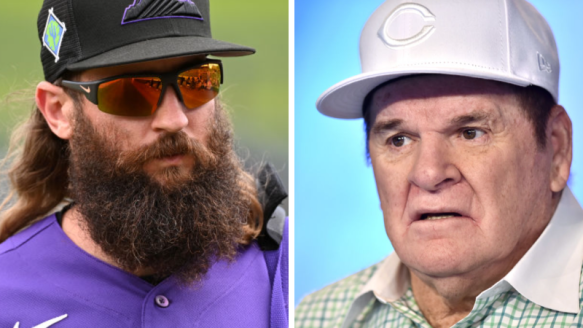
Unknown's avatar

About Jeff Kallman

Member, Internet Baseball Writers Association of America and the Society for American Baseball Research.

A little hustle in the muscle

Dominic Smith

Dom Smith diving across first after Cardinals reliever Giovanny Gallegos (65) was late covering on Smith’s smash up the line and well behind the base in the top of the ninth Monday. Gallegos then tried but couldn’t nail trail runner Jeff McNeil at the plate, kicking the Mets’ overthrow win into overdrive.

It looked simple enough. Mets outfielder Mark Canha down to his and the Mets’ final strike Monday night with third baseman Eduardo Escobar aboard on a one-out base hit. Cardinals reliever Giovanny Gallegos 0-2 on Canha and ready to land the last punch(out).

The good news for the Mets is that they ended up landing the final punch with a two-run homer finishing a 5-2 overthrow into which they hustled themselves after they’d been down to their final strike. Aided and abetted unexpectedly by Gallegos a moment late and two bucks short covering first base on what could have been a game-ending dazzler.

Thus did the first showdown between the leaders of the National League East and Central grind, sprint, and launch its way to the finish in the Mets’ favour. You could almost feel the Cardinals bawling themselves out that it didn’t have to go that way the moment Mets reliever Edwin Diaz struck Cardinals outfielder Harrison Bader out after a two-out walk.

It came to this because the Mets wasted a delicious pitching duel between Max Scherzer and the Cardinals’ Miles Mikolas, trading shutouts for seven innings, after Mets reliever Tyler May couldn’t put Mendoza Line-hitting Tyler O’Neill away and surrendered a two-run single for his trouble with the bases loaded and one out in the bottom of the eighth.

But now Canha wasnt quite so ready, fighting back to a full count, before he hit a bouncer up the third base line to Nolen Arenado, the Cardinals’ third baseman to whom a play like this, even on the short run, was something he could do upside down if necessary.

Arenado on the not-so-hard run whipped a throw across the infield to first base. The ball soared right past first baseman Paul Goldschmidt and Escobar soared home to put the Mets on the board at last, with Canha taking second on the play and Jeff McNeil checking in at the plate.

Canha came out for pinch runner Travis Jankowski. McNeil sent an RBI double deep to right. And Mets manager Buck Showalter sent Dom Smith up to pinch hit for smart catching/modest-hitting Tomas Nido. Smith shot one up the first base line that Goldschmidt stopped one way or the other, diving across the line as he speared it fair.

But when Goldschmidt hustled a throw to the pad he had no target. Gallegos bounced off the mound a moment too late for the out as Smith dove onto the pad and Jankowski and McNeil cross the plate safely, McNeil himself diving home a split second before Cardinals catching insertion Andrew Kinzner could get a tag on him off Gallegos’s throw home.

“The second he hit it, I thought it was a foul ball,” said Gallegos post game. “Then I saw the ball bounce back to first, and that’s when I broke.”

“That’s a mental mistake,” said Cardinals manager Oliver Marmol. “Can’t excuse it. He knows it; we know it: He’s got to cover first.”

“Dom probably ran the fastest 90 (feet) of his life there,” said McNeil. “I knew it would be close at first base. I ended up scoring. It was a lot of fun.”

Smith wouldn’t exactly disagree. “You try to hustle as hard as you can to beat him,” he said. “I saw the closer didn’t get over right away. I just ran as hard as I could. I knew I had a step on him. I felt slow but I tried to run hard.” Don’t fight the feeling next time, either. It could be worth another pair of runs in another eleventh-hour effort.

It put the Mets up 3-2, brought lefthander T.J. McFarland in to relieve Gallegos for the Cardinals, and brought lefthanded-hitting Brandon Nimmo to the plate for the Mets. McFarland threw Nimmo a sinker that didn’t quite sink below the inner middle of the zone, and Nimmo sunk it on a high line inside the right field foul pole.

“It was worth the wait,” said Mets manager Buck Showalter after they banked the game. “It really was. It was fun to watch.”

“We’re a resilient team,” Smith said, “and I feel like we’re in it till the last pitch every night. Even the games that we don’t come up with a win, I feel like we make it tough on our opponents when they do beat us. I think it showed our DNA and what we’re about.”

And it almost (underline that) erased the pitching duel that kept Busch Stadium in thrall most of the night. Scherzer may have struck ten out in his seven innings but he appreciated his mound opponent just as much. Appropriately.

“Tip your hat off to Miles tonight,” he said of Mikolas, whose own seven-inning effort was five punchouts and four scattered hits. “That’s baseball. It was a great game. Sometimes you run into a buzz saw and he did his job tonight. I’m pitching on pins and needles there. I have to make every pitch. I was thinking even a solo shot might lose it.”

He didn’t have to worry as much as he thought. Monday night left Max the Knife number five on the career survey with his 106th double-digit-strikeout game, not to mention 33 punchouts and a measly eight walks in 25 innings pitched this season thus far.

If only he could pitch in Busch Stadium more often than he does. In his previous five gigs there, he’s gone seven innings or more each without a single run being pried out of him. He also has an ongoing 21-straight shutout inning streak against the Cardinals, and now that he has seven starts of ten strikeouts or more against them he’s behind only Hall of Famer Sandy Koufax in that department.

This is the pitcher the Cardinals have never tried to sign when he was on the open market despite his roots being in Missouri. Now they can look forward to this plus two more seasons of potential continuing torture at his right hand. Even if he might still need Met bats in the ninth to keep the bullpen from trashing his best efforts after he departs for the day or night.

“Everybody had a hand in that rally and that’s the cool thing,” he said of the Mets’ ninth-inning grind-out. “When you see your offense go off like that and just find a way to scratch across extra runs.” Catching one of the other guys asleep just enough when there’s first base to cover critically doesn’t exactly hurt, either.
Coming at last, the Yankeegate letter

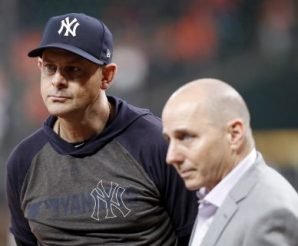
Aaron Boone, Brian Cashman

Manager Aaron Boone and general manager Brian Cashman may have a lot of explaining to do when the Yankeegate sign-stealing letter comes forth to the public.

It didn’t happen when I thought it would happen, but the now-infamous Yankeegate letter will be made public. The Yankees couldn’t quite convince the 2nd U.S. Court of Appeals to reconsider their original denial last month.

They couldn’t convince the court that releasing the letter would calcify your spine, cut your circulation off, amputate both your arms, or destroy the world’s coffee bean crops.

Writing for the three-member panel, Judge Joseph Bianco said it’s very much in the public interest whether commissioner Rob Manfred wrote to Yankee general manager Brian Cashman that he knew the Yankees were up to a little bit more in 2017 than just a little subterfuge involving their dugout telephone.

“As the judge explained it,” writes Sportico‘s Michael McCann, “the letter is a judicial document, which means it is presumptively accessible to the public.” Not to mention Manfred and baseball’s government compromising any privacy arguments by letting a takeaway or two escape to the public purview in the first place.

Major League Baseball swore to anyone who’d listen that the Yankees weren’t using cameras belonging to their YES broadcasting network for any extracurricular in-game field intelligence, while fining them over the dugout phone. MLB also fined the Red Sox after an assistant trainer was caught using his AppleWatch for such intelligence gathering.

It took Astrogate and its fallout to help Manfred to zap the Red Sox, at least, over their 2018 replay room reconnaissance ring, which wasn’t quite as grave as the Astros’ off-field-based, illegal electronic sign-stealing intelligence agency. Both the Astros’ 2017 World Series title and the Rogue Sox’s 2018 World Series title have since been suspect.

The Yankees haven’t won a World Series since 2009. But if the Manfred letter to Cashman reveals anything deeper than a dugout phone at play in any such Yankee intelligence operation, it won’t take the 2017-18 Astros off the hook but it will put the 2017 Yankees on the hook squarely enough.

Suspecting numerous teams used their replay rooms for subterfuge is one thing. Answering it to the extremes the Astros went and the Yankees might have gone is something else entirely. We won’t know until the letter’s release how far the Yankees actually went. But when the Yankees say in court documents that the letter will inflict “significant and reputational harm” if released, look out.

“The letter could also mention coaches, staff and players who were alleged to have played roles in possible shenanigans . . . MLB attorneys have similarly warned the letter could ’cause potential embarrassment,’ while insisting the letter’s release is motivated by ‘perceived shock value’,” McCann writes.

That could prove a significant embarrassment, especially remembering how Yankee outfielder Aaron Judge insisted that Astros second baseman Jose Altuve’s 2017 American League Most Valuable Player award was now tainted in light of Astrogate. Altuve has since been shown not only to have objected to the Astros’ trash-can banging of stolen signs while he was at the plate, but he wasn’t actually wearing any kind of buzzer under his uniform at any time.

The Yankeegate letter saga began when the DraftKings fantasy sports group sued the Astros, the Red Sox, and MLB itself over those teams’ 2017-18 cheatings, and pre-trial discovery included filing the letter under seal. DraftKings lost their $5 million lawsuit, and releasing the letter won’t reinstate the suit. Nor will it take the Astro Intelligence Agency or the Rogue Sox Reconnaissance Ring off the hook.

But one of the five DraftKings plaintiffs, Kristopher Olson, has told McCann that the courts must “recognize the distinction between diffuse, random acts of rules breaking, like the use of corked bats by individual players, and a concentrated, coordinated campaign like the one in which the Astros engaged and [that] MLB took steps to downplay and conceal.”

It took pitcher Mike Fiers blowing the whistle at last to Athletic writers Ken Rosenthal and Evan Drellich to un-conceal Astrogate in November 2019. Manfred himself was compelled to leave almost every Astro player unpunished in return for getting them to spill about the AIA. Drellich’s in-depth Astrogate examination, Winning Fixes Everything: The Rise and Fall of the Houston Astros, twice delayed since last August, is now due to be published in September.

Manfred crunched the Astros with stripped draft picks and owner Jim Crane with a $5 million fine, not to mention imposing yearlong suspensions of then-manager A.J. Hinch and general manager Jeff Luhnow, whom Crane fired posthaste. The players’ union and MLB agreed since that any players involved in any degree of Astrosoxyankeegate-like espionage can be suspended without pay and with a concurrent loss of MLB service time.

Hinch eventually admitted in a wrenching interview that, except for a couple of clubhouse-monitor smashings, he could have but didn’t do more to thwart the AIA. Then, after serving his year’s suspension, he found new life as the Tigers’ manager.

We learned soon enough, too, that Luhnow approved a staffer-created algorithm designed to steal signs from off the field before then-bench coach Alex Cora and then-designated hitter Carlos Beltran masterminded an operation involving either an extra camera or illegally-altered-to-real-time existing one for the AIA. The Astros’ mealymouthed presser as spring training 2020 opened left them an even worse look. The pan-damn-ically cut-off spring training and delayed regular 2020 season shielded them partially from fan retribution.

The Rogue Sox didn’t take quite the beating over the 2018 cheaters as the Astros did, but then the Sox so far were proven only to have been one team who did figure out that their replay room—bestowed by MLB upon home and road teams in all ballparks—had its extracurricular uses. Manfred purged their video room operator J.T. Watkins but, again, let players off the hook in return for details.

Rogue Sox manager Cora, hired for 2018, also resigned before he could be fired in 2020. He, too, gave a self-lacerating interview while sitting out a year-long suspension; it may have helped his re-hiring for last year. Beltran was hired after the 2019 season to manage the Mets, but he was forced out before he got to manage even a single spring training game for them. He works now as a Yankee broadcast analyst.

The Yankeegate letter’s full disclosure may inspire Astrogate-like wrath toward the Yankees. The outrage might be enough to force Manfred to drop at least an Astrogate-like hammer upon the Yankee front office and even manager Aaron Boone. (MLB says releasing the letter would be “embarrassing” to it, too.) “May” and “might” are the operative words there.

If so, there’ll be plenty of fan bases, including the one for those National League East-leaders playing across town in Queens, who’ll think it couldn’t happen to a nicer team.

3,000 hits, and one for the game’s integrity

Miguel Cabrera

Miggy Stardust standing alone at first base after becoming baseball’s only 3,000-hit/500-home run/Triple Crown winning player Saturday afternoon.

Well, it proved too much to ask that Miguel Cabrera should get number 3,000 by launching one over the fences in Comerica Park Saturday afternoon. Sometimes the Elysian Fields insist that drama takes an inning off. But he didn’t wait long for the big knock, either. A sharply-cued single is equal to a home run in the hit total.

With Robbie Grossman aboard with a leadoff single in the bottom of the first, Cabrera shot a 1-1 fastball from Rockies pitcher Antonio Senzatela through the right side of the infield as if he’d lined up a money shot in a pool tournament. The bedlam began before he had a chance to hold up at first.

The Comerica audience chanted and cheered down upon him from just about the moment he left the batter’s box. He raised his fist at first as the ballpark scoreboard gave him the fireworks equivalent of a 21-gun salute. Former teammate José Iglesias, now a Rockie, ambled over to give him a bear hug—and the ball he’d just hit into history.

The Tigers poured out of their dugout to congratulate their man. His wife, his son, his daughter, and his mother gave and received hugs with him behind the plate while time was still in effect. Who says it wasn’t worth the extra day’s wait?

Cabrera barely had time to settle back in at first base when Jeimer Candelario struck out but Jonathan Schoop pushed him to second and Austin Meadows (safe on a fielder’s choice) home with an infield hit, and Spencer Torkelson—who’s taken first base over while Cabrera settles in strictly as a designated hitter—hit Senzatela’s first pitch to him into the right field seats.

Just like that, the Tigers showed they knew how to celebrate Miggy Stardust’s big knock the right ways. Then, after Grossman singled home a fifth run in the fourth, the big puddy tats ramped up the party with two outs in the sixth, and the guest of honour struck again, his two-run single being sandwiched between a pair of RBI singles, including Candelario pushing Meadows home on another infield hit.

Tigers manager A.J. Hinch gave Cabrera the rest of the game off, and his mates treated him to another two-out four-run inning in the seventh, this time Meadows singling home a pair, Candelario drawing a bases-loaded walk, and Schoop singling Meadows home. The Tiger bullpen took care of the rest, even if Angel De Jesus had to claw his way out of a self-inflicted bases-loaded jam to seal the 13-0 win.

That was the opener of a doubleheader in which the Rockies threatened to shut the Tigers out in the nightcap until Meadows hit a two-out, two-run triple off Rockies reliever Alex Colome. But Colome struck pinch hitter Harold Castro out swinging on three straight cutters to nail the 3-2 Rockies win.

Cabrera picked up another base hit in the nightcap’s bottom of the first to set first and third up for Candelario, who struck out swinging before Meadows forced the guest of honour at second for the side. But nothing could spoil Cabrera’s party, not even a doubleheader split. Nothing could spoil him becoming the first man ever to nail 3,000+ hits, 500+ home runs, and win a Triple Crown.

Not even the Comerica crowd booing wrongly when the Yankees ordered him walked in the bottom of the eighth Thursday, so their lefthanded reliever Lucas Luetge could have a more favourable matchup with the lefthanded-hitting Meadows.

That debate poured into the following two days, even as the Tigers and the Rockies were rained out of playing Friday night. It was a foolish debate, in which the booing Tiger fans proved nothing more than that they’re not averse to a little tanking—when it might involve one of their own getting the ideal matchup to get the big knock after he’d gone 0-for-3 thus far on that day.

Down 1-0, Yankee manager Aaron Boone could have been accused of a little tanking himself if he’d let Luetge pitch to the righthanded Cabrera, whose splits show he manhandles pitching from both sides but is that much better against the portsiders, and handed Cabrera the immediate advantage going in.

Boone had even a slight a chance to hold those Tigers and keep his Yankees within simple reach of overcoming and winning. History be damned, he took it. And even if the lefthanded-swinging Meadows did wreck the maneuver promptly with a two-run double, it happened just as honestly as the free pass to Cabrera occurred.

“What a shame and not a good call by the opposing team,” sniffed one social media denizen about the Yankees, a sentiment expressed by only a few too many thousand from the moment Cabrera took his base that day. “Just let him have his victory at home for the fans. What a shame.”

Just “let” him have his victory?

No—the shame would have been if the Yankees let Cabrera have one more chance to  help beat them even with an historic hit providing a little extra Tiger insurance. The game’s integrity includes especially that everyone present and playing makes an honest effort to compete and win. That’s what the Yankees did in that moment.

Cabrera may be aging, but he’s still a formidable bat. A Hall of Famer whose age is only too pronounced but whose spirit and love of the game hasn’t been eroded out of its career-long presence is too smart not to know the Yankees weren’t about to let him bury them alive if they could help it.

So he waited an extra day or two to swing into the history books. The only thing wrong Saturday was probably that it couldn’t have been a home run. It’s happened before when baseball competition required precedence over baseball history. It can happen again with the next significant milestone approached by the next significant player. For integrity’s sake, we should hope that the participants play the game right then, too, even if it means history waiting an extra day or two.

The Comerica Park racket after Cabrera pulled up at first in the first should tell you one historic swing wasn’t just worth the wait, it was good for baseball, the Tigers, and Miggy Stardust. And in that order.

Blackmon doesn’t quite open the door for Rose

Charlie Blackmon, Pete Rose

Blackmon (left) has an endorsement deal with a legal Colorado sports book. It doesn’t mean Rose (right) comes off the permanent hook against betting on baseball. (Photo montage by Outkick.)

Almost four years ago, MGM Resorts and Major League Baseball agreed to a promotional deal, MGM Resorts owning several hotel/casinos in Las Vegas and elsewhere. Almost as if by a script, it prompted Pete Rose’s partisans to demand his “rightful” reinstatement to baseball. And it was dismissed simply enough, most profoundly by Craig Calcaterra, then an NBC Sports baseball analyst.

“While there may be the broadest, most cosmic level of discontinuity between baseball going into business with a casino given its ban on players, coaches and umpires gambling,” Calcaterra began, “there is no practical inconsistency or hypocrisy or irony or anything else about it.”

This is because baseball’s ban on gambling was never, ever about gambling being some moral abomination that cannot be countenanced in any way. It was about the manner in which gambling compromised the competitive integrity of the game and thus imperiled baseball as a going concern. Players were gambling on baseball and cozying up to gamblers to throw baseball games. That had to be stopped and it was stopped. Full stop.

What, then, to make of Rockies outfielder Charlie Blackmon signing an endorsement deal with a Colorado sportsbook, MaximBet? Does the first known endorsement deal between an active major league player and a sportsbook—made possible by clauses in the new collective bargaining agreement—equal the open door through which baseball’s most notorious living gambling exile returns to the game’s good graces and, thus, to the Hall of Fame?

Rose’s partisans seem to think yes. Post haste. So does Rose himself. The bad news for them is that they are wrong, on more than one ground. Ground one: As ESPN writer David Purdum noted, MLB policy enjoins Blackmon from promoting baseball betting specifically. Blackmon can promote MaximBet itself as a company but he can’t promote or encourage anything the company does that involves betting on his own sport.

Ground two: Baseball has had promotional partnerships with brewers and distillers in the past. It didn’t and still doesn’t mean that a player, a coach, a manager, or an umpire can get bombed out of their skulls before or during a game. Just let Shohei Ohtani walk out to the mound or check in at the plate with a bottle of sake and a glass in his hand and see if he goes unpunished.

Ground three: If Blackmon were foolish enough to think his MaximBet deal gives him an opening to bet on baseball himself, you can, ahem, bet on it. MaximBet would be obligated to blow the whistle at once, thus subjecting Blackmon to discipline under Rule 21(d), the punishment depending upon whether Blackmon bet on games not involving his Rockies or whether he bet on Rockies games for which he was in the lineup.

Bet on games in which your team isn’t playing, the punishment is one year’s ineligibility to be part of organised baseball. Bet on teams in which your team is playing, and you’re in the lineup, coaching, or managing, and the punishment in plain language is permanent ineligibility.

Do you need one further reminder? Rule 21(d)’s language does not distinguish between whether you bet on your own team or against your own team. The rule also extends to off-field, non-playing personnel from the most obscure ballpark ticket taker to the most visible team owner to the commissioner of baseball himself.

Just because MLB has a promotional deal with MGM Resorts, it doesn’t mean Rob Manfred himself can belly up to the nearest sports book and drop a bet on tonight’s Dodgers-Padres game. Just because Charlie Blackmon has an endorsement deal with a sports book now up and running in Colorado but planning (according to Purdom) to expand to Iowa and Indiana, it doesn’t mean he’s allowed to drop a bet even on whether the Tigers’ future Hall of Famer Miguel Cabrera will nail career hit 3,000 in his first, second, third, or fourth plate appearance against the Rockies tonight.

“I just came up at the wrong time,” Rose said to USA Today when the Blackmon deal with MaximBet became known. “I was thirty years too early. Baseball is pretty much in bed with gambling now.”

Look, I [fornicated] up. I messed up when I did what I did, ok? I can’t bring it back. However, I would wish baseball would just give me an opportunity to be on the [Hall of Fame] ballot. Not, put me in, let the writers decide. I’ve been suspended since ’89, 33 years ago. That’s a long time. And to be honest with you, it probably cost me $100 million. I’m not complaining, I’m just saying I’ve been punished pretty severely.

Baseball is “pretty much in bed with” legal gambling. Rose seems to forget that one of the most powerful pieces of evidence against him is a notebook recording a considerable volume of his baseball bets—made and kept by Michael Bertolini, a bookmaker outside the lines of legal gambling, through whom Rose bet on baseball including on his Reds while he was still an active player as well as the team’s manager.

Blackmon’s MaximBet deal isn’t necessarily a great look, depending upon your point of view, even if it’s major relief that Blackmon will be on a very tight leash that keeps him away from just promoting baseball betting, never mind betting on the game himself. But the deal doesn’t quite open the door for Rose’s return from baseball’s Phantom Zone, either. And it still isn’t up to MLB to put him on a Hall of Fame ballot.

The Hall itself, not governed by MLB, passed a rule denying those permanently ineligible from appearing on Hall ballots. Rose seems almost as forgetful of that distinction as he and his remaining partisans seem of the distinction between “lifetime” and “permanent.”

A Saturday special for Miggy Stardust?

Miguel Cabrera

Miguel Cabrera beamed while tapping his heart, as manager A.J. Hinch helpd him accept a memento from the Tigers for his 500th home run last fall. His 3,000th hit was put on hold one more day by Mother Nature.

“I think,” Miguel Cabrera said when asked his first reaction after he might nail hit number 3,000, “I’m going to cry.” Then, he said, he’d remember the uncle who taught baseball to him in his native Venezuela. He also asked for “El Alma Llanera” to be played through the Comerica Park PA system after he nailed the hit.

He didn’t exactly ask for the rainout Friday that postponed it another day.

Amo, lloro, canto, sueño, con claveles de pasión, the song’s lyric says in part: “I love, I cry, I sing, I dream, with carnations of passion.” That’s as good a short description as any you might find of the way Cabrera has played baseball. Even if it omits mention of high-wattage smiling. Cabrera’s been as good at that as he’s been at the plate.

“So long as one can grasp concepts like ‘fun’ and ‘joy,’ Miguel Cabrera has always been delightfully uncomplicated,” writes Bleacher Report‘s Zachary D. Rymer. “Rarely has he shown any pretense that he’s doing something other than playing a game for a living.”

“I used to low-key creep your at-bats in my hotel room EVERY SINGLE NIGHT, after our games,” tweeted Reds first baseman Joey Votto this past Wednesday. “I knew I had to study the best to beat the best. Good luck with your final steps to 3000. You are a joy to watch.”

Votto wasn’t talking about his own hitting, necessarily, so much as he might have been talking about how him and his team could keep Miggy Stardust in check. That was about as simple as trying to stop an oncoming train with a bathroom plunger.

Cabrera may be unpretentious about the game he plays and the game he brings to it, but this is a player whose first major league hit was a home run, whose 1,000th career hit was a home run, and whose 2,000th hit was also a home run. Would it be too much to ask the Elysian Fields to arrange for number 3,000 to clear the fence for Cabrera this weekend?

Wouldn’t it?

They already arranged it for Hall of Famers Derek Jeter and Wade Boggs. They swung it for Álex Rodríguez. But you wouldn’t necessarily bet against them moving their huge hands on Cabrera’s behalf, either. Not for a player who will become the only man in Show history to collect 3,000+ hits, 500+ home runs, and a Triple Crown.

Fifteen other Hall of Famers—including Oscar Charleston, Ty Cobb, Jimmie Foxx, Lou Gehrig, Josh Gibson, Mickey Mantle, Frank Robinson, Ted Williams, and Carl Yastrzemski—were Crown winners without finishing where Cabrera will finish in all three of those places. (Charleston and Gibson, of course, were limited to the Negro Leagues and their shorter playing schedules arbitrarily and unfairly.)

The chunky first baseman/designated hitter whose face is still mostly that of a wide-eyed ten-year-old boy is about to travel aboard his own exclusive jet. Cabrera’s surname translates to “goatherd.” He’s made goats out of plenty of pitchers from the most modest to the Hall of Famer alike.

In ten or more lifetime appearances each against five Hall of Famers, Cabrera would have a 1.000+ OPS if it wasn’t for John Smoltz, against whom his OPS is a puny .611. He has a 1.105 OPS against Greg Maddux, a .933 against Tom Glavine, a .912 against Pedro Martínez, and an .833 against Randy Johnson. When Miggy Stardust enters Cooperstown, he’ll enter with four sets of bragging rights.

The single mark against Cabrera is that he’s been a career-long negative defender. Among first basemen—and Cabrera’s played more games there than at third base since 2014—he’s five fielding runs and 38 defensive runs saved below his league average. As all-around first basemen go, Albert Pujols he ain’t.

Among third basemen, he’s less: 46 fielding runs and 88 defensive runs saved below his league average. As all-around third basemen go, Mike Schmidt he ain’t. (I could have said Adrián Beltré, too, but Beltré finished 23 short of the 500-bomb threshold, alas. It won’t keep him from welcoming Cabrera as a Hall of Famer in due course.)

He hasn’t exactly been the Road Runner on the bases, either. In fact, he’s barely beyond Cecil Turtle but without Cecil’s bag of sneaky tricks. Cabrera has only 106 infield hits in 2,999. And he’s stolen in a career (39) what Hall of Famer Rickey Henderson could steal in a season—near the end of Henderson’s career.

Cabrera has tried sixty thefts and been arrested a little over a third of the time. He’s only tried an average of three times per season. It may be miraculous, or a case of catching the other guys with their pants down, that he has a .650 lifetime stolen base percentage. Presumably, his teams warned him that any more than three tries a year would get him arrested for malicious mischief.

Except there’s no malice aforethought involved with Cabrera. This is the guy who’s been seen hugging opposing fans in the seats when diving for a foul ball, and giving Phillies pitcher Jeremy Hellickson a grinning thumbs-up, after Hellickson once struck him out on a changeup nobody could hit—even swinging a shovel.

It takes something to stay the course even when your team has collapsed. As age and injuries caught up to Cabrera from 2017 through the end of last season, only one team in Show lost more than the Tigers in the same span. Now, the Tigers actually look like a team approaching true contention, and Miggy Stardust is their still-enthusiastic elder statesman.

Mother Nature trumped the Elysian Fields to rain the Tigers out Friday night. Maybe she knows something we and they don’t. Something about a Saturday special that turns Comerica Park into the hardiest party spot in Detroit.