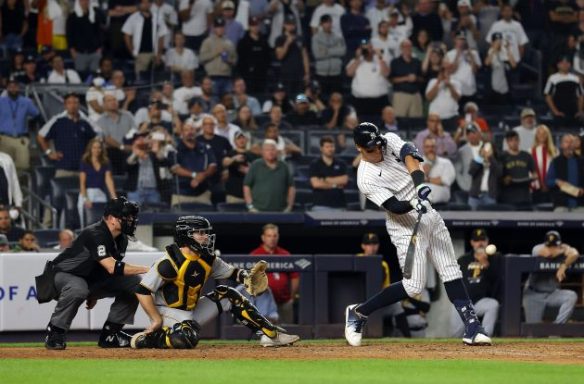
Unknown's avatar

About Jeff Kallman

Member, Internet Baseball Writers Association of America and the Society for American Baseball Research.

The kids are alright, the postseason isn’t

Steven Kwan

Steven Kwan’s grand salami slammed an exclamation point on the young Guardians’ AL Central division clinch last weekend. But the postseason to come has exposed, yet again, a flaw too many in baseball government’s current (lack of) thinking about the current (lack of) true pennant race and championship meaning . . .

Considering what most seemed to think going into this season, you could be forgiven if you thought the Guardians might dig deep enough into music history to declare their team song the Who’s rock and roll chestnut, “The Kids Are Alright.” They might also reach further for Nat King Cole crooning “They tried to tell us we’re too young . . . ”

They may keep trying to tell them, now that the young Guards are the American League Central champions. Maybe the division wasn’t exactly the strongest in the league. The Guards still had to prove that their actual foray into the past—going as old-school on the field and at the plate as they could get away with—would still work.

It may (underline that, ladies and gentlemen) be the only thing old school about the postseason to come.

Less than three decades ago baseball’s postseason was the nation’s most meaningful because it remained the most exclusive in professional team sports. Even with divisional play then, you finished your season with your cans parked in first place or you waited until next year. Well, let’s look at three decades ago precisely.

There were a mere four divisions. East and West, each league. Their champions were the Blue Jays, the Athletics, the Pirates, and the Braves. The Blue Jays and the Braves went to the World Series; the Braves, of course, got there on Sid Bream’s impossibly dead legged dash home. The Blue Jays won the Series in six; Pat Borders (1.250 OPS in all six games) was the Series MVP.

Come 1995, the World Series restored after its cancellation due to the owner-provoked players’ strike, baseball accepted three divisions and a wild card team in each league. This didn’t dilute the season’s competition so much as people feared, even if there was something disconcerting in watching a couple of teams fighting to the last breath to finish in second place.

That was also the year the classic Braves teams of 1991 through the mid-Aughts won their only World Series, against a club of the Guardians’ Indians ancestors. (Hall of Famer Tom Glavine through eight plus Mark Wohlers in the ninth shut the Indians out, 1-0.) Both the Braves and the Indians finished the season as division leaders. All remained reasonable.

Next month, baseball will see what the NFL, the NBA, and the NHL have known for a few decades—forty percent of its teams going to the postseason. This month, we’ve seen the result of the Manfred Administration’s propaganda that a more deeply expanded postseason entry field would surely guarantee more exciting pennant races.

It’s been exposed as a factual and shameless lie. A lie even more egregious than the lie that the pitch clock will shorten the times of games while the continuing proliferation of broadcast commercials between each half inning and during pitching changes actually does elongate them.

Deadspin‘s Sam Fels has observed just how much more “exciting” it’s been, if you define “exciting” as putting fannies in the seats. He couldn’t help noticing that, last week:

* The Phillies, hanging by a thread in the National League race, hosted the Jays, hanging in for a home-field wild card advantage. Citizens Bank Park holds 42,792 people. Both those Phillies-Jays games, postseason-critical games, barely drew half for each.

* The Milwaukee ballpark formerly known as Miller Field can hold 41,900, but held barely half when the wild card-contending Brewers hosted the National League East-leading Mets for three games. The Brewers drew slightly more than half the park’s capacity and still about a grand less than their 2022 average thus far.

“Those aren’t bad crowds,” Fels writes, “but at the end of September against a well-known and good team . . . wasn’t the point of all this that September attendances would be juiced?”

 . . . That doesn’t mean there aren’t teams drawing well. They’re the names you’d expect–the Dodgers, Yankees, Padres, Braves, Cardinals, Astros. And the overall economy has many factors that don’t Uleave a whole throng of people with the disposable income to attend a ton of games. Except, again, we were told that more teams vying for more playoff spots were supposed to punch through these kinds of factors. It’s what they’ve been telling us for nearly 30 years.

It may just be that fans actually recognize when the regular season is devalued, and the dangling carrot of just two or three wildcard games doesn’t really get the loins tingling. Or that teams that have playoff spots locked up for months can’t really generate excitement until those playoffs actually arrive, unless you’re the Dodgers. Playoff expansion was supposed to bring anticipation and excitement to places it doesn’t normally live. Look at the numbers and tell us.

I looked at the same numbers as Fels. Then I caught hold of the Mets hosting the Marlins in Citi Field Tuesday night, a game that’ll be remembered if at all for a) the Mets losing 6-4, to fall into a tie with the Braves atop the NL East; but, b) Marlins pitcher Richard Bleier  becoming the first pitcher since the birth of the American League to balk three times against . . . the same batter, enabling the Mets’ Jeff McNeil to score without stealing a base or a ball in play after he reached himself on an infield hit.

Citi Field can hold 41,922 in the seats. Tuesday’s game drew 69 percent of that. The game was meaningless (other than the spoiler role) to the eliminated Marlins but critical to the Mets, especially since the NL East is the only remaining division race yet to be resolved, and the formidable, defending World Series champion Braves refuse to go gently into that not-so-good gray night. (Hurricane Ian may have more than a little something to say about the two combatants’ coming weekend set in Atlanta.)
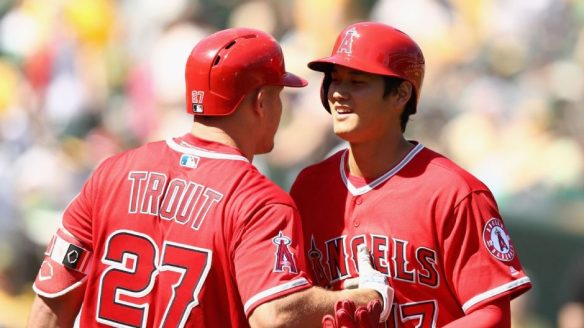
Mike Trout, Shohei Ohtani

Trout and Ohtani, plus the Yankees’ Aaron Judge, are almost all that’s left to root for thanks to baseball’s postseason race competition dilution.

All of that tells us playoff expansion does no favours to the game or its fans, but it does plenty of favours for that which is nearest and dearest to Commissioner Nero’s and his employers’ hearts. Well. They may remain the gang that believes the common good of the game equals making money for it, but they can’t (or won’t) answer what good 40-60 percent full houses do for those cherished coffers.

The expanded pelf for the playoffs goes to all teams regardless of whether they become postseason teams. “This only softens that lack of additional fans attending games that they’ve come to realize doesn’t really mean anything,” Fels writes. “MLB can shrug off the lack of heightened ratings or attendance with the bigger checks from TBS, FOX, and ESPN.”

Almost the only things left for which to root are Yankee outfielder Aaron Judge, Angels outfielder Mike Trout, and Angels unicorn (pitcher/designated hitter) Shohei Ohtani. Hall of Famer-in-waiting Albert Pujols reached his lifetime 700 home run milestone in his homecoming finale with the NL Central-champion Cardinals, but Judge, Trout, and Ohtani still have long distance achievements to achieve.

The Yankees are the official AL East champions, and on Wednesday Judge met Roger Maris at last as the AL’s single-season home run champion. Pressing perhaps understandably since he matched Babe Ruth’s 1927 output, Judge has eight games left to pass Maris. Few are willing to bet against him still.

The Angels go nowhere (again) through no fault of Trout’s or Ohtani’s own. But with eight games left to play on the season future Hall of Famer Trout still has a shot at a 40th home run or more despite missing 31 percent of the season on the injured list. (He had 37 after Tuesday.) It’s to wonder what he might have hit if he hadn’t missed that time. Would 60+ have been out of the question? We’ll never know now.

Ohtani has a shot at a 40th home run, too. (He has 34 at this writing.) He can also become the only man in Show history to have a 40 home run season at the plate and finish on the mound with an ERA and a fielding-independent pitching rate below 3.00. At this writing, Ohtani sits with 34 home runs, a 2.47 ERA, and a 2.52 FIP. Not to mention 203 pitching strikeouts and counting. Say good night, Babe.

But how long can Commissioner Nero and company shrug off the further dilution of real pennant race competition? The kind that would compel owners in all baseball cities and not just the big boys to make substantial investments in their teams, from the ground up, year in and year out? Whoops. Better not go there. We may be striking toward 21st century schizoid heresy.

Paid in full to Club 700

Albert Pujols

Could you blame Albert Pujols for spreading his wings with the biggest grin on the planet after number 700 flew out?

It took Albert Pujols 98 home runs before he finally caught hold of one in Dodger Stadium the first time, off a sophomore Dodger import from Japan named Kaz Ishii. Ishii spent four years in the Show before returning to pitch again in the Japanese leagues until age 39. He retired as he began, the walk (almost six per nine innings) being his wounding flaw.

Pujols at age 39 had 656 major league home runs on his resume and would meet and pass Hall of Famer Willie Mays on the all-time bomb list, before his injury-laden decline as an Angel finally finished with a brief but memorable tenure in a Dodger uniform last year. He couldn’t possibly imagine then that his final major league wish, a 700th home run, might come in the Dodgers’ venerable venue.

But the designated hitter, the only slot available to enable Pujols to play major league baseball one more season, finally became universal this year. And the Cardinals, the team with whom Pujols arose, starred, and became a baseball immortal in the first place, were more than willing to bring La Máquina home to try. Not just because they respected what he did, but because they genuinely believed in whatever he had left in the tank.

He wasn’t going to win a National League home run title. There wasn’t that much left of his power stroke. But whatever he had to give, the NL Central leaders would accept gladly. It turned out he had just enough to give until Friday night. Not just some key hits and key big blows, but history. And key stretch drive wins.

Pujols had only six home runs before the All-Star break but thirteen from then until he checked in at the plate the first time Friday night. All of a sudden, it didn’t seem just a dream that he could get to within two freeway exits worth of sight of 700.

The Cardinals couldn’t have scripted this one better if they had Paddy Chayevsky, Budd Schulberg, and Ring Lardner, Jr. collaborating on it.

In the top of a scoreless third, with Tommy Edman aboard on a one-out walk, Pujols fell behind to his lefthanded former Angel teammate Andrew Heaney 1-2 before catching hold of a fastball practically down the pipe and drove it almost to the rear end of the left center field bleachers. Appreciating his effort in his brief time in their team’s silks, the Dodger Stadium crowd exploded.

When the Cardinals put first and second aboard after two quick outs in the top of the next inning, with Pujols about to check in at the plate, Dodger manager Dave Roberts decided not to let Pujols get a second shot at making Heaney’s night any more miserable. Roberts brought righthander Phil Bickford in. With La Máquina sitting one blast from history, the manager wasn’t going to let him have a lefthanded treat.

He was going to make Pujols earn it the hard way. Except that Bickford has a 4.26 fielding-independent pitching rate this year, and Pujols lifetime has been almost as solid against righthanders (.295/.372/.532) as he’s been against lefthanders (.301/.381/.574). On the other hand, Pujols against righthanders this year has looked like the old man he is in baseball terms.

Roberts had to know Pujols’s .209/.297/.384 against the starboard siders made it the safest bet on the planet to bring in a Bickford. When Bickford had Pujols even at 1-1, Roberts could be forgiven if he signed in contentment knowing history wasn’t going to be made on his dollar. Then Bickford threw a third straight slider just a shade down and a shade in.

Pujols may be a living ghost of his old self no matter how much history he chased this year, but he still knows what he’s doing at the plate. The mind and the eye remain intact even if the body might still be hurling obscenities toward him. He swung at Bickford’s gift right as it knocked on his door.

This one only cleared about four rows of the same left center field bleachers. But it didn’t matter how far it traveled, just that it traveled to the right place in the first place. He joined the 700 Club at last. And there wasn’t a teammate, opponent, or fan in the house who’d have denied him his right to spread his wings and grin all the way around the bases.

As he’d done so often during the peak of his Hall of Fame-in-waiting career, Pujols singlehandedly handed the Cardinals a lead, 5-0 if you’re scoring at home, and it turned into an 11-0 demolition of the ogres of the NL West.

The fun continued in the top of the fifth when—abetted by Juan Yepez with one out reaching second on a Max Muncy throwing error across the infield—Dylan Carlson smacked an RBI double, and Lars (Sometimes You Feel Like a) Nootbaar followed Carlson with a two-run homer a third of the way up the right field bleachers.

Yepez thanked the Dodgers for that fifth-inning present with a one-out blast of his own over the left field fence in the seventh, after which Carlson doubled again but Nootbaar had to settle for sending Carlson home with a mere single. Then, come the top of the eighth, Alec Burleson pinch-hitting for Pujols thanked La Máquina for the memories with a leadoff blast off Dodger reliever Hanser Alberto to finish the Cardinals’ demolition.

But this was still Pujols’s night. Lots of former teammates and opponents and watchers have been remembering some of his biggest blasts of the past.

Mike Trout, his longtime Angel teammate and a future Hall of Famer himself, can’t forget how Pujols joined the 600 Club. “The grand slam, when he hit 600,” says Trout.

Just the situation. I mean it was a big spot in the game, and everyone was thinking the same thing. “This is for 600. This is gonna be sick right here.” And then he hit it. He loves the moment. And that’s the thing—people kept asking me, “Hey, do you think he’s going to get it [700]?” For sure. The way Albert prepares himself—he doesn’t change his approach, doesn’t try to hit a homer. He’s just trying to put a good swing on the ball. That’s big.

Manny Machado was a year away from first wearing an Oriole uniform when he saw his signature Pujols attack: Game Three, 2011 World Series, when Pujols wrecked the Rangers with three homers—all starting in the sixth inning. “That,” the Padres’ gazillion-dollar third baseman says, “was just incredible.”

I mean, he was not missing. You could throw him whatever and he was going to hit it. You could even throw the rosin bag and he was probably going to hit it out. Just that sweet swing. Even all his homers, going back—his first home run. I just admire that swing, how smooth it is, how long it stays in the path. It’s impressive.

Just don’t ask former Astros reliever Brad Lidge. When the Astros were still in the National League and playing the Cardinals for a trip to the 2005 World Series, Lidge got the worst possible taste of Pujols. It only proved to delay the Astros’ sweep out of the Series by that year’s White Sox, but Lidge still can’t forget.

“I made a mistake,” Lidge says now of the hanging ninth-inning slider Pujols demolished so thoroughly that only the roof braces of Minute Maid Park kept the ball from landing in the streets behind the building. “And it wasn’t super-surprising that he didn’t make a mistake.”

With a little help from his Astros pitching staffmate Roy Oswalt, Lidge by then knew that Pujols had evolved into a Ph.D. student of the game and its pitchers. “All of a sudden,” he says, “t started to feel like he knew what you were going to throw before you did. You felt like you had to be perfect . . . He had so much plate coverage, whether you’re throwing a 97 mph fastball or a slider down and away, you had to be perfect.”

“My game plan for him,” says Hall of Fame pitcher Greg Maddux, who once threw Professor Pujols a repeat changeup and saw it fly onto Chicago’s Waveland Avenue, “was to give up a single or less.”

But that was then. This is now. The greats normally approach such milestones in decline as it is. Pujols’s injury-smashed decline was a shock long before he rejoined the Cardinals. His Angel tenure started well enough. Then the body regions below his hips began attacking him like fresh meat under attack from the wolves past which he once hit lamb chops almost at will.

None of that matters now. Baseball players don’t always get to make their dreams, never mind their final wishes, come true. The only thing better than the 700 Club for Pujols now would be the Cardinals going all the way to the World Series and coming out with what would be his third lifetime Series ring. Just ask La Máquina himself.

“[D]on’t get me wrong,” he begins. “I know what my place is in this game.”

But since Day One, when I made my debut, it was never about numbers, it was never about chasing numbers. It was always about winning championships and trying to get better in this game. And I had so many people that taught me the right way early in my career, and that’s how I’ve carried myself for 22 years that I’ve been in the big leagues. That’s why I really don’t focus on the numbers. I will one day, but not right now.

“He talks the talk and walks the walk with saying those things,” says his Cardinals teammate Nolan Arenado. “And I really believe him.”

On Friday night, making history with a two-bomb evening, Pujols made believers all over again as he joined the club heretofore populated only by Barry Bonds, Henry Aaron, and Babe Ruth. Even for one night, nobody could take that resurrected belief away.

He gets my Vogt

Stephen Vogt

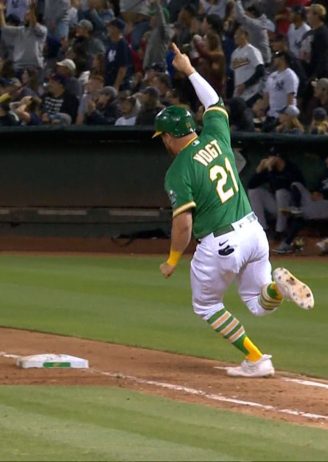
Stephen Vogt runs out the game-tying bomb he hit toward an A’s walk-off win over the Yankees in late August. The 37-year-old veteran will retire at season’s end.

As legendary 20th century radio malaproprietess Jane Ace might say, we’ve been sitting on pins and cushions awaiting the milestones this season. Pick the season, show yourself who has a shot at reaching which one before the season ends. Nature of the baseball fan beast.

We’re waiting for in-prime Aaron Judge to meet and pass Roger Maris as the American League’s new single-season home run champion. We’re waiting for elder Albert Pujols, who busted Blake Snell’s no-hit bid in the seventh Wednesday, to join the 700 Club—and we don’t mean the one Pat Robertson founded, either.

Waiting for the stars to erupt further in the record books one way or the other is as old as the professional game itself, seemingly. But just as Meryl Streep didn’t bag Academy Awards without solid supporting casts off which to play, baseball’s big men don’t have room to be the big men without the not-so-big men around and behind them.

One of those journeymen will call it a career after the regular season ends. He won’t get a postseason epilogue; his Athletics are about as close to being there as a mouse to trapping the cat. Stephen Vogt is one of those little big men who deserves to be shown the love after a decade which personified the journeyman’s life.

His career began 0-for-32, from 2012 through 28 June 2013. Then, leading off the bottom of the fourth with the A’s ahead 5-0, Vogt sent an 0-2 service from then-Cardinal relief pitcher Joe Kelly down the right field line and over the fence. If you’re going to smash a career-opening slump that went year-to-year, you couldn’t do it better even in the cheesiest film script.

What began ending the longest career-opening position player’s hitless streak since another Athletic (Chris Carter) did it three years before Vogt teed off became a career that included two All-Star selections and clubhouse value to five teams including his return engagement in Oakland this year.

Vogt didn’t make a show of that slump-breaking, first-hit home run. Idolising Barry Bonds when he grew up, Vogt could only remember his father’s advice prior to his making the Show in the first place, after asking as a kid why Bonds stood watching before a home run cleared the fences. “Stephen,” the old man replied, “when you have 500 home runs in the major leagues, you can do whatever you want. Until then, you put your bat down and you run around the bases.”

He told a reporter he made one exception a few months after that first-hit homer, facing future Hall of Famer Justin Verlander in the 2013 American League division series—his first career game-winner, a bases-loaded RBI single—after fouling off seven in a ten-pitch plate appearance—for the 1-0 win over the Tigers that sent the set to Detroit tied at a game each.

Such moments have been few enough for the 37-year-old who’s caught, played first base, and played in the outfield in his Show decade, but he’s been one of those there-to-be-called-upon who inspired fan loyalty wherever he suited up. “I believe in Stephen Vogt!” became their rallying cry. Over a journey such as his, it has to be appreciated. (The A’s will honour his career before their season-ender against the Angels on 5 October.)

Vogt is realistic about a career that’s paid him a somewhat modest (in baseball terms) but much liveable $14 million.

“I haven’t always been the best player,” he said. “I’ve been one of the best players in the league, I’ve been one of the worst players in the league. I’ve been injured and everywhere in between, I’ve been DFA’d twice, I’ve been traded, I’ve been non-tendered, you name it. I’ve been the guy that knew he was going to have a job next year to the guy that had to fight for his job next year, and just always go out and earn it.”

A guy with that becalmed an attitude is a guy who earns respect without having to reach for the heavens or punch a hole in them. He’s also a guy who earns it on a self-resurrecting World Series champion even if he couldn’t contribute on the field because he was injured. That was Vogt earning a ring regardless with last year’s Braves.

“Vogter is one of the most inspiring players I’ve ever managed,” says Padres manager Bob Melvin, who once managed him with the A’s. “What he means to a clubhouse is immeasurable—two-time All-Star, beloved in Oakland. One of my all-time favorites. Definitely has a future in managing.”

Vogt has picked the brains of Melvin plus managers Mark Kotsay and Craig Counsell (for whom he once played in Milwaukee) along the way, perhaps with just that purpose in mind. He’s been a student of the game as long as he’s played it, and Melvin may not be out of line to suggest his baseball future. If nothing else, too, Vogt may become one of those skippers who knows how to keep his clubhouse engaged.

“He felt passionate about it and spoke up,” Kotsay told reporters, after the A’s beat the Mariners Tuesday. “Does he need to do that at this point in the season when he’s on his last fifteen games? No, he doesn’t. But that shows his character and his love for the game, his love for his teammates. It came across loud and clear.”

“Having him back this year is great,” says Sean Murphy, the A’s catching anchor now, who remembers Vogt mentoring him right out of the gate in spring training 2017 and taking him around to meet everyone the better not to let him feel like just another rook. “When I heard they signed him, I was like, ‘Yes, awesome, I can’t wait to play with him again’.”

“I had a coach tell me, ‘Every day you take the field, there’s a little boy or girl that’s at their very first baseball game and you need to show them the correct way to play’,” Vogt says,  “and I’ve taken that to heart. And every night, that’s why I run hard, that’s why I play hard. It’s the correct way to play baseball.”

We’re not waiting for Vogt to punch a hole in the heavens for a major milestone. But we might be waiting to hit the Net running or pick up what’s left of the newspapers or flip on the television news and learn that Vogt’s going to be somebody’s next manager.

For now, let’s do honour to the Stephen Vogts who didn’t have to be game breakers, postseason race difference makers, or record busters, but who were equal value to their teams than the ones who earn the MVPs or the Cy Young Awards or just plain break the games and the championships open wide enough.

With the Vogts among them, the big men who can’t do it all by themselves don’t have to do it all by themselves. They don’t have to try striking guys out with single pitches equaling three strikes or hitting six-run homers with every swing. The Vogts let them play the game with the least possible additional stress.

That’s what the A’s will honour iat the end of their otherwise deflated season. It’s a tribute the hint of which other clubs might care to take when it’s time for their own veteran journeymen to step away from the field.

The Sixty Special

Aaron Judge

“Slide over, Babe, you’ve got some company!” So hollered announcer John Sterling as Aaron Judge hit number 60 Tuesday night.

If nothing else, it might have been the only time a solo home run that started a ninth-inning comeback win could possibly upstage the grand slam that finished it. That’s what happens when your teammate’s chase of baseball history precedes you.

On any other night, Yankee designated hitter Giancarlo Stanton’s ultimate grand slam, off Pirates reliever Wil Crowe, would have put a vise grip on the headlines. Even on a night the crosstown Mets came from behind against the Brewers in Milwaukee to take a lead they wouldn’t relinquish on a Francisco Lindor grand slam in the seventh.

Stanton’s launch suffers a fate almost worse than that suffered by Crowe leading the inning off, when he fed Aaron Judge a 3-1 sinker that didn’t quite sink and was enough to send three-quarters of the way up the left field bleachers. “Slide over, Babe, you’ve got some company!” Yankee announcer John Sterling hollered as Judge rounded second.

Cadillac once called a variant of its top-of-the-top-of-the-line Fleetwood model the Sixty Special. The marque’s Fleetwood line is long gone, of course. But what Judge did Tuesday night made it resemble a Trabant.

Not just because the Yankees went from there to win without the Pirates recording a single out. Not just because Anthony Rizzo followed Judge by reaching for a down and away changeup and doubling to center. Not just because Gleyber Torres walked on five pitches to follow. Not just because Josh Donaldson singled to right to load the pads. And, not just because Stanton turned on a 2-2 changeup and drilled it to roughly the same real estate as Judge’s milestone, if not quite as far back.

From the moment it appeared Judge really would chase the ghosts of Babe Ruth and Roger Maris for the American League’s single-season home run championship at minimum, the old 154-vs.-162 game shibboleth instigated by then-commissioner Ford Frick’s capricious conflict of interest (he was, of course, a Ruth ghostwriter once upon a time) was revived a little too often by the idiot brigades of today’s social media swamp.

With Maris’s sons Roger, Jr. and Kevin among the Yankee Stadium crowd, Judge connected to finish a night on which it looked as though he might go hitless. He’d grounded out twice, struck out once, and walked once, before he launched the milestone that began the overthrow of an unlikely four-run Pirate lead. He did it in the Yankees’ 147th game, seven sooner than Ruth in 1927 and twelve sooner than Maris in 1961.

His chances of going past Ruth and Maris in the Yankees’ Sixty Special Club are overwhelming. He may or may not get to the Seventy Society populated by two men, Mark McGwire and Barry Bonds. But would you really bet heavily against a man who’s hit more into the ether since the All-Star break than any individual on four known teams (the Athletics, the Pirates, the Giants, the Nationals) has hit all season?

Now that Judge has met and stands on the threshold of passing Ruth, and is likely to meet and pass Maris posthaste from there, Judge may also have wrapped up the American League’s Most Valuable Player award. May.

Shohei Ohtani remains in the conversation, and the Angels’ two-way unicorn won’t go gently into the proverbial good gray night no matter how far out of contention the badly misadministered Angels are. It might not be out of bounds to ponder whether it ends up with Judge and Ohtani sharing the award. May.

It isn’t always the rule that a league MVP should play on a postseason contender. It isn’t always the rule that he shouldn’t, either. But pursuing history has its call upon MVP voters, too. Ohtani’s already made his history, with his Rookie of the Year 2018 and his MVP 2021; anything else he does merely augments it, unless he becomes crazy enough to bust a single-season home run record while winning a Cy Young Award.

Judge is doing his level best not to think about things such as that, or about things such as the ginormous free agency payday into which he’s swinging himself when the Yankee season finally ends, whenever that may be. It’s about as simple as having to face far more and far different pitching with near-guaranteed freshness every day than Ruth and Maris had to face in the conditions of their time.

“I don’t think about the numbers,” Judge told reporters postgame. “We talk about Ruth and Maris and Mantle and all these Yankee greats, you never imagine as a kid getting mentioned with them. It’s an incredible honor and something I don’t take lightly at all. But we’re not done. We’ve still got a couple of games left in this season, and hopefully more wins come with it.”

His Yankee teammates are another proposition. “Having a front seat from the on-deck circle for most of this,” says Rizzo, “has been amazing.

“He hit 60 tonight and it’s like nothing happened,” Stanton said. “He’s got more work to do, and that’s the mindset. This is just fun to be a part of.”

“The craziest thing,” said pitcher Gerrit Cole, “is that he’s gonna hit so many more. If we play baseball another six weeks, through the postseason, he’s gonna hit like 12, 13 more home runs. He’s just getting started.”

“I want him to hit a home run in every at-bat,” said catcher Kyle Higashioka, “and I think that’s the same sentiment amongst everybody else in this clubhouse, too. As good as he’s playing on the field, he’s the best teammate you could ever imagine. So there’s nobody in here who doesn’t wish for the absolute best for him.”

Judge had to be all but forced out of the dugout for a quick curtain call that amounted to nothing much more than a small wave. He tried to wave it off as nothing much and somewhat out of proportion. “I really didn’t want to do it,” he said. “Especially, we’re losing. It’s a solo shot.”

He had to know he wasn’t going to get away with that. With or without the overthrow he ignited. “I’m trying to enjoy it all, soak it all in,” he said, “but I know I still have a job to do out on the field every single day and I just have to keep my head down, keep preparing and stay mentally focused.”

Maybe forget 60. Or 61. Maybe start thinking about a Seventy Special. Even lifelong, hard credentialed, card-carrying Yankee haters are enjoying this. Lifelong, hard credentialed, card-carrying Yankee fans, of course, may petition to have the stadium’s Judge’s Chambers renamed the Supreme Court.

The Red Sox need to receive, not send messages

Rafael Devers

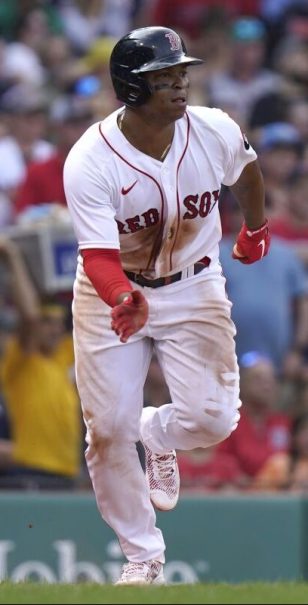
Rafael Devers’s 4-for-6 Sunday—including a two-run single and another RBI single—helped the Red Sox bury the Royals. Where were days like these from others when the Red Sox needed them most?

When the Orioles sent Trey Mancini to the Astros in a three-way deal at the trade deadline, it looked like general manager Mike Elias pushed the plunger on the season despite the team rising back from the dead. No less than Baseball Prospectus described the popular Mancini as “the heart and soul of a franchise long depleted of either.”

Well, Mancini’s now guaranteed a trip to the postseason with the Astros having clinched a postseason berth at minimum (wrapping up the American League West is just a formality waiting to happen for them) . . . and the Orioles remain within sight of a wild card entry, a mere four games back of the Mariners for the league’s fourth wild card.

Nobody really wanted to see Mancini leave Baltimore, not even Elias despite his word-salad explanation of the deal. Not in the Oriole clubhouse, not in the Camden Yards stands. But candor requires us to own up and admit the Mancini deal wasn’t popular but neither did it prove disastrous. It’s been how long since the Orioles finished seasons with winning records?

The Orioles may end up falling short, but they put on a show of self-revival that portends well for their 2023 and shows what teams can do despite losing well loved members to the business’s actualities. There are teams who would do very well to pay attention, listen, and learn.

The team in Boston, for example.

It sent the Red Sox clubhouse into a wrench when backup catcher Kevin Plawecki was designated for assignment late last Friday night and released officially Monday. On Sunday, after the mostly moribund Red Sox ironed up and smothered the Royals 13-3, the players bathed the joint with Plawecki’s walk-up song, “Dancing on My Own.” That’d send the message, right?

What message? The message that it’s not nice to send a popular clubhouse guy packing? The message that it’s not nice to cut a guy loose who kept the club loose amid disaster and started the laundry-cart dugout ride for home runs with them even if he didn’t get to take the ride himself too often? The message that the front office just doesn’t get it?

How about whether the Red Sox didn’t need to be sending but receiving messages? Such messages as yes, the front office Lucys got some splainin’ to do but so do the players. They got some splainin’ to do about what NBC Sports Boston’s John Tomase calls “this undercurrent of victimization and grievance that has left the clubhouse feeling like it plays no part in the results on the field.”

We saw it in the mopey reaction to the trade of catcher Christian Vazquez, whose replacement, Reese McGuire, has significantly outperformed him, it must be noted. We saw it a year earlier when trade deadline reinforcements didn’t arrive quickly enough, even though Kyle Schwarber ended up keying a run to the American League Championship Series. And we’re seeing it now with Plawecki, a fine backup and veteran presence who isn’t the issue here.

The issue is the reaction of players who seem unwilling to accept responsibility for their role in this disappointing campaign. When right-hander Nathan Eovaldi tells WEEI.com’s Rob Bradford the clubhouse misses presences like Schwarber, Plawecki, and Hunter Renfroe, it comes off as a direct dig at Bloom’s priorities. But how about Eovaldi fills that gap? We’re still talking about a veteran-laden roster, after all. From Xander Bogaerts to J.D. Martinez to Rafael Devers to Kiké Hernández to Nick Pivetta to the dearly departed Vazquez, the Red Sox did not lack for experienced, winning players.

So where were they when the season started going south in July? They never stanched the bleeding, even though within their very own division, the Rays survived the loss of burgeoning superstar Wander Franco, Gold Glove center fielder Kevin Kiermaier, All-Star catcher Mike Zunino, ace relievers Andrew Kittredge and J.P. Feyereisen, and potential future ace Shane Baz, among others. They currently trail the Blue Jays by only half a game for the first wild card.

The Rays didn’t give up when injuries hit, but the Red Sox did, rendering the final eight weeks of the season meaningless.

It might now seem an Eighth Amendment violation to remind the Olde Towne Team now. It wasn’t that long ago when their age-old rivals from the south Bronx went to back-to-back postseasons despite being hit with injury bugs so pronounced you’d have thought their games were episodes of Bones, Grey’s Anatomy, and House, and that The New England Journal of Medicine was really the Yankee yearbook.

I get it. Plawecki wasn’t a world beater at the plate or behind it; his usual role seemed to have been as the catcher of choice for starting pitchers Eovaldi and Michael Wacha, their two best starters when they’re not injured. Above and beyond that, Plawecki was one of the cast of Show characters who play roles unseen on the field.

“The Plaweckis of the world,” writes the Boston Globe‘s Jon Couture, “get teams through the grind, help rookies adjust, and are beloved for their conscientiousness and camaraderie. They’re needed. Thus, the pointed reaction for an end-of-the-roster guy.” (Thus, too, the likeliest reason the Rangers are interested in the now-free Plawecki and might even sign him today.)

Tomase gets it, too, but only to a particular valid extent. “Recognizing the temperature of the locker room is a necessary management skill,” he writes, “and at times the Red Sox could do a better job of communicating decisions to the rank and file.”

But we often go too far in castigating this move or that as harmful to the delicate clubhouse ecosystem.

Sometimes the players just need to man up and admit that management doesn’t owe them anything, because they did not honor their half of the bargain. Sometimes their performance leaves the boss no choice but to cut their buddy because he’s not part of the future. Sometimes next year matters more than this one.

Castigate Bloom as you wish for this unmade move or that unmade move or the other move that backfired. Fair enough. But when Tomase says the Red Sox players left Bloom little enough choice this year but to play wait-till-next-year, too (or wait-till-last-year, considering their reinforced run to the ALCS), he’s not just writing through his chapeau.

Lucky for the Red Sox they’ve got more 21st Century World Series rings than anyone else in the Show so far. Before that, a season such as this would have been written off as just another entry in the long log of rotten Red Sox malfortune. Who would have thought that the Orioles of all people would end up better off and with more respect approaching the finish line?