Unknown's avatar

About Jeff Kallman

Member, Internet Baseball Writers Association of America and the Society for American Baseball Research.

Hall of Fame unanimity has a down side, too

2019-01-23 marianorivera

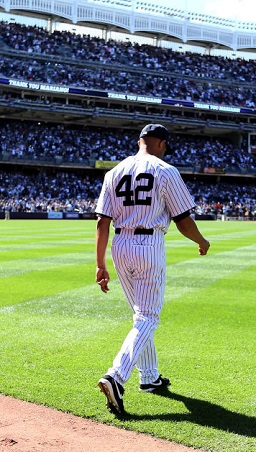
We may yet say “Thank you Mariano” for something he couldn’t possibly have known he might provoke . . .

There’s another reason to heave a big sigh of relief now that Mariano Rivera’s unanimous election to the Hall of Fame is consummated and confirmed. At long enough last the ridiculous tradition of no unanimous Hall elections has been fractured. But does it also mean a new headache for Hall of Fame voting through no fault of his or anyone’s own?

Baseball inspires debates as often as it inspires jaws to drop, but few things about the game inspire as many debates which do drop jaws as often as Hall of Fame debates. They drop jaws, run temperatures up scales, and produce almost as much foolishness as political debates with about a sixteenth of the damage.

I guarantee it: Even the jaw dropper involving Harold Baines’s election to the Hall of Fame by the Today’s Era Committee provoked fewer days of rage than the mildest politically based dispute. I’m on record as saying Baines has about as much business in the Hall of Fame as Danielle Steele has winning the Nobel Prize for Literature, but nobody was likely to want to run me out of town and into a dungeon’s shackles over it. (I think.)

As much fun as it is to get into Hall of Fame debates, the one that was really never that much fun was over why this, that, or the other guy didn’t get into Cooperstown unanimously . . . and why assorted members of the Baseball Writers Association of America decided in their voting, as too many without such votes have, that nobody was entitled to go in unanimously simply because certain no-questions-asked greats of the past didn’t.*

“[I]t appears that after a certain point, every player’s flaw was being not as good as Babe Ruth (who was elected, though not unanimously, in the inaugural class) or Willie Mays (who got nearly 95 percent four decades later),” writes ESPN’s Sam Miller. “From that point on, it was enough for a writer to argue that a player couldn’t possibly merit unanimity, on account of his being inarguably worse than Ruth and Mays.”

Aside from laughing your fool head off when you ponder that worse things can be said of you than your not being as good as Ruth or Mays, Miller has a point though he didn’t come right out and say it. You don’t have to be Babe Ruth or Willie Mays to be a Hall of Famer. You don’t have to be their kind of great. You just have to be great at all, under the terms of the game you played when you played it.

In my lifetime I can think of a number of Hall of Famers whom you might have thought to be unanimous choices but weren’t. But if they were that obviously Hall of Fame great (there are several writers-vote Hall of Famers whose cases kind of snuck up on you when you looked at their careers deeper, including newly-elected Mike Mussina) what was to keep them from being unanimous choices? Not just because they were going to go in anyway but because the voting writers saw them as so obviously Hall of Fame-great.

But it came down too long to, The Hall of Fame’s inaugural five (Ruth, Ty Cobb, Walter Johnson, Christy Mathewson, and Honus Wagner) weren’t unanimous; Joe DiMaggio wasn’t unanimous; Stan Musial, Sandy Koufax, and Bob Gibson weren’t unanimous; Willie Mays, Hank Aaron, Frank Robinson, and Tom Seaver weren’t unanimous; so, why should anyone else get to be unanimous? 

And I suppose the answer really was as Miller describes it: By God they weren’t perfect. Well, there isn’t one player who ever played the game who was. And that, Miller argues, is a patently ridiculous way to measure a Hall of Famer regardless of whether you also live on comparing one player to another:

This has always been obnoxious — a petty veto power a tiny minority of the voters have chosen to wield — but it also cuts directly against one of baseball’s main themes: It’s a game of failure. You fail seven out of 10 times and make the Hall of Fame, they say. But here the Hall’s gatekeepers had decided that in fact failure was prohibitive. No matter how good you got, you had to be perfect or else not worthy of some recognition these vetoers denied you.

Funny thing about that: Within the defined perimeters of the job he did to make himself a Hall of Famer, Mariano Rivera was close enough to perfect. When Worcester Telegram-Gazette writer Bill Ballou first decided publicly he’d rather not submit his ballot than send one in without a vote for Rivera (he changed his mind in time to vote for Rivera), one of his arguments compared The Mariano to Craig Kimbrel, the Red Sox closer, and how worthless saves are: he noted Kimbrel went six for six in postseason save conversions last fall despite a 5.90 ERA, nineteen baserunners allowed, and that when Kimbrel pitched “Boston’s victories felt like defeats.”

I couldn’t resist rejoining that comparing Mariano Rivera to Craig Kimbrel was tantamount to comparing a millionaire who got that way from his own creation to one who got that way from organised crime. If all you looked at were the saves, you’d have Rivera as the all-time leader and maybe—big maybe—nothing much more. It’s when you remembered how he got those saves that you saw a so-obvious-Stevie-Wonder-could-see-it Hall of Famer.

And when you look deeper, what do you see? You see a guy whose money pitch (the cutter) is in the same conversation of singular pitches as a Koufax curve, a Steve Carlton slider, a Hoyt Wilhelm knuckleball, a Bruce Sutter splitter, a Pedro Martinez changeup, an Elroy Face forkball. (By the way, Face, the redoubtable Pirates reliever of the 1950s and the 1960s, has a borderline Hall of Fame case as the arguable pioneer of the modern relief closer.)

You see a guy whose lifetime ERA plus (205+), the measure of your overall run prevention that’s adjusted to all the parks in which you pitched and not just your home park, is the highest in baseball history at this writing among pitchers whose careers involved their working 1,000 innings or more. (Did I forget to remind you that Rivera was a righthander whose home parks could normally spell disaster for righthanded pitchers—yet lefthanded hitters hit five points lower against him lifetime than righthanded hitters did?)

You see a guy who was just as deadly with occupied bases as he was with the bases empty, deadly enough to earn 42 postseason saves with 31 of them involving his having been asked for four or more outs and often coming into the games with men on base. One of these days I’d love to see a truly deep study of how relief pitchers fare when they’re brought in with men on base and in scoring position and whom among them were better than serviceable when it came to keeping earned runs off the records of the men they relieved. (Maybe such a study already exists; if so, I’d love to see it.)

But in case you missed when I first recorded it, batters swinging with men on base at all hit .210 against Rivera lifetime (and that’s three points less than they hit against him with the bases empty), and when they hit with men in scoring position against him they hit .214 lifetime. There are other bona fide Hall of Fame pitchers who weren’t that deadly against the hitters who faced them.

When Luis Gonzalez whacked the World Series-winning hit off him in 2001, it was the extremely rare exception, not the rule. When the almost non-descript Jay Payton tore a three-run homer out of him with two out in the bottom of the ninth of Game Five, 2000 World Series, it was the extremely rare exception, not the rule. (The Mariano shook that one off to finish the Yankees’ Series conquest by catching Kurt Abbott looking at strike three.)

There was never any argument over whether Rivera would make the Hall of Fame at all in his first appearance on the writers’ ballot. So why on earth should there have been any over whether he’d become the first to get there unanimously? Because, well, you know all those other, previous, too-obviously-first-ballot Hall of Famers who didn’t get there unanimously, too. And Rivera just blew those arguments away with the same aplomb with which he blew hitters away.

If anything, the one possible land mine in Rivera’s unanimous election might be that we revive the perfection argument all over again—future relief pitchers who prove to be Hall of Fame worthy in their line of work (with or without a reconstitution of a relief save) may be compared to him and dismissed because, well, they won’t prove to have been as near-perfect as he was. This is the last thing we should want or Rivera himself might seek.

But another ESPN writer, Buster Olney, says something else new might come about thanks to Rivera’s unanimous election: “Now that this is finally possible, moving forward, the new 100% standard will help to create an inner circle of HOFers—the players who are unanimous selections from 2019 forward.” There’s something good and bad about that, and it’s not even The Mariano’s fault.

Good because obvious Hall of Famers from this point forward (I’m talking about you, Justin Verlander, Clayton Kershaw, Max Scherzer, and Mike Trout) won’t be diminished by the petty prejudices and hypocrisies of even single voting writers. (I’m talking about you, Ken Gurnick, who refused publicly to vote for Greg Maddux on his first ballot because you refused to vote for anyone who played in the era of actual or alleged performance-enhancing substances—yet voted only for Jack Morris that year despite Morris having pitched his final seven seasons in that era.)

Bad because there may come too many instances of people judging Hall of Famers not by the actual way they played the game but by whether or not they got into the Hall of Fame unanimously. Mike Trout and Max Scherzer becoming unanimous Hall of Famers (yes, it could happen, depending on the rest of their careers) shouldn’t be allowed to diminish Willie Mays or Randy Johnson for it.

It’s one thing to revise history based on real evidence and real conditional differences (the latter, of course, were hardly his direct doing) and conclude Babe Ruth was the greatest player of his time and of the pre-integration/pre-night ball era but not of all time. It’s something else again to decide he’s less a Hall of Famer than someone else simply because he wasn’t the unanimous Hall of Fame selection he should have been.

Who’d have thought we’d have a chance to get to the place where we go from diminishing Hall of Famers because their forebears weren’t unanimous selections to diminishing them because their forebears were unanimous selections? Well, I did say half the fun of baseball is in the debates it inspires. But as Yosemite Sam once said, maybe that’ll learn me to keep my big mouth shut.


* In the interest of fair disclosure, I should point out that the Internet Baseball Writers Association of America, of which I am a life member, does ceremonial Hall of Fame votes every year—and, alas, the IBWAA didn’t vote for Mariano Rivera unanimously. The lone holdout was a member who writes about the Mets for Forbes and says, erroneously, that The Mariano is the most overrated player of all time.
 

Mo, Moose, and Cooperstown

2019-01-22 halloffamemontage

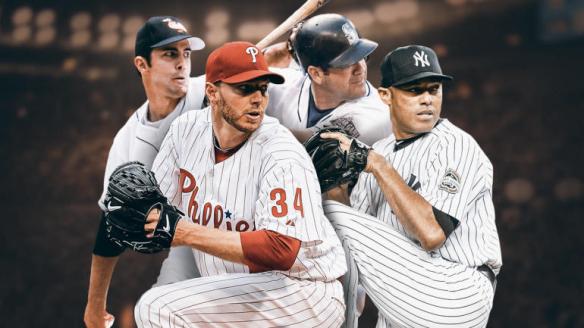
The BBWAA Hall of Fame class of 2019, left to right: Mike Mussina, Roy Halladay, Edgar Martinez, and The Mariano. (CBS Sports montage.)

On the day of the announcement, it came forth that Red Sox writer Bill Ballou of the Worcester Telegram-Gazette changed his mind. Charity says he saw the light; certain realities suggest he felt the heat. But after calling closing the low hanging fruit of baseball achievement and refusing to submit his ballot rather than snub Mariano Rivera, Ballou weighed the tonnage of heat he took “from writers and observers whose voices are important” and submitted his ballot—with a vote for Rivera.

It’s not exactly an unqualified change of heart, of course. “No baseball history would be complete without a serious mention of Rivera, of course, even if that mention is based upon a flawed statistic, the save,” Ballou writes. “It was gut instinct that convinced me to not cast a vote against Rivera originally, since he was a “know when I see it” performer. However, logic said his greatness was based on baseball’s most useless statistic, the save.”

Apparently, being great while doing a particular job under the specific perimeters of the job should still be held somewhat against the man who does it. If you care to read my original rejoinder to Ballou’s original plan of ballot non-submission and my concurrent analysis about why he was wrong about The Mariano, you can. I’m pretty sure that the last thing anyone cares about today is whether Bill Ballou saw the light, felt the heat, or fell somewhere between them. Rivera probably doesn’t. Nor should he.

The only thing Ballou withholding his ballot would have done was . . . absolutely nothing, so far as an impact on Rivera becoming the first Hall of Famer ever to be elected with one hundred percent of the Baseball Writers Association of America vote on his first ballot appearance. That was the only question facing him as his election approached. Anyone else who thought he wouldn’t be a first ballot Hall of Famer at all probably spent the last quarter century in the Delta Quadrant.

Mike Mussina wasn’t one of them. And Mussina, too, is going into the Hall of Fame, though it was his sixth try. As Rivera was renowned for his singular cutter (Hall of Famer Chipper Jones likens it to “throwing chainsaws”), Mussina was for his knuckle curve. And just as The Mariano exuded class and dignity while assassinating opposing hitters, Mussina exuded likewise while making a powerful career-value Hall of Fame case and still maintaining a little curmudgeon.

Maybe the classic example was a 31 May 2006 game against the Tigers. Mussina took a shutout into the ninth inning, until Magglio Ordonez swatted a two-out single to send Placido Polanco home with an unearned run. (Polanco reached on a throwing error with one out.) Yankee manager Joe Torre looked like he was about to step out of the dugout holding a hook with Mussina’s name on it. Watch the clip. You can’t tell whether Mussina said, “Joe, stay back!” or “You stay back!” Torre stayed back. And Mussina struck Carlos Guillen out to end the 6-1 Yankee win.

Only the second man in baseball to retire after a 20 game-winning season (after Hall of Famer Sandy Koufax), Mussina became a Yankee in the first place not because of big free agent dollars but because he had no intention of re-upping with the Orioles after they infuriated him during his walk year. Not because of anything they did to him, but because they traded  one of his best friends on the club, catcher B.J. Surhoff. Thomas Boswell, the Washington Post columnist who belongs in the Hall of Fame as a Ford C. Frick Award winner but hasn’t gotten it yet, unconscionably, told the story right after Mussina was elected to Cooperstown:

The Surhoffs had a child they believed could get better medical care at Johns Hopkins than anywhere else, and B.J. absolutely wanted to stay in Baltimore. But Mussina, and other Orioles, believed he was traded in part out of spite after petty tiffs with a member of ownership.

“That’s it,” spit out Mussina, who was in his free agent walk year. “I’m out of here.”

The next year, he was a Yankee. Cause and effect?

Some ask why Mussina and why not Andy Pettitte? The answer is simpler, really, than just dismissing Pettitte over his admission that he tried human growth hormone in a bid to deal with nagging elbow trouble. Mussina was a better pitcher than Pettitte, by a large enough margin. They both pitched in a time of inflated offense, and neither of them show up big for peak value, but Mussina was better at getting outs by his own devices than Pettitte and, while batters could get their hits off both, Mussina was a little tougher to hit against than Pettitte and a lot tougher to avoid the strikeout against. (Pettitte has a 2.37 strikeout-to-walk ratio; Mussina, a 3.58 K/BB rate.)

Who would you rather have on the mound if your team makes it to the World Series? Mussina—who pitched his entire career in the rough-tough American League East—went to two World Series and while his won-lost record in those Series is only 1-1, he has a 3.00 ERA and a 1.27 walks/hits per inning pitched rate, while Pettitte pitched in eight World Series with a 5-4 won-lost record but a 4.06 ERA and a 1.40 WHIP. Mussina’s overall postseason record is 7-8 but a 3.42 ERA and a 1.10 WHIP; Pettitte is 19-11 with a 3.86 ERA and a 1.31 WHIP. I submit that you actually have a better chance to win with Mussina on the mound than with Pettitte.

You don’t have to compare those two pitchers to make Mussina’s Hall of Fame case, but you might care to note that, by way of the Bill James Hall of Fame measurements, Pettitte met 44 of the Hall of Fame pitching standards and Mussina met 54, with the average Hall of Famer meeting 50. Mussina also mops the floor with Pettitte on the Black Ink (league leaderships) and Gray Ink (league top ten) Tests, Mussina showing 15 Black Ink and 250 Gray Ink to Pettitte’s 7 and 103, respectively. Mussina ranks as the number 29 starting pitcher of all time; Pettitte ranks 90th.

Edgar Martinez, who made it to the Hall of Fame at last and on his final BBWAA ballot try, says this about Rivera: “It was always a challenge to face him, but I enjoyed the competition and I think he did, too.” That’s putting it politely. As Rivera himself once put it, “It didn’t matter what I threw him. I couldn’t get him out. My God, he had my breakfast, lunch, and dinner.” The only thing he left out was dessert: Martinez’s lifetime slash line against The Mariano is .579/.652/1.053. The last is only Martinez’s slugging percentage against him; the OPS would be 1.705.

Think about that: The likely second greatest hitter who ever played the bulk of his career as a designated hitter (if you’re not giving Frank Thomas the number one spot, you need help) had a 1.705 OPS against the no-questions-asked greatest pitcher ever to work as a major league closer.

It makes you sad that Martinez’s teams weren’t as good as Rivera’s teams long range; the thought of seeing them tangle in more than just a couple of postseason games is just too delicious to bypass. It probably makes Mariners fans sadder that they couldn’t send a lineup of Edgar Martinezes up against a pitching staff of Mariano Riveras. And it makes you look forward to the pair of them needling each other affectionately on the Hall of Fame stage.

Roy Halladay once picked up a baseball that still showed the imprint of Rivera’s cutter grip and carried it in his travel bag on road trips for the rest of his career. It’s to mourn further that Halladay didn’t live to see himself go into Cooperstown with Rivera, Mussina, and Martinez. (Halladay died in the November 2017 crash of his Icon a5 airplane; his widow posted a statement of thanks after the election was announced.)

The best starting pitcher of the 21st Century so far (well, among those not named Clayton Kershaw, anyway)—who also made the Hall of Fame on his first try this time around, and who’s the only pitcher in the game’s history to pitch a perfect game in the same season during which he’d pitch a postseason no-hitter—Doc Halladay would probably love playing maitre d for whether Rivera or Martinez shake hands before or after Gar hands The Mariano three plates, one with breakfast, one with lunch (a Ballouney on wry, perhaps?), and one with dinner.

For Sonny Gray, it’s a sort of homecoming

2019-01-22 sonnygray

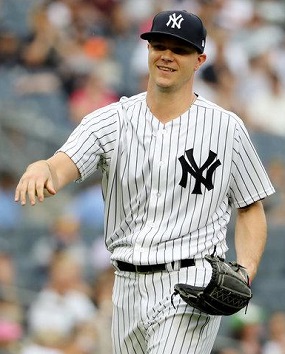
Sonny Gray didn’t have many reasons to smile as a Yankee, unless he was on the road . . .

Yankee Stadium old and new alike haven’t been for everyone. Few showed it more harshly than Sonny Gray, who won’t have it to kick him around anymore. The Yankees finally brought off a trade that sent Gray to the Reds with minor league relief pitcher Reiver Sanmartin for second base prospect Shed Long and a competitive-balance draft pick for later this year.

The deal became a three-way trade when the Yankees promptly shed Long upon the Mariners for minor league outfielder Josh Stowers, who played last year one level lower than Long. Leaving them room on their 40-man roster, the deal now has some wondering whether the Yankees might make a play for free-agent starter and former Cy Young Award winner Dallas Keuchel.

As noted by MLB.com’s Mark Sheldon, Gray didn’t have a choice in his actual trade destination, but once the deal was done and the Reds would be his new team, he jumped on the chance to sign a three-year contract extension with the Reds totaling $30.5 million, to kick in after his current deal expires. The answers seem simple enough: if the Reds wanted him that badly, the feeling was mutual.

Gray grew up in Tennessee, outside Nashville, and his father often took him to Reds games, where he enjoyed both the baseball and the Skyline Chili sold at Great American Ballpark. And the Reds’ pitching coach now is Derek Johnson, who’s known Gray since the righthander was fourteen and who coached him at Vanderbilt University. For Gray putting on a Reds uniform is a sort-of homecoming.

Yankee Stadium isn’t exactly famous for being a comfort to righthanded pitchers, but you’d be hard pressed to find a more oppressive home-road split than Gray recorded last year. At Yankee Stadium he pitched fifteen games with a ghoulish 6.98 earned run average. On the road, Gray pitched fifteen games with a superb 3.17 ERA. At home he had a 1.98 walks/hits per inning pitched rate; on the road, a 1.16 WHIP. Batters hit .318 against Gray in Yankee Stadium but .226 against him on the road.

If you bring aboard Gray’s overall performance as a Yankee, which he became near the July 2017 non-waiver trade deadline, his home ERA was 6.55 and his road ERA was 2.84.

There will always be those players who succumb to the pressure of pitching in Yankee Stadium in the Yankees’ pinstripes with all the franchise’s history and expectations (of all the cliches about the Yankees the truest one is that they consider seasons failures when they don’t get to the World Series), but by his own admission Gray can’t figure out what made him such a bust in Yankee Stadium but a comparative smash on the road.

“I’m not going to lie,” he told a conference call with reporters after the trade announcement. “I felt comfortable taking the mound. I felt good. It just didn’t work out. I don’t know. I don’t have an answer.”

Gray has known deeper sorrows than Yankee Stadium. His father was killed in an automobile accident on the same 2004 day, when Gray was fourteen, that Gray went out as a high school freshman and threw four touchdown passes in a football game. The least applicable question you can present regarding him is his makeup.

He spoke about his father briefly, too. “I know he’s looking down with the biggest smile on his face right now,” Gray said. “He was a huge Reds fan. That was my immediate reaction was looking back and me growing up as a kid and him having Reds hats on everywhere we went. That was a cool trip down memory lane for me, for sure.”

What makes the Reds think Gray will thrive in a home park that’s even more cozy for hitters than Yankee Stadium’s short right field porch? For one thing—and this may surprise those who saw Gray last season and decided he was one of the classic Yankee flops—FanGraphs has figured out that five pitchers threw 100 innings or more with 20 percent plus strikeout rates and 50 percent or better ground ball rates . . . and one of them was Gray, with a 21.1 percent strikeout rate and an exactly 50 percent ground ball rate in 130.1 innings of work.

There’s also the Derek Johnson factor. “I’ve known D.J. since I was fourteen years old,” Gray said. “He knows what makes me go. He definitely knows what I’m about.” And the feeling is mutual.

“I really think that Sonny’s best attribute is how competitive he is,” Johnson told Sheldon. “You’re talking about a guy who blew through the minor leagues and became a quality major leaguer early. I think it’s not only a testament to his ability, but also his drive, his competitiveness. He’s almost a born leader. It shows on the field, and I’m just really excited about those traits coming back out and him doing his thing.”

When Gray came up with the Athletics in 2013 he had a couple of bullpen appearances and a return trip to the minors, but they brought him back that August, made him their fifth starter, and he ended up pitching well enough including back-to-back postseason spot clinchers, the 2013 game that clinched the American League West (SONNY WITH A CHANCE OF STRIKEOUTS said one banner hung from a ballpark rail, when Gray started Game Two of the ALDS) and the 2014 game that clinched a wild card.

Gray even finished third in the American League’s Cy Young Award voting in 2015, when Keuchel (then with the Astros) won the prize. He had a solid fastball and a terrific array of breaking balls including a changeup he can throw up to 88 mph and a cutter that almost hits 92. But in 2016, after two seasons making a case as the A’s arguable staff ace, he had two serious disabled list residencies including elbow and forearm inflammation and a right trapezius muscle strain earlier. He pitched well enough to start 2017 that the Yankees found him attractive in the first place.

When he pitched poorly Gray never shied from holding himself accountable, even when the Yankees moved him to the bullpen for a spell last year, but he couldn’t bring himself to say whether or not the Yankee Stadium spotlight, which sears as often as not, got the better of him.

“It’s no secret [2018] didn’t go as good for me as you would like,” Gray told the reporters on the conference call. “But at the end of the day, I showed up every day and was ready to put in the work. I honestly think you can go through some hardships at times and come out the other end better than you ever were. That’s honestly how I feel. I learned a lot [in 2018] . . . unfortunately, I got to sit and watch a little more than I would have liked. I got to learn a lot not only about baseball but about myself and about what makes me tick.”

The closest Gray would come to admitting he wasn’t comfortable pitching in Yankee Stadium was when he assessed his chances in Great American Ballpark, saying that park’s hitter coziness doesn’t exactly bother him. “I’m not huge into that type of stuff,” the 29-year-old righthander said. “You can pitch, and you’re comfortable pitching somewhere, you can go out and get the job done for sure.”

The A’s were thought to be interested in bringing Gray back, and the Giants were thought to be in play for him as well. But the Reds have him and Gray was happy enough about it to sign on for three years beyond 2019. (He would have become a free agent for the first time after the 2020 season.)

“I’ve got a really good feeling,” he said about joining the re-tooling Reds. “We’re trying to turn the corner here and trying to start winning a lot of games, and that’s exciting for me for sure. It just feels right for me. It just felt right the whole time.”

“He’s going to be out to try and prove something, not only to other people but to himself as well,” Johnson told the Cincinnati Enquirer. “I think that when you have that type of player on your hands, some really good things can happen.”

Just make sure he doesn’t overdose on that Skyline Chili.

Sale, no sale

2019-01-20 earlaverilljoerudi

Judge Landis was ignored when he suggested Earl Averill (left) should get a piece of his sale price; Bowie Kuhn voided the sale of Joe Rudi (right) and two teammates. Baseball might have been a little different if Landis was heeded and Kuhn wasn’t ignorant.

One commissioner’s ignored suggestion and a future commissioner’s foolish ruling, both involving player sales, might have made major differences if each went the other way. Especially on the pressures brought into the game in the years after the reserve era ended with the Andy Messersmith-Dave McNally ruling of 1975.

In 1928, Earl Averill of the Pacific Coast League’s San Francisco Seals caught the eye of the Indians. The Indians bought Averill from the Seals for a reported $50,000, with the apparent proviso that Averill wouldn’t have to report to the Tribe until after the PCL pennant race was over. A quiet man whose passions included animals and flowers, the future Hall of Famer was also savvy enough to flinch when he read about the sale in a newspaper article.

As Bill James exhumed for The New Bill James Historical Baseball Abstract in 2001, Averill asked how much of the sale price he could expect to receive. James didn’t say whether the Seals laughed their fool heads off, but he did say the answer was nothing. If that was the case, Averill decided he wasn’t going anywhere, never mind that both the Seals and the Indians tried to talk him into deciding otherwise.

That debate reached the eyes and ears of Kenesaw Mountain Landis, baseball’s autocratic first commissioner. Landis may have been foolish administering justice more rough than just over baseball’s former gambling scandals. He was utterly stupid in his de facto upholding of baseball’s colour line. (He never formally or officially rejected black players in the major leagues, but no team dared to sign one so long as he ran the Show.) But Landis was absolutely visionary when it came to his reaction to the Averill sale.

The commissioner actually agreed with Averill. He actually thought Averill’s demand for a piece of the sale price was reasonable. As James phrased it, Landis suggested “that baseball should adopt some sort of legislation by which, whenever a player was sold, the player himself would get a cut of the proceeds.” James merely said the idea went nowhere; one can imagine too readily the owners of the time asking what was in Landis’s tea in that moment because they wanted to get loaded, too.

But Landis’s suggestion also never crossed the mind of future commissioner Bowie Kuhn, in 1976, when Kuhn allowed his distaste, shall we say, for Athletics owner Charlie Finley, to get in the way of sound judgment and, concurrently, put an unnecessary virus into baseball’s financial body.

Like his fellow owners of the time Finley quaked over the Messersmith ruling. Unlike many of his fellow owners, Finley operated the A’s by the proverbial seat of his pants, even if he shared with them a passion for operating as cheaply as he could get away with doing. But he also saw a way to balance his own financial scale in Messersmith’s immediate wake.

Over sixty players would face their first free agency after Messersmith won the end of reserve clause abuse. Finley traded two of them before the 1976 season began, outfielder and future Hall of Famer Reggie Jackson and pitcher Ken Holtzman, to the Orioles, for outfielder Don Baylor and pitcher Mike Torrez. Three more of Finley’s free agents-to-be—outfielder Joe Rudi, pitchers Vida Blue and future Hall of Famer Rollie Fingers—refused to sign 1976 contracts, and Finley renewed the three under the maximum allowable twenty percent pay cut each.

Rudi, Blue, and Fingers refused to sign deals lacking their biggest known demand: the no-trade/no-cut clause whose rejection by the Dodgers instigated Messersmith into pitching without a 1975 contract in the first place. And the Oakland trio knew the manipulative Finley only too well. As Rudi was eventually quoted as having told the incoming Baylor, “Any time you hear him clearing his throat, he’s lying.”

Finally, Finley shifted gears from trade talk to sale talk. In addition to Rudi-Blue-Fingers, Finley brought third baseman Sal Bando to the sales floor, the price $500,000. The Red Sox struck first. They wanted Rudi and Fingers, even though they also needed a lefthanded starting pitcher like Blue more than they needed an outfielder or relief pitcher. The Yankees swung into the store next, ready to bring Blue right to the checkout line.

That jolted the Red Sox. Knowing Kuhn wasn’t George Steinbrenner’s biggest fan, either, they feared Kuhn would void their purchases if the Yankees were seen just in the store’s neighbourhood. They even lured the Tigers, who’d shown prior interest in Blue, back to the sales floor. (Get that sonofabitch away from the Yankees, one published account quoted Red Sox general manager Dick O’Connell as telling Tigers GM Jim Campbell.) And the Tigers were ready to pay the same million for Blue that the Yankees were ready to spend.

One day later, the Yankees raised by $500,000. And as the rest of baseball realised Finley wasn’t kidding about his intended fire sale, the Rangers jumped in offering $1 million for Baylor, while Bill Veeck—who’d re-purchased the White Sox—asked about buying Bando. All this and more reached Kuhn about Finley’s Supermarket as he sat in Comiskey Park watching the White Sox host the Orioles.

Kuhn was anything but amused, and Finley, likewise unamused, told Kuhn it was none of his bloody business; since when did commissioners poke their noses into player transactions? Finley was probably as unaware of Landis’s earlier thoughts regarding Averill as he was too well aware of a previous A’s owner, Connie Mack, breaking up powerhouse teams twice with fire sales because he was cash strapped.

But according to John Helyar in Lords of the Realm: The Real History of Baseball, Dodgers owner Walter O’Malley (whose team’s fractured negotiation with Messersmith led to the end of the reserve clause abuse in the first place) told Kuhn that if Finley could consummate the sales, the end of the reserve era now meant pennant races could be decided in June. You could buy the pennant at the checkout counter! Don’t let it happen, Bowie! This is baseball, not the A&P! 

That was from the owner who bought longtime Giants mound menace Sal Maglie from the Indians in May 1956, thus helping to make the final Brooklyn Dodgers pennant possible, while Kuhn was a young lawyer working for the New York firm Willkie, Farr & Gallagher—whose clients included the National League.

Kuhn voided the Rudi-Blue-Fingers sales. He couldn’t “persuade himself” that buying the three Oakland stars was “anything but devastating to baseball’s reputation for integrity and to public confidence in the game, even though I can well understand that their motive is a good faith effort to strengthen their clubs.” Any player who dealt with any front office duplicities in reserve-era contract negotiations, as well as any of the very few genuinely honourable owners*, had to have laughed his fool head off right then and there.

It got even better. Lenny Bruce schpritzing at Carnegie Hall couldn’t have topped Kuhn from that point:

If such transactions now and in the future were permitted, the door would be opened wide to the buying success of the more affluent clubs, public suspicion would be aroused, traditional and sound methods of player development and acquisition would be undermined, and our efforts to preserve the competitive balance would be gravely impaired.

God rest his soul in peace, but the only thing gravely impaired in that moment was Kuhn’s thinking. That, James wrote, “was an ignorant, bone-headed, destructive policy which had no foundation in anything except that Kuhn hated Charlie Finley and saw that he could drive Finley out of the game by denying him the right to sell his [star] players.”

What Kuhn should have done, if he had been thinking about the best interests of the game, is adopt the Landis policy: rule that players could be sold for whatever they would bring, but 30% of the money had to go to the players. Had he done that, the effect would have been to allow the rich teams to acquire more of the best players, as they do now. But this policy would have allowed the rich teams to strengthen themselves without inflating the salary structure, and would have allowed the weaker teams, the Montreal-type teams, to remain financially competitive by profiting from developing young players.

If you think Rudi, Fingers, or Blue would have objected to pocketing $300,000 each as their cut of those sale prices, I have a cheap old ballpark to sell you—on Coogan’s Bluff. Finley might have squawked over getting only $2.1 million for only as long as it took him to put it in the bank.

If Kuhn was smart enough to apply the Landis suggestion, there might have been instances of a sold player pocketing more as his cut of his sale price than he earned in salary the same year. Joe Rudi earned $84,000 in 1975 and, after that twenty percent pay cut, $67,200 in 1976, but thirty percent of his intended sale price would have put almost as much money in his pocket at once as he asked for over three years before the sale proposal.**

Who’s to say those owners not as financially endowed (or daring) as Steinbrenner wouldn’t have been able otherwise to lure some of the choice free agents Steinbrenner could lure, or offer competitive signing bonuses to prime draft picks, if they could have continued player sales? Who knows how much less the salary structure might have inflated in due course, if Kuhn hadn’t voided the Rudi-Fingers-Blue sales while imposing a concurrent cap of $400,000 on straight cash deals, meaning teams in need couldn’t sell their stars for big money while keeping their bargains on the sales floor for comparative pocket change?

We’ll never know for sure, but we do know how things turned out for Averill. His impasse was resolved when the Indians paid him both a $5,000 bonus and a salary somewhat higher than the normal major league rookie salary of the time, and he went to Cleveland to begin the Hall of Fame career compromised when a back injury in a 1937 game wrecked his formidable swing.

Averill was elected to the Hall of Fame in 1975. He looked only slightly less foolish criticising the Hall for his not being elected sooner, as he did in his inauguration speech, than Kuhn looked placing a chance to stick it to Finley over the good of the game.

————————————————————————

* Phillies owner Bob Carpenter was one such owner, if you take the word of his Hall of Fame pitcher Jim Bunning. When Carpenter tried to talk Bunning—the Phillies’ player representative and one of the players union’s committee who recruited Marvin Miller as their executive director—out of hiring Miller in the first place, Bunning gave Carpenter a testimonial right to his face.

“If you were the owner and I was the player representative, we wouldn’t need Marvin Miller,” Bunning said. “But you don’t own all the other teams and I’m not the player representative on all the other teams . . . If I had a dispute with you, I wouldn’t worry. We’d solve it. Not everybody has that kind of relationship, though.”

** With free agency on his horizon, Joe Rudi wanted $375,000 over three years to stay in Oakland. Sidebar: He was the one player among the big three in Finley’s intended fire sale who actually reported to his new club, even being fitted for a Red Sox uniform, right before Bowie Kuhn voided the three sales.

When Rudi hit free agency after the 1976 season, he signed a five-year, $2.09 million deal with the Angels. After an injury-plagued four seasons in Anaheim, the Angels traded Rudi and pitcher Frank Tanana to . . . the Red Sox, in the deal making an Angel of outfielder Fred Lynn.

Rudi finished the deal with another injury-riddled season in Boston and became a free agent, signing with . . . the A’s, now owned by Walter Haas. He played 1982 with the A’s, who released him in late October. Career over. But not before ending it with a bang; Rudi hit a two-run homer off Kansas City’s Larry Gura in his final major league at-bat.

A Washington writer bats for Bowie

2019-01-19 micahbowie

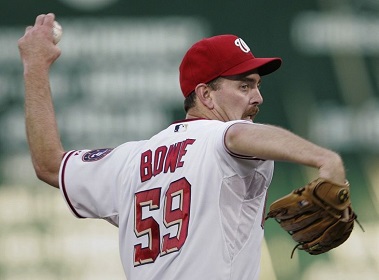
Micah Bowie on the mound for the Nationals.

Someone in the mainstream sports press, as opposed to just one obscure blog writer like me, has taken up Micah Bowie’s battle. Thom Loverro, of the Washington Times, was able to talk to the former pitcher for the Nationals and four other clubs for a profile on Bowie’s battle to get help from the Major League Baseball Players Association to stay alive in the first place.

I wrote about Bowie earlier this month. Not long after I published my piece, Douglas Gladstone, the journalist who’s taken up the cause of 1947-1979 players aced out of a pension plan change and thus denied even small pension dollars, and who’s also taken up Bowie’s battle for help from his union and other baseball assistance sources, provided me Bowie’s telephone number.

But I couldn’t bring myself to dial it. I admit it. It may sound foolish now but I remain haunted by the boyhood experience of trying to talk to a father dying of lung cancer. There were too many days when just saying hello to him when I came home from school and hearing him strain further and further to reply were too much. I couldn’t tell anyone I feared I might be the one responsible for the final outcome that finally happened in June 1966.

Somehow, Loverro had the guts I lost and called Bowie. And it turned out that I had nothing to fear, after all. Bowie is on 24/7 oxygen; as Lovarro describes it from Bowie’s own words, “the levels he needs per minute now are hospice-level care to help his lungs, severely damaged from back surgery he had that went wrong to relieve pain from baseball injuries he suffered.” But the former pitcher could talk. And, did.

Bowie’s pitching related injuries included elbow, hip, shoulder, and groin injuries; I was unaware at the time I wrote that the ruptured diaphragm he has since suffered traces to a back surgery gone wrong, a surgery he underwent to relieve as much as possible of the pain those injuries inflicted on him.

“The pitching had really taken its toll on my lumbar,” Bowie was able to tell Navarro. “Once I got done with baseball, and the pain became unbearable and unmanageable, we had a spinal cord stimulator put in in August 2016 to help with the pain and to try to get me ready for some fusions that were necessary because of baseball. Not long after we had some complications from the surgery the battery bounced around, created some damage. I ended up with both lungs being damaged and my diaphragm being ruptured. I’ve had multiple surgeries to try to correct that damage.”

Bowie hoped to convince the players’ union to vest his medical disability benefit far sooner than the age-62 vesting age. Lacking the full four years’ major league service time, Bowie told Loverro, he applied based on his back issues tying directly to his major league injuries. He and his family started a lengthy appeals process after the union first turned him down, and they were denied again. The benefit would equal $5,000 a month.

“I called the union,” Bowie told Loverro. “I talked to a member of the pension committee, one of the guys who had declined my benefits, and he informed me he didn’t even read my case. He just read from the attorney for the pension plan that they could deny it, so without looking at my stuff they just denied me. I said how in the world can you deny me and not read my appeal. I haven’t gotten anywhere with the union or any pension committee members since that point. It is very disheartening to know this. Because I played major league baseball, I am going to bankrupt my family with the injuries it has left me. That’s not right.”

I noted when writing of Bowie earlier that the players’ union had no problem granting an early disability vesting to one-time Oakland Athletics pitcher Mike Norris, who underwent spinal surgery in 1999 to correct cervical myelopathy, and asked for and received an early vesting of his $89,000 annual family disability benefit a decade after his surgery.

Unlike Bowie, Norris wasn’t in palliative care, said Gladstone, who added that he couldn’t fathom why the players’ union agreed to vest Norris early but not Bowie.

Loverro writes that Bowie has had to sell off assets and make other somewhat radical changes just to try keeping up with his medical expenses. Medical malpractise? “Texas malpractice laws have a cap on damages that can be awarded,” Loverro writes,  “and Bowie said that cap would have been lower than the costs of him pursuing a lawsuit. The union somehow reversing their decision may be his only hope to keep him from losing everything — including his life.”

“We’ve done a lot to try to keep me alive as we navigate through the medical system,” Bowie told him. “Unless the situation changes dramatically, it bankrupts my family for me to live. That’s very hard for me to say publicly.”

Having seen a harrowing YouTube video of him in his struggle, I couldn’t bring myself to call him. Every time I picked up my phone to dial his number, I could see only my father, in his oxygen tent, struggling for whatever breath was left to him, remembering my own anxiety not to tax him further (and we’d had a difficult enough relationship before his illness as it was), and despite the removal of five decades and almost three years I thought only that I couldn’t tax Bowie that way.

That was hard enough for me to admit publicly. (Well, as publicly as this still-obscure journal might be.) But I’m glad that somebody had the guts to call him and sorry that I didn’t. I hope someone in the players’ union has the guts to reverse their refusal and give Bowie and the family who love him the relief they deserve.