Unknown's avatar

About Jeff Kallman

Member, Internet Baseball Writers Association of America and the Society for American Baseball Research.

Bob Friend, RIP: He helped pitch a game changer

2019-02-03 BobFriend01

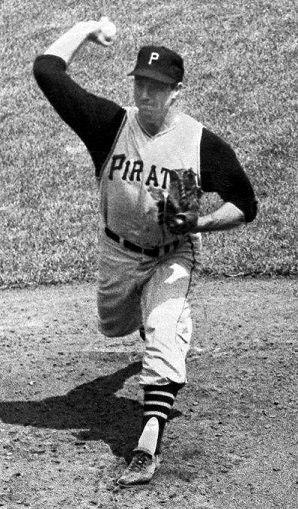
Bob Friend on the mound during the 1960s.

Today’s baseball free agents and every one who preceded them back to the first such class, following the Messersmith-McNally ruling of 1975, may not know that they owe former Pirates pitcher Bob Friend a partial debt for the Players’ Association’s ultimate growth and triumphs. Even if Friend, who died on Super Bowl Sunday at 88, wouldn’t have been likely to take a bow for his role.

A durable if somewhat hard-luck pitcher during a sixteen-year career, Friend just so happened to be the National League’s overall player representative in 1965 when his predecessor, Hall of Fame pitcher Robin Roberts, asked a small favour: could he, Roberts, attend a meeting of player representatives in Houston late that year?

Roberts had something to give the player reps: his own analysis of the picture around the pension plan due to expire in early 1967, especially what he saw (correctly, as things turned out) as a metastasis of baseball’s television revenues and a question of whether or not the players—who then funded 40 percent of the pension plan to the owners’ kicking in 60 percent—would see a dime of it.

The only television money the players saw for themselves at the time tied to the All-Star Game and the World Series; ABC fed baseball $5.7 million for Game of the Week broadcasts starting in 1965, and the players didn’t get a nickel of it.

Though he was no longer a team’s player rep nor either league’s, Roberts—winding down his career with the Astros, though he’d be dealt to the Cubs to finish a year later—wanted to pitch the reps an idea: it was high time the nascent players’ union found themselves an executive director who could negotiate effectively. Friend was only too willing to let Roberts make his case.

What alarmed Friend at first was player militancy, even though he got Roberts’ message when the former Phillies ace said, “Things are getting more complicated. There’s going to be a lot of money involved, and without a negotiator we won’t get our share. I think we need someone full time to do two things: work on the next pension contract and do more with group licensing.”

An incumbent Phillies ace, Hall of Fame pitcher Jim Bunning, threw another factor into the mix. “The nature of ownership groups was changing dramatically,” Bunning would remember. “We wanted to make sure we knew where we were going even if management didn’t.” Indeed. Baseball’s transformation to mostly corporate ownership had only just begun when CBS bought the Yankees controversially enough in 1964; CBS would have an uneasy time of it with the Yankees and it would take several decades for the transformation to be complete.

The player reps got the message and authorised a search committee to find an executive director/negotiator. The committee would be Friend, Roberts, Bunning, and veteran outfielder Harvey Kuenn. And it meant that Judge Robert Cannon, the owner-imposed director, wasn’t going to be long in that seat. Even though Cannon got the owners to fund a director and office for the Players’ Association, the player reps quaked when Cannon refused to move to New York, where the owners wanted the office.

Friend was a particular ally of Cannon, who happened to have the ear of then-Pirates owner John Galbreath, who also happened to lend Friend and his players an equal ear—as long as it meant Cannon would get the full-time directorship. (Galbreath, in fairness, also agreed with Friend that they needed full-time representation on pension and other issues.) Marvin Miller came into the picture when Roberts approached Kaiser Committee labour negotiator George Taylor to help find a candidate. Taylor suggested Miller.

At first, Miller had only one champion among the four-man search committee: Roberts. Kuenn was nervous about the players’ association becoming more like a trade union; Bunning preferred an attorney who’d once handled a lawsuit for him successfully; and, Friend was still in favour of Cannon, assuming they could find a compromise on the office issue. Miller at first was voted down.

But Cannon decided to resign altogether if the players were as bent as they were (and the owners apparently agreed on this point) on the MLBPA office being in New York. They were, and he did. That enabled Roberts to re-submit Miller for consideration. And Roberts now had a key ally: Friend, who’d seen the light about Cannon versus Miller, realised Miller wasn’t either an owners’ plant or what Jim Bouton eventually referred to as “a knuckle-dragging, ‘deze and doze’ guy with a cigar out of the corner of his mouth’,” and talked to Miller, who’d felt burned over the original vote.

“If the players elect me,” Miller told Friend, “I’ll accept the job.”

It got easier when, little by little, the owners’ attempts to intimidate players out of picking Miller began to dissipate the closer a look the players actually got at Miller, whose mild manner, understated style, and willingness to shoot straight, no chaser changed a lot of minds, just as he had Friend’s.

The players voted for Miller. It would take time, hiccups, and a few nasty surprises to come before Miller and the union found their surest footings and could shepherd the bone-rattling changes to come—mostly for the better, but now and then a shot in their own feet, especially the amended pension plan change of 1980 that left 874 retired short-career players from 1947-1979 devoid of both a pension allowance and health benefits.

2019-02-03 BobFriend02

Friend in the 1950s, before the Pirates switched to vest jerseys.

Friend retired as a pitcher after a 1966 season divided between the hapless Mets and the sinking Yankees. (Kuenn and Roberts retired  after the same season; Bunning pitched until 1971.) The first Pirate pitcher to lead the National League in earned run average with 2.83 in 1955, when the Pirates finished dead last, Friend led the league in wins with 22 in 1958, only to lead in losses with 19 in 1959. He retired holding Pirates records for career starts (477), innings pitched (3,480.3), and strikeouts. (1,682.) He’s fourth on the franchise’s pitching wins list (191) but first on its pitching losses list. (218.)

His rubber arm (as they used to refer to seemingly unbreakable pitchers) wasn’t always rewarded with the right results, especially pitching for so many ill-endowed Pirates teams of the 1950s then the teams who couldn’t stay competitive after their dramatic 1960 World Series triumph.

Friend unfortunately was murdered in that Series, starting twice, relieving a third time, and surrendering ten runs (nine earned) and thirteen hits in six innings’ work. The saddest part was how good he was on the 1960 regular season: he led the National League with a 4.07 strikeout-to-walk rate and a 2.54 fielding-independent pitching (ERA with defense removed from the equation), the only season his FIP was under 3.00.

After his pitching career ended, Friend—who looked and acted like his family name except when he was on the mound, and who earned a degree in economics from Purdue University over several off-seasons—kept a home in Pittsburgh, becoming Allegheny County’s controller for eight years before going into the insurance business and becoming an agency vice president. (He was also a delegate to three Republican National Conventions.) He also helped found the Pirates’ Alumni Association and stayed active on its board.

“Friend is articulate, cooperative and knowledgable,” sportswriter Leonard Koppett once wrote of him. “His blue eyes twinkle with a humor that’s softer than Whitey Ford’s, but rich enough. And if there is such a thing as big league atmosphere, Friend exudes it.”

“I never met anyone in my entire life who had every quality that makes a man a man,” said his son, Bob, a longtime PGA golfer. “He was loyal. He was smart. And he worked hard. He had incredible character, and had a great sense of humor. He was a man’s man and a gentleman who stood whenever a lady entered the room and held doors open for ladies.”

He also held a door for the hiring that changed the Players Association and baseball itself irrevocably.

God bless you please, Mr. Robinson

2019-01-31jackierobinson

Jackie Robinson celebrating in the Dodger clubhouse with (left) Hall of Fame shortstop Pee Wee Reese, the Kentuckian whose refusal to sign a petition against calling up Robinson was invaluable in helping ease his acceptance; and (right), lefthanded pitcher Preacher Roe, whose money pitch was a discreet spitball.

Jackie Robinson, whose centenary baseball as a whole plans to celebrate this season, had a playful side that isn’t often discussed when discussing the player and the man. After a few struggles with Connecticut realtors who flinched at the thought of a black family buying and building in some of the state’s more comfortable environs, two bankers rolled the dice for Robinson, his wife, Rachel, and their three children.

“Finally,” Rachel Robinson told Roger Kahn, “we found one builder, Ben Gunner, a bank operated by two Jewish brothers, and they’d take the chance. Ben Gunner and I used to sit out and watch the water and talk and one day I told him I’d always wanted a fireplace for the bedroom. To surprise me, he built one. Then Ben thought children should have a secret staircase. He put one in, and a fireman’s pole . . . to slide down and so many extra things, for which he didn’t charge, he may have gone broke building this house for us. Nothing shakes it.”

Not long afterward, the Robinsons’ eldest son—a troubled young man singed by his experience in the Vietnam War, but trying to remake himself by working with addicts as a counselor at a treatment center called Daytop—was attacked when someone poleaxed him with a board, splitting his forehead open. At the time, his sister, Sharon, was married and living and working in Washington, D.C. (After a career as a nurse and teacher, like her mother, she has since written nine books and is an education consultant to MLB.) His younger brother, David, crossed the country to attend Stanford University. (He is now a longtime coffee farmer in Tanzania.) As Mrs. Robinson spoke to Kahn of the attack and Jack, Jr.’s brief hospitalisation, her husband occupied himself with Kahn’s young children before having to retrieve his son from the hospital.

“When Robinson found [my] older boy wanted to become an architect,” Kahn wrote in The Boys of Summer, “he showed him something of how the house was built. My younger son wanted to fish. Robinson found him a pole and baited the hook and pointed out a rock. ‘That’s the best place to fish from.’ He was playing peek-a-boo with my three year old daughter when the time came for him to leave. ‘You and the children stay,’ he pleaded. ‘I wish Rachel could see them playing. That’s what this house was built for, children’.”

Robinson himself at the time dealt with rising health issues. Now white-haired somewhat prematurely, perhaps a crown for a baseball prince who had to play the game harder while at first suppressing much as he began eroding its de facto segregation, Robinson was now under strict doctors’ orders. “I lost weight on doctor’s orders,” he told Kahn. “I have diabetes, high blood pressure, and I’ve had a heart attack. That’s because I never drink and I don’t smoke.”

Diabetes in fairness ran in his family; his brothers also dealt with it. His heart and diabetic issues would leave him almost blind and facing a likely leg amputation. The first heart attack left him bedridden for three weeks. A second heart attack would kill him in 1972, at 53, months after his old Dodgers teammate Gil Hodges died of his own second heart attack. Robinson was among those at the Hodges funeral and said, “Gil was always a calming presence. I always thought I’d be the first to go,” the first meaning from among the men he played with in ten Dodger seasons.

He retired from baseball at 37 thanks to the knees he’d punished for ten seasons finally resigning their commission. And he couldn’t retire without one last shenanigan thrown his way. Before he made his retirement public, the Dodgers traded him to the Giants, of all people, after the 1956 World Series loss, while Robinson accepted a commission to write about his retirement for Look. Unable as always he’d been to say “No comment,” Robinson then had to deal with a more generous contract offer from the Giants, until Dodgers general manager Buzzie Bavasi told reporters he was sure Robinson would play no matter Look because “I know the guy and he likes money.”

Right then and there Robinson knew the retirement would hold, any lingering doubt erased when he awoke one morning to a knee swollen to the point where he couldn’t get out of bed. He entered the corporate world, working for Chock Full o’Nuts, the coffee company who’d created a chain of lunch counters staffed mostly by black people, before trying the insurance business and then food franchising. Before his death, Robinson assembled an enterprise he intended to build low-income housing using black capital and integrated builders and workmen.

He refused to surrender his belief in integration even in the face of rising militancy in the 1960s and 1970s civil rights movement. At a protest near a new state office building in Harlem, which was aimed at encouraging integration, Robinson—who warned the young black protestors that they’d lose if the project failed—assisted an elderly white man who’d been flattened from behind and knocked down by a pair of young black militants and listened to the young blacks hound him as an Oreo.

2019-01-31jackierobinson02

Tossing out a ceremonial first pitch at the 1972 World Series just prior to his death. Robinson said he longed for the day a black man would be a manager; three years later, the Indians named Hall of Famer Frank Robinson to be the first.

“They see me in a suit and tie and they look at my white hair and they’re too young to remember what I did or they don’t care,” he told Kahn. “I began to talk and someone shouted ‘Oreo.’ You know. The cookie that’s black on the outside and white underneath.” His Dodgers teammate Carl Erskine (“Oisk” to Brooklyn fans) understood.

“Now I hear people putting him down,” Erskine told Kahn, also for The Boys of Summer. “To [them] he’s a period piece. When I hear that, I feel sorry for them. [They] can never understand what Robinson did. How hard it was. What a great victory. But he can understand them. He was a young black man once, and mad and hurt. He knows their feeling, and their ignorance must hurt him more.”

Robinson often flinched when people pointed out that his business life proved unequal to his baseball life, but his baseball life was just that overwhelming. His major league career was a short one at ten seasons, for which you could thank the colour line plus World War II service. (Where he prevailed at an Army court martial after refusing to move to the back of an Army bus.)

But at this writing he rates as the number twelve second baseman ever to play the game according to the wins above replacement-level metric, which shows him at a peak value 8.4 points above the average Hall of Fame second baseman. He played all four infield positions and two outfield positions during his career, but he played far more at second and was rated there when elected to the Hall of Fame in 1962 with Bob Feller.

He was a solid hitter and turned baserunning into guerrilla warfare that only begins with leading his league twice in stolen bases (in 1947 and 1949, a clear opening to returning the running game to baseball) and merely includes his having stolen home sixteen times in his career. He drove pitchers and defenders out of their thinkings; he averaged 197 runs produced per 162 games almost more with his basepath tactics than with his bat.

“You want a guy that comes to play? This guy didn’t just come to play,” crowed Leo Durocher, who would have been Robinson’s first major league manager but for his suspension over consorting with gamblers in 1947. “He come to beat you. He come to stuff the goddam bat right up your ass.”

Said one of Durocher’s coaches and eventual Dodger manager Charlie Dressen, “Now on this team there’s some guys, they don’t like Robi’son. But that don’t mean shit because we’re gonna win the pennant and when they see it’s Robi’son getting them World Series money, he’s gonna look awful white awful fast.” Robinson helped get his Dodgers World Series money for six pennants and the only World Series championship of their life in Brooklyn.

During the fiftieth anniversary of Robinson’s major league debut there were those baseball writers writing against Robinson’s Hall of Fame credentials in terms of strictly baseball play, one particularly grotesque such observation being, “If Jackie Robinson had been white he wouldn’t be in the Hall of Fame today, but . . .” Rejoined Allen Barra, in Clearing the Bases: The Greatest Baseball Debates of the Last Century, “Is it possible that anyone without brain damage could make a statement more asinine? If Jackie Robinson had been white, he probably would have been one of the most obvious and popular choices for the Hall of Fame of the 1950s, or, if he had retired later, the 1960s.”

You could argue his Hall of Fame induction was six parts his actual play and half a dozen parts his pioneer position, and you won’t get too ferocious an argument. If you strip the pioneer position from him a moment, you get a bona fide Hall of Fame infielder who was better than eleven second basemen elected to the Hall but fell short of another eight. Being smack dab in the middle of a pack of Hall of Famers is no shame.

(He was another kind of pioneer, by the way: he won the first baseball Rookie of the Year award, a prize awarded to one rookie across the board, in 1947. The leagues began awarding it separately in 1949. In 1987, it was renamed formally as the Jackie Robinson Award.)

But you restore the pioneer position and discover that he was man enough to leave it outside the door when he came home though the temptation to fume over the external indignities and grotesqueries must have been overwhelming.

“My husband underplays things,” Rachel Robinson once said. “That’s his style, Don’t let him fool you. What he came up against, and we all came up against, was very, very rough. He was explosive on the field, and reporters used to ask if he was explosive at home. Of course he wasn’t. No matter what he’d been called, or how sarcastic or bigoted others had been to him, he never took it out on any of us.”

When the Dodgers acquired pitcher Russ Meyer, who’d tangled no end of tough against Robinson, Meyer admitted he was very nervous about joining Robinson. Until Robinson greeted him in the clubhouse for the first time, held out a hand, and smiled while saying, “We’ve been fighting each other. Now let’s fight them together.”

“OK, pal,” Meyer replied. “You just made it easier for me.” In the same remembrance, for Peter Golenbock’s Bums: An Oral History of the Brooklyn Dodgers, Meyer looked back with admiration. “Jackie,” he said, “was a competitor. He played the goddam game the way it’s supposed to be played. He played to win.” Meyer could have been talking about life itself as the man himself lived it, shattering barriers but never remaining less than a man.

Two kinds of tanking

2019-01-29 miketrout

There are tankers, and then there are the Angels, whose inability to build Mike Trout a winner may yet cost them the future Hall of Famer while he’s still in his prime . . .

So much for the Dodgers dealing Yasiel Puig, Matt Kemp, and Alex Wood to the Reds for a struggling major league pitcher (Homer Bailey, whom the Dodgers subsequently released*), a pair of prospects, and room to make a run at Bryce Harper. Unless they’re laying in the weeds ready to strike, and team president Stan Kasten played artful Dodger when saying the team’s shrinking payroll doesn’t mean they won’t be playing for another National League West title.

Because right now the only thing the Dodgers reeled in after dumping the Puig-Kemp-Wood salaries on the Reds was, apparently, room to sign . . . A.J. Pollock, who gives the Dodgers the righthanded bat they wanted. He also gives them a track record marred by injuries and showing less than ideal performance for a righthanded hitter against lefthanded pitching. (The slash line for Pollock against portsiders in 2018: .221/.277/.464 in 155 plate appearances.)

If Pollock stays healthy he’s a solid pickup. The key is “if.” He was an MVP candidate until he was injured yet again last year, and staying healthy means the Dodgers get a bargain for as long as he wears the uniform. He’s not Bryce Harper, though. And whomever has eyes for Harper should ponder that right now it looks reasonably certain that—unless outliers are laying in the same weeds ready to pounce—Harper’s liable to be wearing a Phillies uniform for the foreseeable future.

It’s one thing to observe as many in and out of the sporting press do that baseball’s owners seem to be trying to restore a semblance of player salary sanity, never mind that their track record generally suggests the owners may also be looking for new and devious ways to suppress the legitimate players’ market while stuffing their own pockets as deep as possible from baseball’s climbing revenues.

But too many teams still look like they’re tanking. I was skeptical of the idea myself at first but the evidence is just too powerful to overlook anymore. You don’t need only money to compete, of course, and this is no longer the era of small family-or-otherwise baseball ownerships who relied purely on the turnstile take to support their teams. Most of today’s ownerships are corporate and loaded, and too many of them seem indifferent about putting at minimum competitive teams on the field. CBS Sports’s Jonah Keri recently ran it down:

* The Orioles have been reduced by a ten-thumbed management approach to where their postseason appearances in recent seasons seem aberrations. The organisation and enough of their close observers seem to hope new management takes them upward, but coming off the worst season in franchise history since their years as the St. Louis Browns they seem content enough to stay in the tank awhile.

* The Royals’ pennant runs of 2014 and 2015 (and their World Series championship in ’15) now seem distant memories. “They’re hoping,” Keri writes, “they can reload through homegrown talent as they did during those glory years, but they’re going to keep payroll at rock-bottom levels and make fans wait years for results in the meantime. But hey, at least they’re stockpiling cheap speed, and plan to lose entertainingly.” The last team who lost entertainingly that I know of were the 1962 Mets. I just don’t see the Royals-to-be as baseball’s version of the Marx Brothers. Oh, wait: the Marxes usually prevailed at the end of their farcial foulups, bleeps, and blunders.

* The Marlins are in the tank deeper than Flipper ever was. They secured such a depth in 2018 after dumping an entire outfield—two of whom demanded trades away from such a hopeless enterprise (and who could blame them?) and replacing them with dubious prospects. Two thirds of that outfield went to the postseason in 2018 with other clubs and one of them ended up as the National League’s Most Valuable Player. And they’re not even thinking about losing entertainingly, either.

* That was then for the Tigers: Mike Illitch spending whatever he thought he had to spend to put something viable on the field. This is now: his son Chris, who isn’t exactly the Hal Steinbrenner to father George, cutting as close to the bone as he can get away with. Last year the Tigers’ package collapsed thanks to injuries and eroded performance from elderly veterans and less than viable youth. This year, the Tigers may look like a dollar store version. Never mind Miguel Cabrera saying he’s looking forward to having a mashup this year like in the good old days, you have to wonder whether all his injuries have worn him down and out.

* The good news for the Rangers and their fans: They actively and impressively patched up a lot of their pitching cracks and haven’t tried dumping what above-average talent they have. Yet. The bad news: They still have cracks elsewhere around the field. And they haven’t been that brilliant with their recent drafts or international work, while not even thinking about the more prime free agent market. Tanks a lot.

* The Giants’ three Series-in-five-years core got awful old fast enough. They haven’t yet made a move to suggest a tank job just yet, but two things suggest it isn’t impossible: 1) Hiring veteran Dodger front office wheel Farhan Zaidi, whose reputation is that of a budget hawk. 2) Dropping only too many hints that Madison Bumgarner—who hits the free agency market for the first time after the coming season—actually can be had for the right package to begin a rebuild.

* The Diamondbacks let three top of the line players with plenty of upside still inside them escape without so much as a by-your-leave. Paul Goldschmidt stands to solidify what the Cardinals started over after executing manager Mike Matheny during last season. Patrick Corbin pumps the Nationals’ overall pitching picture a little higher. Pollock won’t hurt the Dodgers if he’s healthy, even if the Dodgers might hurt themselves in other ways. And if you think the Snakes won’t flip Zack Greinke at the earliest opportunity, you think the Browns won the 1944 World Series after all.

* The Mariners had their best record in fifteen years in 2018. And they still decided to push the plunger. Goodbye Edwin Diaz, James Paxton, and Jean Segura, among players who still have miles to go before they sleep in baseball terms. I can’t be that critical of them prevailing upon the Mets to take Robinson Cano if they wanted Diaz; if Cano isn’t at the end of the line, he’s at least seeing the wrong light at the end of the proverbial tunnel. But Nelson Cruz was allowed to walk and he didn’t exactly look like he was approaching baseball’s walker age. And the pitching staff—especially with Felix Hernandez showing his age—isn’t exactly stable. As Keri observed, “going straight from a franchise’s best record in 15 years to a total teardown is anything but standard operating procedure in baseball.”

Remember: So far, tanking has worked only for the Astros and the Cubs. The Astros followed a World Series ring with almost getting back to the big dance. The Cubs returned to the postseason twice following their surrealistic World Series conquest, then sputtered down the stretch last year (and scored a measly two runs in the most important 22 innings of baseball they played, first to try to hold their NL Central supremacy and then to sneak into the postseason with a wild card), but they can be restored even if the Series-winning core’s window isn’t going to stay open very long. And their division looks a lot stronger up and down approaching 2019 than in recent seasons.

But the Astros and the Cubs made tanking work because they were smart enough to bring aboard some brains in the front office and deliver a few smart trades each and some equally smart player development. Without that in hand, tanking is an exercise in futility. Keri nails it down quite well:

It’s time to reassess the practice of tanking, though, and recognize it for what it is: cover for profit-hungry owners to line their pockets, at the expense of their own fans’ entertainment . . . [I]t can certainly make sense to trade contributing 30-somethings for untested younger players, since those younger players stand a better chance of being on the roster (and in or near their prime) the next time your favorite rebuilding team climbs back to relevance. But the combination of rich teams suddenly feigning terror at going over the luxury tax, qualifying offers tamping down players’ asking prices, a growing glut of older but still capable players getting ignored, and other factors has made it easier than ever to find useful talent on highly affordable, one-year deals.

For a look at the opposite issue, look to the Angels. They have baseball’s best all-around player and haven’t won a thing with him. And there are now whispers that, rather than the Angels looking to deal Mike Trout for a farm replenishment, Trout himself might be tempted to demand a trade if there doesn’t come a better team around him soon.

Now, it’s not that the Angels didn’t try. The season in which Trout was the no questions asked AL Rookie of the Year was the season in which the Angels extended Jered Weaver for a five-year bargain at a time Weaver approached an open market where he could have earned more. Who knew Weaver would finally wear down from all those innings as their workhorse ace?

Right after Trout’s 2011 cup of coffee the Angels landed Albert Pujols, a certain Hall of Famer still at prime value. Who knew a foot issue would turn into disaster for Pujols’s heels and knees and reduce him to a DH who’s got little left other than pure power? Pujols is still run productive and powerful (he hit career home run numbers 500 and 600 in Angels silks) but nothing much else. You can’t really blame either Pujols or the Angels—no player looks to incur injuries, if you don’t count those like Pete Reiser and Butch Hobson who played the game like physical war and didn’t get a third out of their talent that they could have gotten—but the deal still proved a disaster.

The Angels also threw some large dollars at C.J. Wilson, Josh Hamilton, and Zack Cozart. Who knew at the time they threw the dollars that Wilson would have only a couple of good years before his elbow ended his career? Who knew that Hamilton would struggle through injuries before one substance abuse relapse that drove owner Arte Moreno to run him out of town like a criminal despite facing the relapse like a man and owning up? Who knew that Cozart would struggle as a new Angel in 2018 before losing the final two-thirds of the season with a torn labrum incurred while fielding a grounder?

But a couple of years before Trout came into his own, the Angels gutted their scouting system ridiculously. First, they made international scouting director Clay Daniels the scapegoat for bonus skimming shenanigans by some of his subordinates; then, they pinked overall scouting chief Eddie Bane—one of whose last achievements was urging the Angels to sign a kid named Trout in the first place—as the scapegoat for a series of bad drafts and worse free agency signings and trades.

How often can you remember any team raising a Hall of Famer in the making while being absolutely incapable of putting a winning team around him while he’s in a prime that’s certain to last for a possible seven more seasons? (Trout at this writing is 27 years old.) The Cubs with Ernie Banks come to mind. Banks didn’t even taste a pennant race until he was 38 years old and having his last genuinely good season. Two part-time years later his career was over.

Trout’s at least tasted one or two. But only that. And he’s twenty times the player Banks was at the same age already. Trout is already the seventh-best center fielder ever to play the game by wins above replacement-level measurements; Jay Jaffee, the nonpareil Hall of Fame analyst, shows Trout’s peak value to be almost 20 WAR above the average Hall of Fame center fielder. He could very well pass the average career value Hall of Fame center fielder’s WAR this season.

Any team’s fans would kill for the chance to watch that kind of player in his prime. Angel fans would like to kill not because they have the blessing of watching Trout but because their administration with the best intentions haven’t built a team their best player can be proud of. And they may not blame him one bit, no matter how wrenching the loss, if Trout finally becomes fed up enough to want out even before he hits free agency for the first time.

Tanking teams are bad enough. Teams whose best intentions throw them in the tank time after time are just as bad. If not worse.


* Bailey waived his 10-5 rights to enable his release. Once a promising pitcher, Bailey’s career took a bad turn—from 2012-2014 he turned early-career control issues into a run as one of the National League’s better back-end starters—after he underwent Tommy John surgery in 2015. Entering that season he signed a six-year, $105 million extension to stay with the Reds.

But after recovering and rehabbing from Tommy John surgery, Bailey also underwent surgery to remove elbow bone spurs and incurred assorted knee issues . It’s not unreasonable to think those injuries and surgeries took a toll on his pitching tools; it’s likewise not unreasonable to think he was lucky to get in all or parts of twelve major league seasons at all.


Adam Ottavino’s Ruthian gaffe

2019-01-27 ottavinoruth

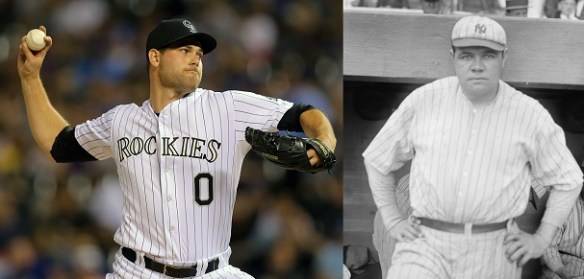
Adam Ottavino (left), who thinks the Bambino (right) in today’s game would be very different than in his own game.

Adam Ottavino is an excellent relief pitcher who’s just turned two out of three splendid seasons including a marvelous 2018 (2.43 earned run average; 2.74 fielding-independent pitching rate) into a three-year, $27 million contract, joining a Yankee bullpen already thought to be the bulls in the American League’s china shop. And he charmed further by asking for and receiving uniform number 0, the absolute final single digit the Yankees could offer with 1 through 9 retired.

But Ottavino has also raised temperatures thanks to the exhuming of, shall we say, a less than worshipful observation involving a Yankee icon.

By his own admission on a December podcast Ottavino committed heresy when, pitching some years earlier in Triple-A and talking to a coach, he observed almost offhand that Babe Ruth in today’s game might not post quite the jaw-dropping batting performances he posted in his actual time. Ottavino went far enough to suggest he just might strike Ruth out as often as not, and he does have the kind of slider and sinker to suggest that’s not a fanciful flub.

In some places you might have thought Ottavino committed the rough equivalent of John Lennon’s ancient observation, in an offhand remark made months before its American revelation, that the Beatles in 1966 were more popular than Jesus Christ.

Lennon’s republished-out-of-context remark finally compelled him to clarify, at a sober Chicago press conference, that he’d forgotten in that earlier moment that he was himself one of the Beatles and, memorably, “If I’d have said television was more popular than Jesus, I might have gotten away with it.” When the Yankees introduced Ottavino formally last week the righthander felt just as obliged to clarify.

“I probably used a bad example of the point I was trying to make: the evolution of the pitching in baseball over baseball history,” Ottavino said. “And Babe Ruth’s probably a name that I shouldn’t have used in this example. But I’ve got a lot of flak for it, mostly funny stuff, like my uncle telling me that he can’t go anywhere without hearing about it, things like that. But I meant no disrespect. I’m a huge baseball historian and love the game, and it’s not even something that can be proven anyway, so I find it a little funny.”

The genuine problem with Lennon’s ancient controversy is that there were moments indeed during the Beatles’ extraterrestrial international fame and achievement where you might well have believed them to be more popular than Christ; indeed, at least one clergyman responded to the uproar, “To many people the golf course is more popular than Jesus.” A deeper look indicated that Lennon himself didn’t exactly believe that that possibility was a good thing.

But Ottavino in a couple of ways was quite right. Even amidst the evolution of baseball analysis in my lifetime, you can still find a considerable community that refuses to allow anything other than the image of Ruth as the single greatest baseball player who ever lived without the deviant consigned to the rack.

During the mid-to-late 1990s a Village Voice writer named Allen St. John isolated the point: “Ask someone who the greatest basketball player of all time is. They’ll say Michael Jordan. Ask him who the greatest quarterback is. They’ll say Joe Montana. Ask them to name the greatest heavyweight champion. It’ll be Muhammad Ali. The greatest hockey payer? Of course, Wayne Gretzky. Now ask them the greatest baseball player of all time? And the answer will be Babe Ruth. Now, look over that list of names and ask yourself what’s different about the last one?”

I’m not conversant enough with their sports to suggest possible successors to Ali or Gretzky and have no wish to be, but one suspects LeBron James may have succeeded Jordan and Tom Brady, Montana. May. And they won’t erode the places in their sports’ histories of, say, Bill Russell or Bart Starr.

Writing in Clearing the Bases: The Greatest Baseball Debates of the Last Century in 2002, Allen Barra answered St. John: “Every other sport gets to choose a current or modern player as its greatest, but a baseball fan always has to look at the past . . . A couple of years ago I proposed that Wilt Chamberlain and not Michael Jordan was the most dominant player in basketball history . . . I was scoffed at; how could I say that when the conditions of the game have changed so greatly from the early 60s to now? And yet, when it came time to pick the greatest player in baseball history, four of five picked Babe Ruth without batting an eyelash (the other picked Willie Mays, the player people usually pick who don’t pick Ruth). Apparently, the conditions of basketball had changed radically over the last thirty-five years but in baseball, over seventy years, not at all.”

Barra cited St. John in his book’s leadoff chapter, provocatively titled “Getting Tough with Babe Ruth.” Essentially, he set out to prove a sacred cow’s genuine worth—steak—and he did a splendid job, particularly when he lanced one of the key boils of the Ruthian myths, that being he was the great all-around player who could Do It All better than anyone else could Do It All, and did.

As a full-time pitcher Ruth was good and occasionally great (especially in the 1916 World Series), but a full-time ERA only a few points below his league average in a low-scoring era isn’t exactly Randy Johnson being almost two full runs below his league average in a high-scoring era. And throwing short range as a pitcher throws is an entity unto itself; a right fielder throws considerably different, and with a considerably different eye and aim.

Ruth was a league-average defensive right fielder whose throwing arm was passable but not exactly the model for Roberto Clemente. He was a mediocre baserunner with no speed as a full-time position player, the evidence for which exists above and beyond his colossal blunder in ending the 1926 World Series in the Cardinals’ favour. (With Bob Meusel at the plate and Lou Gehrig on deck, a pair of hitters not exactly renowned for being pushovers, Ruth took off for second base entirely on his own thought and was out by a enough space for a car to pass through.)

Those who do argue Mays over Ruth have power/speed combination evidence on their side, too: remove Barry Bonds if you must because of his involvement with actual or alleged performance-enhancing substances, and Mays is the number two power/speed combination of all time, right behind fellow Hall of Famer Rickey Henderson. The Babe? How does number 84 strike you? Might strike you out, actually.

Despite the image of Ruth having thunderous power all over the place, period descriptions (Barra’s phrase) show him the classic pull hitter who probably picked up a lot of non-home run extra base hits going the other way into cavernous left center fields like his own home parks, distance enough that even a leadfoot like himself could leg out a triple.

If today’s fan frets over the obsession with “launch angles,” over hitters obsessed enough with them to neglect other facets of run-creating hitting while pitchers learn to tie them up in their launch obsessions, how on earth does the parabolic Ruthian blast named for a batter whose power swing was itself a body-twisting uppercut not become the very great-great-grandfather of the very launch angle obsession today’s baseball fan and analyst abhors?

Ruth still has as well a concurrent reputation as the most dominant team player of the 20th Century until you look a lot closer. As a full-time pitcher, he was on Red Sox teams good enough to win without him, one of which won a World Series the year before he joined the fun. As a Yankee full-time position player, he went to three World Series as the team’s best player and they won one out of the three; he went to four more with a player of equal ability as his teammate, Lou Gehrig, and won three out of four; he had a thirteen-year stretch of seven Yankee pennants and four World Series rings.

That’s not Gehrig’s thirteen-year stretch of seven Yankee pennants and six World Series rings. That’s not Joe DiMaggio’s ten pennants and nine World Series rings. That’s not Yogi Berra’s fourteen pennants and ten Series rings (and Yogi had maybe the single most important job in the field, guiding his pitching staffs); it’s not Mickey Mantle’s twelve pennants and seven Series rings. On Yankee terms that evidence suggests Gehrig, DiMaggio, Berra, and Mantle being better and more dominant team players.

What’s absolutely fair to Babe Ruth is to call him the greatest player of the pre-World War II/pre-integration era, playing in a time when major league baseball limited its talent pool by design and, for all manner of perverse reasons, refused to let Ruth play against the best black, Latino, and further international talent. (Ruth himself would have welcomed that chance; he thought nothing of off-season barnstorming baseball tours that included games against Negro Leagues players he admired.)

But then we add to pre-World War II/pre-integration a third condition—the pre-night ball era. Between the limited talent pool he was allowed to face, and the strictly day game he was allowed to play, it’s to wonder whether Ruth’s batting statistics would have become as platinum looking as they are to the naked, un-inquiring eye if he’d played half or more of the time at night. (It’s also to wonder how much gaudier Henry Aaron’s, Willie Mays’s, and Ken Griffey, Jr.’s batting statistics would look if they never had to play at night.)

I’ve yet to read Jane Leavy’s The Big Fella: Babe Ruth and the World He Created, and you may rest assured it’s prime on my to-read list, but the reviews I’ve seen indicate she plumbed as deep as a human could plumb into everything that made Ruth Ruth, from his grotesque childhood and its legacy of insecurities to the baseball fame manufactured six parts Ruth himself and half a dozen parts his era’s pliant sporting press and the randy adolescence of the public relations industry.

“With the help of his shameless business manager, Christy Walsh, Ruth cultivated and grew his celebrity and cashed in on it big-league,” writes one of the best reviewers, Nicholas Frankovich in National Review. “It was extraordinary, of a magnitude unprecedented for an Ameri­can athlete. Ruth was shameless too, so blush not for him, and more amoral than immoral, so temper your head-shaking at his Rabelaisian over­indulgence in food and sex.” Temper it, we presume, without a concurrent thought about all the athletes of the past two decades whose Rabelaisian appetites and thuggish behaviours receive condemnation instead of, pardon the expression, Ruthian indulgence. (If you don’t think the Babe could be thuggish, you don’t know about the time he hung manager Miller Huggins over the end of a moving train to try convincing Huggins to rescind a disciplinary fine.)

Placing Ruth in context and beyond mythology is entirely do-able without writing him out of his own legend or that of the Yankees and the game itself. “The Babe gets a free ride from the modern historians and documentary makers,” Barra wrote, “and his name is often evoked by people who in practise seem to abhor the very kind of big power-big strikeout, low emphasis on speed and defense game that Ruth was most associated with in his own time. Nobody ever gets tough with Babe Ruth . . . The Babe is tough enough to take a few knocks from me. Or anyone. Maybe even tough enough to put up with a modern reassessment and still stay a hero.”

Maybe even tough enough to withstand Adam Ottavino’s gaffe, for which Ottavino beyond a momentary lapse of rhetorical temperance should have owed not one degree of penance.

The Cubs’ cloudy window

2019-01-24 chicagocubs

Anthony Rizzo (far left) and the Cubs went out of 2018 with a whimper and enter 2019 with question marks . . .

You look back and think that it ended almost in a blink. The Cubs’ 2018 season, that is. They had the National League Central under lock and key, almost, and that turned out to be deceptive. Especially when their lineup couldn’t hit with a hangar door when it mattered the most. In two days and 22 innings of baseball, they collapsed.

With practically the same team with which they pulled World Series rabbits out of their hats two years earlier, give or take one or two different pieces, the Cubs needed to play a tiebreaker to win the NL Central—and blew it. Then, they needed to win the wild card game to stay in the postseason at all—and they blew that, too.

In two days of the most important baseball they played all year, after being unable to hold a five-game division lead, the Cubs scored only two runs and went 1-for-8 with men in scoring position. They entered the winter with a somewhat depleted farm, a bullpen with holes, and the possibility that they didn’t strike when replenishments would have made a bigger difference then or now.

Their owner still thinks they have a championship core despite other observers thinking their dynastic window is cloudy at best and closing at worst. Tom Ricketts says the Cubs didn’t have the financial flexibility this time around to play a big ticket or two this winter. And he says that’s kind of a moot point. “We like the team we have,” he told ESPN Radio last week. “We have strong young guys at most positions.”

Last weekend’s annual fan convention didn’t feature Ricketts but did feature team president Theo Epstein. That’s one mixed signal. Another is that the Cubs’ winter has amounted to little more in the way of additions than utility veteran Daniel Descalso and relief pitcher Brad Brach. Also absent from the fan convention was honeymooning first baseman Anthony Rizzo.

Meaning third baseman Kris Bryant became a convention focus. Where it was one thing for him to criticise this winter’s second consecutive sluggish free agency market, but it was something else for him to start a feud with the division rival Cardinals, who need very few excuses to want to do to the Cubs what Sparta once did to Athens.

And all of a sudden it was enough to make you wonder what’s happened to the Cubs’ team leadership. With Rizzo on his honeymoon nobody else was there to give Bryant an assist in choosing his words carefully. The rivalry between the Cubs and the Cardinals is testy enough without Bryant declaring St. Louis a boring city and Cardinals catching mainstay Yadier Molina vowing it wouldn’t be forgotten when the dance gets underway in earnest.

All of a sudden, too, it was enough to make you miss David Ross even more. Grandpa Rossy showed the younger Cubs having fun didn’t mean leaving accountability behind. With him as a mentor they weren’t afraid to call each other out when need be. It took especially with Rizzo, who didn’t skip a beat calling out Miguel Montero when Montero—already on thin ice after he kvetched about his 2016 postseason playing time—was foolish enough to blame his pitcher for seven stolen bases against him in a June 2017 game. Big mistake.

Montero was gone post haste; he bounced from the Blue Jays to the Nationals and called it a career in December. Not the happiest end for a guy who turned his limited 2016 postseason playing time into two of the most important hits in Cub history (the tiebreaking grand slam in Game One of the 2016 National League Championship Series, and driving in what proved the Series-winning run in the top of the tenth) and who’d been a two-time All-Star with the Diamondbacks.

But Rizzo on his honeymoon wasn’t there to stuff a sock into Bryant’s pie hole before he could rag on St. Louis and get the iron into the Cardinals’ spine. When Molina answered everyone listened. There’s probably no more respected member of the Cardinals’ clubhouse. If you think Molina’s going to let the Cardinals forget that joker in Chicago who says their home turf is a bore, think again.

Nobody else was there last weekend to assure Bryant there’d be a cleaning and stuffing party in his dishonour if he got that fast and loose with his tongue again. If Ross was still around he’d have been the first to pull Bryant to one side and remind him a big mouth works best when kept shut. They’re going to need a full season of Cole Hamels joining Rizzo in the clubhouse to bring sense and sensibility back.

And who’s to say a little stronger clubhouse leadership might not have made a difference with Addison Russell? The shortstop slaughtered his market value thanks to treating his now-former wife like a punching bag; the Cubs are standing by their man giving him a very conditional second chance, though his continuing suspension means he won’t be back until May. But would a healthier clubhouse self-policing have kept Russell from making it bad to worse for himself?

The Cubs just added Brach to the bullpen. With closer Brandon Morrow possibly on the disabled list to open the season (Morrow underwent elbow surgery this winter), Brach gives the Cubs pen some needed breathing room. A veteran who can set up or close out and worked a 1.52 ERA for the Braves down last year’s stretch is a guy who keeps your bullpen off the respirator.

Except that the Cubs needed a lefthanded reliever more. And they could have had Andrew Miller for a comparative song, since Miller is looking to prove his solid return from last year’s disabled list isn’t a fluke. Bryant thinks St. Louis is boring? It won’t be Bryant’s team sending Miller out to show the Cardinals a little excitement.

Don’t look now, but nobody in the NL Central is rebuilding. Don’t look further, because the fourth-place Pirates had the best within-the-division record last year. Don’t look further than that, because while the Cubs have added just a utility infielder and a veteran relief arm, the Cardinals dealt for Diamondbacks mainstay batsman Paul Goldschmidt before they reached out and touched Miller. The Reds dealt for Yasiel Puig, Matt Kemp, and Alex Wood. With Rizzo the Cubs didn’t necessarily need Goldschmidt, but Puig and Kemp would have been solid outfield upgrades and Wood would be a nice piece to shift between the rotation and the pen for them.

The Cubs might have had a few more strong young guys to send out to the mound, starting and relieving, if they’d struck when Kyle Schwarber’s value was at its height. The Schwarbinator may have been one of their feel-good stories of 2016, but for all his power he’s been worth 2.7 wins above replacement-level in four seasons and isn’t exactly much more than a two-tool player in danger of becoming a three-true-outcomes specialist. If he’s not there already.

If the Cubs had flipped him at last year’s non-waiver trade deadline, they might have brought back some younger, healthier pitching. That would have been better insurance in the event expensive Yu Darvish doesn’t return healthy or, if he does, he doesn’t complete the fix on the pitch tipping flaws that got him murdered in the 2017 World Series. Now the power hitting market ain’t what it used to be for guys who can bomb but not do a lot else. Opportunity misplaced.

And unless they can find a defense-oriented taker for pricey Jason Heyward, who still brings it with his glove while still losing it at the plate, the Cubs will be hobbled by the $106 million they still owe him for the next five years. Right there is the likely reason the Cubs haven’t made more than a rumoured run at Bryce Harper, who’d be more of an outfield upgrade than either Puig or Kemp would have been. Unless they’re in the laboratory conjuring up a brew of very creative financing.

The Cubs have been very good at getting creative the last few years. They’d better be now if they don’t want to be bastinadoed by hungry teams of Brewers, Cardinals, Pirates, and Reds, not to mention snide choruses of “Ahhh, wait till three years ago.”