
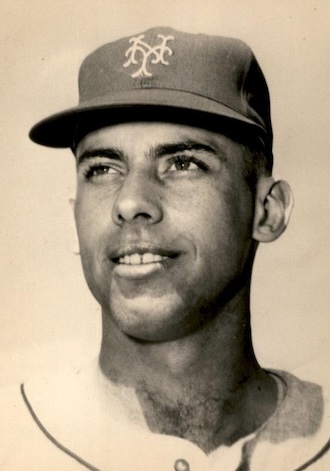
“He crowds the plate like Raquel Welch crowds a bikini.”–The Pittsburgh Press, about Ron Hunt, long after he left the Mets in a heartbreaking trade.
Many enough in New York were impressed early and often with Ron Hunt, the first Met to earn a starting berth in an All-Star Game (1964, played in newborn Shea Stadium), aside from us kids who believed the comically inept Mets were just that much more human than the aloof, imperial Yankees.(“The Yankees,” Bill Veeck once wrote, “always took the attitude that they were doing you a favour by permitting you to watch them perform.”)
The impressed included Roger Angell, in only his second year of writing literarily virtuosic baseball reports, opinions, asides, and epitaphs for The New Yorker. “The sun’s brightest rays this spring,” Angell wrote, in a May 1963 essay, “have shone around the middle of the [Mets’s] infield.”
Ron Hunt, a skinny twenty-two-year-old second baseman up from the Texas League . . . has quick hands, excellent range to his left, and a terrier’s eagerness for a moving ball . . . [He] has kept his [batting] average close to .300. He reminds me of Pee Wee Reese at the plate—an unassuming, intelligent swinger who chokes up on the bat and slaps singles to all fields.
Hunt ripped a walkoff double for the first Mets win of 1963; original owner Joan Payson sent his wife, Jackie, two dozen roses. He actually finished second to Pete Rose in the National League’s 1963 Rookie of the Year vote. A year later, Hunt impressed Angell yet again. “The Mets are short on heroes,” Angell wrote.* “Their gamecock, their small nova, is Ron Hunt, the second baseman.”
Now in his second season, Hunt appears to be one of those rare ballplayers who improve from year to year. Four years ago, he batted .191 in the low minors. Last year, as a major-league rookie, he hit a solid .272, and so far this young season a stream of modest singles and doubles has kept him constantly above the .300 mark. Originally a third baseman, he now has mastered the pivot at second and he fields with assurance, if not brilliance. His new partnership with Roy McMillan, the veteran shortstop just purchased from the Braves**, cements the Mets’ infield. McMillan has slowed down a step or two and is having trouble at the plate, but he is a tough, tobacco-chewing, old-time pro and a boon to this young team.
He also began mastering the art of taking one for the team, quite literally. His 243 lifetime drills were a modern major league record when he retired in spring 1975. (“He gets good flesh on the ball,” cracked one newspaper once upon a time.) If they’d had walkup music in that era, you could have had a field day picking Hunt’s. He was 1960s/1970s baseball’s great plunk rocker.
In May 1965, Cardinals infielder Phil Gagliano blasted Hunt on a takeout slide as Hunt tried to pick a slow grounder by Hall of Famer Lou Brock. That shoulder separation almost killed a season which began with Hunt missing its first fifteen games with a jammed finger. He came back early that August but the season was more than lost.
After returning to form enough to make the NL All-Stars in 1966, Hunt ran afoul of Mets manager Wes Westrum (Casey Stengel’s successor) and was dealt to the Dodgers with outfielder Jim Hickman for former NL batting titlist Tommy Davis and outfielder/infielder Derrell Griffith, who’d never play a single major league game for the Mets or anyone else again.
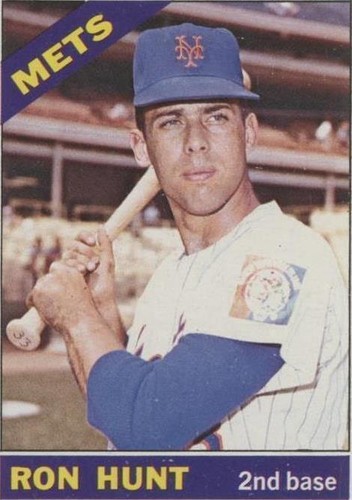
Hunt’s final Topps baseball card as a Met. He didn’t exactly look the junkyard-dog type.
“The trade broke his heart,” wrote Hunt’s Society for American Baseball Research biographer Tad Myre. “The Hunts loved New York City, the Mets team, and the Mets fans. Ron figured he’d be a Met forever and wanted to be around when the club started to win. It did not help that he had to learn of the trade from sportswriter Dick Young.”
With the Dodgers for a season, the Giants (after a trade) for three, the Expos for three and two thirds, and his hometown Cardinals for shy of a third, Hunt broadened his reputation as a baseball junkyard dog. For seven straight years he led the National League in getting hit by pitches, and for the first six he led the entire Show. He also walked far more than he struck out, but he once said pitchers told him if he got them to 3-1 in the count they might as well drill him.
“He even practised getting hit in batting practise,” said his Expos manager, Gene Mauch. “Hunt has had to fight for everything he got . . . Hunt has a big day, goes four-for-four, the next day he’s out early wanting to work on some things, wanting to do it again, nor being satisfied.”
When his playing career ended, Hunt—who died last Wednesday at 85, after a long battle with Parkinson’s disease that may have come from four baseball concussions and “indeterminate” ones when he played high school football—involved himself in farming, liquor and sporting goods stores, and a youth baseball association from 1987-2003 aimed at preparing kids aiming to play college baseball.
The great plunk rocker also made sure that at least one piece of his Mets past stayed with him: he kept two pairs of seats from the late Shea Stadium in his home. (He was also known to have saved a good number of the balls that hit him during plate appearances as well.***)
Hunt was probably one of the most classic examples of the player whose guts you hated with a passion—until or unless he became your teammate. If you made him a friend, you had a friend for life, according to just about every published tribute to the man.
If you made him a husband, as his high school sweetheart Jackie Stewart did, you had what Myre called a marriage “for the storybooks” which produced two children, Tracie and Ronnie. “The happiest day of my life,” Hunt called his 1961 wedding day. “That’s what she told me to say.”
Ron and Jackie Hunt had a habit of making friends among the fans with whom they dwelled off the field. Veteran New York Post writer Ken Davidoff, profiling Hunt and his Parkinson’s battle in 2018, asked whether he wanted Met fans to pray for him. “Just tell them I said hi,” Hunt replied. “I don’t know them. They don’t know me personally. Just tell them I said hi. I’ll never forget you.”
His wife, children, grandchildren, fans, and friends won’t forget him, either. Here’s hoping Hunt’s entry into the Elysian Fields was gentler than his near-customary way of reaching base.
* Both Roger Angell essays quoted were included in the first of his imperative anthologies, The Summer Game. (New York: Viking Press, 1972; Nebraska: Bison Books, 2004.)
** Hunt himself was an acquisition from the Braves, the Mets having bought him after their first tremendously, hysterically horrendous (or should that be horrendously hysterical) season.
*** Don Baylor broke Hunt’s modern-era lifetime plunk record in 1987 and retired with 267. Hall of Famer Craig Biggio broke Baylor’s record in 2005 and retired with 285.)

