They’ll love Arozarena in Seattle . . .

Randy Arozarena

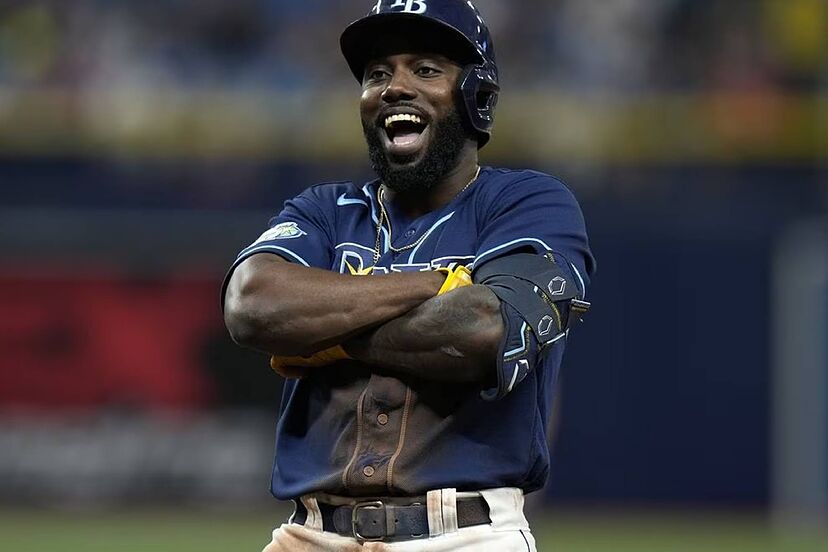
Arozarena’s smile could light up any ballpark felled by a power outage.

Nobody likes to see teams send their most heroic postseason heroes onward. Sometimes that happens when the most recent of their postseason heroics are still in full rearview mirror view. That stings the deepest.

So maybe the Rays did their fans a favour by sending Randy Arozarena to the Mariners long after the postseason postings that made his name disappeared from rearview sight. But it’s a small favour. And, depending upon the net results of the haul they got in return, it might not even prove that much of a favour.

Once up as high as ten games atop the American League West, the Mariners have since gone 11-20 as the formerly-moribund Astros reheated enough to take the division lead by a full game. Losing a ten-game lead in a 24-game stretch was unprecedented. No team before them ever blew that fat a lead that soon.

Arozarena’s season began slumping until he re-heated before the trade, but he hasn’t factored in the Mariners fortunes just yet, even if they took a pair from the White Sox after making the deal. The Mariners have the patience of Job when it comes to waiting for his full emergence in their silks.

They sent the Rays two prospects with upside enough if you consider the Rays’ ability to shape players, minor league outfielder Aidan Smith and pitcher Brody Hopkins. The Rays had better hope they can forge that pair into more than just replacement-level major leaguers. Arozarena was worth about a hundred times that much from the moment his 2020 coming-out party began.

Arozarena picked up one hit on Saturday but then went 2-for-4 with a run scored in Sunday’s 6-3 Mariners win. He beat an infield hit out in the first to score almost promptly on Cal Raleigh’s immediately-following home run, then he beat another infield hit out to load the bases with two out in the second only to be stranded there.

“He’s really loved by his teammates and fans,” said Mariners outfielder Luke Raley, himself an Arozarena teammate in Tampa Bay for two seasons, “and he’s going to be a fun addition for sure. He’s the low heart-beat kind of guy. He’s just made for the big moment. Late in the game, you need a big hit, you want Randy at the plate.”

Raley spoke after the Mariners demolished the bottom-crawling White Sox 10-0 Friday night. He even revealed Mariners president Jerry Dipoto consulted him on Arozarena before pulling the proverbial trigger on the deal. “I kind of gave him a three-, four-minute spiel about my thoughts and the things that [Arozarena] does,” Raley said. “You try to explain it, but it’s really hard—because until you see it, you don’t fully understand it. But he just is like a bright star.”

This is the effervescent who defected from Cuba in a rowboat and was first signed by the Cardinals. A year before that coming-out party, Arozarena made what some call a mistake and others call serious. When the Cardinals destroyed the Braves 13-1 in 2021 National League Division Series Game Five, manager Mike Schildt broke into a postgame rant that left himself and his team resembling sore winners:

They [the Braves] started some (excrement). We finished the (excrement. And that’s how we roll. No one (fornicates) with us ever. Now, I don’t give a (feces) who we play. We’re gonna (fornicate) them up. We’re gonna take it right to them the whole (fornicating) way. We’re gonna kick their (fornicating) ass.

Schildt’s rant went viral thanks to Arozarena capturing it on video and sending it there. Once the rejoinders went flying in earnest, he couldn’t wait to take the video offline. The only place the Cardinals went from there was to a four-game sweep out of that National League Championship Series by a team of Nationals whose manager was smart enough not to say they were going to [fornicate] the Astros up in the World Series—they simply did it, in seven thrilling games.

A cynic might suggest the Cardinals waiting to trade Arozarena to the Rays the following January was a matter of not wanting it to look as though they were teaching him a lesson about impudent videomaking. But their loss was the Rays’ gain, once baseball resumed after the long enough and weird enough pan-damn-ic shutdown. The Rays hit the expanded postseason running. Arozarena hit it exploding.

He hit ten home runs to smash Hall of Famer Derek Jeter’s record for a single postseason. He set a single-postseason record with 29 hits. He was named that American League Championship Series most valuable player. Perhaps fittingly, too, he slammed the exclamation point down upon one of the weirdest and wildest World Series game-ending walkoff hits in Game Four.

He pounded the plate nine times with his right palm to be sure he wasn’t imagining having scored the walkoff run to finish 2020 World Series Game Four’s insane finale. Compared to his grin, the Cheshire Cat was suffering depression.

Arozarena was on first in the ninth when pinch-hitter Brett Phillips singled Kevin Kiermaier home with the tying run. Except that Dodgers center fielder Chris Taylor coming in to field the ball had more eye on Kiermaier and the ball caromed off his glove to his left. Taylor scrambled to retrieve the ball and get it to his cutoff man Max Muncy.

Except that Muncy took the throw past first and wheeled to throw home, but the throw bounded off catcher Will Smith’s mitt at the split second Smith began wheeling for a tag on an oncoming Arozarena—who wasn’t within two nautical miles of the plate just yet. Arozarena tumblesaulted after tripping and stumble back toward third before righting himself when he saw Smith lacked the ball, diving home and pounding the plate with the palm of his right hand nine times.

The Rays would lose that Series, of course, but Arozarena went from there to become the 2021 American League Rookie of the Year, his rookie status unblemished by his late arrival down the 2020 stretch. He was likely the first ROY to win that award after making himself into a postseason breakout star. And few postseason breakout stars had Arozarena’s knack for making even opposing fans take to him.

He was made for the arena. A word that just so happens to be the final three syllables of his surname. But he’s also made of more endearingly human things. When he learned he’d been traded, Arozarena delivered a farewell to admire. He slipped into the stands and greeted, shook hands with, and thanked as many fans and stadium workers as he could before departing. No newspaper ad or billboard stuff for him.

Arozarena’s likely salary escalation plus the Rays’ apparent inability to make any AL East gains prompted the team to move him to Seattle and pitcher Zach Eflin to the Orioles. Closing the book on this season and looking toward next may make baseball sense for the Rays.

“Tampa Bay has been hovering on the edge of the AL playoff picture for nearly the entire season, but a late-season surge wouldn’t have been out of the question,” says FanGraphs writer Jake Mailhot. “By moving Arozarena at this point in the season, the Rays have indicated that they’re more interested in ensuring they’re set up well for the future than in hoping for a long-shot playoff run over the next few months.”

But sending a franchise icon away—in a year that cost them their $182 million shortstop to administrative leave over an underage sex scandal in the Dominican Republic—stings even more. The Rays may lead the Show in frugality, but don’t think for a nanosecond that they entered 2024 intending to change Arozarena’s home address just yet.

They’re not the first to think they had to move such an icon, of course. But depending on what’s to come the rest of this season and most of next, Rays fans may yet come to see the Arozarena trade as comparable to that of the Mets trading Hall of Famer Tom Seaver to the Reds in 1977. Breaking hearts and backs and what was left of a franchise’s spirit alike.

“I loved every challenge of playing third base”

Adrián Beltré

He hit home runs on one knee, he was a human highlight reel at third base. Welcome to Cooperstown!

Of all the stories that abounded this weekend about Adrián Beltré, on the threshold of his induction into the Hall of Fame, there’s one which may be forgotten except by Angel fans left (as almost usual) to ponder what might have been. It’s the story of the Angels pursuing Beltré as a free agent after he spent five often injury-plagued seasons in Seattle.

Essentially, Angels owner Arte Moreno wanted Beltré in the proverbial worst way possible, after the Dodgers who reared him were willing to let him escape to the Mariners in free agency—despite Beltré having just led the Show with 48 home runs in 2004—because then-owner Frank McCourt didn’t want to pay what the Mariners ultimately did.

Beltré went from the Mariners to the Red Sox on a one-year, prove-it kind of deal. When that lone Boston season ended in October 2010, Moreno kept Beltré in his sights. But nothing the Angels presented Beltré impressed him enough to sign with them. He opted to sign with the Rangers instead. Moreno was so unamused he ordered his then-general manager Tony Reagins to deal for Blue Jays outfielder/slugger Vernon Wells.

Well. The Angels learned the hard way (don’t they always?) that Wells was damaged goods. The fellow they sent the Jays to get him, bat-first catcher Mike Napoli, would join Beltré for a hard-earned trip to a World Series that would break their hearts, before moving on to help Cleveland to a pennant and the Red Sox to the 2018 World Series triumph.

Meanwhile, before leaving Seattle for a one-year, show-us deal with the Red Sox, Beltré by his own admission finally learned he could have a shipload of fun playing baseball without losing the focus, the discipline, or the outlying durability that were going to make him a Hall of Famer in the first place. With the Rangers, he finished his ascent into what Baseball-Reference calls the number four all-around third baseman ever and, concurrently, built and secured a reputation as a team-first Fun Guy.

Nail his 3,000th lifetime major league hit? Party time—for the whole team and then some. “After he got 3,000 hits he had a party,” says Rangers in-game reporter Emily Jones to The Athletic‘s Britt Ghiroli and Chad Jennings. “It was like our clubhouse moved to this place. Every clubbie. Every trainer. Every massage therapist. He was extremely inclusive.”

“He was the oldest guy on the field,” says his former Rangers teammate Elvis Andrus, “but acted like the youngest.”

Beltre’s fun-loving rep went hand in glove with being a veteran clubhouse leader to whom even his manager often deferred. “If he stared at you some kind of way,” says Ron Washington, now managing the Angels but then managing the Rangers, “you knew he meant business. A couple of times, I got off my perch to go get (on a player). He would stop me and say, ‘Let me get it, skip’.’

“I saw him chew veterans,” says one-time Rangers batting coach Dave Magadan, “like they were 19-year-old rookies.”

But he also never forgot teammates, even after he retired. Lots of players can make their teammates go with the flow during arduous seasons. Beltré made them friends. Even if he might chew them out one day, he’d re-cement the friendship side by asking, “You know why I did that, right?”

Former Rangers teammate Mitch Moreland remembers taking a group of later Athletics teammates to a Seattle restaurant to which Beltré had taken a host of Rangers once upon a time. “I called (Beltré) and I was like, ‘Hey, what was the guy’s name at Metropolitan? I’m going to take the boys there’.”

He goes, “Oh, I got you.” So, he called the guy up, set it up. I took the whole team over there, we ate, and I got ready to get the bill, and Adrián had picked it up. For the Oakland A’s. After he was retired.

What of the once-familiar running gag involving Beltré’s real distaste for having his head touched and teammates—usually spearheaded by Andrus—going to great lengths to touch it and get away with it? “I still do,” Andrus says. “He still doesn’t like it. That’s what I am going to try to do at Cooperstown . . . I need to touch his head. I need to touch his head while he’s talking!”

He didn’t get anywhere close to that. Hall of Famer David Ortiz did, right smack at the podium.

But no matter. The third baseman who declined a grand farewell tour didn’t need any further validation for his place in the Hall of Fame. Those who do, however, should marry his 27.0 defensive wins above replacement level player (WAR) to his Real Batting Average (total bases + walks + intentional walks + sacrifice flies + hit by pitches, divided by total plate appearances) among Hall third basemen whose careers were in the post-World War II/post-integration/night-ball era:

HOF 3B PA TB BB IBB SF HBP RBA
Mike Schmidt 10062 4404 1507 201 108 79 .626
Chipper Jones 10614 4755 1512 177 97 18 .618
Eddie Mathews 10100 4349 1444 142 58 26 .596
Scott Rolen 8518 3628 899 57 93 127 .564
George Brett 11625 5044 1096 229 120 33 .561
Ron Santo 9397 3779 1108 94 94 38 .544
Wade Boggs 10740 4064 1412 180 96 23 .538
Adrián Beltré 12130 5309 848 112 103 97 .533
Paul Molitor 12167 4854 1094 100 109 47 .510
Brooks Robinson 11782 4270 860 120 114 53 .458
HOF AVG .555

He’s not higher there because a) he drew far less unintentional walks than most of the men on that list; and, b) that aforementioned durability led him to playing through injuries insanely enough to cause him a few so-so seasons that pulled his numbers down somewhat. But as a defensive third baseman he’s the second-most run-preventive player (+168) who ever worked that real estate . . . a mere 125 behind a guy named Robinson.

“I loved every challenge of playing third base,” said the first third baseman in Show history to nail 400+ home runs and 3000+ hits. “I was hooked. Those hot shots, slow ground balls, double plays, I couldn’t get enough of them.” Come Sunday, the Cooperstown gathering almost couldn’t get enough of Beltré, either.

ASG: As (almost) usual, show biz yields to baseball

Jarren Duran

Red Sox center fielder Jarren Duran hoists the clear bat awarded the All-Star Game’s Most Valuable Player. His tiebreaking two-run homer held up to give the AL the 5-3 win.

God help us all, everyone. The All-Star break began with a pre-Home Run Derby singing of “The Star Spangled Banner” Monday night (by country star Ingrid Andress) that made youth cringe and elders think wistful thoughts of Roseanne Barr. It ended with a tenth American League All-Star Game win in eleven seasons.

In between, of course, was much to ponder and much to dismiss as patent nonsense, which seems to be far more the norm than Chicago Tribune sports editor Arch Ward, who initiated the game in 1933, might have imagined.

Phillies third baseman Alec Bohm could be seen having to labour to keep from laughing (presumably, that he might not weep—or wish to commit manslaughter) when Andress tackled “The Star Spangled Banner” as though too well besotted. It turned out that appearance was everything: She copped the following day to being drunk and having enough issue with it to seek rehab and recovery.

Wish her well, but demand to know why nobody in baseball’s administration noticed she was drunk as she took the mike in the first place.

That was then: The Derby rules were, a participant had ten outs to hit as many homers as they could, the hitter with the most such bombs advanced, and that was that. So simple that, in fact, even Mark Belanger (human Electrolux at shortstop, but a spaghetti bat who hit three fewer homers in eighteen major league seasons than the late Hall of Famer Willie Mays hit in the first half of 1965) could have done it.

This is now: Round One—three minutes or forty batted balls, whichever came first, followed by an old-style three outs to hit as many bombs as possible. Round Two—the top four floggers moved to a bracket-like semifinal. Round Three—the two semifinal winners head to head. The net result: Teoscar Hernandez (Dodgers) defeating Bobby Witt, Jr. (Royals), who nearly forced a playoff with a ICBM-like blast stopped only by the left center field fence.

Some of us still wonder why we’re supposed to tolerate three-hour long Home Run Derbies but arise armed against two and a half hour-plus real baseball games. Or, why we had three-minute commercials aboard Fox’s All-Star Game telecast Tuesday before seeing supersonic relief pitchers blowing the side away in order in a minute and a half if that long.

Perhaps commissioner Rob Manfred might have an answer to that one. At least he has a sort-of answer to the question (posed by The Athletic‘s Tyler Kepner) of when the ever-more-hideous generic All-Star Game uniforms of the past several years will be disappeared in favour of returning the fine old tradition of All-Stars wearing their own uniforms and thus representing their teams.

“I am aware of the sentiment and I do know why people kind of like that tradition,” Commissioner Pepperwinkle told Kepner. “There will be conversations about that.” The proper two-word answer to that, of course, is, prove it. About knowing why people (more than kind of) like that tradition and holding serious conversations about it.

Well, take the proverbial pause for the proverbial cause. That very first All-Star Game featured the American League representatives wearing their own teams’ home uniforms with the National League wearing road threads, as modeled below by Hall of Fame catcher Gabby Hartnett:

Gabby Hartnett

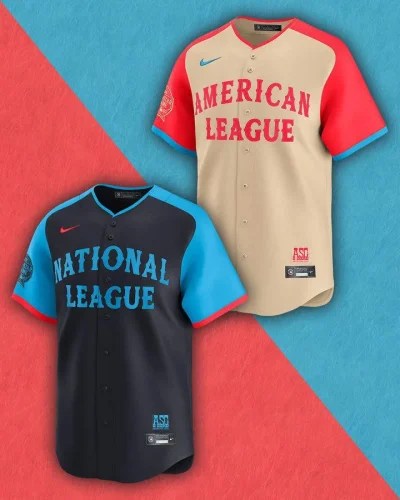
Behold now this year’s threads for each league:

Yes, we have seen far worse for generic All-Star uniforms.

Except for each league’s colour scheme, is it really that radically different from the 1933 NL haberdashery? Now, this year’s threads would look far nicer if the American League jersey was done with red-on-white (the AL was the home team in Globe Life Field) and the National League was done with blue-on-gray (since the NL is the visiting team). And worn over either white (home) or gray (road) pants.

My normal position is to be all-in on returning to the practise of each league’s All-Stars wearing their own teams’ uniforms, representing their teams and fan bases, as their forebears did for so many decades. If Commissioner Pepperwinkle insists ultimately upon keeping generic league uniforms, this year’s style just might be the right way to go, switching the core white and gray each year depending upon which league is the All-Star host.

The wherefores of this year’s uniforms mattered less when the game got underway, and rookie NL starting pitcher Paul Skenes (Pirates) got to face Aaron Judge (Yankees) after all, thanks to Judge’s teammate Juan Soto wringing himself into a walk. The bad news: Judge forcing Soto at second with a grounder to third for the side.

AL manager Bruce Bochy (Rangers) was well aware of the marquee appeal of Skenes versus Judge while penciling Judge into his cleanup slot. But he sent three lefthanded swingers with impeccable on-base credentials up against the righthanded Pirate phenom to open, hoping precisely to get that marquee match without sacrificing his best chances to start winning the game.

Joe and Jane Fan insist, “This is just an exhibition, dammit!” Maybe they’re right. Maybe the metastasis of regular-season interleague play to a full-season thing has left the All-Star Game bereft of meaning, as opposed to such artifices as the period when postseason home field advantage went to the league who won the Game..

But maybe a Hall of Famer in waiting who’s won four World Series as a skipper knows, however the game’s been kicked around like a commissioner’s plaything for too damn long, that himself, his NL counterpart Torey Lovullo (Diamondbacks), and the players on both sides, actually do play this particular game as baseball, not show business.

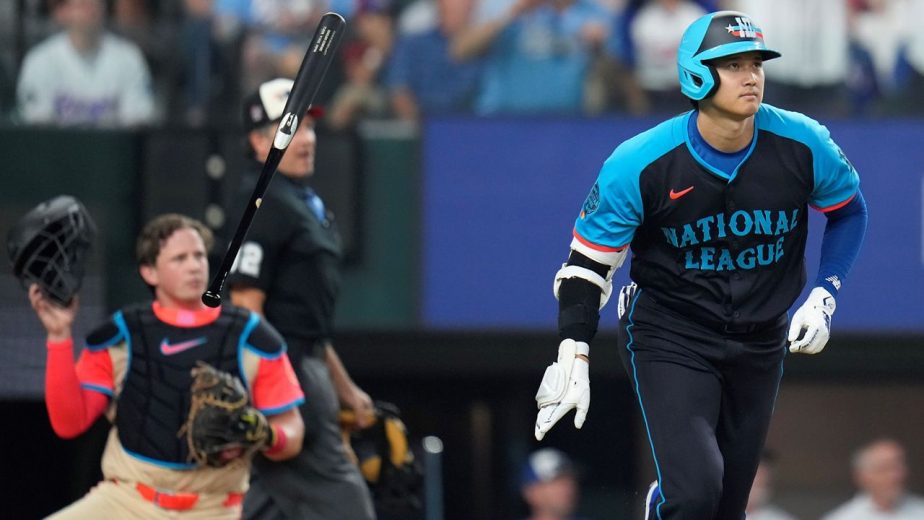
Shohei Ohtani

Shohei Ohtani detonating a three-run homer in the third inning. “To be able to share a dugout with him was surreal.”—Pirates pitcher Paul Skenes. Ohtani is now the only player in Show history to earn a pitching win in one All-Star Game and a home run in another All-Star Game.

So Bochy got Joe and Jane Fan their marquee matchup the old fashioned way, and Skenes came out of it on top, but Bochy’s diligence left him the only manager in major league history to win a World Series and an All-Star Game in each league. And, the first since Hall of Famer Joe McCarthy to manage an All-Star Game at home the season after he won a World Series.

Putting baseball ahead of show biz has enriching payoffs, of which Commissioner Pepperwinkle seemed as unaware as both managers were reminded soon enough en route the American League’s 5-3 win Tuesday.

Lovullo got the first such reminder when Shohei Ohtani (Dodgers) faced Tanner Houck (Red Sox) in the top of the third with nobody out, two men on, and sent a 2-0 splitter a few rows back into the right center field seats. (The last Dodger to hit one out in All-Star competition? Hall of Famer Mike Piazza, 28 years earlier.) Bochy got his in the bottom of that inning, when Soto shot a two-run double to center and David Fry (Guardians) singled him home to tie the game at three after another Judge ground out.

Two innings later, Lovullo got the reminder that ended up counting for the game, when Jarren Duran (Red Sox) batted with two out and one on, took a strike from Hunter Greene (Reds), then caught hold of a Greene splitter and sent his own message into the same region of seats where Ohtani’s blast landed.

“It won’t hit me until I try to go to sleep tonight,” Duran told The Athletic postgame. “Who knows if I’ll be able to sleep tonight.”

A guy in his fourth Show season who entered this All-Star Game leading it with ten triples and the AL with 27 doubles, then detonated what proved the winning bomb Tuesday, deserves to sleep the sleep of the just. So does the rookie whose first two months in Show have made him a name and an arm to reckon with as it was, without giving him the additional gift of being an Ohtani teammate even for just one game—thus far.

“I tried to enjoy the three hours I had on a team with him,” Skenes said postgame, “because that’s probably only going to happen once a year. It was really cool to watch him do that, really cool to watch him go about his business and get to meet him and all that. You know, he’s—I don’t know of any hitters I’ve faced that’s better than him in my career. So, to be able to share a dugout with him was surreal.”

The only thing better for either would have been an NL win, of course. Nobody had to tell Skenes it was neither his nor Ohtani’s fault the NL came up two bucks short Tuesday.

The Baltimore rumble

Basebrawl

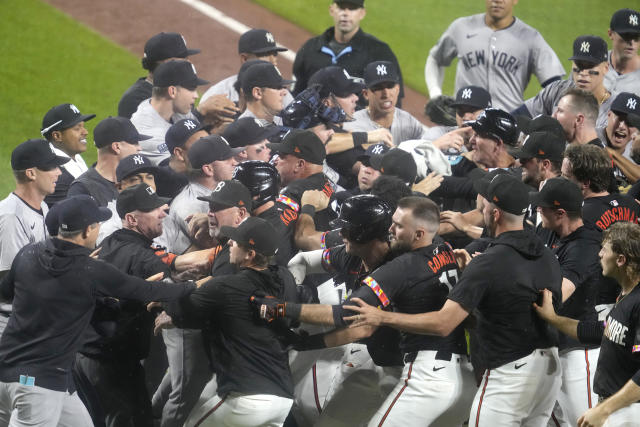
The Orioles and the Yankees rumble in the bottom of the ninth Friday night, after Oriole Heston Kjerstad took one on the side of his head from a Clay Holmes who clearly couldn’t control his pitch grip as the rain kept falling on Camden Yards . . . and after an incensed Oriole manager Brandon Hyde hollered at a Yankee or three to trigger the rumble. Upper right: Aaron Judge (with eye black) about to re-enter the crowd and scatter Orioles as best he could . . .

You could see the rainfall continuing in Camden Yards to the point where Yankee relief pitcher Clay Holmes had few dry spots on his road jersey. You could also imagine gripping and pitching a baseball in that bottom of the ninth moment, the Yankees up 4-1, one out, none on, and an 0-2 count on Orioles center fielder Heston Kjerstad, would be two things: difficult, and impossible.

What you didn’t have to imagine was Kjerstad on the ground in the batter’s box after Holmes’s supposed-to-have-been sinkerball took an ascending flight, instead, crashing into Kjerstad’s head through the right helmet flap, with a crack loud enough that you might have thought for one moment the ball hit Kjerstad’s bat, somehow, and enough force to knock the helmet off Kjerstad’s head as he went down.

What you didn’t want to imagine, if you still had your marble (singular) and weren’t bound to whole servitude by a particular rooting interest, was Holmes wanting to leave Kjerstad with a hole in his head when he was a strike away from putting Kjerstad away for a second out and the Yankees that much closer to sealing a win.

But too many of those bound by Oriole rooting interest decided in the jolt of the moment that Holmes, if not his fellow Yankees, was guilty of attempted murder. I can’t speak for you, but I’m not aware of that many murder attempts that end with the executioner moving and talking toward an apparently genuine concern for the victim’s well-being.

Whatever your position on the Sacred Unwritten Rules, on this much there seems general agreement: It is easier for a fastball to travel through the eye of the needle than for its pitcher to decide with premeditation that two outs short of his team’s victory requires he perform sixty-foot-distance neurosurgery upon the batter in the box

Orioles manager Brandon Hyde thought anything but, seemingly. Almost the split second Kjerstad hit the deck in agony, and Holmes himself tried to make certain he’d be all right, Hyde’s switch flipped. So did his team’s, soon enough, the Orioles pouring out of their dugout and bullpen and the Yankees pouring forth likewise from both directions.

You might understand why when you remember that Yankee pitches have hit Oriole batters up and in with alarming proliferation this season. Yankee pitches have hit a lot of players on several teams with alarming proliferation; the Yankee staff accounted for 62 hit batsmen as of Sunday morning. The Oriole staff? Tied with those of the Padres and the Rangers with 37 each to their discredit.

But Oriole pitchers had hit only three Yankees before Friday night’s blight, compared to Yankee pitchers hitting ten Orioles before that point. It’s one thing to point out that the Yankee strategy against the Orioles’ lefthanded hitters has been to work them inside, inside, and inside, but keeping it that way without resembling headhunters requires control, and lots of it.

Holmes has three hit batsmen thus far this season and has averaged seven per 162 games lifetime. This is not necessarily the resumé of a marauder. But the Orioles had reason enough to find fault that it may have escaped their thinking that the rainy inning affected Holmes’s grip enough to rob him of his control. His attempt to determine Kjerstad’s condition almost at once should have been the clarifier.

Not so fast, Hyde decided. Checking his fallen batter around the plate, Hyde first glared at Holmes; then, as Kjerstad arose from the batter’s box and began to walk around with a trainer’s aid, Hyde looked toward Holmes and hollered a rasping “[fornicate] you!” to the Yankee pitcher. The umpiring crew heard it loud enough and clear enough to converge and keep the Yankees reasonably calm and the Orioles from thinking about a rumble in the Camden jungle.

Hyde sticking up for his player was one thing, as even the Yankees acknowledged after finishing the 4-1 win. “Anybody who was out there knows it was tough to grip the baseball tonight,” said Yankee pitcher Gerrit Cole. “That said, though, the guy got hit in the head. It’s understandable that Brandon’s pissed. He’s defending his players.”

But Hyde hollering vulgarities at the Yankee pitcher who showed some genuine human concern over a serious injury he’d caused without intent was something else. As Kjerstad was escorted to the Oriole clubhouse, a  few Yankees chimed in with a variation on it was an accident, you know it was an accident, look at this rain, brain, and don’t give our guy that crap! 

At which point Hyde turned toward the Yankee dugout, and you didn’t require lip-reading training to see he was hollering back, You talkin’ to me? [Fornicate] you! Don’t [fornicating] talk to me! Then, Hyde confronted and pushed Yankee catcher Austin Wells backward some steps. Whoops.

Out poured the teams into a thick pushing and shoving mob around the innermost infield. Into the scrum walked Aaron Judge, the Leaning Tower of River Avenue, who looked to all the world as though single-handedly bumping this, that, and the other Orioles to one side as best he could.

Somewhere in the middle of the melee Hyde was ejected for the rest of the game. Somewhere else, two fan bases tried their best to urge the Yankees to pull back on the constant up-and-in pitching (down-and-in, we presume, would be less likely to incite on-field riots) and to urge the Orioles, their skipper especially, to take a breath before deciding an opponent who wounded one of theirs without intent should be tried, convicted, sentenced, and executed right then and there.

Both sides picked themselves up, dusted themselves off, and started all over again Saturday, with the Yankees winning again, this time 6-1, ensuring their first series win in what began to seem eons. Not an Oriole or a Yankee got hit by a pitch, either. The temptation was to greet each inning by whispering, “they wouldn’t dare.”

But a few baseballs got rapped or detonated by Yankee bats, especially Judge setting a new team record for most bombs before an All-Star break (the previous record holder: you guessed it—Roger Maris) immediately following Juan Soto’s solo in the fifth, and Wells blasting a three-run homer in the top of the first.

The series wrapped Sunday afternoon with a 6-5 Orioles win that began with their starting pitcher Dean Kremer hitting Judge with the first pitch of the plate appearance in the first. It ended with Yankee left fielder Alex Verdugo misplaying Oriole center fielder Cedric Mullins’s liner into a game-winning two-run double, after Yankee shortstop Anthony Volpe misplayed  what should have been Oriole first baseman Ryan Mountcastle’s game-ending, Yankee win-sealing grounder, allowing the bases to stay loaded for Mullins and the Orioles back within a run.

That left the Orioles in first place in the AL East by a hair entering the All-Star break. It also ended the regular season series between the Yankees and the Orioles. The two American League East beasts don’t have to look at each other the rest of the regular season. While wishing for Kjerstad’s fully restored health, it’s also nice to see that, as of Sunday, the Judge plunk to one side and with no apparent rough stuff as a result, the two really do know how to play nice with and against each other.

Orlando Cepeda, RIP: “Winter always turns to spring”

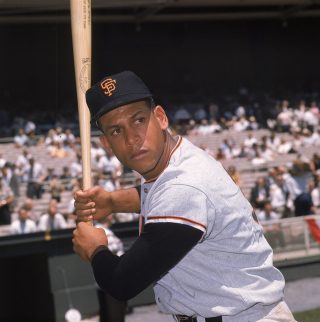
Orlando Cepeda

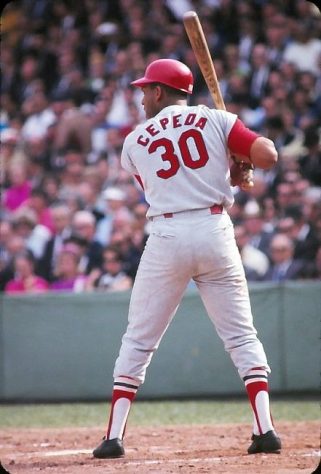
Cepeda was the Giants’ first San Francisco idol from the moment he emerged in 1958.

It took the late Hall of Famer Willie Mays more time than he deserved to become a San Francisco treat as a New York import. It took the now-late Hall of Famer Orlando Cepeda, who died Friday at 86, five minutes during the Giants’ first season by the Bay.

OK, that’s only a slight exaggeration. But having no tie to the Giants’ New York past, having a blast against the Dodgers in the Giants’ first San Francisco regular season game (a home run against Don Bessent with one out in the fifth), and posting a Rookie of the Year season with 25 bombs and a National League-leading 38 doubles, Cepeda became a Giants’ matinee idol at once.

It didn’t hurt that this son of Puerto Rican baseball legend Pedro (The Bull) Cepeda found San Francisco a treat from the word go, either. “Right from the beginning,” the Baby Bull would remember to Sports Illustrated‘s Ron Fimrite in 1991.

There was everything that I liked. We played more day games then, so I usually had at least two nights a week free. On Thursdays, I would always go to the Copacabana to hear the Latin music. On Sundays, after games, I’d go to the Jazz Workshop for the jam sessions. At the Blackhawk, I’d hear Miles Davis, John Coltrane . . . I roomed then with [outfielder] Felipe Alou and [pitcher] Rubén Gómez, but I was the only one who liked to go out at night. Felipe was very religious and quiet, and Rubén just liked to play golf, so he wasn’t a night person. But I was single, and I just loved that town.

Show me a ballplayer who loves a good jazz jam and I’ll show you my kind of ballplayer, folks. The only thing that would make my jazz heart go pitty-pat a little more would be discovering Cepeda in the Blackhawk audience on the April 1961 nights that produced the classic Miles Davis In Person Friday and Saturday Nights at the Blackhawk.

Imagining the smiling Cepeda at the Blackhawk raptly listening to a Davis quintet running the range from Miles’ modal classic “So What” to Thelonious Monk’s equally classic “Well, You Needn’t” and back to, say, Johnny Mercer’s “Autumn Leaves” or Miles’s own blues, “No Blues,” is an imagining worth securing.

The sole sore spot was Cepeda’s early tussle with fellow Giants comer/Hall of Famer Willie McCovey for playing time at first base. Cepeda won the early battles when McCovey, an equally likeable soul, struggled to find consistency, compelling Giants manager Bill Rigney to switch the pair off between left field and first base, a switchoff that didn’t always sit right with Cepeda.

“I know I could’ve played left field if I’d put my mind to it,” he’d remember to Fimrite, “but I was only 21 years old and very sensitive. Friends and other players kept telling me I should demand to play first. It was all pride with me. And ignorance.”

A 1961 knee injury left Cepeda to play in pain for most of the rest of his Giants tenure, but it didn’t stop him from leading the National League with 46 home runs and finishing second to Hall of Famer Frank Robinson in the league’s Most Valuable Player Award vote. Somehow, Cepeda would manage to post performances through age 26 that would make him a rival to Hall of Famers Jimmie Foxx and Lou Gehrig (and, retroactively, Hall of Famer in waiting Albert Pujols) for first basemen.

The knee pain was nothing compared to the psychic pain of playing for Rigney’s successor manager Alvin Dark. Dark was known too well to mistake Cepeda and his fellow Latinos’ effervescence for indifference, to say nothing of Dark despising their speaking Spanish among each other. The manager also thought Cepeda was exaggerating the extent to which his knee bothered him.

“Some people think that because we are Latins — because we did not have everything growing up — we are not supposed to get hurt,” he told another SI writer, Mark Mulvoy, in 1967. “But my knee was hurt. Dark thought I was trying not to play. He treated me like a child. I am a human being, whether I am blue or black or white or green. We Latins are different, but we are still human beings. Dark did not respect our differences.”

Dark’s successor, Herman Franks, suspected Cepeda of loafing in spring 1965 when in fact Cepeda found it difficult to put his full weight on the bothersome knee. He’d spend May through August on the disabled list, have surgery on the knee in the offseason, and lose the first base job to McCovey at last. In May 1966, after another spell in left field and despite hitting reasonably, Cepeda was traded to the Cardinals for pitcher Ray Sadecki.

Shocked at first, Cepeda welcomed the deal quickly when he made two discoveries. The Cardinals needed a first baseman in the worst way possible, and his new teammates plus manager Red Schoendienst took a quick liking to his upbeat personality and his equal loves for jazz and Latin music. They nicknamed him Cha-Cha; he returned the favour by nicknaming the 1967 Cardinals El Birdos.

Orlando Cepeda

He nicknamed his 1967 Cardinals El Birdos, and they went on to win that World Series while he won the NL’s MVP.

Well, now. El Birdos would go all the way to winning the World Series and Cha-Cha would go all the way to winning the NL’s MVP. Inexplicably, though there’s always the chance that his repaired right knee might still have tried to rebel, Cepeda went from first to worst of his career to date, sort of, in 1968. Hoping to make a 1969 comeback, he was dealt to the Braves for catcher/third baseman Joe Torre before spring training ended.

Leery about the South (he’d learned the hard way about Jim Crow as a minor leaguer in Virginia over a decade earlier), Cepeda relaxed when reunited with former Giants teammate Felipe Alou and making a new friendship with Hall of Famer Henry Aaron. His regular season was a struggle, but in the new divisional play format with the Braves winning the NL West, Cepeda hit a ton in a losing cause (1.448 OPS) as the Braves got swept in the best-of-five by the Miracle Mets.

He hit a ton in 1970 (34 bombs; .908 OPS) as the Braves fell to fifth place otherwise, but in 1971 his good knee gave out on him. He’d never be the player he once was again other than a surprise 1973 in which he became the Red Sox’s first official designated hitter. Released for youth in 1974, he tried a comeback in the Mexican League and a brief spell with the Royals before calling it a career at last.

Hall of Famer Roberto Clemente’s tragic death in 1972 led Puerto Rico to anoint Cepeda a hero, but in December 1975 his astonishing arrest for accepting a delivery of 170 pounds of marijuana (he claimed he was expecting a smaller amount, for himself) sent him from hero to poison. There wasn’t a jazz performance alive that could save him from that.

“He and his family received death threats,” observed his Society for American Baseball Research biographer Mark Armour. “He lost all of his money on his legal case, which caused him to miss child-support payments and led to more legal trouble. He finally stood trial in 1978, was found guilty, and was sentenced to five years in prison. He served ten months in a minimum-security facility in Florida.”

Cepeda struggled further after his release, losing a job as a White Sox minor-league hitting coach and his second marriage. Somehow, he took up Buddhism and there lay the key to changing his life permanently. “It allowed him to take responsibility for the mess he had made of his life,” Armour wrote, “to get control of his shame and his anger, and to help him find a path forward. He also met Mirian Ortiz, a Puerto Rican woman who eventually became his third wife. He and Mirian moved to the Bay Area, close to where his baseball journey had begun 30 years earlier.”

“Buddhism cleared the air for me,” Cepeda said. “I discovered that winter always turns to spring.”

In time, Cepeda re-established ties with the Giants, first with fantasy camps, then with scouting and roving instruction, and finally as a humanitarian ambassador. He was also elected to the Hall of Fame by the 1999 Veterans Committee, the second Puerto Rican (behind Clemente) to be elected, five years after he missed Baseball Writers Association of America election by seven votes in his final year of eligibility.

Shy of a decade later, Cepeda became the fourth Giant to be immortalised in bronze outside what’s now Oracle Park, joining Mays, McCovey, and Hall of Fame pitcher Juan Marichal, shown standing tall with his customary smile, wearing a first baseman’s mitt and holding a baseball inches from the webbing. It was a long, hard enough road for the man who’d had to use his Giants signing bonus to pay for his father’s funeral.

Let’s pray his widow and five sons find comfort in his eternal serenity in the Elysian Fields. And, that they can’t resist saying, “It figures,” if they discover one of the first things he did upon arrival was seek out a Miles Davis Quintet here, a John Coltrane Quartet there, a Mongo Santamaria group yonder, and engage the only swinging that ever engaged him above and beyond his own with a bat.