La Maquina, al finale?

Albert Pujols

That was last fall: Pujols tying Willie Mays on the all-time home run list. This is Mays’s 90th birthday, today: the Angels announced they designated the sadly-declined Pujols for assignment.

Late in February, Albert Pujols’s wife posted a social media message suggesting that, when his mammoth contract with the Angels expired after this season, so would her husband’s playing career. That option may not belong to him anymore.

The Angels jolted baseball when they announced Thursday that they designated the Hall of Famer in waiting for assignment. Once upon a time, timing was Pujols’s ally at the plate and beyond. Announcing the designation on Willie Mays’s 90th birthday, of all days, just made it sting that much more.

It had to. No less than Mays himself sent Pujols a text message last year saying, “It’s your time now. Go get it.” Meaning, go meet and pass Mays’s 660th lifetime home run. Pujols met 660 last September and passed it with 661 five days later. The Machine had six more bombs in him before the Angels finally gave up his ghost.

Let’s get this out of the way right now: Pujols didn’t ask to have maybe the most heartsickening, prolonged decline in the game’s history.

It wasn’t his idea to have a down season his first time out as an Angel. (Codicil: a down season for Pujols in 2012 was still a career year for more players than you can fit aboard two Dreamliners.) He didn’t ask for plantar faascitis in his heel the following year to begin a punishing series of lower half injuries that drained everything he had left.

ESPN writer Alden Gonzalez, who’s covered Pujols for most of his Angels life, saw up close and personal what Pujols put himself through in what we now know was a futile attempt to find the St. Louis smash buried somewhere inside what was left of him now.

“I’ll remember,” Alden says, “that even though his lower half was shot and he wasn’t quick enough to get around on the devastating stuff pitchers throw these days, he still showed up early, still spent hours in the training room to get ready for games, still took batting practice with intent, still crouched really low on defense and still looked for any opportunity to take an extra base. He might not have been productive, but it wasn’t for lack of effort.”

The stubborn, proud spirit was too willing, but the body was likewise too ready to tell him where to shove it at long enough last. No recent play was more emblematic than the ground ball he hit to the hole at shortstop but didn’t run out—because he couldn’t. He’d have been better off taking a skateboard out of the box up the line; he was thrown out on a lob across the infield before he was even halfway up the line.

The only tool Pujols’s body left alone was his still-devastating long ball power. Gonzalez’s ESPN colleague David Schoenfield is right to observe that’s not enough to stay aboard a major league roster. Not even though Pujols remained mostly as difficult to strike out as he always was. (His average per 162 games: 74; or, a single punchout every other game.)

But he’s all but quit taking walks; he rarely hits for extra bases beyond home runs; and, no matter how ironed up his will is, he hasn’t been the first base defender he once was for what seems eons. His Cardinals era was off the charts enough to keep his lifetime statistics showing him a plus first baseman by 95 runs saved above his league average. Fortunately.

Aside from what it did to him as a man, Pujols’s injury-instigated and perpetuated decline robs him of sitting atop the rest of the Hall of Fame’s post-World War II/post-integration/night-ball era first basemen according to my Real Batting Average. (Total bases + walks + intentional walks + sacrifice flies + hit by pitches, divided by total plate appearances.)

First Base PA TB BB IBB SF HBP RBA
Jim Thome 10313 4667 1747 173 74 69 .653
Jeff Bagwell 9431 4213 1401 155 102 128 .636
Albert Pujols 12486 5955 1334 313 115 111 .627
Willie McCovey 9692 4219 1345 260 70 69 .615
Harmon Killebrew 9833 4143 1559 160 77 48 .609
Orlando Cepeda 8698 3959 588 154 74 102 .561
Eddie Murray 12817 5397 1333 222 128 18 .554
Tony Perez 10861 4532 925 150 106 43 .526
HOF AVG .597

Had his career ended when his years with the Cardinals did, Pujols would have retired with a .708 RBA. Had he not been betrayed by his heels, feet, and most of the rest of his lower body as an Angel, he might still have finished with a higher RBA than Jim Thome did. And none of those Hall of Fame first basemen are as far above their league average for runs saved at the position as Pujols. (Eddie Murray’s +61 are 34 below Pujols.)

Pujols’s berth in Cooperstown is solely a question of when he retires as a player officially. No matter how sad his injury-instigated, protracted decline, he secured that in St. Louis to devastating effect. If the Angels don’t work a trade out now, and there’s no assurance they’d find a trading partner willing to part with viable talent in exchange for a ghost, there’s no guarantee another team would sign him for a pro-rated minimum salary as a free agent, either.

His longtime Cardinals manager Tony La Russa came out of his Hall of Fame retirement to take on the White Sox—but La Russa has already shown trouble handling today’s experimental rules as it is. No matter how much he still respects and loves Pujols, La Russa isn’t going to convince his bosses to take the ghost over young and establishing designated hitter Yermin Mercedes.

The DHs in Tiger uniforms are hitting this year at levels low enough to make Pujols continue resembling his Hall of Famer-to-be old self—but the Tigers have an aging incumbent themselves, named Miguel Cabrera. Hands up to anyone and everyone who thinks that even the current Tiger regime would hold with manager A.J. Hinch sending Cabrera to the pine in favour of Pujols now.

Purely in baseball terms, designating Pujols for assignment makes too much sense. Especially with Jared Walsh standing in for injured right fielder Dexter Fowler but far better suited to play first base. Especially with Shohei Ohtani more than capable of holding a DH slot on the days he doesn’t pitch. Pujols’s designation means the Angels don’t have to let Ohtani bat on his pitching days; they can save him for the final role Pujols can’t handle anymore.

But in human terms, this is a heartbreak. Especially for a man so community and charity oriented that you could believe the Angels well enough, even committing boilerplate, when owner Arte Moreno’s formal statement praised Pujols in character terms, as a man whose “historical accomplishments, both on and off the field, serve as an inspiration to athletes everywhere, and his actions define what it means to be a true superstar.”

If only the announcement didn’t have to happen on the 90th birthday of Mays, a man Pujols respects and maybe even loves almost as much as he loved and respected St. Louis icon Stan Musial. This may have been the worst case of bad timing in baseball since . . .

Maybe since Brad Lidge’s bad timing hanging Pujols a breaking ball to demolish for a National League Championship Series Game Five-tying three-run homer in 2005. Or, the bad timing of Rangers relievers Alexi Ogando, Mike Gonzalez, and Darren Oliver gifting Pujols three meatballs to destroy beginning in the top of the sixth in Game Three, 2011 World Series.

When Hall of Fame pitcher Tom Seaver was traded to the Reds from the Mets, following contract extension talks that went from difficult to scurrilous thanks to Mets management and certain sports columnists smearing him, A. Bartlett Giamatti—then president of Yale University, as opposed to his eventual higher calling as a baseball commissioner—wrote in Harper’s, “[A]mong all the men who play baseball there is, very occasionally, a man of such qualities of heart and mind and body that he transcends even the great and glorious game, and that such a man is to be cherished, not sold.”

If Giamatti had lived to see Pujols, he might have thought likewise, ending with “such a man is to be cherished, period.” Pujols wasn’t sold, but half his body sold him out. Whether you called him El Hombre (the nickname he hated, insisting there was only one Man and his name was Musial) or The Machine (La Maquina in his language), he didn’t deserve having his gears stripped into a long, painful, sad decline.
Appreciating Willie, at 90 and beyond

Willie Mays

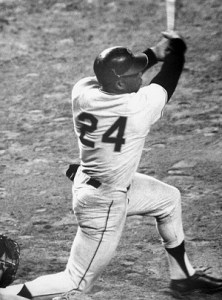
Willie Mays hits his 500th career home run in the Houston Astrodome, 1965.

I started watching baseball in earnest with the 1961 World Series, when I was pushing six, and the almighty Yankees faced the almost all-surprising Reds and beat them in five. Something about the game put a vise grip upon me that hasn’t let go in the years and over the changes good and bad since.

The Reds’ Frank Robinson was named the National League’s Most Valuable Player for 1961. Willie Mays finished sixth. As I would learn in due course, Robinson won the award as much because he had an MVP-type season as because he played on a pennant winner, but there were better MVP cases in the 1961 National League by Mays and fellow Hall of Famer Hank Aaron.

Then they finished inventing the Mets. I was no longer stuck with having to think purely about the Yankees in New York, since the National League was coming back into business there. (Assorted family members, especially my maternal grandfather, began telling me about the former exploits of the Dodgers and the Giants.)

And I’d get to see Willie Mays, even if on television alone. His Giants came to play my embryonic Mets in their former cavern, a big, horseshoe-shaped, rambling wreck of a ballpark known as the Polo Grounds. They played against each other there nine times in 1962. The Giants didn’t visit their former home until 1 June, but it certainly felt like a visit to the old neighbourhood—they swept the Mets in four.

I got to see the first of those four. Mays came exactly as advertised, playing center field as though he were part of a track meet; hitting a home run off future Giants manager Roger Craig the other way in the fifth, about 390 feet from the plate and into the right field seats; taking third from first on a seventh-inning single by another future Giants manager, Felipe Alou.

The bad news is that even a Willie Mays who leaves magnificent first impressions just warming himself up in the on deck circle can have days where someone else makes bigger impressions in the game. Fellow Hall of Famer Willie McCovey hit two bombs for the price of one Mays mash. And even McCovey didn’t steal the day’s headlines.

That theft belonged to Jim Davenport, a left-side infielder who wasn’t quite that serious a plate threat, squareing off against Mets reliever Willard Hunter two batters after Mays scored, with the bases loaded and one out. Davenport hit one not too far short of where Mays’s bomb landed in the right field seats.

It made the score 9-1, the Mets’ lone run to that point courtesy of Rod Kanehl hitting Giants starter Billy Pierce for a leadoff jack into the left field seats. The Mets managed to chase Pierce in the eighth with an RBI double (Charlie Neal) and a two-run single (Frank Thomas) back to back, before Felix (Wrong Way) Mantilla greeted Giants reliever Bobby Bolin rather rudely with a two-run homer.

That was the last of the day’s scoring. I’m reasonably certain that that was not the game during which Mets manager Casey Stengel visited Craig at the mound with McCovey due to hit and asked, “How do you want to pitch him—upper deck or lower deck?”

The Giants banked the 9-6 win. I didn’t get to watch the next three games, alas. Perhaps just as well, since the Giants outscored the Mets over those three games 22-6, including a doubleheader in which the scoring difference was 16-6, Giants.

Mays had himself a grand time playing baseball in New York for the first time since the Giants went west four years earlier. In game one of that doubleheader he opened with an RBI single and a run scored on a sacrifice fly in the first and continued with a two-run homer in the second, though somehow the Mets kept him quiet in the nightcap.

Then, he had one more homecoming message to deliver in the fourth game of the series, taking one of the Mets’ two Bob Millers (the righthanded one) into the left field seats with one out in the sixth.

The Giants met the Mets nine times in New York in 1962 and beat them seven times. Mays had himself an .851 OPS during those nine games. He was a lot more rude a house guest of the National League’s other newborn team in 1962, the Houston Colt .45s: despite Colt Stadium being a whole pitcher’s park, Mays battered the Colts for a 1.214 OPS in 1962.

Mays was 31 years old in 1962. But he still played as though still ten years younger. He had that stance with his feet about half a foot forward and aft of home plate, the stride starting his swing where you saw his front foot step forward about another full foot plus, swinging down and across his midsection, not extending his muscular forearms until a split second before contact, the bat sweeping a little up going around.

The stride and swing that delivered 3,283 Show hits including 523 Show doubles and 660 Show home runs, and leaves open for question even now how many of his 140 Show triples came mostly from his bat or from his legs, considering how relentless a baserunner he really was.

“Willie had great instincts on the bases and he was always aggressive,” Pete Rose has said of him. “I was an aggressive baserunner also. I developed my baserunning skills watching Willie Mays play.” An interesting recollection, that—Mays took extra bases on followup hits 63 percent of the time he reached base, meaning he took more than one base on such a hit. Rose did it 49 percent of the time.

“[O]n a single, it would have been strange if he didn’t go first to third,” Rose’s teammate, Hall of Famer Johnny Bench has said. “He had one of the best turns rounding second or third you could possibly have. With his agility, he made the most perfect turns.”

Mays’s legs did as much for him playing center field as they did on the bases. He thought nothing of starting in as shallow a positioning as he could get away with before reading, hunting down, and snaring a drive. “Curt Flood was the best I’ve ever seen against the wall. He was better than Willie against the wall,” Flood’s Cardinals teammate Tim McCarver has said. “But Curt played deep. Willie didn’t play deep; he played shallow. Willie never went to the wall. Willie was the wall.”

Hall of Fame pitcher Bob Feller had a dugout seat with the rest of the Indians during the 1954 World Series, including and especially for the catch for which Mays remains remembered singularly, the run to the absolute rear of the Polo Grounds’ right center field, some 460 feet from the plate, to haul down Vic Wertz’s drive.

To everyone else in the house—including a writer named Arnold Hano, sitting in the bleachers and writing A Day in the Bleachers about that game and that play—the play seemed God’s next to last miracle. (My last miracle, said George Burns as God in a 1977 film, was the 1969 Mets.)

“That really wasn’t that great of a catch,” the curmudgeonly Feller once said. And why? “As soon as it was hit, everyone on our bench knew that he was going to catch it . . . because he is Willie Mays.”

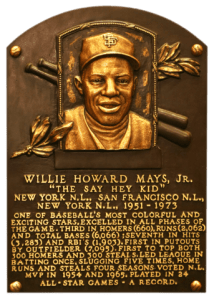
Willie Mays Hall of Fame

Wouldn’t you love to know even now just whom the meatheads were that denied Mays first-ballot Hall enshrinement?

When Ted Williams was inducted into the Hall of Fame in 1966, he name-checked Mays respectfully. “The other day Willie Mays hit his five hundred and twenty-second home run,” said Teddy Ballgame himself. “He has gone past me, and he’s pushing, and I say to him, ‘go get ‘em Willie’.” Willie went and got 138 more of ’em before his life as a player finally ended.

For me it was baseball fortune to get to see the better of Willie Mays even in his thirties, even if he was on the road team or I had to wait for one of the Giants’ turns on the old national network Game of the Week telecasts. It was worth the wait to see him square off against such Hall of Famers as Sandy Koufax, Bob Gibson, Don Drysdale, the aging Warren Spahn, the young Tom Seaver, the young Steve Carlton.

You might care to note that Mays faced Spahn more than he faced any pitcher, Hall of Famer or otherwise, and had ownership papers on the lefthander who owned a nasty screwball and was a bit of a screwball himself. According to Stathead, Mays faced Spahn 253 times, hitting eighteen home runs among 68 hits, with a slash line pretty close to his overall career slash: .305/.368/.587, and a .955 OPS.

His first major league hit was a home run off me,” Spahn said often enough, “and I’ll never forgive myself. We might have gotten rid of Willie forever if I’d only struck him out.”

Drysdale might have told Spahn, “Why the hell didn’t you strike him out?” Mays faced Drysdale 243 times and, while he hit a measly thirteen bombs off the Dodgers righthander, the slash line is .330/.374/.604. The OPS is .978. Why the hell indeed.

Having learned more than a shard of baseball history by age 16, and having seen more than enough of Mays even as a road player to know that I was watching greatness that belonged not of this world but about five dimensions beyond it, it was easy to feel a little New York sentimentality when the Giants—entering a somewhat testy reconstruction and no longer able to afford carrying aging players, not even Hall of Famers—sold Mays to the Mets to let him finish where he began.

He only looked resplendent in the Mets’ fatigues, under the blue hat that brandished the same orange interlocked NY which once crowned Mays’s forehead on the old black Giants hat. Sunday, 14 May 1972, was my mother’s 42nd birthday; she was a year older than Mays. The date was also Mays’s first game as a Met.

The Mets took an early four-run lead thanks to Rusty Staub’s first-inning grand salami off erstwhile Indians howitzer Sudden Sam McDowell. The Giants tied the game with a four-run fifth. Leading off the bottom of the fifth came Mays, who’d been 0-1 with a walk and a strikeout when he checked in against Giants reliever Don Carrithers.

Mays hit one about 400 feet over the left field fence to bring the Shea Stadium house to a boil of delight. The fan’s heart prayed it might be an unlikely revival; the analyst’s head knew in its heart that it was only a question of when, not if we’d have to imagine baseball games played somewhere without Mays playing in one of them.

The greats don’t always go gently into that good gray night when they can no longer play the games that made their names. This son of an Alabama industrial league ballplayer  fought a small war in his soul when his age insisted he was no longer able to play the game he loved so dearly at the level on which he’d played it for so many years. Some said he’d become sullen, moody, dismissive in the clubhouse. Some resented him, others felt for him, still others mourned.

The smiles may have become rare now but when they came he still looked like the Say Hey Kid. But, yes, you can look it up: Mays never said, “Say hey!” His early habit of starting greetings to people with “Hey . . . ” inspired beat writers covering the Giants to tab him the Say Hey Kid.)

When he smiled as a Met, you still saw him in his youth, you didn’t see the manchild who was yanked rudely into manhood by a San Francisco that shocked him with skepticism as a New York import rather than a hero of their own. By a San Francisco that also shocked him, for all its reputation otherwise, when his bid to buy a home with his first wife was obstructed long enough by the sting of neighbourhood racism.

But when he accepted the now-inevitable, you cried the tears he fought to suppress when the Mets gave him a Willie Mays Night, 25 September 1973, and he addressed the Shea Stadium throng and his pennant-aspiring teammates alike, when Mets announcer Lindsey Nelson beckoned him to a microphone:

I hope that with my farewell tonight, you will understand what I’m going through right now. Something that—I never feel that I would ever quit baseball. But as you know, there always comes a time for someone to get out. And I look at the kids over here [pointing toward his Mets teammates], the way they are playing, and the way they are fighting for themselves, tells me one thing: Willie, say goodbye to America.

The game couldn’t possibly love Mays back as deeply as he loved the game, but it did its best with what it had. Today Mays celebrates his 90th birthday as the oldest living Hall of Famer, and someone like me who was there for enough of his best on the field and at the plate wishes almost as much as he must at times that we could take him back to one more day in the prime of his youth and turn him loose.

This sexagenarian and a half who saw more of him than he had a right to expect would love to shake his hand and say thank you for the honour of watching him play the game the way he played, but the fear is that “thank you” would be insufficient.

We’d love to remove the glaucoma that’s caused him to stop driving and playing golf, and take him back eyes wide open to make one more rambling catch in the depth of the Polo Grounds or in the eye of the Candlestick Park hurricane. We’d love to take him back to the day he won a second National League Most Valuable Player award eleven years after he won his first; we’d love to show him the record and get him at least two or three other MVPs he should have won.

We’d love to take him back to hit one more bomb off the Warren Spahn who only thought we’d have gotten rid of Mays if Spahn had only struck him out; to have his way with Spahn, Drysdale, fellow Hall of Famer Robin Roberts, and others; to let him have one more crack at the Bob Gibson who more or less owned him in comparison; to let him have, especially, one more chance in the single most transcendent one-on-one battle between pitcher and hitter you could ever hope to see, Willie Mays facing Sandy Koufax.

We’d also love to bring back his beloved Mae Louise, his second wife, who wept with him that farewell night at Shea Stadium, and whose eventual suffering with Alzheimer’s her loving husband didn’t allow to stop him from tending her, caring for her, loving her until she died a little over eight years ago.

But all we can do is say “Happy birthday, Willie, and here’s to many more,” we Americans who’ve never really said goodbye to the man who transcended the game we’ve loved, and who have no known inclination to do so. America without Willie Mays would feel like England without the Beatles: anything except themselves anymore.

On self-appointed Yankee security censors

Yankee Stadium

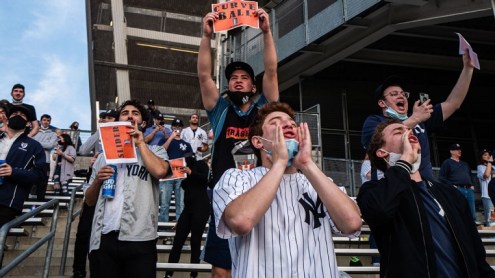
Yankee fans let the Astros have it Tuesday night. Did stadium security eject some protesting fans under false pretenses?

The worst kept secret in baseball opening this week was Yankee fans liable to let the visiting Astros have it, but good, when they visited Yankee Stadium for the first time since the 2019 American League Championship Series. The second-worst thing about that worst-kept secret was Yankee Stadium censorship.

The first-worst thing was this not-so-little red flag raised in the account by Sports Illustrated writer Stephanie Apstein, about a fan costumed like Oscar the Grouch in a trash can, and who only thought he’d gotten assurance from stadium personnel that there’d be no issue with him wearing it at Tuesday’s game:

When [David Taub] arrived wearing the costume and carrying a sign reading YOU AIN’T STEALING THIS COSTUME TRASHTROS, he drew laughs and cameras. Unfortunately, he also drew attention from security. “Our policy changed,” he said the guard told him. He said the guard added that the Astros had complained to MLB about fans in other cities, and MLB had told the Yankees to tighten their rules. (Officials from the Astros and the commissioner’s office said they were unaware of any such complaints or directives.)

Censorship at Yankee Stadium isn’t exactly virgin territory. Ask any frustrated Yankee fan present in the 1980s who had an anti-Boss placard or sheet banner confiscated under George Steinbrenner’s orders. Or, such frustrated Yankee fans who had their placards and banners confiscated before they were ejected from the stadium themselves.

Ask especially the Yankee fan who won a Banner Day contest by wearing the garb of a monk and carrying a Grim Reaper’s scepter from the scythe of which hung a large placard pleading, “Forgive him, Father, for he knows not what he does.”

If Yankee Stadium personnel purging David Taub for a non-destructive demonstration against Astrogate and its most questionable net result (no players disciplined in return for spilling about the scheme) is bad enough, what would you suggest we call the possibility that stadium security lied through their teeth while censoring him and other fans?

“I hope the Yankees fans smell blood tonight,” Taub told a reporter. “I hope we don’t do anything irresponsible, but I hope we give our shares of boos and let them hear it. We definitely got robbed of a World Series. There’s no question about that.”

Other fans brought inflatable trash cans to the park, similar to the one that fell onto the right field warning track at Angel Stadium when the Astros played a set there last month. Two of them were confiscated by stadium security, too.

Apparently, Astros manager Dusty Baker is a little more sanguine and a lot less censorious about the reception he knows his team can expect when they’re on the road this year. “It sounded like a packed house tonight even though it wasn’t,” he told reporters after the Yankees trashed the Astros, 7-3. “We kind of expected that reception. We’ll probably get more of that tomorrow and the next day.”

“I wouldn’t want to be on the other side of that,” said Yankee outfielder Giancarlo Stanton of the fans’ night-long booing, catcalling, and occasional swearing (F– Altuve! F–Altuve!) after the game. “They brought some heavy.” (And, a lot of funny, including a placard depicting Altuve the Grouch in a somewhat battered metal trash can.)

Stadium security brought heavier. This was a look no better than that ancient Banner Day ejection.

Last year’s pan-damn-ically inspired, cutout-occupied stands kept legions of fans from letting the Astros know just how they felt about the Astro Intelligence Agency’s singular take on sign stealing. Unless they bought cutouts showing imagery against it, there was little they could do other than whoop, holler, and catcall if they saw the Astro team bus pulling up to the ballpark.

But fans are back at the ballparks now to whatever limited extent continuing safety protocols allow. Unless their racket includes true violence, or throwing debris on the field (as a few reckless Angel fans did throwing a real, not inflatable trash can onto the right field warning track), or attacking Astro players or personnel physically, Yankee Stadium’s security was way out of line.

Whether they like it or not, the right to protest comes with the purchase of a ticket. Fans can boo truly bad plays, truly bad plate appearances, truly bad umpiring to their hearts’ content. They can even boo visiting teams verified for all time as barely-apologetic illegal  high-tech cheaters.

Even if their own team got caught trying a little high-tech hijacking once upon a time? Not so fast. The Yankees got caught only with someone in the dugout using an AppleWatch to steal signs. They weren’t accused of or proven to have either a) altered an existing camera off its mandatory eight-second transmission delay, or b) installed another, illegal, real-time camera to steal signs.

Realistically, the Yankee fans made one mistake that everyone else continues to make. There are only five actual Astrogate team members left on this year’s edition: Altuve, Alex Bregman, Carlos Correa, Yuli Gurriel, and Lance McCullers. Chanting “Mother Tucker!” at hapless outfielder Kyle Tucker isn’t fair to a guy who wasn’t even there to be part of the 2017-18 can can.

Unfortunately, if it isn’t fair to hold the entire 2021 Astro roster responsible for what the 2017-18 edition did, it’s also unlikely that the Astros will be done hearing the protests until the last man standing from the Astrogate team doesn’t wear their uniform any longer.

Not every security force in every ballpark practises fan censorship at all. Never mind claiming the visiting team complained to baseball’s government and baseball’s government told the home team “to tighten their rules.” I suspect Apstein meant that to mean, “to quash the anti-Astrogate protests.”

The Astros have had enough bad looks since Astrogate’s exposure and official consequences. Would they really be stupid enough to compel baseball government to strong-arm road teams into censoring road fans bent on letting them have it over a script they and nobody else wrote in the first place?

It was one thing when the worst Yankee fans rained nasty upon Astros pitcher Zack Greinke during the 2019 ALCS—based on Greinke’s very well known battle with clinical depression. Those fans were ejected properly for assaulting a human being verbally over an illness for which he takes prescribed medication and through which he works and lives with courage his assailants probably lacked.

Ejecting fans protesting a team’s well-exposed and (in more ways than one) institutionalised cheating? That demands a formal MLB investigation. Post haste. No waiting. The Yankees themselves should have no issue with cooperating. If they do, they should be sanctioned heavily.

The House That Ruthless Built isn’t private property. The ballpark’s official ownership is listed as the New York Industrial Development Agency, a subsidiary of the city’s Economic Development Corporation whose board is appointed by the city’s mayor. Government or government-overseen agencies at any level, from the village up to the nation, have no business trucking with or allowing censorship.

If Yankee Stadium security people spoke out of line while confiscating Yankee fans’ properties and/or ejecting them from the stadium, because they took it upon themselves to neutralise or silence Astrogate protests, they need to be held accountable. Strictly.

Lindor’s April shudders

Francisco Lindor

He’s his usual high-flying self at shortstop, but Francisco Lindor seems pressing too hard at the plate. So far.

It’s not even close to a new story, and it won’t be the last time you hear or see it. Star player signs gigabucks deal and presses out of the season gate to have first month about which “terrible” gets applied liberally. Anywhere else it might be merely alarming. But New York isn’t anywhere else, alas.

You’d think the watchword of the New York sports fan is, “To err is human, to forgive is not New York policy.” They’re not going to sink—yet—to the reputed depths of Philadelphia fans who inspire such gags as the Philly wedding clergyman pronouncing a newlywed couple husband and wife before telling new husband and gathering alike, “You may now boo the bride.”

New York fans have their own expectations and demands, evidence and actualities be damned, even if they’re not going to go Philadelphia just yet. (Or are they?)

Yankee fans, of course, have the patience of a barracuda whose three squares of the day are delayed; to them, anything less than an annual World Series ring is treason. When the Yankees lose it’s God’s will, somebody else’s fault, or time to throw out the first manager of the season. And that’s with George Steinbrenner gone to the Elysian Fields for over a decade.

Who’d have thought they’d see the day when Yankee fans make The Boss resemble Job? Who’d have thought another Steinbrenner (Hal) would epitomise calm seas compared to (a favourite phrase of his father’s) the fannies in the seats?

Met fans are a little more patient. It’s in their DNA. The team was born making edgy comedy while finishing below the basement. They’ve won a few pennants and a couple of World Series, experienced times troubled enough to make the Black Plague resemble the Paisley Underground, watched excellent teams collapse, and survived team overseers and administrations that could be tried in court for premeditated malfeasance.

But even the most patient, good-humoured Met fan has limits.

It’s one thing for the Citi Field boo birds to beat their wings and squawk every time Jacob deGrom pitches knowing there’s no jury on earth who’d rule against him if he files non-support papers on his mates—or entertains even microscopic thoughts of post-game manslaughter.

They’re watching virtuoso pitching on behalf of a team whose bats are so inexplicably paralysed on his game days deGrom himself has to think about delivering base hits (the outlier has six in thirteen plate appearances) and even runs batted in (he has two), when he checks in at the plate and sees the unlikely presence of a man on base ahead of him.

Come to think of it, Met fans are probably unsure what to make of a segment almost as bright so far as deGrom is virtuosic continously: the bullpen that once caused seven-eighths of New York to consider filing arson charges. The five main bulls—Edwin Diaz, Miguel Castro, Trevor May, Jeurys Familia, and Aaron Loup—have a combined 1.46 ERA/1/49 fielding-independent pitching rate in 41 collective gigs over which they’ve surrendered a mere (count them!) seven earned runs.

Right now, they’ll cheer and holler wildly for that livestock. Let those April showers turn into Mayhem, however, and Met fans will treat that cattle like burnt meatloaf almost in the same time it takes to snap their fingers for the waiter.

The bad news is that Mets bats not belonging to Pete Alonso (.837 OPS), Brandon Nimmo (.870 OPS), and J.D. Davis (1.089 OPS) are a stalled production line. None is singled out more for his season-opening plate futility than a freshly-minted import shortstop.

Getting used to deGrom pitching like a Hall of Famer with his mates hitting like Hall of Shamers in his starts is one thing. But flapping and squawking over Francisco Lindor is something else entirely. They didn’t quite bargain on SuperLindor showing up with only half his A-game calibrated for the new season.

Let’s get the contract business out of the way first. Lindor wouldn’t be the first gigabucks player to sign his first serious big-bucks deal and press it at the plate trying too hard to live up to it. If you want a single example, hark back to Hall of Famer Mike Schmidt. He signed his first big multi-year deal starting in 1978—and had a rather down season at the plate to start that term.

The most cynical of the most cynical Phillies fans dismissed Schmidt as dogging it. Those who paid the closest attention to him knew he was only too anxious to live up to the new deal’s notices and implications. Even if he did win one of his ten Gold Gloves that year. The following year, Schmidt hit like his usual self again (40+ home runs, 210+ runs produced, etc.), led the National League in walks, and made one of his twelve All-Star teams.

For all his pressing at the plate now, Lindor’s still an above-plus study at shortstop. He’s still helping save runs with the leather, legs, and arm. He still has a fielding average 22 points above the rest of the league’s shortstops, and his range factors are still about 30-35 points above the rest. He’s also turned fourteen double plays thus far, well enough on pace to get near his career average 72.

He’s also picking it up when it comes to ducking the strikeout at the plate. Now, I don’t go as nutshit as too many others seeing high strikeout totals, if only because I’d rather see a batter strike out than whack into a double play, but Lindor’s striking out only 11 percent of the time he’s at the plate . . . and taking walks 11 percent of the time. The strikeout rate is lower than his career percentage; the walk rate, higher.

Lindor’s been hitting about as many ground balls as fly balls and that may equal hard batting luck, since he’s not hitting too many weak balls so far. When he does reach base, so far he’s taking extra bases on followup hits 88 percent of the time—his career such average is 47 percent, which is more than just a good rate.

Joe and Jane Fan forget something about baseball players. Allow me to remind you: They’re not automatons or holograms, they’re human beings. No two of them are alike entirely. For every Mike Trout or Mookie Betts who lives up to the implied mandate of a new gigabucks deal right out of the proverbial chute, there’ll be ten struggling powerfully to live up to such deals at the outset or even through the first full season after they sign them.

“It’s interesting and it’s funny, and it sucks,” the usually ebullient shortstop told reporters on a conference call last week. “It doesn’t feel right, for sure. Interesting because it’s the first time that it happened in my career. And funny because I’m getting booed and people think I’m going to go home and just think, oh, why am I getting booed? I get it. They’re booing because there’s no results. That’s it.”

Derek Jeter would empathise. He was as close to a Yankee god as you could get and ended up in the Hall of Fame. But even he took it on the nose and in the brain on the bad days and nights. “I don’t blame them. We would have booed ourselves tonight,” he often said after such games. Jeter understood only too well how quickly a ballplayer might go from hero to villain—sometimes before 24 hours passed.

Don’t kid yourself that it doesn’t really sting. Lindor’s learning fast enough: Come up short as far as New York Fan is concerned and you’re the worst thing to hit town since the November 1965 power blackout. Come up long, you’ll find fewer places more ready to shower you with their love, affection, keys to the city, and maybe first born children, too.

If the right to boo, hiss, catcall, hang snarky banners, or flood Twitter indignantly comes with the price of a ticket to the ballpark, there’s an implicit correlation that says you don’t really know whether a player is just dogging it or is driving himself to nineteen nervous breakdowns trying to deliver.

The appropriate answer when Joe or Jane Fan huffs, “For x hundred bazillion dollars I could hit the you-know-what out of that slop,” is to reply, “If you could, you’d have been there instead.”

“I can’t hit like Vada Pinson,” said a social media baseball group member discussing the old Reds outfielder, “but he can’t make strawberry shortcake like me.” Lucky him. By age fifteen I couldn’t even hit like Strawberry Shortcake. I made a major leaguer with a paltry .200 hitting average and a mere .300 Real Batting Average (RBA) resemble Mike Trout.

A shortstop with a .537 lifetime RBA (once again: total bases + walks + intentional walks + sacrifice flies + hit by pitches, divided by total plate appearances) might also suggest that if one must endure a slump for any reason, it’s better to slump in April than down the stretch of a pennant race.

New York Fan still needs to be reminded that pennant races won in April and May are the exceptions, not the rules, outside a closet full of Yankee pennants in the last century plus the 1986 Mets. That one player won’t make or break a pennant except in very extraordinary conditions. Not even if he signs for nine figures over the ten years to follow this one.

No, Roberto Alomar wasn’t Pete Rosed

Roberto Alomar

Roberto Alomar’s new baseball ineligibility doesn’t mean a backdoor pass into Cooperstown for Charlie Hustler.

Let’s get this out of the way first and foremost, since (it almost figures) at least a few social media tweeters raised it. Hall of Fame second baseman Roberto Alomar’s fresh ineligibility to work in baseball doesn’t mean Pete Rose suddenly gets a pass to stand for Hall of Fame election.

The news broke Friday that Alomar—working as an advisor to baseball’s government and a Blue Jays special assistant concurrently—is now on baseball’s ineligible list over sexual misconduct said to have occurred in 2014, at the sad expense of a baseball industry employee. He’d been elected to Cooperstown on his second try in 2011.

“Roberto Alomar got Pete Rose’d today,” tweeted Ice Cat Sports Cards, from South Dakota. “If Roberto Alomar is on the Ineligible list,” asked a tweet by someone handling himself ElScorcho, “how can he stay in the Hall of Fame? I mean that says Pete Rose should be in right?”

Wrong.

Specific details of Alomar’s sexual misconduct aren’t disclosed as I write. But it happened three years after he was elected and inducted into the Hall of Fame. (To its credit, the commissioner’s office engaged an independent law firm to investigate.) If he’d committed the misconduct that now has him purged before 2011, Alomar wouldn’t have even been on the ballot, never mind elected.

Rose violated Rule 21(d) before he would have made his first Hall ballot. The very likelihood that he might be elected despite his ban prompted the Hall to rule: if you’re ineligible to associate with organised baseball, you’re not eligible to appear on a ballot conferring the game’s highest honour.

No, ladies and gentlemen, Roberto Alomar did not get Pete Rosed on Friday. Any drumbeating for shoving Rose into the Hall of Fame on the basis of Alomar’s banishment is factual and moral idiocy. So don’t even think about hammering the Hall of Fame for refusing to purge Alomar.

“When he was elected to the Hall of Fame by the Baseball Writers’ Association of America in the Class of 2011, Alomar was an eligible candidate in good standing,” the Hall said in a formal Friday statement. “His plaque will remain on display in the Hall of Fame in recognition of his accomplishments in the game, and his enshrinement reflects his eligibility and the perspective of the [Baseball Writers Association of America] voters at that time.”

Alomar isn’t the first to land on baseball’s permanently ineligible list over sexual misconduct or its concurrent behaviours. Former Astros assistant general manager Brandon Taubman got there for crowing he was so [fornicating] glad they obtained relief pitcher Roberto Osuna while Osuna was still under investigation for domestic abuse. A rant delivered in the presence of three female reporters in the Astro clubhouse after they won the 2019 American League Championship Series.

The persona non grata list also includes one-time Cardinals scouting director Chris Correa, thanks to his being caught red-handed hacking into the Astros’ databases. It also includes former Braves general manager John Coppolella, after he inflated or deflated signing bonuses for Dominican prospects to maneuver around baseball’s international signing rules.

Maybe the BBWAA will fume over the Hall of Fame refusing to purge Alomar. But at least  one member might advise not so fast. “I don’t disagree with the Hall’s more measured response,” wrote Toronto Star columnist Rosie DiMinno Friday, after commissioner Rob Manfred announced the Alomar termination and purge.

It would be insupportable to retroactively banish someone from Cooperstown when egregious conduct comes to light. Just imagine going backwards in time and stripping a player of that specific honour, a summation of career brilliance, for behaviour which is now recognized as reprehensible but wasn’t then. So many scoundrels are in the Hall and, at least figuratively, their statues would have to be toppled.

Please don’t ask which such scoundrels not named Cap Anson and Kenesaw Mountain Landis would be removed from the Hall right now. You won’t like a lot of the answers. They might or might not only begin with Babe Ruth.

Lisa Banks, the attorney for the unnamed woman at the center of the Alomar purge, sent a statement out as well. Quoted by DiManno, Banks said, “We applaud MLB for having this matter thoroughly investigated and for taking meaningful action against Mr. Alomar . . . My client has no plans to file a lawsuit or take further action. She has not exposed Mr. Alomar’s behaviour for notoriety or for money and looks forward to moving on with her life. She simply wants to ensure that Mr. Alomar is held accountable.”

But DiManno goes forward saying that while baseball has a perfect right to purge someone over particular misbehaviours, since being in professional baseball is not an absolute right but an absolute privilege, something about the Alomar case isn’t quite passing the proverbial smell test yet.

. . . I don’t know what Alomar is alleged to have done and Manfred isn’t telling. I do know that some accusations, when exposed in a court of law, criminal or civil, do not rise to the threshold of conviction. And nowhere have I seen a claim that Alomar’s conduct was criminal. It might or might not pass the sniff test of a human rights complaint. It clearly did not pass scrutiny of the MLB investigation — conducted independently by an external legal firm . . .

I wish there were more details disclosed about the alleged incident, which surely could have been done without identifying the complainant . . . I’ve covered enough legal proceedings on this subject to understand that a great deal of nuance separates accusation from even the lower bar of civil action proof. The vacuum of information leaves a worrisome gap for warranting so ham-fisted a decision.

And that, she continues, “comes from someone who was once called a [fornicating (four-letter euphemism for ‘vagina’ starting with ‘c’)] by a player in the Jays clubhouse; who, on another occasion, had a player simulate pelvis thrusting from the rear while I was bending over to conduct an interview with another player at his stall. These were not incidents I reported to the club or to my employer. I’m just not that delicate a flower.”

The Blue Jays will disappear Alomar’s presence promptly enough, the team has said, including pulling his commemorative banner down from Rogers Centre and removing him from its Level of Excellence. The Jays also said in their own statement they’re committed to an environment of respect for everyone in their organisation, applauding concurrently the unnamed woman who stepped forward in the first place.

This is not a pleasant denouement for the man who hit what DiMinno says remains, arguably, the single most important home run in Blue Jays history. That would be the Game Four-tying two-run homer off Hall of Famer Dennis Eckersley in the top of the ninth, finishing a comeback from a five-run deficit, pushing the Jays to the eleven-inning win that gave them a 3-1 American League Championship Series advantage in 1992. En route their first World Series conquest.

I’m not entirely convinced that launch compares to Joe Carter’s World Series-winning three-run bomb in 1993. But you can’t convince me Alomar’s blast off Dennis the Menace wasn’t just as important in Jays history. “Emotional bonds are difficult to sever,” DiManno opened. “Historical facts can’t be expunged.”

Neither can a Hall of Famer eligible for election and getting elected well enough before the acts that got him banished from baseball eligibility. Alomar’s behaviour as a three-year Hall incumbent is terrible enough, without using it to argue Rose into the Hall when Rose’s rule breaking got him blocked before he was eligible for a Cooperstown ballot at all.