That new old fashioned medicated goo

Trevor Bauer

Trevor Bauer doesn’t like being singled out for medicating his pitches.

Good golly Polly shame on you
Cause Molly made a stew that’ll make a new girl out of you
So follow me, it’s good for you
That good ole fashion medicated goo
Steve Winwood, Jimmy Miller (for Traffic)

Ahhhhhhhhhhh, this is more like it, you can hear more than a few people thinking. Just like the Good Old Days. The Good Old Days in question here being the days when more than a few pitchers were suspected of putting more on their pitches than just their fingers.

The kind of potential cheating scandal that inspires wink-winks, nudge-nudges, not pontificating protest and near-universal outrage. The kind involving whether one of baseball’s more (shall we say) outspoken pitchers is giving the (shall we say) treatment to his pitches, thus to the batters, and maybe to the game itself.

Trevor Bauer has a few reputations, from misogynistic all the way back to the nutty professor. Now the Show’s government would love to know whether Bauer also deserves a reputation as a genuine throwback—to the lives and times when pitchers looked for every last edge they could get including but not limited to whatever they could think of to put on the ball, blissfully uncaring about breaking the law.

From publicly pondering since 2018 how often (not whether) pitchers are mixing up some new old fashioned medicated goo to get (hee hee) better grips on the balls, Bauer himself is now suspect. When he started for the Dodgers against the Athletics this week, umpires collected a fair number of balls he’d thrown that were claimed to be sticky and scuffy. How many depends upon whom you read on the subject.

Last month MLB sent its teams a pair of memos saying, essentially, “We’ve got our eyes on your balls.” None of that sneaky stuff. Keep the strange brews to yourselves. The season’s barely past a week old, and Bauer has already provided a crash course in pitch paranoia.

Not to mention a few arched brows, not because of whether Bauer has joined the society of spitballers but because of whether he’s been singled out particularly—and thus a victim of a little leaking subterfuge himself.

That one pitcher is drawing scrutiny over the foreign substance rules — in this case, Trevor Bauer — seemingly through leaks and innuendo is kind of gross,” tweets ESPN’s Buster Olney. “MLB should either step up and grab the steering wheel and publicly insist that umpires enforce the rule, or stand down.”

If Thomas Boswell was right to say in the late 1970s that cheating was baseball’s oldest profession, it’s also right to say that different cheats provoke different responses.

Find a team altering off-field cameras illegally and tying them to clubhouse monitors for sign stealing? It’s Astrogate. Find a team turning the MLB-provided video room into an illegal helpmate for old-fashioned sign-stealing gamesmanship (sending pilfered intelligence to baserunners to transmit to batters)? It’s Soxgate.

Find a pitcher putting a little goop, gunk, or glop on what he throws? Even the morally outraged can’t resist a little snicker. A little snicker, a lot of mad fun trying to catch him in the act and write standup comedy routines about it, and maybe a couple of gags—such as the time longtime manager Gene Mauch suggested Gaylord Perry’s Hall of Fame plaque should have a tube of K-Y jelly (Perry’s reputed substance of preference) attached. (Was it fellow Hall of Famer Reggie Jackson who once sent Perry a gallon of lard as a birthday present?)

The MLB memos told teams the Show’s government would review Statcast data on pitch spin rates closely enough to determine whether abrupt changes in pitcher’s career spin norms might suggest foreign aid. Which reminds me of George Frazier, the last man charged with three losses in a single World Series: “I don’t use foreign substances. Everything I use is made in the U.S. of A.”

The suspicion toward Bauer, who’s been outspoken about pondering himself whether some pitchers are mixing up the medicine to hike their pitches’ spin rates, didn’t come from a Statcast analysis but from suspicious umpires.

“Pitchers use tacky substances to improve their grip on the ball and increase movement on their pitches,” writes The Athletic‘s Ken Rosenthal. “In November, The Athletic’s Eno Sarris quoted a coach with experience in several major-league organizations as saying, ‘Almost everyone is using something.’ A player-development executive told Sarris the benefits are ‘better than steroids’.”

Yet in the same article Rosenthal said that whatever is or isn’t found on Bauer’s balls (don’t even think about going there!), “it remains to be seen whether the league can prove he was responsible for their application, or whether any punishment imposed by commissioner Rob Manfred would stand.”

Ever since the spitter was outlawed formally after the 1920 season, there’ve been pitchers caught or at least formally suspected who thought of protesting, “It wasn’t me!” It wasn’t as out of bounds as you might think.

For decades it’s been known that Hall of Famer Whitey Ford—in his final years, anyway—benefited from his catcher Elston Howard scraping balls against his shin guard buckles before returning them to Ford. (“The buckle ball,” Jim Bouton wrote in Ball Four, “sang two arias from Aida.”) Howard was also crafty at scraping a ball on particularly wet dirt around the plate before sending it back.

Tommy John could claim plausibly that he didn’t actually put something on the ball or give it a scrape or a smudge. His particular specialty was finding scuffs on balls that were just in play and not yet removed from the game and then, as Boswell once noted, “turn[ing] the tiniest scratch into a double play grounder.”

Nobody ever quite knew what Hall of Famer Don Sutton was applying, but when he started a game against John late in both men’s careers, a scout in the press box cracked, “Tommy John and Don Sutton. If anyone can find one smooth ball from that game, he ought to send it to Cooperstown.”

If there was one pitcher who could claim even more plausibly not to use foreign substances, it was probably Phil (The Vulture) Regan, the mid-to-late 1960s relief star. Regan’s trick of the trade was his own propensity to sweat somewhat heavily; he’d let it run down his arm into his hand and go to work. At least, he did until a combination of an ump or two catching on plus Leo Durocher burning him out from overuse as a Cub ruined his late-career effectiveness.

A little over a year ago, the Angels’ longtime visitors clubhouse attendant Brian Harkins was fired after the Show’s government showed the Angels Harkins was mixing up a little froth for the opposing pitchers, a blend of pine tar, rosin, and maybe a couple of other things. Harkins sued the Angels and the Show for defamation; the suit was thrown out of court in January.

It was too simple to have a sad laugh over the Harkins case. Why on earth would he have been compelled to give opposing pitchers the breaks considering that the Angels haven’t exactly been known as a pitching powerhouse the last few seasons? Harkins himself claimed he did it for safety reasons, since mixtures such as his were longtime helpmates for rubbing up fresh, smooth, hard-to-handle balls before games.

That’s what then-Tigers pitcher Kenny Rogers said, too, when he was caught on camera with a particularly vivid brownish smudge on his pitching hand in the first inning in Game Two of the 2006 World Series. (He pitched eight shutout innings in the game, running his shutout inning streak that postseason to 23.) When he went back out for the second inning, the smudge was history.

“It was a big clump of dirt. I didn’t know it was there,” Rogers told reporters after the game. “They told me about, but it was no big deal. It was dirt and rosin put together. That’s what happens when you rub [the ball] up.  I just went and wiped if off. I didn’t think it was an issue. After the first inning, it was fine. I felt I was pretty comfortable after that.”

Not everybody bought it, of course. Sports Illustrated writer Tom Verducci pronounced himself “deeply disappointed” that the only thing happening to Rogers that night was being told to go back and wash his hands before he continued eating the Cardinals for supper:

The entire world saw Rogers using what appeared to be a foreign substance on his pitching hand and he incurred no penalty, not even an inspection by the umpires of the offending hand we saw on TV. It was worse for the sport than if Rogers, like Jay Howell in the 1988 NLCS, was examined, ejected and suspended. [Too much pine tar on Howell’s hat had the Mets suspicious of the Dodger reliever—JK.] At least in that case there was enforcement of the rule book. This was just another example of the perverse culture in the game, this twisted code of “honor” among the scoundrels and cheats in baseball in which the act of calling somebody out for cheating is deemed worse than the cheating itself.

Seven years later, Verducci was a little more kind to then-Red Sox pitcher Jon Lester during the 2013 World Series: “This time of year, especially when it’s colder and the balls are slicker, pitchers need something on their fingers to throw the baseball without putting hitters at risk.”

But nobody thought Lester’s pitches were dancing, double-axeling, or singing “Do You Want to Know a Secret,” either. (Not for public consumption, anyway, so far as I remember.) “Somebody said they thought they saw pine tar on [Rogers],” Cardinals second baseman Aaron Miles told ESPN after that Game Two. “That’s about it. Whether he got rid of it, or he never had it in the first place, we don’t know. His stuff was good all game.”

Sutton was so proud of his defiance that he once said he “ought to get a Black & Decker commercial out of it.” He did, in due course. He also threatened to sue umpire Doug Harvey and the National League after being cuffed and stuffed on one occasion. Nobody thought to offer Joe Niekro a Maybelline commercial, after the knuckleballer was caught infamously (and hilariously) trying to confiscate an emery board when caught by umpires, but Niekro never contemplated taking it to court, either.

Niekro’s infamous capture came on a day he was struggling on the mound. Bauer’s outing against the A’s Wednesday wasn’t exactly something you’d call lights out—nothing like the near no-hitter he pitched in his first Dodger start—though it wasn’t a terrible outing, either.

He threw 110 pitches and only 61 percent were strikes. Of those strikes, 24 were called, thirteen were swinging strikes, and 67 were either fouls or balls put into play. He struck out six, walked four, and surrendered five hits plus two earned runs. He left with a 3-2 lead, two outs, and one on in the seventh after surrendering Matt Chapman’s leadoff home run, leaving Kenley Jansen to surrender the tying run in the ninth and Jimmy Nelson to surrender the winning run in the tenth.

If Bauer’s using any particular blend for a little extra oomph in his repertoire, he may not be as fearworthy as he and others think he looks. He might also have learned the hard way what happens when a suspect pitch is “hit on the dry side,” as the old-timers said about how to hit the spitter.

Remember: In baseball, talent won’t get you as far as skill, and for all its formal illegality and semi-formal outrage (and snickering) throwing a spitter isn’t the easiest skill, either. “For every career it salvages, there is probably another that it helps to ruin,” Boswell once wrote. “For every hanging curve that finds a bleacher grave, there is a spitter with too much spin that floats like a batting practise fastball into the batter’s power zone and disappears.”

If Bauer did try throwing Chapman (ahem) a creamy spitter, Chapman caught the dry side and creamed it over the left center field fence.

So how does Bauer feel about falling under particular scrutiny for sneaky services? He’s a little furious about being leaked when he may not be even close to the only pitcher in the game rubbing up with extra elixir for reasons above and beyond merely getting better grips on the ball. And he’s not necessarily wrong.

When he asks “[W]here are the articles about balls from every other pitcher being taken out of play in literally every other game this season?” he’s not wrong. Being un-shy about speaking out has its downside on the backside of its upside. Rightly, wrongly, the unapologetic controversialist paints his own back with a target.

He wouldn’t be Trevor Bauer if he dummied up, of course. But it’s awful tempting to ponder whether he, too, would think about throwing a ball to the plate with bolts attached to it. Actually—never mind. Bauer already has enough people thinking he needs to return to the lab every other day to have his bolts tightened.

Kimbrel keeps the crash carts at bay—so far

Kimbrel still resembles the old TWA terminal at JFK Airport when he leans to take his signs—but so far he doesn’t resemble the guy who used to force the crash carts on immediate standby.

Ordinarily, a week-old season wouldn’t (shouldn’t) have you either pushing panic buttons or awarding pennants before they’re actually won. Enough fans and social media crawlers hoist up the earliest numbers as though they’re final revelation or final condemnation.

But there’s a spectre haunting no more, for three games worth of the new season, anyway. Craig Kimbrel—the closer whose “saves” too often involved tempting, not being tempted by the devil—is not a spectre any more.

So far. Any temptation the Cubs have had to keep the crash carts on double-secret red alert whenever they’ve had to reach for him is quelled.

For now.

Three assignments. Three innings pitched. Nine batters faced. No hits surrendered. Six strikeouts; a two-per-inning average. He actually punched out the side in his first assignment (against the Pirates), landed two punchouts in his second (also against the Pirates), and landed one in his third (against the Brewers).

The Cubs won Kimbrel’s first two gigs and lost the third through no fault of his own: he worked a spotless ninth, but Brandon Workman came on to pitch the tenth and surrendered a three-run homer for which the Cubs had only an RBI single to answer in the bottom for the loss.

Kimbrel has only one save to his credit for his early effort, simply because in his first gig against the Pirates the Cubs handed him a four-run lead to protect. Kimbrel not only treated his assignment as though the entire fate of the Cubs rested on it, he struck out the side with every batter facing him looking at strike three.

For a moment or two you could have sworn you’d heard assorted Pirates muttering to themselves that they couldn’t reconcile this to the guy who’d become infamous a couple of postseasons ago for running up cardiac surgeons’ bills.

In the second Pirate gig, well, yes, these are still the Pirates, but the Cubs handed him a mere one-run lead to protect. The kind of narrow lead with which Kimbrel once raised temperatures if not blood pressures the moment he arrived on the mound.

He struck Michael Perez out swinging on 2-2. He caught Anthony Alford looking at a full-count third strike. He got Wilmer Difo to line out to shortstop on 0-2 for the side and the game.

“It’s too early to definitively say that Kimbrel is back to his old self after struggling in 2019 and 2020,” says RotoWire, “but it’s certainly encouraging to see him get off to a good start.” They only left out 2018’s postseason. The one which “struggling” didn’t even begin to describe.

When Worcester Telegram writer Bill Ballou first threatened not to vote for Mariano Rivera for the Hall of Fame (under protest ferocious enough he changed his mind), his initial defense included Kimbrel’s incendiary 2018 postseason performances: “When he pitched,” Ballou wrote, “Boston’s victories felt like defeats. In 10-2/3 innings he had an ERA of 5.90, and permitted nineteen baserunners. He was also six for six converting saves — a perfect record.”

That was then, when the Red Sox managed to win the World Series decisively enough, if now controversially enough. This is now: So far this season, Kimbrel resembles the kid howitzer who had a 1.43 ERA, a 1.52 fielding-independent pitching rate, a 14.8 strikeouts-per-nine rate, and a 266 ERA+ in his first four seasons, with the Braves.

“His presence on the mound, throwing strikes, being really aggressive with the heater — that’s Craig Kimbrel,” says Cub center fielder Ian Happ. The knuckle curve he works in isn’t exactly flat or hesitant so far, either.

“My first two appearances have been good,” Kimbrel said after his second dispatch of the Pirates. “I’ve successfully hit my spots and executed pitches how I wanted to. The life and movement on my pitches have definitely been there and with that, I’ve had some success.”

He also said having a normal spring training—as opposed to last year’s pan-damn-ically enforced quick “summer camp” and, more markedly, his midseason 2019 signing that compelled him to try rushing into form, doing him and the Cubs few favours—mattered this time around. It enabled him to iron out the knots without putting himself on the rack.

“I had an opportunity to get into games and work on things without the runs mattering,” he said, “and being more concerned on getting out there and executing what I was trying to do gameplan-wise each and every time instead of worrying about how many runs are getting across the plate. That was definitely helpful. As we saw at the start of spring training, [I] gave up some runs, gave up hits and as we went, I was able to throw more strikes and miss more bats. It was a good six weeks and we’ve gotten off to a pretty good start so far.”

That’s far, far, far away from the look he left after Game Four of the Red Sox’s 2018 division series triumph over the Yankees in four games. When he walked Aaron Judge on four pitches to open that ninth, surrendered a base hit (Didi Gregorius), struck Giancarlo Stanton out, but walked the bases loaded (Luke Voit) and hit Neil Walker with the first pitch before surrendering a sacrifice fly (Gary Sanchez) that shrunk the Red Sox lead to one run.

When Kimbrel got Gleyber Torres to ground out for game and set, Red Sox Nation didn’t know whether to thank him for the escape or kill him for dangling a few too many lamb chops in front of the Yankee wolves.

He “saved” Games Two and Four of that American League Championship Series by tempting the Astro wolves a little too much—well, since-departed (to the Royals) left fielder Andrew Benintendi really saved Game Four with that electrifying diving catch, on Alex Bregman’s sinking liner that would have crawled to the back of the yard for possibly three runs and an Astro win otherwise. And that was after Kimbrel walked the bases loaded again.

That was then; this is now. For now. Whether it proves too good to last no crystal ball can show with certainty. But for the bearded righthander who still resembles the old TWA terminal at Kennedy when he leans in to take his signs, it’s a season start he hasn’t experienced in too long. The Cubs won’t complain. Yet. It’s tricky and pricey keeping the crash carts on double-secret red alert.

Dusty does the whatabout

He had nothing to do with Astrogate, but manager Dusty Baker isn’t helping his team move on by calling out fan trolling on whatabout grounds, either.

You wouldn’t expect Dusty Baker to find the catcalls, trash canning, booing, and other trolling of his Astros all that amusing. You get that he’d love nothing more than to have the long stench of Astrogate away from his team. You’d even want to award him a Nobel Grace Under Pressure Prize for taking the job in the Astrogate wake in the first place.

But you sure wouldn’t have wanted Baker to resort to whataboutism when the fan trollings began and continued in earnest. Except that that’s what he’s done, according to the Houston Chronicle‘s Astros beat writer Chandler Rome.

How many (fans) in the stands have never done anything wrong in their life?” Rome quotes Baker as asking. “We paid the price for it. How many people have not cheated on a test or whatever at some point in time. It’s easy when you live in glass houses, but we don’t live in glass houses . . . When you hear things, what are the kids supposed to think in the stands?”

Admittedly, Baker wasn’t quite as harsh as some social media scribblers who asked how many hadn’t cheated on their spouses or their job applications, or committed robbery or higher crimes including murder. But committing whataboutism about the scandal that destroyed the Astros’ credibility is a very bad look, especially for a man as sensitively intelligent as Baker is.

You really want to play whatabout? Whatabout what the kids were supposed to think when the 2017-18 Astros were exposed as flagrant cheaters who just might have cheated their way to the 2017 World Series championship? That boys will be boys?

Didn’t we all grow up with our parents hammering into us that two wrongs didn’t make a right? Didn’t we drive ourselves batshit cray-cray the last few years over two halves of a country essentially telling each other two wrongs make a new wrong right? And that was before Astrogate.

We carried the message our parents hammered into us . . . until we didn’t, usually when someone we liked did something merely wrong or undeniably criminal.

Picture if you will a corrupt police officer on trial for bribery. The key witnesses against him won’t all be model citizens. Now, picture that cop getting off with acquittal or a hung jury because the jury simply couldn’t take the word of the criminals among the witnesses over the word of a cop. More extreme on the flip side: Just because George Floyd might have resisted arrest did that give an arresting officer the right to kill him?

The Watergate burglars could argue very plausibly that crime on behalf of politics didn’t exactly begin with them. (Unfortunately, it didn’t exactly end with them, either.) Did that make them innocent? (Lots of people said yes on whatabout grounds.) Richard Nixon wasn’t the first (nor the last) sitting president to ponder covering up crime committed on his behalf. Would that have made him less impeachable if he hadn’t resigned in August 1974?

Bill Clinton wasn’t the first president to cheat on his wife in the White House. But he may have been the first to commit three actual crimes trying to cover it up and thus make himself impeachable. Hollering whatabout regarding prior presidents and who knew how many members of both houses of Congress over the years didn’t help him. The Senate that refused to even think about convicting and removing him did.

Senators and Representatives caught en flagrante indicto or confirmed committing crimes usually get thrown out or kinda sorta forced out before they can be thrown out. Just ask J. Parnell Thomas, Wayne Hays, Ray Lederer, Harrison Williams, Bob Packwood, Mario Biaggi, Bob Livingston, Mel Reynolds, Duke Cunningham, and Jim Trafficant, among others. All the whatabout arguments on earth didn’t do them any favours.

Donald Trump was impeached twice. Two immediate predecessors, Barack Obama and George W. Bush, did quite a few things that warranted articles of impeachment, but none were drawn up despite calls for them from those who opposed them. If you wanted to say Trump didn’t cross the line to impeachability, you needed a lot better evidence than the absence of Bush or Obama impeachments.

More than enough tried whatabouting Astrogate. Whatabout the Yankees caught flatfoot (and merely slapped on the wrist) using an Apple Watch to steal signs from their dugout? Whatabout the Red Sox turning their video rooms at home and on the road into sign-stealing apparatus? Whatabout other teams doing or thinking about doing as the Rogue Sox did?

Not only didn’t two or more wrongs make an Astrogate right, the Astros went a lot farther. They not only had a long-since-deposed and disgraced general manager soliciting algorithms to enable high-tech chicanery, they either took a center field camera off its mandatory eight-second transmission delay or installed a fresh camera operating on real time.

Remember: whichever camera it was, it sent real-time opposition signs to clubhouse monitors next to which someone banged the can slowly to signal Astro hitters. The trash can bangings that have inspired as much amusement as outrage—and given fans in Oakland and Anaheim troll fodder so far—were merely the finishing rinse, not the entire shampoo.

The least shocking thing in baseball should have been that fans returning to the ballparks this year, in whatever limited capacity deemed best according to pandemic safety protocols, would want to make up for lost time and do what they couldn’t do with last irregular season’s cutout crowds. (Unless they bought trash can cutouts to plant in the stands, as lots of fans surely did. Or, lined up socially distant but massive enough to troll the Astros’ team bus—as Dodger fans at least did.)

It might have been slightly out of line, but at least the large black-and-gray inflatable imitation trash can falling from the right field bleachers to the warning track in Angel Stadium Monday night was amusing and hardly dangerous. (Jose Altuve certainly seemed to think so, showing a tiny smile from the plate.) It wasn’t funny when a real trash can, large, square, and mostly pink, landed on the track elsewhere during the game. That kind of troll is dangerous. Even the Astros don’t deserve that.

Baker’s in a precarious position, and you feel for the man. Only five members of the Astrogate teams (2017-18) remain with them now. In his heart of hearts, he has to know how patently unfair it is that the many current Astros (including himself) who had nothing to do with the Astro Intelligence Agency should have to suffer the slings, arrows, catcalls, and bangs in and from the stands for the baseball crimes involving the very few remaining.

He also has to understand how outraged were so many fans, and practically four-fifths of the game itself, not just over the depth of Astrogate but the lack of discipline imposed on the players themselves. It cost the Astros a GM and a manager, but the players walked scot-free. Maybe it wouldn’t have been simple to discipline them even if they were willing to spill the deets without immunity, but Commissioner Nero either barely even tried or listened to short-sighted legal counsel.

Starting the season 4-1 didn’t neutralise the trolling. Going whatabout certainly won’t. It was painful to say and is painful to repeat, but the stench and the trolling of Astrogate won’t dissipate until the last Astro standing from the 2017-18 teams no longer wears that uniform. That’s not what Baker wants to hear, of course. The right to boo, hiss, catcall, or bang the can slowly (so long as you don’t let the real cans hit the field) comes with the price of admission.

From sports time immemorial, fans have booed teams for far more ridiculous reasons than proven cheating. From sports time immemorial, too, unfortunately, there have been fan bases who inspire others to think booing is in their DNA. (What’s an old gag about Philadelphia fans? The minister tells the newlywed Philadelphia couple, “I now pronounce you husband and wife,” then tells the husband and the chapel gathering, “You may now boo the bride.”)

The Astros, not the fans, wrote the script that inspires the trolling in the first place. You get why Baker feels that the devil plagues him without warrant. But most of the game and its fans think the Astros still don’t get it. Going whatabout won’t do anything other than exacerbate Astrogate, not eradicate it.

The first five days

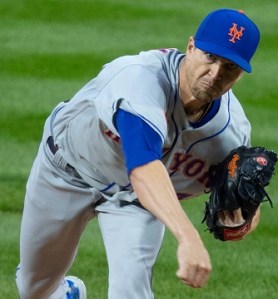
Stop me if you’ve heard it before: Jacob deGrom pitched like a Hall of Famer, but the new Mets bullpen puked the bed like the old one did.

The fans are back in the stands, however limited by ongoing COVID-19 safety protocols, but the Nationals have yet to play a regular-season game thanks to a few players and a staffer or two testing positive. There went that Opening Day must-see match between Max Scherzer and the Mets’ Jacob deGrom.

With their opening set with the Nats thus wiped out, deGrom had to wait until the Mets went to Philadelphia Monday. Oops. That and everything else seemed to play a support role to the horrid news out of San Diego.

The news that Fernando Tatis, Jr., the Padres’s new bazillion dollar shortstop, suffered a partial left shoulder dislocation on a hard third inning swing at the plate during a Monday loss to the Giants.

Padres manager Jayce Tingler told reporters he thinks team trainers and medical people were able to pop the shoulder back together, but the team isn’t taking chances. At this writing, MRI results aren’t available and nobody knows yet whether Tatis will spend significant time on the injured list.

If it’s more than a small shoulder dislocation, it may not be significant time. If it’s something like a labral tear, Tatis could miss six months—essentially, the rest of the season—according to one doctor who knows such shoulder troubles and spoke to the Los Angeles Times. Don’t fault the Padres if they’re saying to themselves, “Thank God for insurance.”

DeGrom could use a little extra insurance himself, alas. The good news for the Mets: deGrom was his usual self Monday night. Six shutout innings, seven punchouts, three hits, three-figure speed on his fastballs. The bad news, alas: the Mets are gonna Met, so far. At least out of the bullpen.

Their on-paper impressive offense found nothing more than two runs to support their ace. They got an inning of shutout relief from Miguel Castro relieving deGrom for the seventh, but the bullpen puked the bed in the eighth—including hitting Bryce Harper with the bases loaded. Not exactly a Rhodes Scholarship move there.

The Old Fart Contingency thundered aboard social media that Mets manager Luis Rojas blew it lifting deGrom after six strong—until they were reminded the added layoff after the Washington postponement put both deGrom and the Mets into caution mode.

“If that was [last] Thursday and I’m on normal rest,” the smooth righthander said postgame of the early hook, “I don’t think there is any chance I’m coming out of that game. We discussed it before what was the right thing to do. Long season and talking to them coming in, it felt like was the right decision.”

It was neither deGrom’s nor Rojas’s fault that, after Garcia took care of the Phillies in the seventh with just one infield hit within a fly out and two ground outs, the Phillies loaded the bases on the Mets’ new relief toy, Tyler May, in the eighth with one out, before Rojas went to another new Met bull, Aaron Loup. And Loup promptly hit Harper to push Miller home, before J.T. Realmuto singled home pinch runner Quinn, Mets late third base replacement Luis Guillorme threw home off line allowing Harper and Rhys Hoskins to score, and Didi Gregorius pushed Realmuto home with a first-pitch sacrifice fly.

The Mets had nothing to answer except a two-out ninth-inning stand that came up two dollars short against Phillies closer Alvarado. Kevin Pillar singled up the pipe, Francisco Lindor—the Mets’ own new bazillion-dollar lifetime shortstop—dumped a quail into shallow right that landed just in front of and then off the glove on oncoming, diving Harper, and Michael Conforto singled Pillar home while setting up first and third.

Pete Alonso, their 2019 Rookie of the Year bomber, hit one to the back of right field that looked as though it had a chance to ricochet off the top of the fence if not clear it. It wasn’t quite enough to stop Harper from running it down, taking a flying leap with his back against the fence, and snapping it into his glove to stop a game-tying extra-base hit and end the game with the Phillies on the plus side, 5-3.

Marry the foregoing to deGrom going 2-for-3 at the plate including an RBI single, and no wonder May himself said post-game, “Jake shouldn’t have to do everything himself. That’s not what teams are, and frankly Jake did almost everything today.”

Just don’t marry that to things such as the Angels’ Shohei Ohtani hitting 100+ mph on the mound and hitting a mammoth home run that flew out 100+ mph in the same inning last Friday night. Ohtani the two way player is an outlier among outliers; deGrom’s merely an outlier.

As of Tuesday morning— with the National League’s pitchers having to bat because Commissioner Nero simply couldn’t bring himself to keep the universal designated hitter this year at least, and Ohtani batting second in the Angel lineup the night he started on the mound, among other things—the pitchers have a .131/.157/.192 slash line and a .349 OPS.

The pitchers at the plate from Opening Day through the end of Monday night collected thirteen hits in 149 plate appearances: nine singles, three doubles, and Ohtani’s Friday night flog a third of the way up Angel Stadium’s high right field bleachers. They also walked three times and struck out 56 times. And the OFC still insists the National League just say no to its own invention.

All around the Show, too, there was one home run hit every 35 plate appearances and fourteen percent of all 928 hits the season’s first five days cleared the fences. It took five outs to create a single run, with 5.3 average runs created per game and 631 runs created while 559 scored.

It was fun to hear the fan noises even in limited capacities, too, though the limits in Angel Stadium made Ohtani’s blast sound even more explosive at the split second he hit it. If only things had been more fun for the home crowds: the many themes for the Show’s first five days could include, plausibly, the blues classic “On the Road Again.”

The home teams’ slash lines: .225/.313/.374/.687 OPS. The road teams: .245/.328/.403/.731 OPS. The road teams drove in fifteen more runs, hit thirteen more home runs, seven more doubles, and had seventy more hits overall. They also took eleven more walks, though they struck out fifty more times and grounded into fifteen more double plays. The road rats also had a +29 batting average on balls in play over the home boys and 108 more total bases while they were at it.

Maybe the shocker among the opening road rats were the Orioles. The Woe-rioles. Taking three straight from the Red Sox in Fenway Park. Out-scoring the Olde Towne Team 18-5, including and especially an 11-3 battering on Sunday afternoon. Even those paranoid about ID cards might want to insist the Orioles show theirs, even after the Orioles got a brief return to earth from the Yankees beating them 7-0 Monday in New York.

Unless it was the Reds, taking two out of three from the Cardinals to open, including and especially a 12-1 battering Sunday afternoon that proved the best revenge against abject stupidity is to slap, slash, scamper, and smash your way to a six-run seventh when you’re already up three runs—thanks to Nick Castellanos ripping Cardinal starter Carlos Martinez for a two-out, three-run homer an inning earlier.

Castellanos got drilled by Cardinals reliever Jack Woodford Saturday . . . two days after he bat-flipped a home run. Then, when he dove home to score on a wild pitch, Castellanos got bumped by Woodford sliding in to bring down the tag Castellanos beat. Castellanos sprung up, barked at Woodford, and began walking away before trouble could arrive. Oops. Trouble arrived—when Yadier Molina shoved him from behind to spark a bench-clearing brawl.

Baseball government myopically suspended Castellanos two games for “provoking” the brawl. Who’s baseball’s official optician? Who couldn’t see what everyone else with eyes saw? And how long has Molina—handed only an “undisclosed fine” along with a few others in the scrum—been so privileged a character that he can get away with the actual kickoff of a brawl that was seeded in the first place because the Cardinals are one of the game’s self-appointed Fun Police precincts?

“I was pleased,” Cardinal manager Mike Schildt told the press after that game. “Our guys came out there. We’re not going to take it. I know Yadi went immediately right at him, got sidetracked by [Cincinnati’s Mike Moustakas]. Woody, to his credit, got up and was like, ‘I’m not going to sit here and be taunted.’ Good for him.”

Taunted? All Castellanos said when he sprang up, by his own admission, was “Let’s [fornicating] go!” Anyone who thinks Woodford lacked intent didn’t see that ball sailing on a sure line up into Castellanos’s shoulder and rib region. Nor did they see Molina very clearly shoving Castellanos without Castellanos having the benefit of a rear-view mirror.

Castellanos appealed the two-game suspension. The final result wasn’t known at this writing. But the Cardinals should be getting a message of their own: Defund the Fun Police. Pronto.

How about the Astros, who went into Oakland and swept four from the Athletics before ambling on to Anaheim and losing 7-6 to the Angels Monday night? That was despite dropping a three-run first on Angel starter Jose Quintana and yanking a fourth run out of him in the top of the fourth, before the Angels finally opened their side of the scoreboard with Mike Trout (of course) hitting Luis Garcia’s 2-2 meatball about twelve or thirteen rows into the left field seats.

The Angels pushed a little further back, the Astros pushed a little further ahead, until the Angels ironed up and tore four runs out of the Astros in the bottom of the eighth with an RBI single (Dexter Fowler), a run-scoring force play (David Fletcher), a throwing error (on Jared Walsh’s grounder to first), an intentional walk (to Trout, of all people), and a sacrifice fly (Anthony Rendon).

Kyle Tucker’s ninth-inning solo bomb turned out more a kind of excuse-us shot than a last stand. The game left both the Astros and the Angels at 4-1 to open the season and what could be very interesting proceedings in the American League West. Now, if only the Astros could finally get past Astrogate.

They’ve been playing and winning through numerous catcalls, howls, and even a few inflatable and actual trash can sightings in Oakland and Anaheim. Jose Altuve—who’s looked more like his old self at the plate so far—seemed mildly amused when an inflatable trash can fell to the warning from those high Angel Stadium right field bleachers.

Astrogate was and remains anything but amusing. The Astros could keep up their torrid opening and overwhelm the AL West this season, but the scandal won’t go away entirely (nor should it) until the absolute last Astrogater standing no longer wears their fatigues. Yes, you’ve heard that before. That doesn’t make it any less painful for Astro fans or less true for everyone else. The Astros, nobody else, wrote the script that made them pariahs. Bang the cans slowly, fans.

Will off-field-based illegal electronic sign stealing disappear at all? Players got same-game video access back this year. There are three security people in every team’s video room at home and on the road. League cameras have been installed in those video rooms. Maybe it wouldn’t hurt to add guard dogs?

The players union agreed last year: there’ll be no more players getting away with murder even in return for spilling the deets—the commissioner can drop a lot more than a marshmallow hammer on the cheaters from now on. All by himself. He can demand answers without plea bargaining. And he doesn’t need a permission slip.

“But one of the prevailing lessons from the electronic sign-stealing era is that even if a scheme sounds far-fetched, someone might give it a whirl if they believe they can get away with it,” writes The Athletic‘s Evan Drellich, one of the two reporters (Ken Rosenthal was his partner) who helped break and burrow deep into Astrogate. “This holds true no matter what MLB does. Even a total ban on electronics, which the players would never agree to, would not be enough. In that case, a player or staffer could simply go rogue.”

In other words, boys will be still be boys, if they can-can.

“I’ve just traded hamburger for steak”

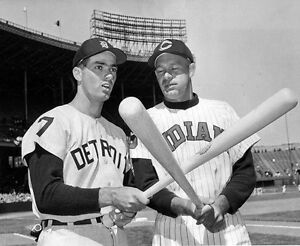
Rocky Colavito (left) and Harvey Kuenn in their new 1960 wardrobes. Could showing this photograph around Cleveland still get you run out of town . . . after you’ve been broiled, basted, batter-fried, braized, and beaten into a froth?

The American League’s 1959 home run champion wanted a $5,000 raise for 1960. His team’s general manager forced him to haggle yet again, signed him to a 1960 contract with the raise . . . and traded him out of town for the American League’s 1959 “batting champion” on the final day of spring training.

“We’ve given up forty homers for forty doubles,” said that general manager, Frank Lane of the Indians. Actually, it was 42 home runs for 42 doubles in 1959, but let’s not get technical.

To this day, Rocky Colavito (the 42 homers) thinks Frank Lane is a seven-letter euphemism for a male sexual prophylactic. Cleveland citizens probably call Lane far worse. To them, Colavito for Tigers veteran Harvey Kuenn (the 42 doubles) was even worse than Chicago would come to see Lou Brock for Ernie Broglio.

As Cleveland Plain-Dealer columnist Terry Pluto observes, Colavito was an Indian on his first Opening Day 65 years ago though he didn’t play in that game. The Indians wanted to return him to the minors for a spell, but Colavito balked until the team’s then-GM, Hank Greenberg, a Hall of Famer Colavito admired, assured him: let us fix this little roster problem we have and you’ll be back in three weeks.

Greenberg proved as good as his word and then some, which meant the world to the straight-shooting Colavito, like Greenberg a native of the Bronx. Colavito appeared in only five 1955 games, but in 1956 he hit 21 home runs to crown a full, fine rookie season and he asked Greenberg for a $3,000 raise. Greenberg gave it to him: $1,500 immediately, with a promise of a second $1,500 if he played 100 or more 1957 games. He did.

“I went right up to his office,” Colavito told Pluto. “Hank looked at me and said, ‘I know why you’re here.’ He then told (Indians traveling secretary) Bob Gill, ‘Get Rocky his check for $1,500.’ Hank Greenberg was the greatest general manager I ever had. He always was a man of his word.”

Not so Lane, whom Pluto once recorded in The Curse of Rocky Colavito as having reneged once too often on this or that assurance for Colavito’s taste. Right down to Lane’s late spring training 1960 assurance that the last thing on his mind was trading his right field star. Until he made the deal.

Colavito, the matinee idol with the big swing, the fine throwing arm, and the reputation for fan friendliness that went so far as to insist children clamoring for his autograph line up properly and say “please” and “thank you.” (What a surprise that Indian fans lived by the watchword, “Don’t knock the Rock.”) For Kuenn, the grizzled shortstop-turned-outfielder with the persistent clump of chewing tobacco in his cheek, the increasingly persistent leg issues, and a similar contract haggle approaching the 1960 season.

Lane had another issue with Colavito, which Pluto also recorded in the aforementioned book. Lane preferred baseball players who lived and drank hard. Like his best friend and ill-fated Indians roommate, pitcher Herb Score, Colavito was anything but the hard-living, hard-drinking type.

Even before taking the Indians’ GM job, Lane was infamous around baseball for treating trading as the most persistent itch that required a scratch. As the Cardinals’ GM previously, Lane was notorious for building a trade involving Hall of Famer Stan Musial that was stopped only by the intercession of owner Gussie Busch, who knew St. Louis would send him and anyone else associated with the team to the rack if it went through.

“Some of [Lane’s] trades were nuts, and some were good,” said longtime Cardinals GM Bing Devine. “Frank Lane was a great trader,” said longtime Dodgers GM Buzzie Bavasi. “But when I say that, I don’t mean the trades he made were great.”

Indians manager Joe Gordon walked out to first base after Colavito arrived in the team’s final exhibition game to tell him he’d just been dealt to the Tigers. “I’ve just traded hamburger for steak,” crowed Lane, who’d been trying to pry Kuenn out of the Tigers for several years.

Lane was also a typical baseball man of the time in that he tended heavily to rate players according to their “batting averages” alone. For all we know, Lane shrugged it off if he didn’t laugh his head off when Branch Rickey published a Life essay that said among other things that “[b]atting average is only a partial means of determining a man’s effectiveness on offense”—in 1954.

To Lane, trading the AL’s 1959 home run king for the league’s 1959 “batting” champion trading as he also said “forty home runs for forty doubles” made all the sense in the world:

We’ve added fifty singles and taken away fifty strikeouts . . . I’ll probably make bobby-soxers mad at me, but they’ve been mad at me before . . . I realise Colavito is very popular. There were many people who came to the park to see him hit a home run, whereas they wouldn’t come to the park just to see Kuenn hit a single. But those singles and doubles win just as many games as home runs . . . Rocky’s best year was 1958 when he batted over .300 and hit 41 homers, but our attendance was only 650,000 because we didn’t have a contending club.

“Where do you begin to shovel through this pile of public relations pap spewed out by Lane?” Pluto asked in his book. “Last time I checked,” said Sporting News writer Hal Lebovitz, whom Pluto also cited, “a single doesn’t count as much as a home run.” The last time I checked, the 1959 Indians were second in American League home attendance (1.50 million fans) to the Yankees (1.6 million).

Let me show you Hamburger vs. Steak in 1959 according to my Real Batting Average metric. (Total bases + walks + intentional walks + sacrifice flies + hit by pitches / total plate appearances.)

1959 PA TB BB IBB SF HBP RBA
Rocky Colavito 664 301 71 8 3 2 .579
Harvey Kuenn 617 281 48 1 7 1 .547

Now, let me show you Hamburger vs. Steak from Colavito’s first full major league season through the end of 1959:

1956-1959 PA TB BB IBB SF HBP RBA
Rocky Colavito 2166 992 275 14 16 7 .602
Harvey Kuenn 2572 1049 201 16 18 4 .501

This may have been one of the more polite Cleveland protests after the Colavito-for-Kuenn trade. (Akron Beacon-Journal.)

Both players dealt with nagging injuries in those four seasons, though Kuenn probably had the harder time of it. He depended as much on his legs as anything else to succeed and those were his most often injured parts. He’d pounded them, too, playing shortstop in his first few years, though it did him little good: as a shortstop, Kuenn was worth 27 defensive runs below his league average.

Colavito was also a superior defender; as a corner outfielder, his lifetime numbers show him worth 61 defensive runs above his league average.

What Lane also didn’t either think about or comprehend if he did think was that Colavito was hurt somewhat by Municipal Stadium, that pitching paradise and hitting challenge. Colavito hit far better on the road. Kuenn had the opposite issue: Tiger Stadium was a hitting haven. He hit far better at home, but coming to Municipal Stadium was likely to be a nightmare.

Well, now. Kuenn missed quite a number of 1960 games thanks to further nagging injuries and, yes, when he could and did play he did hit better on the road than at home. The split isn’t glaring since he was essentially a singles-and-doubles hitter with about as much power as a push mower, but “batting average” Nazis should note that thanks to age and injuries Kuenn would never hit as high as .308 again (his 1960 “batting average”) the rest of his career.

According to Pluto’s book, Colavito was given another stab in the back by Gordon, who seems to have told those who would listen that Colavito’s immediate reaction to the trade was, “For Kuenn and who else?” Colavito denounced the remark as the biggest. lie. ever.

I never said anything negative about Harvey Kuenn. After that, I never had any stomach for Gordon or Lane . . . I feel bad for Harvey because he caught some of the public backlash from the deal. Harvey was a helluva player, and he could really run when he was younger. He once got five infield hits in one game. I don’t know if I got five infield hits in my career. If I could run like Harvey I would have been a lifetime .300 hitter. But Detroit wanted to trade Harvey for me because they weren’t sure how much longer his legs would hold up. That was a big factor in the trade, and no one talked about it until long after the deal had been made.

Devastated as he was by the trade and by the betrayals he felt, Colavito’s 1960 opening with the Tigers had to make him feel worse: the Tigers opened against the Indians. He had to fly with the Indians from spring training to Cleveland and then change sides. He went hitless in the first of the two games but smashed a three-run homer in the top of the fourth off Jim Perry in the second game.

“The first year in Detroit was rough for me because I had left a place and a team that I loved and the fans in Cleveland loved me,” Colavito told the Detroit Free Press in 2020. “I am sure it was the same for Harvey, who was a really good man. Even my neighbor at the home I rented in Detroit said to me: ‘I don’t care who you are, I was a Harvey Kuenn fan.’ That was the last time we ever spoke. In the home opener in Detroit, I remember it was a very warm day and that I hit a two-run homer and we won.”

Yet when 1960 finished shaking out, Colavito still came out ahead of Kuenn, according to RBA:

1960 PA TB BB IBB SF HBP RBA
Rocky Colavito 616 263 53 4 3 4 .531
Harvey Kuenn 537 197 55 6 3 4 .493

No wonder then-Tigers GM Bill DeWitt, who’d partnered with Lane on the Big Trade, crowed back, “I like hamburger.” Even though DeWitt’s 1960 Tigers weren’t exactly world beaters at hitting or reaching base overall, even though four of his top five players by wins above replacement-level player were pitchers. (Hall of Famer Jim Bunning plus Frank Lary, Don Mossi, and Dave Sisler.)

Neither Colavito nor Kuenn would be quite the same player they’d been before the Big Trade, though Colavito hit 139 home runs in four seasons as a Tiger. As a matter of fact, Colavito was anything but a Detroit breakdown:

Hold That Tiger! PA TB BB IBB SF HBP RBA
Rocky Colavito 2723 1171 346 22 26 9 .578

In due course, Colavito would have an encore in Cleveland, under a far different regime, but also far from his early seasons when the Tribe remained serious American League contenders. Lane had much to do with reducing the team to also-rans, of course.

Kuenn would learn the hard way what it was like when Lane decided you didn’t fit into his plans. After a 1960 in which he finished fifth in the American League with that .308 “batting average,” but missed most of September due to injuries, Kuenn signed a 1961 contract. Lane called him “untouchable”—until he wasn’t, trading him to the Giants for pitcher Johnny Antonelli and outfielder Willie Kirkland.

Antonelli turned up with arm trouble and the coming end of his career. Kirkland would average 25 home runs a season as a three-year Indian but offered not a lot else other than plus defense in the outfield, then tapered away in Baltimore and Washington before going on to play six seasons in Japan.

Kuenn would remain a respected veteran who still knew how to hit when he was healthy. But he’d also finish his career with the strange distinction of having made the final outs in two no-hitters by Hall of Famer Sandy Koufax: in 1963, as a Giant; and, more famously (Two and two to Harvey Kuenn!—Vin Scully), in 1965 as a Cub.

He’d also be one of the four-man committee (with his old teammate Bunning plus Pirates pitcher Bob Friend and Hall of Fame former Phillies pitching great Robin Roberts) who ended up finding and hiring Marvin Miller to run the Major League Baseball Players Association.

Lane had one final dagger to stick into Colavito, in 1965, when the two men bumped into each other by happenstance after the Kansas City Athletics—for whom Colavito played one season, 1964—traded Colavito back to Cleveland. As Colavito told Pluto, Lane told him the A’s traded him because owner Charlie Finley didn’t want to negotiate a contract with him.

“Who knows if that’s true?” Pluto asks. Who knows, given what’s only too well known of Lane, if it’s not true? This was the man who once said his best trade was sending a kid named Roger Maris to the A’s for infielder/outfielder Woodie Held and first baseman Vic Power.

Well, now. Held was a versatile player with some power; Power was a flashy first baseman with a little less power but enough defense and four All-Star teams while he was at it. You’ve probably heard Maris had a little more to come. When he ended up in New York, as a back-to-back American League Most Valuable Player, and smasher of ruthsrecord, Lane’s tune changed faster than a disc jockey’s patter.

“If I’d known Maris would end up a Yankee,” Trader Lane sniffed in due course, “I never would have made that deal.”

By 1964, Lane had this to say about trading Hamburger for Steak: it was “the most unfortunate I ever made—not from a baseball standpoint but from the fans’ standpoint. The gals loved that boy with his boyish grin.” The gals and everyone else might also have loved the forty home runs a season Colavito averaged as an Indian between 1956 and 1959. Chicks dug the long ball even then, but they weren’t the only ones.

When Lane died at 85 in 1981, only one baseball person showed up for the funeral, and that only at the request of then-commissioner Bowie Kuhn: Bobby Bragan, whom Lane fired as the Indians manager in 1958. Bragan denied the long-holding Cleveland legend that he put a curse on the Indians upon his departure.

“I didn’t put a hex on the club,” he said in his memoir, You Can’t Hit the Ball with the Bat On Your Shoulder. “Having Frank Lane as the general manager was curse enough.”

Especially when he really traded prime rib for meat loaf. From a baseball standpoint.