Why Wander Franco must go

Wander Franco

Rays shortstop Wander Franco amidst reporters as he arrived at a Dominican court Friday. (AP/WTSP Tampa Bay photo.)

Last August, when a social media post first hinted that Wander Franco dined upon forbidden fruit, he was held out of the Rays’ lineup. But he was quoted as saying, “They don’t know what they’re talking about. That’s why I prefer to be on my side and not get involved with anybody.”

Franco had the part about “they” not knowing what they were talking about kind of right.

He wasn’t just “running around” with an underage girl in his native Dominican Republic. Authorities there say he was sexually involved with her and, apparently, paying her mother about $1,700 a month for seven months in return for, as the old rhythm and blues song pleads, mama keeping her big mouth shut.

You thought Trevor Bauer turned out to be a nightmare for women and for baseball? Sexual violence with a fellow adult who wasn’t awake to continue giving her consent (which was never discredited in court even if his victim lost her restraining order bid) is demeaning and dangerous. What should we call kidnapping (for two days), seducing and schtupping a fourteen-year-old girl even once, never mind over four months?

Especially if the girl in question, fourteen years old when Franco began his relationship with her, may have been forced into this kind of rodeo before, sadly and sickeningly. She said so when interviewed by a psychologist during Dominican authorities’ investigation of the Rays shortstop.

“Since I was little,” the girl told a psychologist, according to court documents made available to The Athletic, “my mother has seen me as a way for her to benefit both from the partners she has had and from my partners. And it is something that I dislike very much.”

The shortstop who was worth sixteen defensive runs saved above the American League average in 2023 won’t be able to throw his way out of this one as readily as he can throw enemy batters out after slick and swift fielding of their batted balls. This isn’t, say, a high school sophomore having a romp with an eighth grader, as shattering as that sounds. This is a legal adult in his early 20s accused of putting it to at least one girl of eighth-grade age and possible others as well.

Like Franco, the mother is charged formally with commercial sexual exploitation. Like Franco, she could go to prison for 20-30 years if convicted in court. If her daughter told the truth to the investigating psychologist, mama may not have had to be paid to keep her big mouth shut in her daughter’s case.

For now, the Rays and baseball’s government have a more immediate problem to solve, namely what to do with a 22-year-old shortstop who’s at once a face of the Rays and a guy who was on baseball’s restricted list over this case from last August through the end of the World Series.

MLB has been investigating since. The sport’s protocols governing domestic violence, sexual assault, and child abuse allow teams and the commissioner to discipline a player for violating it regardless of a court verdict. Bauer escaped legal punishment but not baseball discipline. Franco’s case is far more grave than even Bauer’s.

It isn’t helped by a Tampa Bay Times column, written by John Romano, describing him as a ballplayer beyond his years on the field and at the plate but a comparative child off the field and without a bat in his hands.

If his baseball skills had advanced beyond his chronological age, then Franco’s social skills were more like an adolescent.

It was nothing dramatic; nothing immediately noticeable. But common courtesies seemed to elude him . . . It wasn’t that Franco was mean or rude, he just didn’t seem to consider the needs of those around him.

There was also a propensity to make impulsive choices. Franco was a father at 17. He bought a Lamborghini, a Mercedes and a Rolls Royce SUV before he was 21. He traveled with high-end bling, which the world discovered when his car was broken into at a Jacksonville hotel during a minor league rehab assignment and $659,000 worth of jewelry was stolen.

He got into an altercation with centerfielder Jose Siri near the end of spring training in 2023, and then another with Randy Arozarena during the regular season. The longer he was in Tampa Bay, the more isolated he seemed to become in the Rays clubhouse . . .

The first public sign that there might have been issues was earlier in the summer when Rays manager Kevin Cash took the unusual step of sending Franco home for two games. It wasn’t a suspension per se, more like sending an unruly child to timeout. Cash talked that day about Franco needing to control his emotions better.

Eventually it was decided to invite one of his best friends from the Dominican, Tony Pena, to join Franco in Tampa Bay. A few years older, it was hoped that Pena would be a steadying influence. And for a short time, Franco’s off-field mood and on-field performance did seem to improve. He hit eight homers in a 32-game stretch in July and August.

Then came the social media post heard ’round the sport. Then the probe. Then Franco’s arrest during 2023’s final week when he failed to appear on a court summons. Then the details thus far in the current case. And, his release under such conditions as a guaranteed two million pesos payment (roughly $35,000 U.S. dollars), and showing up every month before the Dominican Public Ministry. (He is allowed to leave the country so long as he meets those conditions.)

Can the Rays or baseball government itself send Franco—who signed the fattest contract in Rays history after the 2021 season, eleven years and $182 million—back to the Phantom Zone before he goes to trial?

Hark back to 2019. Pirates relief pitcher Felipe Vázquez, in his second All-Star season, was bagged for having sex with a Florida girl whose age he claimed not to know was thirteen years old when he first intercoursed with her. Baseball’s government wasted no time putting him on the restricted list—they did it practically the moment he was arrested.

The Pirates wasted no time, either. They disappeared Vázquez just as fast. They scrubbed his image from scoreboard videos and banners outside PNC Park, not to mention removing his name from inside-the-park monitors showing National League relief pitching leaders. “By game time, looking around,” wrote The Athletic‘s Rob Biertempfel, “it was as if Vázquez had never played for the Pirates.”*

It was the least both baseball government and the Pirates could have done out of respect to Vázquez’s victim. Returning Franco to the Phantom Zone now is the least both baseball government and the Rays can do out of respect for his victim, too.

They may wish to consider a remark from Franco himself to the girl in question, during a WhatsApp conversation cited in the court documents and disclosed by the Dominican news agency Diario Libre: “My girl, if my team realises this it could cause problems for me, it is a rule in all teams not to talk to minors, and, nevertheless, I took the risk and I loved it.”

If that quote is accurate, the Rays and baseball government have even less time to move. For the girl’s sake, and for baseball’s. And in that order.

—————————————————————

* In due course, Vázquez was convicted and sentenced to two-to-four years in state prison with a 23-month credit for time served before trial and sentencing. He lost an appeal in Pennsylvania Superior Court in 2021 and was deported back to his native Venezuela last March.

The All-Scar Game

Austin Riley, Pete Alonso

Austin Riley’s (Braves, left) kneeling throw to kneeling scooper Pete Alonso (Mets, right) ended the bottom of the All-Star Game eighth with a double play . . . (MLB.com photo) . . .

The best thing about Tuesday night’s All-Star Game? Easy. That snappy eighth inning-ending double play into which Athletics outfielder Brent Rooker hit. He shot one up the third base line to Braves third baseman Austin Riley, who picked and threw on one knee across to Mets first baseman Pete Alonso, who scooped on one knee to nail two outs for the price of one, doubling Blue Jays second baseman Whit Merrifield up.

That play preserved what proved the National League’s 3-2 win over the American League in Seattle’s T-Mobile Park. They got the second and third runs in the top of that eighth, when Elias Díaz (Rockies) pinch hit for Jorge Soler (Marlins) with Nick Castellanos (Phillies) aboard after a nine-pitch leadoff walk and nobody out. Díaz sent Orioles righthander Félix Bautista’s 2-2 splitter off a bullpen sidewall, then off an overhang into the left field seats.

It meant the first NL All-Star win since 2012. It also meant Díaz becoming the Rockies’s first-ever All-Star Game Most Valuable Player award winner. Otherwise? It meant almost nothing. Because the worst thing about this year’s All-Scar Game was . . . just about everything else.

Mr. Blackwell, call your office. All-Star Game specific threads have been part of it for long enough. They began ugly and devolved to further states of revulsivity. But Tuesday night took the Ignoble Prize for Extinguished Haberdashery. The only uniforms uglier than this year’s All-Star silks are those hideous City Connect uniforms worn now and then during regular season games. Both should be done away with. Post haste. Let the All-Stars wear their regular team uniforms once again.

Who are those guys? They sort of anticipated long ovations for the hometown Mariners’ All-Star representatives. But they didn’t anticipate they’d be longer than usual. To the point where two Rays All-Stars—shortstop Wander Franco, pitcher Shane McLanahan—weren’t even introduced, when they poured in from center field among all other All-Stars. (Rays third baseman Yandy Díaz, an All-Star starter, did get introduced properly. But still.)

Maybe the two Rays jumped the gun trotting in while the ovation continued, but they should have been announced regardless.

While I’m at it, what was with that nonsense about bringing the All-Stars in from center field instead of having them come out of the dugouts to line up on the opposite base lines? Some traditions do deserve preservation. Not all, but some. What’s next—running the World Series combatants’ members in from the bullpens? (Oops! Don’t give the bastards any more bright ideas!)

Down with the mikes! In-game miking of players has always been ridiculous. But on Tuesday night it went from ridiculous to revolting. When Rangers pitcher Nathan Eovaldi took the mound miked up, the poor guy got into trouble on the mound almost at once. He had to pitch his way out of a two-on, one-out jam in the second inning. He sounded about as thrilled to talk while working his escape act as a schoolboy ordered to explain why he put a girl’s phone number on the boys’ room wall.

What’s the meaning of this? We’ve got regular-season interleague play all year long now. The National League All-Stars broke a ten-season losing streak? Forgive me if hold my applause. So long as the entire season is full of interleague play, the All-Star Game means nothing. Wasn’t it bad enough during those years when the outcome of the All-Star Game determined home field advantage for the World Series?

The road to making the All-Star Game mean something once more is eliminating regular-season interleague play altogether.

Elias Díaz

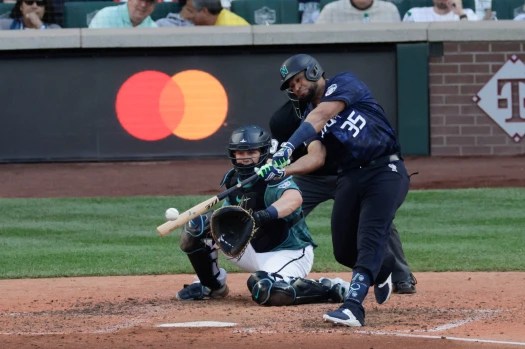
. . . saving the lead (and, ultimately, the game) Elias Díaz gave the NL with his two-run homer in the top of the eighth. (And, yes, the All-Star uniforms get uglier every year. Enough!) (AP Photo.)

Tamper bay. Sure it was cute to hear the T-Mobile Park crowd chanting for Angels unicorn star Shohei Ohtani to come to Seattle as a free agent. The problem is, he isn’t a free agent yet. He still has a second half to play for the Angels. I’ll guarantee you that if any team decided to break into a “Come to us!” chant toward Ohtani, they’d be hauled before baseball’s government and disciplined for tampering.

I get practically every fan base in baseball wanting Ohtani in their teams’ fatigues starting next year. If they don’t, they should be questioned by grand juries. But they really should have held their tongues on that one no matter how deeply you think the All-Scar Game has been reduced to farce. Lucky for them the commissioner can’t fine the Mariners for their fans’ tamper chants. (Not unless someone can prove the Mariners put their fans up to it, anyway.)

Crash cart alert. Cardiac Craig Kimbrel (Phillies) was sent out to pitch the ninth. With a one-run lead. The National League should have put the crash carts on double red alert, entrusting a one-run lead to the guy whose six 2018 postseason saves with a 5.90 ERA/6.74 fielding-independent pitching still felt like defeats. The guy who has a lifetime 4.13 ERA/4.84 FIP in postseason play.

Kimbrel got the first two outs (a fly to right, a strikeout), then issued back-to-back walks (six and seven pitches off an even count and a 1-2 count, respectively) before he finally struck Jose Ramirez (Guardians) out—after opening 0-2 but lapsing to 2-2—to end the game. Making the ninth that kind of interesting should not be what the Phillies have to look forward to if they reach the coming postseason.

Sales pitch. How bad is the sorry state of the Athletics and their ten-thumbed owner John Fisher’s shameless moves while trying and failing to extort Oakland but discovering Nevada politicians have cactus juice for brains? It’s this bad—when the T-Mobile crowd wasn’t chanting for Ohtani to cast his free agency eyes upon Seattle, they were chanting “Sell the team!” when Rooker whacked a ground rule double in the fifth.

Can you think of any other All-Star ballpark crowd chanting against another team’s owner in the past? Not even George Steinbrenner’s worst 1980-91 antics inspired that. That’s more on Fisher, of course, but it’s still sad to think that a team reduced to cinder and ashes with malice aforethought captured an All-Star Game crowd’s attention almost equal to the attention they might have paid the game itself.

“Whatever it takes to win”

Kike Hernandez (center, hatless) surrounded by Red Sox teammates after his walk-off sacrifice fly sealed their trip to the American League Championship Series.

Well, the Rays only thought their rather decisive first-game win in this now-concluded American League division series meant the beginning of another deep postseason trip. Who knew it would prove to be just the last win of the year for the American League’s winningest regular season team?

Come to think of it, a lot of people only thought the Red Sox’s apparent disarray in enough of the regular season, including their final home set while the Yankees swept them, and in losing two of three to the Orioles before sweeping the also-ran re-tooling Nationals to finish the schedule?

The Rays won the AL East decisively, and with the best regular-season record in franchise history. The Red Sox had to wrestle their way into the wild card game before beating the Yankees in a game featuring the sort of thing happening to the Empire Emeritus that used to mean surrealistic disaster for the Olde Towne Team.

Lovely way to send the Yankees home, many must have thought, but oh, are they going to feel it when the Rays get hold of them.

The only thing the Red Sox must feel now is that their postseason work has only just begun. But if the ways they shook off that Game One 5-0 loss to take the next three from the Rays are any indication, they’re about as up to the task as any formerly buffeted team awaiting their American League Championship Series opponent can be.

They live by the team play motto to such a fare-thee-well that you can suggest any given one will sacrifice for the good of the team—which makes it so appropriate that they finally won this division series with . . . a sacrifice fly.

Lose a 2-0 top of the first Game Two lead to a grand salami in the bottom of that inning? “No panic,” said manager Alex Cora. No panic—and allow only one more Tampa Bay run while turning that quick-as-you-please 5-2 deficit into a 14-6 blowout.

Lose a 6-2 Game Three lead on an eighth-inning leadoff homer by Rays rookie star Wander Franco and a two-out RBI double by not-too-young Rays rookie star Randy Arozarena, then have to ride a Phillies throwaway named Nick Pivetta for four extra innings? No sweat—just let Christian Vazquez rip a one-out two-run homer into the Green Monster seats in the bottom of the thirteenth and win, 6-4.

Blow a 5-0 Game Four lead off a five-run third crowned by Rafael Devers sending a three-run homer over Fenway Park’s second-highest wall and into the center field seats? We do this kinda stuff to them all through the picture. Just let Kike Hernandez say thank you to the nice Rays for not putting him on to load the bases for an any place/any time/extra-innings ticket double play—by banging the game and set-winning sacrifice fly short of the left center field track.

“I mean, here we are surprising everybody but ourselves,” said Hernandez post-game, once he escaped drowning in the Red Sox celebration. “We knew in spring training we had the team to make it this far and here we are.”

Well, the Red Sox did lead the entire Show in comeback wins during the regular season. They also managed a rather impressive .591 winning percentage in one-run games. But they also suffered a 12-16 August that wasn’t necessarily as disastrous as some other Augusts by some other teams this year. (Hello, Mess—er, Mets.) Between injuries, COVID-19 illnesses, and assorted other mishaps. nobody else seemed to remember if they knew what Hernandez said the Red Sox knew last spring.

Surprising everybody but themselves? Sure. Let’s buy into that despite the Red Sox trailing in three of these four division series games. Let’s buy into that despite the Red Sox having to win twice in their final plate appearances. Let’s buy into that despite an ankle-compromised designated hitter, a second baseman getting his first daily plate appearances in around three months, and pulling a hutch of rabbits out of their hats.

Well, guess what? You’ve probably bought into more improbabilities than those in your lives as baseball fans, observers, writers. If you speculated on the Red Sox’s apparent pitching goulash out-pitching the Rays’ more obvious pitching depth going in? You ought to think about buying lottery tickets in every state that offers them.

If you bought into Garrett Whitlock, a find on the Rule 5 minor league draft heap, pitching no-hit, no-run relief for the final two Game Four innings and becoming the Red Sox’s highest-leverage bullpen bull, forget the lottery? You ought to be investing on Wall Street. You can’t lose. Yet.

If you bought into Jordan Luplow doubling and scoring in the fifth, Franco abusing Red Sox reliever Tanner Houck for a two-run homer in the sixth, and Kevin Kiermaier whacked an RBI double ahead of Arozarena whacking a two-run double to tie things at five in the eighth? You ought to seed the advent of Jetsons-style flying cars.

But if you bought into Game Three hero Vazquez leading off the Red Sox ninth with a base hit, Christian Arroyo sneaking a sacrifice bunt to the short right of the first base line, pinch hitter Travis Shaw slow bouncing a tough hopper toward third that wouldn’t get him in time at first, then taking second on defensive indifference with Hernandez at the plate? That’s beyond my pay grade, too.

Why didn’t Cash put Hernandez on with one out? He wasn’t really about to load the pads for Devers and be forced to prayer that he could get away with it. Devers already had three hits on the night. With the winning run already ninety fee from scoring, putting Hernandez aboard would have meant only the possibility of having put the insult-adding-to-injury run on base.

So Cash trusted his reliever J.P. Feyereisen to take care of Hernandez. The first pitch tied Hernandez up by sailing up and in tight on the Red Sox center fielder. The next pitch sailed into Austin Meadows’s glove in left center, too far back to keep pinch-runner Danny Santana from sailing home with the Red Sox’s ALCS tickets punched.

“It was quick,” Feyereisen said postgame, and he could have been talking the series as well as the end of Game Four. “I think that’s one of the main things when we sat down, like, ‘Wow, I didn’t think it was gonna be over this quickly’. We felt good. We played some good games. You come in here, especially with this atmosphere with these [Fenway] crowds and two walk-off wins, that’s tough.”

What was even more tough for the Rays is that, all series long, they struck out 46 times at the plate to the Red Sox’s 23—and that includes 20 Rays strikeouts in Game Three’s thirteen-inning theater. By contrast, the Red Sox picked up from being shut out in Game One to hit .364 with nine home runs in Games Two through Four and delivered 56 hits the entire set.

The Rays’ wounding offensive flaw, being Three True Outcomes enough all year long, bit their heads off in the division series. They hit seven homers and ten doubles but had a collective .211 team batting average all set long. They’ll have to figure out how to improve their overall contact without sacrificing their impressive power.

They’re young, they’re deep, they’re they’re tenacious, they’re a model of resourcefulness despite their limited dollars. Their championship window isn’t being boarded up just yet.

Their farm is considered deep and still promising. They’ve got their own kind of guts, playing and pitching rookies in the postseason as if it was the natural thing to do. Even if it was borne of the unpleasant necessities delivered by injuries, near-habitual turnover, and in-season moves that didn’t work. The rooks—shortstop Franco, pitchers Shane McClanahan and Luis Patino in particular—showed heart beyond their years even in defeat.

Yes, it’s tough to remember Arozarena was still a rookie this season, technically. His coming-out part last postseason took care of that, and he shone like a well-established veteran this time around. From homering and stealing home in Game One through two hits and that Game Four-tying hit in the eighth, Arozarena was a rookie in name only this year.

Losing righthander Tyler Glasnow to Tommy John surgery was probably the key blow to the Rays in the end. Free-agent veteran Michael Wacha took a 5.05 regular season ERA into the postseason . . . and allowed a mere two-run deficit to turn into that 14-6 Game Two blowout in two and two thirds innings. One more veteran other than Game Four opener Collin McHugh might have made a big difference.

The Red Sox are just as conscious of analytics as any other team so advanced, including the Rays who practically live by it. But they’re a lot better in balancing analytics to the moment. Cora is as much an advance information maven as any skipper in baseball, but he’s also unafraid to shift his cards and play to what’s in front of him when it’s demanded of him.

He doesn’t play October baseball like the regular season. If he did, he wouldn’t have gone to eight postseason series as a manager or a bench coach and been on the winning side in each of them. He’s not afraid to take risks, he doesn’t sweat it if and when they backfire.

“That’s our motto right now: Whatever it takes to win,” said Hernandez. “Just win today, and we’ll worry about tomorrow, tomorrow. Lineup, bullpen, starting rotation, like, it doesn’t matter. We’re a team, and we’re one. We’re not 26 dudes, we’re just one.” Lucky for them the Red Sox aren’t out of tomorrows just yet.

Cora’s Game Four starting pitcher, Eduardo Rodriguez—lifted after an inning and two thirds in Game One following that first-inning disaster, but pitching shutout ball until Luplow scored on a ground out in the fifth, then coming out after Kiermaier doubled to open the sixth—calls Cora “like a father, brother, manager, whatever. He trusts us. He trusts everybody in that clubhouse. He gives you the chance every time that he hands (the ball) to you, and you’ve just got to go out there and do your job.”

“He’s a guy you’d run through a wall for,” said Whitlock. “If he told me to run through that wall, I’d believe that he had something there to make sure it would fall for me.”

It turned out the Rays wall wasn’t quite as sturdy as everyone else thought going in. The Red Sox have sturdier walls to face going forward. Walls that won’t be as friendly to them as the Green Monster seems to be.